Introduction
With the rise in disabling chronic diseases associated with old age (e.g. Arthritis, Parkinson's Disease; Boult et al., Reference Boult, Kane, Louis, Boult and McCaffrey1994; Salomon et al., Reference Salomon2013), more older persons are dependent on others for care crucial for their subsistence. This care can directly affect their experience of living and ability to age at home.
There have been many efforts to improve quality of care and resultant quality of life (Wiener, Reference Wiener2003) for older persons residing in nursing homes. However, quality of care is a somewhat elusive concept (Singer et al., Reference Singer, Martin and Kelner1999) and, as such, multiple investigational approaches have been undertaken. Most common are satisfaction surveys and quality indicators, including nursing homes’ patient outcomes (e.g. infection control, usage of pain medications; Cohen-Mansfield et al., Reference Cohen-Mansfield, Ejaz and Werner2000; Zimmerman, Reference Zimmerman2003). Despite frail older persons’ well-being depending on the quality of their care, few investigations of this topic exist, in particular with regard to in-home care. As a performance-based service, care is not easily quantifiable, and quality is subject to individual expectations and circumstances (Malley and Fernández, Reference Malley and Fernández2010). Additionally, when live-in caregivers provide older persons with care, this provision of care by the caregiver and its consumption by the older person occur at the same moment, impeding separation of caregivers’ contributions to the experience of quality of care from that of the care-recipient. Indeed, when searching PubMed for a review on quality of long-term care, what emerged was a 1986 document by the Institute of Medicine (1986). Although “quality of care” questionnaires exist for doctor–patient and intensive care unit settings (McDonald et al., Reference McDonald2010), these rarely concern older persons, and often evaluate care services by physicians and nursing homes in terms of their processes (e.g. receiving adequate information, atmosphere; Sixma et al., Reference Sixma, van Campen, Kerssens and Peters2000; Redfern et al., Reference Redfern, Hannan, Norman and Martin2002). We therefore believe it is time to re-examine this concept.
Homecare and its provision by migrant live-in caregivers (hereafter referred to as “caregivers”) have been increasing in recent years (Cohen-Mansfield et al., Reference Cohen-Mansfield, Garms-Homolová and Bentwich2013), sometimes encouraged by Western nations’ subsidies for in-home care (Wilkins, Reference Wilkins2006) resulting in its increased demand (Burbridge, Reference Burbridge1993). Concomitantly, supply of caregivers has diminished. Women's increased participation in labor markets limits their availability as full-time caregivers, roles traditionally associated with women (Hoff et al., Reference Hoff, Feldman and Vidovicova2011). This shortage is exacerbated by poor wages and benefits for caregivers (Boris and Klein, Reference Boris and Klein2006). As a result, many individuals employ migrants, who are often more willing to undertake a caregiver position than local residents (Cangiano, Reference Cangiano2014). In this paper, we examine the construct and assessment of quality of care provided by migrant live-in caregivers.
The Institute of Medicine (1986) clarifies that quality of care in a nursing home would be examined differently than that of acute care due to nursing homes being residents’ homes, residency being permanent rather than temporary and residents’ care needs requiring less acute care and medical attention. These nursing home characteristics hold for older persons receiving 24-h homecare. In contrast, the requirements posed in this publication for high-quality care (e.g. comprehensive assessment, the development of a treatment plan and its coordinated execution, and quality assurance procedures) are inapplicable to live-in caregiving, as these relate to a regulatory system (Braithwaite and Braithwaite, Reference Braithwaite and Braithwaite1995). Care in the homecare setting usually relies on a single live-in caregiver, whereas nursing home care involves interactive procedures with multi-disciplinary team members, allowing for consultation and feedback (Tarricone and Tsouros, Reference Tarricone and Tsouros2008). Even in cases where agencies assume responsibility over referring the caregiver to an older person, these agencies do not usually develop a care plan for the older person, ultimately placing the provision of care solely with the live-in caregiver. Likewise, caregivers providing homecare are not necessarily equipped with tools to provide medical care (Devlin and McIlfatrick, Reference Devlin and McIlfatrick2010), such as preventing, spotting, and handling emergencies; this includes coordinating between care-giving agencies and hospital services, thereby contributing to the patient's welfare. As a result, live-in caregivers tend to focus on regular activities of daily living (ADLs; e.g. eating, getting dressed; Katz et al., Reference Katz, Downs, Cash and Grotz1970) and instrumental ones (IADLs; e.g. shopping; Graf, Reference Graf2008), and potentially also social care and hospitality services.
In this paper, we examine the construct of quality of care for frail older persons receiving round-the-clock homecare by migrant caregivers, through customer perceptions. Customers were defined as older persons receiving care and family relatives involved in organizing homecare. Although we assumed that relatives and older persons would differ somewhat in their quality of care views, we hypothesized their general understanding of quality would converge.
Methods
Participants
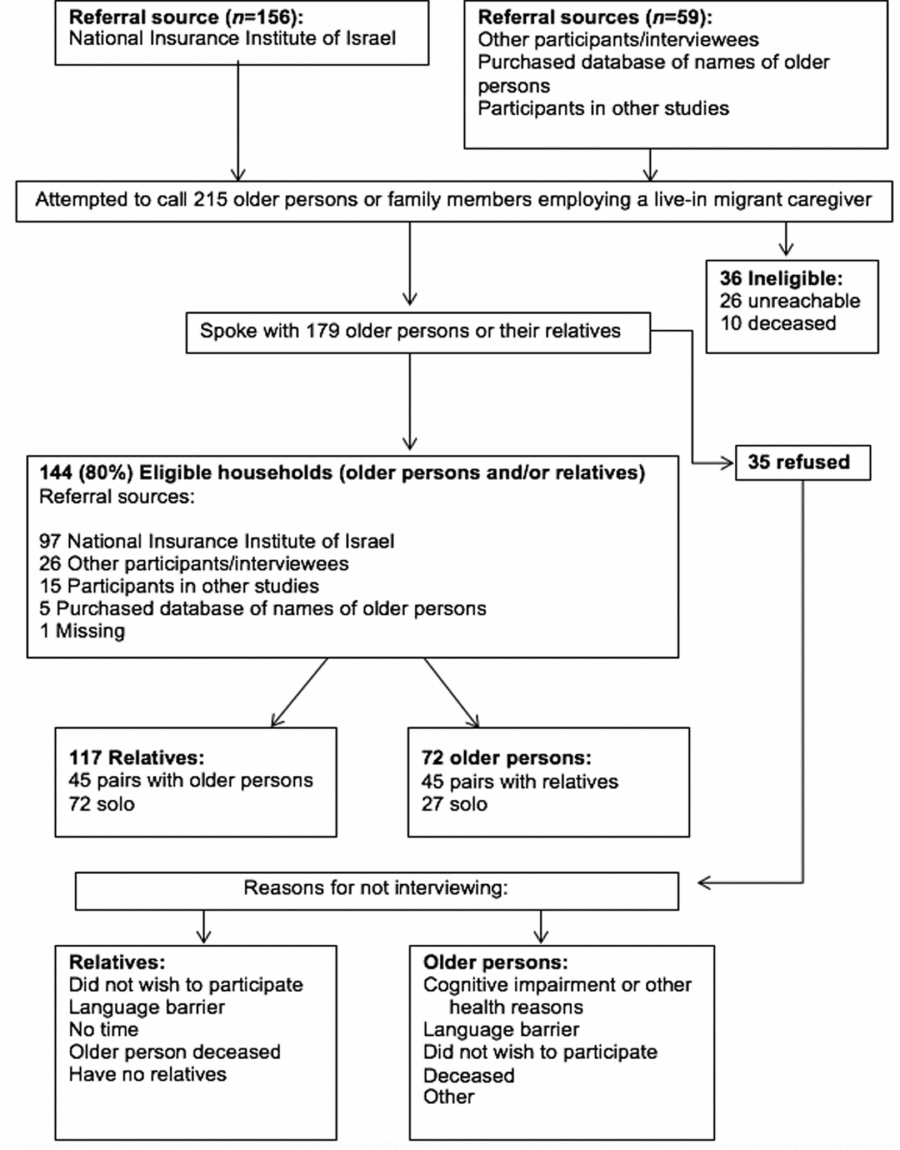
Households employing migrant live-in caregivers in the Tel-Aviv and Jerusalem areas were identified and recruited through a few mediums (see Figure 1), forming a convenience sample. Inclusion criteria required older persons (and those reported by relatives) to be at least 60 years of age. Additional requirements of both older persons and relatives included sufficient fluency in either Hebrew or English and cognitive ability to complete an interview. Thus, even if older persons were living with dementia (as reported by relatives, caregivers, or older persons themselves), those at the early stages still fit inclusion criteria so long as cognitive ability was sufficiently intact to answer interview questions. When possible, both an older person and their relative were interviewed. However, when older persons were incapable of being interviewed for cognitive, physical or personal reasons, only relatives were interviewed. Therefore, we interviewed 72 older persons and 117 relatives, including 45 corresponding pairs. Older persons (either self-reporting or by relatives) were cared for round-the-clock (as needed) by migrant live-in caregivers. These caregivers were referred to older persons and their relatives by an agency, though they were employed by the older persons and/or the relatives themselves. Migrant live-in caregivers’ roles are supposed to consist of helping with direct care (e.g. assisting with ADLs/IADLs), although caregivers often perform additional tasks (e.g. watching TV together; see Cohen-Mansfield et al., Reference Cohen-Mansfield, Garms-Homolová and Bentwich2013; Cohen-Mansfield et al., Reference Cohen-Mansfield, Jensen, Golander and Iecovich2016; Cohen-Mansfield et al., Reference Cohen-Mansfield, Golander, Iecovich and Jensen2017). Since the investigation reported in this paper was part of a larger study consisting of older persons, their relatives and caregivers, some information from 116 caregivers is also included below.
Recruitment methods.

Measures
Demographics
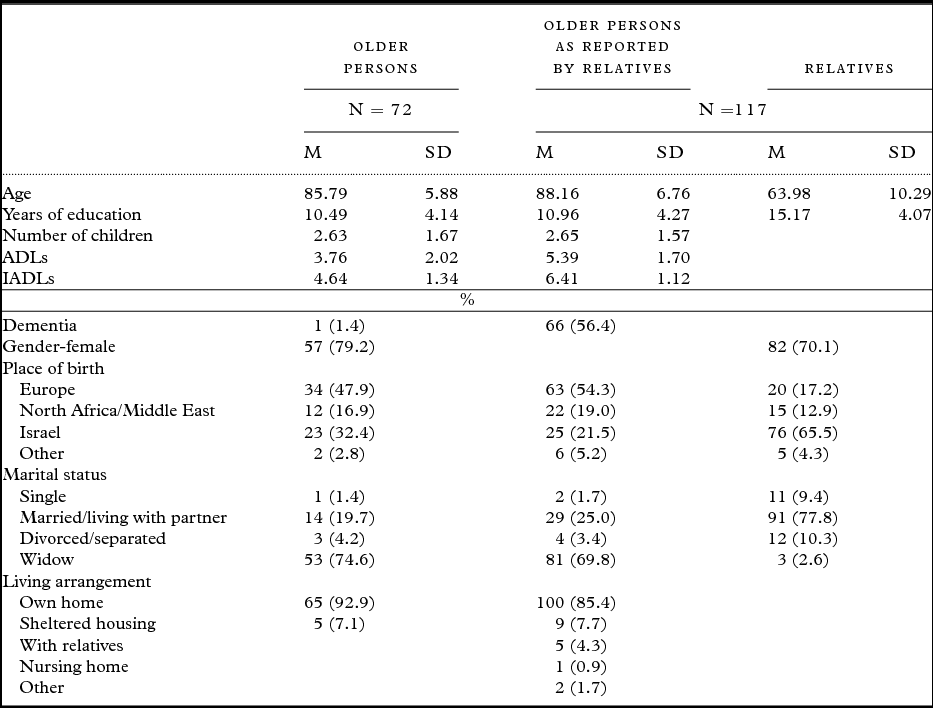
Demographics (e.g. age, gender, and education; see Table 1) were obtained from relatives regarding both themselves and the older person. Both respondents rated the degree to which the older person needed help with ADLs and IADLs. ADLs included eating, getting dressed, walking, taking care of one's appearance, getting in and out of bed, taking a bath or a shower, and getting to the toilet on time. IADLs included using the telephone, getting to places out of walking distance, going shopping, preparing meals, doing housework, taking medications, and handling money. Participants were also asked whether older persons were living with dementia.
Participants’ demographic characteristics represented either using means and standard deviations or no. (%)

Quality of care
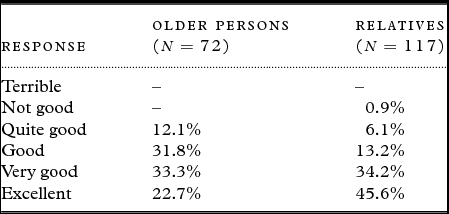
The Quality of Care Questionnaire (QuCQ) was developed for this study and its particular population, and includes eight questions (see Appendix 1). Two items are based on the Primary Care Assessment Survey (PCAS, Safran et al., Reference Safran1998), which measures quality of care given by out-of-home physicians. These are “knowing the older person” (i.e. knowing the older person's values, beliefs, preferences, etc.) and “knowing his/her main concern.” Other PCAS items were not applicable to the live-in setting. The other items measured in the QuCQ were developed by one of the authors and refined by co-authors who are experts in long-term care. These items rated the extent to which caregivers provide support in needed areas and the extent and promptness with which needs are met. The QuCQ also assessed the extent to which caregivers treat the older person with respect, and the older person and caregiver understand each other. All aforementioned items were rated on a 1 (= not at all) to 5 (= to a very great extent) scale. An additional item asked participants to rate the general quality of care provided by the caregiver (1= terrible, 6 = excellent). Frequencies of responses to the general quality of care item are displayed in Table 2. Additional items were considered (e.g. how frequently caregivers get up at night) but deemed to be indicators of older persons’ needs more than general indicators of quality of care.
Responses given to the item “how would you rate the general quality of care the caregiver provides to you/the older person?” (1 = terrible, 6 = excellent). Values are percentages

Procedure
The study was approved by the ethics committee of Tel Aviv University. Older persons’ relatives and/or older persons themselves signed informed consent. They responded to a one and a half-hour long structured interview (including additional topics, such as caregivers’ working conditions). Interviews mostly took place at older persons’ homes.
Statistical analysis
Analyses were conducted using IBM SPSS 23.0 and conducted separately for older persons and relatives. Demographics were analyzed using descriptive statistics. Factor analysis was used to understand the components of quality of care. Principal components extraction was performed with both oblique (Promax) and orthogonal (Varimax) methods. As in previous analyses (Sixma et al., Reference Sixma, van Campen, Kerssens and Peters2000; Baltussen et al., Reference Baltussen, Yé, Haddad and Sauerborn2002), only factors with eigenvalue larger than 1 were used.
Results
Demographics and background information
Participants (older persons, relatives, and caregivers alike) were predominantly women. Relatives’ mean age was 63.98 years; older persons that were accounted for by relatives had a mean age of 88.16 years, and older persons who were interviewed reported a mean age of 85.79 years. Based on older persons, mean numbers of ADLs and IADLs for which they required help (each out of 7) were 3.76 and 4.64, respectively. According to relatives, means were 5.39 for ADLs and 6.41 for IADLS. Approximately half of the relatives reported dementia in the older person, and only one older person had dementia (Table 1). Caregivers reported caring for the older person an average of 44.6 months (SD = 30.5), with 82.5% of caregivers indicating having received previous relevant training. These caregivers indicated an average of 3.9 (SD = 2.5) ADLs and 4.8 (SD = 2.8) IADLs for which the older person required help with. When complete triads (N = 36) of older persons, relatives, and caregivers were interviewed, older persons reported ADLs and IADLs were 4.14 (SD = 1.90) and 5.56 (SD = 1.27), respectively. For these triads, relatives reported older persons’ ADLs to be 4.61 (SD = 1.64) and IADLs to be 5.72 (SD = 1.54). Lastly, corresponding caregivers reported ADLs of 4.70 (SD = 1.53) and IADLs of 6.0 (SD = 0.93). Relatives reported a significantly higher number of ADLs for which older persons required assistance than did older persons themselves (t (35) = 2.15, p < 0.05). As for IADLs, caregivers’ reports were significantly higher than those made by older persons (t (35) = 2.21, p < 0.05).
Factor analysis
Results using Varimax and Promax methods were similar and are displayed according to Promax analyses.
Older persons
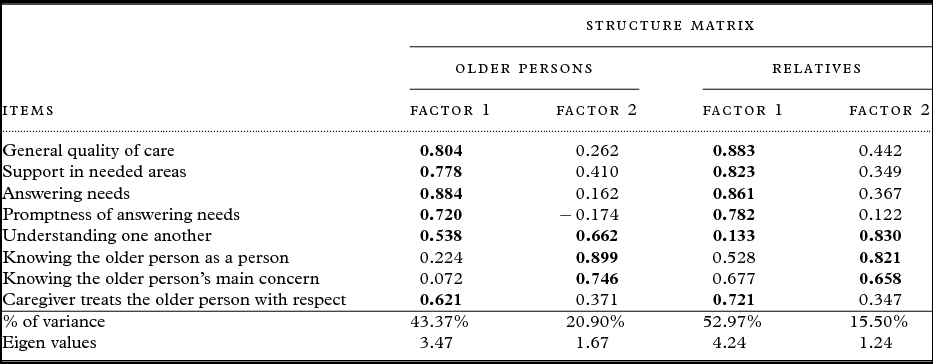
Factor analysis revealed two factors (Table 3), explaining 64.27% of variance. The first factor, “caretaking,” (Cronbach's α = 0.82) had the highest loadings on items measuring general quality of care, answering older persons’ needs and treating them with respect, a pre-requisite for good care. The second factor, labeled “relationship,” had the highest loadings on interpersonal items, including knowing the older person as a person, knowing their main concern, and understanding one another (in descending order; Cronbach's α = 0.69). Internal reliability (Cronbach α) was checked for each factor with item loadings of 0.45 or higher.
Factor analysis results using older persons' and relatives' interviews

Note: Loadings appearing in bold text represent items used as components of their respective factors.
Relatives
Promax factor analysis for relatives’ responses revealed two factors similar to those based on older persons' interviews (Table 2). However, the items “knowing the older person” and “knowing the older person's main concern” had high loadings on both factors. The item “understanding one another” did not have a high loading among relatives’ first factor, unlike that of older persons. For “caretaking” items common to both older persons and relatives, the order of high to low loadings differed somewhat. Nevertheless, the same five variables had the highest ratings for both, indicating that the factor represented general caregiving regardless of responder type. We therefore retained older persons' factor structure for both respondents (Table 2) in order to be able to compare between factors and across respondents, as described in the following paragraph. Factor 2, “relationship,” consisted of the same items as in older persons’ factor structure. Cronbach's α was 0.79 for “caretaking” and 0.73 for “relationship.”
Pearson's correlations were computed using factor scores of corresponding pairs (n = 45) to test whether quality ratings converged between older persons and relatives. We created weighted Z-scores (i.e. each item's standardized score multiplied by its loading; DiStefano et al., Reference DiStefano, Zhu and Mindrila2009) for items maintained in the factors' structure, and then averaged factor scores for relatives and older persons separately. “Caretaking” weighted averages significantly correlated between respondents (r = 0.35, one-tailed p = 0.010) as did “relationship” (r = 0.27, one-tailed p = 0.039).
Significant correlations (one-tailed p < 0.001) between factors were found among older persons (n = 72, r = 0.49) as well as relatives (n = 117, r = 0.50).
Discussion
This study explored underlying dimensions of quality of care to clarify its meaning in the context of in-home care of frail older persons. This was achieved using factor analysis, which identified two factors; the first loaded predominantly with items indicating prompt and complete responsiveness to needs, whereas the second loaded primarily with more socially oriented items. In other words, quality of care is first and foremost dependent on caregivers’ receptiveness to physical care needs, followed by caregivers’ ability to interact with older persons and understand them beyond “surface” care needs. These results could contribute to training of live-in caregivers to improve the quality and efficacy of care. Agencies and private caregivers may benefit from these results by improving relevant underlying skills (e.g. empathy, active listening, and conversational skills; Morse et al., Reference Morse, Bottorff, Anderson, O'Brien and Solberg2006).
Other quality of care questionnaires in the older population mostly focus on caregivers’ perspectives (Hazzan et al., Reference Hazzan, Ploeg, Shannon, Raina and Oremus2015) or target care recipients as healthcare patients (e.g. with items regarding “waiting time” or “being taken seriously”; Sixma et al., Reference Sixma, van Campen, Kerssens and Peters2000), neglecting interpersonal aspects. In line with other studies, our results highlight interpersonal aspects of care as contributors to older persons’ experience of quality of care (Eustis and Fischer, Reference Eustis and Fischer1991). One study has focused on the consumers’ perspectives of in-home care, but used satisfaction as an indicator of quality of care instead, and concerned caregivers who did not reside with older persons; rendering some issues inapplicable (e.g. “I need more hours of homemaker/home health aide service each week”; Geron et al., Reference Geron, Smith, Tennstedt, Jette, Chassler and Kasten2000). Our study also incorporated results using relatives' responses, since many older persons could not respond to questionnaires. Therefore, a questionnaire that gauges quality of care over a large range of older persons is important and presented in the current assessment. Furthermore, this tool is not intended to assess satisfaction. Satisfaction, while influenced by quality of care, is also affected by other factors, such as personal expectations, individual differences, and personal gains (Cleary and McNeil, Reference Cleary and McNeil1988; Sureshchandar et al., Reference Sureshchandar, Rajendran and Anantharaman2002). By contrast, questions regarding quality of care may direct respondents to focus on the characteristics of care provided (e.g. addressing needs, promptness) rather than one's satisfaction.
Although replication of the factor structure is needed, the re-emergence of similar structures between older persons and relatives, assessed independently, serves as preliminary validation. Significant Pearson's correlations between respondents for each factor strengthen factors’ value and utility. Additionally, Cronbach coefficients for both factors among both respondents indicate that these items reliably measure said constructs.
Although correlations between relatives’ and older persons’ ratings are statistically significant, their strength is weak, suggesting different perspectives. This is likely a function of different levels of exposure to the caregiver as well as different needs. Older persons are often dependent on caregivers for daily living function and experience, while relatives need caregivers to provide a service. Consequently, relatives’ ratings may be affected by this exposure and by levels of empathy with the older person.
A limitation of the study is its reliance on the literature and experts to develop the questionnaire rather than including a complementary qualitative question concerning the nature of quality of care. Such an open-ended query should be included in future studies. Some items yielded high loadings with both factors, including for older persons’ “understanding” ratings, and for relatives’ “knowing as a person” and “knowing main concern” ratings. Those could indeed be conceptualized as relating to both. For instance, caregivers’ “understanding” of older persons can be construed to have two meanings; an indication of empathy and interpersonal attributes, or as understanding older persons’ needs necessary for providing prompt care. Future renditions of these items may alter wording to differentiate between these meanings. Likewise, that some items could be perceived as both “quality of care” and “quality of relationship” calls for further clarification of the conceptualization of quality of care. For example, the items assessing the extent to which caregivers answer the needs of the older person and their promptness may be interpreted as referring to either physical and social needs. In the present sample, comments by relatives and older persons indicate that these items were mostly understood as referring to physical needs. To illustrate, one relative indicated that the caregiver answers the older person's need to a great extent (=4) and commented “physical [needs] yes [are met], and social [needs] less so.” Nonetheless, these items should be further explored and refined.
Additionally, future studies should see whether some of these items can be used as criteria in measuring quality of care. For instance, the item querying general caregiving might be sufficient as a criterion due to its inclusive nature. Nonetheless, evaluation of the item may be influenced by other latent factors, such as those presented in the current study.
Factor analysis is traditionally recommended when using large samples, with some suggesting having at least three or four variables emerge as determining each factor coupled with high communalities to justify samples as small as 100 (Fabrigar et al., Reference Fabrigar, Wegener, MacCallum and Strahan1999). Accordingly, the factor analysis used with relatives’ sample likely provided an accurate estimate for population parameters (n = 117) but not for the older persons’ sample (n = 72). This limitation results from including caregivers of persons with dementia, who form a sizable proportion of those receiving homecare. It is therefore more representative of actual care situations than studies choosing to exclude them. The lack of complete pairs limits both sample size and ability to examine relationships between ratings of relatives versus corresponding older persons (n = 45). This study is also limited by the context of the Israeli health and social care system. Systems which allow for the use of migrant caregivers and their employment regulations vary across nations (Cohen-Mansfield et al., Reference Cohen-Mansfield, Garms-Homolová and Bentwich2013), which may affect expectations and evaluations of quality of care. Future research should attempt to replicate these findings in populations with different care models.
Although this study sought to clarify the concept of quality of care among in-home caregivers, future studies should investigate whether findings generalize to caregivers who live out of older persons’ homes. Studies have shown that older persons cared for by “live-in” workers tended to be classified as more severely disabled than their “live-out” cared for counterparts, as well as reporting higher levels of satisfaction (Iecovich, Reference Iecovich2007).
Conclusions
These limitations notwithstanding, this is the first study to examine the quality of care construct within those receiving homecare by migrant caregivers. A questionnaire to assess quality of homecare according to service users (i.e. older persons and their relatives) was developed. Using this questionnaire (the QuCQ), factor analysis revealed two structures underlying quality of homecare; “caretaking” and “relationship.” These results help clarify the concept of quality of care in the wider arena of care for older persons. We hope this will trigger further use of similar assessments to clarify this concept and to drive its improvement in multiple settings.
Conflict of interest
The authors have no conflicts in the cover letter as well as in the manuscript.
Description of authors’ roles
JC-M: Conceptualized the study, was involved in choosing and developing the assessments, oversaw the data collection, was involved in the analysis and interpretation of data, writing and editing the manuscript; AHS: Was involved in analysis and interpretation of data, writing and editing the manuscript; EI: Assisted with conceptualization of the study, choice and development of assessments, and interpretation, and editing the manuscript; HG: Assisted with conceptualization of the study, choice and development of assessments, and interpretation, and editing the manuscript.
Acknowledgments
This work was supported in part by the National Insurance Institute of Israel, by the Minerva-Stiftung Foundation, the Ministry of Senior Citizens in Israel, and by the Herczeg Institute on Aging of Tel Aviv University. The National Insurance Institute of Israel helped in recruitment of participants by sending letters to potential participants and asking about their interest in participating in the study. The sponsors had no role in the design, methods, data collection, analysis or preparation of this paper.
Appendix 1
The Quality of Care Questionnaire (QuCQ) was developed to assess quality of homecare for older persons. Words in italic letters and in brackets represent substitutions for prompting relatives of older persons.
1. How would you rate the general quality of care the caregiver provides to you [the older person]?
1. Terrible
2. Not good
3. Quite good
4. Good
5. Very good
6. Excellent
2. To what extent does the caregiver provide you [the older person] support in the areas where you [he/she] need [needs] help?
1. Not at all
2. To a small extent
3. To a moderate extent
4. To a great extent
5. To a very great extent
3. To what extent does the caregiver answer your [the older person's] needs?
1. Not at all
2. To a small extent
3. To a moderate extent
4. To a great extent
5. To a very great extent
4. To what extent does the caregiver respond promptly to your [the older person's] requests?
1. Not at all
2. To a small extent
3. To a moderate extent
4. To a great extent
5. To a very great extent
5. To what extent do you [the older person] and the caregiver understand each other?
1. Not at all
2. To a small extent
3. To a moderate extent
4. To a great extent
5. To a very great extent
6. To what extent does the caregiver know you [the older person] as a person (the values, beliefs, hobbies, wills, preferences, etc.)?
1. Not at all
2. To a small extent
3. To a moderate extent
4. To a great extent
5. To a very great extent
7. To what extent does the caregiver know what your [the older person's] main concern is?
1. Not at all
2. To a small extent
3. To a moderate extent
4. To a great extent
5. To a very great extent
8. To what extent does the caregiver treat you [the older person] with respect?
1. Not at all
2. To a small extent
3. To a moderate extent
4. To a great extent
5. To a very great extent