1. Introduction
The last decade has witnessed a rapid increase in interest in multilingualism. In Europe, this development is certainly linked to the commitment of the European Union to a multilingual Europe. In 1995 it was proposed that EU citizens should be proficient in three European languages, their L1 and two other community languages, to ensure multilingualism as an essential characteristic feature of European identity. In later documents this was specified as including one foreign language with high international status (not necessarily English) and a neighbouring language, such as French in Germany or Italian in Austria (cf. White Paper on Education and Training 1995).
These ideas, which were developed on a socio-political level, do not necessarily correspond to the attitudes towards bi- and multilingualism which currently exist in the European population. Although, according to the Eurobarometer Report 54, the majority of parents consider it important to learn other European languages, multilingualism is still seen as an exception because it is misunderstood. Multilinguals are still seen as multiple monolinguals in one, which most of the time necessarily leads to the treatment of multilinguals as incompetent speakers in each of their languages. The misunderstanding of the phenomenon of multilingualism is rooted in the long-standing Western tradition of prejudice against bi- and multilingualism, ascribing a negative and harmful effect on the cognitive development of bi- or multilingual children (e.g. Laurie Reference Laurie1890; Jespersen Reference Jespersen1922). On the other hand, recent research promotes bilingualism as a kind of guarantee for lifetime cognitive advantages over monolinguals (Bialystok et al. Reference Bialystok, Craik, Klein and Viswanathan2004). The benefits of multilingualism and multilingual education have been advocated during the last decade. In particular, findings in the area of third language acquisition and trilingualism, which has established itself as a field in its own right, have contributed to a better understanding of multilingual processes and use. Third language teaching, in consequence, has been informed by various trends in research of multilingual acquisition, but is also challenged by these findings.
The aim of this article is to provide an overview of international research on third language learning and teaching. Although both fields are very young, some trends can be described. However, more fundamental work on multilingual education lies ahead of us and certainly presents challenges for researchers, educators and politicians involved in language planning.
This article is written from a European perspective in the sense that, apart from the international review of literature on third language acquisition, it mainly draws on examples stemming from a European context. The three main aspects of L3 research which are of a sociolinguistic, psycholinguistic and educational nature will be discussed in the various sections, whereby, for obvious reasons, the main focus is on the latter.
2. Researching multilingualism: history, definitions, conceptual framework
2.1 Historical development
One of the first scholars to show interest in the topic of multilingualism was the German linguist Maximilian Braun, who published the article ‘Beobachtungen zur Frage der Mehrsprachigkeit’ [Observations on the question of multilingualism] in 1937.Footnote 1 He pointed to the problems of finding a definition for multilingualism and suggested defining multilingualism as ‘aktive vollendete Gleichbeherrschung zweier oder mehrerer Sprachen [active balanced perfect proficiency in two or more languages]’ (Braun Reference Braun1937: 115). He distinguished between natural multilingualism, in the sense of acquired from birth, and learned multilingualism. According to Braun, learned multilingualism can also result in active balanced proficiency, but this is an unusual case linked to specific circumstances. The majority of scholars around this time (e.g. Saer Reference Saer1923; Weisgerber Reference Weisgerber1929) emphasized the negative effects of bilingualism on intelligence and cognition (see also Baker Reference Baker2006: 143ff. on the history of research on bilingualism).
Some thirty years later, Vildomec (Reference Vildomec1963) published a monograph on multilingualism, in which he dealt with the learning styles of his multilingual subjects, by reporting mainly on the self-evaluation of his multilingual subjects. Like Braun, he addressed terminological problems in multilingualism research, the book including the following opening sentence: ‘It is not easy to define multilingualism’. He emphasized the distinction between bilingualism, referring to the mastery of two languages, and multilingualism, denoting the familiarity with more than two. Furthermore, he had already pointed out that the subject had been neglected by linguists due to the principal denial of the existence of mixed languages until Schuchardt (Reference Schuchardt1884: 5, cited in Vildomec Reference Vildomec1963: 68) claimed that no language is unmixed. Vildomec was also one of the first to describe the advantages of multilingualism. That multilingualism is worth investigating was also expressed by Singh & Carroll (Reference Singh and Carroll1979: 51), who referred to research of multilingualism as ‘the step-child of language learning’.
In the late 1960s and in the 1970s, based in the behaviouristic framework of the Contrastive Analysis Hypothesis, typical research questions dealt with the influence of the L1 on the other language(s), thereby paying attention mainly to the phenomenon of interference described as negative transfer. Until the early 1990s, it seemed to be clear for most scholars that contact with more than one language would have to result in problems of either a cognitive or a linguistic nature. A comparative look at the study of bilingualism, where cognitive advantages of bilingualism were already detected in 1962 (see Peal & Lambert Reference Peal and Lambert1962), would certainly have helped to answer a number of questions. However, until very recently, the two fields of second language acquisition (SLA) research and bilingualism were kept completely apart. This isolated treatment of related issues has its origin in the theoretical framework both fields of study are rooted in, that is, SLA research stems from a pedagogical background whereas bilingualism research stems from a sociolinguistic one. One of the most crucial aspects of third language research, the effects of bilingualism on third language acquisition (TLA), clearly shows how intertwined the two research areas are. Or in other words, the move beyond the contact of two languages was a necessary prerequisite for researchers to become aware of the relatedness between bilingualism and SLA.
Twenty years ago, in 1987, the first book on TLA was published. Ringbom (Reference Ringbom1987) compared monolingual and bilingual (Finnish–Swedish) learners in Finland learning English as their third language and found that the bilinguals outperformed the monolinguals. Stedje's study on learning German as a third language was carried out ten years earlier in the same context but since she published in Swedish and German it has never become that widely known (Stedje Reference Stedje1976). Another investigation evidencing the advantages of bilingual learners over monolinguals in the process of learning an L3 was carried out by Thomas (Reference Thomas1988) in the USA. She showed that English–Spanish bilingual students performed significantly better than their monolingual peers when learning French in the classroom (see also Genesee, Tucker & Lambert Reference Genesee, Tucker and Lambert1975). Although at the same time Mägiste (Reference Mägiste1984) pointed to slower speech rates in multilingual subjects, it can be stated that these early studies, which proved that the contact with more languages also involves cognitive advantages, already paved the way towards a positive viewpoint. Nevertheless, until very recently, the only guarantee for successful instructed language learning seemed to be strict separation of the languages in the multilingual learner and in the classroom.
2.2 Definitions and terminological challenges
The term multilingualism covers a range of meanings. Since in the past most studies have concentrated on L2 learning or bilingualism both terms are still used as cover terms for multilingualism. Apart from Braun (Reference Braun1937), this attitude was also expressed in Haugen's pioneering work on multilingualism when he subsumed multilingualism under bilingualism and suggested that bilingual includes plurilingual and polyglot (Haugen Reference Haugen1956: 9). In contrast, in more recent research looking beyond the study of two languages, bilingualism is treated as a variant of multilingualism (Haarmann Reference Haarmann1980: 13; Herdina & Jessner Reference Herdina and Jessner2002: 52). For an increasing number of scholars, a clear distinction between SLA and TLA has to be drawn based on their view that learning an L3 differs from learning an L2 in many respects. As a consequence, multilingualism is only used to refer to the learning of more than two languages (e.g. Hufeisen Reference Hufeisen, Hufeisen and Lindemann1998). Yet, a dynamic systems approach to multilingualism makes it possible to integrate both viewpoints. It describes research on multilingualism as referring to any kind of language acquisition, but also discusses qualitative changes in language learning related to an increase in the number of languages involved in multilingual development and use (Jessner Reference Jessner2008). It is important to note that this perspective does not imply the synonymous use of ‘bilingualism’ and ‘multilingualism’ or ‘SLA’ and ‘TLA’, as explicated in more detail below.
Over the last few years in the European context, the use of plurilingualism to denote individual multilingualism has become increasingly common as one of the terminological consequences of the European Union's enhanced emphasis on multilingual education. Multilingualism, in contrast, is used to refer to the societal use of more languages. Another term is ‘polyglottism’ but its use is less common. In this article the author prefers to use multilingualism to cover both meanings.
The term L3 is used to refer to a third language in the sense of the third language that the speaker has contact with during her/his lifetime. In parallel, in the English-speaking research community, the expression third language acquisition seems to be an accepted one although the term covers a variety of developmental patterns (more details below). Some scholars, mainly those with an educational or pedagogical background, use tertiary language when referring to the L3 learned. Usually, at least in the European context, the tertiary language refers to the second foreign language. In this article L3 presents the preferred use.
In this article the reader will also notice that the terms learning and acquisition are used synonymously when applied in a general sense, because nowadays most researchers have become familiar with the continuum use of the two terms covering all sorts of learning, from implicit intake to explicit learning (see N. Ellis Reference Ellis2005). This stands in clear contrast to Krashen's (1982) non-interface position.
The fact that multilingualism research focuses on more than two languages has resulted in a number of terminological problems based on traditional monolingual norms in the field of linguistics. Studies of SLA are mainly concerned with the L1 and the L2, and the use of these terms has been rather clearly defined, at least until research on language attrition studies started questioning whether the term L1 refers to the language system acquired first or to the dominant language in a bilingual system. Due to the dynamics of multilingualism, that is, the changes which usually take place in the course of time with regard to language proficiency and consequently language dominance in a multilingual repertoire, the use of the terms L1, L2 and L3 becomes even more problematic. In order to shed more light on the nature of TLA, the following sections are intended to illustrate the concepts and theories applied in multilingualism research which go beyond the study of SLA.
2.3 Conceptual framework
As already hinted at above, for some researchers the study of SLA refers to the learning of a second language and languages. In other words, they view development and processing of an L2 as involving the same mechanisms which guide L3 learning and use (e.g. Sharwood Smith Reference Sharwood Smith1994; Gass Reference Gass, Ritchie and Bhatia1996). In contrast, a growing number of researchers are convinced that SLA differs from TLA in various respects (e.g. Cenoz & Jessner Reference Cenoz, Hufeisen and Jessner2000; Cenoz, Hufeisen & Jessner Reference Cenoz, Hufeisen and Jessner2001a, Reference Cenoz, Hufeisen and Jessnerb; 2003a) and that it needs studies of TLA to provide essential insights about language learning which neither first language acquisition (FLA) nor SLA can provide (Herdina & Jessner Reference Herdina and Jessner2002; Flynn, Foley & Vinnitskaya Reference Flynn, Foley and Vinnitskaya2004). Thus, the research aim of these scholars is to work out the differences and similarities between SLA and TLA.
2.3.1 Complexity and diversity of TLA
The spectrum of TLA covers a range of multilingual acquisition and use patterns. Some typical examples of L3 learners discussed in the literature on multilingualism include:
• children growing up with three languages from birth (e.g. Oksaar Reference Oksaar, Molony, Zobl and Stölting1977; Hoffmann Reference Hoffmann1985; Barnes Reference Barnes2006),
• bilingual children learning an L3 – in many cases English – at school at an early age, as is the case in the Basque Country (Cenoz Reference Cenoz2005) or in South Tyrol (Jessner Reference Jessner2006),
• bilingual migrant children moving to a new linguistic environment, such as Kurdish/Turkish children learning German in Austria (Brizic Reference Brizic2006).
Another example of TLA is adolescent students in the Austrian and German school system who start learning French and/or Spanish as typical second foreign languages after English. Or pupils in Luxemburg who, next to Luxemburgish as their L1, often come into contact with German as their L2 and French as L3 at an early age in their school environment (Hoffmann Reference Hoffmann, Cenoz and Genesee1998). Please note that with the exception of the UK, these patterns seem to be typical for most European countries, apart from those countries which start introducing other languages at an early age, as mentioned above.
In SLA there are two kinds of routes, that is, one can learn an L2 in parallel to the L1 from birth as is the case in childhood bilingualism, or one starts learning an L2 consecutively. In TLA the number of routes of acquisition increases. Cenoz (Reference Cenoz and Jessner2000) describes at least four types of acquisition order:
(i) simultaneous acquisition of L1/L2/L3,
(ii) consecutive acquisition of L1, L2 and L3,
(iii) simultaneous acquisition of L2/L3 after learning the L1,
(iv) simultaneous acquisition of L1/L2 before learning the L3.
In addition, in multilingual acquisition, the learning process is often interrupted because the learner starts learning another language. This process might be reversed by reactivating and starting to relearn the L3. Obviously the possibility of interruption and restart of language learning leads to an increase in diversity in TLA, in contrast to SLA. Additionally, language learning can take place in either naturalistic or instructed settings or in a combination of both. In a TLA context the possibilities of combinations are increased, as described above.
The complexity of TLA is also linked to individual or psycho-social factors in language learning. As shown by various studies in an SLA-context, the interplay between the various individual factors influencing the language learning process is rather complex (e.g. Dörnyei Reference Dörnyei2005). It is assumed that in TLA the complexity increases. Unfortunately, the number of studies focusing on more than one variable at a time is still limited (Gardner, Tremblay & Masgoret Reference Gardner, Tremblay and Masgoret1997) but it might turn out that the results differ in a multilingual learning context.
2.3.2 L3 learners and users
Finding a definition of multilingualism can be described as one of the most daunting research questions of current linguistics. The question of when a person can be called multilingual has led to heated debate among scholars. Since multilingualism is still considered exceptional in our part of the world, it is measured against monolingual standards, that is, a trilingual person is thought to consist of three monolinguals in one, and this view has been accompanied by the belief that a true multilingual never mixes his/her languages. Unfortunately, this monolingual perspective of multilingualism is still prevalent in traditional research on language acquisition.
There are numerous types of bilingualism. For instance, Li Wei (Reference Wei and Wei2000) identified 37 types of bilingualism including, for example, dormant and receptive bilinguals. A very useful way of defining multilingualism was offered by Skuttnab-Kangas (Reference Skuttnab-Kangas1984: 81), who identified the following types of definitions. Definitions by origin view multilingualism as a developmental phenomenon, definitions by competence are based on the linguistic competence in two or more languages, functional definitions are based on functions that the use of language serve for the individual or the community. Very recently, Pavlenko (Reference Pavlenko2006) has suggested integrating emotions as a criterion into the study of multilingualism. She argues that through the study of multilingualism unique insights into the relationship between language and emotions can be offered by focusing on language choice, language embodiment and affective (re)socialization (2006: 227). Yet, a comparison of definitions of bilingualism is bound to reveal their arbitrary nature so that it is best to view bilingualism on a continuum (see also Valdés Reference Valdés2003).
Whereas a number of scholars in language acquisition research still base their work on monolingual norms, others have developed more realistic views over the last few years. The origin of these monolingual norms is based on Chomskyan linguistics, which centers on the competence of the native speaker who, although not expressed explicitly, is monolingual. One of the most influential concepts presented during the last decade is Cook's concept of multicompetence (http://homepage.ntlworld.com/vivian.c/SLA/Multicompetence/MCrefsList.htm; accessed 15/6/2007).
Cook bases his ideas on Grosjean's bilingual view of bilingualism (e.g. Reference Grosjean1985, 2001) portraying the bilingual as a competent but specific speaker-hearer. In accordance with Grosjean, Cook (Reference Cook and Cook2003, Reference Cook2006) argues that the L2 user, a term which he favours in contrast to ‘bilingual’, develops multicompetence which considerably differs from monolingual competence as the multilingual learner cannot simply be described as a monolingual with some extra knowledge. That is, in contrast to monolinguals, bi- or multilinguals have a different knowledge of their L1, their L2, a different kind of language awareness and a different language processing system. This new concept has been supported by various studies of the cognitive aspects of multilingualism in which bilinguals have turned out to be better language learners than monolinguals, as described above.
2.3.3 Current models of TLA
Most of the models used in research on multilingualism have been developed from a psycholinguistic perspective. Since research on TLA is supposed to bridge the areas of SLA and bilingualism, models from both fields have been taken into consideration. Some of them are concerned with multilingual processing only; others try to meet educational needs. Furthermore, a dynamic systems theory approach has changed perspectives in the study of multilingualism.
Bilingual and multilingual production models (De Bot Reference De Bot1992, Reference De Bot2004; Clyne Reference Clyne2003a)
Levelt's (1989) speech processing model, developed for monolingual processing, is the most widely used model in the field. Both De Bot (Reference De Bot1992) and Clyne (Reference Clyne2003a) use his model as the basis for their reflections on multilingual production. According to Levelt, speech processing takes place in successive steps in the three information stores, the conceptualizer, the formulator and the articulator. Via the conceptualizer, which turns communicative intentions into pre-verbal messages, the speaker can access extralinguistic world knowledge and the individual communicative situation. Messages are received by the formulator having access to the lexicon. The lexicon consists of a lemma part (containing the world's semantic and syntactic information) and a lexeme part (specifying the possible forms of the world). The formulator consists of two subcomponents: one for grammatical encoding, which accesses lemmas from the lexicon and produces a surface structure, and another for phonological coding, which uses the surface structure for the production of a phonetic plan which is fed into the articulator. In his bilingual model De Bot (Reference De Bot1992) describes how selection and control work in a bilingual speaker. He thereby draws on Green's (1986, 1998) activation/inhibition model as discussed below. De Bot introduces a language node with a monitoring function. This node provides information about the state of activation of various languages and acts as a monitoring device comparing the intended language with the language currently used. De Bot (Reference De Bot2004) stated that our knowledge of how languages interact in the multilingual mind is still too limited to make a specific model for multilingual processing necessary.
Also based on Levelt's work, Clyne (Reference Clyne2003a) presented a model of plurilingual processing. His framework integrates linguistic and social psychological dimensions such as a speaker's multiple identity. In his model, language choice is influenced by social and motivational factors (more details in the section 4.2 below, on crosslinguistic influence).
The activation/inhibition model (Green Reference Green1986, Reference Green1998)
Green (Reference Green1986) concluded from his studies of codeswitching and bilingual aphasia that bilingual speakers do not switch their languages on and off, rather their languages show different levels of activation. The highest level of activation occurs when a language is selected and consequently controls the output. In a speech situation, the bilingual's languages are selected to varying degrees, that is, a language may be selected as the language to speak, active in the sense of taking part in the speech processor, or dormant as stored in the long-term memory but not interacting in the speech process.
About a decade later, Green (Reference Green1998) developed the inhibitory model which emphasizes multiple levels of control. A language task schema inhibits potential competitors for production at the lemma level by virtue of their language tags. A supervisory attentional system monitors the established schemata. The cost of switching is described as asymmetrical, as switching to the suppressed language in unbalanced bilinguals takes longer.
The language mode hypothesis (Grosjean Reference Grosjean1998, Reference Grosjean and Nicol2001)
As discussed above, Grosjean's bilingual view of bilingualism has been most influential in research on multilingualism. Recently, he has developed the notion of language mode, which concerns the variability of multilingual speech situations and has also exerted considerable influence in the field of multilingualism. According to Grosjean, a language mode describes the ‘state of activation of the bilingual's languages and language processing mechanisms at a certain point in time’ (Grosjean Reference Grosjean and Nicol2001: 2). Depending on the language mode, the speaker finds himself/herself in a situation where she chooses a base or most highly activated language and how many languages should be activated. Therefore a trilingual person can find herself in a mono-, bi- or trilingual mode. The language mode depends on various factors, such as the participants' language mixing habits, the usual mode of interaction, the presence of monolinguals, the degree of formality, and the form and content of the message uttered or listened to as well as the socio-economic status of the communication partners (Grosjean Reference Grosjean and Nicol2001: 4f.; see also Dijkstra & Van Hell Reference Dijkstra and van Hell2003).
The next two models have been developed to explain the foreign language learning process with a special focus on multiple acquisition in an instructed context. Whereas the first concentrates on the factors which influence language acquisition processes, the second provides insights into language processing from a multilingual didactics perspective.
The factor model (Hufeisen Reference Hufeisen, Hufeisen and Lindemann1998; Hufeisen & Marx Reference Hufeisen, Marx, Thije and Zeevaert2007b)
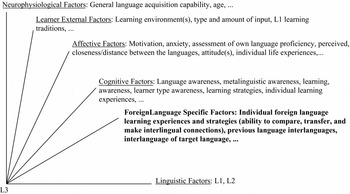
In her model, Hufeisen (Reference Hufeisen, Hufeisen and Lindemann1998) describes four initial stages of language acquisition referring to the four languages that the learner acquires. For each stage, as shown in Figure 1, the factors which control or exert substantial influence on the language learning process are listed. These include:
Learning an L3 (based on Hufeisen & Marx Reference Hufeisen, Marx, Thije and Zeevaert2007b: 314; bold in the original).

(a) neurophysiological factors which provide both the basis for and precondition of general language learning, production and reception capability;
(b) learner external factors such as socio-cultural and socio-economic surroundings, including culture-specific learning traditions, and the type and the amount of input the learner is exposed to;
(c) emotional factors such as anxiety, motivation, or acceptance of the new target language;
(d) cognitive factors such as language awareness, linguistic and metalinguistic awareness, learning awareness, knowledge of one's own learner type and the ability to employ learning strategies and techniques;
(e) linguistic factors as included in the learner's L1(s).
The main focus of Hufeisen's model can be seen in the factors responsible for differences between the SLA process and the TLA process: they explain, according to Hufeisen, why TLA cannot be subsumed under SLA (see also section 2.3). Whereas the L2 learner is a complete beginner in the learning process of a second or first foreign language, the L3 learner already knows about the foreign language learning process and has (consciously or subconsciously) gathered individual techniques and strategies to deal with such a situation with differing degrees of success. Additionally, the learner may have intuitively learned about her/his individual learner style. These new features are part of a new set of factors: foreign/L2 learning-specific factors such as individual L2 learning experiences, (explicit or subconscious) foreign language learning strategies and interlanguages of other learned languages. It should be pointed out that at this stage the L2 will probably take over the role of a bridge or supporting language in TLA development (e.g. Hufeisen Reference Hufeisen1991). Therefore, L3 learners have language specific knowledge and competencies at their disposal that L2 learners do not.
Hufeisen notes that this model serves to illustrate the prototypical language learning process and analyse individual learning situations. According to her, each learner will develop a specific factor complex, and some factors may turn out to be predominant and exert a strong influence on the learning situation. Others may become completely unimportant and irrelevant for the individual learning process.
The multilingual processing model (Meißner Reference Meißner, Klein and Rutke2004)
Meißner (Reference Meißner, Klein and Rutke2004) developed his multilingual processing model to explain processes taking place during the reception of written and oral texts in an unknown language, ideally belonging to a typologically related language family. The assumption is that if a learner has learned Spanish as a foreign language, the learner should be able to develop receptive skills in all the other Romance languages (see section 5.3.1 on EuroCom below).
In his model, the focus of attention is on the underlying processes facilitating and enabling the understanding of the new language. It is assumed that in their attempt to make sense of a new text, learners rely systematically on their knowledge of previously learned languages and use them as bases for hypothesis building about the new language. In case of two typologically- related languages, the hypotheses are constantly revised by the learner. The result of this process is a so-called spontaneous (or hypothetical) grammar which at the beginning relies more on the system of the previously learned language(s) than on the target language system. During the language learning process the spontaneous grammar is continuously revised and developed towards the structures and lexicon of the target language. The previously learned foreign language being closest to the new target language takes over the role of a bridge language and functions as a kind of matrix against which the new structures and lexicon are compared and contrasted.
In order to build a spontaneous grammar a number of preconditions must be met:
(a) An etymological relationship between the languages should exist.
(b) The learner has to be proficient in the bridge language(s).
(c) The learner has to be instructed in how to use the knowledge of a previously learned language as a bridge language.
Only when these three conditions are met can a spontaneous grammar develop in the multilingual learner. This development of receptive skills consists of four stages. During the first stage after the first encounter with the new target language, a first spontaneous grammar for this language is developed. This initial understanding is facilitated by the bridge language. For instance, a Basque speaker learning French is supported by her knowledge of Spanish. The generation and revision of the hypotheses for this grammar concerning interlingual regularities works dynamically by systemizing and generalizing the target language input. At the second stage, an interlingual correspondence grammar is created through the spontaneous grammar, which constructs interlingual correspondence rules. These rules meander between the previous linguistic knowledge of the bridge language(s) and the growing knowledge of the new target language system and over time develop towards the latter. Noticeable features of this interlingual correspondence grammar are transfers between the source language(s) and the target language. At the third stage, a multilingual inter-system is constructed. It stores and saves all successful (as well as some unsuccessful) interlingual transfer processes. It consists of transfer bases which provide the learner with a general framework for the decoding and understanding of the new language. The multilingual processing model introduces six such transfer bases: communicative strategy transfer, transfer of interlingual processing procedures, transfer of cognitive principles, transfer as pro- or retroactive overlap, learning strategy transfer, and finally transfer of learning experiences. At the fourth and final stage, learning experiences in the target language are stored as a collection of metacognitive strategies.
In time, the learner constructs multilingual system knowledge with both positive and negative correspondence rules which can be used when confronted with written or spoken texts. They can also be changed, revised and extended when another language system is introduced.
A dynamic systems theory model of multilingualism (Herdina & Jessner Reference Herdina and Jessner2002)
Holistic approaches such as Grosjean's realistic view of bilingualism and Cook's concept of multicompetence have strongly influenced recent research on TLA, as mentioned above. They both describe the bilingual as a competent or multicompetent but specific speaker-hearer whose mind is not comparable to the monolingual in either language.
Herdina & Jessner (2002) also apply holism to the study of multilingualism but emphasize the dynamics of multilingualism as a necessary prerequisite of holism (Phillips Reference Phillips1992). Following other sciences such as meteorology, physics, biology and mathematics, they apply dynamic systems theory (DST), also known as chaos theory or complexity theory, to the study of multilingual development whose changing nature calls for a new thinking metaphor. According to DST, interactions between the subsystems of a complex system need to be described as non-additive ways of influencing overall and individual development. A few years ago some scholars in applied linguistics became interested in the new perspectives that DST offers to the study of language acquisition (Karpf Reference Karpf1990; Larsen-Freeman Reference Larsen-Freeman1997; Meara Reference Meara, Broeder and Muure1999). In parallel, emergentist models of language acquisition have been developed (N. Ellis Reference Ellis1998; MacWhinney 1999) and recently the application of DST to language development has been reinforced by a number of publications (De Bot, Lowie & Verspoor Reference De Bot, Lowie and Verspoor2007; special issue of Modern Language Journal 2008).
Multilingualism is a dynamic process which lends itself to the application of DST theory, as suggested by Herdina & Jessner (Reference Herdina and Jessner2002) in their dynamic model of multilingualism (henceforth DMM; see also Jessner Reference Jessner2008). According to DMM, the development of a multilingual system changes over time, and is non-linear, reversible – resulting in language attrition and/or loss – and complex. It is also highly variable since it depends on social, psycholinguistic and individual factors, apart from the different forms of contexts in which language learning takes place, as explained above. The model is conceptualized as an autonomous model of multilingualism to serve as a bridge between SLA and bilingualism research. It indicates that future language acquisition studies should go beyond studies of the contact between two languages, turning their attention towards trilingualism and other forms of multilingualism. Furthermore, it provides a scientific means of predicting multilingual development on the basis of factors found to be involved (Herdina & Jessner Reference Herdina and Jessner2002).
The DMM is based on a number of assumptions. The discussion is centred on psycholinguistic SYSTEMS (LS1/LS2/LS3/LS4 etc.) which are defined as open systems depending on psychological and social factors. These systems are seen as interdependent and not as autonomous systems, as they are perceived in mainstream research. In the DMM, systems stability is related to language maintenance. The perceived communicative needs of the multilingual speaker influence language choice. The holistic approach taken in the DMM is a necessary prerequisite for understanding the dynamic interaction between complex systems in multilingualism.
Consequently, multilingual proficiency (MP) is defined as the dynamic interaction between the various psycholinguistic systems (LS1, LS2, LS3, LSn), crosslinguistic interaction (CLIN), and the M(ultilingualism)-factor or M-effect (Jessner Reference Jessner2008), as shown in the following crude formula:

Apart from the usual contact phenomena such as transfer, borrowing and codeswitching, crosslinguistic interaction, which is a concept wider than crosslinguistic influence (Sharwood Smith & Kellerman Reference Sharwood Smith, Kellerman, Kellerman and Sharwooddr Smith1986), also covers cognitive effects of transfer as identified, for instance, in the Interdependence Hypothesis by Cummins (e.g. Reference Cummins1991). The M-factor refers to all the effects in multilingual systems that distinguish a multilingual from a monolingual system, that is, all those qualities which develop in a multilingual speaker/learner due to the increase in language contact(s) in a non-additive or cumulative way such as metalinguistic and metacognitive awareness (Jessner Reference Jessner2006). According to the DMM, seemingly identical phenomena of transfer can lead to divergent results in different multilingual systems, which can be transitionally commanded by the same speaker. The M-factor is an emergent property that can contribute to the catalytic or accelerating effects in TLA. The key variable is metalinguistic awareness, which consists of a set of skills or abilities that the multilingual user develops due to her/his prior linguistic and metacognitive knowledge. This language learning experience and metalinguistic awareness influences further language learning or learning a second foreign language (see Hufeisen Reference Hufeisen, Hufeisen and Lindemann1998; Kemp Reference Kemp2001). The catalytic effect of TLA has mainly been detected in experienced language learners in the case of typologically related languages, as explained below. So from a DST perspective it can be stated that multilingual systems include certain components which monolingual systems lack, and even those components that the multilingual system shares with the monolingual system have a different significance within the system.
The model of multilinguality (Aronin & Ó Laoire Reference Aronin, Laoire, Hoffmann and Ytsma2004)
According to Aronin & Ó Laoire (Reference Aronin, Laoire, Hoffmann and Ytsma2004) the study of multilingualism should be based on multilinguality by arguing that language constitutes one of the most defining attributes of the individual. They present an ecological model of multilinguality in which they point to the terminological difference between multilinguality and individual multilingualism. Whereas individual multilingualism only refers to the processes and results of TLA or the trilingual speaker, linguistics and language, multilinguality concerns the multilingual communicator in a social and physiological environment, society, communication and sociology. In the following section, sociolinguistic and psycholinguistic factors of TLA will be described as two dovetailed and interdependent components of multilingualism.
3. Sociolinguistic aspects of third language learning
As often mentioned in recent publications on multilingualism, many countries are multilingual and so are many of their citizens. In fact, from a global perspective, multilingualism presents the rule and not the exception (e.g. Edwards Reference Edwards1994). From a European perspective though, the application of monolingual norms to multilingual contexts is still predominant, despite the efforts of the European Union to foster plurilingualism or individual multilingualism in European citizens, as touched upon already in the introduction.
In this section, a selection of topics dealing with multilingualism in society will be presented, starting with a description of some multilingual countries, in which learning an L3 – in many cases English – is considered necessary, not only for immigrants. This is followed by a short discussion of language prestige and the resulting attitudes and motivation of learning additional languages. It will also be made clear that the study of multilingualism has to be placed at the crossroads of socio- and psycholinguistics, in particular with regard to multilingual planning and education.
3.1 Multilingualism in European countries
In a larger society, such as a country or nation state, communities can be divided according to the type of pattern that multilingualism takes in the larger society. Communities display either horizontal or vertical multilingualism (Mansour Reference Mansour1993). According to this model, which views speakers in terms of their organization in space, speakers who live in horizontal multilingualism live in their own geographic spaces and are often monolingual. This means that multilingualism is present at a higher level of society, but this does not imply that every citizen is multilingual, e.g. Switzerland is multilingual but its citizens are not necessarily multilingual. The other type, vertical multilingualism, is found when people are in daily contact with other languages because of work, where and how they live, where they go to school, etc. According to Mansour (Reference Mansour1993: 19f.), the individual spaces differ from each other with regard to spatial organization and mindset depending on the kind of multilingualism (see also Myers-Scotton Reference Myers-Scotton2006). An example of this could be one of the major cities in Europe such as Brussels, London or Paris. In many cases English presents the L3 for a number of bilingual citizens.
Bilingual regions can be found in a number of European countries such as Spain, the Netherlands, Finland, Belgium, Switzerland and Austria to name but a few. In the Basque Country about a third of the population is bilingual in Spanish and Basque, and the younger generations study English as an L3. Likewise in Catalonia many people are bilingual Spanish and Catalan, and English is learned as an L3. In the northern part of the Netherlands the citizens of Friesland use Friesian and Dutch on a daily basis and children learn English from an early age on (Ytsma Reference Ytsma, Cenoz and Jessner2000). In Austria, where the majority of the population speaks German as a dominant language, there are three bilingual enclaves: one in Carinthia, where both Slovene and German are used, and the others in Burgenland, where Hungarian and Croatian are used with German on a daily basis. Here again the bilingual children come into contact with English as their L3. It is clear that the population in neighbouring areas is very often bilingual, such as Germans living in the north of Germany in Schleswig-Holstein who are bilingual Danish and German or those who are bilingual Polish and German living at the Polish border, for instance, in eastern Brandenburg. On the other hand, in Cyprus there are two official languages but this does not necessarily mean that all the citizens are bilingual. The same applies to Switzerland with its four official languages, as already mentioned above.
English is learned as an L3 in many European countries due to globalization (Cenoz & Jessner Reference Cenoz, Hufeisen and Jessner2000; Jessner Reference Jessner2006). The term introduced by Hoffmann (Reference Hoffmann, Cenoz and Jessner2000) to refer to this phenomenon is ‘multilingualism with English’, which can be seen both as a societal and individual phenomenon. As described by Viereck (Reference Viereck and Hartmann1996), the spread of English in Europe cannot be considered a uniform phenomenon. While learning English has a long tradition in northern Europe, for instance in the Scandinavian countries, in some southern or eastern European countries its importance is growing steadily, replacing other traditionally taught foreign languages. But although the number of people using English as a lingua franca is increasing steadily, this does not necessarily mean that English will be the only language used in the future. This is supported by Graddol (Reference Graddol2004: 1330) who points out that ‘English will indeed play a crucial role in shaping the new world linguistic order, but its major impact will be in creating new generations of bilingual and multilingual speakers across the world’.
3.2 Language prestige and attitudes towards multilingualism
Language prestige influences language choice in at least two respects, with regard to
(i) the maintenance of a certain language, very often the first language, in a new environment and
(ii) the attitudes towards learning additional languages.
With the distinction between additive and subtractive bilingualism, Lambert (Reference Lambert and Hornby1977) established a crucial concept of how language choice is influenced by the prestige of a language in a community or society. Whether a language is maintained in a new environment depends very much on the prestige of that language in this context. For instance, whereas a Croatian family now living in Austria will most probably meet problems with the maintenance of Croatian in the family, a French family might find it much easier to maintain the family language in the same context. Whereas French is still considered by many people to be part of élite multilingualism in Austria, Croatian certainly is not so, meaning that the younger generation will opt for language shift in the Croatian family.
Furthermore, the prestige of a language also influences the choice of learning this language as an additional language. Lasagabaster & Huguet (2007) published a large-scale questionnaire study on the language attitudes of pre-service teachers towards TLA and/or multilingualism in a number of bilingual contexts in Europe such as Ireland, Malta, Wales, Friesland, The Basque Country, Catalonia and Galicia. The researchers concluded from their comparative study that the widespread favourable attitudes towards the minority languages reflect the changes in linguistic policies promoting protection and recovery of the minority languages over the last two decades. They add that trilingual education or the presence of three languages in the curriculum is becoming more commonplace. Raising an awareness of the richness in linguistic and cultural diversity in multilingual contexts should present an important part of new programmes.
4. Psycholinguistic aspects of third language learning
Research on individual multilingualism is concerned with three main areas of investigation:
(i) acquisition of multilingualism
(ii) multilingual use
(iii) multilingual processing
In other words, psycholinguistic studies are interested in the tri- and multilingual learner, the developmental patterns of TLA, maintenance, attrition and loss as well as the characteristics of multilingual production and their underlying cognitive mechanisms (see also section 2 above on models of TLA). In psycholinguistic research on TLA, focus has been laid on early trilingualism, the effects of bilingualism on additional language learning and crosslinguistic influence. In particular, the two latter have turned out to be of major importance for research on the educational perspectives of multilingualism. In the following, an overview of the main studies in these two fields will be given.
4.1 Effects of bilingualism on additional language learning
It seems to be widely known that under certain circumstances life with two or more languages can lead to advantages, not only with regard to language knowledge but also in terms of cognitive and sociopragmatic development. As is known from Cummins' Threshold Hypothesis (e.g. Reference Cummins1991) a certain level of proficiency in both languages has to be attained in order to profit from the cognitive advantages which are related to a heightened level of metalinguistic awareness, creative or divergent thinking, communicative sensitivity and further language learning. All these are skills which develop at the higher level of creativity and reorganization of information (Hamers & Blanc Reference Hamers and Blanc1989; Mohanty Reference Mohanty1994; Baker Reference Baker2006).
Following the early studies of TLA by Ringbom (Reference Ringbom1987) and Thomas (Reference Thomas1988) as described above, a number of studies were carried out with children in the Basque Country and in Catalonia to explore the effects of bilingualism on TLA (Cenoz Reference Cenoz1991; Cenoz & Valencia Reference Cenoz and Valencia1994; Sanz Reference Sanz, Díaz and Pérez1997; Muñoz Reference Muñoz, Cenoz and Jessner2000; Sagasta Reference Sagasta2003). In all of these studies, bilingual children outperformed monolinguals in the acquisition of English. Furthermore, Lasagabaster (Reference Lasagabaster1998) applied Cummins's Threshold Model to trilingual children in the Basque Country and found support for the relationship between the varying levels of proficiency in the three languages and the stages in cognitive development. González (Reference González1998) studied Turkish and Moroccan immigrants with regard to learning English and also found superiority for the bilingual population. In a Swiss context, Brohy (Reference Brohy2001) showed that Romansch-German bilinguals outperformed German monolinguals when learning French (see also Grießler Reference Grießler2001 in section 6.1 below).
In an extensive overview, Cenoz (Reference Cenoz, Hufeisen and Jessner2003a) found a tendency towards mixed results in studies on the effects of bilingualism on further language learning which she related to the diversity of the studies concerning the specific aspects of proficiency, methodology used and the testing context. Summarizing, she pointed out that the majority of studies on general proficiency indicated a positive effect of bilingualism on TLA and that this effect was linked to metalinguistic awareness, language learning strategies and communicative ability, in particular in the case of typologically close languages. The overview also showed that more research is needed to explore the complexity and diversity of TLA. As already pointed out by Bialystok (Reference Bialystok2001), a bilingual does not have across-the-board metalinguistic advantages or universally superior metalinguistic abilities but increased abilities in tasks that require selective attention. Additionally, her latest work (Bialystok et al. Reference Bialystok, Craik, Klein and Viswanathan2004), focusing on executive functions in bilingual adults, suggested cognitive advantages of bilinguals across the lifespan.
The results of these studies seem to imply that the development of a ‘bilingual awareness’ (McCarthy Reference McCarthy1994) or the application of a bilingual norm – instead of a monolingual norm (Herdina & Jessner Reference Herdina and Jessner2002) – provides the necessary prerequisite for successful further language learning (see also section 6.3.2 below). Jessner (Reference Jessner2006) defined linguistic awareness in multilinguals as an emergent property of multilingual proficiency and as consisting of at least two dimensions in the form of crosslinguistic awareness and metalinguistic awareness. Crosslinguistic awareness refers to the learner's tacit and explicit awareness of the links between their language systems.
4.1.1 Multilingual learning strategies
Metalinguistic and metacognitive awareness play an important role in the development of language learning strategies in multilingual learners and users (Jessner Reference Jessner2006; Moore Reference Moore2006a). Due to their experience in language learning, multilingual learners use different strategies to monolingual students learning their first foreign language, as already pointed out by McLaughlin (Reference McLaughlin, Harley, Allen, Cummins and Swain1990). According to R. Ellis (Reference Ellis1985: 293) strategies are referred to as some form of mental activity which occurs at a specific stage in the language learning process and are not necessarily problem-oriented and conscious (see also Schmid Reference Schmid1995).
The most well-known study on the good language learner, that is multilingual learners, was carried out by Naiman et al. (Reference Naiman, Fröhlich, Stern and Todesco1996[1978]). In their large-scale interview study they found that learning success of good language learners was attributed to a number of strategies, such as an active learning approach, realization of language as a system, realization of language as a means of communication, handling of affective demands and monitoring of progress (see also Ramsey 1980). As shown in several further studies around 1990 (Nation & McLaughlin Reference Nation and McLaughlin1986; McLaughlin & Nayak Reference McLaughlin, Nayak, Dechert and Raupach1989; Nayak et al. Reference Nayak, Hansen, Krueger and McLaughlin1990), expert language learners show a superior ability to shift strategies and restructure their internal representations of the linguistic system. Thomas (Reference Thomas and Harris1992) also concluded from her TLA studies that a student's prior linguistic experience influences the strategies which they subsequently adapt and their success in the foreign language classroom. Mißler (Reference Mißler1999, Reference Mißler and Dentler2000) carried out a large-scale study on language learning strategies in multilingual students in a German context by using a German version of the Strategy Inventory for Language Learning, originally developed by Oxford (Reference Oxford1990). Mißler found that the increase of language learning experience was reflected in the number of strategies, which also turned out to depend on individual factors. In her reading study of multilingual learners of French at Innsbruck University in Austria, Ender (Reference Ender2007) used Mißler's German translation of Oxford's inventory. She also found that expert learners outperformed other learners who did not exploit their prior language knowledge in the same way. Based on another large-scale study in Germany focusing on Romance languages, Müller-Lancé (Reference Müller-Lancé2003) developed a strategy model of multilingual learning. He distinguished between productive (or retrieval) and receptive (or inferencing) strategies which turned out to depend mainly on formerly acquired lexical competences in other foreign languages.
Kemp (Reference Kemp2001) showed that multilinguals pick up the grammar of another language faster, i.e. they use more grammar learning strategies (see also Klein Reference Klein1995). In her most recent study Kemp (in press) detected a threshold effect for the use of grammar learning strategies, namely that diversification and augmentation of strategy use occurs to a greater extent during the acquisition of the L3. But she also points out that although most studies use multilingual learners as the good language learners, the good language learner who profits from an ability to learn languages without having much experience is not necessarily the same as the experienced multilingual learner who develops automaticity in processing several languages as demanded by the linguistic environment (see also Jessner Reference Jessner2006: 64–68 on the relationship between metalinguistic awareness and language aptitude).
4.2 Crosslinguistic influence
In a multilingual system crosslinguistic influence not only takes place between the L1 and the L2 but also between the L2 and the L3, and the L1 and the L3, not forgetting the fact that the influence can also work vice versa in all cases. In comparison to SLA this presents an increase in transfer possibilities which cannot be neglected, or possibly subsumed as L1 influence – as traditional SLA research would suggest. Due to changes in linguistic behaviour, for instance in a migration context, both L2 and/or L3 can jeopardize the maintenance of the L1 and consequently, language attrition might set in (see also Jessner Reference Jessner2003).
Various studies of TLA and L3 use have made clear that the L2 in a trilingual system has to fulfil a particular role. In fact, it turned out that the L3-learners or users do not rely on their L1, as expected, but on their L2. In a number of studies of learning an L3 of Indo-European origin, L3 learners whose L1 is typologically unrelated to the L2 and/or L3 tended to transfer knowledge from their L2, or in the case of bilinguals, from the related L1 (e.g. Chandrasekhar Reference Chandrasekhar1978; Ahukanna, Lund & Gentile Reference Ahukanna, Lund and Gentile1981; Bartelt Reference Bartelt, Dechert and Raupach1989; Hufeisen Reference Hufeisen1991; Cenoz Reference Cenoz, Cenoz, Hufeisen and Jessner2001; Wei Reference Wei and Cenoz2003). Studies focusing on Indo-European languages only (Singleton Reference Singleton1987; Dewaele Reference Dewaele1998; De Angelis & Selinker Reference De Angelis, Selinker and Cenoz2001; De Angelis Reference De Angelis2005a, Reference De Angelisb) supported this finding.
Psychotypology, the perceived linguistic distance between languages, plays an important role in the activation of languages other than the target language (see e.g. Kellerman Reference Kellerman1979). Other factors are recency of use, the level of proficiency in the target language (Hammarberg Reference Hammarberg and Cenoz2001), the foreign language effect, namely a tendency in L3 language learners to activate the first foreign language (Meisel Reference Meisel1983), and the learner's perception of correctness of a target word (De Angelis & Selinker Reference De Angelis, Selinker and Cenoz2001) (see also Hall & Ecke Reference Hall, Ecke and Cenoz2003). The results of a recent Canadian study carried out by Tremblay (Reference Tremblay2006) suggest that L2 exposure can influence learners' ability to use their knowledge of L2 in order to overcome their lexical deficits in L3, while L2 proficiency seems to have an impact on the frequency with which the L2 intrudes during L3 production.
Furthermore, Hammarberg (Reference Hammarberg and Cenoz2001), Cenoz (Reference Cenoz2003b) and Jessner (Reference Jessner2006) detected different roles of the supporter languages activated in L3 performance. Jessner (Reference Jessner2006), for instance, found that when the majority of the bilingual (German/Italian) students from South Tyrol activated German and Italian for different reasons in order to counteract lexical deficiencies during production in their L3 English, it was German, in most cases the dominant language, which acted as a kind of springboard for the detection of lexical deficits whereas Italian was used as a confirming agent after having found the cognate in the target language.
So far, most L3 studies have been carried out at the lexical level, and have often made use of introspective methodology as an adequate means to elicit metalinguistic thinking processes during target language performance, for example, in the form of word associations during a translation task.
Most studies have concentrated on either German or English as an L3 but some other languages such as L3 French or L3 Italian have also been focused on, as can be seen in the list in the appendix. In some other studies where multilingual learners were the centre of interest, the status of the languages within the multilingual repertoire was not always clear. For instance, in Hammarberg & Williams (Reference Hammarberg, Williams and Hammarberg1993), the object of study, Sarah Williams, had been in contact with several L2s (Italian and French) but nevertheless identified German as her principal L2 and Swedish as her L3. In another set of studies the focus has been on multilingual learners with different L1s and/or L2s learning an L3 (e.g. Hufeisen Reference Hufeisen1991; Herwig Reference Herwig and Cenoz2001; Hufeisen & Gibson Reference Hufeisen and Gibson2003; Lindqvist Reference Lindqvist2006) or multilingual learning techniques (e.g. Spöttl & McCarthy Reference Spöttl, McCarthy and Cenoz2003).
Although, traditionally, sociolinguistic and psycholinguistic aspects have been studied in different fields of research, the above discussion should have made clear that learning and using additional languages is dependent on both social and psychological factors, as discussed in Herdina & Jessner (Reference Herdina and Jessner2002). If we want to make progress in the study of multilingualism, we must acquire an understanding of its multiple aspects, in particular if this research basis is to be used for planning multilingual education.
5. Educational aspects of third language learning
Learning third languages at school presents a common experience for many children in the world. Most of these children study two foreign languages at school, such as English and French in Austria or Germany. TLA also exists in certain schools like the European schools where several languages are used as media of instruction (e.g. Baetens-Beardsmore Reference Baetens-Beardsmore and Skuttnab-Kangas1995) or due to double immersion, as described by Genesee (Reference Genesee, Cenoz and Genesee1998). All in all, it can be stated that TLA is nothing new but is becoming more widespread these days due to the recent trends to foster multilingualism, either through the introduction of a foreign language at an early age, or one or two second foreign languages in secondary school, and the changing status of minority languages (see Cenoz et al. Reference Cenoz, Hufeisen and Jessner2001a, Reference Cenoz, Hufeisen and Jessnerb). But as described by Cenoz & Genesee (Reference Cenoz and Genesee1998: vii), multilingual education can present additional challenges above and beyond those encountered in bilingual education because it is much more complex. In contrast to bilingual education, though, TLA has not received much attention. One of the very few, and perhaps the first, to study trilingual schooling was Gulutsan (Reference Gulutsan1976), reporting on double immersion programmes in Canada. He had already pointed to the intellectual enrichment resulting from multilingual learning.
After reporting on the theoretical background of research on TLA, in this section, educational and/or pedagogical aspects of TLA will be explored. First of all, multilingual education in its complexity and differences as compared to bilingual education will be described. Furthermore, some examples of multilingual school concepts and a description of multilingual teaching projects funded by the European Union will be presented.
5.1 The complexity of multilingual education
Cenoz & Genesee (Reference Cenoz and Genesee1998: 14) define multilingual education in the following way:
By multilingual education, we mean educational programmes that use languages other than the L1s as media of instruction (although some teach additional languages as school subjects) and they aim for communicative proficiency in more than two languages. Accomplishing this calls for complex educational planning in order to accommodate multiple linguistic aims, curricular materials, and teaching strategies within the framework of limited school schedules. Multilingual education, like bilingual education, can take different forms because it is necessarily linked to the sociolinguistic context in which it takes place and has to take account of the relative status and use of the languages involved.
Their definition makes clear that multilingual education is most of all characterized by its complex nature. Complexity and diversity in multilingual education are related to the variety of forms of language teaching leading to multilingualism and diverse social environments requiring different forms of multilingual education. In multilingual education the choice of languages plays an important role. Nowadays, it seems to have become clear that minority or heritage languages in a migration context have to be fostered and be integrated into the process of multiple language learning (Olshtain & Nissim-Amitai Reference Olshtain and Nissim-Amitai2004; Krumm Reference Krumm, Hufeisen and Lutjeharms2005). Yet, the exact planning concerning, for example, the number of hours of tuition in the heritage languages that are necessary for successful learning is still going on. Also, the problems that teachers meet because they have to deal with several migrant languages within one classroom are underestimated and only individual solutions seem to exist. The integration of community languages (Clyne et al. Reference Clyne, Rossi and Isaakidis2004) accompanied by some necessary initiatives to improve the status or value of languages other than English (known as LOTE) present other important issues in multilingual education (see also section 6). García, Skuttnab-Kangas & Torres-Guzmán (Reference García, Skuttnab-Kangas and Torres-Guzmán2006b) also point to the local conditions of multilingual education which should not be ignored (see also Widdowson Reference Widdowson2003 on the localization of English language teaching). At the same time the complexity refers to the complex and dynamic nature of TLA, as explained above.
TLA in school shares many important characteristics of second language learning but, at the same time, builds on second language learning; specifically it is influenced by the degree of bilingualism already attained by the student. Whereas second language learning refers to teaching an L2 as a subject, bilingual education usually refers to the instruction in two languages. But to view this differentiation as a dichotomous feature would be misleading. Rather, SLA and bilingual education should be taken as existing on a continuum, also including content-based approaches using the L2 as medium of instruction within the L2 subject classes (Met Reference Met, Cenoz and Genesee1998). Equally, the distinction between TLA and trilingual (or multilingual) education is not clear. Whereas TLA is used to refer to learning an L3 as a school subject, trilingual education involves the use of three languages as languages of instruction. But again, the boundaries between the two concepts have to be seen as blurred according to the methodological approaches and educational aims for the individual languages (Jessner & Cenoz Reference Jessner, Cenoz, Cummins and Davies2007: 160).
5.2 Multilingual schooling: some examples
In this section, some examples of multilingual schools will be presented. They concern minority contexts where trilingual schooling is common, such as in the Basque Country and the Ladin-speaking community in South Tyrol. Furthermore, multiple language teaching principles used in International schools and European Schools are sketched so that examples of both élite multilingualism and minority-context multilingualism will be provided. These examples will show that the first prefers the teaching OF multiple languages (as subjects) whereas in the latter the teaching IN multiple languages is focused on (see also below).
5.2.1 European minority language contexts: The Basque Country and Ladin Valleys
The Basque Country Although Basque and Spanish are both official languages of the Basque Autonomous Community, Basque is actually a minority language spoken by about 29% of the population. Since Basque is a unique non Indo-European language in Western Europe, it is typologically distant from Spanish. In the Basque Autonomous Community both Basque and Spanish are used as compulsory subjects at school in a variety of multilingual programs. These programs differ with respect to the languages used for instruction, their linguistic aims and students. Currently, most schoolchildren have Basque for some or even all subjects both in elementary and secondary school. Additionally, English is studied as a foreign language in the Basque Country from the second year of primary school at the age of 4. Some schools have even started using English as an additional medium of instruction (Jessner & Cenoz Reference Jessner, Cenoz, Cummins and Davies2007; Cenoz in press).
Ladin Valleys The Ladin-speaking community lives in an area of northern Italy, including the four valleys of Val Badia, Gardena, Avisio and Livinallongo, as well as Cortina d'Ampezzo. Ladin, which is a minority language within the bilingual area of South Tyrol, belongs to the Rhaeto-Romanic subgroup within the Romance family. The Ladin school system reflects the trilingual situation of the community whose members are proficient in German, Italian and Ladin. At the beginning of elementary school in the valley of Gardena, parents can decide whether their children attend the German-Ladin or Italian-Ladin class where Ladin is used as a language of communication and instruction in a play context in the first year (27 hours of tuition). Note that this is not the case in all the other Ladin speaking communities, where parents are not entitled to influence such decisions. From the second year onwards, teaching takes place during 12.5 hours of tuition in German and Italian, and these classes include two hours of Ladin a week. This remains the same from the third to fifth year of primary school. At secondary level, Ladin is maintained at school both as language subject and as language of instruction. Nowadays, learning English sets in at primary school level, as in many Italian schools (Kaspers Reference Kaspers2007).
5.2.2 European schools
There are currently fourteen European schools in seven countries (Belgium, Netherlands, Germany, Italy, United Kingdom, Spain and Luxembourg) with a total of approximately 20,000 pupils on roll (www.eursc.eu; accessed 17/5/2007). They are established to provide free education for children of personnel of the European Institutions, and others (fee-paying) if places are available.
Basic instruction is given in the official languages of the European Union. This principle allows the primacy of the pupil's mother tongue (L1) to be safeguarded. To foster the unity of the school and encourage genuine multicultural education, there is a strong emphasis on the learning, understanding and use of foreign languages. This is developed in a variety of ways:
• The study of a first foreign language (English, French or German), known as ‘L II’, is compulsory throughout the school, from the first primary class.
• All pupils must study a second foreign language (L III), starting in the second year of secondary school. Any language available in the school may be chosen.
• Pupils may choose to study a third foreign language (L IV) from the fourth class of secondary school. Any language available in the school may be chosen.
History and Geography are taught in the pupil's first foreign language or ‘working language’ from the third class of secondary school. Economics (optional from the fourth class of secondary school) is also studied in a working language.
5.2.3 International schools: the example of Vienna International School
Perhaps the most impressive example of an international school is Vienna International School (VIS; www.vis.ac.at, accessed 12/4/2007). As written on the web site, VIS is truly international in its outlook, staff and curriculum. Students represent more than one hundred nationalities and speak over seventy mother tongues. VIS uses English exclusively as the language of instruction. All students with a sufficient command of English (to follow regular lessons) must take German (the host language) as a first foreign language. There are also German classes for native speakers (‘language A’). Students whose proficiency in English is not adequate are offered English as a L2. When they become proficient enough to be mainstreamed, they can start learning another foreign language; VIS offers French and Spanish (only as a ‘language B’ or a foreign language). Latin is also available, but only as an optional, privately-paid course. The school also encourages mother tongue lessons, and will help parents arrange this; however, these lessons take place outside regular class time and are paid for separately. The school provides the classrooms, and students can in most cases earn school credit for the lessons.
5.3 Multilingual teaching projects in Europe
Over the last decade, due to the efforts of the Council of Europe to foster plurilingualism, a number of projects have been initiated within Europe. As the most well-known, the EuroCom project will be described first, followed by the activities of the European Centre of Modern Languages to promote multilingualism. The stimulating influence of the language awareness movement on some projects on multilingual learning in Europe is clearly visible.
5.3.1 EuroCom
The EuroCom (European Comprehension) project (!www.eurocom--frankfurt.de; accessed 14/3/2007) aims to provide European citizens with a solid linguistic basis for understanding each other, at least within their own language family. In order to meet this goal, a number of inferencing techniques in typologically- related languages have been developed. The pioneering work was completed in the Romance languages (see Klein & Stegmann Reference Klein and Stegmann2000; Stoye Reference Stoye2000; Klein & Rutke Reference Kjär2004; see also Meißner above). The other programs are EuroComGerm for Germanic languages (e.g. Hufeisen & Marx Reference Hufeisen and Marx2004, Reference Hufeisen and Marx2007a) and EuroComSlav for Slavonic languages (e.g. Zybatow Reference Zybatow2003). Galanet (http://www.galanet.eu/; accessed 30/6/2007), coordinated by the University Stendhal in Grenoble, has also focused on the intercomprehension between speakers of Romance languages (e.g. Carrasco Perea Reference Carrasco Perea, Müller-Lancé and Riehl2002; Masperi Reference Masperi, Müller-Lancé and Riehl2002).
As explained on their website, EuroCom makes learners aware of their prior language knowledge, that is, due to their European origin ‘they already know an unexpectedly large amount about the new language, which gives them greater self confidence in starting to learn the language. The learners first discover how much they do not need to learn. They see that they have not taken full advantage of the linguistic capital that they already possess, and that they only need to take this and invest it in the new language’.
As EuroCom concentrates on the development of receptive skills, in the entire initial phase, which is called ‘the core of EuroCom’, reading competence is trained. By guiding the discovery of familiar elements in an unknown text, the human ability to transfer previous experience and familiar meanings and structures into new contexts is activated. This process, which is called ‘optimised deduction’, focuses on both the recognition of structural elements on the phonetic, morphological and syntactical levels and international words and expressions of similar lexical origin, as used in many social, professional and technical areas.
EuroCom organizes text material into what is called the Seven Sieves. New learners are compared to prospectors extracting the ‘gold’ – their previous language knowledge – from the new language by passing it through seven sieving processes. With the First Sieve, words from the International Vocabulary are extracted from the text. Since most of this vocabulary, which is present in most modern European languages, is derived largely from Latin, it benefits the learner of the Romance languages or English. Five thousand of these easily recognizable words are included in most adults' repertoire anyway and taken together with internationally known personal and institutional names or geographical concepts, for instance, it is assumed that a newspaper article on international politics can be immediately understood since this kind of vocabulary usually forms the larger part of that genre. The Second Sieve makes use of vocabulary knowledge common to the language family, and it is shown how knowledge of just one language can open the doors to the others in a language family. With the Third Sieve, EuroCom provides learners with all the essential sound correspondence formulae, so that they can recognize the relationships between the words and therefore their meaning. For instance, if one compares French nuit ‘night’, which corresponds to Spanish noche and Italian notte, then Spanish leche ‘milk’ and Italian latte correspond to French lait. In this way, a large number of historical changes can be understood and the word recognized in its new ‘clothing’. The Fourth Sieve concentrates on spelling and pronunciation by pointing out that although, for instance, the Romance languages generally use the same letters for writing the same sounds, some spelling solutions are different and can hinder the recognition of the relationships between words and meanings. In the Fifth Sieve, which is concerned with (pan-Romance) syntactic structures, nine basic sentence types which are structurally identical in all the Romance languages are concentrated on. It is argued that against a background of syntactic similarity, the particular features of the individual languages can be isolated and briefly explained. In the Sixth Sieve morphosyntactic elements are focused on. They provide the basic formulae for recognizing the different ways different grammatical elements have developed in the Romance languages. Working on these is considered most rewarding since they are among the most common elements of any text. The Seventh Sieve then works with lists of Greek and Latin prefixes and suffixes and enables the learner to work out the meaning of compound words by separating affixed elements from the root words. EuroCom argues that at the end of this process the learner will have become aware of what a large store of familiar knowledge they already had, or has become available to them in extremely productive formulae. And this not just for one language, but for eight other languages as well.
5.3.2 Projects funded by the European Centre of Modern Languages
In order to assist the challenge of creating a multilingual Europe the Council of Europe has established The European Centre of Modern Languages (ECML) in Graz (Austria) (http://www.ecml.at; accessed 15/5/2007). The centre describes itself as a ‘unique institution whose mission is to encourage excellence and innovation in language teaching and to help Europeans learn languages more effectively’. In this sense, it focuses on the practice of the learning and teaching of languages, promoting dialogue and exchange among those active in the field, trains multipliers and supports programme-related networks and research projects. Over the last few years, a number of projects focusing on multilingual learning have been funded by the ECML. One of them was the project on language awareness in children initiated by Candelier, whose work is also known from another European project focusing on primary school children called Evlang, Eveil aux langues or Awakening to Languages. This Socrates/Lingua D project, which was coordinated by Candelier (Reference Candelier2003), concentrated on the development of awareness-raising techniques in children with regard to multilingualism in the classroom and is linked to the language awareness movement (see also Hélot & Young Reference Hélot, Young and García2006).
Over the last two years he has been working on a framework of competences to support multilingual and multicultural approaches and so develop an overall concept of language education integrating the teaching and learning of all languages. Hufeisen & Neuner (Reference Hufeisen and Neuner2003) worked on a project dedicated to creating synergies in language learning. They proposed to teach L3 German beyond language borders.
6. Emerging trends in teaching third languages
Several trends in teaching third languages which have developed over the last few years can be traced. The general trend to acknowledge the benefits that multilingualism and multilingual education can offer has now existed for a while and is certainly of major importance as an argument for multilingual education and as part of the dynamics of trend development. The teaching implications of these trends are difficult to pin down. Their origins may be linked to the European projects, just mentioned. Or they might be part of an increased interest in the development of multilingualism awareness-raising activities in the classroom, or both. The language awareness movement, initiated in the UK about 15 years ago to counteract illiteracy in English, has certainly contributed to the development of such activities, as has the growing interest in multilingualism. Hawkins (Reference Hawkins1999), one of the pioneers of applying language awareness to L2 learning, referred to language learning in the classroom as language apprenticeship consisting of two main aspects: (a) learning to learn a language and (b) cross-language comparisons with special emphasis on the L1 in SLA. Although he did not explicitly refer to TLA or multilingualism, his ideas appear to provide an ideal basis for education with multilingual goals.
Since the development of ideas in education are also linked to developments in research, these trends, which will be described in detail in this section, can be subsumed as multicompetence approaches to language proficiency development. Although so far the notion of multicompetence has mainly been known among SLA researchers, a tendency to integrate the main ideas of the concept into multilingual teaching has been noted, although not described as such before (Jessner in press b). These ideas mainly concern linguistic awareness in multilinguals and the mental links between the languages of the learner or user. As a consequence, the concepts of language teaching presented in the following section are concerned with awareness-raising techniques and, in particular, enhancing the connections between the languages in both teachers and learners; that is, bridging the languages, creating synergies and exploiting resources (see also Jessner Reference Jessner2008).
Although contact with other languages in the classroom has been intensified by an increase in immersion programmes or content-based language teaching, the individual language subjects are still treated as separate entities within the syllabus. Yet, as recent research on TLA and multilingualism clearly shows, during multilingual production, links are established between the languages in the multilingual mind and made use of (see section 2 and 4 on psycholinguistic aspects of TLA). Additionally, metalinguistic awareness and metacognitive skills are developed as part of multilingual development and should also be fostered in an instructed context (Jessner Reference Jessner1999, Reference Jessner2006).
6.1 Focus on the multilingual learner
As just mentioned, in the traditional classroom the language subjects are often kept totally apart and contact between the languages in the curriculum is forbidden since it is considered a hindrance to successful language learning. Consequently, teachers keep knowledge about other languages, including the L1, out of the classroom in order not to confuse students. This idea is rooted in traditional Contrastive Analysis, which proposed the strict separation of the languages in the classroom with the intention of preventing the negative influence of the L1 on the L2 (see also section 2.1 above). This stands in contrast to new developments in both multilingualism research and teaching, which propose to move away from isolation towards cooperation between the languages in the learner. In this vein, Clyne (Reference Clyne, Dewaele, Housen and Wei2003b) suggested a language-centred approach which means that a relationship through and with a language should be developed.
A number of cross-language or language-centred approaches allowing the L1 and other languages into the classroom have been developed over the last decade. Since TLA is not SLA, it is suggested not to start from scratch, in particular when teaching adult students. This also requires that the roles of L1 and L2 in L3 have to be redefined by raising awareness of the existing potential for competencies in other languages. That is, the use of previous foreign language learning experiences and strategies as well as the development of skills to compare, transfer and infer should be fostered in TLA (Hufeisen Reference Hufeisen, Hufeisen and Lutjeharms2005). Today, the facilitative role that transfer can play in language learning is not disputed any longer but has become widely acknowledged together with the cognitive benefits of contact with two and more languages in general (Kellerman Reference Kellerman1995; Schweers Reference Schweers1996; Jessner Reference Jessner2003). How to profit from an already established language system has been discussed by Lewis (Reference Lewis1997). Such a position is clearly linked to Cummins' idea of a common underlying proficiency in relation to the interdependence hypothesis which discusses the formation of a repertoire of cognitive skills (see above).
As pointed out in earlier publications (e.g. Jessner Reference Jessner2006), the search for similarities is a natural feature of multilingual learning and use (Ringbom Reference Ringbom2007). But, although it is well-known that students resort to other languages for support when meeting linguistic problems in the target language, even more so since research on TLA has established itself as a field, so far very few attempts have been made to focus on similarities between the languages in the classroom (Jessner Reference Jessner1999). Such an approach also implies that prior linguistic knowledge of students can be exploited and not regarded as some kind of negative, interfering and destructive force that hinders the language learning process.
So far most examples of how to bridge and teach across languages have been developed in the field of learning German as a foreign language since, internationally, German presents a typical L3 in educational contexts (e.g. Hufeisen & Lindemann Reference Hufeisen and Lindemann1998; Cenoz et al. 2000; Dentler, Hufeisen & Lindemann Reference Hufeisen and Lindemann2000). Janovsky (Reference Janovsky2000), for instance, argued for the use of French in the German classroom for speakers of a non-Indo-European language such as Arabic. She bases her ideas on the common influence of Latin in both languages and offers a number of examples on the grammatical and lexical level. In a study focusing on learning German as an L3 in the Italian-speaking community of Switzerland, Terrasi (Reference Terrasi and Dentler2000) suggested a contrastive approach in the area of functional pragmatics including Italian, French and German, in particular for older learners of German.
Such a cross-language approach can also be helpful in English language teaching. Jessner (Reference Jessner2006: 134f.) suggested exploiting the etymology of English when teaching English in the multilingual classroom. As pointed out by Wandruszka (Reference Wandruszka1990; see also section 6.3 below), to understand English, an awareness of the history of the language is necessary. Both Germanic and Romance elements form an important part of the English language and, therefore, should not be ignored in English language teaching (see also Cummins Reference Cummins2001). For instance, Grießler (Reference Grießler2001) described the positive effects of French on English in a study carried out in Austria. She found that those students who started learning French in parallel with English at an earlier age outperformed those students from a regular high school. Müller (Reference Müller1999), on the other hand, studied the transfer potential of English for learning French but also concluded that a number of structures led themselves to be transferred to French. Additionally, Hufeisen (Reference Hufeisen1994) suggested using English when teaching German as a foreign or third language. Such an approach becomes even more important if the goal of multilingual teaching is teaching multilingualism with English, as discussed below. Teaching across languages presents a promising didactic tool of multilingual teaching, whatever languages are involved in the learning process. For instance, Köberle (Reference Köberle, Hufeisen and Lindemann1998) based her teaching of Tchek as L4 on the prior language knowledge of her students, including English and Russian, and emphasized the positive interaction between the languages in the classroom.
As described in section 4 above, language learning strategies present a crucial part of multilingual development and, as results of recent studies show, the number of strategies employed seems to increase with linguistic experience and language proficiency in the various languages in contact. This supports the call of several scholars such as Cohen (e.g. Reference Cohen1998) to integrate strategy training in all sorts of language learning. Applied to a multilingual classroom, Jessner (Reference Jessner1999) argued that the silent processes in multilinguals known from natural language learning and use should be made explicit in instructed language learning. Schmid (Reference Schmid, Kettemann and Wieden1993, Reference Schmid1995) described strategies as potentially conscious and, therefore, controllable and teachable. He carried out a teaching experiment on the learning of Italian by Spanish immigrant workers in Switzerland. The strategies that he identified are the following:
(a) congruence (the identification of interlingual correspondences),
(b) correspondence (the development of processes to relate similar forms in the related L2 and L3),
(c) difference (identification of contrasts).
Spöttl (Reference Spöttl and Cenoz2001) showed how the process of learning English as an L3 was positively influenced by strategy training. In another study, Spöttl & Hinger (Reference Spöttl and Hinger2002) taught their German-speaking students, learning English as their first and Spanish and French as their second subject at university, simultaneously in Spanish, English and French. The students clearly profited from their prior language knowledge, mainly stemming from Latin, since it eased crosslinguistic consultation and facilitated access to other knowledge such as interlingual collocations. Inferencing techniques, or informed guessing, also form a considerable part of the process of learning to learn a language, namely by raising the students' learning awareness. This kind of ‘entdeckendes Lernen [learning through discovery]’ helps to develop procedural knowledge, and it is suggested this be fostered in multilingual learners since it equips the learner to be autonomous (Chamot & O'Malley Reference Chamot and Ellis1994: 388; Schmid Reference Schmid1995: 82).
6.2 Focus on the multilingual teacher
In order to discuss the role of the teacher in multilingual learning, more than one perspective of that teacher has to be taken into consideration. First, the teacher who teaches several languages and second, the teacher who – ideally – is also a language learner and therefore – ideally – engages more or less constantly in language learning in order to counteract fossilization in the learning process.
As shown in a comparative study carried out in Ireland and Israel, teacher multilingualism is perceived as an advantage, even if the teacher only teaches one language (Aronin & Ó Laoire Reference Aronin and Ó Laoire2003). This means that the ideal language teacher has also experienced language learning and can pass on and use this knowledge in the classroom. This language learning experience should be complemented by the study of language acquisition research as part of teacher education. Before multilingual awareness can be raised in the classroom, it needs to be manifested in the teacher through her own multilingual learning skills and knowledge (see also Skuttnab-Kangas Reference Skuttnab-Kangas, Hall and Eggington2000).
Having said this, the debate over the native versus non-native teachers needs to be recalled since this issue is of a somewhat higher significance in multilingual teaching if the varying levels of language proficiency in the languages a multilingual teacher teaches are taken into consideration. Although the original discussion concerned the English language teacher (Cook Reference Cook1999; Seidlhofer Reference Seidlhofer2000; E. Ellis Reference Ellis2005), the problem concerns all language teachers, regardless of the language subject they teach. As pointed out by Seidlhofer (e.g. Reference Seidlhofer, Gnutzmann and Intemann2005), the non-native teacher has to be accepted as a teacher in her own right because the students can profit from skills and abilities which are based on her linguistic background and her language learning experience (see also various contributions in Llurda Reference Llurda2005).
6.3 Focus on multilingual didactics
This section aims to describe some innovative didactic approaches to multilingual teaching. In such an overview, the role of the English language needs particular attention before moving on to the important elements of multilingual didactics.
6.3.1 The special role of English
Although a number of activities seem to have been initiated to fight the imperialism of English in the world, for the majority of the population, it is clear-cut that English presents the world's lingua franca, and hence cannot be ignored. Therefore, including English in the curriculum of schools in a non-English speaking environment seems to be necessary and is also welcomed by both parents and students. But this does not imply that students should stop learning other languages, as some critics of this development have claimed so many times in reaction to the predominance of English. To the contrary, recent statistics show that English will be learned together with other languages, at least in the European context (Graddol Reference Graddol2004). Yet, there are a number of scholars who see considerable danger in the fact that English is learned as a first foreign language on the continent. For instance, Krumm (Reference Krumm, Hufeisen and Lutjeharms2005) argues that pupils are not motivated to study other languages if they start with English. In the same vein, a number of scholars, such as Hufeisen (e.g. 2005), argue that multilingualism can be achieved more effectively if pupils start learning other languages before having contact with English.
In contrast, Vollmer (Reference Vollmer and Aguado2001) suggested that early English learning should be organized in such a manner that multilingualism through or with English will be fostered. English is required to stimulate a curiosity about learning other languages, together with multicultural awareness or awareness of the limitations and relativity of one's own language-dependent lifestyle. English needs (or could serve to) to activate and support cognitive processes for further language learning and it could serve as cognitive foundation for contrastive learning and reflection on language learning, that is, it could contribute essentially to the development of linguistic awareness in multilingual learners. In other words, English could and should function as a kind of ice-breaker and this way create an openness to linguistic diversity.
Ideally, such an approach should be complemented by an etymological approach to English language teaching, as described above, or to make use of multilingualism within English in order to foster multilingualism with English (Jessner Reference Jessner2006: 136). An approach focusing on the effects that the influence of other languages has exerted on English could be exploited. English can only be understood and learnt with the necessary awareness of its language history (Wandruszka Reference Wandruszka1990). This means that approximately 60% of all the words (3–4 syllables long) in written English are of Greco-Latin origin; everyday high-frequency words of the Anglo-Saxon lexicon tend to be just one or two syllables (Corson Reference Corson1995). ‘While it is true that English is in terms of its basic grammatical structure a Germanic language, in terms of its lexis it can, thanks to 1066 and all of that, plausibly be regarded as a Romance language’ (Singleton & Little Reference Singleton and Little1991: 75). Exploring the crosslingual aspects of the Greco-Latin lexicon could provide useful insights for English language students. For instance, Cummins (Reference Cummins2001) suggested analysing complex words where the root is joined with a variety of prefixes and suffixes, or working with cognates from different European languages deriving from Greek and Latin (see also Wandruzska below).
6.3.2 Common curriculum and multilingual didactics
Over the last few years, a trend has been noted towards a common curriculum for all languages accompanied by multilingual didactics. Such a common curriculum for all languages, which should exist at all instructional levels, requires the integration of all language subjects, in the sense of bridging the hitherto isolated language subjects, and including them in other subjects, as in content-based language learning. This has been done in Luxemburg, where Spanish is taught in French, Italian in Spanish or English in German, before the target languages are later taught as language subjects (Hoffmann Reference Hoffmann, Cenoz and Genesee1998). Bulgaria, with its long immersion tradition in Russian, was the first country to present such a common curriculum (Dikova, Mavrodieva & Stankulova Reference Dikova, Mavrodieva and Stankulova2001). Another country with a common curriculum is Ireland (Ó Laoire Reference Ó Laoire, Hufeisen and Lutjeharms2005). Yet, for most countries this is a challenge for the future. From an international perspective, it is worth noting that élite multilingualism seems to favour teaching language as an isolated subject whereas multilingual countries (see examples of India and Africa) have a tradition of integrated language teaching (García et al. Reference García, Skuttnab-Kangas, Torres-Guzmán and García2006a: 22; see also European examples in section 5.2 above).
With regard to the German context, Hufeisen (Reference Hufeisen, Hufeisen and Lutjeharms2005: 15) describes her ideas of a common curriculum which should be governed by a multilingual concept. She assumes that such an approach fosters language learning in the sense that more languages are learned, which might be positive for languages such as French which otherwise would be dropped, that the approaches to learning would differ (fewer but more intensive training as in content-based approaches, regular exchange or trainee programs abroad) and that languages would not compete with, but rather support, each other (see also Hufeisen & Neuner 2003; Hufeisen & Lutjeharms Reference Hufeisen and Lindemann2005).
Furthermore, Hufeisen (Reference Hufeisen, Hufeisen and Lutjeharms2005) suggests joint courses in multilingualism research, didactics and pedagogy together with intercultural education comprising heritage/minority/migrant languages offered to all language students as part of pre- and in-service teacher training. One such attempt has been made at Innsbruck University in Austria, where for some years now all language students are taught integrated foreign language didactics (Hinger et al. Reference Hinger, Kofler, Skinner and Stadler2005).
In contrast to other linguists who deliberately exclude multiculturalism from their work on multilingualism, in her recently published book on plurilingualism and schooling Moore (Reference Moore2006b) proposes links between languages and cultures (see also Coste Reference Coste1997). She describes her ideas on multilingual didactics, which are rooted in a social-constructivist framework, by pointing to both a bilingual conceptualization of language learning and a bilingual conceptualization of bi- and/or multilingual competence (2007: 242). She defines plurilingual and pluricultural competence in terms of life-long capital and a reservoir of coordinated experiences, developing differently and in relation to individual social trajectories. She focuses her assumptions concerning curricular scenarios and classroom teaching methodologies on the plurilingual asset working as a potential learning facilitator (see also M-factor in section 2 above). In this way, multilingual didactics promotes language learning and the contact with other cultures as resources and means to develop multilingual expert knowledge for each pupil, thereby fulfilling an ideological and sociological function (Moore Reference Moore2006b: 243; see also Hélot Reference Hélot and Laoire2006).
That a multilingual teaching approach to multilingualism is needed, was already suggested by Wandruzska (e.g. 1986, 1990), who is reported to have often addressed his students at Salzburg University in a different Romance language. Based on his work on the crosslinguistic links between the European languages, he pleaded for an introductory course in Latin and Greek for all language students that would provide them with the basics for learning modern European languages (see also Munske & Kirkness Reference Munske and Kirkness1996 on Eurolatin; see also EuroCom and discussion of etymological approach to English language teaching above). Recently, Müller-Lancé (Reference Müller-Lancé, Klein and Rutke2004) has also promoted the central role of Latin in the development of school multilingualism, in particular in the study of Romance languages (see also Müller-Lancé Reference Müller-Lancé and Riehl2002; Hinger et al. Reference Hinger, Kofler, Skinner and Stadler2005).
In the search for links between languages some attempts have been made to develop adequate material in a systematic manner. For instance, Glinz (Reference Glinz1994) composed a comparative pedagogic grammar of German-French-English-Latin, and Müller (Reference Müller1999) concentrated on German-English-French. Other materials, mainly for the use at primary level, have been developed as a result of the language-awareness movement (Feichtinger et al. Reference Feichtinger, Lanzmaier-Ugri, Farnault, Pornon and Matzer2000; Candelier Reference Candelier2003; Behr Reference Behr2005; Hélot & Young 2005: 88 with a list of language awareness websites). Oomen-Welke (Reference Oomen-Welke and Timm2006) points to the demand for open material which is needed to incorporate new languages into the classroom. Even if only the pupils – and not the teacher – know them this would create an ideal situation for students, to show their expert knowledge, which would strengthen their roles in migration contexts. Such material should also include information on the development of multiliteracy (Cummins Reference Cummins2006; see also Moore Reference Moore2006b). Yet, a lot more work needs to be invested in material development, such as textbooks, ideally equipped with common terminology for all languages.
7. Challenges for the future
The aim of this article has been to show that the implementation of concepts related to third language teaching is needed not only as an essential part of multilingual education but also of language teaching in general. In this way, language teaching in general could profit from the experiences of L3 teaching. The two major assets of such a conceptualization concern bridging the languages and the need to disclose the linguistic background of all students and teachers. First, languages being taught in the classroom need to be linked in order to profit from the synergies and to exploit the resources that many of the pupils already have available through their prior language knowledge. Second, portfolios or some other form of linguistic background documentation should be obligatory in any classroom so that the advantages or positive effects of multilingualism can be identified and eventually taken advantage of. In this way an awareness of the students' multilingualism can be provided for both teachers and fellow-students.
As already anticipated, a great deal of work on multilingual education still needs to be done. Most of all, this work entails developing linguistic awareness in teachers, learners and teachers as learners, as well as assessing and testing multilingual proficiency. As noted by Cenoz & Genesee (Reference Genesee, Cenoz and Genesee1998) earlier, the goal of communicative proficiency in more than two languages entails the definition of multiple linguistic aims. How to define and describe the various levels of language proficiency which the multilingual students and pupils are supposed to reach can be seen as a very challenging endeavour and although there has been intense work on the Common European Framework of Reference, it has to be stated that we will only be able to document multilingual proficiency if a multilingual norm is applied to the definition of multilingual competence (see also Krumm Reference Krumm, Hufeisen and Lutjeharms2005). Some work on bilingual testing has been done (e.g. Valdés & Figueroa Reference Valdés and Figueroa1994; Escamilla, Chavez & Vigil Reference Escamilla, Chavez and Vigil2005) but findings from research on multilingualism suggest some new ways of viewing multilingual competence or proficiency, as discussed in the previous sections.
One of the most difficult aims of future work on language teacher education will be to make sure that all language teachers are experts on multilingualism, even if they teach only one language. This is addressed by Krumm (Reference Krumm, Hufeisen and Lutjeharms2005: 35) who emphasizes that the most difficult correction of the educational system will be not to train teachers for English or French but experts for multilingualism, who teach a certain language but also accept at the same time the multilingualism of the learner and foster multilingualism. And he continues by saying that the use of other languages in the classroom has to be allowed in order to profit from the languages and the language learning experiences that students bring with them to the classroom. Students (and teachers) must learn to demonstrate their language biographies, allow languages in the classroom which they do not know and develop strategies for solving problems resulting from the variety of languages on the one hand and the interest in a speedy learning process of a language on the other.
There is still a long way to go but in order to provide an adequate framework for applying new approaches to the development of multilingual proficiency, prerequisites and implications for studying and teaching in a multilingual context have to be discussed and re-examined. It is clear that the implementation of all the necessary changes, concerning both learning and teaching an L3, presents a major challenge for future multilingual education. The lesson that multilingualism research can teach multilingual education is that only by leaving traditional concepts and boundaries behind will new perspectives be able to emerge along with a holistic understanding of the phenomena in question. This is necessary if multilingualism for all, representing a global challenge, is the goal of education.
Acknowledgements
I thank Jasone Cenoz and Britta Hufeisen for various discussions on the issue and the anonymous reviewers for their insightful observations. I am also grateful to Graeme Porte for his enduring support during the production of this article.
Appendix
The following list has been compiled to provide an overview of L3 studies, stemming mainly from a psycholinguistic background. It is by no means a fully comprehensive list but is intended to serve as a starting point for future studies on third language learning and teaching focusing on a particular third language. The list specifies the names of author(s), the year of publication, the country where the study was carried out and the languages involved in the TLA process. Full bibliographic details will be found in the References at the end of the present article. Note that in some cases there is not a clear distinction between the L2 and the L1, as, for instance, Spanish and Basque in the Basque Country or Swedish and Finnish in Sweden. In those cases where the authors published more than once on the constellation of languages, only one publication is given.
Ulrike Jessner has published widely in the field of bilingualism and multilingualism with a special focus on the acquisition of English in multilingual contexts. She is the author of A dynamic model of multilingualism (2002) and Linguistic awareness of multilinguals: English as a third language (2006). She is also editor of the International Journal of Multilingualism and a member of the editorial board of ITL Review of Applied Linguistics and the International Journal of Bilingual Education and Bilingualism, and has acted as reviewer for a number of journals and book publications in the field. Furthermore she has been engaged in the development of the research area of multilingualism both as organiser of the biennial international L3-conferences and as founding member and current Secretary of the International Association of Multilingualism.