Introduction
The purpose of this paper is to link the ‘structured dependency’ thesis as applied to older people to their political participation (cf. Townsend Reference Townsend1981). How does the experience of dependency in old age act as a cultural process, ‘reflect(ing) back in the minds and expectations of citizens’ (Baars et al. Reference Baars, Dannefer, Phillipson and Walker2006: 3)? The contrasting experiences of older citizens in Europe and the United States (USA) suggest that policies affect not only socio-economic dependency but also the capacity and potential of older people to mobilise as a cohesive interest group (Pierson Reference Pierson1993). Campbell's (Reference Campbell2003) empirical work revealed that the US policy of universal benefits in old age through Social Security and Medicare contributed not only to improving the welfare and independence of seniors, but also to producing a cohesive and mobilised interest group, often referred to as ‘senior power’ (Binstock Reference Binstock and Hudson2005; Turner, Shields and Sharp Reference Turner, Shields and Sharp2001). The theoretical work of Schneider and Ingram (Reference Schneider and Ingram1993, Reference Schneider and Ingram2005) identified American seniors as an advantaged group and that policies reflect both their positive social construction and high levels of political influence.
Some American gerontologists, however, have been sceptical of the significance of senior power (Binstock Reference Binstock2000; Hudson Reference Hudson2005) and have argued that despite their political activism, many older Americans become dependent by virtue of ‘age relations – a system of inequality, based on age, which privileges the not-old at the expense of the old’ (King and Calasanti Reference King, Calasanti, Baars, Dannefer, Phillipson and Walker2006: 140). While dependency in old age might be a common experience on both sides of the Atlantic, the extent to which older people view dependency as a political issue differs. Another American empirical study found that recipients of Social Security and Medicare were more likely to be politically active than those receiving means-tested benefits (Verba et al. Reference Verba, Schlozman, Brady and Nie1993: 310). American seniors' image as significant political actors contrasts sharply with United Kingdom (UK) and European research that has found no evidence of a significant senior lobby (Vincent, Patterson and Wale Reference Vincent, Patterson and Wale2001; Walker Reference Walker and Naegele1999). Public policy for older people is ad hoc and disjointed in many European countries. This anomaly between the levels of political activity and their impacts is ‘ripe for comparative research’ (Pierson Reference Pierson1993; Walker Reference Walker, Binstock and George2006a: 353). This paper aims to be the opening paragraph in a new chapter in empirical and theoretical research into citizenship and ageing in comparative national contexts.
The central interest of this paper is the extent to which US research on political power can be usefully applied to other western democratic states. The paper draws on the work of Walker (Reference Walker1981, Reference Walker2005, Reference Walker, Binstock and George2006a, Reference Walker, Baars, Dannefer, Phillipson and Walker2006b), Townsend (Reference Townsend1981, Reference Townsend2006), Estes (Reference Estes1979, Reference Estes2001), Estes, Biggs and Phillipson (Reference Estes, Biggs and Phillipson2003), Vincent, Patterson and Wale (Reference Vincent, Patterson and Wale2001) and Wilson (Reference Wilson2000, Reference Wilson2002) into the social construction of ageing and its relationship to the invisibility and silence of older people in politics and policy making. The paper is mindful of the complexity that globalisation has added to these debates (Estes Reference Estes2001). I apply the Schneider and Ingram (Reference Schneider and Ingram1993) ‘target populations’ model to the Irish experience of making policies for older people ‘in a vacuum’ (O'Shea Reference O'Shea and O'Dell2006c). The paper concludes that policy design for older people has significant implications for their capacity to mobilise politically (Pierson Reference Pierson1993). In turn, the capacity of older people to mobilise as an age-based social movement has long-term implications for the quality of democratic citizenship enjoyed in old age. The relationship between citizenship and ageing will become increasingly important as populations age.
The political economy of ageing and political power
Early work in the political economy of ageing (Estes Reference Estes1979; Townsend Reference Townsend1981; Walker Reference Walker1981) called for the conceptualisation of the dynamics of the ageing experience in terms of social structures rather than individual experiences (Bengtson, Putney and Johnson Reference Bengtson, Putney, Johnson and Johnson2000: 16; Estes Reference Estes2001: 1). Since these foundation contributions, we have seen the notion of ‘structured dependency’ re-modelled to fit the economically liberalised, culturally global and technology-dominated society of the 21st century (Baars et al. Reference Baars, Dannefer, Phillipson and Walker2006). The key variable that has not changed in the intervening period is the extent to which senior citizens have successfully mobilised as a movement for change. Global discourse on population ageing has tended to be conceived in economic terms, as what is the cost of more disability, pensions or health care? (Duncan Reference Duncan2008; King and Calasanti Reference King, Calasanti, Baars, Dannefer, Phillipson and Walker2006: 139). These questions reflect the dominance of neo-liberalism (Walker Reference Walker, Binstock and George2006a), which in post-industrial societies prioritise economics in much social policy planning. This work is highly influential, but omits the implications of ageing for democratic citizenship, and reflects the fact that civil and political institutions have not kept pace with demographic changes (Bengtson, Putney and Johnson Reference Bengtson, Putney, Johnson and Johnson2000: 5).
A number of key questions must be asked if the political economy of ageing is to uncover the implications of ageing for citizenship. In democratic systems, citizenship rights are increasingly tied to economic agency (Estes, Biggs and Phillipson Reference Estes, Biggs and Phillipson2003; Verba, Schlozman and Brady Reference Verba, Schlozman and Brady1995). As older people are generally excluded from the labour market, how can they influence policy making other than through their votes? With an increasing number of older people, will we see more specifically age-related policies? What will be the impact of such policies on intergenerational politics? Whether future ageing policies produce structured dependency or promote independence depends on the extent to which seniors view their status as a common collective experience of ageing, or as a personal, individual experience resulting from bad luck or hard work earlier in the lifecourse. Any citizen's perspective is attuned to national political culture, local social norms and direct experiences with policy, therefore the principles by which we choose to age at nation-state level will determine the shape of state policies. Will we choose to design policies in the liberal tradition of individualism, personal responsibility and reward, or alternatively favour sharing the dividends across generations and collective risk pooling throughout the lifecourse? Specifying the links between national ageing policies and senior citizenship is essential to understanding how policies create dependency, and whether that dependency can be resisted by political means.
Scholars of political economy argue that in recent years the global spread of neo-liberalism has led to the ‘individualization of the social (Ferge Reference Ferge, Beck, van der Maesen and Walker1997), whereby states are expecting individuals and families to take responsibility for risks that were previously collectivized’ (Walker Reference Walker, Baars, Dannefer, Phillipson and Walker2006b: 66). Clearly, scholars recognise that cuts in public funding are the result of political processes, i.e. the election of neo-conservative political leaders in western democracies. Walker (Reference Walker, Binstock and George2006a: 343) identified ‘Thatcherism’ and ‘Reagonomics’ as influential in rolling back state policy in favour of free-market alternatives, but only a handful of researchers have begun to address the political impact of this individualisation. Social policies are first and foremost the outcome of political decision-making. The disadvantage experienced by many older people as insufficient social services and income poverty stems from the fact that they are firstly deprived of power, respect and basic human rights (Townsend Reference Townsend2006). While the UK literature has begun to recognise the significance of basic democratic principles of equality and human rights in influencing ageing policy, this work is still in its infancy (cf. Duncan Reference Duncan2008; Townsend Reference Townsend2006). Meanwhile, researchers in the USA have made some progress in establishing why and how policies influence not only socio-economic status (Estes Reference Estes1979, Reference Estes2001; Estes, Biggs and Phillipson Reference Estes, Biggs and Phillipson2003), but also the capacity of certain groups to mobilise politically (Campbell Reference Campbell2003; Gaventa Reference Gaventa1982; Schneider and Ingram Reference Schneider and Ingram1993). ‘If interest groups shape policies, policies also shape interest groups’ (Pierson Reference Pierson1993: 598). By drawing on this work, this paper theorises that policy design may promote or inhibit the development of senior political action in the future.
US models of senior power
American political scientists with an interest in democracy and policy design link political power and group identity with policy outcomes, and argue that ‘policy creates politics’ (Lieberman Reference Lieberman1995: 438; Pierson Reference Pierson1993; Schneider and Ingram Reference Schneider and Ingram1993). When a policy is designed for a particular ‘target population’, the mobilisation of the group around a common issue can result. Scholars attest that ‘seniors’ in the USA have higher social status and more political influence than their European counterparts, through a combination of policy design and lobbying efforts (Estes, Biggs and Phillipson Reference Estes, Biggs and Phillipson2003: 135). American elders benefit from a history of universal age-related benefits that were introduced to counter the extreme poverty of seniors in the past. The US Social Security Act 1935 gave senior citizens a unique right to Social Security and Medicare. Lieberman (Reference Lieberman1995) and Ingram and Schneider (Reference Ingram and Schneider1995) argued that the Act ‘designed one kind of policy for the elderly and a very different kind for mothers of young children, [and] actually contributed significantly to the current power of the retired persons’ lobby' (Ingram and Schneider 2005: 25–6; Pierson Reference Pierson1993: 601).
Pierson (Reference Pierson1993: 606) gave several examples of how welfare policies provide ‘resources and incentives which can encourage individuals to act in ways that lock in a particular path of policy development’. Moreover, Campbell's (Reference Campbell2003) comprehensive review of how seniors lobby to maintain social security provides compelling evidence of how universal age-based policies encourage political mobilisation. This large empirical study, based on the American Citizen Participation Study, includes examples of the American Association of Retired Persons forcing the US Congress to make complete turnarounds on some policy proposals (Campbell Reference Campbell2003: 93). While some are sceptical of Campbell's methodology (Walker Reference Walker, Binstock and George2006a: 346), her core thesis that ‘policies make citizens’ cannot be ignored. The implications of these findings for the structured dependency thesis are that different types of policy design will affect not only services for older people, and levels of welfare and independence amongst older cohorts, but also the likelihood that older people will mobilise collectively when those benefits are threatened. ‘Both economic and political implications must be considered when designing social programs’ (Campbell Reference Campbell2003: 146).
Schneider and Ingram's (Reference Schneider and Ingram1993) ‘target populations’ model also found American seniors to be a powerful and successful lobby (the authors have since developed the model, see Schneider and Ingram Reference Schneider and Ingram1997, Reference Schneider and Ingram2005). They have used the concepts of social construction and political power to build a model that explains how policy design can target groups in ways which convey powerful messages about who does and who does not deserve government investment. These messages affect group identity and levels of civic participation (Schneider and Ingram Reference Schneider and Ingram2005: 19). Their work draws on a rich tradition of theorising political power (Bachrach and Baratz Reference Bachrach and Baratz1962; Lukes Reference Lukes1974). This school of thought critiques pluralist notions of power for ignoring the capacity of dominant groups to control the decision-making arena. Lukes (Reference Lukes1974) identified the ability to control the political agenda as a third-dimensional use of power. Using power in this way allowed dominant groups to silence oppressed majorities whose ‘sense of powerlessness may manifest itself as extensive fatalism, self-deprecation, or undue apathy about one's situation’ (Gaventa Reference Gaventa1982: 17). Given the absence of theorising around political power in gerontology, this type of critical, theoretical work would be a welcome addition to the discipline. The consideration of uses of power challenges us to identify not only structural barriers to political mobilisation, but also less visible obstacles such as the internalisation of experiences of dependency in old age (Baars et al. Reference Baars, Dannefer, Phillipson and Walker2006). While seniors were not the central focus of Schneider and Ingram's model, it can usefully be applied to other western democratic political systems, when in most cases it is likely that very different ‘target populations’ would emerge. The main features of the model and its implications for gerontology research are now outlined.
The ‘target populations’ model
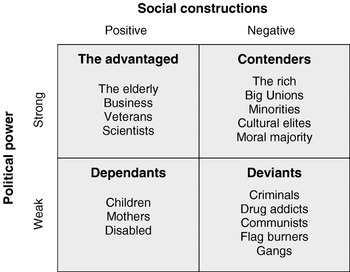
Schneider and Ingram (Reference Schneider and Ingram1993: 334) argued that ‘target populations’ are constructed differently in public discourse and policy design. Elected officials (members of political institutions who have been elected to office by democratic means) perceive certain groups as worthy of investment, and then this perception affects which policy tools are selected and how policy choices are legitimated (1993: 339). Schneider and Ingram defined social constructions as ‘stereotypes about particular groups of people that have been created by politics, culture, socialisation, history, the media, literature [and] religion’ (1993: 335). Positive social constructions are ‘deserving’, ‘public-spirited’ or ‘intelligent’, and negative constructions are ‘stupid’ or ‘undeserving’. The model was developed specifically for American politics and identifies four different socially-constructed target populations: the advantaged (business, veterans, ‘the elderly’), contenders (the rich, big unions, minorities, cultural elites), dependants (women, children, disabled) and deviants (criminals, drug addicts, communists, gangs, flag burners). The model is summarised in Figure 1.
Social constructions and political power: types of target populations.

Groups who are politically powerful and positively constructed are identified as the ‘advantaged’ (top left of Figure 1). Elected officials readily allocate resources to these groups who are constructed as ‘deserving and entitled’ (Schneider and Ingram Reference Schneider and Ingram2005: 2). The advantaged are politically active, and elected officials know they will be supported at the polls and in other public fora if policies favour advantaged groups. The reverse is true for populations that are politically weak or negatively constructed because they hold neither electoral nor political influence (Schneider and Ingram Reference Schneider and Ingram1993: 336). Deviants are the worst off, as few people support resource allocation towards criminals or drug addicts at the expense of groups perceived to be more ‘deserving’ and equally needy. Neither dependants nor deviants are politically mobilised. Elected officials can use stereotyped targeting to legitimate putting the burden of policy on groups that are politically quiescent (Schneider and Ingram Reference Schneider and Ingram1993: 337). In democratic systems, the electoral system provides a perpetual incentive for politicians to appeal to voters for re-election. The result is that elected officials are more sensitive to the demands of groups who they know to be politically engaged, and so are more likely to design generous and effective policies for them.
American seniors are widely recognised as politically active, though neither Binstock (Reference Binstock2000) nor Campbell (2002s) found evidence that they vote strategically. Research has noted, however, that the reputation for voting when combined with advocacy and political action by lobby groups is enough to make elected officials sensitive to seniors' demands (Binstock Reference Binstock and Hudson2005; Campbell Reference Campbell2003; Duncan Reference Duncan2008). The implications of Schneider and Ingram's model for our understanding of senior power are twofold. Firstly, a reputation for power is in itself a factor in maintaining power (Estes Reference Estes2001) – even if senior power is a ‘myth’ (Walker Reference Walker, Binstock and George2006a) it is still necessary to acknowledge it, as a reputation for political action can influence policy design (Campbell Reference Campbell2003; Estes Reference Estes2001). Secondly, social constructions of ‘deservingness’ make it easier for public representatives to design beneficial policies for certain groups. In the American case, seniors' reputation for political action, together with an identity constructed as deserving are enough to place seniors in the advantaged category.
Nonetheless at a time of economic retrenchment, ‘deserving’ groups will increasingly be constructed as ‘costly burdens’ (Walker Reference Walker, Binstock and George2006a). The recent partial privatisation of Medicare (2003) leaves the traditional scheme vulnerable to future cuts, as competition is now in place.Footnote 1 In the terms of the present argument, such piecemeal paring of Medicare suggests that older Americans' status as deserving may be under threat (Herd and Kingson Reference Herd, Kingson and Hudson2005; Walker Reference Walker, Binstock and George2006a). The status of American seniors is being challenged in an ideological debate between neo-conservative proponents of ‘generational equity’ and liberal supporters of ‘generational interdependence’ (Williamson and Watts-Roy Reference Williamson, Watts-Roy and Hudson2008). The generational equity lobby implies that seniors are taking future resources from children and young families. This ideology, developed during the Reagan era, socially constructs American seniors as ‘greedy geezers’ and challenges the traditional perception of seniors as ‘deserving’ (Duncan Reference Duncan2008). It may be impossible to prove the degree to which Schneider and Ingram's classification as seniors as ‘advantaged’ truly reports the status of American seniors today. Universal benefits for seniors have historically placed them ahead of other groups, however, and the generational equity lobby is arguably a ‘backlash’ (Wolf Reference Wolf1991). Nevertheless, the fact that social security has survived repeated attempts to de-legitimate, for example as ‘fiscal child abuse’ (Duncan Reference Duncan2008: 1142), suggests it may indeed be ‘locked in’ to American political culture in terms of the incentives and resources it provides to seniors as an interest group (Pierson Reference Pierson1993: 608).
The fact that the generational equity versus interdependence debate has been vibrant for two decades (cf. Thomson Reference Thomson, Johnson, Conrad and Thomson1989, Reference Thomson1991), and that an infrastructure of interest groups and advocacy organisations has developed around it, demonstrates that US political culture is ahead in acknowledging that demographic ageing has implications for democratic citizenship. Thus far, the generational equity debate has had the upper hand in terms of influential media activity (Williamson and Watts-Roy Reference Williamson, Watts-Roy and Hudson2008: 15). ‘Historically, except under very special circumstances such as the Great Depression, the counter theme of community obligation has been less powerful than the dominant theme (or value) of individualism’ (Williamson and Watts-Roy Reference Williamson, Watts-Roy and Hudson2008: 15). The recent (2008) unprecedented loss of legitimacy in global capitalism, coupled with a strong message of social solidarity under the Obama administration suggests that generational interdependence may in the near future have more opportunities to gain credibility.
Campbell (Reference Campbell2003) and Schneider and Ingram's (Reference Schneider and Ingram1993) work presents challenges and opportunities for gerontologists. If American seniors have maintained their social security entitlements in a political culture whose philosophy of individualism is enshrined in policy, this is a significant outcome. European social gerontologists have inferred that old age is socially constructed as a time of dependency (Townsend Reference Townsend2006), and shown that older people are politically weak (Vincent, Patterson and Wale Reference Vincent, Patterson and Wale2001; Walker and Naegele Reference Walker and Naegele1999), but have not clearly linked political power and social construction to the design of policies for older people. If we applied Schneider and Ingram's model to European states, we would expect to find piecemeal, disjointed and ad hoc national policies for older people. This proposition suggests that political power must become a more important variable in future European research in the political economy of ageing. To what extent is the absence of resources and incentives to take political action for European elders a result of unequal political systems, where some citizens' voices count for more than others? (Verba, Schlozman and Brady Reference Verba, Schlozman and Brady1995). If in the American case political mobilisation around social security has enabled seniors to maintain benefits, what potential is there for social movements having similar effects in other democratic states? As a first attempt at applying this model outside the USA, the next section examines policy design for older people in Ireland, re-conceptualising Schneider and Ingram's (Reference Schneider and Ingram1993) model for the Irish political context.
Policy design for older people in the Republic of Ireland
Central to understanding the contrast between US and European policy design for older people is recognition of the role of national political culture. Political culture is defined as the set of beliefs and attitudes that are deeply held by a population, that tend to be consistent over time and that provide a stable foundation on which political institutions operate (Coakley Reference Coakley, Coakley and Gallagher2005b: 36–7). Political culture is the value system that determines the relationship between the individual citizen and the state, and is a key to understanding how states formulate distinctive responses to ageing populations. A thorough discussion of how national political culture influences policy design for older people merits extensive further investigation. To establish the context of the current analysis, a brief outline of Irish political culture is now offered.
The Republic of Ireland is a small island economy on the western periphery of the European continent. Membership of the European Union has transformed Ireland from a relatively culturally-isolated island nation with mass emigration and protectionist economic policies to a modern, knowledge-based economy with net immigration and a consumer society (Coakley Reference Coakley, Coakley and Gallagher2005a: 3). The political system is a liberal democratic parliamentary system that has been dominated by two centre-right parties (Fianna Fáil and Fine Gael). The principles of social democracy are subordinate in Irish political culture, which modernised from agrarian to post-industrial society during the late 20th century by replacing clerical nationalism with international neo-liberalism (Kirby, Gibbons and Cronin Reference Kirby, Gibbons and Cronin2002). Economically, Ireland has been cited as one of the most enthusiastic participants in economic globalisation: encouraging foreign direct investment and de-regulating markets. Critics have argued that the ‘Celtic Tiger’ era brought economic success, but at huge social cost (Kirby, Gibbons and Cronin Reference Kirby, Gibbons and Cronin2002).
In contrast to the American case, there is no universal provision of health care and social security for older people in the Republic of Ireland. Demographically, the population of over four million is young. Just 11 per cent of the Irish population are aged 65 or more years (Central Statistics Office Reference Central Statistics2007: 11). Policy design for all dependent groups is based on minimising costs, contracting out to private-sector providers, or relying on charities to meet welfare needs. Over the past 20 years, the decline of the power and authority of the Catholic Church and associated institutions such as the extended family has left a ‘policy vacuum’ in relation to ageing (O'Shea 2006 a, Reference O'Shea and O'Dell2006c). Until joining the European Economic Community in 1973, the care of children and older people was almost exclusively the responsibility of married women (Galligan Reference Galligan1998), and the Catholic Church was a major provider of health care and education (Power Reference Power2009). Though public perception is that the State now provides services previously supplied by either the Church or by women in the home, this is only partially the case. Investment in social welfare in Ireland is lower than elsewhere in the European Union, ‘neo-liberal and residual: it relies heavily on means-tested payments and private insurance and there is low direct service provision’ (Timonen, Convery and Cahill Reference Timonen, Convery and Cahill2006: 469). There is no clear agreement between citizens and government as to who is responsible for elder care, pensions' provision, health care or any of the major policy issues presenting for ageing populations. Instead, there exists a ‘state of nature’ where older people and their working families cope with expensive privatised health-care and elder-care systems, which are inconsistently and/or partially subvented by state programmes (cf. O'Dell Reference O'Dell2006).Footnote 2
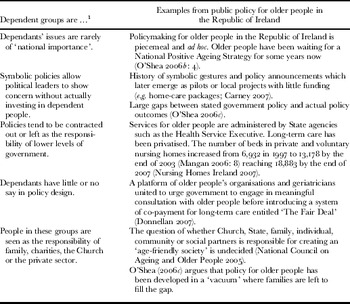
Given these circumstances, it is not surprising that the likelihood of a growing demand for pensions and elder care is reflected in public concern about the ‘demographic time bomb’ (National Council on Ageing and Older People 2005). Public perception reflects a social construction of older people as needy but helpless. Government is expected to pity older people who represent no threat to existing power structures other than by virtue of their rising number. Table 1 summarises this argument with evidence from gerontology research in the Republic of Ireland (right-hand column). Schneider and Ingram (Reference Schneider and Ingram1993: 338) outlined a number of key identifiers of dependent groups, which are summarised in the left-hand column of Table 1.
Classification of older people in the Republic of Ireland as dependent by the target populations model

Notes: 1. Quotations in left-hand column from Schneider and Ingram (Reference Schneider and Ingram1993: 338). Additional material from Carney (Reference Carney2007), Donnellan (Reference Donnellan2007), Mangan (Reference Mangan2006), National Council on Ageing and Older People (2005), Nursing Homes Ireland (2007), O'Dell (Reference O'Dell2006) and O'Shea (Reference O'Shea2006b, Reference O'Shea and O'Dell2006c).
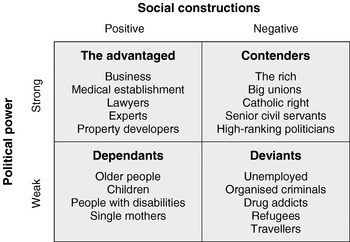
The research referred to in Table 1 suggests that the target population status for older people in Ireland differs greatly from Schneider and Ingram's (Reference Schneider and Ingram1993) categorisation of American seniors. Figure 2 re-conceptualises Schneider and Ingram's model for Irish political culture. The status of older people in Ireland places them in the lower left quadrant of Figure 2 (positive social construction with weak political power=dependent). This is an important difference from the status of ‘the elderly’ in the USA given Schneider and Ingram's contention that, ‘people's experiences with policies actually impact and help shape their identity, their orientation to government, their capacity for mobilization, their direct access to policy making and their understanding of what people “like me” can and should expect from government’ (Schneider and Ingram Reference Schneider and Ingram2005: 27). The structured dependency experienced by many older people, particularly women, is individualised into a list of personal needs, from chiropody through transport and community services to higher pensions and long-term care. Government responds with piecemeal projects which appear to have no clear set of principles other than to minimise the costs of ageing to the State. The implications of the ageing experience for Irish people as citizens has clearly yet to be addressed.
Applying Schneider and Ingram's model to the Irish case.

From this analysis, I contend that older people in Ireland are ‘dependent’: perceived as needy and helpless, the responsibility of the private sector, politically passive and have little potential for mobilisation (Schneider and Ingram Reference Schneider and Ingram1993: 341). Universalism, identified as key in the American case (Schneider and Ingram Reference Schneider and Ingram2005), is the exception rather than the rule in Irish social policy and welfare. The right of Irish citizens to state-provided services is conditional on those services not costing too much. The lack of a rights-based equality framework for older people suggests a weak and ineffectual older people's lobby. As the American case has shown, social movements play a crucial role in allowing groups to improve their political, economic and social status (Campbell Reference Campbell2003; Estes, Biggs and Phillipson Reference Estes, Biggs and Phillipson2003). What is the role of interest groups in the Irish case?
The role of interest groups
The older people's lobby in Ireland is fragmented. There are many advocacy and grassroots organisations of older people, and they tend to ‘fire-fight’, to tackle problems as they arise. The profusion of organisations means that there are many competing voices, which results in the presentation of the elder agenda as a set of disparate issues. These groups are beginning to adopt a more united approach under the ‘Older and Bolder’ banner, an alliance founded in 2006, but the development of a united and coherent political movement remains embryonic (see www.olderandbolder.ie).
Individual charities and grassroots organisations operate as separate entities, make individual submissions on important policy concerns, and have fundamental political and policy disagreements. For instance, pensions and health services policy are perpetually mentioned in annual submissions from age-related voluntary organisations to the Minister for Finance before budget day. Though different groups may make similar claims to represent older people, they display little agreement on whether a system of social insurance, a better-regulated private system or a state-funded benefit system for either pensions or health care is best.Footnote 3
Operationally, voluntary organisations tend to specialise in particular roles, many providing services such as home help, advice and information, or arts programmes (Walsh and O'Shea Reference Walsh and O'Shea2008). In terms of political lobbying, groups engage with government to varying degrees, some primarily through the media, while others use political contacts, direct letter writing or local lobbying of politicians. All of this work is commendable, but the lack of cohesion in the older people's lobby makes it easy for government to avoid making significant commitments that would entitle senior citizens to universal benefits. Instead, governments tend to contract out key services to lower agencies, and to announce aggregate budgets for programmes and national projects which translate into local projects with few or no resources. The creation of a junior Ministry for Older People (a portfolio that had no fewer than five different Ministers between 2001 and 2009) creates an impression that government is concerned for older people, but the Ministry for Older People has had neither the budget nor the mandate to challenge seriously the subordination of older people in the power structures of Irish society.
Older people's identity and political stance
The aggregate result of a fragmented lobby is that there has been no clear improvement in the status of older people over 30 years, which compares unfavourably with the transformation during the same period of the status of women (Galligan Reference Galligan1998) and with the modest but valuable improvements in the relationship of other dependent groups to the state, e.g. children and people with disabilities. It is too soon to gauge the impact of recent disability and children's rights legislation (the Children Act 2001 and the Disability Act 2005), but older people are certainly at an earlier stage in working their way through the process of recognition and differentiation of their needs in terms of a rights-based framework (Kitchin and Wilton Reference Kitchin and Wilton2003: 98). As of 2009, it seems that while all of these groups are dependent in the eyes of elected officials, the children's and disability movements are ahead in terms of developing counter arguments based on a rights framework of equality.
In terms of grassroots political action, there is evidence of Walker's (Reference Walker, Binstock and George2006a: 350) ‘barriers to political participation and influence’ amongst older people in the Republic of Ireland. Older people have struggled to develop a collective identity. Class divisions are reflected in the voluntary organisations. More affluent ‘Active Retired’ organisations, whose ethos resonates with the popular culture of ‘positive ageing’ (McHugh Reference McHugh2003), are vocal but tend not to take critical policy stances. For older people with accumulated disadvantages, the initiatives of charities and advocacy groups who speak for older people to government and State agencies tend to construct them as the deserving poor,Footnote 4 but leave no room for older people to speak for themselves (Evers and Wolf Reference Evers, Wolf, Walker and Naegele1999: 44).
The result is to ‘depoliticise the situation of older people’ whose situation is then viewed as a series of individual health, income or mobility issues (Vincent, Patterson and Wale Reference Vincent, Patterson and Wale2001: 45). The pervasiveness of social constructions which use age to limit the influence and life expectations of older people institutionalise and normalise that individualisation. The experience of grassroots political organisations with origins in the trades union movement, such as the Irish Senior Citizens Parliament, resonate with Vincent, Patterson and Wale's (Reference Vincent, Patterson and Wale2001: 82–101) conclusion about similar organisations in the United Kingdom. According to Vincent (Reference Vincent1999), pensioners' organisations typically lack professionalism, are crowded out by charities who speak for older people, become internally divisive, and adhere to national stances in the face of the unstoppable flow of global capitalism.
These experiences reflect Walker's (Reference Walker, Binstock and George2006a) second and third barriers to political influence, the fact that retirement provides less opportunity for collective identity formation and the lack of formal channels through which elders can exert political influence. Most older people apparently do not see their problems as soluble by political means. A political interpretation of their situation sees elders arguing that these disadvantages accumulate through lack of access to power and resources. This level of political consciousness on the basis of age has yet to be observed. Claims are made on the basis of neediness and hardship rather than through robust engagement with government in the national interest (Schneider and Ingram Reference Schneider and Ingram1993). The protest marches and letter writing of older people following the government's attempt in October 2008 to apply a means test to free primary medical care for the over-seventies suggest, however, that removing existing universal benefits may provide a focus around which older people could unite and mobilise.
Dependency in a time of financial crisis
Partly as a consequence of the global credit crisis, the Irish economy hit a sudden and severe downturn during the autumn of 2008. The government responded by announcing a number of cuts to benefits for dependent groups. There were to be increased class sizes in primary schools, fees for third-level students were to be re-introduced, and free universal primary medical care for the over-seventies was to be replaced with a means-tested alternative. The result was protests by teachers, students' unions and older people's organisations, notably Age Action Ireland and the Irish Senior Citizens Parliament. Older people's organisations, supported by criticism of the plan from the influential Irish Medical Organisation (an interest group representing general practitioners), organised two days of protest marches outside Dáil Éireann (the national parliament). Older people appeared on national news broadcasts, presenting an angry and united front in the face of a threat to one of the few universal state benefits they receive. Within a week, the government made an almost complete U-turn, and issued an assurance that only five per cent of older people would not qualify for free medical care under the new means test.
While the universalism of the medical card was lost, threats never again to vote for Fianna Fáil, the ruling party, may have been enough to shift older people's orientation from ‘passive’ to ‘vigilant’ in the perception of elected officials (Schneider and Ingram Reference Schneider and Ingram1993). This example demonstrates two key points: firstly, the protests revealed how groups will mobilise when a universal entitlement is threatened, particularly when a dependent group is supported by an advantaged group (in this case the general practitioners who enjoyed a generous allowance from government for elderly patients); and, secondly, Schneider and Ingram's (Reference Schneider and Ingram1993, Reference Schneider and Ingram2005) model suggests that if the current financial crisis leads to the re-design of policies, we may begin to observe how this changes the orientation of the target populations towards the government.
Although the medical card for the over-seventies had been introduced only a few years previously, it was widely supported and soon seen as a right for those who had paid tax and social insurance throughout their working lives. In this case, the government had difficulty removing a universal benefit as the policy had become ‘locked in’ to the local political culture (Pierson Reference Pierson1993). Moreover, there was an interaction between resource effects and universalism, in that older people used one universal age-related benefit (free travel on public transport) to travel to the capital city, Dublin, to protest at the removal of another universal benefit, free primary medical care. The inter-relationships between universal policy provision and the accumulation of participatory resources requires further investigation (Verba, Schlozman and Brady Reference Verba, Schlozman and Brady1995).
Summarising the Irish case
Schneider and Ingram's (Reference Schneider and Ingram1993, Reference Schneider and Ingram1997, Reference Schneider and Ingram2005) ‘target populations’ model offers insights into why older people's policy design in Ireland appears illogical or ad hoc. By linking the dependent status of older people to their lack of political power, the multi-dimensional model allows us to begin to understand how a complex set of political interests and social processes conspire to produce ‘structured dependency’ in old age. Perhaps most significantly, the application of the Schneider and Ingram model to the Irish case reveals how taking a holistic perspective on the position of older people vis-à-vis other socially-constructed populations puts their disadvantaged status in perspective, and suggests that the success of the politically powerful may be at the cost of weaker groups. It is arguable that older people in Ireland suffer resource effects from their dependency on paltry pensions (about 33 per cent of gross average industrial earnings in 2007), which they find difficult to augment given that their age bars them from the labour market.
When combined with the vicissitudes of biological ageing, the affect is to make political action a luxury many feel they cannot afford. Conversely, the perception of American seniors as powerful suggests that political action may foster identity formation that is a precondition of the outcome – a process by which the social construction of seniors in the USA has shifted over time: ‘the old become the aged become the elderly become senior citizens’ (Campbell Reference Campbell2003: 65). The Irish case study seems to support Schneider and Ingram's contention that a neo-liberal state apparatus that seeks to diminish state-financed welfare can use the social construction of dependent groups to allocate resources in favour of more politically-powerful groups. What useful learning can be drawn from this comparison of Irish and US senior power and policy research for our understanding of citizenship and dependency in old age?
Conclusion: citizenship and structured dependency
This analysis of Irish policy design and American senior power models has suggested that there may be policy-feedback effects that impact on older people's capacity and potential to mobilise politically (Pierson Reference Pierson1993). Campbell (Reference Campbell2003: 56) argued that universal social security had provided older Americans with enough income and independence to become more like wealthy, educated Americans in terms of political participation and mobilisation. If this is the case, the effect of policy design on senior politics must be investigated in other national contexts. In the Irish case, policy design for older people is based on minimising costs, so that the burdens of population ageing are placed on individual older people not tax payers, a typical response by decision-makers towards dependent groups (Schneider and Ingram Reference Schneider and Ingram1993: 338), and a common orientation in neo-liberal, globally-competitive economies (Walker Reference Walker, Baars, Dannefer, Phillipson and Walker2006b). This process of policy making is detrimental for democracy as it perpetuates class and income inequalities through the constant advantaging of the politically powerful and disadvantaging of the politically quiescent (Schneider and Ingram Reference Schneider and Ingram1997).
While the social constructions of older people as dependent may take a long time to change, the possibility of increasing senior political influence, or at least the reputation of seniors for taking political action, has more immediate promise. In particular, adding the accumulation of participatory resources (Verba, Schlozman and Brady Reference Verba, Schlozman and Brady1995: 514) to lifecourse research would greatly enhance our knowledge of accumulated dis/advantage (Dannefer Reference Dannefer2003). Similarly, work that compares the role of political culture in promoting or curtailing the development of age-based political movements, perhaps through the use of historical institutional analyses of different national contexts, would be very welcome (Pierson Reference Pierson1993: 609–10). This leads to a second important implication of the presented analysis.
The comparative theoretical work identified here suggests that a reputation for political power is almost as significant as actual political action (Binstock Reference Binstock2000; Campbell Reference Campbell2003; Estes Reference Estes2001). If reputation for political action spurs elected officials to produce policies that benefit target populations, then it is important to make it a concern of research into public policy and ageing. If exercising political power offers one means for older people to lift themselves out of ‘structured dependency’, all the more reason to include all types of senior political power in our research. As Estes argued, ‘if people believe that something is so (e.g. that the elderly have political power), it becomes so through a form of self-fulfilling prophecy’ (Estes, Biggs and Phillipson Reference Estes, Biggs and Phillipson2003: 129). The perception that seniors vote strategically makes politicians more sensitive to their demands as a politically-mobilised group (Turner, Shields and Sharp Reference Turner, Shields and Sharp2001; Wilson Reference Wilson2000). The reporting of senior political action must, therefore, be aware of the role of reputation, which would be a fruitful line of enquiry for those who wish to re-designate older people as a potential source of social capital rather than a societal burden (Gray Reference Gray2009).
Further comparative research is necessary to identify the impacts of population ageing for democratic citizenship in other nation-states. Cross-national comparisons of barriers to politicisation are long overdue (Turner, Shields and Sharp Reference Turner, Shields and Sharp2001: 816). The analysis of age as a variable in electoral studies (Campbell, Reference Campbell2003), as well as the application of other models of democratic participation such as social capital in national contexts beyond the USA would add greatly to our understanding of citizenship and structured dependency (cf. Putnam Reference Putnam1995; Verba, Schlozman and Brady Reference Verba, Schlozman and Brady1995).
Thirdly, the argument presented in this paper demonstrates a need for more critical and theoretical research if we are to avoid contributing to the ‘de-politicisation of older people’ (Vincent, Patterson and Wale Reference Vincent, Patterson and Wale2001). If lost opportunities for political engagement are to be understood as more complex than merely a failure to mobilise on the part of older people, the epistemology of ageing (Bengtson, Putney and Johnson Reference Bengtson, Putney, Johnson and Johnson2000: 8) must link ageing to critical concepts like biological determinism,Footnote 5 and to three-dimensional conceptions of power and citizenship (Lukes Reference Lukes1974). To clarify, public discussion of ageing and older people tends to view older people as a group that is passive, economically redundant or socially homogeneous. ‘Biological determinism’, so deplored by feminists of the 1970s, associated femininity with weakness, passivity and powerlessness.
Likewise, the frailties associated with advanced age have become a means of constructing the social status of retired and older people as passive consumers of welfare policies. Chronological age is then socially constructed to give it weight in terms of how we justify the allocation of power, resources and public investment away from older people (Estes Reference Estes1979; Estes, Biggs and Phillipson Reference Estes, Biggs and Phillipson2003). When such stereotyping is accompanied by the common disadvantages of being older, such as exclusion from the labour market, decreases in independent income and failing health, the effect can be devastating for the individual. As populations are ageing, the possibility arises of an increasingly large cohort of people who are outside the workforce, likely to encounter health problems, and to experience social isolation and exclusion. If we find that older people are politically quiescent, a critical epistemology of ageing is necessary to understand not only why the masses do not mobilise (Kelly Reference Kelly1998) but also the significance of the actions of those few radical individuals who do. By espousing such critically engaged research, social gerontology can thereby contribute to the development of a politics of ageing capable of resisting ageism through the representation of older people as senior citizens in the language we use and the research we publish.
Finally, given that the political economy of ageing has already identified how policies create socio-economic ‘structured dependency’ (Townsend Reference Townsend1981), it seems timely to question whether such policies also produce ‘political quiescence’ (Gaventa Reference Gaventa1982). This paper has sought to highlight how directly addressing the ‘political’ element of the political economy of ageing offers opportunities to address ‘the general inadequacies of theory building in gerontology’ (Baars et al. Reference Baars, Dannefer, Phillipson and Walker2006: 1). By applying the ‘target populations’ model to the Republic of Ireland, the paper has attempted to open a new chapter in ‘comparative research on the multi-layered politics of aging’ (Walker Reference Walker, Binstock and George2006a: 356). It is hoped that future national and comparative studies will produce a body of theoretical and empirical work that identifies the implications of demographic ageing for democratic citizenship. Embracing comparative and inter-disciplinary research of this kind is essential if the political economy of ageing is to develop as critical, relevant and emancipatory knowledge of ageing societies.
Acknowledgements
Thanks are due to Professor Eamon O'Shea, Áine Ní Léime, Patricia Conboy, Dr Nalini Persram, Professor Andrea Louise Campbell, Neil Briscoe, Michael Carney Senior and two anonymous reviewers whose comments immeasurably improved this paper. Thanks also to participants at a seminar held at the Mercer's Institute for Ageing Studies, Trinity College Dublin on 31 March 2009 for their valuable comments.