Introduction
Gamete and embryo manipulation in vitro is a powerful tool for efficient production of animals and is applied routinely to a wide variety of fields, from laboratory animals to clinical application for assisted human reproduction. One of its applications is the synchronous production of large numbers of animals for large-scale whole animal experiments that are used in radiation and toxicological research. Another application is the production of gene-modified animals to elucidate the function of gene(s) and their interactions, which still requires the handling and manipulation of large numbers of zygotes or embryos at one time. Among these, the application of manipulating embryos and gametes, in vitro fertilization (IVF) has played a central role and has the widest applicability.
In mice, the first in vitro fertilization using a ‘chemically defined medium’ was reported by Toyoda et al. (Reference Toyoda, Yokoyama and Hoshi1971). Since then, various culture media have been employed for in vitro fertilization of laboratory mice. These media include those based on Krebs–Ringer's bicarbonate solution, Tyrode's solution and complex tissue culture media (Kito & Ohta, Reference Kito and Ohta2005). Recently, two media were reported to have been applied successfully in mouse IVF: a medium developed from the composition of human oviductal fluid (HTF) (Nakagata, Reference Nakagata1996; Kito et al., Reference Kito, Hayao, Noguchi-Kawasaki, Ohta, Hideki and Tateno2004) and a mouse embryo culture medium, mKSOM, optimized by aid of a computer program for mouse embryo culture and modified for IVF (Summers et al., Reference Summers, Bhatnagar, Lawitts and Biggers1995). Most mouse IVF media, however, are tested only on a limited numbers of outbred strains, such as F1 hybrid and closed colonies.
The explosive increase in mice strains in the last few decades, especially in gene-modified mice and mutant mice (Simpson et al., Reference Simpson, Linder, Sargent, Davisson, Mobraaten and Sharp1997), necessitates the maintenance of animals by way of frozen gametes or embryos, which is a more efficient process than that of maintaining intact animals in terms of space, labour and other costs. Many research facilities are specialized in stocking animals by cryopreservation. In these facilities, researchers often encounter poor in vitro fertilization in various inbred mouse strains. Such strains include 129, C3H and BALB/c and their derivative strains including gene-modified animals (Thornton et al., Reference Thornton, Brown and Glenister1999; Choi et al., Reference Choi, Seng and Toyoda2000; Sztein et al., Reference Sztein, Farley and Mobraaten2000; Byers et al., Reference Byers, Payson and Taft2006). The gametes and embryos of BALB/c strain mice have further disadvantages including fragility during the freeze–thaw procedure (Mobraaten, Reference Mobraaten1986). Thus, larger scale embryo cryopreservation is needed for the BALB/c strain and its derivative strains such as BALB/c–nude and C.B-17–scid mice than is needed for other strains. Conversely, the collection of a large number of embryos for cryopreservation and other purposes after natural mating is difficult, because of a poor superovulatory response (Szczygiel et al., Reference Szczygiel, Kusakabe, Yanagimachi and Whittingham2002) and fertilizability in vivo (Roudenbush & Duralia, Reference Roudebush and Duralia1996). Therefore the optimization of in vitro fertilization conditions that are applied widely to various inbred strain is an important issue for assisted reproduction technologies (ARTs) in mice.
Our previous study using BALB/c sperm showed that mHTF was the only medium that could support sperm : ova interaction, i.e. sperm penetration through the zona pellucida and male pronuclear (MPN) formation (Kito et al., Reference Kito, Hayao, Noguchi-Kawasaki, Ohta, Hideki and Tateno2004; Kito & Ohta, Reference Kito and Ohta2005). In this study, we attempted to elucidate factors required for the sperm : ova interaction of BALB/c strains. We used mKSOM as a base medium, which supports sperm : ova interaction in the BALB/c strain poorly, but which strongly supports in vitro development of IVF embryos from various inbred mice including BALB/c (Kito et al., Reference Kito, Hayao, Noguchi-Kawasaki, Ohta, Hideki and Tateno2004).
Materials and Methods
Animals
Inbred BALB/cA mice were purchased from CLEA Japan, Inc. Animals were maintained at 22 ± 2 °C under a lighting regimen of 12L : 12D (lights on from 07:00 to 19:00). All animals were treated according to the Recommendations for Handling of Laboratory Animals for Biomedical Research, compiled by the Safety and Ethical Handling Regulations Committee for Laboratory Animal Experiments, the National Institute of Radiological Sciences, Japan.
Medium preparation
All reagents were purchased from Nakalai Tesque Inc., unless stated otherwise. Glutamine (G5763), sodium pyruvate (P4562), sodium lactate (L7900) streptomycin sulfate (S1277), penicillin G (P4687) and trehalose (T0167) were obtained from Sigma–Aldrich Co. and EDTA (disodium salt) (no. 343–01861) from Wako Pure Chemical Industries.
The composition of mHTF has been indicated previously (Kito & Ohta, Reference Kito and Ohta2005), and had the following composition: NaCl 101.61 mM, KCl 4.69 mM, CaCl2 5.14 mM, KH2PO4 0.40 mM, MgSO4 0.20 mM, NaHCO3 25.00 mM, sodium pyruvate 0.30 mM, glucose 2.78 mM, sodium lactate 18.36 mM, penicillin 100 U/ml and streptomycin 0.05 mg/ml. This medium was included in all experiments as a positive control to manage variability among males (Yanagimachi, Reference Yanagimachi1982). The basic composition of mKSOM was the same as KSOM (Lawitts & Biggers, Reference Lawitts and Biggers1993) except for the glucose concentration, which was included at the same concentration as mHTF (2.78 mM). The composition of mKSOM is NaCl 95.00 mM, KCl 2.50 mM, CaCl2 1.71 mM, KH2PO4 0.35 mM, MgSO4 0.20 mM, NaHCO3 25.0 mM, sodium pyruvate 0.20 mM, glucose 2.78 mM, sodium lactate 10.00 mM, glutamine 1.00 mM, penicillin 100 U/ml and streptomycin 0.05 mg/ml. The osmolarities of media were measured using a freezing-point depression osmometer (OM802, Vogel). Media were stored without glutamine, pyruvate and bovine serum albumin (BSA) at 4 °C for no more than 1 week. All media used for sperm preincubation and sperm : ova coincubation contained 4 mg/ml BSA (Nakalai Tesque). Media were equilibrated overnight at 37 °C under 5% CO2 in air with saturated humidity. When necessary, glutamine and BSA were added before equilibration and pyruvate was added immediately before gamete incubation.
Ovum collection and sperm preparation
The procedures for ovum collection and sperm preincubation were as described previously (Kito and Ohta, Reference Kito and Ohta2005). Briefly, mature females were injected with 5 IU pregnant mares serum gonadotropin (PMSG; Serotropin; Teikoku Hormone Mfg. Co., Ltd) and 5 IU human chorionic gonadotropin (hCG), (gonadotropin; Teikoku Hormone) 46–50 h apart. The cumulus–oocyte complexes were collected 16 h post hCG injection. The cumulus cells were removed with 1 mg/ml bovine testis hyaluronidase (type I-S, H-3506, Sigma) containing 0.01 mg/ml soybean trypsin inhibitor (202–09221, Wako Pure Chemical Industries). In this study, cumulus-free ova were used instead of cumulus-intact ones in order to apply controlled pooling in which ova from individual animals were equally distributed into each treatment to control the variability between individual animals. Sperm were collected from both the distal cauda epididymides and the vas deferentis under mineral oil (M8410, Sigma–Aldrich) and preincubated in mHTF at a concentration of 1–2 × 10⁷ cells/ml for 1.5 h under 5% CO2 at 37 °C. Sperm viability was scored subjectively under a Nikon dark-field dissecting microscope and only males that showed more than 60% of sperm viability were used.
Sperm : ova coincubation and evaluation of fertilization
Preincubated sperm were diluted 1 : 10 in order to count sperm concentration under a haemocytometer. The final concentration of inseminated sperm was adjusted to 1–2 × 10⁵ sperm/ml by dilution with the sperm : ova coincubation medium (total of 1 : 50–100 dilution depending on sperm viability). Sperm and ova were coincubated in 100 μl drops of media covered with the mineral oil in 60 mm Petri dish (no. 1007, Becton Dickinson) under 5% CO2 at 37 °C. After 5 h of sperm insemination, ova were washed a few times to remove attached but non-penetrating sperm and fixed in 2% formaldehyde and 2% glutaraldehyde (Kito & Ohta, Reference Kito and Ohta2005). Fixed ova were mounted on glass slides and overlaid with coverslips supported by a 3 : 1 paraffin wax–Vaseline mixture. Ova were stained with aceto-orcein and examined for sperm penetration through the zona pellucida and male pronuclear (MPN) formation by Nomarski interference microscopy (Nikon). Penetration was defined as ova with at least one sperm head within the zona pellucida. Ova with no sperm heads that had resumed second meiosis and ova that had only one pronucleus were scored as parthenogenotes and were excluded from the study because of their low incidence (less than 3%).
Experiment 1: comparison of ability to support capacitation and fertilization between mHTF and mKOSM
The ability of mKSOM to support sperm capacitation and sperm : ova interaction (zona penetration and MPN formation) was compared with those of mHTF. Two-by-two factorial experiments were performed; sperm preincubation either in mKSOM or mHTF and sperm : ova coincubation in mKSOM or mHTF.
Experiment 2: effects of increasing calcium concentration on sperm : ova interaction
Because it had been found previously that an increased concentration of calcium facilitates fertilization in vitro (Itagaki & Toyoda, Reference Itagaki and Toyoda1992) and because calcium concentration differs between mKSOM and mHTF media, we examined if an increase in calcium concentration in mKSOM during sperm : ova coincubation improved zona penetration and MPN formation. Sperm preincubated in mHTF were coincubated with ova under various concentrations of calcium (1.7, 5.0, 7.5, 10.0 mM). Calcium levels were adjusted by adding appropriate amount of 1 M solution of CaCl2 directly. Osmolarity of mKSOM was adjusted to 254 ± 5 mOsmol by varying the NaCl concentration.
Experiment 3: effect of osmolarity on sperm : ova interaction
Effects of osmolarity during sperm : ova coincubation on sperm : ova interaction was first examined. In this experiment, osmolarity was adjusted to 230 ± 5, 255 ± 5, 280 ± 5 or 305 ± 5 mOsmol by changing the NaCl concentration. Secondly, to distinguish the effects of increased concentration of NaCl on osmolarity and ionic strength of NaCl, various concentrations of NaCl (0, 14, 28 and 42 mM) in sperm : ova coincubation medium were applied by using an equivalent osmolarity of trehalose (75, 50, 25 and 0 mM, respectively) without changing the total osmolarity (305 ± 5 mOsmol) of the medium. Finally, the effects of other osmotic reagents were tested. A NaCl concentration corresponding to 75 mOsmol (42 mM) in coincubation medium was substituted with the equivalent osmolarity of trehalose (75 mM), sucrose (75 mM), choline chloride (42 mM) and sorbitol (75 mM). Osmolarities of all media were adjusted to 305 mOsmol.
Experiment 4: effects of increasing calcium concentration at isotonic osmolarity on sperm : ova interaction
To optimize the calcium concentration in coincubation medium at isotonic osmolarity (305 mOsmol), sperm and ova were coincubated in media with various concentrations of calcium (1.71, 2.5, 5.0 and 10.0 mM) at 305 mOsmol. Osmolarity was adjusted by changing the concentration of NaCl.
Statistical analysis
Each series of experiments was replicated at least six times, except for Experiment 1, which was replicated four times. Sperm from a single male were used in each replicate. Data were recorded as percentages of total number of ova inseminated and transformed using arcsin transformation (Tukey–Freeman transformation) (Zar, Reference Zar1996). Data were analysed by two-way analysis of variance (ANOVA) with a block design using the GLM procedure of SAS program (SAS Institute Inc.) and each male was assigned as a block. The least significant difference was used for multiple comparisons among treatments. A probability of p < 0.05 was considered to be significant.
Results
Experiment 1: comparison of the ability of mHTF or mKOSM to support capacitation and fertilization
When mKSOM medium was used for sperm preincubation and sperm : ova coincubation, the level of zona penetration (13 ± 1%) and MPN formation (1 ± 1%) were significantly lower than with mHTF (89 ± 4% and 64 ± 10%, respectively; p < 0.05) (Fig. 1). Sperm preincubated in mHTF and inseminated in mKSOM had slightly increased levels of zona penetration (41 ± 6%) and MPN formation (15 ± 2%), but the result was still significantly lower than that found when using mHTF (p < 0.05). When sperm were capacitated in mKSOM and inseminated in mHTF, zona penetration (78 ± 10%) was observed at a similar level as that of the mHTF control, but MPN (19 ± 5%) was still significantly lower than those sperm capacitated and inseminated in mHTF (p < 0.05). In the following experiments, we focused on elucidating the requirements for sperm : ova interaction.
Comparison of the ability to support capacitation and fertilization between mHTF and mKSOM. Sperm were preincubated in either mHTF or mKSOM for 1.5 h and then inseminated either in mHTF or mKSOM. Ova were fixed 5 h after sperm insemination and sperm penetration through the zona pellucida (open bar) and male pronuclear formation (filled bar) was scored. Error bars represent SEM. n = Total number of ova inseminated in four replicates. Within each fertilization process, noted with uppercase letters (zona penetration) and lowercase letters (MPN formation), treatments with no common letter are significantly different (p < 0.05).

Experiment 2: effects of increasing calcium concentration on sperm : ova interaction
Increasing calcium concentration to 5 mM or higher in mKSOM enhanced zona penetration to similar percentages (81–91%) as that found for cells incubated in mHTF (97 ± 2%; p > 0.05), but MPN formation (16–41%) was still significantly lower than that of the mHFT control (76 ± 8%; p < 0.05) (Fig. 2). Based on these results, a calcium concentration of 5 mM was used in the following experiments.
Sperm penetration through the zona pellucida (open bars) and MPN formation (filled bars) in mKSOM with various concentrations of CaCl2 at 255 ± 5 mOsmol. Sperm were preincubated in mHTF for 1.5 h and inseminated into media with various concentrations of calcium at 255 ± 5 mOsmol. Fertilization was examined 5 h after sperm insemination. Error bars represent SEM. n = Total number of ova inseminated in six replicates. Within each fertilization process, noted with uppercase letters (zona penetration) and lowercase letters (MPN formation), treatments with no common letter are significantly different (p < 0.05).

Experiment 3: effect of osmolarity on sperm : ova interaction
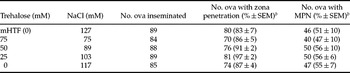
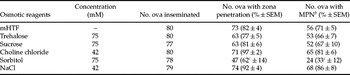
The effect of osmotic pressure was examined by changing NaCl concentration during sperm : ova coincubation. Percentages of zona penetration at 255 mOsmol or higher osmolarity (92–97%) were not significantly different from that of mHTF (99 ± 1%; p < 0.05) (Fig. 3) and percentages of ova with MPN at 280 and 305 mOsmol (73 ± 8% and 81 ± 7%, respectively) were not significantly different from that of cells incubated in mHTF (73 ± 6%; p > 0.05) (Fig. 3). To distinguish between the beneficial effects of increased fertilization in high NaCl concentration in terms of osmolarity and NaCl, NaCl was substituted partially with various concentrations of trehalose without changing total osmolarity (305 mOsmol). As indicated in Table 1, replacing NaCl with trehalose at a maximum concentration of 75 mM did not affect zona penetration and MPN formation. We further examined the effects of other osmotic reagents by replacing NaCl corresponding to 75 mOsmol with sucrose, choline chloride and sorbitol. Zona penetration and MPN formation was not affected by osmotic reagents tested, except for sorbitol, which showed significantly lower zona penetration (62 ± 14%) and MPN formation (33 ± 12%) than others (82–92% and 66–86%, respectively; p < 0.05) (Table 2). In the medium with sorbitol, reduced sperm viability was observed after 5 h sperm : ova coincubation compared with other formulations.
Sperm penetration through the zona pellucida (open bars) and MPN formation (filled bars) in mKSOM with various osmolarity adjusted by NaCl at 5 mM CaCl2. Sperm were preincubated in mHTF for 1.5 h and inseminated into media with various osmolarity. Fertilization was examined 5 h after sperm insemination. Error bars represent SEM. n = Total number of ova inseminated in six replicates. Within each fertilization process, noted with uppercase letters (zona penetration) and lowercase letters (MPN formation), treatments with no common letter are significantly different (p < 0.05).

Effects of replacing NaCl with various concentrations of trehalose in mKSOM on zona penetration and MPN formation under 305 ± 5 mOsmola.

a Total of six replicates of experiments. Sperm were inseminated after 1.5 h preincubation in mHTF and fertilization was examined 5 h after insemination. Osmotic pressure of media was adjusted at 305 ± 5 mOsmol.
b Percentage data were processed for arcsin transformation and analysed by ANOVA.
Effects of various osmotic reagents in mKSOM on zona penetration and MPN formation under 305 ± 5 mOsmola.

a Total of six replicates of experiments. Sperm were inseminated after 1.5 h preincubation in mHTF and fertilization was examined 5 h after insemination. All media include 75 mM NaCl and osmolarity was adjusted to 305 ± 5 mOsmol by various osmotic reagents.
b Percentage data were processed for arcsin transformation and analysed by ANOVA.
c Significantly different from other treatment groups in the same column (p < 0.05).
Experiment 4: effects of increasing calcium concentration at isotonic osmolarity on sperm : ova interaction
Sperm : ova coincubation at 5 mM CaCl2 showed the highest percentages of zona penetration (94 ± 2%) and MPN formation (81 ± 2%) among the CaCl2 concentrations tested (Fig. 4) and these values were not significantly different from those in mHTF (91 ± 4% and 79 ± 5%, respectively; p > 0.05).
Sperm penetration through the zona pellucida (open bars) and MPN formation (filled bars) in mKSOM with various concentrations of CaCl2 at 305 ± 5 mOsmol. Sperm were preincubated in mHTF for 1.5 h and inseminated into media with various concentrations of calcium at 305 ± 5 mOsmol. Fertilization was examined 5 h after sperm insemination. Error bars represent SEM. n = Total number of ova inseminated in six replicates. Within each fertilization process, noted with uppercase letters (zona penetration) and lowercase letters (MPN formation), treatments with no common letter are significantly different (p < 0.05).

Discussion
Minimum concentrations of various components required for IVF have been examined in various mammalian species (Fraser, Reference Fraser1995). Most studies focused on sperm capacitation, which was often examined by the ability of sperm to interact with ova after insemination. As we showed previously (Kito et al., Reference Kito, Hayao, Noguchi-Kawasaki, Ohta, Hideki and Tateno2004), however, results of penetration through the zona pellucida and MPN formation do not reflect sperm capacitation necessarily. Thus, conditions required for capacitation and sperm–ova interaction are not always the same and should be examined separately.
Sperm from inbred BALB/c mice are known to have a high incidence of abnormal head morphology (Burruel et al., Reference Burruel, Yanagimachi and Whitten1996). Although fertilizability of sperm with abnormal morphology either in vivo or in vitro is yet to be determined, embryos fertilized by intracytoplasmic injection with sperm that have abnormal morphology have the ability to develop to normal offspring (Burruel et al., Reference Burruel, Yanagimachi and Whitten1996). The high incidence of abnormal sperm morphology might be related to low fertilization in vitro in BALB/c, but our present study showed that this is not the case, as a change in IVF conditions resulted in successful fertilization.
In the first experiment, we confirmed the inability of mKSOM to support both sperm capacitation and sperm : ova interaction (Fig. 1) and this result was consistent with our previous study (Kito & Ohta, Reference Kito and Ohta2005). When sperm were preincubated in mKSOM and inseminated in mHTF, sperm penetration was increased to similar levels as those found with mHTF. This increased zona penetration is explained by delayed completion of capacitation until sperm was inseminated using mHTF. Much shorter periods of sperm : ova coincubation are preferred when studying sperm capacitation by fertilization in vitro.
The major differences between mHTF and mKSOM are calcium concentration (5.14 vs. 1.7 mM), potassium concentration (4.69 vs. 2.5 mM), lactate (18.36 vs. 10.0 mM) and osmolarity (303 vs. 254 mOsmol). Our preliminary study showed that potassium and lactate concentration had no effect on sperm : ova interaction (data not shown). We first examined the effects of various concentration of calcium on sperm : ova interaction. Sperm penetration through the zona pellucida was enhanced simply by increasing the calcium concentration to 5 mM or higher, although MPN formation was still lower than that found when using mHTF (Fig. 2). These results are consistent with those found by an other group when using outbred ICR mice (Itagaki & Toyoda, Reference Itagaki and Toyoda1992). Optimal calcium concentration during fertilization is controversial in many mammalian species. Some studies have reported that a calcium concentration of 1.7 mM is sufficient and that a higher level is detrimental (Miyamoto & Ishibashi, Reference Miyamoto and Ishibashi1975; Fraser, Reference Fraser1987; Herrick et al., Reference Herrick, Conover-Sparman and Krisher2003), whereas others groups have reported that a concentration higher than 1.7 mM is beneficial for both capacitation and sperm–egg interaction (Kaplan & Kraicer, Reference Kaplan and Kraicer1978; Huneau & Crozet, Reference Huneau and Crozet1989; Itagaki & Toyoda, Reference Itagaki and Toyoda1992). The comparison of IVF media TYH and mHTF in our previous study (Kito et al., Reference Kito, Hayao, Noguchi-Kawasaki, Ohta, Hideki and Tateno2004) showed that the incidence of fertilization differs among inbred strains. These results indicate that the calcium requirement for zona penetration is different among genetic background or strains even in the same species and that BALB/c mice require a high calcium concentration for sperm : ova interaction.
As increased calcium concentration during sperm : ova incubation alone is not sufficient to improve MPN formation to the equivalent level, as found with mHTF, we tested how osmolarity affects zona penetration because differences in osmolarity are another major difference between mHTF and mKSOM. The effect of osmolarity on sperm–egg interaction has been also studied in many mammalian species. In rodents, fertilization or sperm penetration through the zona occurs in a relatively wide range of osmolarity (280–370 mOsmol) (Miyamoto & Chang, Reference Miyamoto and Chang1973). In cows, fertilization occurs in the similar range of osmolarity as in rodents (Kim et al., Reference Kim, Lee, Lee, Lee, Han, Kim and Lee2002). In humans, fertilization in a much higher osmolarity (410 mOsmol) showed a tendency to increased penetration of zona-free hamster oocyte (Aitken et al., Reference Aitken, Wang, Liu, Best and Richardson1983). In present study, an increase in osmolarity, by changing the NaCl concentration, improved MPN formation dramatically in a dose-dependent manner and that plateaued at 280 mOsmol (Fig. 3). This increase is likely to be the direct effect of osmolarity rather than NaCl or ionic strength, because replacement of various concentrations of NaCl with an equivalent osmolarity of trehalose, an immetabolizable osmotic reagents, did not have any effect on zona penetration and MPN formation (Table 1). The effect of osmolarity was further shown by the experiment using other osmotic reagents (i.e. sucrose and choline chloride) (Table 2). The only exception was sorbitol, which was used by Oh et al. (Reference Oh, Miyoshi and Funahashi1998) as an osmotic reagent in other study of rat IVF. In BALB/c mice, sorbitol had a detrimental effect on sperm survival because most sperm were immotile after 5 h sperm : ova coincubation. It is not clear whether or not this finding is also the case in rat IVF as reported by Oh et al. (Reference Oh, Miyoshi and Funahashi1998) as there was no description of sperm viability during IVF.
Fertilization of BALB/c under isotonic conditions (305 mOsmol) showed a different response with calcium from that under hypotonic conditions (254 mOsmol). Sperm : ova coincubation in 5 mM of calcium resulted in the highest incidences of zona penetration and MPN formation, which declined at calcium concentrations higher than 5 mM (Fig. 4). In humans, some groups suggested that the transient exposure of sperm to a hypotonic environment activates sperm for fertilization by the induction of an increased calcium influx into sperm cells (Rossato et al., Reference Rossato, Virgilio and Foresta1996). Conversely, others groups have reported that hypertonic conditions enhance tyrosine phosphorylation and zona binding capacity (Liu et al., Reference Liu, Clarke and Baker2006). Although we could not study the underlying mechanisms, the present study is the first report in mice that suggests an interaction between calcium and osmolarity for sperm : ova interaction in vitro.
It is interesting to note that fertilization in vitro occurs preferentially in isotonic conditions and that development in vitro occurs preferentially in a hypotonic environment (255 mOsmol) in many mammalian species (Hadi et al., Reference Hadi, Hammer, Algire, Richards and Baltz2005). In vivo fertilization and subsequent development takes place in isotonic conditions. This suggests that osmolytes in the oviductal and uterus environments such as glycine and glutamine (Lawitts & Biggers, Reference Lawitts and Biggers1992; Dawson & Baltz, Reference Dawson and Baltz1997) play an important role so that oocytes can fertilize and develop under the same osmotic conditions.
In this study we successfully modified mKSOM for IVF of BALB/c inbred mice. Elevated calcium concentration and isotonic osmolarity is optimal for sperm to penetrate through the zona pellucida and to form MPN. The percentages we obtained were much higher than those found from in vivo fertilization in superovulated animals (Roudebush & Duralia, Reference Roudebush and Duralia1996) and this percentage of fertilization is sufficient to collect embryos for cryopreservation or production of gene-modified mice. In the preliminary experiment, we also found that these conditions can be applied to the C3H inbred strain (Kito & Ohta, unpublished data), one of the strains with poor fertilizability in vitro (Thornton et al., Reference Thornton, Brown and Glenister1999). Inventing IVF media that support both fertilization and embryo development in vitro of all inbred strains definitely would be advantageous for mouse ARTs.
Acknowledgements
We are gratefully thankful to Ms Y. Kaneko the care of animals used in this study. We thank the Department of Advanced Technologies for Radiation Protection Research and the Department of Technical Support and Development in National Institute of Radiological Sciences for their technical assistance. We are also grateful to Mr Craig Steger and Dr Diane Cookfair for critically reviewing this manuscript.