


INTRODUCTION
Businesspeople occupying higher political office are commonplace around the world. Though few systematic data exists, high levels of business penetration of national-level parliaments have been noted since the mid-2000s in such places as Thailand, Benin, China, and Ukraine. Work on so-called moonlighting politicians, members of parliament who continue to work in the private sector after election, has documented numerous policymakers with outside employment in Denmark, Ireland, New Zealand, the United Kingdom, and Canada, among many others (Geys and Mause Reference Geys and Mause2013). Private firm directors have even become national leaders of the executive branch in countries worldwide, such as Italy, the United States, Finland, and Chile (DellaVigna et al. Reference DellaVigna, Durante, Knight and La Ferrara2016).
There are different theoretical explanations about why businesspeople might run for office, largely derived from the citizen-candidate model (Osborne and Slivinski Reference Osborne and Slivinski1996; Besley and Coate Reference Besley and Coate1997). One theory claims that weak electoral institutions incentivize holding office, since voters are unable to punish businessperson politicians when they pursue private interests over the public good (Gehlbach, Sonin, and Zhuravskaya Reference Gehlbach, Sonin and Zhuravskaya2010). Scholars have also identified other institutions, such as the level of pay and disclosure rules, as influencing the trade-off businesspeople face between staying in the private market or entering politics (for a thorough review, see Braendle (Reference Braendle2016)). Further work has shown that due to the high costs of winning office, those who do run may be pursuing public service due to policy goals or altruism (Diermeier, Keane, and Merlo Reference Diermeier, Keane and Merlo2005). To date, however, we have little evidence of the economic consequences of businesspeople simultaneously working in the public and private sectors. Do CEOs who pursue political office achieve disproportionate returns for the firms they lead? If true, then this finding has broad implications about how voters should evaluate the true motivations of businesspeople that contest elections as well as how policymakers should design institutions to curb this type of rent-seeking.
To answer this question, I examine whether businesspeople who become legislators in Russia are able to secure benefits for their firms while serving in elected office. I construct an original dataset of 2,703 politically connected firms over the period of 2004–2013, matching over 12,000 regional-level candidates to any companies they directed at the time of their electoral campaign.Footnote 1 Taking advantage of close elections where the determination of the winner and runner-up is near-randomly assigned (Lee Reference Lee2008), I employ a regression discontinuity (RD) design to identify the causal effect of political connections on firm-level outcomes. Due to the discontinuity in the assignment to treatment, the RD design can causally attribute any differences in profitability, revenue, or other measures of the firm performance to the effect of winning office. In addition, I draw on over 40 semistructured interviews with key actors in three Russian regions (Tomsk, Ryazan, and Perm), including with winning and losing businessperson candidates, to help elucidate the mechanisms behind any effects found. My results indicate that firms connected to winning candidates increase their revenue by 60% and profit margin by 15% by the final year these candidates spend in office. These results are statistically significant, pass robustness checks that vary RD specifications, and reflect a local average treatment effect for firms located near the winning threshold.
Several underlying mechanisms are consistent with these findings. Bank lenders might look more favorably on firms whose directors hold elected office, viewing their political success as a sign of creditworthiness due to greater profitability and lower risk (Houston et al. Reference Houston, Jiang, Lin and Ma2014). Winning a seat in a legislature might open doors to bureaucrats and favorable treatment with regards to regulations and procurement. Determining which channel is most important for rent-seeking has implications for designing reforms. If companies develop political ties primarily to secure loans, then equalizing access to finance for all firms should be paramount. Reforms might include mandating that banks appoint independent directors and empowering supervisory agencies to discipline lenders that prioritize political ties over adequate credit checks. Alternately, if connected politicians abuse access to state agencies, public service reform should come first. Measures should be taken to punish bureaucrats who offer preferential treatment to connected firms. To test between the mechanisms, I collect data on ways legislative power could lead to firm benefits. I find that serving in office helps businesspeople win state contracts but not increase their firms’ financial leverage. Winning a seat in a regional legislature increases a firm’s probability of accessing state procurement by approximately 40%, resulting in $700,000 of revenue. These findings suggest that connections do not alleviate credit constraints but instead open up opportunities for firms to influence how state officials do their jobs.
I then exploit a rich national laboratory to examine how structural and institutional characteristics affect the payoffs of holding elected office. First, winning office is more valuable in richer regions and those endowed with natural resources. Counterintuitively, stronger democratic institutions do not constrain businessperson politicians from reaping rewards to their firms’ revenue and profits. Instead, where the ruling party faces more serious challenges to its hold on power, connected firms enjoy more opportunities to redirect budgetary resources to private interests. I argue that more competitive legislatures are able to exert policymaking authority, thereby increasing the value of winning office. Winning candidates from opposition parties also secure rewards for their firms, suggesting that nondemocratic regimes employ political institutions to distribute rents not only to their supporters but also their potential opponents. More intense political battles between parties require more government resources to buy off all connected firms.
Competition between direct rivals that have secured political representation, however, reduces the value of winning office. When winning firms encounter other potential rent-seekers who have won a seat in a parliament, they find it more difficult to carve out private benefits. In fact, the presence in parliament of at least three firms from a single sector completely washes out the positive gains from winning office. In addition, the more businesspeople represented in parliament overall, irrespective of sector, the smaller the returns for their connected firms. I argue that deliberation within the parliament is most akin to a marketplace, with dividends dropping with the appearance of new entrants. As more economic interests gain representation, the opportunities to achieve firm-specific gains shrink. Economic competitors thus perform an important oversight function, helping check one another’s political advantages and curb illicit rent-seeking.
Russia emerges as a particularly interesting case for such a study, given the large presence of businesspeople on ballots and extensive firm-level data to identify connections. Like many developing and middle-income countries, Russia has weak enforcement of laws, with political ties playing an important role in nonmarket strategy (Slinko, Yakovlev, and Zhuravskaya Reference Slinko, Yakovlev and Zhuravskaya2005). Though national-level institutions were weakened during the period of study, writing off Russia as authoritarian masks important regional variation in democratic development, resource wealth, and economic competition (Bruno, Bytchkova, and Estrin Reference Bruno, Bytchkova and Estrin2013). This subnational variation improves our ability to generalize findings to other settings where similar conflicts of interest have also been found (Acemoglu et al. Reference Acemoglu, Johnson, Kermani, Kwak and Mitton2016), while allowing us to hold constant macroeconomic factors that might imperil a cross-national study. Last, during the period, no law prevented businesspeople at the regional level from holding office. Balance sheet data provides a unique opportunity to study political connections on a scale unavailable to researchers using surveys or stock market returns.
This work contributes most directly to the literature on corporate political strategy. Businesses have numerous avenues to enter the political arena and must navigate a series of trade-offs between allocating resources to lobbying or campaign contributions or to developing direct political connections. But even with an abundance of scholarship estimating the benefits of relational ties for firms (Khwaja and Mian Reference Khwaja and Mian2005; Boubakri et al. Reference Boubakri, Guedhami, Mishra and Saffar2012; Hillman, Keim, and Schuler Reference Hillman, Keim and Schuler2004), we know comparatively less about which firms expend resources to develop them and how they manage to do so. This article explores an oft-ignored but widespread type of corporate political activity: businesspersons winning elected office (a notable exception is Gehlbach, Sonin, and Zhuravskaya (Reference Gehlbach, Sonin and Zhuravskaya2010)). Winning elected office is a powerful way to develop insider political capital and is available to all firms in places where elections are held. This type of political tie is allocated not through bribes or backdoor dealings but out in the open as determined by voters. In this respect, contesting elections democratizes how firms acquire political connections. This article offers the first empirical analysis of the value of successful businessperson candidacy.
To do so, I adopt an identification strategy that goes beyond matching and simple regression analysis to estimate the causal effect of these connections. This research design is closest to Boas, Hidalgo, and Richardson (Reference Boas, Hidalgo and Richardson2014), who also employ close elections to study the returns to campaign contributions. But the fact that many businesspeople hold elected office may lead to more serious distortions for overall economic development than simply donating to campaigns or using public office to increase personal wealth (Fisman, Schulz, and Vig Reference Fisman, Schulz and Vig2012; Eggers and Hainmueller Reference Eggers and Hainmueller2009). The takeover of legislatures by powerful firms (i.e., “state capture”) can have enormous social costs, as winning firms reap rewards not based on their market success but their ability to win elections (Hellman, Jones, and Kaufmann Reference Hellman, Jones and Kaufmann2003). In addition, I present new evidence about how structural and institutional factors impact the value of corporate political activity, building out our understanding of the relationship among democratization, competition for rents, and corruption (Treisman Reference Treisman2007; Faccio Reference Faccio2006). This article offers an important example of a situation where party-based political competition does not check rent-seeking. Preventing excessive industry concentration and promoting the broader representation of economic interests can reduce the appeal for firms of seeking office, as would public service reforms to enforce transparency in public procurement.
The article finally makes several contributions to the literature on the use and consequences of political institutions in developing democracies and autocracies. To date, much work on hybrid and nondemocratic regimes has focused on why regimes adopt nominally democratic institutions to their own benefit (Brancati Reference Brancati2014), with comparatively less done on why elites join up and legitimate these institutions as viable government actors. Parliaments cannot be simply dismissed as institutional window dressing: Economic elites make serious investments to gain access to them and earn large payoffs as a result. My research provides some of the first causal evidence for the claim that elections to parliamentary seats are used to distribute rents among elites (Blaydes Reference Blaydes2011; Gandhi and Lust-Okar Reference Gandhi and Lust-Okar2009). Parliaments allow power and resources to be shared with key actors (Boix and Svolik Reference Boix and Svolik2013) but also are used to monetarily co-opt opposition leaders to solidify their hold on power (Reuter and Turovsky Reference Reuter and Turovsky2014). By utilizing the natural experiment of close elections, I show that institutions in competitive authoritarian regimes are not epiphenomenal to larger societal dynamics (Pepinsky Reference Pepinsky2014) but instead can have independent effects on the behavior of elites and interest groups. The composition of the elites that populate parliaments can have a dramatic effect on how these institutions are used to distribute rents.
The rest of the article is organized as follows. The first section explores the costs and benefits of firm directors holding elected office as a nonmarket strategy. Next, I introduce the data, the research design, and balance checks used to validate the empirical approach. I then present the results from the regression discontinuity for the main outcome variables before delving into the causal mechanisms driving the results and exploring heterogeneous treatment effects. Finally, I conclude with a discussion of policy implications.
BUSINESSPEOPLE HOLDING ELECTED OFFICE AS NONMARKET STRATEGY
Firms are believed to make investments in the political marketplace with the expectation of financial returns, such as increasing shareholder value or revenue. The type of benefit pursued can depend on a variety of factors, including sector, size, and the business environment where they operate. For example, in weakly institutionalized regimes, firms engage in political activity to protect property rights (Markus Reference Markus2012). In more developed business environments where property is less easily expropriated, firms may look to politicians for assistance in maximizing rents in a value chain or lowering taxes.
Multiple strategies are available to firms looking to enter politics. However, the extant literature on corporate political strategies has tended to focus on two types viewed as the most dominant: lobbying and making campaign contributions. Both lobbying and contributing to campaigns are examples of what I term indirect corporate political strategies. Firms contribute information, money, and/or votes to politicians in exchange for access and influence. Politicians then become intermediaries and advocate on the firm’s behalf to achieve its policy goals. Though larger contributions are presumed to increase the probability that a politician will implement the “bought” policy, indirect strategies provide no formal guarantee that the exchange of policy will take place.
Analyses of the benefits of indirect political strategies have not reached definitive conclusions about whether a firm’s expectation of a positive return is warranted. Evidence of exchange is ample (Bonardi, Holburn, and Bergh Reference Bonardi, Holburn and Bergh2006; Hillman Reference Hillman2005), but well-developed identification strategies are much rarer (a recent exception is Boas, Hidalgo, and Richardson (Reference Boas, Hidalgo and Richardson2014)). Some studies have also found no effect of soft money and other political activities on specific firm-level outcomes (Ansolabehere, Snyder Jr, and Ueda Reference Ansolabehere, Snyder and Ueda2004) or that the effect of ties is continent on factors such as the structure of government and partisan competition (Choi, Jia, and Lu Reference Choi, Jia and Lu2014). Engaging in corporate political activity may even produce negative returns for some firms (Hadani and Schuler Reference Hadani and Schuler2013).
Besides lobbying and making campaign contributions, firms have a range of options that forgo the use of political intermediaries. These more direct political strategies essentially blur the line between politicians and firm executives. Direct strategies provide a stronger guarantee that an individual firm’s interest will be represented. Aligning incentives (the politician now benefits monetarily from improvements in firm performance) may help repel other actors competing for the politician’s attention. A common way of nurturing direct political connections is the placement of current or former politicians on the board of directors.
In this article, I focus on a much less studied variant of a direct political strategy: a firm director holding political office. Though appointments to executive positions indeed happen, a more widely available avenue for securing influence in government is for the firm director to seek a legislative seat by running for election.Footnote 2 Part of the reason firm directors run themselves is that they do not trust politicians to represent their interests. At heart is a commitment problem: Firm directors have no guarantee that the money they give will be returned in kind with policy after the election. Sending friends and trusted relatives as firm proxies may help mitigate this problem but also can turn away voters for whom the proxy is an unknown political entity. A firm director, as employer and benefactor, commands superior name recognition and respect within the community, two vital assets for winning personalized elections. Therefore, he or she must personally represent the firm’s political interests to capitalize on these electoral advantages.
Overall, the choice to send representatives from the firm directly into political office differs markedly from the other indirect and direct strategies. First, when businesspeople personally occupy political positions, they enjoy unparalleled access to policy decisions. In Russia, businessperson legislators gain direct access to the executive branch by virtue of their political status and weight in opening doors to bureaucrats (Sakaeva Reference Sakaeva2012). A businessman deputy from Tomsk claimed that bureaucrats are required to meet with deputies if they ask; in the event of noncompliance, these politicians can submit “deputy requests” (deputatskiye zaprosi) that can force bureaucratic action in favor of their businesses.Footnote 3 Well-positioned parliamentarians can even draft laws to benefit their businesses.
Another difference between winning office and other strategies is the former’s substantial cost. In fact, winning elections can be extremely resource intensive in terms of time and money. In the elections analyzed below, businesspeople must finance campaigns entirely on their own. Estimates have put the cost at up to 5–7 million rubles ($160,000–$200,000).Footnote 4 Spending money is also no guarantee of victory, and expenditures are nonrefundable.Footnote 5 Electoral politics can be contentious and vicious. Losing at the polls can damage the reputation of a firm, especially if its candidate took divisive or controversial stances to get elected.
Once in office, the designated representative must allocate some portion of time to political duties rather than firm operations. During re-election campaigns, voters will evaluate politicians not on firm performance (like shareholders would) but on their ability to deliver public goods and help constituents. One deputy admitted that “being a deputy and a businessman at the same time is not easy”; the number of constituent requests, especially for financial assistance, was a significant burden on his ability to run his firm.Footnote 6 Firms may also need to satisfy social obligations mandated by the government in exchange for preferential treatment in other areas. This diversion of time and resources from pure economic activities can easily surpass expenditures on lobbying or campaign contributions, making holding office an especially expensive strategy.
Evidence of the benefits of direct connections has been abundant, but causal effects have been much harder to identify. Moreover, political connections may undermine a firm’s competitiveness, investment behavior, and ability to innovate (Desai and Olofsgard Reference Desai and Olofsgard2008). Successful politicians may not be effective firm managers, as government intervention into company management may lead to weak incentive systems and inadequate monitoring (Okhmatovskiy Reference Okhmatovskiy2010). If political circumstances change, a tie to the “wrong” type of politician can even impose a range of negative consequences on a firm (Siegel Reference Siegel2007). Work on Ukraine has found that at the national level, winning seats in a legislature may not offer sufficient protection for an oligarch’s financial assets (Markus and Charnysh Reference Markus and Charnysh2017). The direct strategy of cultivating ties incurs sizable risks for a firm with only contingent benefits.
To briefly summarize, there is no consensus over whether corporate political activity as a whole is a profitable strategy for firms. The wide variation in empirical results strongly suggests the need for a more refined approach to analyzing the return on political investments. Although firm directors may be rational actors intent on improving market-based performance, their understanding of the political environment they are entering may be limited or flawed. The aim of this article will be to examine if, when, and how the strategy of firm directors seeking and then winning elected political office pays off for their companies’ bottom line.Footnote 7
DATA AND RESEARCH DESIGN
To test the effect of having a director hold political office on firm performance, I adopt an RD design that exploits “close” elections. On average across a large sample, narrowly winning and losing candidates should be plausibly comparable, as if victory in the elections was randomly assigned. Close elections become akin to a coin flip, dependent on such circumstantial factors as the weather on election day (Lee Reference Lee2008). RD designs using close elections have grown increasingly popular in the social sciences due to the clear assumptions required and their ability to identify a causal effect (Eggers et al. Reference Eggers, Fowler, Hainmueller, Hall and Snyder2014). Here, I employ the RD design to compare firm-level outcomes for those companies that are connected to candidates whose vote share falls close to the threshold required to win office. I compare firms connected to narrowly winning candidates to firms connected to narrowly losing candidates. If the assumptions of the RD design are met, then this empirical strategy excludes the influence of unobserved differences over both candidates and firms and allows us to measure the economic effect of a firm having a connection to a legislator.
Data Description
I study the effect of political connections on firm performance using data on regional legislative elections held in Russia between 2004 and 2011 from the Russian Central Election Commission (CEC).Footnote 8 Russia is a federal state composed of subnational units, colloquially called regions, each of which contains a directly elected legislature. Regional legislatures are important actors, responsible for passing budgets, drafting programs for social and economic development, confirming appointments, and setting land and transportation tax rates. Organized interest groups view these legislatures as key sites of contestation over policy and spoils, where laws with long-term impacts on regional matters are passed (Remington Reference Remington2008). Evidence from firm surveys suggests legislatures are attractive venues for companies looking to get involved politically (Reuter and Turovsky Reference Reuter and Turovsky2014). Last, regional deputies do not enjoy parliamentary immunity, unlike their national counterparts.Footnote 9
Regional legislative elections are set every 4 or 5 years according to an electoral calendar that is fixed and exogenous to political or socioeconomic factors. Since the regression discontinuity design I use requires a majoritarian electoral system, the sample of elections begins after December 2003 when a new federal law compelled regional parliaments to adopt a mixed-member system and fundamentally changed regional political competition. Each region determined the exact allocation of seats between election through party list (PR) and single-member district (SMD) electoral districts; approximately 41% of all legislative seats from 2004 to 2011 were chosen using SMD rules. The sample consists of elections to 114 regional legislative convocations in 78 regions from January 1, 2004, until March 3, 2011.Footnote 10
My analysis compares only winners and losers in SMD races or 12,113 candidates running for office in 2,798 elections. In constructing the sample, I omit 45 multimember districts, as the probability of being above the cutoff score is no longer 50%. I also drop all firms connected to candidates from the sample that gained a seat in the legislature on the party list, whether or not they won or lost their single-member district race. The treatment is assigned at the level of the candidate, while the unit of analysis is the firm. All firms with a director, deputy director, board chair, or board member running for office in a SMD are included in the sample. The treatment variable is electoral victory and takes a value of 1 if a firm is connected to a winning candidate and 0 otherwise. The forcing variable used is vote margin, with a cutoff point at zero. For firms connected to winning candidates (the treatment group), this value is the difference (positive in sign) from the first runner-up. For firms connected to losing candidates (the control group), this value is the difference (negative in sign) from the winner. This variable, Vote Margin, takes values from -1 to 1.
Both media and scholarly accounts of Russian politics raise concerns that elections to regional legislatures are not sufficiently competitive to allow for a RD design to be used. Although some falsification does occur at the regional level, there are reasons to believe that elites are truly competing for votes and not all electoral outcomes are preordained. First, the average margin of victory is 30.1% with a median of 25.7%. Importantly, 634 elections were decided by less than 10 percentage points, roughly 23% of the total sample. This substantial sample size and the continuous forcing variable will allow us to isolate the RD treatment effect right around the electoral threshold. Competitive elections are also distributed proportionately across Russia. Figure 1 presents the regional breakdown of elections decided by less than a 10% vote margin, calculated as the proportion of the total number of SMD elections per region.Footnote 11 Next, to preview discussion below, I examine the balance along a range of covariates between winning and losing candidates in close elections and find no evidence that electoral manipulation favors a specific type of candidate or firm. Last, if authorities are indeed faking electoral competition to build legitimacy among the population, we should not expect financial benefit to accrue to the winners (or punishment inflicted on the losers). Any coordination between candidates would result in rent-sharing between complicit firms, and not advantages bestowed on the anointed victor. I exclude the December 2011 election from the sample due to persistent concerns over vote fraud.
Percentage of SMD Elections Decided by Less Than 10%

The main outcome variables for this study are total revenue (logged and measured in millions of rubles) and profit margin (net profits divided by total revenue) for each firm during the last year its connected political candidate held (if won the election) or would have held (if lost the election) office.Footnote 12 I include only firms that reported balance sheet data beginning the year prior to the election and spanning the term in office. In the Russian case, all firms are required to submit balance sheets and income statements to the state statistics agency Rosstat every year. The majority of companies comply to maintain good relations with authorities (Mironov and Zhuravskaya Reference Mironov and Zhuravskaya2016).Footnote 13 The System of Professional Analysis of Markets and Companies (SPARK) aggregates this official data, including registration information and financial statements, for nearly three million firms in Russia (as of March 1, 2014) over the previous 15 years. SPARK data has been used widely by academics and journalists studying firm performance, as well as malfeasance, in Russia.Footnote 14 Using reported data to analyze performance may introduce some biases. For example, companies may avoid submitting accurate information for fear of exposing themselves to greater tax liabilities or hostile takeovers. However, given politicians’ sensitivity to unwanted scrutiny of their dealings in office, we might expect politically connected firms to be more likely to hide their above-normal profits. This downward bias would make the identified effect of political ties on financial outcomes a lower bound.
In addition to revenue and profit margin, I also collected firm covariates from the SPARK database. Below I show a regression analysis with and without these controls, but given the myriad factors affecting firm performance beyond connections, the most refined models are those that employ these covariates. The firm-level control variables include a dummy for foreign ownership, a dummy for state ownership, and logged total fixed assets (measured in millions of rubles) in the year prior to the election taking place. In addition, I employ sector fixed effects by coding the firms into two-digit categories according to the All-Russian Classification of Kinds of Economic Activity. Last, I show models containing region fixed effects based on electoral location and year fixed effects for when the outcome variables were measured. Candidate controls include age (logged), gender, a dummy for membership in the United Russia ruling party, and a dummy if the candidate was an incumbent from the previous convocation.Footnote 15
Firm data was collected by matching each individual candidate with company positions they held in the year prior to running for political office. Data on these ties come from the SPARK database, which collects registration data on almost 12 million “individual entrepreneurs.” Using a programming script, I matched each candidate to his or her corresponding entry in SPARK, using their first name, last name, middle name, region, and birthdate. Next, I manually matched firms to all candidates who listed a company as their place of work on their ballot registration form but who were not located in the SPARK database. Due to data constraints, I am unable to identify whether other candidates not listed as directors ran for office on behalf of the firm (such as friends or relatives of the firm director). Unfortunately, the Russian government collects minimal data on campaign contributions and only at the federal level. In addition, Russia has not passed formal regulations that would require firms and other groups to document their lobbying contacts or expenditures at any level. This absence of data prevents analysis about how firms approach the trade-off between running a director for elected office and seeking political influence through other means; the results should be read with that limitation in mind. The analysis presented below strictly compares firms whose director ran and won political office with those whose director ran and lost.
In all, I identified 2,703 firms connected to 1,930 candidates in Russia from 2004 to 2011. Put differently, these figures suggest that at least 16% of all SMD candidates to regional legislatures during this period were firm directors and/or business executives. Candidates are connected to on average 1.5 firms at the time of their campaign; I include all connected firms in the analysis. Roughly 17% of the companies work in trade, the largest sector for those running for office, with the agricultural and food processing sectors having the second- and third-largest number of firms with 12% and 10%, respectively. During the year prior to the contested election of its director to regional office, the median firm has roughly 61 million rubles in fixed assets ($2 million), revenue of 73 million rubles ($2.5 million), and net profit of 865,000 rubles ($29,000). In fact, 27% of companies were in the red during that year. Companies with some degree of government ownership make up 6% of the sample, while those with a minority foreign ownership share constitute 3.5% of the total.
Regression Discontinuity Design
All analysis is done at the firm level, while the treatment is applied to candidates during the year of the election. Multiple candidates can also run in an election, creating potential for cross-unit dependence. To account for this, I use multiway clustered standard errors on both the candidate and the election level (Cameron, Gelbach, and Miller Reference Cameron, Gelbach and Miller2011). I also collapse the panel data into a cross-section and include the preelection value of each outcome in every regression to account for differences in levels prior to the contested election. Because of midterm entries and exits, the average length of time a candidate spends in office is 4 years. For firms connected to losing candidates, the exit year is the final year of the parliamentary session to which the candidates ran for office.
I follow Lee (Reference Lee2008) in adopting a regression discontinuity approach that maximizes my ability to control for any differences in observed and unobserved heterogeneity among firms. First, I show effects from a simple ordinary least squares (OLS) regression using the global (full) sample of firms connected to candidates. This model estimates a correlation between a politically connected firm winning an election and performance outcomes. However, because of biases discussed above, we cannot interpret the point estimates as reflecting a causal effect. The following specifications are used in these OLS regressions (with and without controls):
 $$\begin{equation}
Y_{i}= \alpha _{i} + \beta *z_{i} + Covariates_{i} + \epsilon _{i},
\end{equation}$$
where Y i is the outcome variable for firm i (revenue and profit margin in the final year of the term); z i is a binary treatment indicator for whether a candidate won or lost the election; Covariates is the set of candidate and firm covariates from the preelection year and region, sector, and year fixed effects; and εi is a normally distributed error term.
Next, I use the regression discontinuity design to estimate a causal effect. The first approach narrows the estimation window and employs a simple OLS model, comparing observations located right at the threshold and weighing them equally. I present results using both 2% and 3% windows around the threshold to focus on very competitive elections.
The second approach also narrows the window but includes control functions (local-linear and cubic) to control for any correlation between the vote margin (the forcing variable) and the outcomes of interest. For the local-linear specifications, I use windows of 5% and the MSE-optimal bandwidth proposed by Calonico, Cattaneo, and Titiunik (Reference Calonico, Cattaneo and Titiunik2014) (CCT) to more closely hone in around the threshold while retaining sufficient sample size.Footnote 16 The cubic control function allows for the fitting of smoothed curves that more heavily weight observations closer to the threshold, which helps control for endogeneity and omitted variable bias. To not overfit the regressions by including outliers at the tails, I restrict the sample to a bandwidth of twice that of the optimal bandwidth for each outcome variable. Below is the specification estimated, with and without controls:
 $$\begin{eqnarray}
Y_{i} &=& \alpha _{i} + \beta *z_{i} + \gamma * f(Margin_{i}) \nonumber\\
&&+\, \eta * z_{i} * f(Margin_{i}) + Covariates_{i} + \epsilon _{i},
\end{eqnarray}$$
where Y i is the outcome variable for firm i (revenue and profit margin in the final year of the term); z i is a binary treatment indicator for whether a candidate won or lost the election; f(Margin i) is the control function that is interacted with the treatment variable to fit above and below the threshold; Covariates is the set of candidate and firm covariates from the preelection year and region, sector, and year fixed effects; and εi is a normally distributed error term. These approaches help illustrate the effects of trade-offs made over the size of the window around the threshold and the type of control function adopted.
Balance Checks
Before moving on to the results, I run a series of checks to determine if any sorting is occurring around the cutoff point. Though regression discontinuity studies using close elections are becoming more common, concerns have been raised about their validity as a quasirandom design. If imbalances occur between winners and losers near the winning threshold, then the assumption that elections are decided randomly is violated. For example, incumbents running from the party in control of the electoral infrastructure may enjoy persistent advantages in close elections (Caughey and Sekhon Reference Caughey and Sekhon2011).
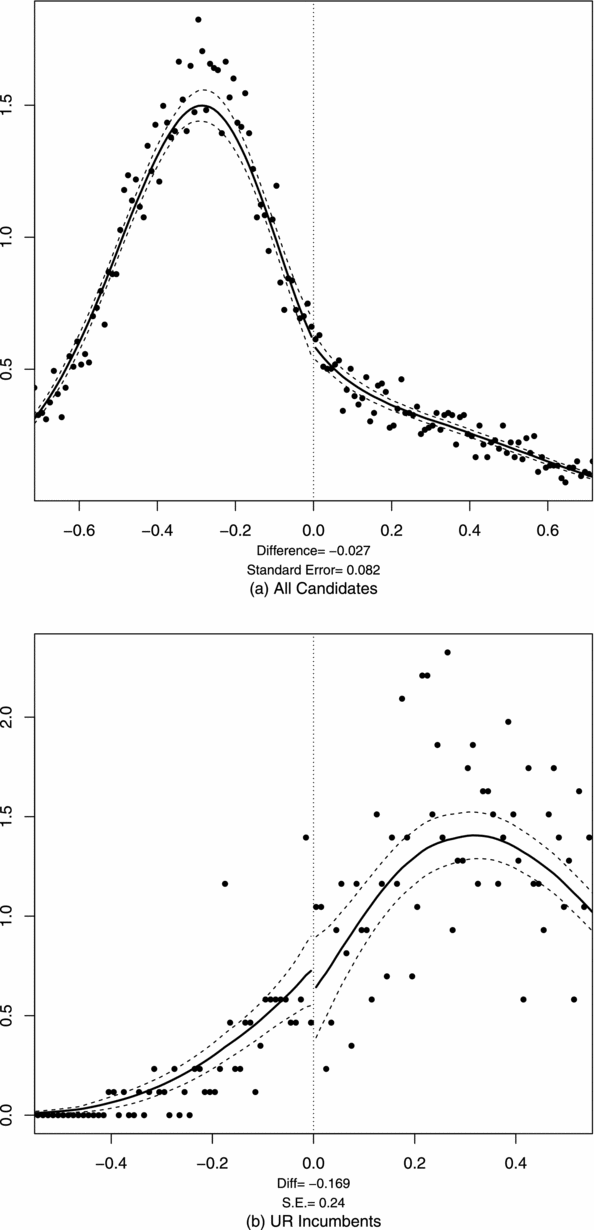
In the case of Russia, the main cleavages around which sorting would most likely occur relate to the incumbent status and party affiliation of candidates. Incumbents from Putin’s UR party may benefit from compatriot election officials and administrative resources to sway close electoral outcomes in their favor. First, I run McCrary (Reference McCrary2008) density tests to formally assess the validity of the assumption of continuity around the threshold. Figure 2 shows the plot of these tests for all candidates in Panel (a) and just UR incumbents in Panel (b). In both cases, the estimated difference is small and the p-value returned is considerably above standard levels of statistical significance. Therefore, we cannot reject the null hypothesis of no sorting around the cutoff point of 0.
McCrary (Reference McCrary2008) Density Tests—Winning Margin

Next, I investigate whether any sorting occurs in both the types of candidates located around the winning threshold as well as the specific firms that these individuals are connected to. For example, recent research has shown that large, state-owned firms are more likely to mobilize their workers to vote during elections in Russia (Frye, Reuter, and Szakonyi Reference Frye, Reuter and Szakonyi2014). Similarly, candidates running on behalf of these firms may be able to marshal company resources to spend on campaigning or influencing officials. To capture the causal effect of winning office, the data must satisfy the assumption that both candidates and the firms they are connected to are similar across a set of baseline covariates.
To assess covariate balance among candidates and firms, I use two specifications: close margin and local linear regressions. The forcing variable in these specifications is again vote margin. I estimate the difference between winners and losers using two sample sizes for the close margin (bandwidths of 2% and 3%) and two sample sizes for the local linear (bandwidths of 5% and 12%).Footnote 17 Robust standard errors are clustered on the candidate and election level.
Figure 3 presents the t-statistics from a two-tailed test of the hypothesis that the difference between the comparison groups (winning versus losing candidates) for each of the 21 covariates is zero. We see little evidence of imbalance between winners and losers and their affiliated firms. In only one of the four specifications run does a t-statistic approach 2 (whether the candidate is a member of a systemic opposition party), the conventional level of statistical significance for rejecting the null hypothesis. Winning candidates are not more likely to run the type of firms most likely to participate in election campaigns nor do they have greater company resources to take advantage of to further their electoral campaigns. The 21 sets of regressions used to generate these t-tests are included in the Appendix.
Balance Statistics

RD RESULTS
First, I present the graphic illustrations of the RD treatment effect in Figure 4. I plot change in logged revenue (Panel A) and profit margin (Panel B) over the period against vote margin in bins of 1%, while limiting the interval of vote margin to elections decided by less than 10% to ease interpretation around the threshold. Each bin contains on average 24.2 observations. The plot includes line fit using a LOESS (locally estimated scatterplot smoothing) regression based on the tricubic kernal using the unbinned data, with the gray area indicating confidence intervals of 95%. The graphs are centered at the discontinuity cutoff point: a vote margin value of zero. The graphs show a positive jump for both revenue and profits around the threshold for winning elections. To calculate the size of this jump more precisely, I turn to regression analysis.
RD—Graphical Illustrations

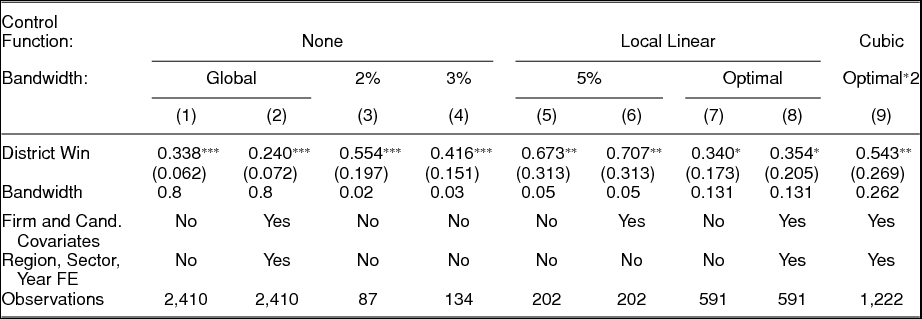
Results from regressions on end-of-term logged revenue on victory in single-member district elections, as indicated by the binary variable District Win, are presented in Table 1. As described above, Columns 1 and 2 present the results from simple OLS on the full sample of firms. The first model indicates that politically connected firms earn higher revenue over the term than firms without connections. Next, I add firm-level (ownership type and logged total assets) and candidate-level controls (age, gender, incumbency, and membership in the United Russia party) as well as year, sector, and region fixed effects. The addition of these predictors reduces the effect of winning office, but the result is still statistically significant. Although we cannot claim that the point estimates from Models 1 and 2 present causal evidence, the correlation between political connections and firm performance is clearly positive in the Russian case.
Political Connections and Firm Revenue

***p<0.01, **p<0.05, *p<0.1 The outcome variable is firm revenue in the final year of the connected candidate’s term in office. Columns 1 and 2 present OLS results using the full dataset. Columns 3 and 4 also use OLS specifications but restrict the bandwidth to close winning vote margins. Columns 5 to 8 are RD specifications using polynomial control functions based on vote margin. Firm and candidate controls include age, gender, incumbency, ruling party membership, state ownership, foreign ownership, and logged total assets in the preelection year. All models use robust standard errors clustered on the candidate and election levels as well as include the preelection value for the outcome.
Moving onto the RD models, we see a consistent, positive, and statistically significant effect of directors winning election on firm revenue. In Columns 3 and 4, the bandwidth is narrowed to 2% and 3%, respectively, without covariates, and the point estimate on District Win indicates that firms connected to winning office enjoy an increase of revenue of between 40% and 55%. Including local-linear and cubic control functions, widening the bandwidth used, and adding the full set of firm and candidate covariates and year, sector, and region fixed effects, return consistently statistically significant point estimates on the treatment variable. In all, the coefficients on District Win from the varied set of RD models range from roughly 30% to 70%, translating into a substantial effect of winning office on revenue. The range of specifications run strongly suggests large revenue advantages for a firm from having its director win elected office.
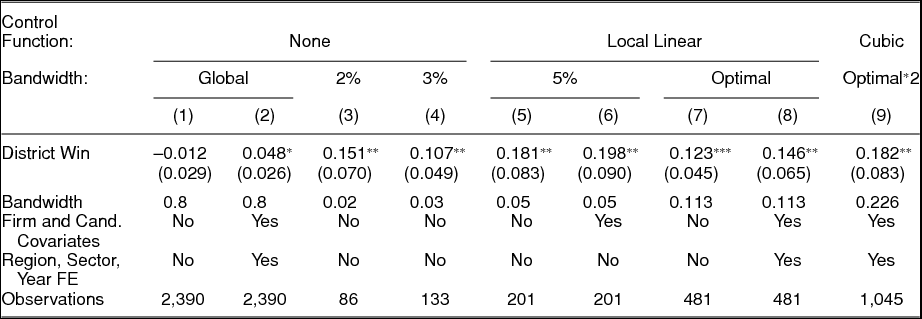
Similar results emerge from the regressions on profit margin shown in Table 2. The order of the model specifications is identical to that from Table 1, except here the outcome variable is profitability. First, the results from the simple OLS models on the full sample indicate that politically connected firms do not see a higher profit margin over their candidates’ term. When controls and fixed effects are added, the result increases but is only significant at the 10% level. Again, given the simple OLS regression, we cannot interpret these correlations as reflecting a causal effect.
Political Connections and Firm Profitability

***p<0.01, **p<0.05, *p<0.1 The outcome variable is firm profitability in the final year of the connected candidate’s term in office. Columns 1 and 2 present OLS results using the full dataset. Columns 3 and 4 also use OLS specifications but restrict the bandwidth to close winning vote margins. Columns 5 to 8 are RD specifications using polynomial control functions based on vote margin. Firm and candidate controls include age, gender, incumbency, ruling party membership, state ownership, foreign ownership, and logged total assets in the preelection year. All models use robust standard errors clustered on the candidate and election levels as well as include the preelection value for the outcome.
However, the RD results on profit margin present more persuasive causal evidence that winning office leads to more profitable firms. The coefficient on District Win is statistically significant across the different model specifications and windows used. Using both the close margin approach and local linear and cubic control functions, as well as varying the bandwidth used and covariates employed returns similar point estimates for the treatment. The difference in profit margin over the term that a winning firm director holds office ranges from 10% to 20%. The presence of a political connection can spell the difference between an impressively profitable firm and one that barely breaks into the black.
In the Appendix, I present several robustness checks. First, the main results on revenue and profitability are robust to subsetting the sample to just candidates that were directors or deputy directors (as opposed to board members) and to candidates that only ran in a single-member district (as opposed to those that ran on the party list as well). Moreover, the RD design used above does not employ a true control group; the firm performance outcomes are compared between “winning” and “losing” firms. Firms that did not have a director run for political office are not analyzed. This leaves open the possibility that the treatment effect is driven not by the benefits of acquiring political ties but by losing firms losing money due to the absence of political representation. To address this, I used Coarsened Exact Matching (CEM) technique to match firms with a director who ran for office with those that chose not to send a representative to participate in this process (Iacus, King, and Porro Reference Iacus, King and Porro2011). Though matching does not generate identification, I find that a substantial portion of the effect of having a political connection on firm performance is from the positive benefits of winning election. Firms losing elections also do better than their competitors down the road, but the revenue and profits they receive are lower.
CAUSAL MECHANISMS
What then is driving the results on increased revenue and profit margins for politically connected firms? I next investigate several channels by which firm directors in office can help their companies. One set of theories argues that political connections help firms by reducing uncertainty among financiers. When markets are underdeveloped, lenders have less information about potential clients and look for other signals of borrowing quality or property rights protection (Richter Reference Richter2010). In a study of firms connected to parliamentarians in China, Truex (Reference Truex2014) finds little evidence of formal policy influence. Instead, investors interpreted membership in the National People’s Congress as a “reputation boost” and lifted their share price. In Russia, signaling legitimacy in the absence of other market mechanisms may be especially important given the role of private banks in lending. A survey of 1,047 Russian firms in 2012 showed that roughly 70% received their most recent loan from a private financial institution.Footnote 18 Having a firm director serve as a legislator may be a powerful tool to secure financing.
Another theory asserts that corporate political activity opens doors to state bureaucrats who hold sway over lucrative public procurement and regulatory treatment. Winning a seat in parliament helps reduce the costs of acquiring information about state contracts and can help companies influence how bureaucrats design and conduct tenders. In the Novgorod Region in 2005, a regional deputy and local firm director openly stated that winning a seat in the regional legislature would help his business achieve a necessary “understanding” with regional officials.Footnote 19 That year his company signed a memorandum of cooperation with the regional executive branch worth 35 million rubles ($1 million). A primary objective for Russian firms has also been to score tax breaks from regional governments (Slinko, Yakovlev, and Zhuravskaya Reference Slinko, Yakovlev and Zhuravskaya2005). Russian regions account for 40% (or $70 billion) of all annual public procurement in the country and assume responsibility for allocating contracts to suppliers. In the Perm Region, a regional deputy and director of a large director of a large silicate panels factory came under investigation for underpaying his tax bill by 31 million rubles ($1 million) in 2003.Footnote 20
Measuring all channels by which political connections operate is impossible. For example, data on subsidies is not available. Codifying influence over the regulatory process would involve drawing generalizations over the key rules affecting each industry across Russia over time, potentially a never-ending enterprise. Therefore, the analysis is limited to performance-improving activities where empirical data are available: taking on additional debt (evidence of signaling to private entities) and then receiving state contracts and paying lower taxes (evidence of achieving access). To measure financial leverage, I calculate a ratio of total liabilities (long-term and short-term liabilities) to total assets using SPARK data. To measure tax bills, I use a ratio of the annual profit tax paid divided by total profit before tax for each firm. Last, I collect data on all state procurement from the Federal Registry of State Contracts.Footnote 21 I code a binary variable to indicate whether firms connected to winning and losing candidates won any state contracts during the full legislative term they sought office in.Footnote 22 As above, the model specifications vary control functions, bandwidths and covariates, as well as include the preelection level of the outcome.
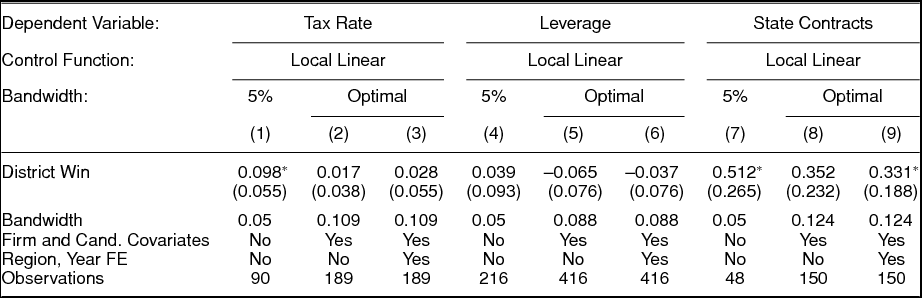
Mechanisms

***p<0.01, **p<0.05, *p<0.1 The outcome variable in Columns 1 to 3 is firm leverage, the outcome variable in Columns 4 to 6 is the tax rate paid to the government, and the outcome variable in Columns 7 to 9 is a binary indicator for whether the firm won any state contracts during its connected candidate’s term in office. In the models analyzing state contracts, firms connected to candidates taking office prior to 2008 are excluded due to a lack of data. All models include a local linear control function and use bandwidths of 5% and the optimal bandwidth (CCT). Controls include age, gender, incumbency, ruling party membership, state ownership, foreign ownership, and logged total assets in the year of the election. All models use robust standard errors clustered on the candidate and election levels as well as include the preelection value for the outcome.
I present results from the set of regressions on tax rates, leverage, and state contracts in Table 3. Judging by the results from Columns 1–3, political connections may drive up the effective tax rate, though the coefficients fluctuate considerably and fall short of conventional levels of statistical significance. Winning elections may increase firms’ public exposure and compel them to follow the letter of the law while their director is in office. More research is needed on how political connections might affect firms’ legal compliance in places where the rule of law is generally weak. Next, political connections are not being used to increase firms’ leverage, as shown in Columns 4–6. The point estimates on District Win do not tell a consistent story across the model specifications. That leaves state contracts, the last mechanism for which data on firms is available. Columns 7–9 in Table 3 present evidence that firms connected to winning candidates indeed enjoy greater opportunities to sign procurement contracts with the government. The estimates from the RD specifications show that winning firms are roughly 30%–50% more likely to win more state contracts than losing firms, amounting to roughly $700,000 in additional revenue from the state. Though the magnitude does not account for the entire increase in revenue as measured in Table 1, it does suggest that one way politically connected firms are able to increase both their revenue and profits is to tap into the largess of public procurement.
HETEROGENEOUS TREATMENT EFFECTS
The value of political connections may also depend on institutional, economic, and convocational factors. First, the strength of democratic institutions may affect the rents businesspeople can extract from government. An underdeveloped civil society makes it harder to hold politicians accountable for their actions by applying pressure through public campaigns (Faccio Reference Faccio2006). Weaker market institutions also make informal access to political power more advantageous, since avenues such as independent courts are unavailable to help protect property rights (Li et al. Reference Li, Meng, Wang and Zhou2008). Where democracy has taken stronger root, politicians may be wary of abusing their public office for personal financial gain, knowing that they might be voted out of office by voters unhappy with their record of providing public goods (Gehlbach, Sonin, and Zhuravskaya Reference Gehlbach, Sonin and Zhuravskaya2010). Where media are less free, politicians face less scrutiny for manipulating legislation to their own advantage.
Alternately, greater political competition might increase the rents elites are able to extract while in office. High levels of competition could empower parliaments to play a more forceful role in regional policymaking. The executive branch no longer can push through its initiatives without resistance and must provide patronage to legislators to win their support. More assertive parliaments attract more attention from businesspeople, since the opportunities to actually wield political influence are greater. Since the early 2000s, the ruling United Russia party has built a formidable monopoly on political power across Russia, winning a majority in 86% of regional legislatures. We might expect firms connected to representatives of the ruling party to fare better than their counterparts from the opposition. But if opposition parties are able to win and control legislative seats, ruling parties must co-opt their members to build coalitions and get laws passed. This internal jockeying for power could result in more spoils being shared with all legislators, such as by providing benefits for connected firms.
Next, the ability of firms to reap benefits from connections may depend on the volume of government revenue that can be diverted. Richer regions, as well as those with natural resources, command larger budgets that may sweeten the pie available to policymakers. These additional funds attract attention from firms through the pork they offer for distribution. In addition, firms that are more vulnerable to regulatory sanction or expropriation may value access to politicians more than companies working in sectors less subject to the whims of local bureaucrats. The harder it is for a firm to redeploy its assets elsewhere (i.e., the level of asset specificity), the easier it is for government officials to engage in opportunistic behavior and extract excessive rents.
Last, the composition of the parliament that businesspeople win entry to may have an effect on their firms’ performance. Legislators use their elected authority to make demands of bureaucrats and draft laws and regulations to benefit their individual firms. But their ability to turn their political power into financial returns for their firms, and their firms alone, requires that other political actors support their initiatives, remain in the dark, or look the other way.Footnote 23 This is especially true with regard to direct economic competitors: When multiple firms from the same sector are represented in the same parliament, each firm’s ability to enact policy to the detriment of its rivals is limited. The more rivals present to monitor and dissent, the less likely that an individual firm is able to dominate policymaking. When economic rivalry spills into legislatures, the potential political dividends to be reaped from holding office are competed away, just as they would when new firms enter the market and place pressure on the profit margins of their competitors.
To examine these mechanisms, I follow the literature by splitting the population of firms into subsets based on the median value of each dimension of theoretical interest. The models use a bandwidth of 5% vote margin and the optimal bandwidth (CCT) for each outcome variable (to retain adequate sample size in each group) and include candidate and firm covariates. To measure institutional quality, I first use the Carnegie Democracy Index which totals five-point expert assessments of ten different measures of democracy for Russia’s regions for a scale of 5 to 50, with higher scores indicative of more liberal democratic institutions.Footnote 24 I also measure the percentage of seats that United Russia controlled in each regional legislature, positing that stronger ruling party control is indicative of less political competition. Regional wealth is measured using gross regional product per capita and a dummy for the presence of natural resources (oil, natural gas, and metals). I code firms with immobile assets as those working in manufacturing, mining, energy/natural resources, construction, or agriculture. Finally, measures of businessperson presence in parliaments come from the analysis dataset. For each firm (winning and losing), I compute the number of other firms from the same sector that have firm directors serving in the regional legislature. I also calculate the percentage of legislative seats held by businesspeople in each convocation.
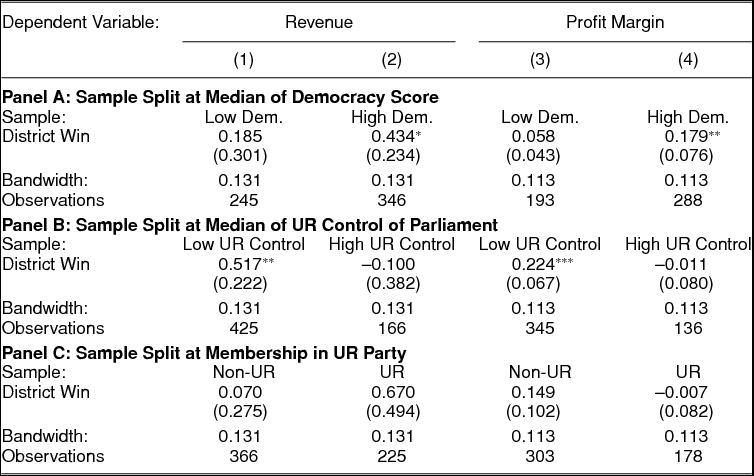
Table 4 presents the results from the regressions using the institutional variables to subset the sample. All models use a local linear control function, candidate and firm covariates, and sector and year fixed effects (Panel C also includes region fixed effects). These results first suggest a slightly positive relationship between the level of democracy (as measured by the Carnegie Index) and firm returns from political connections. In more democratic regions, firms appear to earn larger profit margins (significant at the 90% confidence level) but not necessarily greater revenue. However, in parliaments where the ruling party faces more political rivals (Panel B), connected firms see substantially greater profit margins and revenue. These findings suggest firm directors who can gain entry into legislative institutions marked by greater competition and independence are able to extract more rents from the government. Furthermore, director membership in parties outside of the ruling coalition does not doom the performance of affiliated firms (Panel C). Although opposition candidates can expect smaller growth in revenue, their ability to bring home profits is not diminished compared to those members of the ruling party. If anything, firms whose directors are aligned with the opposition do just as well as their counterparts in United Russia; the differences between the coefficients are not statistically significant. Rents are accruing to both ruling party and opposition members, the latter finding aligning with recent work by Reuter and Robertson (Reference Reuter and Robertson2015). The ruling party sometimes grants rent-seeking opportunities to potential challengers to ensure loyalty and prevent social unrest.
Institutional Heterogeneity

***p<0.01, **p<0.05, *p<0.1 This table displays heterogenous RD treatment effects of winning office using the optimal bandwidth (CCT) and a local-linear control function. Panel A subsets on the median democracy score in the region. Panel B subsets on the median number of legislative seats the ruling party controlled. Panel C subsets on whether a candidate was a member of the ruling party. All models include firm-level and candidate-level covariates, use robust standard errors clustered on the candidate and election levels, and include the preelection value for the outcome.
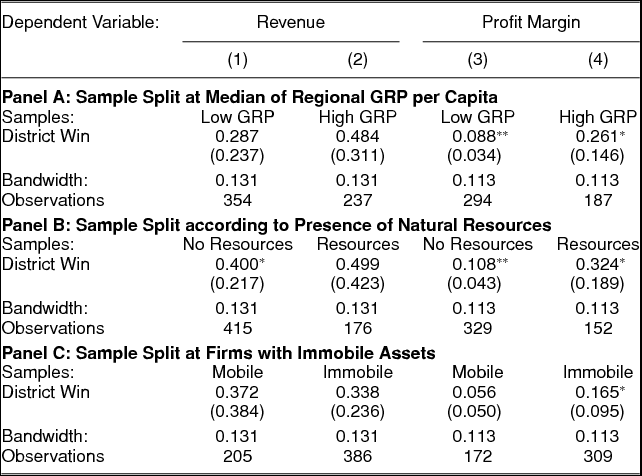
Next, in Table 5, political connected firms may derive slightly greater revenue and profits in wealthier regions, especially where natural resources are fueling economic growth, but the evidence is not definitive. The point estimates regarding profitability are significant at the 85% level. Controlling for individual firm sector, size, and ownership, firms in economically developed and resource-rich regions make several times greater profits. Firms with immobile assets also may see increases in their profit margins are larger over the term, but the differences in the point estimates are not significant at conventional levels. Political access may be helping drive down the costs of business for these firms. Previous outlays on regulation or dealing with bureaucratic arbitrariness are no longer necessary if political ties can help smooth over relations with officials.
Economic Heterogeneity

***p<0.01, **p<0.05, *p<0.1 This table displays heterogenous RD treatment effects of winning office using the optimal bandwidth (CCT) and a local-linear control function. Panel A subsets on gross regional product per capita. Panel B subsets on whether the region possessed natural resources. Panel C subsets on whether a firm has immobile assets. All models include firm-level and candidate-level covariates, use robust standard errors clustered on the candidate and election levels, and include the preelection value for the outcome.
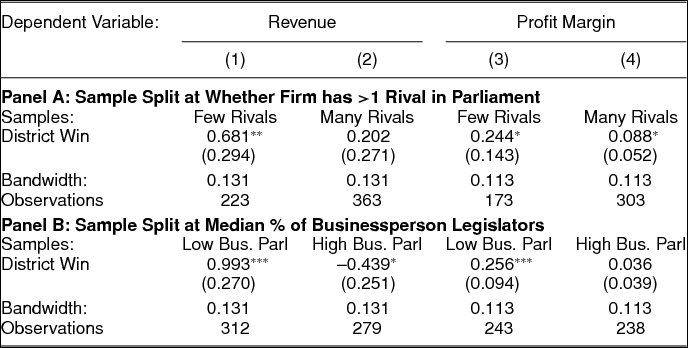
On the other hand, competition between rent-seekers diminishes the return on running for office. As shown in Table 6, connected firms earn both greater revenue and larger profit margins when fewer of the rival firms also get their candidate into office. The return on winning elected office actually disappears completely as more and more firms from the same sector all win seats in a legislature (see the Appendix). The more firm directors overall that become politicians, the smaller the payoff for their affiliated firms. The marketplace for rents that emerges within parliament offers reduced profit margins for participants. Businessperson politicians can serve as a check on each other in office, preventing the passing of policies that would advantage specific firms.
Convocational Heterogeneity

***p<0.01, **p<0.05, *p<0.1 This table displays heterogenous RD treatment effects of winning office using the optimal bandwidth (CCT) and a local-linear control function. Panel A subsets on whether a connected firm had one or fewer sectoral rivals connected to a legislator in the parliament. Panel B subsets on the median number of seats held by businessperson candidates in parliament. All models include firm-level and candidate-level covariates, use robust standard errors clustered on the candidate and election levels, and include the preelection value for the outcome.
This result suggests that improving and expanding the representation of economic interests in political institutions could reduce rent-seeking and the distortion of political benefits to connected firms. Clearly, just encouraging more businesspeople to run for office carries its own sense of problems, as legislatures cannot be expanded indefinitely and other groups in society would suffer from being deprived of their own descriptive representation. Instead, combatting rent-seeking by businessperson politicians requires that competing firms have the means and opportunities to monitor actions that only benefit individual firms. Institutional design matters most. Ensuring free elections may be less important than creating more access points to institutions, holding open hearings and committee meetings, and reducing the barriers to entry to lobbying, such as the high costs and often times lack of a clear legal framework. As institutions become more transparent and inclusive of interest groups, the probability falls that one particular entity can dominate policymaking to its own advantage.
DISCUSSION AND CONCLUDING REMARKS
To summarize, using an RD design to estimate the causal effect of having an affiliated person win office, I find that politically connected firms see an increase in revenue of approximately 60% and enjoy increased profit margins of roughly 15%. Such evidence suggests powerful incentives for firms to send directors into elected office. Because winning elections differs from making campaign contributions or lobbying, benchmarking across these strategies is difficult. Cingano and Pinotti (Reference Cingano and Pinotti2013) show that firms in Italy that employ at least one official at the local level can see increases of roughly 6% in revenue and profitability. Amore and Bennedsen (Reference Amore and Bennedsen2013) report that companies with family ties to politicians can increase their profits by 100% in “lowly corrupt” Denmark, similarly to work on Thailand showing abnormal returns for connected companies of upwards of 200% (Bunkanwanicha and Wiwattanakantang Reference Bunkanwanicha and Wiwattanakantang2009).
In Russia, gaining direct access to regional legislatures can make the difference between profitable and unprofitable firms. I demonstrate that the benefits of connections derive from lowered informational and regulatory costs for firms in their dealings with bureaucrats and not from greater access to finance. Interviews with businesspeople deputies attest to this: Companies whose directors lost electoral campaigns were vulnerable to harassment from officials and the loss of market share.Footnote 25 Furthermore, deputies noted that corrupt state officials only wanted to work with people they already knew from being in office; a lost election meant a closed door to key policymakers and regulators.Footnote 26
The finding that connected firms draw greater revenue and profits in more democratic regions contributes to our understanding of how the value of political connections is shaped by political institutions (Faccio Reference Faccio2006). Gehlbach, Sonin, and Zhuravskaya (Reference Gehlbach, Sonin and Zhuravskaya2010) argue that rent-seeking businesspeople should be less likely to seek elected office when institutions are more democratic, since they fear being voted out by the median voter. This article alternately uncovers that businesspeople value more politically competitive parliaments that are able to pass more encompassing legislation and allow more voices to be heard (Pyle Reference Pyle2009; Govorun, Marques, and Pyle Reference Govorun, Marques and Pyle2016). When parliaments are weak, businesspeople prefer to lobby the executive branch. When parliaments can exert influence on regulations and budgets, businesspeople instead view them as most attractive, and prefer to occupy legislative seats themselves. Parliaments become forums in which business demands are negotiated and private favors exchanged, with rents accrued to the special interests represented. Firms and other groups left outside these networks lose their ability to influence policy.
The results from the article have policy implications with regard to reducing corruption and strengthening representation. First, the findings may be generalizable to other settings, including countries considered more democratic than Russia. Roughly 10%–15% of the parliaments studied in this article are located in regions classified as electorally democratic as the Philippines (Saikkonen Reference Saikkonen2015). Businesspeople run for political office in countries worldwide, no matter the institutional environment, while policies banning them from doing so are not widespread.Footnote 27 Strengthening democratic institutions without paying due attention to the elites that inhabit them will not curb the problem of firms abusing access to political power.
One obvious solution is to restrict the time politicians can devote to outside activities and force them to disclose the firm affiliations they and their relatives possess. Incompatibility and ineligibility rules reduce the attractiveness for public servants to seek public office (Braendle and Stutzer Reference Braendle and Stutzer2016), while cross-sectional evidence from the U.S. suggests that disclosure rules discourage businesspeople from running for state legislatures (Rosenson Reference Rosenson2006). Mandating separation between winning candidates and their connected firms may be a powerful tool to reduce rents misappropriated from public coffers, but more evidence is needed to test whether such institutions could work as intended. Last, as competition for rents intensifies, businesspeople appear to view running for office as a less lucrative corporate political strategy. Policies that prevent oligopolies from dominating industry and encourage the more equal representation of economic interests could return the focus of businesspeople to their companies, while leaving politics to the politicians.
SUPPLEMENTARY MATERIAL
To view supplementary material for this article, please visit https://doi.org/10.1017/S0003055417000600.
Replication materials can be found https://doi.org/10.7910/DVN/DO43V5.








Comments
No Comments have been published for this article.