Introduction
How do changes in faith and occupational type affect fertility? The nature of both religious belief and work is changing over time. In many Western nations, religiosity has been decreasing, although religion continues to play an important role in terms of affecting childbearing outcomes (Goujon et al., Reference Goujon, Skirbekk, Fliegenschnee and Strzelecki2007; Berghammer, Reference Berghammer2012a; PEW, 2012). At the same time, the average job task composition is shifting from routine to more cognitively demanding tasks that require higher education and greater commitment (Murnane et al., Reference Murnane, Willett and Levy1995; Manning, Reference Manning2004; Gordo & Skirbekk, Reference Gordo and Skirbekk2013). Both declining religious affiliation and job demand shifts have been more pronounced among the more educated, a group that also tends to have fewer children and a greater risk of remaining childless (Skirbekk, Reference Skirbekk2008; Choe & Retherford, Reference Choe and Retherford2009; Fieder et al., Reference Fieder, Huber and Bookstein2011). Academic scientists tend to have very low fertility – but the independent influence of education and religion is not yet known (Kemkes-Grottenthaler, Reference Kemkes-Grottenthaler2003; Fieder et al., Reference Fieder, Huber, Bookstein, Iber, Schäfer, Winckler and Wallner2005; Skoog Svanberg et al., Reference Skoog Svanberg, Lampic, Karlström and Tydén2006; Lind, Reference Lind2008). The current study sought to assess the fertility intentions and behaviour of female research scientists, focusing on variation in intended and actual childlessness using Austria as an example. A special sample was collected in Austria, a country with a relatively well-educated workforce, a significant level of secularization and relatively low fertility.
Austria is among the countries where higher education is coupled with high childlessness and relatively low levels of completed fertility. Recently, the issue of fertility differentials by education has received growing attention (Spielauer, Reference Spielauer2005; Sobotka, Reference Sobotka2009). The share of women in Germany, Switzerland and Austria with tertiary education remaining childless at the end of their reproductive period is about twice as high as that of childless women in the population at large for the cohorts born between 1920 and 1960 (Sobotka, Reference Sobotka2011). In this paper the focus is on a specific group of women with tertiary education, namely female researcher scientists working at universities and public or private research institutes. Previous studies have estimated childlessness among female researchers and professors in Austria born between 1940 and 1970 at around 45% (Buchholz, Reference Buchholz2004; Fieder et al., Reference Fieder, Huber, Bookstein, Iber, Schäfer, Winckler and Wallner2005). In other words, childlessness is about three times higher among female researchers than among the population at large.
In order to better understand the fertility behaviour of female researchers, this study analysed intended childlessness and compared this specific group with tertiary and less educated women. In doing so, the following questions were addressed: Is intended childlessness related to religion? Is religion a mediator for childlessness? What are the roles of religious affiliation and level of religiosity? While several studies have already dealt with the fertility of female researchers (for Austria: Buchholz, Reference Buchholz2004; Fieder et al., Reference Fieder, Huber, Bookstein, Iber, Schäfer, Winckler and Wallner2005), the role of religion has not yet been addressed in terms of explaining the link between childlessness among female researchers.
Whereas research on fertility and family behaviour of women in academia has a long tradition in the US (e.g. Hamovitch & Morgenstern, Reference Hamovitch and Morgenstern1977; Hargens et al., Reference Hargens, McCann and Reskin1978; Wasserman, Reference Wasserman2002), it has only really gained attention in Europe in the last decade (Kemkes-Grottenthaler, Reference Kemkes-Grottenthaler2003; Fieder et al., Reference Fieder, Huber, Bookstein, Iber, Schäfer, Winckler and Wallner2005; Skoog Svanberg et al., Reference Skoog Svanberg, Lampic, Karlström and Tydén2006; Lind, Reference Lind2008). Moreover, the religious orientation of scientists has been studied in the US (Vaughan et al., Reference Vaughan, Smith and Gideon1966; Ecklund & Scheitle, Reference Ecklund and Scheitle2007), but less is known in the European context about the link between the fertility and religiosity of this specific group of highly educated persons.
Education may affect preferences and gender roles; it changes the opportunity costs of childbearing (increasing the amount of income and consumption one must give up in the course of childbearing), changes childbearing to later ages, with a greater degree of rationale and fewer unplanned births, and increases contraceptive knowledge and contraceptive use (Goldin & Katz, Reference Goldin and Katz2002; Van Bavel, Reference Van Bavel2006). Further, as most women do not have children during their schooling years, a later graduation age leads to a shorter post-graduation reproductive period. A study based on a ‘natural experiment’ approach (to overcome selectivity bias from education) found that women who exit a given school degree at an older age, all else being equal, initiate family formation at older ages (Skirbekk et al., Reference Skirbekk, Kohler and Prskawetz2004).
Austria’s family-policy regime is classified as ‘conservative’, with limited childcare facilities for 0- to 3-year-old children (Gauthier, Reference Gauthier2002). The majority of parents choose the ‘male breadwinner’ model, where the women stay at home (or work part-time), including highly educated couples (Berghammer, Reference Berghammer2014). Parental leave is available to all mothers, irrespective of their labour force participation prior to childbirth. The longest leave programme of 30 months (+6 for fathers) remains by far the most popular option (Rille-Pfeiffer & Kapella, Reference Rille-Pfeiffer and Kapella2012). Poor availability of full-day early childcare constitutes a barrier to combining motherhood and (full-time) employment and may be an important determinant of low fertility among highly educated women.
Religion has been found to be an important factor in union and fertility behaviour in Europe (Philipov & Berghammer, Reference Philipov and Berghammer2007; Frejka & Westoff, Reference Frejka and Westoff2008). In most European countries, the religiously affiliated have higher fertility ideals, higher odds of intending to have another child and a higher number of expected children than non-affiliated persons (Philipov & Berghammer, Reference Philipov and Berghammer2007). According to the 2001 census, the religious composition of Austria was as follows: 74% were Roman Catholic, 5% Protestants, 4% Muslims, 4% belonged to other religions, 12% were without religion and for 2% religious affiliation was unknown (Goujon et al., Reference Goujon, Skirbekk, Fliegenschnee and Strzelecki2007). More recent census data on the religious composition of the population are not available, as the 2011 census was based on register data that did not include information on religious affiliation. Differences in fertility behaviour (childlessness, number of children) and labour market participation have been documented for Austria, like high childlessness among women without religious affiliation and high fertility levels among migrants with lower education, particularly among Muslims (Fassmann & Reeger, Reference Fassmann and Reeger2007; Prskawetz et al., Reference Prskawetz, Sobotka, Buber, Engelhardt and Gisser2008). Moreover, religiosity plays a role in family life trajectories. Religious people are more likely to directly marry and less often report non-marital childbearing, sequential cohabitation or divorce (Berghammer, Reference Berghammer2012b).
A large literature has explained the relevance of religion on fertility, showing greater fertility among the more religious in a number of different societies and settings (Goujon et al., Reference Goujon, Skirbekk, Fliegenschnee and Strzelecki2007; Skirbekk et al., Reference Skirbekk, Kaufmann and Goujon2010; Kaufmann et al., Reference Kaufmann, Goujon and Skirbekk2012). Unlike for education, where the consequences of childbearing are indirect, there are explicit statements on family formation in Austria’s dominant religion, Christianity. One example is Genesis 1:28: ‘And God blessed them, and God said unto them, Be fruitful and multiply’. Furthermore, Abrahamic faiths tend to be pro-marriage, for family stability and support of children, and against divorce and family dissolution. In the Catholic Church, the marriage between a man and a woman is considered a sacred, unbreakable union, originally coming from God. Further, religious ceremonies, teachings and religious activities tend to celebrate and endorse family formation and fertility (Lehrer, Reference Lehrer1996; McQuillan, Reference McQuillan2004; Goujon et al., Reference Goujon, Skirbekk, Fliegenschnee and Strzelecki2007). A positive relationship between religiosity and completed fertility has been found in a number of countries (Berghammer, Reference Berghammer2012a; Hubert, Reference Hubert2014).
Level of education is a major determinant of the number of children a woman has. Austria is characterized by moderately low fertility, high levels of childlessness and large educational differences in childbearing behaviour (Spielauer, Reference Spielauer2005; Sobotka, Reference Sobotka2011). In the cohorts born in 1955–1960, women with basic education have on average 2 children, while those with tertiary education have 1.4 children. Childlessness at the end of the reproductive period increases with the level of education, ranging from 14% among women who completed at most lower secondary or basic education to 30% among tertiary educated women (Sobotka, Reference Sobotka2011). Childlessness levels of female researchers in Austria exceed those of tertiary educated women by a large margin, with estimates ranging between 41 and 50% (Buchholz, Reference Buchholz2004; Fieder et al., Reference Fieder, Huber, Bookstein, Iber, Schäfer, Winckler and Wallner2005; Buber et al., Reference Buber, Berghammer and Prskawetz2011). Childlessness among female German researchers and professors is even higher, ranging between 50 and 60% (Krimmer et al., Reference Krimmer, Stallmann, Behr and Zimmer2004; Auferkorte-Michaelis et al., Reference Auferkorte-Michaelis, Metz-Göckel, Wergen and Klein2006; Metz-Göckel, Reference Metz-Göckel2009). A comparative analysis revealed that the elevated levels of childlessness in Germany and Austria are in contrast to much lower levels of childlessness among female professors in other countries, which are around 25% in Poland, close to 20% in Sweden and about 10% in France and Spain (Lind, Reference Lind2008).
There is a need to study more data on childlessness among research scientists in low-fertility settings, as growing shares of the population enter these type of professions. There is also a clear need to better understand the drivers of low fertility in this group. One study of the religious lives of scientific professionals revealed generally lower levels of religiosity among scientists than the population at large (Ecklund, Reference Ecklund2010). Apart from demographic factors such as age, marital status and the presence of children in the household, religiosity in the home as a child turned out to be the most important predictor of present religiosity among scientists in US research universities (Ecklund & Scheitle, Reference Ecklund and Scheitle2007).
Methods
The analysis was based on a sample of female researchers and on nationally representative data for Austria, both collected in the framework of the Generations and Gender Survey (GGS) in 2008/09. Respondents with missing information on religious affiliation, religiosity and fertility intentions were excluded. As the interviewed female researchers were aged 25–45 years, this age range was a selection criterion for GGS respondents too. Three groups were distinguished: female researchers (N=186), tertiary educated women (N=350) and women with secondary or lower education (N=2084).
Most studies on the fertility of women in science tend to be based on small surveys (Romanin & Over, Reference Romanin and Over1993; Kemkes-Grottenthaler, Reference Kemkes-Grottenthaler2003; van Anders, Reference van Anders2004; O’Laughlin & Bischoff, Reference O’Laughlin and Bischoff2005), often with low response rates (van Anders, Reference van Anders2004; Lind, Reference Lind2010; see also Buber, Reference Buber2010). The current study contacted, with support from the Austrian Academy of Sciences, all women up to the age of 45 who had applied for a research grant (cohorts 1963–84). The response rate was 22%, with a sample size of N=247 (see Buber, Reference Buber2010). The survey asked questions on religious affiliation, church attendance, self-assessed religiosity, religious socialization in the parental home and attitudes towards religious ceremonies. The wording of the questions was: (1) Which religious denomination do you adhere to, if any? Possible answers were: Roman Catholic, Protestant, Orthodox, other Christian, Muslim, Jewish, Buddhist, Hindu, other religions, none. (2) How often, if at all, do you attend religious services (apart from weddings, funerals, baptisms, and the like)? Answers were coded number of times per week/month/year or never. (3) Apart from the fact of belonging to a religious community or not, how religious do you consider yourself? Please answer using a scale, where 0 indicates ‘not at all religious’ and 10 ‘very religious’. (4) How strongly do you agree with the following statement: When I was 15 years old, issues linked with religion and the church were considered to be very important in our home? Possible answers were: strongly agree, agree, neither agree nor disagree, disagree, strongly disagree, not applicable. Attitudes towards religious ceremonies were captured via agreement and disagreement towards these: (5a) It is important for an infant to be registered in the appropriate religious ceremony; (5b) It is important for people who marry in registry offices to have a religious wedding too; (5c) It is important for a funeral to include a religious ceremony.
Data included information on the actual number of children and on future fertility intentions. As interviewed female researchers were aged 25–45 years, many of them would not have completed their fertility and planned to have (further) children. Therefore, apart from the actual number of children, the focus was on fertility intentions. (Additionally) intended children were captured via: (1) Do you want to have a child now? (2) Do you intend to have a/another child during the next three years? and (3) Supposing you do not have a/another child during the next three years, do you intend to have any (more) children at all? The combination of actual fertility, current pregnancies and future fertility intentions allowed mothers, childless women who intended to have a child in the future and childless women who did not intend to have their own children to be distinguished between. Subsequently a dichotomous variable was generated for intended childlessness, distinguishing between ‘having children or wanting own children’ on the one hand and ‘being childless and intending no own children’ on the other hand.
The study provided descriptive results on various aspects of religiosity and family plans and probit regressions for intended childlessness (using the dichotomous variable described above) and actual childlessness. Explanatory variables for these multivariate analyses were education (non-tertiary, tertiary, researcher), religion (affiliation, no affiliation), self-assessed religiosity (ranging from 0 to 10), age (25–29, 30–34, 35–39, 40–45 years) and partner status (no partner, cohabiting partner, living apart together (LAT)).
Results
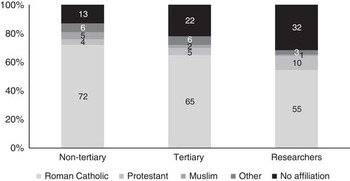
The descriptive results for religious affiliation, self-assessed religiosity and childlessness among the three distinguished educational groups are provided. The majority of Austrian women aged 25–45 years belonged to the Roman Catholic Church. Protestants, Orthodox and other religious communities were a minority in the sample, whereas those without affiliation constituted the second largest group (Fig. 1). The religious composition of the sample was in line with results from the Austrian 2001 census (Goujon et al., Reference Goujon, Skirbekk, Fliegenschnee and Strzelecki2007). The differences for religious affiliation between educational groups were large: whereas roughly three out of four secondary or less educated women belonged to the Roman Catholic Church the share decreased to two-thirds among the tertiary educated and 55% among female researchers. Having no affiliation was less common among less educated women (13%), more frequent among tertiary educated women (22%) and substantially prevalent among female researchers (32%). The Muslim faith was as frequent as Protestantism among the less educated (5%), but rare among tertiary educated women and researchers. The remaining religious communities comprised a small group (3–6%).
Religious affiliation by educational group.

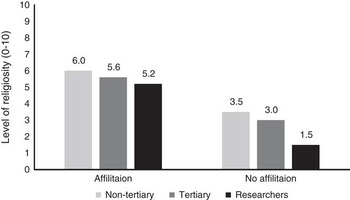
The mean level of self-assessed religiosity decreased slightly with increasing level of education (non-tertiary: 6.0; tertiary: 5.6; researchers: 5.2) (Fig. 2). Moreover, it turned out that non-affiliated persons reported to be religious, too, although at a lower level (non-tertiary: 3.5; tertiary: 3.0; researchers: 1.5), indicating that not being affiliated to a religious group is not identical to not being religious. In-depth interviews revealed that religion is relevant for not-affiliated persons, too, in troubled times (e.g. at the death of a relative or friend) (Krivanek, Reference Krivanek2013). Thus it is not surprising that some non-affiliated persons reported being religious (Fig. 2). But among the non-affiliated, female researchers were different from less educated or tertiary educated women, as they reported very low mean level of religiosity.
Self-assessed religiosity by level of education.

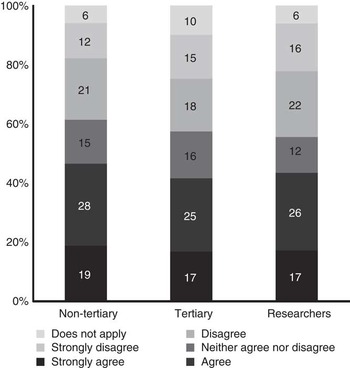
The importance of religion at the time they grew up was very similar in the three educational groups (Fig. 3). As compared with tertiary educated women and female researchers, women with secondary or lower education slightly more often (strongly) agreed that when they were 15 years old, issues linked with religion and the church were considered to be very important in their parental home. But the overall distribution was about the same: (strong) agreement was 43%, 42% and 47% for researchers, tertiary educated and secondary or lower educated women, respectively (Fig. 3). Thus, regarding religiosity, the initial situation in childhood and youth was almost the same for today’s female researchers, and tertiary and less educated women in Austria.
Importance of religion in the parental home.

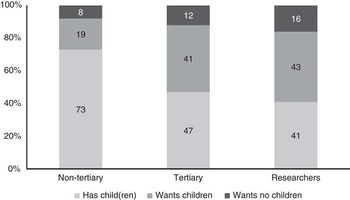
As expected, actual fertility varied substantially by educational group. With increasing level of educational attainment, the share of women aged 25–45 who had experienced motherhood decreased and the proportion of women with future family plans increased, indicating postponement of fertility by highly educated women (Fig. 4). The proportion of women wanting no children of their own increased with rising educational level from 8% (non-tertiary education), to 12% (tertiary education) and to 16% (researchers).
Having children and wanting children of own by educational group.

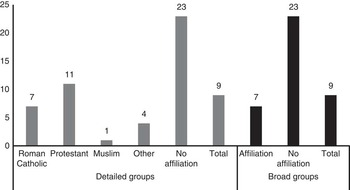
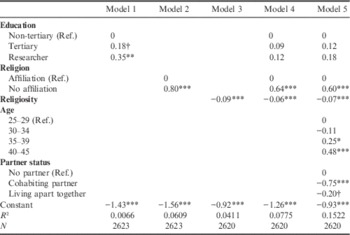
The intention to have no children of their own varied substantially by religion and was most pronounced among women without religious affiliation (Fig. 5): among the women without religious affiliation, about one in four preferred to be childless. The proportions were much lower for women belonging to a religious group (Roman Catholic: 7%; Protestant: 11%; Muslim: 1%; other religion: 4%). Across all religions, intended childlessness amounted to 7%, as opposed to 23% without religious affiliation (Fig. 5: broad groups). In a second step, multivariate probit regressions were used to find out which factors were important for family plans. Positive coefficients imply a higher risk of intended childlessness, and negative coefficients indicate a lower risk. When taking into account education, religious affiliation and self-assessed religiosity as single predictors, the estimated coefficients revealed statistically significant associations (Table 1; Models 1, 2 and 3). Compared with secondary or less educated women, researchers significantly more often opted for childlessness (Model 1). Further differentiation for researchers by discipline revealed that especially women in natural sciences more often preferred to be childless, as opposed to those in social sciences and humanities. University graduates also tended towards higher levels of childlessness as compared with non-tertiary educated women, although the estimated coefficient was smaller in size and lower in statistical significance level (Model 1). Women not belonging to a religious group significantly more often intended to have no children of their own than women with a religious affiliation, the estimated coefficient being large in size and highly significant (Model 2). Self-assessed religiosity was negatively linked with intended childlessness, indicating that the higher the level of religiosity, the lower the intention to be and remain childless (Model 3).
Wanting no children of own by religion.

Estimated coefficients for intended childlessness, probit regression, Austrian women aged 25–45, 2008/09

Ref., reference category.
†p<0.10; *p<0.05; **p<0.01; ***p<0.001.
When taking into consideration both educational groups and religious aspects, education lost explanatory power and was no longer significantly associated with intended childlessness (Model 4). It no longer held that female researchers more often intended to be childless than secondary or less educated women. The estimated coefficient for level of religiosity decreased but remained statistically significant, showing that both affiliation and religiosity contribute to explaining intended childlessness. The final model additionally controlled for age and partner status (Model 5). As expected, when living in a partnership, the risk of wanting no children of their own was significantly lower as compared with having no partner. Not only cohabiting with a partner (either married or unmarried), but also reporting a ‘living apart together’ partnership decreased the risk for intended childless. Age was important too. The large and significant coefficient for the age group 40–45 years showed that especially childless women aged 40 years and above frequently intended to remain childless.
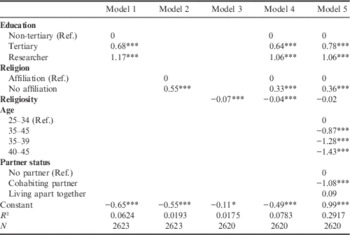
In the multivariate model on actual childlessness, education remained significant(Table 2). Thus, female researchers, but also tertiary educated women, were substantially more often childless as compared with their less educated peers. These results are in line with findings on fertility differentials in Austria (Buchholz, Reference Buchholz2004; Fieder et al., Reference Fieder, Huber, Bookstein, Iber, Schäfer, Winckler and Wallner2005; Sobotka, Reference Sobotka2011). The stepwise introduction of covariates indicated that the difference between female researchers and the overall group of tertiary educated women was substantial, but decreased when controlling for religion and further decreased when controlling for age and partner status. Taking tertiary educated women as the reference group, the estimated coefficient for researchers decreased from 0.49 in Model 1, to 0.42 in Model 4 and to 0.26 in Model 5. Thus, part of the difference in actual childlessness between female researchers on the one hand and tertiary educated women on the other was explained by religious affiliation, religiosity and socio-demographic characteristics. According to the estimated coefficients, age was the most important determinant of actual fertility behaviour, followed by education and partner status. Religion has significant explanatory power for transition to motherhood, although the estimated coefficient was smaller compared with education and age.
Discussion
This study analysed childlessness and fertility preferences among those who were less religious or better educated in Austria. Both high education and low religiosity were found to be strongly negatively associated with fertility. It was found that religion had a stronger influence than education in terms of intended childlessness.
The findings highlight the importance of studying religion as a pathway to family formation. The effects of education on intended childlessness disappeared once religion was controlled for, suggesting that only religion has an independent effect. That implies that low religiosity may be a key reason why certain groups, such as scientists, display very low fertility. The current study contributes to the knowledge on why female researchers have relatively few children. Apart from investigations in the US, little is known about their religious affiliation in the European context and the link between religiosity and family formation.
Working conditions and obstacles to combining family and scientific work have been given as the main explanation for low fertility among (female) researchers. The types of positions that are offered to new researchers generally have poor conditions, including low pay, long hours, high risks and low job security (Whittington, Reference Whittington2011). Such conditions do not favour family formation. There is evidence that having a child negatively affects research productivity for women but not for men (Hunter & Leahey, Reference Hunter and Leahey2010). Deviation from a linear progression in terms of publications and scientific output due to childbearing can have a negative impact on professional goals such as promotion and tenure (Armenti, Reference Armenti2004). While there is some evidence that the gender gap in academia is in part due to a generational effect, recent analyses of academic promotion continue to reveal ongoing discrimination (see Monroe et al., Reference Monroe, Ozyurt, Wrigley and Alexander2008, for an overview). Many of those women who find success throughout their doctoral degrees and land a position at a research institution are then confronted with the ‘maternal wall’ – an institutional bias against women who take advantage of maternity leave and other amenities (Williams, Reference Williams2004).
Religion can be an important driver of human behaviour, in particular with respect to family decisions. Intended childlessness is therefore likely to be related to religion, and thus religion is a mediator for childlessness. Religious affiliation and level of religiosity are important ‘soft factors’ explaining differentials in fertility in modern secularized societies. In the current paper the focus is on intended childlessness.
Previous research has shown that intentions are often not stable but can change over the life course (Quesnel-Vallée & Morgan, Reference Quesnel-Vallée and Morgan2003; Liefbroer, Reference Liefbroer2009). It might be – especially at late reproductive ages – that some childless women prefer to remain childless although they intended to have a family earlier. Problems with conceiving a child, a partner who does not want to have children (any more), absence of a stable partnership or problems with reconciling work and family might be reasons for changing family plans (Sobotka, Reference Sobotka2010).
Being childless towards the end of the reproductive period could imply that a woman who previously wanted to have her own children alters her fertility preferences to accommodate the fact that she is approaching the biological maximum age for childbearing and may be less able to become a mother. In effect, higher levels of preferred childlessness could represent in part a coping strategy in order to avoid a gap between actual and preferred childlessness, as such a gap can cause emotional stress (Coombs, Reference Coombs1979; Lee, Reference Lee1980; Ajzen, Reference Ajzen1991; Nauck & Klaus, Reference Nauck and Klaus2007). For non-religious or less religious women this sort of coping strategy might be psychologically easier and therefore more frequent than for religious women. For the latter, motherhood may have a much more important meaning, so they may not declare being voluntary childless so frequently.
The sample of female researchers has some limitations, as it only included a small number of researchers and it was not a random sample. A larger sample size could have allowed the investigation of further determinants of childbearing preferences and behaviours (e.g. possible differences by disciplines). There might be potential bias through only selecting researchers who applied for a grant, as opposed to researchers more generally. On the one hand, career-oriented researchers might be more likely to apply for a grant and therefore be included in the sample. On the other hand, a successful grant application constitutes important financial support and enables women to combine pregnancy, motherhood and work in a very flexible way. Unfortunately, the available information did not allow for these potential biases to be controlled. Nevertheless, the sample was a unique data source offering insights into the religiosity and family formation of female researchers in a low-fertility European country.
The study also contributes to our understanding of what may determine fertility in a modern context with increasingly higher levels of education, a competitive career environment, often short-term contracts with low security and a highly time-demanding job. Although female researchers may be more likely to remain childless, being religious has a significant strong positive effect on entering maternity. Religion may, through socialization effects and pro-natalism in religious scripture, traditions and religious events, cause many women to want to have a child. Religious female scientists may want to potentially ‘give up more’ in terms of career, independence and scientific recognition, in order to establish a family.
This study suggests that the pronatal effects of religion persist even in a highly educated, low-fertility stratum of a modern, developed society. This finding could become increasingly relevant for foreseeing future fertility trajectories in countries around the world where childbearing levels are low. The type of work conditions that many researchers in knowledge-based industries have could become more common following ongoing changes in the labour market and society. This refers both to the continuing increase in education levels and shift towards cognitively demanding work (Gordo & Skirbekk, Reference Gordo and Skirbekk2013), the high levels of non-tenured, fixed-term contract positions, high levels of competition, great uncertainty in career prospects as well as often high levels of stress and work demands. Yet, these findings suggest that religious differences could play a large role in determining fertility outcomes in such settings.
Estimated coefficients for actual childlessness, probit regression, Austrian women aged 25–45, 2008/09

Ref., reference category.
*p<0.05; **p<0.01; ***p<0.001.
Acknowledgments
Data collection among researchers was financed by the Austrian Academy of Sciences. The Austrian GGS was financed by the Federal Ministry of Economy, Family and Youth, the Federal Ministry of Science and Research and the Federal Ministry of Labour, Social Affairs and Consumer Protection. The authors are grateful to Barbara Haberl, Birgit Distler and Petra Schmutz for valuable support in collecting the data on female researchers and thank Matthew Cantele for proof-reading the manuscript. The authors thank the anonymous reviewers for their valuable comments on the manuscript. They also acknowledge support from ERC-2009-StG 241003-COHORT.