Early modern Ottoman writers who commented on monuments of the Greco-Roman past commonly confronted them not directly but at one remove, since many pagan buildings had already enjoyed a long life as Christian make-overs. The Christians whose lands the Ottomans inherited had done the gradual work of absorption, rejection and adaptation of the pagan material past by the time of the Islamic conquest. This is true for seventh-century Syria and Palestine, and also for fourteenth- and fifteenth-century Anatolia and the Balkans. The ‘Ottomanization’ and ‘Islamization’ of cities and monuments was a many-phased process.Footnote 2
While it remains true that by the fifteenth century many pagan monuments bore the patina of long Christian use, close study of individual writers and local rulers in recent scholarship is revealing different varieties of engagement with the Greek and Roman past. One could mention recent and on-going work by Giancarlo Casale, Gülçin Tunalı, Tijana Krstić, and Emily Neumeier, to name four scholars working on textual and archaeological examples of Ottoman manipulation of pre-Christian, Greek and Roman history, literature and monuments, remixed for a variety of purposes.Footnote 3 The present article examines one very particular instance of reuse of the Athenian pre-Christian past by focusing on the figure of Pericles as builder of the Parthenon in a 291-folio history of Athens composed in early eighteenth-century Ottoman Turkish by a local mufti.
At the time of its conquest in 1456, Athens was a Christian city whose ancient monuments and myths had been reworked and reinterpreted for over a millennium. When Mehmed the Conqueror ascended the Athenian acropolis in 1458, the ancient temple of Athena known to us as the Parthenon was a church dedicated to the Virgin Mary of Athens. It had already served as a church for roughly a thousand years. The construction of a temple dedicated to Athena Parthenos on the Athenian acropolis was begun in 447 BC. This building was remodelled for use as a church probably in the fifth century AD, and converted to a mosque most likely on the occasion of Mehmed's visit in 1458. Anyone who visits the acropolis today will be struck by the singularly classical appearance of what we see, a representation of the past made possible by the destruction of the post-classical evidence from the 1840s onwards, when it was widely considered acceptable to privilege one period so radically at the expense of all others. In recent generations architects, archaeologists and historians have devoted considerable effort to understanding the Christian Parthenon.Footnote 4 It remains to explore how the Ottomans physically re-worked the Parthenon and, above all, imaginatively re-cast the histories of Athenian monuments in order to make them their own.
In a separate monograph I consider the complex reasons why the Parthenon mosque has occupied such a cultural blind spot from the nineteenth century onwards.Footnote 5 What I will focus on here is one episode in the Ottomanization of the Parthenon's history as portrayed by a member of the local ulema named Mahmud Efendi, who wrote over a generation after the more famous Evliya Çelebi's visit to Athens in 1667. Mahmud Efendi is a little-known figure. He describes himself as a native of what we know today as central Greece with family ties in Athens, Thebes and Chalcis. He relates that he studied in Istanbul and became mufti of Athens in 1698. This we know from the few comments he makes about himself in his history of Athens entitled Tarih-i Medinetü’l-Hukema, or The History of the City of Sages, which he began writing in 1715.Footnote 6 Today the unique manuscript of Mahmud's history survives in the Tokapı Palace Library. How it arrived there and what impact it made, if any, is not known. It was briefly discussed by Cengiz Orhonlu in 1972Footnote 7 and was in 2013 the subject of a dissertation by Gülçin Tunalı.Footnote 8 Part of my purpose in discussing one episode in Mahmud's History is to draw greater attention to a source that deserves an edition, translation and thorough study of its socio-historical, political and literary context and significance. My focus in this short contribution is much narrower and is aimed at what I call Mahmud's ‘archaeological imagination’, as part of my wider concern with Muslim responses to ancient monuments, particularly the Parthenon.
Mahmud's work, written in a flowery and allusive style, seems not to have been widely disseminated – whether it enjoyed success as a text to be read aloud is simply not known. Given the fact that Mahmud was educated in Istanbul, where he had tried and failed to procure a permanent position before returning to Greece to take up a post among the local Ottoman elite,Footnote 9 we may infer that he would have aspired to a wide public for his history. While he does not state explicitly who his intended audience was, he offers a social context for his work when he remarks that it was at a meclis that he was encouraged to write his history.Footnote 10 He might have settled for more local educated circles, although no evidence for even that has so far been discovered. Mahmud does, though, provide a fascinating clue to his Athenian social context when he thanks two learned Greek contemporaries in Athens – Papa Kolari and Papa Sotori, reasonably identified by Tunalı as the well-known abbots of the Kaisariani Monastery, Theophanes Kavallares and Gregorios SoteresFootnote 11 – for their help in translating from ancient Greek, Latin, modern Greek and ‘Frankish’, by which he probably means French, though he could be referring to any European language and might have been unclear himself which it was.Footnote 12 Tunalı has detected a compelling similarity between the outlines of Mahmud's work and another history by Georgios Kontares entitled Old and Highly Beneficial Histories of the Celebrated City of Athens, published in Venice in 1675, a work which draws heavily on classical Greek texts to write the history of Athens from its founder-hero Theseus to the first Christian Athenian, Dionysios the Areopagite.Footnote 13 As Tunalı points out, the striking similarities in the historical figures Mahmud includes in his own History suggest that thanks to his abbot-translators Mahmud relied on Kontares for at least some of his access to ancient sources. But in Mahmud's hands, these figures are reshaped to address the experience and expectations of a Muslim audience. The one episode I examine here exemplifies how the history Mahmud produced was not simply a cut-and-paste anthology of sources translated into Ottoman Turkish, but a synthetic and in many ways original work.
Mahmud has a broad historical vision. Not only does his history of Athens stretch from Adam to the late seventeenth century, but his method is complex: he integrates classical authors, eye-witness observation and local information, articulating his material through an Islamic cultural perspective infused with the traditions of Arabic and Ottoman geographical writing that associates topography and monuments with kings and prophets.Footnote 14 As we would expect, Alexander features prominently as he cut a familiar figure in both Hellenic and Islamic worlds.Footnote 15 In describing Athens and its monuments Mahmud shared with Evliya Çelebi an interest in sages. Evliya associates many sites in Athens with philosophers – figures such as Aristotle, Hippocrates, Socrates, Pythagoras, Galen, Ptolemy and Plato, who peopled Arabic philosophical discourse well into the Ottoman period. Evliya even imagines the philosophers of Athens and Baghdad in effortless telepathic communication.Footnote 16 This may have been Evliya's own, rather delightful, literary confection, playing on the prominence of Greek philosophy in the ‘Golden Age’ of Abbasid Baghdad. But Evliya does not write only about philosophers, he also brings Solomon and the Queen of Sheba (as Suleyman and Belkis) into his description of Athens. Again, this taps into the longstanding Arabic tradition of associating great buildings with Solomon and his queen. In Athens, the enormous temple of Olympian Zeus became for Evliya the Throne of Belkis, a palace built for her by Solomon on their honeymoon.Footnote 17 Evliya also mentions that the precinct was used in his own day as an open-air mosque, bringing together his characteristic interests in current circumstances and foundation myths. Both Evliya and Mahmud are mythoplastic in their mode of encountering Athens, its monuments and its history, creating and adapting their inherited traditions of explaining and animating monuments from the past with what they see and learn in situ in order to draw associative links between the Hellenic and Islamic legend and history. Evliya's technique is more an overlaying of Islamic myth and legend onto what he sees and experiences in Athens. Mount Pendeli is crowned by the ruins of an immense marble palace built by Solomon for ‘Belkis Ana’, the Queen of Sheba; the temple of Poseidon at Sounion is a Solomonic construction which housed Belkis's throne, described by Evliya as so many palaces of Khawarnaq, the legendary pre-Islamic qasr near the Euphrates, that became the metonym for a luxurious palace in Arabic, Persian, and Ottoman literature.Footnote 18 Mahmud, by contrast, is not a traveller carrying with him a repertoire of flexible literary tropes to delight his audience with the world’s wonders, but a long-time resident of Athens interested to create a more deeply fused history of his city that is grounded in all the textual evidence as well as local lore he can access in order to communicate this information in a way that would inspire his Ottoman circle.
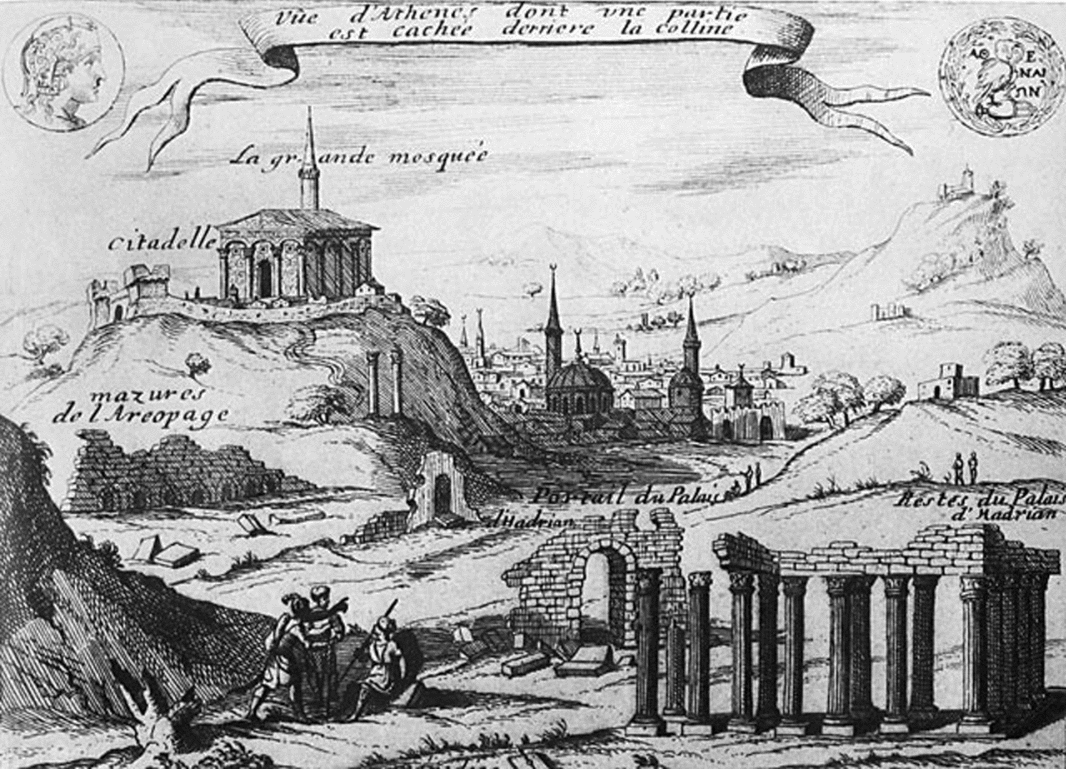
While Mahmud's History is inspired overwhelmingly by texts rather than autopsy, he does weave into his work strands of contemporary detail. Like Evliya – though revealing no direct debt to him – Mahmud Efendi also mentions the Throne of Belkis in Athens (Fig. 1). Whether Evliya had been the first to associate the ancient temple with Suleyman and Belkis, or simply related stories he had been told on his visit, the identification clearly survived at least a generation after him. And Mahmud brings Suleyman into his history of Athens in association with other buildings as well, including the Parthenon. It is not only in the Islamic geographical tradition that one finds the insertion of legendary kings and prophets into historical narrative. Christian chroniclers since Eusebius were accustomed to multiple chronologies and their colourful cast of rulers and sages, kings and prophets. Many chroniclers, such as John Malalas in the sixth century, had preferred a scheme of history with nodal points such as the Creation, the Flood and the Incarnation into which great figures such as Nimrod, Moses, Alexander, and Constantine were fitted. Compiled in the seventeenth century, the Βιβλίον ἱστορικόν by Pseudo-Dorotheos of Monemvasia is one such history that was constantly re-worked and widely read in Ottoman Greece. Whether such Christian schemes available through local informants would have fed into our Ottomanized histories of Athens has yet to be investigated, but what is striking about Mahmud when compared with Evliya and the Byzantine tradition is his focus on two Athenian figures – the hero Theseus and the statesman Pericles – who were not found among the usual ancient kings and prophets. It is to Mahmud's treatment of Pericles, famous as the builder of the Parthenon, that I will now turn.
View of Ottoman Athens, roughly contemporary with the visit by Evliya Çelebi in 1667. In the foreground are the columns of the Olympieion, identified here as the Palace of Hadrian and mentioned by Evliya as an open-air mosque. Both Evliya and Mahmud Efendi associate the structure with Belkis, the Qur'anic Queen of Sheba. ‘Vue d'Athènes dont une partie est cachée derrière la colline’, engraving in P. Jacques-Paul Babin, Relation de l’état présent de la ville d'Athènes, ancienne capitale de la Grèce, bâtie depuis 3400 ans, avec un abrégé de son histoire et de ses antiquités (Lyon 1674). Photo credit: Archaeology of the City of Athens. Digital Edition, National Hellenic Research Foundation. (http://www.eie.gr/archaeologia/En/chapter_more_8.aspx).

The passage of greatest interest comes in Mahmud's account of Pericles’ attempts to justify the construction of a new temple to the Athenian taxpayers. The idiosyncratic description shows distinctive signs of Mahmud's literary ‘Ottomanization’, but there is a faint enough whiff of Pericles addressing the Athenian assembly in Chapter 12 of Plutarch's Life of Pericles, that one may be allowed to envision the scene Mahmud himself describes, whereby his abbot acquaintances transmitted ancient and modern sources that he would subsequently reformulate from his notes into his History.Footnote 19 In Mahmud's description the Athenian statesman is depicted in consultation with the assembled ‘right-thinking learned men in a council’ (ḥükemā feylosofları cem‘ eyledi).Footnote 20 In the speech Mahmud puts into the mouth of Pericles, the latter argues that the new temple in Athens would be as great as Suleyman's in Jerusalem, and like it would attract admiration and pilgrimage.
In noble Jerusalem the sainted Suleyman (greetings be to him) has built a rare, valuable temple, and all, high and low, are desirous of going to worship in it. However, the Greek population of Rumeli, which is extremely far away, has formidable difficulties in reaching [Jerusalem] to worship in the temple. But we must construct an outstanding and magnificent temple, unsurpassed in quality. Its walls should be of pure white marble. The roof that will rest on the walls should be supported on beams of white marble too, and indeed so also should its ceilings and substructures be constructed of white marble. Our region will acquire learning and religious knowledge. Most of its population [already] has a pious insistence on asceticism and on worship.Footnote 21
As we have seen, because Greek philosophers had retained a reputation (however vague) in the Islamic world, they could easily be fitted into an Ottomanized history of Athens. But to incorporate a statesman whose place in the history of Athenian democracy was normally of no particular interest to Byzantine or Muslim writers required a different creative effort on Mahmud's part. His solution is to raise Pericles to the level of a pious king addressing the wise, philosophically-inclined men on his council. And it is not only that Pericles is worked into a universal monotheist narrative. His temple is treated not merely as a monument to admire as an artefact, but as a magnificent structure that attracts pious behaviour. The comparison of Athens with Jerusalem, and the suggestion that the new temple would provide a substitute shrine, may make us think of the many surrogate pilgrimage shrines that from the early Islamic period sprang up all over the Muslim world for those who could not perform the Meccan hajj. But more than this, I suggest that Mahmud – who had studied in Istanbul before returning to Athens as its mufti– was bringing the Parthenon into the charmed world of other great monotheist buildings such as the Haram al-Sharif complex in Jerusalem and, above all, Hagia Sophia in Constantinople, which had become venues of desired association, but also of competition, for rulers who would emulate and even try to surpass Suleyman, the greatest monotheist king, sage, prophet and builder. In fact, elsewhere in his History Mahmud explicitly compares the Parthenon mosque with Hagia Sophia. Referring to the citadel mosque at the time of its bombardment by the Venetians in September 1687, he notes:
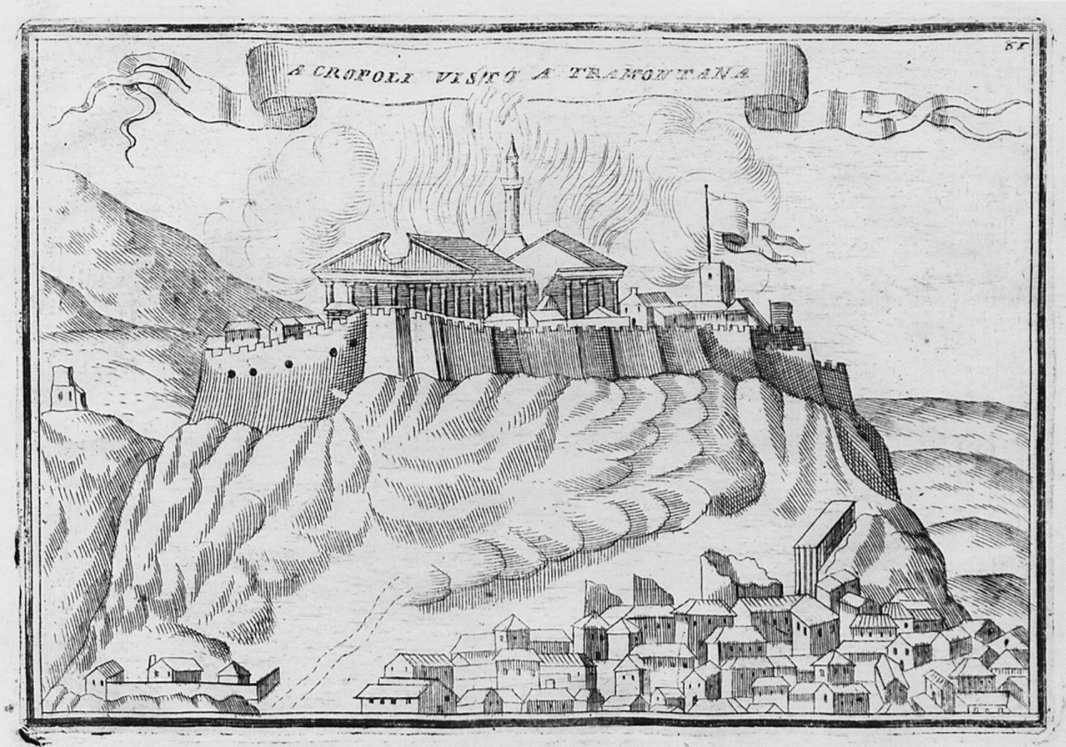
In the year 1098, during the Venetian attack, Venetian shells hit the artillery store within the great temple [ma‘bed] built within the citadel: it was on account of the artillery store that the Venetians shelled the temple. The temple, the noble, richly decorated mosque, had become similar to Ayasofya. Seven hundred Muslims, men, women and children, who were inside it at the time, died when the temple, the mosque, was demolished (Fig. 2).Footnote 22
Vincenzo Coronelli. ‘Acropoli visto a Tramontana’, in V. Coronelli, Citta, Fortezze, ed altri Luoghi principali dell'Albania, Epiro e Livadia, e particolarmente i posseduti da Veneti, IV (Venice 1688) of Stati della Serenissima Repubblica di Venezia in terra-ferma, divisi in cinque parti. Photo credit: Aikaterini Laskaridis Foundation, Travelogues (www.travelogues.gr)

Pairing Pericles with Solomon went a step beyond the insertion into Hellenic history of a legendary Islamic ruler with an architectural habit. The paradigmatic king and prophet Solomon had a tendency to appear at times when a strong authority was needed to bolster political claims in regions where the presence of the past still hung heavily about. The Umayyad dynasty in Syria, for instance, reinforced its political claims and architectural reformulations with overt Solomonic associations. The Umayyad architectural legacy has been understood as a process of absorbing, rejecting and reformulating artistic and architectural language and forms inherited from the Greco-Roman tradition as it had evolved in Christian Greater Syria.Footnote 23 The material process was accompanied by recast legends and an Islamization of space in which the prophet-king Solomon was given a lead role. Umayyad reconfigurations of the symbolic urban spaces that became the Haram al-Sharif in Jerusalem, for example, or the Great Mosque in Damascus, illustrate how early Muslims adapted the late antique built environment and re-interpreted it with figures from the Qur'anic imaginary in order to assert their own ownership of these cities.Footnote 24 And the Umayyads were just the beginning.
In terms of size and political importance, Mahmud's late seventeenth-century Athens cannot be compared with seventh-century Damascus, one of the most important cities in late antique West Asia that became the Umayyad caliphal capital. Constantinople not Athens was, of course, the necessary showcase of power where the Ottomans played the Umayyads, so to speak, in their quest to reformulate and rival the culture they supplanted. Well-known are the Solomonic ambitions of Mehmed II and Suleyman I, expressed in both titulature and architecture: Mehmed's adoption of Haghia Sophia, which had been Justinian's answer to Solomon's temple in Jerusalem, and Suleyman's creation of a new imperial mosque. But Athens still retained its hazy prestige – it was, after all, the City of the Sages. We should not underestimate the power of this reputation when combined with the omnipresent monumental past in a city where ancient buildings had been constantly adapted within the living urban fabric. It was precisely in a space so enlivened by shades of a celebrated past and surviving wondrous structures that competition with the past was bound to be most intense and that Solomon's magical powers were required to impress Islamic tradition more deeply into the Athenian landscape. It is in such an atmosphere of complex cultural claims that Mahmud tapped into Islamic lore surrounding Solomon in order to heighten for an Ottoman audience the magnificence of Pericles’ achievement.Footnote 25
Conclusion
Mahmud Efendi lived a generation after the first wave of travellers who published descriptions of Athens, guided by what they read in classical texts.Footnote 26 Charles Marie François Olier de Nointel and Antoine Galland visited in 1675, followed by Francis Vernon, Jacob Spon and George Wheler a year later. Like Evliya who visited in 1667, this handful of French and English travellers managed to see the Parthenon at its fullest development, just a dozen years before its destruction. This cluster of visits to Athens by Europeans coincided with the publication of Kontares’ Old and Highly Beneficial Histories of the Celebrated City of Athens in Venice in 1675. It was a time of quickening for the acquisition of knowledge about Athens, a provincial city off the usual travellers’ route on account of Ottoman-Venetian tensions. Written roughly a generation after these accounts, Mahmud's History benefited from the dense, multilingual knowledge circuits that emerged from diverse cultural matrices and converged at Athens. He drew on autopsy, local information and the Arab-Ottoman historico-geographical traditions of making sense of the past, as well as all the ancient sources that were accessible, in various forms, in his day.Footnote 27 Like the European visitors, Mahmud was strongly text-guided with a wider range of sources than had been at Evliya's disposal. But Mahmud did not leave behind the tradition of interpreting ancient ruins employed by Evliya. Instead he fused the multiple traditions of responding to the past that would appeal to his Ottoman audience who, like Mahmud, were provincial elites aware of the gradually increasing numbers of foreigners coming to visit, measure and draw the ancient monuments that were an organic part of Ottoman cities such as Athens, Thebes, Chalcis, Livadeia, and Nauplion.
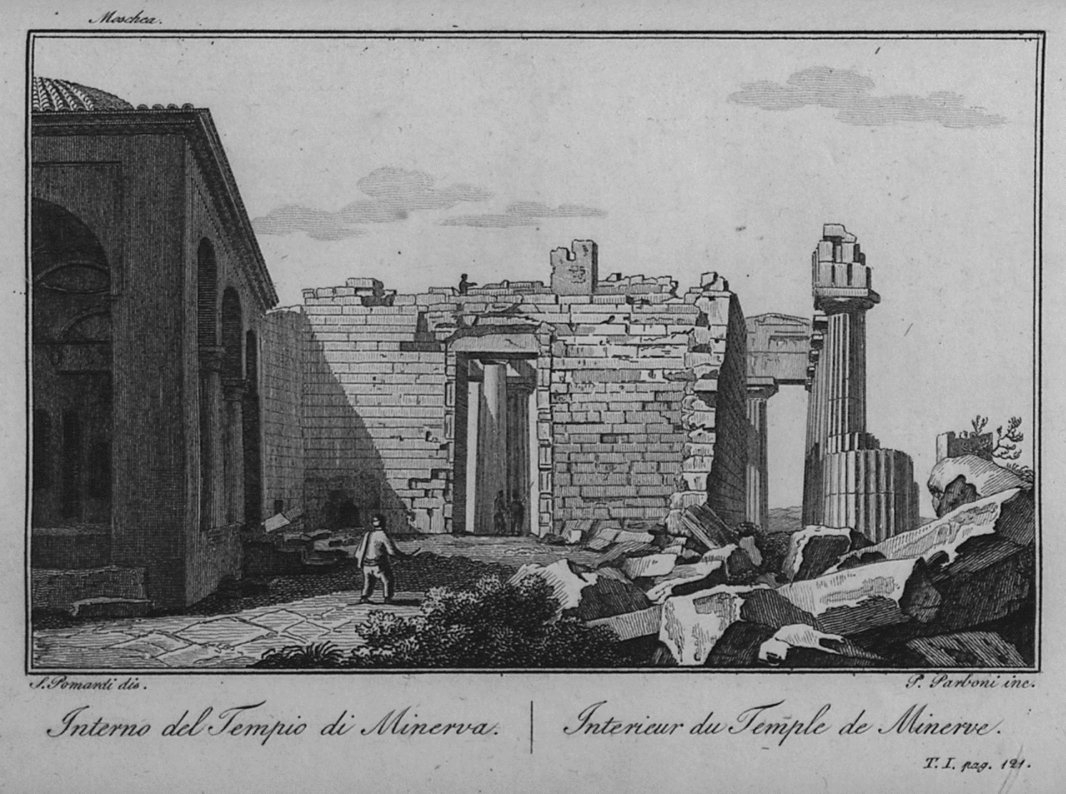
I have focused on the harmonization of Greek and Islamic history in the brief passage where Mahmud introduces his description of the Parthenon. The building he goes on to describe was the temple built by Pericles, in other words, the building as it appeared not in Mahmud's own day, but in classical antiquity. The reason for this lay mainly in his text-based approach to the City of Sages, but also the obvious fact that Mahmud began writing twenty-eight years after the Venetian bombardment. We do not know when exactly the second Parthenon mosque was erected directly on top of the Periclean pavement with cut stones cleared from the wreckage (Fig. 3). It is possible, though not provable from material evidence or Mahmud's own account, that the new mosque was built during the mufti's lifetime. It would stand for roughly a century, appearing in many European drawings of the temple for local colour, or discreetly imagined away by other artists who preferred to offer a view they felt was closer to the original temple.
After the Parthenon's bombardment in 1687, a second mosque was built of reused materials, and oriented on Mecca, inside the ruined shell. Simone Pomardi, ‘Interno del Tempio di Minerva’, c. 1804, in S. Pomardi, Viaggio nella Grecia fatto da Simone Pomardi negli anni 1804, 1805, e 1806, I (Rome 1820). Photo credit: Aikaterini Laskaridis Foundation, Travelogues (www.travelogues.gr).

Had the second mosque been constructed during Mahmud's lifetime one may wonder whether he would have been aware of the ironic parallel between the conditions under which the celebrated Periclean temple to Athena Parthenos and the humble eighteenth-century mosque were built. In 480 BC Achaemenid soldiers, led by Darius's son Xerxes, burned and destroyed the buildings on the acropolis, including the Old Parthenon, then still under construction. For political, financial and symbolic reasons, the temple was allowed to lie in ruins for thirty-three years after the barbarous attack. Pericles would build a monument that would continue in use for more than two thousand years, first as a temple, then as a church for nearly a millennium, and a mosque for over two hundred years. After that building's bombardment by the Venetians in 1687 it lay again in ruins probably for a generation, as it had in the fifth century BC, before a new mosque was built.
The two Parthenon mosques can stand for two modes of seeing the relationship between Islamic and Hellenic culture that predominate today. The first view is represented by the pre-bombardment Parthenon mosque that had begun as the temple built under Pericles and developed organically to reflect on its skin the cumulative history of the holy place. This view understands Islam as interconnected with Greco-Roman history. The second view is represented by the second Parthenon mosque, the free-standing eighteenth-century mosque dwarfed by the roofless temple in which it was erected. This second view understands Islam as something alien imposed onto Greco-Roman history. The second mosque was structurally detached from the columns and fragmentary walls that remained standing and at an angle to the temple foundation on which it stood, oriented instead on Mecca. This shift in orientation, both literal and metaphorical, is what Mahmud Efendi provokes us to re-consider today, by paying more attention to early modern persons who were still attempting to take the former view of Islamic culture, as the culmination and continuation of Hellenic achievements.