Introduction
Among the many social transformations that have taken place during the past 50 years in northwest European countries, improvements in the quality of housing have been a major advance. Better housing has been accompanied by a substantial growth in homeownership, and today the majority of older people are homeowners. Despite these improvements, some sections of the population have not benefited and older people are still over-represented in poor quality housing, which is commonly concentrated in inner cities. These trends have important consequences for the welfare of older people. As the post-1945 baby-boom cohort approaches retirement, new residential strategies may emerge. Many homeowners in the cohort have accumulated substantial housing equity. They have also experienced increased rates of divorce and separation, a social trend with manifest consequences for housing and residential mobility. Some parents in the cohort still have family obligations that influence decisions about where to live, such as adult children living at home and elderly parents requiring support who live nearby – named the ‘sandwich generation’ in recent studies (e.g. Grundy and Henretta Reference Grundy and Henretta2006). These transformations pose several questions about the residential strategies of older people in the future. Will they remain in their current homes or become more residentially mobile? To what use will housing equity be put? Will they continue the patterns of consumption that they helped to create as young adults, and if so what part will housing decisions play in this process? What will be the intergenerational implications for the transmission of housing wealth and assets? And will homeownership be an increasingly important factor in social inequalities in successive cohorts of older people?Footnote 1
In France, as elsewhere in western Europe, these issues are only just beginning to be explored (Bonvalet et al. Reference Bonvalet, Drosso, Benguigui and Huynh2007; Jacquot Reference Jacquot and Bonvalet2007). Several characteristics particular to France's history combine to make it an interesting case study of housing issues in later life. First, France continues to have a relatively generous pension scheme and the rates of old-age poverty are among the lowest in Europe. Since much of France's urban housing stock was built after 1945, the phenomenon of ‘asset rich, house poor’ is less apparent than in the UK and some other European countries (Terry and Gibson Reference Terry and Gibson2006). France also has a more ‘balanced’ housing sector, with owner-occupation, social housing and private-rented accommodation in more equal proportions than in many European countries. Patterns of migration and immigration have also had important consequences for housing. For much of the 20th century, ‘swing’ migration from rural to urban areas and later returns to provincial areas accompanied the life course transitions into employment and from work to retirement. Urban to rural retirement migration in France has been more prevalent than in most European countries. And finally, the early arrival of significant immigrant populations is being followed in the early 21st century by their innovative patterns of retirement migration.
These patterns and their impact on housing in retirement have not gone unnoticed in France, where a long record of research on housing trajectories and residential mobility began with studies of the impacts of the major housing reconstruction after the Second World War. This research has drawn from several disciplines and its richness has largely been missed by non-francophone specialists in housing and social gerontology. The aim of this paper is therefore to synthesise several themes in French housing research that are directly related to the circumstances of older people. This is done by focusing on three domains: the evolution of housing conditions of older people in France and the changes in tenure that have taken place during the late 20th century; the main themes of French research on the residential mobility and choices of older people that have developed since the 1960s; and the implications of the ageing of the post-1945 baby-boom cohort into later life for trends in housing preferences and wealth transmission.
Older people's housing trends, 1946–2006
Improved housing conditions
The improvements in the housing conditions of older people in France need to be set in the context of the general situation after the Second World War. In 1946, the housing stock was nothing short of shambolic. Half-a-million houses and flats had been destroyed outright during the war and a further 1.4 million had been damaged. Even among the housing not directly affected by the war, conditions were deplorable – most had been built more than 100 years previously and only about one per cent had an indoor toilet, a bathroom and central heating (in this paper, the ‘basic facilities’). Ineffective inter-war housing policies had contributed to these problems, and rent controls imposed by the government prior to 1945 had discouraged investors to build new housing (Merlin Reference Merlin1988). As well as the poor physical conditions, the small dwellings and large family sizes made overcrowding commonplace. In 1946, the average number of rooms per household was 2.7 for an average of three persons. The 1954 census found that across France 31 per cent of households had four or more persons but fewer than three rooms, and the comparable figure in Paris was 47 per cent (Cahen Reference Cahen1957).
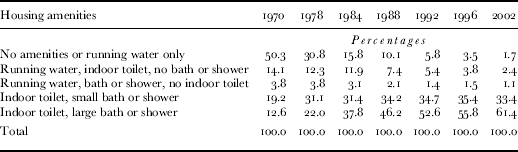
Major house building programmes did not start in earnest until the beginning of the 1950s, but once begun the pace was frenetic (Mouillart Reference Mouillart1993). The phenomenal turn-around of this situation can be seen in the proportion of households that had basic facilities: just over five per cent in 1954, 15 per cent in 1962, 30 per cent in 1970, and 94 per cent in 2005 (Merlin Reference Merlin, Bergouignan, Blayo, Parant, Sardon and Tribalat2005). The construction of social housing, often involving the creation of large housing estates, took place alongside house building in the private sector and the renovation of city centres (Bonvalet Reference Bonvalet and Bonvalet2007).Footnote 2 Throughout the post-war reconstruction, older people were over-represented in the poorest housing conditions, and it was not until the 1980s that their accommodation began to improve significantly. According to national housing survey data, in 1970 one-half of households with a person aged 65 or more years had running water only, and no indoor toilet or bathroom, compared to 10 per cent of the general population.Footnote 3 By 1984, this figure had fallen to 15 per cent, and by 2002 to two per cent.
The prevalence of basic amenities in older people's households, France 1970–2002
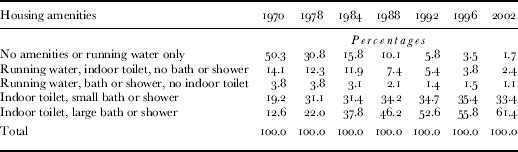
Note: An older person's household is a household with at least one member aged 65 or more years.
Source: INSEE, Enquêtes sur le logement [Housing Surveys], authors' analyses.
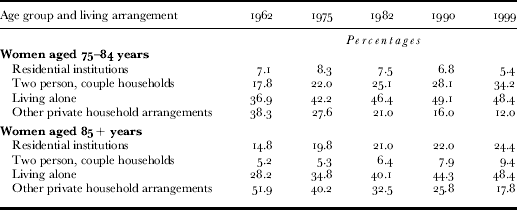
Like many of their northern European counterparts, from the 1960s older people in France gradually had more residential autonomy, with a considerable rise in the number of single-generation households, either older couples without others, or older people living alone following the death of a partner (Ogg Reference Ogg and Bonvalet2007). Multi-generational households, previously common in rural areas, diminished. In 1962, more than one-half of the female population aged over 85 years lived with other family members (mainly children) and 28 per cent lived alone. By 1999, almost one-half were living alone and only 18 per cent in other than single-person or couple households, most of them in multi-generational households (Table 2). It is important to note that during this period, although the number of very old people increased rapidly, the proportion living in residential institutions rose only slightly. By 2002, 39 per cent of households containing a retired person were of a single-person (and 70 per cent were women), 41 per cent were couples only (no children or other persons present in the household), and 10 per cent had three or more members (Minodier and Rieg Reference Minodier and Rieg2004). The shift towards residential autonomy was in part the complement of improved housing conditions, and directly throughout France reduced overcrowding. In 1970, 46 per cent of households with a person aged 65 and above were overcrowded, compared to 18 per cent in 2002.
Older women's households and living arrangements, France 1962–1999
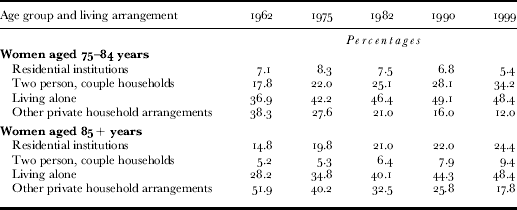
Source: Population Censuses (INSEE) and Statistiques de l'Etat Civil, INSEE. Authors' analyses.
Housing conditions in Paris
The current cohort of older people has witnessed improved housing conditions at first hand, as shown by recent research on residents of Greater Paris (Bonvalet Reference Bonvalet and Bonvalet2007). A Biographies et Entourage [Biographies and Social Networks] survey was undertaken by the Institut National d'Etudes Démographiques (INED) in 2000 among 2,830 residents aged 50–70 years of the Île-de-France Region.Footnote 4 The survey used semi-structured interviews with modules on different aspects of family life and key events during both childhood (such as separation and divorce of parents) and early adult life (couple formation and dissolution). An important feature was the identification of residential histories and trajectories, and the interaction between residential choices and public policies. Interviewees were asked to give details of all the homes they had lived in for more than a year, including their locations. With this information, it is possible to follow residential mobility over the life course and to map changes in the housing circumstances of the sample over time.
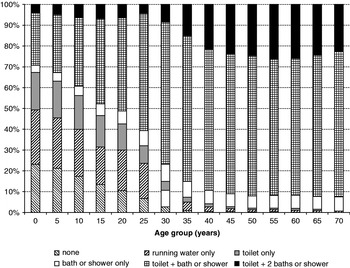
Two-thirds of the respondents to the Biographies et Entourage survey lived in very poor housing with no basic amenities during their early years. Many lived in 19th-century apartment blocks (some were even older) with only a communal water point on each landing or on the ground floor. As they grew up, their housing conditions gradually improved (Figure 1). About one-half were living in very poor conditions at 10-years-of-age and 43 per cent at age 20 years. Most of these respondents (the majority of whom were retired in 2001) were therefore raised in very poor housing conditions, whether in rural areas or city centres. In fact, it was not until they were 30-years-of-age that their housing standards significantly improved, for at that age three-quarters had the basic amenities. The post-1945 baby-boom generation have therefore experienced a major improvement in their housing conditions – 59 per cent of respondents in the Biographies et Entourage survey born during 1946–50 at 20-years-of-age lived in households with basic amenities, compared to 37 per cent of those born during 1930–34 at the same age.
Housing amenities by attained age, Parisians born 1930–50. Notes: Sample of the residents of Greater Paris in 2000. Data collected retrospectively. The five-year age groups are indicated by the lowest age. Source: Bonvalet Reference Bonvalet and Bonvalet2007.

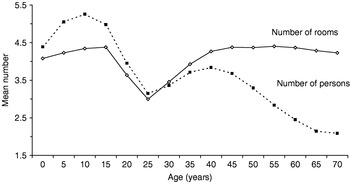
Many of the Biographies et Entourage survey respondents lived in overcrowded homes, the result of the small dwellings, the large family sizes of the older cohorts, and a high rate of intergenerational cohabitation. By 10-years-of-age, the respondents lived in households with on average 4.3 persons and just four rooms (Figure 2). It was not until they reached their early forties, when their children began to leave the family home, that most respondents first lived in uncrowded conditions. Figure 2 shows that, although the average household size of those born during 1930–1950 fell substantially after they attained 45-years-of-age, the average number of rooms that they occupied remained constant until they reached their seventies.
Mean number of rooms and persons per household through the lifecourse, residents of Greater Paris born 1930–1950. Notes: Sample of the residents of Greater Paris in 2001. Data collected retrospectively. The five-year age groups are indicated by the lowest age. Source: Biographies et Entourage survey, 2000.

Growth in homeownership
These improvements in housing conditions occurred alongside rising home-ownership, although the growth was not uniform. In 1954, only 34 per cent of households in France owned their property, but by 2002 this had increased to 56 per cent. The construction of new housing in the private sector peaked between 1950 and 1963 and was primarily for middle class young-adults, the main beneficiaries of the expanding post-war economy and full employment. But a growing proportion of individuals from the lower socio-economic groups also acquired new homes. From 1963 to 1968, the building programmes slowed and less new private housing was available, particularly for those with lower incomes. After 1968, there was renewed house building in the private sector although at a slower pace and again mainly for the middle classes. There was a housing slump in 1974, which was partly corrected by legislation in 1977 that gave incentives for the purchase of new, detached houses on long-term credit. Most homeowners aged 65 or more years in 2002 had acquired their home by 1980.
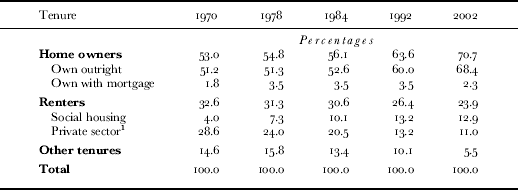
This growth in home ownership was partly enabled by credit reforms and improved access to le crédit foncier [mortgage lending]. By 2002, 70 per cent of the population aged over 65 years were homeowners compared with only 50 per cent in 1972. Alongside the growth in home ownership, the private-rental sector shrank considerably. The proportion of older people living in social housing rose from four per cent in 1970 to nearly 13 per cent in 2002 (Table 3). This growth came about mainly because those living in social housing during the 1960s have remained in situ. Retired people who are not homeowners tend to be in the oldest age groups, and almost three-quarters are in the lower socio-economic groups. Most of today's older renters became tenants early in their adult life and have always had modest incomes. Recent research suggests that their housing costs are particularly high in relation to their income (Bardy Reference Bardy2001). Nevertheless, some older tenants had substantial rises in income during their working lives but remained in social housing; they took the advantage of fixed rents much below the market-rate (Laferrere and Le Blanc Reference Laferrere and Le Blanc2001). This legislation was introduced in 1948 to combat high rent rises in the private sector. Most of these tenants are disinclined to move. The number of older people who remain in the private sector with rents protected by the 1948 legislation has fallen drastically, however, to around 200,000 (Loiseau and Bonvalet Reference Loiseau and Bonvalet2005). By 2007, the rents of tenants in housing built prior to 1948 who have stayed in the same accommodation for decades were significantly below the market rate. The development of ‘sheltered housing’ during this period was another innovation.
Tenure of older people's households, France 1970–2002
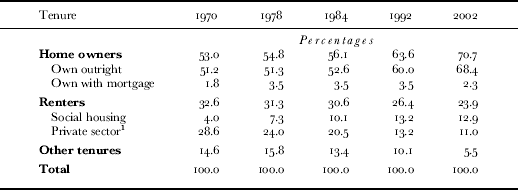
Note: 1. Including renters under the 1948 legislation (see text).
Source: Population census (INSEE). Authors' analyses.
Research undertaken by the Institut de la Statistique et des Études Économiques (INSEE) has shown that older people in France have standards of living that overall are the same as for the population in paid employment (Hourriez and Legris Reference Hourriez and Legris1995). Most older people have benefited from the strong social security system which provides one of the highest pension levels in Europe for those who have completed 40 years full-time employment. According to the 2002 housing survey, 73 per cent of households containing at least one retired member owned their main home and 76 per cent owned at least one home (Minodier and Rieg Reference Minodier, Rieg and Bonvalet2007). But rates of homeownership differ among the successive older birth cohorts, by region and by social class, and they are currently a major source of social inequalities. The richest deciles of retirees (wealth including income and all assets) have four times the wealth of retirees from the lowest deciles (Minodier and Rieg Reference Minodier, Rieg and Bonvalet2007).
Although many retired homeowners live in detached houses, it should be noted that France's large post-war building programme included many flats and apartment blocks. This means that many older homeowners live in town or city flats or apartments. Recent data from the 2004 SHARE survey have shown that 30 per cent of households with at least one person aged 50 or more years live in flats.Footnote 5 Some older people who throughout their life have been in the rental sector and who have experienced important ruptures in their family and working lives continue to live in run-down, inner-city housing estates, or are isolated in apartments in the private sector, with all the ensuing consequences for physical and mental health. Many of the 15,000 victims of the 2003 heat-wave tragedy were living in poor housing (Ogg Reference Ogg2005).
Institutional settings
In 1999 the population in France aged 60 or more years was approximately 12 million, among whom around 500,000 (4%) lived in institutional settings (Renaut Reference Renaut, Colin and Kerjosse2001). Ninety per cent of those aged 70–79 years, 80 per cent of those aged 80–89 years, and 70 per cent of those in the nineties lived in their own homes. Among the population aged 75 or more years, less than one-in-ten lived in a residential institution. Greater life expectancy coupled with an increase in the duration of good health in old age, has increased the average age of entry into an institutional setting. Data from the large Handicaps-Incapacités-Dépendance (HID) survey showed that approximately one-half of the population aged 60 or more years in residential homes entered after 81-years-of-age, and more than 80 per cent after 75-years-of-age (Renaut Reference Renaut, Colin and Kerjosse2001). As elsewhere in Europe, the residents of old-age homes are becoming frailer and more disabled, and as ever women are over-represented (four times the number of men). Moreover, the women tend to be older than the men and more disabled. As far as men are concerned, being single or widowed significantly increases the chance of entering a residential home – the HID survey showed that 23 per cent of men living in residential homes were single compared to 15 per cent of women.
Intergenerational dimensions of housing
A high proportion of older people in France, as in most other European countries including the United Kingdom, still live near to at least one of their children. In 1999, more than one-third of parents aged 75 or more years in urban settings lived either with a child or very near to one, and another one-third lived in the same town (Renaut Reference Renaut, Colin and Kerjosse2001). Residential proximity correlates with the number of children – the more children one has, the shorter the distance between an older person and their nearest child. Geographical proximity is also highly correlated with frequency of contact. The HID survey showed that more than four-in-ten people aged 75-plus saw their children at least once a day and two-thirds at least once a week (Renaut and Ogg Reference Renaut2003). Intergenerational cohabitation, once a common feature in rural areas of France, has fallen significantly during the last 50 years. Where it does occur, it is likely to be one of two types. In rural areas, an adult child who has never left the natal home and continues to live with a parent is most likely to be a son, but in the rarer cases where a widowed elderly parent moves to the household of a child, the child is much more likely to be a daughter (Renaut Reference Renaut2003). Where cohabitation between an elderly parent and an adult child occurs in urban areas, the child is most likely to be a daughter who is married and not in paid employment (Renaut and Ogg Reference Renaut and Ogg2003). The HID survey showed that in these cases of cohabitation, the health of the parent is likely to be worse when the parent lives with a daughter as compared to when the parent lives with a son. In other words, when an elderly parent moves to live with a son, this appears to be for reasons other than health or disability.
Housing and property have an important role in intergenerational transmissions. In the private sector, inheritance plays a strategic role in property acquisition. The SHARE survey (2004) showed that 20 per cent of owner households in which one person was aged 75 or more years inherited their home, compared to seven per cent among households with at least one member aged 50–74 years (authors' analysis). These figures indicate the importance of the property transmission that occurs around the age of retirement, which for many coincides with the death of parents. For a minority of older people (approximately 3%), property is acquired with financial help from other family members. Property is highly valued by some sectors of the population and successive family generations are strongly encouraged to invest in and acquire it (Cuturello Reference Cuturello, Bonvalet and Gotman1993). This trend is clearly seen when rates of intergenerational property ownership are compared (Bonvalet and Gotman Reference Bonvalet and Gotman1993; Wolf and Attias-Donfut Reference Wolf, Attias-Donfut and Bonvalet2007). According to data from the 1992 Actifs financiers survey, children whose parents were homeowners are more likely to be homeowners themselves.Footnote 6 Moreover, these children acquire property earlier than children of non-homeowners, and often property of a higher value. Several researchers have therefore focused on the relation between intergenerational housing wealth transmission and social inequality (Laferrere Reference Laferrere1998, Reference Laferrere and Le Blanc2000; Laferrere and Le Blanc Reference Laferrere and Le Blanc2001; Arrondel and Masson Reference Arrondel, Masson, Mercier-Ythier and Kolm2006).
Residential strategies and mobility
As elsewhere in Europe, elderly households in France are less mobile than younger households. Between 1990 and 1999, only one-in-five persons aged 60 or more years moved home compared to approximately one-half of the younger population (Christel Reference Christel2006). Moving in later life is highly correlated with important life events, such as retirement, widowhood and divorce or separation. The 2002 Housing Survey recorded only a slight rise in the rate of mobility around the age of retirement, followed by another small rise above the age of 84 years. Household moves at these two moments of the lifecourse represent different types of mobility. Research during the 1990s showed that around the age of retirement, a small proportion of the population decided to move – it is estimated that between 1990 and 1999, 2.8 million people aged 60-plus moved home (Christel Reference Christel2006). Such moves were much more common in and from Greater Paris, where households tended to move longer distances compared to retirees in other regions such as Brittany, the Loire valley and Alsace (Christel Reference Christel2006).
International migration among older people who were born in France is very rare compared to several other European countries, notably Britain and Germany. A trend in recent years has been a decreased tendency to return to the area in which one was born. This type of retirement migration was relatively widespread among the oldest birth cohorts who were the vanguard of post-war urbanisation (Cribier Reference Cribier, Bonvalet and Merlin1988), but is gradually being replaced by a preference for small towns and suburbs that are close to local amenities and not necessarily in the region in which the retirees spent their childhood (Bonvalet Reference Bonvalet and Bonvalet2007). Nevertheless, for the Paris conurbation, Gobillon and Laferrere (Reference Laferrere and Bonvalet2007) have shown that among the most recent retirees, the tendency to move to destinations associated with a better quality of life continues among the youngest members of the post-1945 baby-boom cohort. A move away from inner cities remains common, as can be seen from home sales in the Paris region in 2003 – more than one-in-five sales (21.5%) were made by retired households, but they accounted for only six per cent of the purchases (Bonvalet et al. Reference Bonvalet, Drosso, Benguigui and Huynh2007). The majority of moves are made by homeowners who do not change tenure. The trend among these later-life movers is to substitute larger with smaller homes – these are adjustments to decreases in both income and household size brought about by either the departure of adult children or early widowhood.
The second type of mobility arises from factors such as poor health or the loss of a partner, and therefore tends to occur in advanced old age (Bonnet and Gobillon Reference Bonnet, Gobillon and Bonvalet2007). Home moves at this stage in the lifecourse occur more frequently towards the rental sector, including social housing (Christel Reference Christel2006). Following the loss of a spouse, many older people turn to the social or private rental sectors in town centres or other areas close to local amenities. There is a growing demand for small apartments among older people, which can drive up local prices and so affect the availability of housing for younger adults. Moving to smaller homes is again common but, at the more advanced ages, moves are predominately towards or within urban centres and suburbs. Moves into residential settings become more common above 80-years-of-age, in consequence of the onset of disability and loss of independence (see previous section).
Residential strategies in later life can thus be seen as adjustments to certain lifecourse events in conjunction with individual and family preferences. The benefits of moving in old age are often outweighed by the costs, however, particularly of adapting to new homes and environments. Recent research has shown that the financial costs of moving home are strongly associated with age, since older households are more likely to have acquired material objects such as furniture and fittings (Gobillon and Laferrere Reference Laferrere and Bonvalet2007). Many older people have also acquired over time considerable social capital in the local area, which is another factor that impedes mobility in later life. Individuals at advanced ages, of course, have only limited remaining life spans and the emotional costs of moving can also be a deterrent. Overall, this research has shown that house moves in France by those aged over 75 years are prompted by unsuitable homes coupled with a strong wish to move, either by the individuals concerned or on the part of their family.
Several studies have shown a circular pattern of residential mobility between a main and second home (Lelièvre and Bonvalet Reference Lelievre and Bonvalet1994; Bonnin and Villanova Reference Bonnin and Villanova1999; Gotman 1999; Warnes Reference Warnes and Bonvalet2007). Second homeownership is more common than in many European countries, including Britain, and appears to be increasing. Data from the SHARE survey (2004) showed that 24 per cent of households with at least one person aged 50 or more years owned another dwelling, and that the rates were 26 per cent for those aged 50–74 years and 17 per cent for those aged 75 or more years (authors' analysis). Many of these second homes are for the owner's private use or are shared with family members or friends. Recently, however, an increasing number of older people have acquired a second home as an investment asset, or have rented a second property on long leases to a third party, often managed by an agency. This type of investment has been promoted by a low capital-gains tax (the Périssol and Besson legislation). As Gobillon and Laferrere (Reference Gobillon, Laferrère and Bonvalet2007) noted, these incentives apply only to more affluent retirees who have to balance the advantages of tax exonerations on capital gains against taxable rent income.
Although older people in France are less residentially mobile than younger adults, they are far from immobile. Studies of the use of second homes and leisure in later life have stressed the increasing importance of having a ‘double residence’. New residential patterns may be emerging whereby older people stay for extended periods in different settings, a trend that was observed in the Biographies et Entourage survey. The complexity of these residential strategies and the suggestion that different forms of mobility are becoming more common in later life is evinced by a change in terminology. The French have traditionally distinguished la résidence principale [the main home] from la résidence secondaire, which is more correctly translated by ‘secondary’ than ‘second’ home. This distinction, which is recognised in legal documents and for tax purposes, derives from the long-established association between la résidence principale and le pays [land or motherland] of a person's or family's provenance and ‘roots’.
The second home was customarily smaller, had fewer amenities and regarded as supplementary. This distinction is now breaking down, and one increasingly hears of la résidence seconde, a term that has fewer connotations for the individual's main place of residence. The gradual adoption of this term in everyday language reflects changing residential strategies. It illustrates the phenomenon of multi-residence, described by Bonnin and Villanova (Reference Bonnin and Villanova1999) as homes dispersed over extensive geographical areas with the distinction blurred between main and second homes. Another emerging pattern is to own a house – often in the country or away from city centres – as a complement to a city flat or apartment. Circular patterns of residential mobility are also developing as a result of new family configurations stemming from divorce and separation, and from the increasing number of older people who live alone as a lifestyle choice (Clément and Bonvalet Reference Clément and Bonvalet2006). These patterns create new demands in the housing market, such as for pieds à terre [small flats] that are kept on in the town or city coupled with a small house or apartment, either in la province [the country] or close to children and grandchildren.
These emerging types of mobility among recent retirees have consequences for the housing market and general housing stock, depending on the volume of homes bought and sold in local areas and the number of retirees investing in property to rent (Driant Reference Driant and Bonvalet2007). Among the relatively few but possibly increasing number who decide to change their residential status at or around the time they retire, most cases arise from the sale of an existing property and the acquisition of a new property without recourse to any home-purchase loan scheme. This trend is in part linked to the credit cautiousness of the French population, but has also been fuelled by institutional barriers to borrowing in retirement. Laferrere and Le Blanc (Reference Laferrere and Le Blanc2001), from a comparison of French and North American housing policies, identified three reasons for the relatively low level of home-ownership in France – high transaction costs, a less dynamic housing and mortgage market, and more restrictive borrowing. These factors have undoubtedly impact on residential mobility in later life.
France has a long history of immigration and it is currently estimated that eight per cent of the population of retirees were not born in France. Different birth cohorts of ethnic minority elders in 2006 are linked to successive immigration flows. Among those aged 75 or more years, the largest minority groups are the Portuguese, Italians and those from central European countries, and many of them have kept, inherited or acquired a second home in the country of origin. Among younger elderly people, people from North African countries, notably Morocco, Tunisia and Algeria, are well represented in the minority ethnic population. All of these groups, to a greater or lesser degree, in later life migrate and circulate between the country of origin and France. The geographical proximity of France's former colonies (when compared to, for example, Britain's) has probably facilitated the alternating residence pattern that is increasingly found among immigrant young retirees. Attias-Donfut and colleagues' recent studies of a large sample of immigrants aged 45–70 years adopted the now established term ‘transmigration’ for this pattern (Attias-Donfut and Wolff Reference Attias-Donfut and Wolff2005; Attias-Donfut Reference Attias-Donfut2006).Footnote 7 For example, since their arrival in France, 88 per cent of older immigrants have returned several times to their country of origin. At the same time, the frequency of trips to the home country and the nature of these stays differ by social class as well as ethnicity. The great majority of stays recorded in the survey lasted between two weeks and two months, but the mode varied from very short periods (less than one week) in countries that border France, through two weeks in other European countries, to long stays of more than two months in sub-Saharan Africa or Asia.
Housing and the ageing population: challenges of the post-1945 baby-boom cohort
An important characteristic of the post-1945 baby-boom cohort is that, contrary to what might be expected, not all have experienced residential trajectories that were as favourable as their parents'. The housing policies that promoted home-ownership, such as the introduction in 1965 of low interest mortgages, have tended to benefit those born before 1954 more than those born subsequently, who have not enjoyed as high rates of home-ownership (Lévy Reference Lévy and Bonvalet2007). For equivalent levels of wealth, those born before 1930 were more likely to be property owners (of their main home) during the early 2000s than those born between 1950 and 1960 (Arrondel Reference Arrondel and Bonvalet2007). Those who started their working life in the years immediately following the Second World War benefited most from post-war reconstruction, growth and full employment, while those who entered the property market after 1975 have encountered more difficulties, from less favourable economic conditions and inflated house prices. It should also be noted that, even among the post-1945 birth cohort, there are households who have found it difficult to move off the bottom rung of the housing ladder.
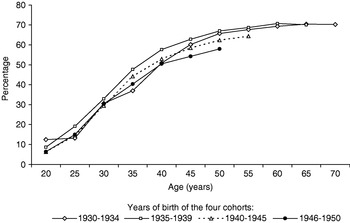
These trends are illustrated clearly by the data from the Biographies et Entourage survey. In the Paris conurbation, the 1945–50 birth cohort were less likely in 2000 to own their main home than the 1930–44 birth cohort. At the age of 35 years, 48 per cent of those born during 1935–39 were already homeowners, compared to 40 per cent of those born during 1945–50. This difference remained throughout the lifecourse – at age 50 years, the comparable rates were 66 and 58 per cent respectively. Unlike the eldest respondents in the survey, however, the youngest benefited more at the beginning of their adult life from the expansion of social housing from the later 1950s. At age 25 years, 10 per cent of those born during 1945–50 were in social housing, compared to three per cent of those born between 1930 and 1934.
Percentage that were homeowners at successive ages through the life course, four birth cohorts resident in Greater Paris in 2001. Note: The five-year age groups are indicated by the lowest age. Source: Biographies et Entourage survey, 2000.

In addition to these different intergenerational patterns of property ownership, there is also some evidence of new intra-generational differences in residential strategies linked to changes in family and household formation among the post-1945 cohort. Residential mobility patterns have become more complex because of the increasing rates of divorce and separation among men and women aged in the fifties, and from the sequelae of separations earlier in the lifecourse (Clément and Bonvalet Reference Clément and Bonvalet2006). Research suggests that the one-way trajectory of a permanent shift from the rental sector to homeownership, which used to be the norm in early adult life, is becoming less frequent (Cuturello Reference Cuturello, Bonvalet and Gotman1993). As a result of the more fluid transformations in professional and family life and of the partly consequential increase in residential mobility, the baby-boom generation has experienced more erratic housing histories than the preceding cohort. It is possible that the greater residential mobility will persist well into old age. There are therefore important questions for many in France about planning for retirement and the most appropriate housing and residential strategies. The attractiveness of housing for investment may lead to a growing number of the baby-boom cohort acquiring a property for the sole purpose of renting to a third party. This trend is contingent on the housing market and government incentives, but if it continues, the proportion of the housing stock that is for rent may increase significantly. Moreover, the properties owned by ‘young’ elderly people may accommodate people of the same age group who require new housing because of divorce and separation. Alternatively, it may be that a greater proportion of future retirees become homeowners, and that the private-rental stock falls correspondingly.
Although those currently around 50-years-of-age are slightly less likely to be homeowners than the immediately preceding cohort, they are more likely to inherit substantial housing wealth from their parents. Many parents of the post-1945 birth cohort are still alive, and as discussed earlier, by the early 2000s many had considerable housing wealth. In 2002, three-quarters of those aged 70–74 years owned their main home, compared to 71 per cent of those aged 75–79 years, and 66 per cent of those aged 80 or more years. Approximately one-fifth of retirees were second-home owners. The probability that the baby-boomers inherit one or more properties from their parents is therefore greater than for preceding cohorts. At the same time, the parents of the post-1945 cohort had their children when relatively young and have enjoyed increased life expectancy, so their children will on average be older when they inherit than the preceding cohort. There are also more siblings in the baby-boom cohort, which means that in many families homes will be sold in order to share the inheritance wealth. So although the baby-boomers have a greater chance of inheriting wealth than preceding generations, most likely each individual will inherit less (real value).
As with other European countries, France is experimenting with measures to release housing equity for income in old age, whether this be to supplement personal income or to pay for care (Coloos and Quinton Reference Coloos, Quinton and Bonvalet2007; Drosso Reference Drosso and Bonvalet2007). Lifetime mortgages are not as well developed as in Britain and North America, but the government has recently introduced measures to promote housing-equity release. The long-established viager hypothécaire [life annuity] arrangements for lifetime mortgages are currently being reformed. The viager allowed an individual (but not a commercial business) to purchase the home of an elderly person at a reduced price so long as a regular income for the seller was guaranteed (Taffin Reference Taffin, Bonvalet, Drosso, Benguigui and Huynh2007). In some cases, the seller remained in the home until her or his death; in others, the buyer recuperated the property at the moment of transaction. In both cases, the viager hypothécaire is in effect an investment risk contingent on how long the seller survives after the transaction.Footnote 8 The arrangement is deeply unpopular among most of the population and regarded by many as improper and even immoral, since the quicker the death of the seller, the greater the financial gain for the buyer. The government has recently allowed financial institutions to enter into this market, but it is too early to assess its degree of success.Footnote 9
A more mobile population
The first of France's baby-boom cohort reached the age of 60 years in 2005. Between 2000 and 2050, population projections suggest that the number of persons aged 60 or more years will double, the number aged 75 or more years will rise by a factor of 2.7, and the number aged 85 or more years by a factor of 3.8 to reach 4.8 million (Robert-Bobée Reference Robert-Bobée and Bonvalet2007). The population projections have focused policy attention on the implications of ‘demographic ageing’, although it is worth noting that the ageing of the French population has been seen as challenging and economically debilitating since the late 19th century (Feller Reference Feller2005). In 2004, a French man aged 60 years had a remaining life expectancy of 21.5 years, and for a woman of the same age, the figure was 26.5 years. The first members of the post-1945 birth cohort are generally in better health than their parents at the same age, having continued to benefit from progress in medicine (Cribier Reference Cribier2005). Delbès and Gaymu (Reference Delbès and Gaymu2004) noted that the arrival of this cohort at the age of retirement pushes back the notion of old age. These demographic transformations are occurring alongside changes in the perception of old age. In the 1970s, the notion of the ‘third age’ began to appear in France, as a period in the lifecourse when as a result of higher pensions leisure and cultural activities could be pursued. The third age was distinguished from the fourth age, a life stage that increasingly came to prominence during the 1980s and which denotes poorer health, the onset of disabilities, and in some cases the loss of autonomy. During the 1990s, the notion of les seniors [seniors] began to emerge, signifying the life stage after age 50 years without reference to occupational status or retirement status. The term ‘senior’ corresponds to the marketing practices of the organisations and businesses that aim increasingly at the baby-boom cohort; it is beginning to permeate the research community, replacing the ‘third age’ and reference to chronological ages such as ‘the over 60s’ (Caradec Reference Caradec2006).
Among the many new projects that seniors of the future may adopt, there are signs that residential mobility will take new forms. This is in part because, as described earlier, the baby-boom cohort has experienced increased rates of divorce and separation, and many couples have therefore been formed relatively late in life. Rates of divorce and separation have been rising steadily in France for 50 years, among couples who have lived together either for only a few or more than 40 years (Vanderschelden Reference Vanderschelden2006). As Caradec (Reference Caradec2004: 84) noted, ‘many couples formed relatively late in life and now arriving at the age of retirement are “in tune” with the new representations of old age as a time in the lifecourse when the self-realisation of individual projects can be made’. The baby-boom cohort may therefore be changing the landscape of old age, just as they transformed representations of youth culture. How then will these changes impact on patterns of residential mobility?
First, continued gains in the life expectancy of the baby-boom cohort may have an impact on retirement projects that are formulated around the age of 60 years, among which residential mobility may be increasingly prominent (Driant Reference Driant and Bonvalet2007). Future retirees may reassess their housing options to try and balance the demands of home comfort, quality of life, proximity to children and anticipation of the need for services in old age. Among the cohort of Parisians studied by Françoise Cribier (Reference Cribier, Bonvalet and Merlin1988), a substantial proportion moved around retirement age to improve their housing conditions, since they had not been able to move to homes with good amenities during their working life, mostly because of restricted building programmes during the 1960s and 1970s. This motive does not apply to the current generation of retirees who have experienced vast improvements in the quality of their housing. In 1961 in France, 53 per cent of those aged 50–59 years expressed the wish to move (Pourcher 1964), compared to only 28 per cent in 2000 (Bonvalet Reference Bonvalet and Bonvalet2007). So even though younger birth cohorts living in the Paris conurbation have had a greater degree of mobility than the cohorts born immediately before the Second World War, they may be less likely to want to move as they approach retirement, and to opt instead for circular patterns of mobility that include stays in second homes.
Secondly, individuals approaching retirement who have experienced divorce and separation have undertaken more residential moves than stable couples. Often these moves have alternated between renting and home-ownership. These same individuals are also more likely to be residentially mobile at or around the age of retirement. The Biographies et Entourage survey data showed that more than one-half of the respondents in the baby-boom cohort who experienced a move during their adult life (either from the rental sector to property ownership, or within the rental sector), and who were renters around the time of their retirement, would like to move or plan to move. Most were low-skilled employees who had been divorced or separated and who lived in flats in the Paris region (Bonvalet Reference Bonvalet and Bonvalet2007). Moreover, more recently formed couples aged in the fifties are developing new lifestyles, whereby both members of the couple retain their own home at which children from previous unions either remain or come to visit. Caradec (Reference Caradec1996) distinguished two emergent living arrangements in later life: couples who live together periodically and whose lifestyles alternate between living alone or as a couple, and couples who live together but share two homes. The latter arrangement resembles the multi-local residence of long-term married couples who possess a second home. It is possible that there will be an increase in these types of living arrangement among the baby-boom cohort.
Thirdly, as noted earlier, the French baby-boom cohort has already experienced greater residential mobility than preceding generations, and may therefore have become accustomed to multi-locality residential habits (Bonvalet Reference Bonvalet and Bonvalet2007; Louchart Reference Louchart and Bonvalet2007). It is possible therefore that the next generation of elderly people in France (the post-1945 baby boomers) will adopt different housing strategies from their parents. They will inherit some wealth from their parents, which may compensate for their slightly lower rate of home-ownership than their parents'. They will have seen the gains in longevity during the 20th century, and the impacts of losing a spouse and of the onset of illness and disabilities. It is possible that many of the current generation around retirement will modify their housing strategies in anticipation of the ‘fourth age’ and the associated risks, notably decreased retirement incomes, widowhood and disabilities. It is also possible that future generations of French retirees will participate more in international residential mobility, following their British and German counterparts (Warnes Reference Warnes and Bonvalet2007). There are already signs that Morocco and Tunisia are becoming retirement destinations fuelled by cheap housing and low taxes in a temperate winter climate. It should also be noted that the new residential strategies may not be particular to the age of retirement and could continue much later in life.
Conclusions
France has experienced a dramatic improvement in the quality of its housing during the past 50 years, and today's older people have been the main beneficiaries. Most of the elderly population are homeowners, and the oldest retirees generally have comfortable levels of retirement pensions that enable them to maintain their homes and make adaptations where necessary. Urban and rural poverty in old age has not been eradicated, however, as reflected in the housing conditions of a small minority, who have grown old in deteriorating buildings or in flats and apartments ill-suited to their needs. A small proportion of older immigrants, mainly from North African countries, have grown old in working men's hostels and are socially isolated from the wider community (Gallou Reference Gallou and Bonvalet2007).
It remains an open question as to how the current cohort of French retirees will adjust their housing to new and competing demands related to increased life expectancy, changing families, greater ease of mobility and higher quality-of-life expectations. What changes will they make to their housing, which during their professional life has been ‘under-used’ and which during retirement will be occupied more intensively? Technological advances are sure to play a major role, enabling older people, if they wish, to remain in their own homes even at advanced ages and with major disabilities. There are already signs that the desire to remain in one's own home, even at advanced ages, is accompanied by the wish for services, such as for a concierge [caretaker] to ensure the security of the building. There is also a growing demand for services that facilitate local mobility, particularly transport improvements. These emerging trends need to be set in the context of the increasing risks of later life, notably lower income coupled with increased longevity. The baby-boom cohort may be facing a dilemma: how to help their children establish themselves in adult life when conditions for finding employment and housing have become less favourable, and at the same time to plan financially for their own old age (Blanchet and Laferrere Reference Laferrere and Bonvalet2007). The strategies adopted will both reflect and determine the evolution of residential mobility among the older population.
Acknowledgement
The authors thank an anonymous referee for helpful comments on an earlier draft of this paper.