The Iberian Peninsula was one of the main refuges of the last glacial period, along with the Italian and Balkan peninsulas (Gómez & Lunt Reference Gómez, Lunt, Weiss and Ferrand2007; Gómez et al. Reference Gómez Olivencia, Arceredillo, Álvarez-Lao, Garate, San Pedro, Castaños and Ríos Garaizar2014; Real et al. Reference Real, Martínez-Varea, Carrión, Badal, Sanchís, Guillem, Martínez-Valle and Villaverde2022). Comprehension of the environmental conditions of this period can help us to understand the living conditions of the last Neanderthals in Europe and the ecosystem of Europe's southernmost cold-adapted faunas. During this period, the protagonists of the Mammuthus–Coelodonta faunal complex (see Kahlke & Lacombat, Reference Kahlke and Lacombat2008) included the woolly rhinoceros (Coelodonta antiquitatis), the mammoth (Mammuthus primigenius) and the reindeer (Rangifer tarandus), while the arctic fox (Vulpes lagopus), the wolverine (Gulo gulo), the musk ox (Ovibos mochatus) and the saiga (Saiga tatarica) appeared in smaller proportions (Álvarez Lao & García Reference Álvarez-Lao and García2011).
The Castilian Plateau, considered inhospitable for human settlement in the Middle Palaeolithic, has received less attention by researchers. However, in recent decades, several studies have shown that human groups traversed this territory parallel to the fauna and the flora with which they coexisted in the most climatically adverse periods of the Upper Pleistocene (Mateos et al. Reference Mateos, Rodríguez, Laplana, Sevilla, Ollé, Karampaglidis and Rodríguez-Gómez2014). In addition to the well-known Valdegoba deposit (Quam et al. Reference Quam, Arsuaga, Bermúdez de Castro, Lorenzo, Carretero, García and Ortega2001; Diez et al. Reference Diez, Alonso, Bengoechea, Colina, Jorda, Navazo, Ortíz, Pérez and Torres2008; Arceredillo Reference Arceredillo2016) there are numerous sites on the Castilian Plateau, and its mountain ranges such as Prado Vargas, San Quirce, Guantes and Cueva Corazón in the Cantabrian mountains (Navazo et al. Reference Navazo, Diez, Torres, Colina, Ortiz, Montes Barquín and Lasheras Corruchaga2005; Mateos et al. Reference Mateos, Rodríguez, Laplana, Sevilla, Ollé, Karampaglidis and Rodríguez-Gómez2014; Martín Sanz Reference Martín Sanz2018; Terradillos-Bernal et al. Reference Terradillos-Bernal, Demuro, Arnold, Jordá-Pardo, Clemente-Conte, Benito-Calvo and Díez Fernández-Lomana2022); Millán, la Ermita, Hundidero, Estatuas and Peña Miel on the Iberian mountains (Diez et al. Reference Diez, Alonso, Bengoechea, Colina, Jorda, Navazo, Ortíz, Pérez and Torres2008; Navazo et al. Reference Navazo, Alonso-Alcalde, Benito-Calvo, Díez, Pérez-González and Carbonell2011; Ríos-Garaizar & Eixea Reference Ríos Garaizar and Eixea2019); and finally the deposits of Cueva del Búho, Cueva de la Zarzamora, Portalon del Tejadilla and Abrigo del Molino in the Central range (Sala et al. Reference Sala, Pantoja, Arsuaga and Algaba2010, Reference Sala, Arsuaga, Laplana Conesa, Ruiz Zapata, Gil García, García García, Aranburu and Algaba2011; Álvarez-Alonso et al. Reference Álvarez-Alonso, De Andrés Herrero, Díez-Herrero, Medialdea and Rojo-Hernández2018).
The glacial landscape during the Upper Pleistocene on the Iberian Peninsula has been reconstructed thanks to the pollen and microfaunal record, cave sediments and geographical features associated with glacial environments (Cascalheira et al. Reference Cascalheira, Alcaraz-Castaño, Alcolea-González, De Andrés-Herrero, Arrizabalaga, Aura Tortosa, García-Ibaibarriaga and Iriarte-Chiapusso2021; Hughes Reference Hughes, Oliva, Palacios and Fernández-Fernández2021). During the isotope stage 3 (OIS3), there were strong thermal alternations that have been well studied in marine sediments and glacial environments by several researchers, whose equivalences in continental environments have been discussed on several occasions (Burjach & Julià Reference Burjach and Julià1994; d'Errico & Sánchez Goñi Reference d'Errico and Sánchez Goñi2003; Jiménez-Espejo et al. Reference Jiménez-Espejo, Martínez-Ruiz, Finlayson, Paytan, Sakamoto, Ortega-Huertas, Finlayson, Iijima, Gallego-Torres and Fa2007). Botanical and faunal records on the Iberian Peninsula reflect, during OIS 3, an alternation between forest environments and open spaces with oscillating cold and warm periods (Daura et al. Reference Daura, Sanz, Allué, Vaquero, López-García, Sánchez-Marco, Domènech, Martinell, Carrión, Ortiz, Torres, Arnold, Benson, Hoffmann, Skinner and Julià2017). Studies of this period are scarcer on the Castilian Plateau, where a variety of vegetation representing these alternations has also been identified (Moure & García Soto Reference Moure and García Soto1983). Microfaunal records indicate an open or semi-open environment with humid areas near the La Mina site (Moure & García Soto Reference Moure and García Soto1983; Diez et al. Reference Diez, Alonso, Bengoechea, Colina, Jorda, Navazo, Ortíz, Pérez and Torres2008).
Until recently, evidence of cold-adapted species has been restricted to the Cantabrian region and the north-east with occasional deposits in central and southern Iberia (Balbin & Alcolea Reference Balbin and Alcolea1994; Álvarez Lao & García Reference Álvarez-Lao and García2011). However, recent analyses have made it possible to complete the distribution of the cold fauna on the Castilian Plateau with sites such as Portalón del Tejadilla (Segovia) (Sala et al. Reference Sala, Pablos, Gómez-Olivencia, Sanz, Villalba, Pantoja-Pérez, Laplana, Arsuaga and Algaba2020) or Mudá (Palencia) (Álvarez-Lao Reference Álvarez-Lao2007; Arceredillo Reference Arceredillo2016).
The main goals of this study are to present the woolly rhinoceros records from La Mina and to place them within the chronological framework of the Upper Pleistocene of the Iberian Peninsula.
Coelodonta antiquitatis
The earliest representative of the genus Coelodonta, Coelodonta thibetana, was found in the Zanda Basin in south-western Tibet in the Pliocene (ca. 3.7 Myr BP) (Deng et al. Reference Deng, Wang, Fortelius, Lí, Wang, Tseng, Takeuchi, Saylor, Säila and Xie2011). The presence of Coelodonta nihowanensis between 2.55 and 1.0 Myr BP has been recorded at several Chinese localities such as Longdan, Shitougu, Zhoukoudian, Lingy and several deposits in the Nihewan Basin (Kahlke & Lacombat Reference Kahlke and Lacombat2008). The arrival of Coelodonta in Europe seems to have been at the beginning of the Middle Pleistocene, around OIS 13/12 (500–400 ka). The earliest record is from Bad Frankenhausen with Coelodonta tologoijensis (Kahlke & Lacombat Reference Kahlke and Lacombat2008) although this species was also present in the same period in most of Russia (Foronova Reference Foronova1999). The C. tologoijensis from Bad Frankenhausen has been considered by Guérin (Reference Guérin2010) and Uzunidis et al. (Reference Uzunidis, Antoine and Brugal2022) as a C. antiquitatis praecursor. The last representatives of European C. antiquitatis have been recorded in Gönnersdorf at around 13,600 ± 80 years in Switzerland (Kuzmin Reference Kuzmin2010) and in Asia at around 13 and 10 ka in several deposits in Siberia (Orlova et al. Reference Orlova, Kuzmin and Dementiev2004).
Coelodonta antiquitatis was present, on the Iberian Peninsula in the Middle Pleistocene in La Parte (Asturias), >150 ka, although its maximum expansion was reached in the Upper Pleistocene (Álvarez-Lao & García Reference Álvarez-Lao and García-García2011; Gómez-Olivencia et al. Reference Gómez Olivencia, Arceredillo, Álvarez-Lao, Garate, San Pedro, Castaños and Ríos Garaizar2014; Sala et al. Reference Sala, Pablos, Gómez-Olivencia, Sanz, Villalba, Pantoja-Pérez, Laplana, Arsuaga and Algaba2020) with remains found from Siberia across to the Iberian Peninsula, Scotland and Greece (Guérin Reference Guérin2010; Pandolfi & Tagliacozzo Reference Pandolfi and Tagliacozzo2013). During the Upper Pleistocene, the arrival of cold fauna is recorded at two different times. On the one hand, between 41 and 36 ka, these species have been identified in the Cantabrian region, eastern Catalonia, Andalusia and Portugal, with two specific records – both Mammuthus primigenius – in Padul and Figueira Brava (Antunes & Santinho Reference Antunes and Santinho1992; Altuna & Mariezkurrena Reference Altuna and Mariezkurrena2000; Álvarez-Lao & García Reference Álvarez-Lao and García2011). Another wave took place around 32 and 20 ka, as suggested by remains from Lezexiki and Cueva del Cuco (Castaños & Castaños Reference Castaños and Castaños2007; Álvarez-Lao & García Reference Álvarez-Lao and García2011).
The Iberian record of C. antiquitatis is from 34 deposits located in four main areas: north-eastern Catalonia (6); central Iberia (3); the Cantabrian region (23); and the Castilian plateau (2) (Álvarez-Lao & García Reference Álvarez-Lao and García2011; Álvarez-Lao Reference Álvarez-Lao2014; Sala et al. Reference Sala, Pablos, Gómez-Olivencia, Sanz, Villalba, Pantoja-Pérez, Laplana, Arsuaga and Algaba2020). Some of these remains have been known since the beginning of the 20th century, but there has been an increase in the number of individuals and deposits discovered since the early years of the present century.
La Mina
La Mina (42°5′15″N/3°25′9″W) is one of the three sites, together with La Ermita and Cueva Millán, located 970 m above sea level in a transversal valley of the Arlanza river in the Hortigüela municipality (Burgos) (Figs 1, 2) (Diez et al. Reference Diez, Alonso, Bengoechea, Colina, Jorda, Navazo, Ortíz, Pérez and Torres2008). The first three test pits in the cave were dug in 2006 (Diez et al. Reference Diez, Alonso, Bengoechea, Colina, Jorda, Navazo, Ortíz, Pérez and Torres2008).
Geographical location of La Mina site on the Castilian Plateau.

Location of La Mina site in the Valparaiso valley.

The cave is halfway up the slope in Bathonian limestone (Domeño Formation, Middle Jurassic), on the northern slope of the southern flank of an anticline cut by the Valparaíso River, which forms a rocky outcrop in a N80°E direction. Its geomorphological and landscape context is made up of open spaces, valleys and very steep slopes with many cliffs and vertical walls with rocky surfaces in the higher areas. The stratification of the cliff limestones has a direction of N120°E and a dip of 34°SW. The cave is in one of the most karstifiable layers on the anticline flank, in the Oricedo sector, which has a strong diaclastic fault line in favour of which the cave galleries have an east–west (dominant) and north-west–south-east (secondary) direction, together with a north-east–south-west conjugate. The cave is 105 m long, ending in a 2-m sinkhole. It is a pressure tube with an elliptical section and a diameter of about 2 m, running along a series of perpendicular fractures to the stratification surface on a 40° slope in a N40°W direction and is characterised by two phases of karstification. On reaching the rocky outcrop, the tube ends in an opening with an elliptical section at its northern end. The surfaces of the cave walls are characterised by the predominance of corrosion, mainly on the sides of the tube walls, and the absence of formations, with only some carbonate matting associated with the stratification planes.
Eleven rhinoceros dental remains were found in the third test pit, which contained the highest sedimentary and stratigraphic sequence. For this reason, it is employed here to describe the stratigraphic sequence. It has a maximum depth of 1.50 m. The stratigraphy in section E (Fig. 3) is, from bottom to top:
• CM.C3.4: Up to 60 cm visible of slightly fine gravelly very fine sandy mud, red, plastic, humid, with small rounded autochthonous limestone clasts. The matrix (<2 mm) comprises sandy clays and silts, mineralogically composed of quartz (53.40%), illite (23.70%), microcline (12.70%), clinochlore (7.90%) and calcite (2.30%). The top has slopes of 40°S towards the cave interior, which is more or less parallel to the floor of the cave. It is sterile. Sedimentologically, it can be interpreted as a mud flow deposit.
• CM.C3.3: 13 to 14 cm of greyish-brown muddy very coarse gravel. There is a predominance of native autochthonous clasts, rounded, centile 14 cm and mean 2 cm. The matrix is sandy silt and clay (sandy mud) and its composition is quartz (42.70%), calcite (27.90%), illite (16.20%), microcline (8.50%) and clinochlore (7.90%). Its contact is powerfully erosive on the underlying level. It contains archaeological material, including the woolly rhinoceros teeth studied here, numerous carnivore’ remains, bones, flint flakes and ceramic fragments. It appears to be a solifluxion or debris flow deposit.
• CM.C3.2: It is organised in two sub-levels:
o CM.C3.2b: 10 to 15 cm of clays and silts with coarse gravelly mud, reddish to brown in colour. The matrix is sandy clay and silt (sandy mud) and consists of quartz (48.10%), illite (24.10%), calcite (12.60%), microcline (8.10%) and clinochlore (7.10%). It is erosive over the underlying rock. Towards the cave interior there is a greater abundance of small pebbles.
o CM.C3.2a: 15 cm of brown clays and silts with coarse gravels and cobbles (very coarse gravelly mud), in diffuse contact with the previous level. The clasts are autochthonous limestone, rounded and altered. The matrix is sandy silt and clay (sandy mud), mostly quartz (70.60%), accompanied by microcline (10.80%), calcite (8.60%), illite (7.50%) and clinoclore (2.50%). The appearance is very chaotic and gives the impression of being jumbled. It contains archaeological material: hyena teeth; flint flakes; and ceramics. The bones are arranged vertically.
Both sub-levels can be interpreted as debris flow deposits.
• CM.C3.1: 25 cm of muddy very coarse gravels, dark brown in colour. The clasts are autochthonous limestone, rounded and little altered; centile 10 cm and mean 2 cm. The matrix, sandy silt and clay (sandy mud) is abundant and the general aspect is heavily mixed. It is made up of quartz (43.90%) and calcite (38.80%), accompanied by illite (14.20%) and clinochlore (3.19%). It is erosive over the underlying level. It seems to correspond to a debris flow deposit with subsequent remobilisations.
Stratigraphic profile of the third test pit where the rhinoceros dental remains are located.

The deposit is dismantled at the top. There is a 30 cm of autochthonous limestone breccia adhered to the wall 30 cm above the current ground level.
Two possible faunal assemblages (CM.C3.3 and CM.C3.2a) have been identified in this sequence which offer an idea of the possible occupations of the cavity. The first assemblage includes 55 rolled bone remains with carnivore bite marks. This group has not yielded any archaeological remains. Most of the fossils correspond to fragmented diaphyses of medium to large herbivores. The second aggregate includes 493 fossils and 13 lithic items. Carnivore coprolites and digested bones were also recovered.
The identified remains of large and small birds and mammals include 21 taxa (Diez et al. Reference Diez, Alonso, Bengoechea, Colina, Jorda, Navazo, Ortíz, Pérez and Torres2008): Grus grus; Erinaceus europaeus; Eurotestudo sp.; Oryctolagus cuniculus; Lepus sp.; Hystrix sp.; Ursus arctos; Canis sp.; Vulpes vulpes; Panthera sp.; Lynx pardina; Felis sylvestris; Crocuta crocuta spelaea; Meles meles; Coelodonta antiquitatis; Equus ferus; Equus hydruntinus; Sus scrofa; Cervus elaphus; Rupicapra pyrenaica; and Bos/Bison sp.
The presence of lithic industry and cut marks on some bones, as well as the identification of Crocuta, hyena coprolites and gnawed bones in La Mina, do not allow us to know whether the rhinocerotids were brought to the cavity by Neanderthals or carnivores.
The raw materials mainly consist of flint and quartzite. The flint has macroscopic characteristics similar to those found at the Mousterian La Ermita and Millán sites, except for one lamellar flake made from allochthonous material. Exhausted cores have been recovered with orthogonal exploitation. A number of naturally-backed blades, Levallois flakes, several denticulates, a quartzite retouched point and a straight lateral scraper on natural backing have been identified. Although the tools were found in disturbed sediment, their technological features and their shape types are typical of the Upper Pleistocene Mousterian repertoires (Diez et al. Reference Diez, Alonso, Bengoechea, Colina, Jorda, Navazo, Ortíz, Pérez and Torres2008) (Fig. 4).
Lithic remains from La Mina.

The deposit was dated using amino acid racemisation on a rhinoceros tooth. Results revealed an approximate age of 52.5 ka BP (Diez et al. Reference Diez, Alonso, Bengoechea, Colina, Jorda, Navazo, Ortíz, Pérez and Torres2008). This date places the site at the beginning of oxygen isotope stage 3 (OIS 3) (60–24 ka BP).
1. Material and methods
Eleven fossil remains were identified as belonging to rhinoceros. Eight of them are dental fragments, difficult to identify and measure, and the other three correspond to a D4 (upper fourth decidual) (05.LM.E3.M5), a p3 (lower third premolar) (05.40.LM.738) and a m1 (lower first molar) (05.40.LM.759).
The nomenclature used in the description of the material follows the model of Guérin (Reference Guérin1980) and Made (Reference Made2010), and measurements follow Made (Reference Made2010) (Figs 5, 6): DAP = maximum anteroposterior diameter; DAPb = basal anteroposterior diameter taken in the zone of contact between the root and the crown; DT = maximum transverse diameter; H = maximum crown height; Hci =shortest distance between the cingulum and the lower border of the crown; and Hli = the distance between the point where the bases of the lingual cusps meet and the lower border of the crown.
Dental nomenclature. (a) Upper teeth. (b) Lower teeth (Made Reference Made2010).

The way of measuring the teeth. (a) Upper molar (b) Lower molar.

There are few studies of age at death for the family Rhinocerotidae. These analyses mainly focus on species such as the woolly rhinoceros (Borsuk-Bialynika Reference Borsuk-Bialynicka1973; Álvarez-Lao Reference Álvarez-Lao2007; Kirillova & Shidlovskiy Reference Kirillova and Shidlovskiy2010; Dirks et al. Reference Dirks, Potapova, Witzel, Kierdorf, Kierdorf, Protopopov, Holwerda, Madern, Voeten, van Heteren, Liston, Meijer and den Ouden2016) and Stephanorhinus hundheimensis (Fortelius & Solounias Reference Fortelius and Solounias2000; Kahlke & Kaiser Reference Kahlke and Kaiser2011). Garutt (Reference Garutt1994) conducted an exhaustive study of this species using a large collection of woolly rhinoceros mandibles and maxillae, considering morphological elements that had not been used in previous studies, as well as the replacement of teeth.
Álvarez-Lao (Reference Álvarez-Lao2007) used teeth, the most frequent elements, from a large reference collection to determine age from the degree of wear of the occlusal surfaces and the attrition observed in the enamel on the anterior and posterior faces of the premolar–molar line. Finally, he correlated his data with the age groups defined by Borsuk-Bialynika (Reference Borsuk-Bialynicka1973). Kirillova & Shidlovskiy (Reference Kirillova and Shidlovskiy2010) designed a methodology that contributes the study of the cementum layers of the upper first molar and the observable growth lines in the nasal and frontal horns. These authors established the white rhinoceros as a comparison group, and concluded that the results of both methods and the tooth wear analysis are similar. Cement growth lines was also the methodology chosen by Dirks et al. (Reference Dirks, Potapova, Witzel, Kierdorf, Kierdorf, Protopopov, Holwerda, Madern, Voeten, van Heteren, Liston, Meijer and den Ouden2016). Álvarez-Lao (Reference Álvarez-Lao2014) also used white rhinoceros’ data to determine the age of the specimens identified at Jou Puerta using the age of eruption and wear given in Hillman-Smith et al. (Reference Hillman-Smith, Owen-Smith, Anderson, Hall-Martin and Selaladi1986). In the present study, we employed age at eruption as well as dental wear defined by Hillman-Smith et al. (Reference Hillman-Smith, Owen-Smith, Anderson, Hall-Martin and Selaladi1986) to facilitate comparison with other Iberian records.
2. Results
The rhinoceros records recovered at La Mina consist of 11 items: a D4; a p3; an m1; and eight enamel remains (Fig. 7).
Coelodonta antiquitatis dental remains identified at La Mina (LM): (1) 05.LM.E3.M5 – upper right fourth decidual (D4): (1.a) occlusal view; (1.b.) lingual view; (1.c) buccal view. (2) 05.40.LM.738 – lower left third premolar (p3): (2.a) occlusal view; (2.b) lingual view; (2.c) buccal view. (3) 05.40.LM.759 – lower left first molar (m1): (3.a) occlusal view; (3.b) lingual view; (3.c) buccal view.

D4 has rough, narrow enamel. The ectoloph shows an anteroposterior orientation, marked metacone column, elongated ridges and a crochet almost closing the central fossa, a rare feature according to Guérin (Reference Guérin1980, Reference Guérin2010). The protocone is very constricted as, in some cases, in S. hemitoechus (Guérin Reference Guérin1980). It has narrow lingual valleys. Both prefossa and postfossa are anteroposteriorly oriented. This item presents a developed lingual cingulum. This character is normally absent in Coelodonta according to Guérin (Reference Guérin2010).
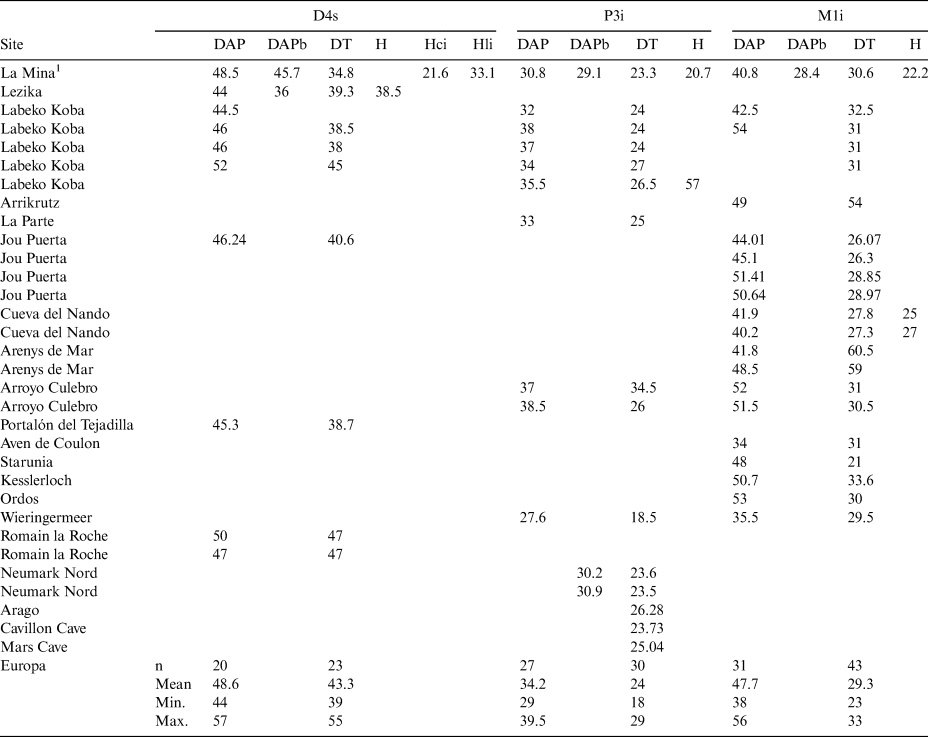
The lower premolar has a deep and open syncline, a short, narrow metaconid and a broad metalophid. The entoconid is more or less at the same level as the metaconid. The metaconid has an anterior position while the metalophid is oriented anteriorly. The anterior valley is wide and has a V-shape, like the posterior one, the latter is similar to S. hemitoechus (Made Reference Made2010). The posterior valley is narrower than the anterior one and has a posterior orientation. This tooth does not present any cingula. Measurements are similar to those of other European Coelodonta. P3 measurements are close to those of specimens from Asturias such as La Parte and Jou Puerta (Table 1) and slightly lower than those from Basque sites such as Labeko Koba.
Measurements of the items recovered at La Mina and their comparison with similar Coelodonta specimens.

1 Own data. (Guérin Reference Guérin1980; Álvarez-Lao Reference Álvarez-Lao2007; Castaños et al. Reference Castaños, Murelaga, Bailon, Castaños, Saez de Lafuente and Suarez2009; Álvarez-Lao Reference Álvarez-Lao2014; Sala et al. Reference Sala, Pablos, Gómez-Olivencia, Sanz, Villalba, Pantoja-Pérez, Laplana, Arsuaga and Algaba2020)
The lower first molar shows a high degree of wear that hinders observation of the morphological features of the occlusal surface. However, the enamel is thick and rough and there are no cingula. This tooth is larger than those from Jou Puerta and similar to those from Labeko Koba (Table 1). In all cases, values are within the ranges analysed by other authors for this species in Europe (Guérin Reference Guérin1980; Álvarez-Lao Reference Álvarez-Lao2007; Sala et al. Reference Sala, Pablos, Gómez-Olivencia, Sanz, Villalba, Pantoja-Pérez, Laplana, Arsuaga and Algaba2020).
Several analyses of age of eruption in white rhinoceros conducted by Bigalke et al. (1950) and Wallach (1962) (in Hillman-Smith et al. Reference Hillman-Smith, Owen-Smith, Anderson, Hall-Martin and Selaladi1986) suggest that the fourth upper decidual appears around 140 days, the third lower premolar from the fourth year (unspecified date) and the first lower molar at around three years. Considering the wear of D4 and m1, we conclude that these items cannot be from the same specimen, and we thus estimate the presence of two individuals. The first one is represented by the fourth upper decidual and the second by the third premolar and the first lower molar due to the similarity with Labeko Koba's mandible.
The first specimen, represented by D4, is between 140 days and eight years old, the eruption age of the fourth upper premolar. Following the criteria developed by Hillman-Smith et al. (Reference Hillman-Smith, Owen-Smith, Anderson, Hall-Martin and Selaladi1986) for the white rhinoceros due to their phylogenetic and ecological similarities (Antoine Reference Antoine2012), also used by Álvarez-Lao (Reference Álvarez-Lao2014), Tong & Wang (Reference Tong and Wang2014) and Fourvel et al. (Reference Fourvel, Fosse, Fernandez and Antoine2015) for the Coelodonta remains recovered at Jou Puerta, Fouvent-Saint-Andoche and Shanshenmiaozui, the wear of this item corresponds to phase V, with an age between 1.5 and 3 years. This age coincides with Garutt's (Reference Garutt1994) observation in his study on the ontogenetic development of the woolly rhinoceros. This author places a similar attrition of D4 in the CII phase with an age between 2 and 3 years. Something different occurs with the second individual, represented by p3 and m1. This last item shows maximum wear with complete loss of enamel on the occlusal surface. According to the Hillman-Smith classification, this would occur in white rhinoceroses from the age of 30 years, phase XV, although the wear of the third premolar would not coincide in any of its phases with those of the first molar. However, if we take as a reference the mandible recovered at Labeko Koba, where a similar wear is observed for both items, p3 and m1, this degree of erosion would be complementary. Álvarez-Lao (Reference Álvarez-Lao2007) assigns an adult–elderly age range for this mandible, including it in his group 3. Due to the similarity with the items from La Mina, its wear is assigned to the same group and therefore the same relative age, an adult–elderly following the phases defined by Borsuk-Bialynicka (Reference Borsuk-Bialynicka1973). According to the mortality curves modified by Bacon et al. (Reference Bacon, Demeter, Duringer, Helm, Bano, Long, Thuy, Antoine, Mai, Nguyen Thi May Huong, Chabaux and Rihs2008) from the data of Hillman-Smith et al. (Reference Hillman-Smith, Owen-Smith, Anderson, Hall-Martin and Selaladi1986), the specimen represented by D4 is a juvenile while the one represented by p3 and m1 is an old adult in the last stage of life.
3. Discussion
The presence of several species from the family Rhinocerotidae is common throughout the European Pleistocene. Several frameworks have been proposed for the distribution of the two main rhinocerotid genera in this period. Fortelius et al. (Reference Fortelius, Mazza and Sala1993) relies on the presence/absence of species at different sites, but without defining their distribution. Sardella et al. (Reference Sardella, Caloi, Di Stefano, Palombo, Petronio, Abbazzi, Azzaroli, Ficcarelli, Mazza, Mezzabotta, Rook, Torre, Argenti, Capasso Barbato, Kotsakis, Gliozzi, Masini and Sala1998) presents data specifically for Italy and Von Koenigswald & Heinrich (Reference Von Koenigswald and Heinrich1999) provide a large amount of data base on the distribution of a large number of species, mainly from central Europe, but without providing specific data on changes between species.
Coelodonta antiquitatis has received various names since the first descriptions of its remains by Pallas (1773). Despite this variety in nomenclature, the morphological characteristics are well established. The lower jugal teeth are small but have high crowns, rough and thick enamel, and paralophids, metalophids and hypolophids separated by valleys (Guérin Reference Guérin1980; Made Reference Made2010). The lower premolars have closed V-shaped valleys with a large difference in level and lack lateral cingula. In the first molar, the valleys are V-shaped in the first molar with a marked difference in height. There are no cingulae, unlike S. hemitoechus in which these are frequent (Guérin Reference Guérin1980, Reference Guérin2010; Made Reference Made2010). The morphological characters observed in the dentition from La Mina, together with the measurements taken, suggest its assignment to the species C. antiquitatis. The upper dentition is generally smaller than Stephanorhinus teeth, with rougher enamel, higher crowns, quadrangular ectolophs, posteriorly directed protocones, shorter hypocones, narrower lingual valleys, deep prefossae and ridges and hooks that tend to isolate the central fossa (Guérin Reference Guérin1980; Made Reference Made2010). The upper fourth decidual from La Mina has closed the middle fossa although the crochet is not well developed. The protoloph and metaloph are oriented anterioposteriorly and there is no lingual cingulum as described by Guérin (Reference Guérin1980).
The arrival of Coelodonta to the Iberian Peninsula seems to have occurred in several waves since the Middle Pleistocene (Álvarez-Lao & García Reference Álvarez-Lao and García2011; Álvarez-Lao Reference Álvarez-Lao2014). The presence of Coelodonta on the Castilian Plateau is an interesting phenomenon, recorded previously at the Peña de Mudá (Palencia) and Portalón del Tejadilla sites (Álvarez-Lao Reference Álvarez-Lao2007; Arceredillo Reference Arceredillo2016; Sala et al. Reference Sala, Pablos, Gómez-Olivencia, Sanz, Villalba, Pantoja-Pérez, Laplana, Arsuaga and Algaba2020). Peña de Mudá was mentioned by Casiano del Prado (1864), who described several rhinoceros’ teeth without assigning them to a specific taxon. This was done by Calderón (1876), who assigned them to Rhinoceros mercki. Álvarez-Lao (Reference Álvarez-Lao2007) assigned one of the four remains at the Geomining Museum (Madrid) to Coelodonta. The lack of data on the deposit, location and dating prevents its designation to a specific context.
The remains from La Mina, initially classified as S. hemitoechus (Diez et al. Reference Diez, Alonso, Bengoechea, Colina, Jorda, Navazo, Ortíz, Pérez and Torres2008), have provided the only dating of the deposit, 52.5 ka. This date places the woolly rhinoceros of La Mina as the oldest of the Iberian Upper Pleistocene, only surpassed by the Middle Pleistocene La Parte site (Álvarez-Lao & García Reference Álvarez-Lao and García-García2006). Sesé & Soto (Reference Sesé, Soto, Panera Gallego and Rubio Jara2002) suggest that the Los Rosales site could also belong to the Middle Pleistocene and Álvarez-Lao & García (Reference Álvarez-Lao and García2010, Reference Álvarez-Lao and García2011) include the remains of Arroyo Culebro in the early Upper Pleistocene. However, neither Los Rosales nor Arroyo Culebro have yielded numerical dates, making the La Mina remains the oldest from the Iberian Upper Pleistocene at present and suggest an earlier arrival in this period.
This new date indicates that Coelodonta entered the Castilian Plateau earlier than traditionally thought. Its presence seems constant throughout OIS 3, with a slight increase between 42 and 39 ka (Fig. 8).
Curve of cumulative probability of radiocarbon dates (AMS) obtained from Iberian deposits with remains of Coelodonta antiquitatis (Blumenbach, 1799), showing amino acid racemisation dating from a molar of the species recovered at Level CM.C3.3 of the La Mina cave. Calibration was done by the IntCal 2020 curve (Reimer et al. Reference Reimer, Austin, Bard, Bayliss, Blackwell, Ramsey, Butzin, Cheng, Edwards, Friedrich, Grootes, Guilderson, Hajdas, Heaton, Hogg, Hughen, Kromer, Manning, Muscheler, Palmer, Pearson, Plicht, Reimer, Richards, Scott, Southon, Turney, Wacker, Adolphi, Büntgen, Capano, Fahrni, Fogtmann-Shulz, Friedrich, Köhler, Kudsk, Miyake, Olsen, Rining, Sakamoto, Sookdeo and Talamo2020) using CalPal software (version 2020) (Weniger & Jöris Reference Weninger, Jöris, Higham, Bronk Ramsey and Owen2004). It is compared with the δ18O GISP2 Hulu Age Model curve (Grootes et al. Reference Grootes, Stuiver, White, Johnsen and Jouzel1993; Meese et al. Reference Meese, Alley, Go, Grootes, Mayewski, Ram, Taylor, Waddongton and Zielinski1994; Wang et al. Reference Wang, Cheng, Edewards, An, Wu, Shen and Dorale2001).

The earliest presence of cold-adapted faunas on the Iberian Peninsula is still not well defined. Evidence of Rangifer tarandus seems to date back to approximately 200 ka at the Mollet site (Álvarez-Lao Reference Álvarez-Lao2007) and >150 ka at La Parte, where the oldest remains of Coelodonta antiquitatis on the Iberian Peninsula have also been found. Mammuthus appeared on the Iberian Peninsula in the Middle Pleistocene, although its greatest expansion occurred around 14 ka. Mammoths only appeared consistently in the record (13 sites between chronologies 14–38 ka) in the 38 ka period, coinciding with the presence of Gulo gulo (Lezetxiki, 21–25 ka), Alopex lagopus (Aitbitarte III, 18–20 ka), Ovibos mochatus (L'Arbreda, 17–18 ka), Saiga tatarica (Abauntz, 13.5 ka) and Rangifer tarandus, whose records are the most abundant of cold fauna with a more or less continuous presence from 80 to 9 ka (Santa Catalina) (Álvarez-Lao Reference Álvarez-Lao2007; Rufi et al. Reference Rufi, Solés, Soler and Soler2018; Rodríguez-Almagro, Reference Rodríguez-Almagro, Sala, Wibing, Arriolabengoa, Etxeberria, Rios-Garaizar and Gómez-Olivencia2021) (Table 2).
Sites where Coelodonta antiquitatis remains have been found on the Iberian Peninsula, location and chronological dates.

Radiocarbon dates provided with their calibration using the IntcCal 2020 curve (Reimer et al. Reference Reimer, Austin, Bard, Bayliss, Blackwell, Ramsey, Butzin, Cheng, Edwards, Friedrich, Grootes, Guilderson, Hajdas, Heaton, Hogg, Hughen, Kromer, Manning, Muscheler, Palmer, Pearson, Plicht, Reimer, Richards, Scott, Southon, Turney, Wacker, Adolphi, Büntgen, Capano, Fahrni, Fogtmann-Shulz, Friedrich, Köhler, Kudsk, Miyake, Olsen, Rining, Sakamoto, Sookdeo and Talamo2020) and using CalPal software (v. 2021) (Weniger & Jöris Reference Weninger, Jöris, Higham, Bronk Ramsey and Owen2004).
La Mina adds a new site with Coelodonta to the 34 presented by Álvarez-Lao (Reference Álvarez-Lao2014) and Rodríguez-Almagro et al. (Reference Rodríguez-Almagro, Sala, Wibing, Arriolabengoa, Etxeberria, Rios-Garaizar and Gómez-Olivencia2021) and a new dating to the 14 previously dated sites (53 dates). This discovery raises two new aspects, not only regarding the distribution of this genus but also the possible access routes to the Castilian Plateau during the Palaeolithic. Álvarez-Lao & García (Reference Álvarez-Lao and García2011) discuss three detected entries for this species to the Iberian Peninsula, one in the Middle Pleistocene and two in the Upper Pleistocene (three including Arroyo Culebro). The first of the Upper Pleistocene took place between 41 and 36 ka at sites such as Labeko Koba and Covacho Arenillas; and the second between 32 and 20 ka with deposits such as Leguintxiki, Abauntz, Cueva del Cuco, Lezetxiki and Jou Puerta (Álvarez-Lao & García Reference Álvarez-Lao and García2010; Álvarez-Lao Reference Álvarez-Lao2014). The new record and dates push back the arrival of this taxon to the Iberian Peninsula by at least 10 ka. The possible absence of material between 53 and 100 ka could be due to either an absence of this species on the Iberian Peninsula or the fact that the period is outside the carbon-14 limit, which restricts dating in some cases.
The discovery of frozen individuals in the Siberian permafrost has provided further insight into their anatomy, suggesting poor adaptation to extremely snowy environments due to their short legs and lack of hooves or pads (Kingdon Reference Kingdon2008). The remains recovered in their soft tissues show high contents of Asteraceae and other shrubby plants (Boeskorov et al. Reference Boeskorov, Lazarev, Sher, Davydov, Bakulina, Shchelchkova, Binladen, Willerslev, Buigues and Tikhonov2011). These data were confirmed by Tiunov & Kirillova's (Reference Tiunov and Kirilova2010) studies of carbon (13C/12C) and nitrogen (15N and 14N) isotopes in Siberian specimens. The analysis of these isotopes has also reflected possible changes in the seasonal composition of the diet. A closer isotopic study was carried out by Rodríguez-Almagro et al. (Reference Rodríguez-Almagro, Sala, Wibing, Arriolabengoa, Etxeberria, Rios-Garaizar and Gómez-Olivencia2021) on the remains recovered at Mainea (OIS 3). The woolly rhinoceros’ representatives from this site lived in environments dominated by the mammoth steppe. No other species associated with cold climates have been located at La Mina, in contrast to other Cantabria deposits at low altitudes. Analyses of pollen remains from sites where woolly rhinoceros remains have been recovered on the Iberian Peninsula, with the caution of chronological difference, reveal a great variety of landscapes, large forests and open environments (Iriarte Reference Iriarte2000; Álvarez-Lao et al. Reference Álvarez-Lao, Ruiz-Zapata, Gil-García, Ballesteros and Jiménez-Sánchez2015; Rivals & Álvarez-Lao Reference Rivals and Álvarez-Lao2018; Rodríguez-Almagro et al., Reference Rodríguez-Almagro, Sala, Wibing, Arriolabengoa, Etxeberria, Rios-Garaizar and Gómez-Olivencia2021). It would therefore be interesting in the future to design studies to better understand the ecological capabilities of Coelodonta from the more forested ecosystems near the coast from those at higher altitudes and with more steppe-like potential ecosystems (Rodríguez-Almagro et al., Reference Rodríguez-Almagro, Sala, Wibing, Arriolabengoa, Etxeberria, Rios-Garaizar and Gómez-Olivencia2021). Two nearby sites in the same region, La Ermita and Cueva Millán, which are also located in the same OIS 3 (59–27 ka), contained ecosystems dominated by temperate forest landscapes with deciduous forests with small patches of conifers and open spaces with herbaceous plants (Moure & García Soto Reference Moure and García Soto1983). In Millán, pine, oak and birch have been identified, as well as different aquatic species and eight herbaceous taxa (Moure & García Soto Reference Moure and García Soto1983). The presence of Eliomys quercinus, Microtus duodecimcostatus, Microtus agrestris and Microtus nivalis in Millán and La Ermita confirm the presence of these open or semi-open environments (Moure & García Soto Reference Moure and García Soto1983; López García Reference López García, Cambra-Moo, Martínez Pérez, Chamero Macho, Escaso Santos, de Esteban Trivigno and Marugán Lobón2007). The faunal records and taphonomic evidence recorded in these two deposits suggest an occupation in temperate phases (Diez et al. Reference Diez, Alonso, Bengoechea, Colina, Jorda, Navazo, Ortíz, Pérez and Torres2008).
Currently, 32 of the 34 sites with woolly rhinoceros remains of the Iberian Peninsula have been located in the north: 23 in the Cantabrian region; six in Catalonia; and three on the Castilian Plateau. The other two are in the centre, in Madrid. According to Delpech (Reference Delpech1983), populations of woolly rhinoceros entered the Iberian Peninsula by crossing the Pyrenees at the western and eastern extremities, and occupied the Cantabrian and Catalan regions, respectively. These access routes have also been taken into account by Arrizabalaga & Ríos-Garaizar (Reference Arrizabalaga and Ríos-Garaizar2012), who added that after crossing these areas, fauna roamed freely and occupied other territories, but always followed the same geographical axes. These authors propose several mountains passes between the Cantabrian coast, the plains of Alava and the Ebro valley, which were later connected to the Castilian Plateau. These passes were widely used by human groups and were also probably favourable for fauna passage, as many of these groups followed herds and established their settlements in passing places. We can therefore infer two possible access routes to the Castilian Plateau from both extremes of the Pyrenees: from the west, through the upper Ebro valley; and from the east, through the Egea and Arga valleys.
These two possibilities could explain the presence of woolly rhinoceros on the Castilian Plateau and also the remains found in the centre of the Peninsula. An additional possibility may have been through the Cantabrian mountains range via passes such as Palombera, San Glorio, Piedrasluengas, El Escudo, Estacas de Trueba, La Lunada or La Sía. All of these passes are close to the Prado Vargas and Peña de Mudá deposits. Díez Fernández-Lomana & Navazo (Reference Díez Fernández-Lomana, Navazo, Montes and Lasheras2005, Fig. 7) suggest several passes through this mountain range, which were maintained during the Upper Palaeolithic (La Palomera, Ojo Guareña, Penches, La Blanca, etc.) and in historical times. This could explain the presence of remains at the Peña de Mudá and Portalón del Tejadilla sites, opening up further possibilities for the population of the Castilian Plateau as also suggested by Rodríguez-Almagro et al. (Reference Rodríguez-Almagro, Sala, Wibing, Arriolabengoa, Etxeberria, Rios-Garaizar and Gómez-Olivencia2021) (Fig. 9).
Possible access routes from the Pyrenees to the Iberian Peninsula, and proposed access routes to the Castilian Plateau. (a) Cantabrian coast. (b) Access to the Ebro Valley. (c) Mediterranean coast. Red numbers indicate possible access passes from the Cantabrian region to the Castilian Plateau: (1) La Sía, (2) Lunada, (3) Estacas de Trueba, (4) Escudo, (5) Palombera, (6) Piedrasluengas and (7) San Glorio. Green numbers indicate Upper Palaeolithic sites closed to La Mina and sites with Coelodonta antiquitatis in the Castilian Plateau. (1) La Mina. (2) La Palomera. (3) Ojo Guareña. (4) Penches. (5) Peña de Mudá. (6) Portalón del Tejadilla.

4. Conclusions
In this paper we present a new deposit containing cold-adapted fauna in the Spanish Castilian Plateau. New evidence describes, illustrates and characterises both taxonomically and metrically the new records of C. antiquitatis. On the Iberian Peninsula, the woolly rhinoceros has been found in 34 deposits, most of them located in the Cantabrian region. The rest of the deposits are located in the Levant and central Iberia, with two deposits to date on the Castilian Plateau.
Dating obtained from one of the rhinoceros’ teeth from the site permits the addition of another access point to the two previously recorded for this species during the Upper Pleistocene. This date pushes back the arrival of Coelodonta to Iberia during this period by 10 ka, placing it in a region in which remains from Mudá and Portalón del Tejadilla were its only representatives. This location on the Castilian Plateau, together with the dating obtained, may help us to understand the possible access routes of cold-adapted fauna to this area. Further analysis will be necessary to fully comprehend these arrivals and to complete the map of cold-adapted fauna in a region where deposits from this period, corresponding to OIS 3, are not very abundant.
5. Acknowledgements
We thank Jan van der Made, Alfonso Arribas, Antonio Sánchez and Marcos Terradillos for their help in the identification of the fauna and the characterisation of the lithic industry. We are also grateful to the La Mina excavation team.
6. Financial support
Our study was supported by Project CGL2006-13532-C03/BTE ‘Gestión del territorio en el Paleolítico medio del área centroriental de Castilla y León por medio del estudio de fuentes y productos líticos’ funded by the Consejería de Educación de la Junta de Castilla y León.
7. Competing interests
None.