


Introduction
Cognitive behavioural therapy (CBT) has become established as an evidence-based treatment for reducing the emotional and behavioural impact of medication-resistant psychotic phenomena such as hallucinations and delusions in schizophrenia (National Institute for Clinical Excellence, 2009; Wykes, Steel, Everitt and Tarrier, Reference Wykes, Steel, Everitt and Tarrier2008). However, up to 50% of people fail to respond to this therapy (Garety, Fowler and Kuipers, Reference Garety, Fowler and Kuipers2000). In order to facilitate the recovery of people who have ongoing distressing psychotic experiences there is a need to understand what the barriers are to benefiting from psychological treatment.
In spite of there being over 30 randomized controlled trials of CBT for psychosis (Wykes et al., Reference Wykes, Steel, Everitt and Tarrier2008), there have been relatively few reports of predictors of outcome. Some trials have reported that people with more severe and longstanding experiences of psychosis are less likely to show improvement following CBT (Durham et al., Reference Durham, Chambers, Power, Sharp, MacDonald, Major, Dow and Gumley2005; Tarrier et al., Reference Tarrier, Yusupoff, Kinney, McCarthy, Gledhill, Haddock and Morris1998), but these factors were identified as applying to both CBT and control treatments, rather than specifically applying to CBT. Identification of these broad variables also has limited implications for how to improve therapy outcomes. Of more clinical importance are specific clinical characteristics that may predict therapy response. A study of a wide range of predictors was conducted as part of one of the earlier clinical trials of CBT for psychosis (Garety et al., Reference Garety, Fowler, Kuipers, Freeman, Dunn, Bebbington, Hadley and Jones1997). This study's key finding was that post-treatment outcome was related to a pre-therapy measure of whether service users could acknowledge the possibility that they were mistaken in their delusional beliefs, and also to a dimension of insight relating to awareness of the social disability associated with psychosis. Other variables, including IQ, verbal fluency, and probabilistic reasoning, were found to be unrelated to outcome. Another more comprehensive examination of predictors of outcome was conducted on data from the Insight into Schizophrenia Trial (Turkington, Kingdon and Turner, Reference Turkington, Kingdon and Turner2002), which examined a brief course of six sessions of CBT for psychosis delivered by community psychiatric nurses; higher levels of delusional conviction and lower overall levels of insight predicted poorer outcome (Brabban, Tai and Turkington, Reference Brabban, Tai and Turkington2009; Naeem, Kingdon and Turkington, Reference Naeem, Kingdon and Turkington2008).
These findings, relating to the overlapping constructs of strong delusional conviction, and lack of insight into psychotic experiences as mentally generated, suggest that CBT for psychosis may be less successful when people hold rigid delusional explanations of their experiences. This has been interpreted as there being a need for a “chink of insight” to conduct belief modification with people experiencing the reality distortion inherent in psychosis (Garety et al., Reference Garety, Fowler and Kuipers2000). This has received support from a qualitative study of experiences of therapists delivering CBT for psychosis (McGowan, Lavender and Garety, Reference McGowan, Lavender and Garety2005). However, a difficulty in interpreting these findings is that they have been from trials of CBT for persisting positive symptoms in general, which may have involved addressing either delusions, hallucinations, or both in combination. Consequently, it is unclear whether insight and belief conviction are important solely in the treatment of delusions or also when hallucinations are the focus of therapy. Indeed, if poor insight and high delusional conviction impede the process of belief modification, this might not be a barrier to successful therapy if applying more behavioural methods such as coping strategy enhancement (Tarrier et al., Reference Tarrier, Beckett, Harwood, Baker, Yusupoff and Ugarteburu1993). A further limitation of studies combining CBT for delusions and hallucinations is that measurement of outcome has been reliant upon the use of broad mental state measures such as the Positive and Negative Syndrome Scale (Kay, Opler and Lindenmayer, Reference Kay, Opler and Lindenmayer1987), which may be relatively insensitive to treatment effects on the specific symptoms targeted by therapy. Together with heterogeneity arising from differences in service user presentation and more than one potential focus of therapy, this may lead to further specific predictor effects being obscured.
Another strategy in examining predictors of outcome is to study CBT delivered for a specific target symptom. Auditory hallucinations, typically experienced as hearing voices, are one of the most common such targets, and they represent a discrete phenomenon for which more focused measures are available. Examining CBT for voices allows the role of belief conviction and insight to be clarified with this particular symptom. Also, by examining therapy targeted at a specific phenomenon with a dedicated outcome measure, other sources of variability in outcome are reduced, which may highlight other predictor variables.
A starting point in examining predictors of outcome in CBT for voices is to examine the influence of other psychotic phenomena on outcome. The symptoms of schizophrenia have been conceptualized in terms of three statistically-derived symptom clusters, which relate to distortion of reality, disorganization and negative symptoms (Liddle, Reference Liddle1987). Reality distortion symptoms include hallucinations, together with delusions and lack of insight. It is typical for auditory hallucinations to be associated with delusional beliefs about the origins and identity of voices (Chadwick and Birchwood, Reference Chadwick and Birchwood1994). It is possible that strong conviction in these beliefs may present a barrier, not only to modifying these beliefs themselves, but also to restructuring related beliefs about voice power and control over the experience (Chadwick and Birchwood, Reference Chadwick and Birchwood1994; Trower et al., Reference Trower, Birchwood, Meaden, Byrne, Nelson and Ross2004). Similarly, lack of insight into the origins of voices as internally generated may make it more difficult to establish a rationale for a psychological treatment, which may hinder formation of a working alliance.
Disorganization most frequently manifests as formal thought disorder, which often involves the person's speech frequently slipping into loosely related or unrelated topics. This may present a problem in the process of therapy as the person may be hard to direct through Socratic dialogue, and may have difficulties following the thread of therapy.
Negative symptoms such as affective blunting, amotivation and poverty of thought may make it difficult for the therapist to establish a working alliance with the service user and for the service user to engage in the sessions and complete between-session exercises. Indeed, a non-significant trend has been observed for affective blunting to be associated with a poorer outcome in CBT for psychosis (Brabban et al., Reference Brabban, Tai and Turkington2009), suggesting that further study of negative symptoms is warranted.
The present study provides an examination of these potential predictors of outcome in an open trial of CBT for auditory hallucinations within a specialist clinic.
Method
Participants
Participants were people seen in a specialist outpatient clinic providing CBT for auditory hallucinations to people referred by public mental health services, private psychiatrists and general practitioners alongside their routine care. Inclusion criteria were: (a) a diagnosis of a schizophrenia or schizoaffective disorder; (b) current auditory hallucinations in the form of voices, occurring at least once per week; (c) voices associated with significant subjective distress; (d) history of voices for at least one year; and (e) currently prescribed antipsychotic medication. Of the 33 participants, 21 (64%) were male and the overall mean age was 36.4 years (SD 8.99). Ten (30%) were in paid or voluntary employment. Participants reported hearing voices for an average of 13.5 years (SD 8.23). All participants had already been trialled on at least two separate antipsychotics prior to the outset of therapy.
Therapy
Participants received weekly to fortnightly treatment sessions up to a maximum of 24 sessions, with a mean therapy length of 12.1 (SD 5.98) sessions. In all, 26 participants received therapy from a clinical psychologist with 7 years’ experience of CBT for psychosis, and the remaining 7 participants received therapy from other psychologists under fortnightly supervision of the main therapist. Therapy was based upon the manual of Fowler, Garety and Kuipers (Reference Fowler, Garety and Kuipers1995) and broader literature on the psychological treatment of auditory hallucinations (e.g. Chadwick and Birchwood, Reference Chadwick and Birchwood1994; Morrison and Renton, Reference Morrison and Renton2001; Tarrier, Reference Tarrier, Birchwood and Tarrier1992). This included the development of a formulation based upon assessment of voice phenomenology, other psychotic symptoms, antecedents of and responses to hearing voices, and appraisals of voices that may mediate distress. This formulation was used to guide treatment, incorporating elements of building an adaptive shared understanding of hallucinatory experience, coping enhancement, developing adaptive responses to voices, and modifying appraisals relating to distress through Socratic questioning and behavioural experiments.
Measures
The following therapist-administered measures were completed at the beginning and end of therapy:
The Psychotic Symptom Rating Scales (PSYRATS; Haddock, McCarron, Tarrier and Faragher, Reference Haddock, McCarron, Tarrier and Faragher1999) is an interview-based set of clinician rating scales, comprising 11 5-point items assessing different dimensions of voice experience, such as frequency, distress, impact upon functioning. The total score was used as the main outcome measure, and the beliefs about origins of hallucinations scale (item 5) was used to assess strength of belief that voices heard are of external origin. High scores on this item correspond to strong delusional conviction that voices are externally generated, and low scores correspond to complete belief that voices are internally generated. The inter-rater reliability of the PSYRATS is excellent, including for specific items, and it shows good test-retest reliability and validity (Haddock et al., Reference Haddock, McCarron, Tarrier and Faragher1999; Drake, Haddock, Tarrier, Bentall and Lewis, Reference Drake, Haddock, Tarrier, Bentall and Lewis2007).
Positive and Negative Syndrome Scale (PANSS; Kay et al., Reference Kay, Opler and Lindenmayer1987) is an interview-based measure of positive and negative psychotic symptoms, and other symptoms associated with psychosis, on three scales (positive, negative and general), comprising 30 7-point items. The negative syndrome scale was used to index negative symptoms, and the cognitive disorganization item (P2) was used to assess formal thought disorder. The PANSS shows excellent inter-rater reliability and validity (Bell, Milstein, Beam-Goulet, Lysaker and Cicchetti, Reference Bell, Milstein, Beam-Goulet, Lysaker and Cicchetti1992; Kay, Opler and Lindenmayer, Reference Kay, Opler and Lindenmayer1988).
The Schedule for the Assessment of Insight (SAI; David, Buchanan, Reed and Almeida, Reference David, Buchanan, Reed and Almeida1992) is a clinician rating scale assessing three dimensions of insight into illness (awareness of illness, treatment compliance, and relabelling psychotic experiences) with a total score of 0–14; it has good inter-rater reliability and validity (David et al., Reference David, Buchanan, Reed and Almeida1992).
Results
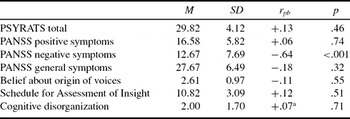
Twenty-eight participants (85%) remained in the study and completed post-treatment assessments. Mean scores on the main measures at pre-treatment are presented in Table 1. Scores on each of the scales used were normally distributed, with the exception of PANSS Negative, which was transformed using a logarithmic function for analyses, and cognitive disorganization for which non-parametric statistics have been used. Including all 33 participants in the analysis, assuming no change in those who dropped out, participants showed improvements on PSYRATS (mean change −5.09, 95% CI −7.31 to −2.87, t(32) = 4.633, p < .001, Cohen's d = 1.24), PANSS Positive (mean change −2.79, 95% CI −3.97 to −1.61, t(32) = 4.818, p < .001, Cohen's d = 0.48) and PANSS General (mean change = −2.67, 95% CI −4.40 to −0.93), t(32) = 3.128, p = .004, Cohen's d = 0.76) scales at the end of treatment. There was no significant post-treatment change on PANSS Negative (mean change = −0.33, 95% CI −1.31 to +0.64, t(32) = 0.030, p = .98, Cohen's d = 0.02).
Pre-treatment scores on measures and correlations with outcome

Notes: Positive correlations represent associations with better outcome. n = 33.
a rank biserial correlation.
Outcomes of therapy were dichotomized according to whether an improvement of five points or more was obtained on the PSYRATS Auditory Hallucinations Scale. This corresponds to reliable change calculated from test-retest reliability data on the PSYRATS (Drake et al., Reference Drake, Haddock, Tarrier, Bentall and Lewis2007). Drop-outs were initially included in this analysis in order to provide an estimate of whether therapy had been effective on an intention-to-treat basis, assuming that drop-outs had not benefited. According to this criterion, 16 (49%) participants showed improvement. To provide a standard effect size estimate across different types of data, correlation coefficients were calculated for each predictor variable's association with outcome, using point-biserial coefficients for normally distributed variables, rank-biserial coefficient for cognitive disorganization, and phi coefficients for categorical predictors.
Outcome was not significantly related to sex (Φ = −.28, Yates’ χ 2 = 1.483, p = .22), employment status (Φ = .28, Fisher's exact p = .14), or age (rpb = −.29, p = .11), but did show a trend to be associated with length of illness (rpb = −.33, p = .06), with better outcomes for a shorter duration of illness. Outcome was not related to whether participants were seen by the main therapist or another therapist (Φ = .21, Fisher's exact p = .40).
The correlations between hypothesized predictor variables and outcome are presented in Table 1. There was no association between outcome and either insight or conviction that hallucinations were externally generated. Examination of individual dimensions of insight on the SAI likewise revealed no statistically significant predictors of outcome. Similarly, there was no association between outcome and cognitive disorganization.
Conversely, overall negative symptoms showed a statistically significant correlation with outcome. Exploration of the association between individual PANSS negative scale items and outcome found that all items showed at least a trend (p < .06) to be associated with outcome (rrb = .33 to .57), with the strongest effect sizes for items N2 (emotional withdrawal, rrb = .57), N4 (passive apathetic social withdrawal, rrb = .46) and N3 (poor rapport, rrb = .45). Outcome was not correlated with depression (PANSS item G6).
Repeating the analysis including only the 28 participants who completed therapy found a similar pattern of results: of the hypothesized predictors, only negative symptoms correlated with outcome at a statistically significant level (rpb = −.60, p = .001). However, in this analysis, outcome also correlated with both age (rpb = −.41, p = .03), and length of illness (rpb = −.38, p = .05). When controlling for age, length of illness and the number of therapy sessions attended, negative symptoms remained a statistically significant predictor of outcome (partial rpb = −.43, p = .03).
Data on medication doses pre- and post-treatment were available for 24 of the 28 completers, and was examined in order to consider medication changes as a potential confounding variable influencing outcome. Only one participant switched to a different antipsychotic during therapy, and in the group as a whole average chlorpromazine-equivalent doses did not change significantly from pre- to post-therapy (pre: M = 793.1 mg, SD = 468.6 mg; post M = 768.1 mg, SD = 473.8 mg; t(23) = 0.518, p = .61). Within-participant changes in dose were not significantly related to outcome (rpb = −.28, p = .18).
Discussion
The study observed post-treatment improvements in hallucination severity when auditory hallucinations are a specific target of psychological treatment. Whilst the study was uncontrolled, these improvements arose independent of medication changes in a sample with longstanding treatment-resistant symptoms. This adds to findings from initial case series (e.g. Chadwick and Birchwood, Reference Chadwick and Birchwood1994) and trials (Haddock, Slade, Bentall, Reid and Faragher, Reference Haddock, Slade, Bentall, Reid and Faragher1998; Trower et al., Reference Trower, Birchwood, Meaden, Byrne, Nelson and Ross2004), suggesting CBT to be an effective treatment for auditory hallucinations. In contrast to many previous studies that have focused on a specific element of CBT for auditory hallucinations, such as promoting recognition that voices are internally generated (Haddock et al., Reference Haddock, Slade, Bentall, Reid and Faragher1998), or restructuring beliefs about voice power (Trower et al., Reference Trower, Birchwood, Meaden, Byrne, Nelson and Ross2004), this study examined a formulation-driven approach incorporating elements of these different approaches according to the person's presentation. Such an approach is widely advocated in treatment manuals (e.g. Fowler et al., Reference Fowler, Garety and Kuipers1995; Morrison, Renton, Dunn, Williams and Bentall, Reference Morrison, Renton, Dunn, Williams and Bentall2004), and is likely to be more reflective of the delivery of CBT for voices in service settings. Hence, although the content of therapy was less standardized, the study has good ecological validity, which is particularly useful in considering predictors of outcome relevant to routine provision of therapy.
When examining predictors of outcome, key factors that were hypothesized as barriers to effective therapy did not emerge as such, with findings suggesting that CBT can be effective with voice hearers in spite of lack of insight, high delusional conviction or cognitive disorganization. The finding that outcome was unrelated to insight and belief conviction was in contrast to previous findings related to delusions. Whilst working with delusions is heavily reliant upon belief modification, CBT for voices may incorporate a wider range of therapeutic interventions, including the enhancement of coping strategies (Farhall, Greenwood and Jackson, Reference Farhall, Greenwood and Jackson2007; Tarrier et al., Reference Tarrier, Beckett, Harwood, Baker, Yusupoff and Ugarteburu1993) and promoting disengagement from voices (Haddock et al., Reference Haddock, Slade, Bentall, Reid and Faragher1998). In addition, cognitive restructuring need not target beliefs about whether voices are real or hallucinatory, and may work effectively within the person's explanatory model to target beliefs such as the voices’ ability to harm the person, or the person's level of control over the experience (Trower et al., Reference Trower, Birchwood, Meaden, Byrne, Nelson and Ross2004). It seems possible that by having a number of avenues of intervention available, therapists were able to bypass rigidity in beliefs that voices were real. Indeed, some emerging developments in psychological interventions to promote acceptance of or alter relationships with voices do not involve belief modification (e.g. Gaudiano and Herbert, Reference Gaudiano and Herbert2006; Hayward, Overton, Dorey and Denney, Reference Hayward, Overton, Dorey and Denney2009; Shawyer, Farhall, Sims and Copolov, Reference Shawyer, Farhall, Sims, Copolov, Jackson and Murphy2005). Further study is required to clarify how the therapy process may be influenced by the levels of insight and delusional conviction, and specifically whether these lead to different therapeutic strategies being employed. However, given that insight has been suggested as a predictor of outcome, an important implication of findings is that lack of insight may not be a specific barrier to effective treatment of auditory hallucinations, and at the present time should not be used to judge suitability for treatment when delusions are not the focus of therapy.
These considerations similarly apply to cognitive disorganization. Again, there may be ways in which therapists use alternative routes such as a focus on more behavioural methods when service users exhibit high levels of disorganized speech and thinking. It may also be that the cognitive elements of therapy are helpful in assisting the person to develop a clearer understanding of their psychotic experiences, which their disorganized thinking makes it hard to attain. Indeed, there is some evidence that levels of cognitive disorganization may reduce following CBT (Tarrier et al., Reference Tarrier, Kinney, McCarthy, Wittkowski, Yusupoff, Gledhill, Morris and Humphreys2001). Further study may also help clarify this.
In contrast, negative symptoms emerged as a strong pre-therapy predictor of outcome. This was above any effect on drop-out, indicated by this association being maintained when analysing only completers and when controlling for number of sessions. This effect also appeared to be independent of length of illness. These data are consistent with the finding of a trend for affective blunting to be associated with poorer outcome in a trial of brief CBT for psychosis (Brabban et al., Reference Brabban, Tai and Turkington2009). It may be that negative symptoms are a barrier to treatment specific to hallucinations, although it would be important to verify this association in other studies. Further study might also determine in more detail the specific barriers that may arise in people with negative symptomatology. For example, whilst the reasons for this association cannot be determined from the current data, it is possible to speculate that aspects of the negative syndrome interfere with engagement in therapy and manifest in measurable factors such as rapport with the therapist, session attendance and completion of homework. This might lead to modifications of CBT to compensate for the presence of negative symptoms, such as use of more behavioural methods, or to parallel intervention that also addresses negative symptoms (e.g. Rector, Beck and Stolar, Reference Rector, Beck and Stolar2005). Alternatively, it might be that therapies based upon direct cognitive remediation (e.g. Favrod, Vianin, Pomini and Mast, Reference Favrod, Vianin, Pomini and Mast2006) and more intensive coaching in coping with voices may be more suited to this population than therapies reliant upon a primarily verbal therapy.
It should, however, be noted that the negative syndrome is not a unitary construct, and reflects a range of symptoms, including aspects of subjective emotional experience, affect, thinking and behaviour. Data from this study using the PANSS, which does not provide a fully comprehensive measure of negative symptomatology, were too limited to be able to clearly delineate the specific aspects of the negative syndrome most predictive of outcome. Furthermore, whilst often characterized as representing core deficit psychopathology associated with schizophrenia (e.g. Kirkpatrick, Buchanan, Ross and Carpenter, Reference Kirkpatrick, Buchanan, Ross and Carpenter2001), the negative syndrome has also been conceptualized as an adaptational response to living with psychosis (and the associated responses of others), which may be related to factors such as defeatism and anticipation of social exclusion (e.g. Rector et al., Reference Rector, Beck and Stolar2005). More precise measurement of such constructs in future study may be more informative of targets for improving the effectiveness of therapy.
Limitations of this study include the small sample size. This resulted in reduced power to consider the relative importance of age and length of illness in predicting outcome. However, there were no non-significant findings for the hypothesized clinical predictors with estimated effect sizes of r = 0.20 or more, which reduces the likelihood that clinically meaningful effects for these variables were undetected due to lack of power. The study did not include a control therapy condition, so the possibility that pre-treatment negative symptoms predicted poorer spontaneous improvement as opposed to being a barrier specific to CBT cannot be ruled out. In the absence of a control condition, assessments could not be masked, and were completed by therapists, which may have introduced bias. Long-term follow-up was not conducted, so findings are specific to post-treatment outcome, and may not apply to the durability of therapy effects.
Whilst bearing these limitations in mind, our findings suggest that therapists should consider the possible impact of negative symptoms when addressing the specific therapeutic target of auditory hallucinations.
Acknowledgements
This research was conducted at the Mental Health Research Institute of Victoria, funded by the William Buckland Foundation. We would also like to acknowledge the support of the mental health services of Melbourne Health, Mercy Health and St Vincent's Hospital Melbourne.



Comments
No Comments have been published for this article.