Anomalous origin of the left coronary artery from the pulmonary artery is a rare congenital cardiac malformation accounting for 0.25–0.50% of children with congenital cardiac disease.Reference Ojala, Salminen, Happonen, Pihkala, Jokinen and Sairanen1–Reference Backer, Stout and Zales3 Brooks first described the anatomy of anomalous origin of the left coronary artery from the pulmonary artery in 1886 at Trinity College in Dublin.Reference Brooks4 Bland, White, and Garland described the typical clinical presentation in 1933.Reference Bland, White and Garland5 The natural history is poor, and if left untreated in infancy, the mortality rate can reach 90%.Reference Dodge-Khatami, Mavroudis and Backer2, Reference Wesselhoeft, Fawcett and Johnson6, Reference Arciniegas, Farooki, Hakimi and Green7 Among those who survive to adulthood, there is an 80–90% incidence of sudden death by the age of 35 years, with acute ischaemic myocardial infarction or malignant arrhythmia as the cause of death.Reference Arciniegas, Farooki, Hakimi and Green7–Reference Fernandes, Kadivar, Hallman, Reul, Ott and Cooley14
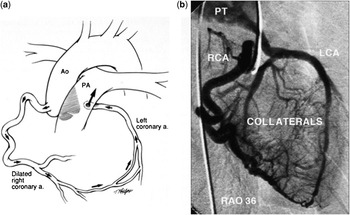
EdwardsReference Edwards15 first described the pathophysiology of anomalous origin of the left coronary artery from the pulmonary artery in 1964.Reference Edwards15 With foetal circulation, both the aorta and the pulmonary artery are at equal systemic pressure and pulmonary arterial blood is only slightly less saturated than the aortic blood. Therefore, the anomalous origin of the coronary artery in utero is of no consequence and patients are born with normal cardiac structure and function. As the arterial duct closes, the pulmonary arterial pressure declines, as does the pressure in the anomalous left coronary artery arising from the pulmonary artery. Flow of blood in the anomalous left coronary artery eventually moves retrograde into the pulmonary artery, resulting in a left-to-right shunt and coronary arterial steal (Fig 1).Reference Nichols, Ungerleider and Spevak16, Reference Takimura, Nakamoto, Hotta, Campos, Malamo and Otsubo17 Coronary arterial steal leads to inadequate left coronary arterial perfusion resulting in
• myocardial ischaemia,
• left ventricular dysfunction,
• dysfunction of the papillary muscles,
• left ventricular dilatation, and
• mitral regurgitation.Reference Brown, Ruzmetov, Parent, Rodefeld and Turrentine18
Pathophysiology of anomalous origin of the left coronary artery from the pulmonary artery. After birth, the arterial duct closes and pulmonary arterial pressure declines, as does the pressure in the proximal left coronary artery that originates from the pulmonary artery. Flow in the anomalous left coronary artery moves retrograde into the pulmonary artery, resulting in a left-to-right shunt and coronary arterial steal. This steal leads to inadequate perfusion of the left coronary artery, resulting in myocardial ischaemia, left ventricular dysfunction, dysfunction of the papillary muscles, left ventricular dilatation, and mitral regurgitation. In the patient who survives into childhood with anomalous origin of the left coronary artery from the pulmonary artery, myocardial perfusion depends on collateral flow from the right coronary artery to the left coronary arterial system. The degree of cardiac ischaemia is variable and depends on two main factors: the pattern of coronary arterial dominance and the development of intercoronary arterial collaterals (reproduced with permission from Nichols et alReference Nichols, Ungerleider and Spevak16 and Takimura et alReference Takimura, Nakamoto, Hotta, Campos, Malamo and Otsubo17).

In the patient who survives into childhood with anomalous origin of the left coronary artery from the pulmonary artery, myocardial perfusion is reliant on collateral flow from the right coronary artery to the left coronary arterial system. The degree of cardiac ischaemia is variable and depends on two main factors: coronary arterial dominance and the development of intercoronary collaterals.Reference Arciniegas, Farooki, Hakimi and Green7, Reference Moodie, Fyfe and Gill11–Reference Alexi-Meskishvili, Berger, Weng, Lange and Hetzer13, Reference Agustsson, Gasul, Fell, Graettinger, Bicoff and Waterman19 A restrictive opening between the pulmonary artery and the anomalous origin of the left coronary artery from the pulmonary artery, which limits coronary steal, has been identified in survivors who reach adulthood.Reference Bland, White and Garland5, Reference Arciniegas, Farooki, Hakimi and Green7, Reference Berdjis, Takahashi, Wells, Stiles and Lindesmith12, Reference Agustsson, Gasul, Fell, Graettinger, Bicoff and Waterman19
Infants usually have onset of symptoms days to weeks following birth as pulmonary arterial pressure begins to fall. The presentation is that of congestive cardiac failure with tachypnoea, respiratory distress, diaphoresis, pallor, poor feeding, paroxysms of crying, and agitation.Reference Moodie, Fyfe and Gill11, Reference Edwards15 These patients can be difficult to distinguish from those with myocarditis or dilated cardiomyopathy. When the child survives past infancy, the diagnosis is suspected in the patient with moderate left ventricular dysfunction, mitral regurgitation, or ischaemic symptoms with exercise.Reference Raisky, Roubertie, Ali and Vouhe20 Children and adults can present with episodic angina and symptoms of congestive cardiac failure, or they may be asymptomatic until they present with sudden death. Among adults with anomalous origin of the left coronary artery from the pulmonary artery, sudden death can be the initial presentation in 80–90%.Reference Dodge-Khatami, Mavroudis and Backer2
Diagnosis
The diagnosis of anomalous origin of the left coronary artery from the pulmonary artery must be suspected in any infant presenting with left ventricular dysfunction and mitral regurgitation. The chest roentgenogram will show marked cardiomegaly. The electrocardiogram is usually consistent with a myocardial infarction involving the anterolateral wall.Reference Arciniegas, Farooki, Hakimi and Green7 The diagnosis is nearly always made by echocardiography. Briefly, echocardiography shows
• left ventricular dilatation and hypokinesis,
• a left-to-right shunt from the anomalous left coronary arterial ostium,
• retrograde flow in the proximal left coronary arteries, and/or
• signals of colour flow in the interventricular septum consistent with coronary arterial collaterals.Reference Backer, Stout and Zales3, Reference Arciniegas, Farooki, Hakimi and Green7, Reference Frommelt, Miller, Williamson and Bergstrom21
Cardiac catheterisation and multi-slice computed tomography may rarely be needed to confirm the diagnosis.Reference Arciniegas, Farooki, Hakimi and Green7 Cardiac catheterisation, when used, is a sensitive technique of imaging that will show the absence of aortic origin of the left coronary artery.Reference Backer, Stout and Zales3 Retrograde flow in the left coronary artery is supplied by collaterals from a normally arising right coronary artery, which is usually markedly dilated. Left ventriculography shows a dilated, hypokinetic left ventricular chamber, often with mitral valvar regurgitation.
Surgical management
The evolution of surgical management of patients with anomalous origin of the left coronary artery from the pulmonary artery is marked by procedures directed at ameliorating the pathophysiology such as
• banding of the pulmonary artery,
• ligation of the left coronary artery, and
• restoring antegrade flow in the left coronary artery through the use of bypass grafts of brachiocephalic vessels.Reference Kittle, Diehl and Heilbrunn22–Reference Meyer, Stefanik, Stiles, Lindesmith and Jones27
Many of these early procedures were courageous attempts to salvage critically ill infants before development of suitable techniques of cardiopulmonary bypass and myocardial protection. In 1974, the modern era of repair of anomalous origin of the left coronary artery from the pulmonary artery was established when Neches et alReference Neches, Mathews and Park28 described the direct reimplantation of the anomalous origin of the left coronary artery from the pulmonary artery into the ascending aorta. In 1979, Takeuchi et alReference Takeuchi, Imamura and Katsumoto29 described the creation of a baffle within the pulmonary artery to channel blood from the aorta to the origin of the anomalous coronary artery, an operation now known as the “Takeuchi procedure”.
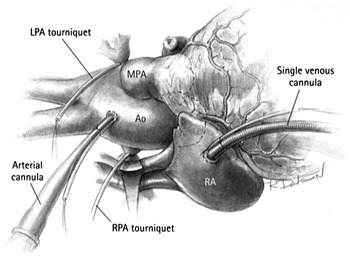
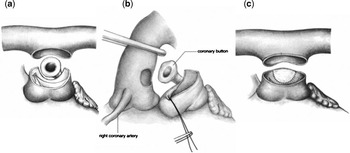
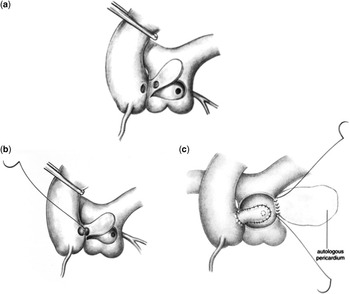
The diagnosis of anomalous origin of the left coronary artery from the pulmonary artery is an indication for surgical repair. A two-coronary arterial system is the goal and is almost always achievable.Reference Turley, Szarnicki, Flachsbart, Richter, Popper and Tarnoff30 Ligation of the anomalous coronary artery has been abandoned because of the high early mortality, ranging from 20% to 50%, and the high late mortality of 33%.Reference Backer, Stout and Zales3, Reference Arciniegas, Farooki, Hakimi and Green7, Reference Bunton, Jonas, Lang, Rein and Castaneda9, Reference Kececioglu, Voth, Morguet, Munz and Vogt31–Reference Wilson, Dlabal and McGuire33 Today the procedure of choice for treatment of anomalous origin of the left coronary artery from the pulmonary artery is direct reimplantation of the anomalous left coronary artery into the aorta. The operation is performed with cardiopulmonary bypass. Generally, mild hypothermia is used in the range of 28–32 degrees centigrade. The main pulmonary arterial branches are snared during delivery of cardioplegia in order to prevent run-off and achieve uniform delivery of cardioplegia (Fig 2).Reference Brown, Ruzmetov, Parent, Rodefeld and Turrentine18, Reference Jonas34 Other strategies of myocardial protection include administering cardioplegia into the pulmonary trunk and the use of retrograde cardioplegia.Reference Backer, Stout and Zales3 The anomalous left coronary artery most commonly originates from the left posterior pulmonary sinus.Reference Raisky, Roubertie, Ali and Vouhe20 The coronary artery is excised along with a generous cuff of pulmonary arterial sinus. The proximal coronary artery is mobilised taking care not to injure an early septal perforating branch. The pulmonary root is in a slightly more superior position than the aortic root. As a consequence, the nearest point to reimplant the coronary artery is the left side of the ascending aorta, just above the sinotubular junction of the aortic valve. A horizontal incision is made in this area and the coronary button sewn in place with a 6–0 or 7–0 polypropylene suture (Fig 3). The site of excision of the coronary arterial button from the pulmonary artery is repaired with a patch of autologous pericardium.
Strategy for cannulation and cardiopulmonary bypass strategy for patients with anomalous origin of the left coronary artery from the pulmonary artery. Once cardiopulmonary bypass is initiated, the branch pulmonary arteries are snared and antegrade cardioplegia is delivered. Snaring the branch pulmonary arteries prevents a run-off of cardioplegia from the anomalous left coronary artery into the pulmonary arteries and allows for effective myocardial protection (reproduced with permission from JonasReference Jonas34).

The reimplantation procedure. (a) The pulmonary arterial trunk is transected proximal to the branch pulmonary arteries, and the anomalous coronary is excised along with a generous cuff of the pulmonary arterial wall. (b) A horizontal incision is made on the left side of the ascending aorta and the anomalous coronary artery is reimplanted. (c) The site of the excision of the coronary arterial button is repaired with a patch of the autologous pericardium (reproduced with permission from YasuiReference Yasui36).

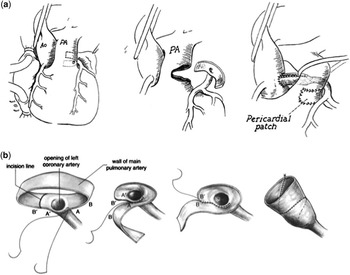
Occasionally, the anomalous coronary artery has inadequate length to reach the aorta without excessive tension. Several innovative strategies have been developed to provide additional length. Autologous tissue can be used to create tubular extensions; these tubes can be fashioned from an extended cuff of the pulmonary arterial wall (Fig 4).Reference Raisky, Roubertie, Ali and Vouhe20, Reference Jonas34–Reference Barth, Allen, Gulecyuz, Chiemmongkoltip, Cuneo and Ilbawi37 The Takeuchi procedure may also be used when direct reimplantation is not possible. An aortopulmonary window is created just above the sinotubular junction of the pulmonary valve and the adjacent ascending aorta. An anterior flap of the pulmonary artery, based at the origin of the surgically created aortopulmonary window, is then sutured to create a baffle within the pulmonary artery between the coronary ostium of the anomalous origin of the left coronary artery from the pulmonary artery and the newly created aortopulmonary window (Fig 5).Reference Takeuchi, Imamura and Katsumoto29 Anteriorly, the pulmonary artery is then reconstructed using a patch of homograft or pericardium. Despite the usefulness of this technique when the anomalous origin of the left coronary artery from the pulmonary artery has a remote location from the aorta, it has largely been abandoned as a “first choice procedure” due to a high rate of complications, including
• obstruction of the intrapulmonary tunnel,
• baffle leak, and
• supravalvar pulmonary stenosis due to obstruction by the baffle.Reference Backer, Stout and Zales3
Several innovative techniques have been developed to lengthen the proximal coronary artery in patients with anomalous origin of the left coronary artery from the pulmonary artery. (a) A cuff of the pulmonary artery is excised and fashioned into a tubular graft to permit reimplantation without tension. (b) A cuff of the pulmonary artery is excised and a spiral cuff extension is created (reproduced with permission from Ando et alReference Ando, Kado and Masuda35 and Barth et alReference Barth, Allen, Gulecyuz, Chiemmongkoltip, Cuneo and Ilbawi37).

Technique of repair with the creation of a baffle within the pulmonary artery, commonly known as the Takeuchi tunnel. An aortopulmonary window is created just above the sinotubular junction of the pulmonary valve and the adjacent ascending aorta. An anterior flap of the pulmonary arterial wall, based at the origin of the surgically created aortopulmonary window, is then sutured to create a baffle within the pulmonary artery between the coronary ostium of the anomalous origin of the left coronary artery from the pulmonary artery and the newly created aortopulmonary window. Anteriorly, the pulmonary artery is then reconstructed using a patch of homograft or pericardium (reproduced with permission from YasuiReference Yasui36).

Bypass procedures have been describedReference Mustard23, Reference Case, Morrow, Stainsby and Nestor24, Reference Mavroudis, Backer and Muster38 using
• the left common carotid artery,
• the saphenous vein,
• the left subclavian artery, and
• the internal thoracic artery.
Bypass procedures are no longer used as a primary procedure in infants, and yet they may be useful for acquired stenosis of the proximal left coronary artery after reimplantation, or as a salvage operation. Brachiocephalic vessels are rarely used due to the risk of cerebral ischaemia or limb ischaemia, and grafts using the saphenous vein have poor long-term patency, making the internal thoracic artery the conduit of choice. Virtually, all cardiac surgeons have been trained in the techniques of harvesting the internal thoracic artery and coronary bypass grafting. The internal thoracic artery has excellent long-term patency rates and is even recommended as the procedure of choice in adults by some groups.Reference Chan, Hare and Buxton39
Perioperative management
Challenges in care before and after surgery for anomalous origin of the left coronary artery from the pulmonary artery are generally dictated by the degree of left ventricular dysfunction and mitral valvar regurgitation at presentation. Patients with anomalous origin of the left coronary artery from the pulmonary artery with a left dominant coronary arterial pattern and inadequate collaterals may have marked dysfunction of the left ventricle and mitral valvar regurgitation, whereas patients with anomalous origin of the left coronary artery from the pulmonary artery with a right dominant coronary arterial pattern and adequate collaterals may have preserved left ventricular function. In addition to pre-existing myocardial dysfunction and mitral valvar regurgitation, operative correction with cardiopulmonary bypass will predictably result in
• ischaemia-reperfusion injury,
• alterations in the autonomic nervous system, and
• a systemic inflammatory response.
These pathologies will lead to
• worsening systolic and diastolic dysfunction,
• increased metabolic demands, and
• increased potential for arrhythmias.
Post-operative management is directed at optimising the delivery of oxygen and minimising shock, which is characterised by an imbalance in the supply of oxygen and the demand of oxygen. Low cardiac output syndrome, characterised by reduced cardiac index and concomitant elevation in pulmonary and systemic vascular resistances, should be anticipated and ideally prevented.Reference Wernovsky, Wypij and Jonas40 Haemodynamic monitoring includes the continuous measurement of
• central venous pressure,
• left atrial pressure,
• systemic arterial pressure,
• pulse oximetry,
• capnography,
• two-site near-infrared spectroscopy, and
• the electrocardiogram.
Serial biochemical assessment of the acid-base status, monitoring of venous saturation, and measurement of the output of urine should be performed as a means to identify inadequate perfusion and permit timely initiation of treatment.
Stepwise management of the post-operative patient with anomalous origin of the left coronary artery from the pulmonary artery includes preserving atrioventricular sequential rhythm with sufficient cardiac rate. Maintaining adequate biventricular preload is essential. In order to maintain adequate biventricular preload:
• one must recognise that the patient will frequently require increased preload due to myocardial dysfunction, and
• one must understand the danger of excessive loading with volume in the patient with altered ventricular compliance.
Inotropic support is universal and includes catecholamines that have a high affinity for beta 1 receptors. Sustained reduction of afterload is fundamental in patients following corrective surgery for anomalous origin of the left coronary artery from the pulmonary artery. Milrinone, a phosphodiesterase inhibitor, has been shown to reduce the incidence of low cardiac output syndrome in a prospective, randomised blinded study following corrective cardiac surgery in children.Reference Hoffman, Wernovsky and Atz41 Milrinone is an effective inodilator that works by preventing intracellular hydrolysis of cyclic adenosyl monophosphate in the myocardium and vascular smooth muscle, and hence increases myocardial contractility and relaxation, as well as vasodilatation of peripheral, pulmonary, and coronary vasculature.Reference Chang, Atz, Wernovsky, Burke and Wessel42
Persistent shock, refractory arrhythmias, and inability to wean from cardiopulmonary bypass are all indications for utilisation of mechanical circulatory support. Risk factors for needing post-operative mechanical circulatory support include
• the degree of pre-operative left ventricular dysfunction,
• pre-operative mitral valvar regurgitation, and
• longer cardiopulmonary bypass times.Reference Nasseri, Alexi-Meskishvili and Schmitt43, Reference Ben Ali, Metton and Roubertie44
Devices for mechanical circulatory support include both extracorporeal membrane oxygenation and left ventricle assist devices.Reference Nasseri, Alexi-Meskishvili and Schmitt43–Reference del Nido, Duncan, Mayer, Wessel, LaPierre and Jonas45 For patients in whom biventricular and respiratory support is desired, extracorporeal membrane oxygenation with left atrial decompression is the preferred system of support. Left ventricular assist devices require adequate pulmonary function; pharmacologic support for dysfunction of the right heart and arrhythmias may be necessary.
Adjunctive therapies used to minimise the consumption of oxygen, as part of the effort to better match the delivery of oxygen and the consumption of oxygen in patients with decreased cardiac output, include analgesics, sedatives, and regulation of temperature. In addition, in the case of left ventricular dysfunction, mechanical ventilation may assist in optimising the delivery of oxygen through improved exchange of gases, reduced work of breathing, and decreased systemic afterload.
Operative outcomes
Between 1979 and 2009, 32 patients have undergone repair of anomalous origin of the left coronary artery from the pulmonary artery at the Children’s Hospital of Wisconsin. In all patients, the goal was the establishment of a two-coronary arterial system. Procedures included direct reimplantation in 23 patients and intrapulmonary baffle, or Takeuchi repair, in nine patients. No mitral valvar procedures were performed at the time of surgery for anomalous origin of the left coronary artery from the pulmonary artery. The age at operation ranged from 2 months to 18 years and averaged 51 plus or minus 62 months. There were 14 patients who were less than 12 months of age. There was one early death in 1979 in a patient initially undergoing repair of an isolated left pulmonary artery from the aorta. The anomalous coronary artery was not identified until 3 days after reimplantation of the left pulmonary artery into the main pulmonary artery when an acute decrease in left ventricular function prompted further evaluation. This patient predates the availability of post-cardiotomy mechanical circulatory support in our programme. There were three patients who required post-cardiotomy support with extracorporeal membrane oxygenation, and all survived. There were two late deaths:
• one at 10 months after reimplantation, and
• one at 10 years after repair with an intrapulmonary baffle.
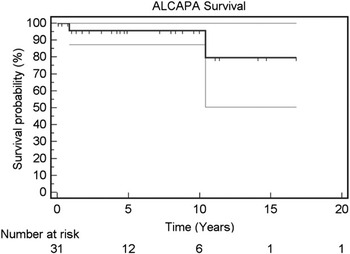
We found a 10-year survival rate of 95% (Fig 6). There were four reoperations.
The survival of patients undergoing repair of anomalous origin of the left coronary artery from the pulmonary artery at the Children’s Hospital of Wisconsin. We found a 10-year survival rate of 95% and a 10-year freedom from reoperation rate of 86%.

• One patient required coronary artery bypass grafting for proximal stenosis of the left main coronary artery after reimplantation.
• Three patients underwent reoperation after repair with an intrapulmonary baffle, including two procedures on the intrapulmonary baffle and one repair of the mitral valve.
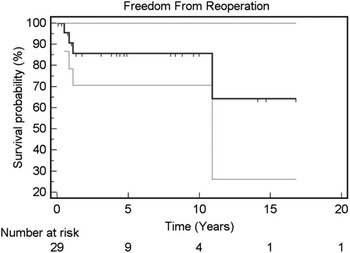
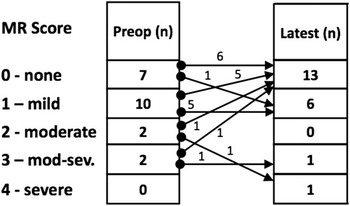
The proportion of reoperations was significantly higher in patients who underwent repair with an intrapulmonary baffle in comparison to those who underwent repair with reimplantation. The 10-year freedom from reoperation was 86% (Fig 7). At last follow-up, 90% of the patients have mild or less mitral valvar regurgitation (Fig 8).
Freedom from reoperation for patients undergoing repair of anomalous origin of the left coronary artery from the pulmonary artery at the Children’s Hospital of Wisconsin. We found a 10-year freedom from the reoperation rate of 86%.

The outcomes of patients after repair of anomalous origin of the left coronary artery from the pulmonary artery at the Children’s Hospital of Wisconsin. At last follow-up, 90% had mild or less mitral valvar regurgitation (MR = mitral regurgitation).

There are two recent series from the Indiana University and University of Paris Descartes that summarise experiences spanning decades and report early mortality of about 8% and 10-year survival between 86% and 92%.Reference Brown, Ruzmetov, Parent, Rodefeld and Turrentine18, Reference Ben Ali, Metton and Roubertie44 Likewise, the 10-year freedom from reoperation was between 83% and 89%. In both of these series, presentation with mitral regurgitation was common: 30–40% of patients had moderate or severe mitral valvar regurgitation before surgery. Similar to our experience, no patients underwent intervention on the mitral valve at the time of surgery for anomalous origin of the left coronary artery from the pulmonary artery. Mitral valvar regurgitation improved in nearly all patients. Reoperation for mitral valvar regurgitation was rare, and 88–90% of patients had mild or less mitral regurgitation at last follow-up. These results are remarkably similar to ours.
Conclusions and summary
Anomalous origin of the left coronary artery from the pulmonary artery is a cause of myocardial dysfunction in young infants. The origin of the coronary arteries must be confirmed in any child presenting with left ventricular dysfunction. The goal of surgical therapy is the creation of a two-coronary arterial system, which appears to provide better long-term survival and protection from left ventricular dysfunction and mitral valvar regurgitation than does simple ligation of the anomalous coronary artery. Direct reimplantation of the anomalous coronary artery is straightforward and borrows from well-practised techniques commonly used in other operations such as the arterial switch operation. For the rare patient in whom direct reimplantation is not possible, strategies to lengthen the anomalous coronary artery, or baffle it within the pulmonary root, are available. Mitral valvar regurgitation is common at presentation, but following the establishment of a two-coronary arterial system and satisfactory myocardial perfusion, regurgitation of the mitral valve resolves in the vast majority. Therefore, mitral valvuloplasty at the time of initial surgery for anomalous origin of the left coronary artery from the pulmonary artery is not indicated. Post-operative care requires careful manipulation of inotropic support and reduction of afterload. Mechanical support, with either extracorporeal membrane oxygenation or left ventricular assist device, should be available for use if necessary.