For more than a decade, home visitation services have been identified as one of the most promising strategies for the prevention of child maltreatment (Leventhal, Reference Leventhal2001; National Research Council, 1993; US Advisory Board on Child Abuse and Neglect, 1991). Interest in home visitation has led to the development of several program models, and subsequent research has found these programs to have some limited success in preventing child abuse and neglect (Gomby, Reference Gomby2000). Recently, Reynolds and Robertson (Reference Reynolds and Robertson2003), for example, have reported a reduction in child maltreatment reports in a long-term, quasiexperimental evaluation of the Chicago Parenting Center program that includes preschool and home visiting components. The strongest evidence for this strategy has come from the long-term evaluation of a randomized trial of a program of prenatal and infancy home visiting, conducted in Elmira, NY, and now known as the Nurse Family Partnership (NFP), which found significant reductions in the total number of substantiated maltreatment reports over a 15-year period (Olds, Eckenrode, et al., Reference Olds, Eckenrode, Henderson, Kitzman, Powers and Cole1997).
Evaluations of prevention programs have tended to focus on reductions in the amount of maltreatment experienced by children, by either examining the presence or absence of maltreatment, or the overall number of maltreatment occurrences aggregated across time. Typically, this has been indicated by the number of reports to Child Protective Service (CPS) agencies or through parental reports. Focusing on such outcomes provides an important, but static, view of the impact that interventions may have on maltreatment outcomes.
Developmental psychopathology is focused in part on the processes that account for later adaptation and maladaptation in the face of adversity (Cicchetti & Hinshaw, Reference Cicchetti and Hinshaw2002; Cicchetti & Toth, Reference Cicchetti, Toth, Luthar, Burack, Cicchetti and Weisz1997), and child abuse and neglect represent an extreme form of such adversity. As such, research conducted with regard to maltreatment can provide valuable insight into the processes of risk and resilience that all children encounter to some degree. Debate continues on definitional issues within this field, but there has been increasing acceptance that maltreatment represents a complex, multidimensional construct (Cicchetti & Manly, Reference Cicchetti and Manly2001; Manly, Cicchetti, & Barnett, Reference Manly, Cicchetti and Barnett1994; National Research Council 1993; Zuravin, Reference Zuravin and Dubowitz1999). Among the multiple dimensions of maltreatment, timing, including age of onset, has frequently been cited as an important, although overlooked, developmental feature that may affect the outcomes associated with abuse and neglect (Barnett, Manly, & Cicchetti, Reference Barnett, Manly, Cicchetti, Cicchetti and Toth1993; Manly et al., Reference Manly, Cicchetti and Barnett1994).
In this paper we examine the temporal features of maltreatment that were affected by the NFP. Focusing on the timing of the intervention's impact is important for two reasons. First, it allows for a more detailed account of when the preventive effects of the intervention emerged. Program effects may occur early or late, be sustained over time, or fade out. Different temporal patterns of effects have implications for program design and for evaluation strategies used to gauge treatment effects. Second, program-related alterations in the timing of maltreatment may have implications for the long-term effects of the program on developmental outcomes associated with the maltreatment (Bolger & Patterson, Reference Bolger and Patterson2001; Manly et al., Reference Manly, Cicchetti and Barnett1994; Manly, Kim, Rogosch, & Cicchetti, Reference Manly, Kim, Rogosch and Cicchetti2001; Thornberry, Ireland, & Smith, Reference Thornberry, Ireland and Smith2001). Several studies, for instance, have found victimized children's age at the time of maltreatment onset to be significantly related to their later psychological well-being (Chu, Frey, Ganzel, & Matthews, Reference Chu, Frey, Ganzel and Matthews1999; Johnson, Pike, & Chard, Reference Johnson, Pike and Chard2001; Keiley, Howe, Dodge, Bates, & Pettitt, Reference Keiley, Howe, Dodge, Bates and Pettitt2001; McClellan et al., Reference McClellan, McCurry, Ronnei, Adams, Eisner and Storck1996). However, there is little literature to date that has examined how the timing of maltreatment may be affected by home visiting or other early intervention programs.
Earlier reports from the Elmira trial of the NFP have found program-related reductions in both official records and indirect measures of child maltreatment. At the completion of the 2-year intervention, for example, nurse-visited children had significantly fewer visits to the emergency room, including fewer visits for ingestions and injuries (Olds, Henderson, Chamberlin, & Tatelbaum, Reference Olds, Henderson, Chamberlin and Tatelbaum1986). Although overall the number of official CPS reports did not differ between the entire sample of nurse-visited and comparison children, there was an 80% treatment-comparison difference (p = .07) in the number of CPS reports among mothers who at registration in the trial were poor, unmarried, and less than 19 years of age.
Between ages 2 and 4, treatment group differences in the number of CPS reports, even within the highest risk subgroup, were no longer significant. However, among children who were maltreated, those in the nurse-visited condition, in contrast to their counterparts in the comparison group, lived in homes that were observed to be considerably safer and, following additional observations, more conducive to children's cognitive and emotional development as measured by the HOME (Olds, Henderson, Kitzman, & Cole, Reference Olds, Henderson, Kitzman and Cole1995). They also had substantially fewer emergency department visits and physician office visits for injuries and ingestions. Olds and colleagues (Reference Olds, Henderson, Kitzman and Cole1995) interpreted these findings as a reflection of the nurses' detection of less severe maltreatment that otherwise would have gone undetected.
When families were again assessed at 15 years, the nurse-visited/comparison group difference in state-verified abuse and neglect overall was greater than it had been at earlier ages. Within the entire sample, nurse-visited children had received on average 0.29 verified CPS reports by age 15, compared to 0.54 reports in the comparison group (p < .001); these differences were even larger among the highest risk families (Olds, Eckenrode, et al., Reference Olds, Eckenrode, Henderson, Kitzman, Powers and Cole1997; Olds et al., Reference Olds, Henderson, Kitzman, Eckenrode, Cole and Tatelbaum1999).
The current study examines the timing of child maltreatment in this trial. As noted, treatment differences in the number of official maltreatment reports grew significantly between the children's 4th and 15th years, implying that the intervention affected the timing of abuse and neglect. Aside from MacMillan et al.'s (Reference MacMillan, Thomas, Jamieson, Walsh, Boyle and Shannons2005) recent report on a trial of nurse home visiting designed to reduce recurrence among caregivers who had already maltreated their children, so far as we know, no other home visitation program has examined treatment effects on the timing of maltreatment. In the current study, we examined the effects of the NFP on the age at which children received their first verified CPS report. Given the previously reported findings of relatively small and inconsistent program effects between ages 0 and 4 and larger effects between ages 4 and 15, we hypothesized that intervention effects on age of first report would be small during the first several years and grow larger as children matured.
Method
Details of the study's design can be found in earlier articles (Olds et al., Reference Olds, Henderson, Chamberlin and Tatelbaum1986; Olds, Eckenrode, Reference Olds, Eckenrode, Henderson, Kitzman, Powers and Cole1997). A summary of the design and measures is presented here.
Setting and participants
The intervention was originally conducted in a small, semirural city in the Appalachian region of New York State. Pregnant women were recruited from a free, county health department-sponsored antepartum clinic and the offices of private obstetricians from April 1978 through September 1980. Women were actively recruited for the study if they had no previous live births, registered in the study prior to the 25th week of gestation, and had at least one of the following characteristics that that predisposed their child to health and developmental problems: (a) young age (<19 years at registration), (b) single-parent status, or (c) low socioeconomic status (SES; Hollingshead Social Classes III and IV). To avoid creating a program stigmatized as being exclusively for the poor, and to ensure that treatment differences because of risk-level could be examined, any woman who asked to participate and had no previous live birth was accepted into the study. Eighty-five percent of the sample originally recruited had at least one of the three risk characteristics used for recruitment. Forty-seven percent were <19 years of age, 62% were unmarried, and 61% came from households classified as low SES at registration during pregnancy.
Four hundred of the 500 invited women enrolled in the study. There were no differences in the age, education, or marital status of those women who chose to enroll and those who declined; however, 80% of invited European Americans agreed to participate versus 96% of invited African Americans. The final sample was 11% African American and 89% European American. After completing informed consent and baseline interviews, women were stratified by sociodemographic characteristics and randomized to one of four treatment conditions. The resulting groups did not differ across their sociodemographic characteristics.
Treatment conditions
Families in Treatment Group I (n = 94) were provided sensory and developmental screening for the child at 12 and 24 months of age. Based upon these screenings, the children were referred for further clinical evaluation and treatment when needed. Families in Treatment Group II (n = 90) were provided the screening services offered those in Treatment I plus free transportation for prenatal and well-child care through the child's second birthday, employing a taxi cab voucher system. Because there were no differences between Treatments I and II in their use of prenatal and well-child care (both groups had high rates of completed appointments), these two groups were combined to form a single comparison group. Families in Treatment Group III (n = 100) were provided the screening and transportation services offered Treatment II, and in addition were provided a public health nurse who visited them during pregnancy. Families in Treatment IV (n = 116) were provided the same services as those in Treatment III, except that the nurse continued to visit through the child's second birthday. The current study examines differences between the full intervention (Treatment IV) and the combined comparison group (Treatment Groups I and II). Treatment Group III (prenatal home-visiting only) was not included in our analyses because few and inconsistent effects for Group III have been found in previous studies (Eckenrode et al., Reference Eckenrode, Ganzel, Henderson, Smith, Olds and Powers2000; Olds, Eckenrode, et al., Reference Olds, Eckenrode, Henderson, Kitzman, Powers and Cole1997).
In their home visits, the nurses had three major goals: (a) to improve the outcomes of pregnancy by helping women improve their prenatal health, (b) to improve the child's health and development by improving parents' competence in early care of the child, and (c) to improve the mothers' economic self-sufficiency by helping them develop a vision for the future, plan future pregnancies, complete their educations, and find work. The program was designed explicitly to reduce risks for child abuse and neglect (Olds, Reference Olds, Garbarino and Stocking1980). To achieve these goals, the nurses worked directly with the mothers, linked families with needed health and human services, and attempted to involve other family members and friends in the pregnancy, birth, and early care of the child. The program was based on theories of self-efficacy, human ecology, and human attachment (Olds, Kitzman, Cole, & Robinson, Reference Olds, Kitzman, Cole and Robinson1997). Although the nurses used detailed assessments, record-keeping forms, and protocols to guide their educational activities and work with families, they also adapted the content of their home visits to the individual needs of each family. The nurses spent considerable attention to developing a close working relationship with the mother and her family.
The nurses were scheduled to visit once every other week during pregnancy, once a week for the first 6 weeks postpartum, and then on a diminishing schedule until the children were 2 years of age. The nurses completed an average of 9 (SD = 3) visits during pregnancy and 23 (SD = 15) from birth to the child's second birthday.
Overview of follow-up study
Of the 400 original dyads, 26 were ineligible for follow-up because of fetal, infant, or child death, 2 because of the mother's death, 15 children had been adopted, and 6 requested no further participation at earlier phases, leaving 351 eligible cases for the 15-year follow-up study.
At 15 years, 27 families were unable to be located or declined to participate. Assessments were completed for 324 women, representing 81% of those who were originally randomized and more than 90% of those eligible for follow-up. There were no treatment group differences in the rates of completed assessments at the 15-year follow-up. Interviews were conducted with the mothers, their adolescent children, and custodial parents if the biological mother no longer had custody. For respondents living within the original community, in-person interviews took place; otherwise, phone interviews were conducted. Data from social service, school, and criminal justice records were also collected. All data were gathered by staff members who had no access to the families' treatment assignments, except in a few cases where the mothers inadvertently revealed that they had been visited by a nurse.
Measures
Assessments conducted at earlier phases are specified in previous publications (Olds et al., Reference Olds, Henderson, Chamberlin and Tatelbaum1986; Olds, Henderson, & Kitzman, Reference Olds, Henderson and Kitzman1994; Olds, Henderson, Tatelbaum, & Chamberlin, Reference Olds, Henderson, Tatelbaum and Chamberlin1988). Intake interviews, which were conducted with women prior to randomization, included assessments of women's sociodemographic and personality characteristics, health-related behaviors, and health conditions. Women's household SES was estimated employing the Hollingshead four-factor method (Hollingshead, Reference Hollingshead1975); families were classified into lower SES (Levels III and IV) and higher SES (Levels I and II) categories. Other variables measured at baseline and assessed for inclusion in this study include mother's marital status, age, educational level, race (White/non-White), and child gender.
Child abuse and neglect
Mothers provided consent for the research staff to review CPS records from states in which they resided during the interval from the birth of their first child to that child's 15th birthday. Because program effects were hypothesized to be concentrated on the mother and the study child, all reports involving either the mother or the study child were coded. Reports that did not involve the mother as a perpetrator or the study child as victim were excluded. Substantiated reports (where a caseworker determined after investigation that the abuse or neglect allegations were founded) were abstracted to ascertain key features of the maltreatment incident. All New York State records were searched, as were records accessible from other states in which families resided over the 15-year period. At the time of interview, the proportion of treatment and comparison participants who resided in New York State did not significantly differ (24.0% of nurse visited participants vs. 20.3% of comparison participants). Data from some states were not available over part of the 15-year period because of some states' policies regarding the expunging and release of case-level data. Nonetheless, records were available for an average of 13.4 years, and there were no treatment differences in the amount of time searched. Children for whom there was one year or less of maltreatment data (n = 10) were excluded from the current study, because they could neither be given an age at first report, nor be properly considered censored data points.
Given that the data collected from CPS agencies also included the type of maltreatment experienced by the study children, we further sought to examine the effects of the intervention on the individual types of maltreatment. Of the 69 children who had verified reports of maltreatment in the comparison and full treatment conditions, 84% (n = 59) were subjects of neglect reports, either exclusively or in combination with other forms of maltreatment. These included reports of failure to provide, lack of supervision, inadequate guardianship, educational neglect, and medical neglect, and were specified on the report by the investigating CPS agency. Analyses for the current study explicitly examine the developmental timing of maltreatment generally, as well as of neglect specifically. There were not sufficient cases to estimate separate models involving either physical abuse (n = 17) or sexual abuse (n = 13).
The primary maltreatment variable in the current study represents the age at which the child first received a verified CPS report. All ages were calculated in base 10 (e.g., 2 years and 3 months = 2.25) and children who did not receive any reports received a score of 16, indicating a censored case.
Data analysis strategy
Maltreatment onset was examined based on the children's age at which they received their first CPS report. Survival functions were plotted, and Cox proportional-hazard regression models were estimated. Cox regression is similar to multiple regression; however, the dependent variable is the hazard rate, sometimes called the failure rate, which in this paper represents the risk of any child at time t receiving a CPS report given that they have not received one previously (Cox, Reference Cox1972; Singer & Willett, Reference Singer and Willett2003). It is, furthermore, a nonparametric test in that it is not based on any assumptions about the shape or nature of the underlying survival distribution. Cox models were utilized in the current study to test differences between the nurse-visited versus the comparison children's temporal patterns of maltreatment onset. Given that there were varying and relatively small treatment effects on CPS reports during the children's first 4 years, yet strong program effects by the time they had reached age 15, we expected that the treatment and comparison groups' survival functions would differ over time (i.e., would not be proportional). For this reason, two additional Cox models were estimated to examine the interaction of treatment with two different temporal conceptualizations. The first included an interaction of treatment with continuous time. The second included an interaction of treatment by time period (ages 4–15 compared to ages 0–4). Given previously published findings that there were no treatment-comparison differences at child age 4 (Olds et al., Reference Olds, Henderson and Kitzman1994), and examination of the survival curves, we reasoned that this age split might provide a better fit to the data. In addition, children begin entering nursery school at approximately this age, with teachers being a primary reporting source for maltreatment events (Sedlak & Broadhurst, Reference Sedlak and Broadhurst1996). Given the lower power in the interaction models, as well as a clear directional hypothesis based on the previous literature, we adopted a p < .10 criteria when evaluating significance for these interaction effects.
Previous studies have found the NFP to have the greatest success in reducing maltreatment within its highest risk subsample, that is, cases in which the mothers were both unmarried and had low SES at program initiation (Olds, Eckenrode, et al., Reference Olds, Eckenrode, Henderson, Kitzman, Powers and Cole1997). At 15 years, there were 38 nurse-visited children (39%) in the high-risk subsample and 62 comparison children (42%). Separate Cox models were fit for the entire sample and this highest risk subsample. However, given limitations in cell sizes, the Treatment × Time Period analyses could only be fit using the full sample. Each set of analyses was conducted to examine the timing of the first CPS report, irrespective of maltreatment type, as well as the timing of first neglect report.
Results
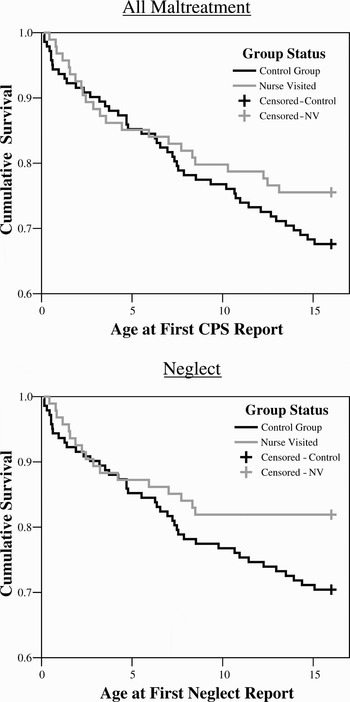
We examined differences in children's age at first CPS report between the nurse-visited and comparison groups. Figure 1 shows the Kaplan–Meier survival functions for the treatment and comparison groups: one when measuring any type of maltreatment report, the other specifically for reports of neglect. In the whole sample, 68% of the children in the comparison group “survived” to age 15 without being the subject of a CPS report, compared to 76% of nurse-visited children. For neglect, 73% of comparison children, compared to 83% of children in the nurse-visited condition, had no initial reports by age 15. These survival curves have two notable features. First, there is little difference in the curves until ages 5 to 6, indicating that the intervention had little effect on the risk of having an initial CPS report in those early years. This is consistent with earlier reports from the project that reported no significant treatment effects on the number of maltreatment reports at age 4 in the overall sample (Olds et al., Reference Olds, Henderson and Kitzman1994). Second, after age 5 to 6, the curves begin to separate. The steeper decline in the comparison group indicates that these children continued to be at risk for first-time reports through age 15. In the nurse-visited group, the more gradual rate of decline indicates less risk in the 5–15 age period. Indeed, after age 8 there were no more initial reports of neglect for children in the nurse-visited group.
The Kaplan–Meier survival functions for age at first Child Protective Services report.

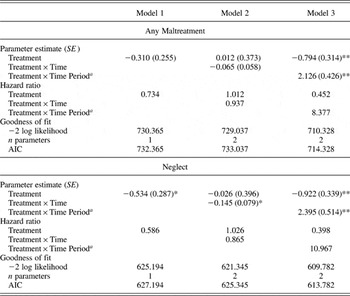
To statistically evaluate these curves, Cox regression models were fit examining the treatment main effect, an interaction of treatment by continuous time, and a Treatment × Time Period interaction. The models presented include no covariates, given that there were no treatment-comparison differences in background characteristics at registration. When examining all forms of maltreatment in the full sample, the treatment main effect was not statistically significant; that is, the survival functions did not differ when averaged across the full time period (B = −0.31, SE = 0.26, p = .23; see Table 1). To test the hypothesis that the shape of the survival functions between the treatment and comparison group differed over time, models were fit including Treatment × Time interactions. The interaction between treatment group and continuous time was not significant (B = −0.07, SE = 0.06, p = .26), most likely reflecting the similarity in the survival rates in the children's early years. When examining the interaction between treatment effects during different time periods, Cox regression models showed a highly significant interaction (B = 2.13, SE = 0.43, p = .00), indicating that the treatment effect between ages 4 and 15 is larger than the effect between ages 0 and 4. Hazard ratios (exp B) are provided in Table 1 from each model as an additional measure of effect size, and the Akaike information criterion (AIC; −2 log likelihood + 2 × n parameters) is provided as a goodness of fit statistic across models. The AICs for the maltreatment analyses indicate that the model including the treatment by time period interaction, which had the lowest AIC statistic (714.33), appears to fit the data best.
Summary of Cox regression models within the full sample

aTreatment effect between ages 4 and 15 compared to ages 0 and 4.
* p < .10. **p < .05.
In the Cox models for neglect onset, treatment effects were notably stronger than those for maltreatment generally. The analyses found that the risk for experiencing a first-time neglect report differed between nurse-visited and comparison children (B = −0.53, SE = 0.29, p = .06; see Table 1). Differences between groups were also found to vary differentially across time. Cox models showed that the treatment by time period interaction model (B = 2.40, SE = 0.51, p = .00) and the interaction model with continuous time (B = −0.15, SE = 0.08, p = .07) were both significant. Based on the AIC statistics, the treatment by time period interaction model (AIC = 613.78) was found to fit the data better than the main effect and continuous time models.
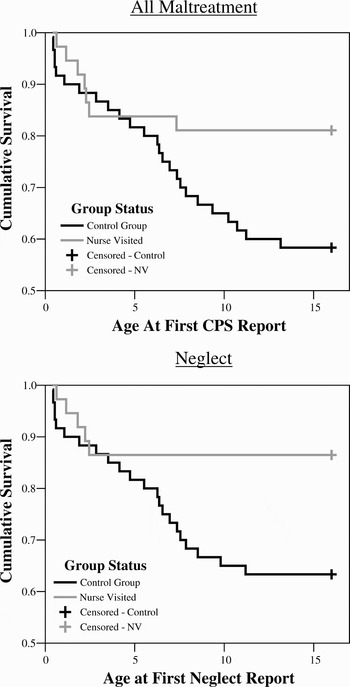
Figure 2 shows the survival curves within the high-risk subgroup. The patterns are similar to those of the overall sample, although the differences between treatment and comparison groups are greatly accentuated. Only 58% (any maltreatment) and 63% (neglect) of comparison group children reached age 15 without a report, whereas 81 and 87% of the nurse-visited children, respectively, did not a have report. After age 8 there were no first-time CPS reports in the nurse-visited group, whereas there continued to be initial reports in the comparison group up through age 13. Treatment effects were even more pronounced when neglect specifically was examined. Although initial neglect reports continued in the comparison group through age 12, first-time reports among nurse-visited children ceased after age 3.
The Kaplan–Meier survival functions for age at first Child Protective Services report within the high-risk subgroup.

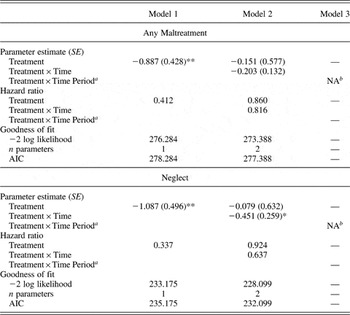
Cox regression models were also estimated to evaluate the temporal patterns in the high-risk subgroup. For the analyses examining initial CPS reports, the results showed there was a significant treatment main effect (B = −0.89, SE = 0.43, p = .04; see Table 2). The treatment by time interaction effect was not significant (B = −0.20, SE = 0.13, p = .12), although this model's goodness of fit was found to be slightly better than that of the main effects model. For neglect onset among the highest risk children, the Cox model showed a significant overall difference between the home-visited and comparison children's survival functions (B = −1.09, SE = 0.50, p = .03; see Table 2). The Treatment × Time interaction for neglect was also significant (B = −0.45, SE = 0.26, p = .08), and had a slightly lower AIC statistic, indicating better fit than the main effects model.
Summary of Cox regression models within the high-risk subgroup

aTreatment effect between ages 4 and 15 compared to ages 0 and 4.
bCell size for maltreatment between ages 4 and 15 among nurse-visited children was not large enough for analysis.
* p < .10. **p < .05.
Discussion
Previous research on the NFP has shown nurse home visitation to be an effective means for reducing high-risk children's overall number of maltreatment reports (Olds, Eckenrode, et al., Reference Olds, Eckenrode, Henderson, Kitzman, Powers and Cole1997). The current study examined this effect in greater detail, specifying how the intervention affected the developmental timing of abuse and neglect. It provides new evidence that the intervention had an effect on the onset of maltreatment. We will address the results of these analyses, as well as their implications for the development of at-risk children.
Maltreatment onset
Our results within the full sample showed that the temporal patterns of maltreatment for nurse-visited and comparison children were not the same. The two groups' survival functions remained nearly identical until age 5, at which point the nurse-visited group's risk for onset began to level off. Indeed, when neglect was specifically examined, first-time reports ceased among children who received the intervention by approximately age 8, whereas in the comparison group children continued to receive first reports through age 15 (the end of data collection). These visual patterns appear to support our initial hypothesis. To further corroborate these effects, we tested two interaction models that examined the relationship between treatment group status and time. For these analyses, the strength of the interaction effects differed depending on the type of maltreatment. When all forms of maltreatment were examined, only the treatment by time period interaction was found to be significant. For neglect, we found that treatment group status interacted with time when it was operationalized both continuously and as discrete periods of time. Visually, the maltreatment and neglect functions maintain a similar pattern, although the divergence between treatment groups is considerably more pronounced for neglect onset.
Among children whose mothers had been both poor and unmarried at baseline, we found that nurse visited children were at lower risk than comparison children for receiving a first-time maltreatment report. This pattern was particularly notable when we examined neglect. By age 3, first-time neglect reports for high-risk children who had received the intervention had completely stopped. Among comparison children, however, first-time neglect reports continued through age 12. This finding demonstrates the enhanced effectiveness of the intervention for the sample's highest risk children, showing that first-time reports had completely ceased within 1 year of the program's completion at age 2. Although both the main effects for treatment group status were found to be significant for this subgroup, the treatment by time interaction models were found to be less significant; indeed, in the model for any CPS report it was not significant at all. This is not surprising given the smaller sample size among the high-risk subsample, and may indicate a problem with statistical power to detect such interactions.
Implications
Taken together, the analyses from this study showed that the intervention affected the onset of child maltreatment. Although the program did not prevent all cases of maltreatment, it is clear that it did change the trajectory of risk for these families. The picture that emerges is one where the maltreatment that did occur in the nurse-visited group was confined to instances that occurred early. The findings suggest that as the functioning of nurse-visited families improved over time (Olds et al., Reference Olds, Henderson, Tatelbaum and Chamberlin1988; Olds, Eckenrode, et al., Reference Olds, Eckenrode, Henderson, Kitzman, Powers and Cole1997), their risk of maltreatment was reduced correspondingly to the point where almost no initial cases emerged once the children were school aged. In contrast, the comparison families did not show the same improvements over time. Their risk for maltreatment was higher throughout childhood and adolescence. The implications of this for the children's developmental well-being are considerable. Thornberry et al. (Reference Thornberry, Ireland and Smith2001), using data from the longitudinal Rochester Youth Development Study, found that maltreatment that occurred only in adolescence, as well as persistent maltreatment beginning in childhood and continuing into adolescence, showed stronger and more consistent risks for problem behaviors such as delinquency, substance use, and externalizing problems when compared to children experiencing maltreatment only in early childhood. Results from their study imply that adverse outcomes may be the result of more proximal maltreatment. Given the program's success in limiting first-time reports in late childhood and early adolescence, Thornberry et al.'s (Reference Thornberry, Ireland and Smith2001) findings indicate a significantly better developmental trajectory for the nurse-visited children. Indeed, previous research on the NFP has shown that nurse-visited children who did experience maltreatment were significantly less likely to have engaged in problem behaviors in early adolescence than comparison group children who were maltreated (Eckenrode et al., Reference Eckenrode, Zielinski, Smith, Marcynyszyn, Henderson and Kitzman2001). We had hypothesized that this finding was due to a significant reduction in maltreatment chronicity among nurse-visited children. The current study's results may offer an additional explanation for these previous findings related to the timing of maltreatment onset.
Our results further suggest that it is important to follow intervention samples long enough to detect temporal patterns of the type reported here. Ending assessments at 4 or 5 years of age would have provided a very different picture of the program's effects on preventing maltreatment. As young first-time parents mature and develop, the small positive changes that occur in the first few years while the program is in place can build and multiply over time, yielding larger effects in later years. Other early intervention studies have reported program effects that similarly grew over time (e.g., Achenbach, Howell, Aoki, & Rauh, Reference Achenbach, Howell, Aoki and Rauh1993).
Limitations
Several limitations to the current study should be noted. The size of the maltreated group in our sample, although sufficient for the analyses presented here, was not large enough to examine the differential effects of several dimensions of maltreatment. The relatively small number of victims who experienced physical and sexual abuse precluded our ability to analyze their unique survival functions. Presenting the results for all maltreatment alongside those for neglect provides some indication of the intervention's temporal effects on abuse, but this comparison is limited in scope.
Furthermore, the current evaluation of the NFP suffers from methodological challenges common to maltreatment research more generally. Notably, there are significant concerns within the field over how best to measure the occurrence of maltreatment. The current study utilizes official reports from CPS agencies; a practice frequently used in maltreatment research (Duggan et al., Reference Duggan, McFarlane, Windham, Rohde, Salkever and Fuddy1999; Olds et al., Reference Olds, Henderson, Chamberlin and Tatelbaum1986; Olds, Eckenrode, et al., Reference Olds, Eckenrode, Henderson, Kitzman, Powers and Cole1997). CPS reports can provide a detailed account of maltreatment that has been reported to the state, and reports that have been investigated and substantiated provide an additional degree of certainty that the alleged event did occur. However, definitions of maltreatment subtypes utilized by CPS agencies also differ between states, potentially making comparisons or collapsing data between states difficult. The current data originate primarily from New York state, which has strict standards for defining abuse. This generally leads to less severe cases being labeled as neglect, which may further explain the limited number of abuse reports in this study. A further limitation of the use of CPS reports in maltreatment research lies in the fact that they represent a very conservative measure of whether children have experienced maltreatment.
This is a particular problem given recent evidence that official records contain only a small fraction of maltreatment that actually occurs (Theodore et al., Reference Theodore, Chang, Runyan, Hunter, Bangdiwala and Agans2005). This problem is exacerbated when the intervention being tested, such as the one presented, increases the detection of maltreatment (Brayden et al., Reference Brayden, Altemeier, Dietrich, Tucker, Christensen, McLaughlin and Sherrod1993) and leads to treatment differences in maltreatment surveillance (Olds et al., Reference Olds, Henderson, Kitzman and Cole1995). It is important to note that the nurses' home-visit guidelines called for them to collaborate with CPS workers and other health and human service providers in serving families; they particularly were required to call attention to families needs, including risk for maltreatment, as they discharged them at child age 2. The treatment by time period interaction observed here is thus also likely to be affected by the gradual decrease in surveillance bias over time.
Furthermore, it may be difficult to gauge with CPS reports exactly how long maltreatment had been occurring before the state was contacted. It is reasonable to assume that, early in life, the families visited by nurses had their maltreatment detected early and treated before it became more serious, and this may help account for the treatment-comparison difference in total number of verified reports detected at child age 15. Thus, CPS records in this study may have different meanings for maltreatment and community-level responses to that maltreatment.
Despite these limitations, this study provides evidence that the NFP was successful not only in reducing the overall amount of maltreatment, as previous studies have noted, but also impacted the developmental timing of the maltreatment process. Although further research is required to understand more clearly the pathways through which the intervention affected the onset of maltreatment, the current findings lend support to the enduring value of this program in reducing maltreatment and improving the life course of at-risk children.