




No CrossRef data available.
WOODEN FIGURINES, SCEPTERS, AND RELIGIOUS SPECIALISTS IN PRE-COLUMBIAN MAYA SOCIETY
Published online by Cambridge University Press: 04 March 2004
Abstract
Wooden figurines, idols, and scepters are commonly depicted as paraphernalia in Classic-period ritual iconography, but few examples of these objects exist. In 1999, a small wooden figurine was recovered from a cave near the Late Classic center of Muklebal Tzul in the Maya Mountains of southern Belize. It probably represents an ancestral deity or historical figure. Its recovery from a cave is appropriate. Caves functioned as arenas for legitimizing ancestral relationships through mediation with earth-focused deities. Combining analysis and interpretation of the archaeological context with a reading of documentary sources, we review the role of ancestor figurines in Maya society and offer interpretations of how this and similar objects functioned in Classic-period Maya religion and ritual.
Information
- Type
- Research Article
- Information
- Copyright
- © 2003 Cambridge University Press
In 1999, a small wooden figurine was recovered from Xmuqlebal Xheton cave near the Late Classic center of Muklebal Tzul in the Maya Mountains of southern Belize. The context of its recovery, combined with current knowledge of the function of other wooden ceremonial figurines during the Postclassic and Historic periods may broaden our understanding of how scepters and figurines were used in Maya prehistory. Figurines are commonly depicted in Maya art, generally as ritual paraphernalia either held in the hands of historical or supernatural figures or as parts of belt assemblages. Previous discussions have focused on one type of figurine, the God K, or K'awiil, scepter, generally called a “manikin scepter” (Coggins 1988), who has been identified as a deity of royal dynasties in elite political institutions (Grube 2001:96). Less frequently discussed are the numerous other figurines in Maya art. These are generally thought to be representations of historical ancestors or ancestor deities and are shown as human images rendered in wood, clay, or stone, or depicted on monuments or ceramics (McAnany 1995).
Interpretations of this artifact raise questions about the roles of ritual specialists in ancient Maya society. Although ancestor veneration and its representations were central to Maya statecraft, rituals related to ancestors and images linked to such practices are part of much larger social formations related to kinship. The data presented here show that Maya ancestor effigies are largely the domain of ritual specialists, some of whom operate in caves. Caves were and are important locations for activities demonstrating linkages between humans and ancestral deities. They were used by ritual specialists representing both elite and non-elite elements of Maya society and are considered both sacred and feared elements of cultural geography. Their use is almost exclusively reserved for very specialized classes of ritual specialist (Brady and Prufer 1999). Although the discovery of an ancestor figurine in a cave should not be considered surprising, and although a small number of similar objects have been found in caves or cavelike spaces, this is a phenomenon that has not been adequately described.
The Xmuqlebal Xheton figurine is small, measuring just 23 cm in length, 2.9 cm in width, and 3.3 cm in depth (Figure 1). It is a finely carved image of a male individual wearing a triangular loincloth or wraparound skirt and a turban headdress. Tucked under his left arm, the figure holds what may be a small fan, and it was once holding an object in the right hand. The back of the artifact is deeply fluted, and it was most likely affixed to a larger ceremonial staff. The figurine was carved from a single piece of wood that has been tentatively identified as a species belonging to the tropical cedar family (Cedrela sp.). In May 1999, the object was removed from the cave and taken to the United States for analysis and conservation. Here, we discuss the archaeological context of recovery, the results of laboratory analysis, interpretations of the iconography of the object, and the role and use of figurines in pre-Columbian Maya society.

Four views of the Xmuqlebal Xheton figurine, drawn after conservation and repair. Light stippling at the midsection indicates an area that was partially reconstructed (illustration by Thomas Gatlin).
THE SETTING
The Maya Mountains of southern Belize are one of the last largely unexplored regions in the Maya Lowlands (Figure 2). The only prominent mountain range in the lowlands, this area receives the highest rainfall and has the coolest temperatures in the region. Largely a carbonate massif overlying older igneous formations, the region is home to a variety of biological and mineral resources unavailable elsewhere in the lowlands (Dunham 1996; Dunham and Prufer 1998; Graham 1987, 1994). Although the interior of the Maya Mountains was largely uninhabited when the Spanish arrived, it has long been known that the southern foothills were home to several important Early to Late Classic ruins, including Lubaantun, Nim Li Punit, Pusilha, and Uxbenka (Gann 1925; Grube et al. 1999; Hammond 1975; Joyce 1929; Joyce et al. 1928; Leventhal 1990, 1992; Morley 1938; Wanyerka 1996a). Nevertheless, despite the history of these nearby sites, the Maya Mountains have until recently received relatively little attention from archaeologists (Dunham and Prufer 1998; Prufer and Wanyerka 2001).

Map showing the location of the study area in the southern Maya Mountains of Belize, with major pre-Columbian centers in the region.
Since 1992, a total of 16 previously unreported Maya centers and more than 100 cave sites have been investigated by the Maya Mountains Archaeological Project (MMAP), under the direction of Peter S. Dunham, Cleveland State University, and by the Maya Mountains Ritual Caves Project (MMRCP), directed by Keith M. Prufer. From 1996 to 2000, attention was focused on two medium-size centers near the headwaters of the Monkey River. These sites, Muklebal Tzul and Ek Xux, are both surrounded by karst hills containing numerous caves. A total of 56 cave sites were investigated in the hills surrounding the settlement of these two sites (Prufer 2002). The figurine was found in a cave located near the northwestern edge of the Muklebal Tzul settlement. Muklebal Tzul is one of the largest sites in southern Belize, with a site core and centralized residential precinct that extends over 3 km2 and an even wider dispersed settlement (Figure 3). Although most of the architecture is modest in size, the site has two stelae groups (though none were carved) and a raised civic/ceremonial plaza that is more than 100 m long.

Map showing the location of Xmuqlebal Xheton cave in relation to the Muklebal Tzul site core and settlement. Muklebal Tzul is a substantial regional center, with two stelae plazas and more than 300 residential structures. The dotted line shows the extent of the settlement; the shaded area is the site core (modified after Director General of the Military Survey 1993).
Although the recovery of wooden artifacts is rare in the Maya Lowlands, several objects fashioned from wood have been recovered from the Maya Mountains region. In 1995, a small wooden stool was found in a mortuary cave 25 km north of Pusilha in southwestern Belize (Prufer and Dunham 1997). The stool dates to the Early Classic period (a.d. 210–350 cal. at 68% probability, Beta 98152) and closely resembles the Late Postclassic stools dredged from the cenote at Chichen Itza (Coggins and Ladd 1992:302–303). Also in 1995, a 2-m long wooden bench was found in a cave near Muklebal Tzul (Prufer 2002:583). Radiocarbon analysis indicates that it dates to the eighth or ninth century a.d. (a.d. 672–895 cal. at 98.3% probability, AA 43274). In 1984, an adventurer recovered a wooden figure of a seated lord, reportedly from a cave located near the headwaters of the Monkey River (Stuart and Housley 1999). Other notable organic materials recovered from caves in the area include preserved cacao beans, copal incense, maize cobbs, a bird's egg, and hundreds of pine (Pinus sp.) wood fragments, many clearly the remains of burning incense and torches, including several intact wooden torches (Prufer 2002). The caves of the Maya Mountains offer a unique opportunity to examine the role of organic materials in ancient Maya cave rituals.
XMUQLEBAL XHETON CAVE
Xmuqlebal Xheton is a 250-m long passage accessed from a crest between two hills overlooking Muklebal Tzul. It is situated approximately 1,500 m from the site core (Figure 3) and is the northwestern most cave in the Muklebal Tzul Valley, with no settlement identified beyond it. The nearest settlement to the cave is a 2-km long ridgetop residential group approximately 500 m east of the cave. This settlement group contains a small stelae plaza, although none of the monuments was carved (Kindon 2002).
The cave was first discovered in March 1999 during a regional cave survey of the area surrounding Muklebal Tzul. Access to the cave is difficult. It requires a steep climb over boulders, followed by a 15-m near-vertical drop into a series of chambers that were heavily used by the ancient Maya. The entrance area to the cave contained no evidence of cultural activity. That is surprising, given that most caves within the Maya Mountains contain evidence of offerings left within semi-lit areas near their entrances (Prufer 2002). Evidence of cultural activity was found in two large rooms in the back of the cave, both of which are located beyond a 15-m drop into the lower level (Figure 4). The Maya who repeatedly used this cave modified both chambers by constructing walls to demarcate spaces, presumably into separate subterranean activity zones. Within these two chambers artifacts were concentrated in seven discrete areas (Suboperations A–G) that were physically delineated by natural cave walls and through the construction of cut-stone walls (Figure 5). Evidence of burning was abundant in all of the chambers.

Profile view of Xmuqlebal Xheton cave. All of the areas in which cultural materials were found are located below the 15-m vertical drop.

Plan view of Xmuqlebal Xheton cave showing the locations of all suboperations. The figurine was recovered from Suboperation A.
At the base of the vertical descent, the cave opens to a large, boulder-strewn chamber. Although there is a small crevice in the ceiling, it does not illuminate any of the areas where evidence of cultural activities was found. Along the eastern cave wall of this chamber, a long but low cut-stone wall rises above a flattened floor measuring 12 × 4 m, with the long axis running north–south. This area is a designed or built environment that is likely to have served as a space for conducting specialized ritual activities (Houston 1998:333). Four discrete clusters of artifacts were recovered from this area. These were designated Lots 1–4 (Figure 6).

Detailed plan of Suboperation A showing the location of Lots 1–4. The figurine was found in a small crevice in the wall and was designated Lot 2.
Lot 1 consisted of one complete and two large partial jars, or ollas, atop the terrace and along the south wall of the chamber. Partly buried by detritus moving down the slope from the semi-lit portion of the chamber, these vessels probably had been disturbed from their original placement. The complete vessel was found inverted, whereas the other two appear to have broken as a result of sliding down the slope or overturning. Here, and throughout the cave, there is no evidence that these vessels were used for storage or water collection.
Lot 2 contained the painted wooden figurine of a human or supernatural being. The artifact was found in a deep narrow crevice in the north wall of the chamber, approximately 1.67 m above the cave floor, and completely hidden from view. The crevice is a vertical fracture in the natural cave wall, approximately 7 cm wide, 30 cm long, and 45 cm deep.
Lot 3 consisted of at least six vessels that were found at the base of a 6-m talus slope leading to a large upper chamber designated Chamber 3, Suboperation D (Figure 5). Lot 3 is almost directly below Lot 2. The vessels found in Lot 3 probably were intact when they were deposited, but rocks tumbling down the talus slope or the activity of animals appear to have broken some of them (Figure 7). When reconstructed, they are largely complete, and the small fragments that are missing probably fell through cracks in the cave floor. Several unbroken vessels were also recovered from this lot: a restricted neck jar decorated with a modeled appliqué monkey-head spout; an undecorated and unslipped “barrel” shaped bowl; and a small, unrestricted monochrome bowl, undecorated except for a small button appliqué design around the shoulder. Also found was a pedestal base pyriform vase with red slip identified as Duck Run: Incised from the Belize Valley (Gifford 1976:240). Unfortunately, this vessel was badly damaged by falling debris from the talus slope. The remains of at least two partial ollas were also recovered, as was a large quantity of carbon and carbonized wood fragments.

Three Late Classic-period vessels recovered from Suboperation A, Lot 3, located directly below the niche where the figurine was found.
Lot 4 overlooks a 2-m drop to the west of Lot 3. The edge of the drop had been leveled and terraced. Along the edge of this drop, three partial jars were recovered, the insides of which were heavily carbonized, indicating this may have been a location of repeated wood burning or censing activities. One of the sherds, the concave base of a large jar, was found inverted over a small quantity of carbonized pine (Pinus sp.) wood fragments (Lee A. Newsom, personal communication 2001). Several large pieces of partially carbonized wood that may represent torch fragments were also found in this area.
Suboperations B through G (Figures 4 and 5)
Suboperation B was a cache in a small chamber along a narrow passage 5 m to the east of C99-2/A. It consisted of three complete vessels, a small pile of sherds, and an intact basalt mano. One vessel, an undecorated open-mouth (slightly restricted) jar, was upright. Another is a red-slipped, undecorated, oven-foot tripod plate with ik' (wind) signs carved in the rattle feet. This plate probably once covered a vessel jar found next to it but shifted and was found on its side. A mano was found propped upright (on end) between two rocks to the north of the ceramics.
Suboperation C consisted of a cache of two complete vessels, two partial vessels; a small scattering of sherds; a small jadite adze; and a large chunk of a soft, red pasty processed pigment, possibly hematite. It was located on a high shelf that was reached with technical climbing equipment. One of the vessels is a polychrome barrel-shaped bowl decorated with stylized seated spider monkeys.
Suboperation D was located at the top of a narrow passage overlooking Suboperation A and was composed entirely of ceramics, primarily intact and broken jar forms, as well as two very large (more than 40 cm in diameter) bowls. In other nearby caves we have seen similar bowls placed atop large jars as covers, though none of the vessels contained evidence of having been used for storage.
Suboperation E was defined as two small niches set high into the wall overlooking Suboperation D. One of the niches contained two upright large jars and a small amount of sherd material; the other contained an upright single jar.
Suboperation F was at the bottom of a narrow 3-m vertical shaft, the opening of which is a hole in the floor below Suboperation E. The shaft drops into a small chamber 4 × 3 m in diameter and 2 m high. The floor of the chamber was partially prepared and leveled and contained two unbroken jars, both of which were inverted. One of the vessels is more than 50 cm in height.
Suboperation G consisted of a number of vessels cached in a small chamber directly below Suboperation F. Access to the chamber was difficult; it required squeezing through a narrow hole that had been partially blocked by flat rocks. The chamber was collected as three lots. Lot 1 consists of seven complete and partial vessels. The most interesting of these is a series of three stacked vessels. The bottom vessel is a large unrestricted jar. It was covered with an upright basal fragment of another jar, the upper portion of which was not found. The top stacked vessel is a small-undecorated inverted bowl. The other vessels were inverted ollas and one a small, undecorated red-slipped plate. Lot 2 consists of two ollas cached in the north end of the narrow chamber. Interestingly, one of the vessels has a unique slotted pouring spout. Lot 3 is in a small pit in the floor of chamber 5 that contained a broken monochrome bowl and fragments of several other vessels, mostly jars.
ANALYSIS OF THE CONTEXT AND FIGURINE
A total of 46 complete or largely complete vessels were recovered from the cave, including 30 jars, 11 bowls, 4 dishes or plates, and 1 vase. The vessels date from the Late Preclassic through the Terminal Classic period.
Ceramic analysis and accelerator mass spectrometry (AMS) radiocarbon dates from Xmuqlebal Xheton and from the nearby surface site Muklebal Tzul suggest that the cave was used before and while the site was occupied, but not after. Muklebal Tzul was probably constructed and occupied during the latter part of the Late Classic period (eighth century a.d.) and was largely abandoned before the middle of the tenth century a.d., although the site was revisited during the Postclassic period, and at least two structures show evidence of censing rituals that may have been related to pilgrimages. AMS radiocarbon dates from wood torches recovered at Xmuqlebal Xheton indicate a likely range of utilization from the Middle Preclassic through the Late Classic period (Table 1). The wooden figurine provided an AMS radiocarbon range at 2 σ of a.d. 670–890 (AA36481), placing it firmly within the occupation sequence of the nearby site.
Radiocarbon dates from Muklebal Tzul and Xmuqlebal Xheton Cave

That the cave might have been used before the occupation of Muklebal Tzul is not surprising. During his cave investigations at Dos Pilas, Guatemala, James Brady (1997) found considerable evidence of pre-occupation ritual cave use. Much of the earlier use of the Xmuqlebal Xheton Cave may be associated with the occupation of another nearby community, Ek Xux, which is located 3 km to the east of Muklebal Tzul and was first settled in the Late Preclassic period (Kindon 2002; Prufer 2002). Because there is no known occupation in the southern Maya Mountains before the Late Preclassic or after the Terminal Classic, it is likely that earlier and later cultural activity is the result of forays into the mountains for possible pilgrimage activities, hunting, or exploitation of montane and forest resources.
In late May 1999, the figurine was removed from the cave. With the aid of the 25th Flight Squadron of the British Army Air Corps, the artifact was airlifted by helicopter out of the Maya Mountains. It was then flown to the United States and carried by hand to the Smithsonian Center for Materials Research and Education (SCMRE) for analysis and conservation. It has since been returned to Belize and is curated at the Department of Archaeology in Belmopan.
When the object arrived at the SCMRE, its condition was extremely fragile, and the object was not structurally sound. The figurine had completely dried, causing existing cracks to expand, and the figurine had broken in half. Because of insect and fungal attack, the integrity of the wood was poor. The surface showed evidence of weathering, probably a result of both abrasion and fungi. In addition, there were small white spheres, possibly mold, on the surface of the figurine.
The surface was carefully cleaned under the microscope, using a water-dampened tool to lift the spores from the surface. The object was then consolidated and impregnated with Butvar B-98, an acrylic resin that has been used successfully in other wood-conservation treatments. The break in the figurine was mended using 30% Acryloid B-72 in acetone.
Three types of analyses were conducted: radiography to assess the figurine's internal structure and condition; scanning electron microscopy to identify the wood type; and energy-dispersive spectroscopy (EDS) to analyze the paint on the surface of the figurine. In addition, a sample of wood was taken from the figurine and radiocarbon-dated. Xeroradiography was conducted using a Philips MG X-radiography unit with a 300 kV double focus tube. Images of the figurine revealed the extent of cracks and insect tunnels and were then used to assess the structural integrity of the figurine. The results of this analysis guided the conservation treatment described earlier. The wood was identified as belonging to the family Cedrela (Spanish cedar); however, not enough anatomical information was present to identify the species.
Visual examination of the object suggested that there were remnants of coloring or paint on the surface: a dark brown-black covered most of the surface, and red decoration was extant on parts of the face, arms, and skirt. Typically, paints consist of a colorant (pigment) and a medium, each of which requires different analytical techniques for identification. Analysis of the pigments and media was conducted using polarized light microscopy (PLM), microchemical tests, EDS, and Fourier-transform infrared spectroscopy (FTIR). Analysis of the red decoration identified the colorant as an earth pigment, possibly hematite, which is found in abundance in the Maya Mountains (Dunham et al. 1996). The predominant component of the medium was proteinaceous, suggesting the use of a medium derived from an animal. Analysis of the dark–brown-black coating revealed that both the colorant and medium consisted of multiple components. The colorant appears to be a mixture of pigments, with data suggesting charcoal black and earth pigments. The medium used in the brown-black coating consists of both proteinaceous and carbohydrate (polysaccharide) components and may have consisted of both animal and plant derivatives.
OTHER DOCUMENTED WOOD FIGURINES
Preservation of wooden artifacts in the Maya area, especially portable art, is rare because of the humidity of the tropical environment. In general, wooden artifacts survive only in rare environmental conditions that favor wood preservation (such as caves) or in waterlogged contexts where anaerobic conditions favor preservation. Most pre-Columbian and early Historic wooden artifacts have long since deteriorated. Wooden figurines that survived the Spanish predilection for destroying such “idols” may have been secreted away (Gann and Thompson 1937:136), possibly in caves, but most likely did not survive except in the rarest of environmental conditions.
There have been at least two other reports of Late Classic wooden figurines being recovered from the Maya Lowlands. In 1964, Ekholm reported one in the collections at the Museum of Primitive Art in New York. The figure is a seated male and was radiocarbon-dated to the middle of the sixth century a.d. Although unprovenienced, Ekholm offers that it may have originated in southern Tabasco, near the Usumacinta River (Ekholm 1964). Another figurine depicting a seated individual was reportedly looted from a cave in the Bladen Branch of the Monkey River, probably near the site of Ek Xux and less than 3 km from Xmuqlebal Xheton. Radiocarbon assays place it between a.d. 230 and a.d. 560 (Stuart and Housley 1999), which is congruent with the early occupation of the region (Kindon 2002; Prufer 2002). Measuring 31.2 cm in height by 19.4 cm in width, this wooden statue has been interpreted as depicting a seated lord and was carved from a single piece of Achuras sapote (Stuart and Housley 1999:2). Although its head is missing, the figure clearly depicts a male seated in a cross-legged position with his hands on his knees and wearing a royal belt assemblage.
Postclassic Maya examples of wooden figurines are far more numerous, although their areal distribution is limited. At Chichen Itza, some 18 anthropomorphic wooden figurines or idols were recovered from the centote (Coggins and Ladd 1992). The association of cenotes and caves is important here. Both are cognitively and linguistically associated by Yukatek Maya as ch'en or ch'enob'. Although most of the Chichen Itza figurines bear no resemblance to the Xmuqlebal Xheton example—or to other figurines depicted in Maya art as handheld or parts of belt assemblages—three share morphological similarities, and one in particular merits discussion. That figurine depicts a kneeling male holding a fan in his right hand, which is tucked under the arm, and a rattle-like object in the left hand (Coggins and Ladd 1992:270, Figure 8.45b). The position of these objects is very similar to the objects held by the Xmuqlebal Xheton figure, although they are held in opposite hands. Clemency Coggins and John Ladd (1992:270) note that the figure cannot be identified as any known deity, and unlike the Xmuqlebal Xheton example, it was also used as a censer.

Examples from the Madrid Codex showing (a) cutting of trees with axes (Madrid Codex, page 89c); and (b) carving of figurines (Madrid Codex, page 96d, after Villacorta and Villacorta 1930).
Wooden figurines have been recovered in other regions of Mesoamerica. Two Postclassic figurines were reported from the basin of Mexico, near modern Texcoco. They were found together and radiocarbon-dated to approximately the fourteenth century a.d. (Nicholson and Berger 1968). Three other unprovenienced figurines originated in Mexico. Two may date to the nineteenth century (Nowotny 1949), and the third may have originated from a cave in Puebla (Nicholson and Berger 1968:6; Nowotny 1961). Aside from the reference to a cave, all of these are poorly described in the literature.
There are also accounts of figurines where no objects were recovered. Thomas Gage reports an odd encounter with a wooden figurine during his seventeenth-century travels in Alta Verapaz, Guatemala. He describes the finding of an “idol” in a cave
standing upon a low stool covered with a linen cloth. The substance of it was wood, black shining like jet, as if it had been painted or smoked; the form was of a man's head unto the shoulders, without either beard or mustachios. His look was grim with a wrinkled forehead and broad startling eyes [Thompson 1958:281].
If ethnohistoric accounts are any indicator, it is likely that wooden figurines or effigies were common paraphernalia in ancient Mesoamerican ceremonial or religious settings. During the mid-sixteenth century, Landa recounts that upward of 1 million idols of gods, animals, and even insects were brought forth during his crusade to abolish pagan idolatry: “[A] large quantity of idols was discovered, of clay and wood of different kinds, large and small, in quantity, according to what is believed, of almost a million of them, a thing never seen or heard of” (Tozzer 1941:108). The Spanish chroniclers were amazed by the incredible numbers of idols they witnessed everywhere they went. Idols were found “in the temples and smaller shrines, the oratories of the chiefs, and [in] the homes of the common people, as well as on the roads, at the entrances to the towns, and on the stairways of the temples” (Roys 1943:72). Landa's account also states that a great number of these idols were burned, thus suggesting that most were made of wood. The fact that sculptured effigies were worshipped and found in such large numbers led Tozzer to believe that they were privately owned rather than property belonging to the town or priestly class. In addition, these wooden figurines were considered heirlooms and “the most important part of inherited property” (Tozzer 1941:110–111).
Several sixteenth-century accounts describe the making of wooden figurines. Landa notes that Maya artisans “earned a great deal by making idols out of clay and wood” for ceremonial occasions (Tozzer 1941:94), and the Maya month Yaxk'in was dedicated to the manufacturing of wooden statues or figurines (Tozzer 1941:159). These wooden statues were used in ritual ceremonies that took place during the following month of Mol, which was dedicated to honoring all Maya gods. In addition, artisans responsible for carving these statues were separated or removed from the general population and carried out their work in specially built huts. While secluded, the artisans undertook rites of sacrifice and penance to honor and venerate the gods (Tozzer 1941:159–160). As part of the ritual carving of statues, the artisans' tools were anointed with blue dye, and the hands of the artisans were ceremonially struck so that the artist would become skillful in the task. Thus, from Landa it is clear that certain artists worked in specialized areas and were members of a sacred profession responsible for carving and maintaining images of their gods.
The Madrid Codex illustrates at least four examples of wood being carved into idols (pages 95d, 96d, 97b, 98b), as well as the cutting of trees with axes (pages 89c, 98a) (Roys 1965:xiv; Villacorta and Villacorta 1930:403, 415–421) (Figure 8). In early–contact-period Yucatan, ancestral masks and sacred idols were almost always made of cedar, which was especially desired by the Maya for its soft straight grain (earning it the nickname k'u-che [tree of the gods] in Yukatek Maya) (Roys 1943:50; Tozzer 1941:160). This is especially interesting in light of the identification of the Xmuqlebal Xheton figurine as being carved from cedar, a common hardwood in the southern Maya Mountains.
MORPHOLOGY AND ICONOGRAPHIC DESCRIPTION AND CORRELATES
The Xmuqlebal Xheton figurine has several iconographic elements that may provide clues to its use or function. The figure is holding what we suspect is a woven fan under his left arm. Fans made of woven palm fronds or basketry are commonly depicted in Maya art. Made of perishable material such as feathers, cloth, folded bark paper, or even woven reeds stretched over a wooden frame, fans have long been identified as emblems of authority and have strong associations with Maya merchants, curing rituals, and dancing (Miller and Taube 1993:86; Roys 1943:150). Although a possibility remains that the object is a shield, its position tucked under the arm is similar to numerous objects depicted on Classic-period ceramics that have been interpreted as woven fans (Robicsek 1975:128). A similar fan can be seen on a polychrome vessel nicknamed the “Chama Vase” (Kerr File No. 593), now in the collections of the University Museum in Philadelphia (Figure 9). The vessel depicts an elaborate ceremonial scene involving seven individuals, four of whom are holding woven fans. One of these individuals is clearly holding the fan under his left arm in a position similar to that of the Xmuqlebal Xheton figurine. The woven details of a palm-frond fan can also be seen on another polychrome vase from Chixoy, Guatemala, that features an unusual processional scene (Figure 10). This vase shows a Maya lord being carried on a litter and holding a finely detailed woven palm-frond fan. Landa described a nearly identical scene, which involved a specific type of dance:
[T]he dancers carried on their shoulders a litter, on which was a high painted stand like a pulpit. In this was a handsomely dressed man holding a rattle in one hand and a feather fan in the other; and he swayed, twisted his body, and whistled, keeping time to the beat of a drum [Roys 1943:29].

Detail from a vessel depicting an individual holding a woven palm fan. The vessel is from Chama, located in Alta Verapaz, Guatemala (modified after Kerr File K-593; Justin Kerr, 1976).

The Ratinlinxul Vase, Chixoy Valley, Guatemala, showing detail of processional scene of an individual being carried in a litter and holding a palm-frond fan (illustration courtesy of John T. Hales and Donald M. Hales, 2003).
One wooden figurine of a male recovered from the cenote at Chichen Itza is also holding what appears to be a fan with a handle in his right hand and a rattle or scepter in his left (Coggins and Ladd 1992:270). Fans are also portrayed on ceramic figurines. One of them, now in the collections of the National Museum of the American Indian, Washington, D.C., depicts a dwarf holding the handle of a similar woven fan tucked below his left arm (Schele 1997:149, Plate 28). Finally, an object that has been identified as a woven fan can be seen depicted in the Madrid Codex (page 88b), where a seated God H is holding a fan (Villacorta and Villacorta 1930). We have observed that woven palm-frond fans are still popular among the Maya today.
The object once held in the Xmuqlebal Xheton figurine's right hand has deteriorated or broken away and was not present in the niche where the figurine was found. The position of the hand and vertical cavity created from the missing element suggests a staff, rattle, or other type of object with a handle. The figurine from the cenote at Chichen Itza is grasping what may be a rattle or small staff (Coggins and Ladd 1992:270, 272, Figure 8.45b).
Because the figurine is deeply fluted on the posterior side, it may once have been attached to a stick or staff. Historically, both fans and staffs have been cited as emblems of royal power and authority (Roys 1933:150, 1965:8; Vogt 1988). According to the K'atun Prophecies of the Chilam B'alam of Chumayel, “a heavenly staff and heavenly fan” was created on the day 13 Etz'nab' from which descended the word of God (Roys 1933:150). In addition, fans and staffs played an important curing role in the Ritual of the Bacabs, where incantations call forth the curing powers of the fan and staff: “I cast you down, I slap you, by the power of the fan, by the power of the staff, ye four gods, ye four Bacabs” (Roys 1965:41). From this incantation it is clear that both objects represented specific emblems of the Sky-Bearer Gods. Farther afield, in central Mexico, Sahagún describes at least two important Aztec deities (Yiacateculti, a Merchant God, and Napateculti, a Lord of the Four Directions) who carry fans and staffs (Anderson and Dibble 1970:17–20).
The Xmuqlebal Xheton figure is wearing a triangular wrapped skirt that is tied in the back. In general, wrapped skirts tend to show one flap of the skirt overlapping the other while tied in place by either tucking the overlapping flap into the waistband or securing it with a separate cord. Individuals wearing similar wrapped skirts are commonly depicted on monumental art and on painted ceramics that feature palace or courtly scenes (Reents-Budet 2001:197, Figure 7.2; Valdez 2001:153, Figure 5.8) and where historical individuals are shown in ritual acts (scenes from Palenque in Miller 1999:112–114). Thus, it would seem that this particular skirt was reserved for elite members of Maya society, suggesting that the individual depicted on this wooden figurine was meant to portray a historical individual of elite status. In this case, the skirt is wrapped around the figure, creating a triangular point that hangs down along the right leg. As is common for this type of wrapped skirt, the drooping triangular point was meant to draw attention to the decorative elements displayed along the edge of the garment. Here, the outlines of a border fringe or edging are apparent. In many cases, textile borders were elaborately decorated with important cosmological symbols or motifs, such as sky bands or mat signs. It is worth pointing out possible analogies to designs found on the modern huipils (a dress belted at the waist), which were designed to enclose a woman in sacred space and allow the image to be radiated outward in the four cardinal directions of the Maya universe (Morris 1988:110; Wanyerka 1996b:79).
Although the textile border on the figurine is now eroded, it is clear that the figure wears an elaborate belt assemblage that may have been decorated within the framing borders. In many cases belt assemblages were also decorated with elite iconography, often in the form of iconographic motifs such as sky bands or mat symbols. Elaborate portrait heads of important Maya deities are often depicted affixed to the front, the back, or to the sides of belt assemblage, indicating the royal status of the wearer (Schele and Miller 1986:71). The looted figurine reported by George Stuart and R. A. Housley (1999) has a portrait head of the Waterlily Jaguar attached to the back of his royal belt, indicating his status as ajaw, or “lord.” Located on the Xmuqlebal Xheton figurine are a series of design elements on the front of the figurine's skirt that may represent a short glyphic text or nametag indicating this person's status as a lord (Figure 11). The main design element, located near the triangular point of the skirt, is clearly Thompson's (1962:291–292) T-687a syllabic sign po, perhaps indicating a glyphic spelling of ajpo or ajaw (lord). Given the round shape of the eroded element directly above the po sign, the missing element could plausibly be the missing aj sign for the word ajpo. If correct, this nametag could be analogous to the wooden “god-impersonator” figures found in the well at Chichen Itza whose images also included badges of office (Morris et al. 1931:453–454). Despite the erosion of the initial glyph, enough survives to suggest that the figure depicted on this scepter was named specifically as a lord. When the glyphic evidence is combined with the elite clothing that this figure is shown wearing, a case can be made that the individual depicted on this scepter was meant to represent either an ancestral figure or an elite member of Maya society.

Detail of the garment of the Xmuqlebal Xheton figurine from a photograph taken during its recovery from the cave and before conservation. Note the possible glyphic element -po'. The elements directly above -po' may be a phonetic spelling of -aj, but the surface is too eroded to say for certain.
The Xmuqlebal Xheton figure is also wearing a wrapped turban headdress that encases the individual's hair behind his head. Turban headdresses come in a variety of styles and forms and can be used as an iconographic marker to indicate a person's rank, lineage, or vocation (Reents-Budet 2001:216–217; Schele and Miller 1986:68). Often devoid of any ornamentation, turban headdresses are formed by wrapping a broad length of cloth around the head several times. Usually, the cloth is wide enough to cover the individual's hair completely; however, here it was designed to show the individual's bangs. The figurine's turban is wrapped around the head a minimum of three times it was designed to create a hollow space, exposing the back of the neck. According to Linda Schele and Mary Miller (1986:67), a shaved area running from ear to ear behind the head is characteristic of certain bloodletting rituals involving earlobe perforation during which a thin, clothlike paper was pulled through one earlobe, around the back of the head, and through the other earlobe. It is interesting to note that both earlobes on this figurine are pierced with small holes. Because no ornaments were recovered, it is possible that the figurine was meant to depict an individual in the midst of a bloodletting ritual.
THE INDIVIDUAL DEPICTED
Attempts to identify the personage of the Xmuqlebal Xheton figurine have been problematic. Figurines depicted on Classic-period monuments and ceramics have been identified as manikin scepters, an emblem of Maya rulership and divine authority. Most are described as depicting God K (K'awiil), one of the most important Maya deities associated with dynastic descent and rulership and well known as the god of lightning and warfare (Taube 1992:79). However, the Xmuqlebal Xheton figurine lacks the diagnostic attributes associated with God K. For most of the Classic period, God K is usually portrayed as a zoomorphic reptilian creature that sports a serpent-headed foot. The main diagnostic feature of God K is a smoking celt, torch, or mirror on his forehead. None of these characteristics is seen on the figurine; therefore, although the object may be a scepter, it is clearly not a manikin scepter.
Based on the attributes and context of recovery of the Xmuqlebal Xheton figurine, it is not clear whom it was meant to represent or depict. It may be that it represents a local patron deity or a previously undocumented variant of a known God. As such, the object may have functioned in a manner consistent with other manikin scepters depicted in Late Classic iconography: as an emblem of divine kingship. Coggins (1988) notes multiple manifestations of deities are represented on manikin scepters and that they all imply divine lineage and the continuity and legitimacy of rulership. In referring to these objects, she notes that manikin scepters were “an essential component of a cluster of integrated signs and symbols” that constituted the authority legitimating symbolism of Maya rulers (Coggins 1988:143).
It is more likely that the figurine represents a historical figure or local ancestor/patron deity, possibly associated with the nearby site Muklebal Tzul. Sculptured effigies of supernatural or ancestral figures, also known as u-winb'a in Yukatek and quicines in Chontal, were common among the ancient Maya. They were designed to embody the spiritual force of the beings they represented in a sort of quid pro quo relationship between the gods and the various sociopolitical groups (Thompson 1970:170). In large part, Maya nobility was defined through its relationship to particular deities or gods. According to Stephen Houston and David Stuart (1996:297), Maya rulers and members of the elite class were able to assume the identities of particular deities or gods through ritual impersonation. Thus, sacred images, such as this effigy figurine, were viewed as containing a divine or supernatural power that could be passed to the possessor of the object, transforming the owner of the object into a replica of the god. Often set in bounded spaces interpreted as liminal regions between the surface world and the underworld, these elite individuals are shown mediating with deities and ancestors and are often shown holding fans, rattles, or, frequently, manikin scepters.
In contemporary and historic Maya societies, figurines and other image media are usually possessed by or under the protection of ritual specialists, who can operate both within political hierarchies and at the margins of socioeconomic orders. In examples from across the Maya area, religious specialists use figurines and other images as media to communicate with ancestral spirits and otherworldly deities. They are also responsible for the care and maintenance of these objects, which are frequently considered both powerful and dangerous.
ANCESTORS, FIGURINES, AND RITUAL SPECIALISTS
In the Classic period, many types of specialists are likely to have been associated with divine kingship, and religious specialists are likely to have been involved with or part of ruling lineages. Specialist activities probably included rituals intended to legitimate political authority. There is no reason to doubt that, as happens today, there were specialists who functioned outside political institutions and that, as happens today, these specialists were closely associated with earth deities, ancestor worship, and caves. Although we do not intend to imply that the Xmuqlebal Xheton figurine could not have functioned as paraphernalia in elite-sponsored ceremonies, it is important to consider the range of potential use of these objects in Maya society.
Ancestor veneration is suspected to have been a cornerstone of Classic-period Maya social organization; it was integral to elite and commoner ideologies and practiced in both public and private settings (McAnany 1995:53). In both images and texts, the Maya provided countless examples of how the power of elites was grounded in purported ties to powerful founding ancestors, many of whom were deified (Houston and Stuart 1996). However, ancestor veneration did not originate with—nor was it the exclusive purview of—Classic-period elites. Rather, it is likely to have been “appropriated from a larger social milieu, politicized, and used as a means to sanction elite power and authority” (McAnany 1995:127). There is no reason not to believe that dialectics between kingship and kinship persisted throughout the Classic period. This contrast in ritual roles is still visible today in existing hierarchies of ritual specialists.
Maya religious specialists are notoriously ambiguous individuals whose roles can be divided into overlapping, and sometimes inseparable, categories. In many communities, religious specialists operate within political hierarchies, bearing public responsibility for social reproduction through official duties such as offices of the cofradía (Carlsen and Prechtel 1994; Tedlock 1992) in Highland Guatemala; the calpule in Tzeltzal communities (Villa Rojas 1985:420–421), and other syncretic cargo systems (Scotchmer 1986). Other specialists operate more clearly in the domestic sphere; they are involved in healing, in mediation with earth deities, and alongside political institutions—for example, as h-men in Yukatek villages (Bartolome 1978:78; Hanks 1990). Although all of these specialists make appeals to earth-focused deities and may visit cave entrances, springs, or other natural features as part of their duties, they rarely, if ever, venture into the dark zones of caves. Those activities are the purview of very specific types of practitioners.
This distinction is important. With notable exceptions (Barrera Vasquez 1970; Schackt 1984:18; Wilson 1995:71–73), specialists who venture into caves, or who directly intervene with cave-associated deities such as the witz, frequently are distrusted, feared, or otherwise marginalized. William Hanks's (1984:134, 160, note 4) informant, an h-men practitioner, asserted ignorance of underworld deities, though he acknowledged there were other shamans who “traffic with underworld spirits [and that] differentiate sectors of the underworld.” Among the Tzotzil, caves are feared for their association with sorcery and because they are portals to dangerous Earth Lords. Although there are some hi'lol (healing shamans) who are willing to make journeys into caves to recover those souls sold to the Earth Lords, “[T]his procedure is highly reprobated and informants will furnish few details,” though some types of features associated cognitively with caves, such as rock shelters, springs, and small cave openings, are used in parts of pilgrimage circuits and community rituals (Fabrega and Silver 1973:260–261). “Good” Tzoltzil h'iloletik are reputed to have no knowledge of how caves are used, although some secretly use caves to recover souls taken by witchcraft (Silver 1966:45, 219). In the Mam-speaking village of Santiago, Chimaltenango, the most powerful healing shaman, the aj mees, communicates directly with the witz, or mountain lords, on behalf of their client. The spirits respond in the form of small speaking saints who carry whips made of snakes and speak in deep voices in Spanish. Such consultations come with a heavy price; the patient becomes the “child” of the altar of the aj mees, and when he dies, his soul is sent into the employ of the specific witz to whom the aj mees is beholden (Watanabe 1992:188–189).
There is some evidence that Postclassic- and early–Historic-period figurines and idols were associated with other, nonpolitical aspects of Maya religion, and often these objects were kept well hidden (Farriss 1984:292; Gann and Thompson 1937:136; Scholes and Roys 1968:395; Wisdom 1940:380). At Chan Kom, some santos, or figurines, can be privately owned and are distinguished from the community patron, and several santos are reported to have mysterious origins in caves, including the village patron San Diego. Although some of these santos are community guardians, others are thought by religious specialists to have special functions related to a hierarchy of deities, and all play a role in traditional healing practices (Redfield and Vila Rojas 1934:107–109). This notion could be analogous to the padrinos, or “religious specialists,” among the Ch'orti. According to Charles Wisdom (1940:373), padrinos were responsible for all of the religious activities within the community, only they knew how to recite prayers and conduct rituals associated with religious ceremonies correctly. Further, the Ch'orti practice of storing saintly figures in a darkened “altar-house,” and the Yukatek practice of storing idols in “oratories,” may be related to the caching of the Xmuqlebal Xhelton figurine in a darkened cave.
Caves figure prominently in beliefs associated with ancestor worship (Carlson 1981:201) and have played an integral role in Mesoamerican religion for more than 3,000 years. As elements of a sacred geography, the Maya view caves as portals to the Underworld, a place both feared and revered because it was the home of numerous supernatural deities, creatures, and powerful ancestors. In the past, as in the present, the veneration of such important sacred landmarks required the talents of religious specialists (Brady and Prufer 1999).
Just like Maya rulers who were able to intercede with the natural and the supernatural worlds to benefit their personal authority, Maya shamans were probably responsible for a community's physical and spiritual health and prosperity. Becaue shamans were able to travel freely between these two realms, they were also feared, precisely because of their ability to intercede directly with Underworld beings that determine health and success in the world of the living (Prufer 2002). As physical access points to supernatural beings, physical characteristics of caves were probably thought to be as mysterious as the beings that dwelled there. Even among the Maya today, caves and other sacred metaphoric equivalents such as mountains, mountain passes, rocks and boulders, and some trees are places where supernatural beings can be found if one wishes to make contact with them; they are also places to avoid if one wishes to minimize contact (Wisdom 1940:428).
Caves can also serve as ethnic and community boundaries. Local geography is fundamental in the construction of community identity (McAnany 1995:90). Cenotes, caves, and wells formed community boundaries in Colonial Yucatan (Roys 1943:181). For the Q'eqchi', this communal identity is vested in the earth lord Tzuultaq'a (Wilson 1993:126), who is accessed through caves. In the Guatemala Highlands, earth lords, or witz, reside in the mountain, and territorial sovereignty is validated through annual ceremonies at mountains (Watanabe 1992:141). Across Mesoamerica, mountains have named earth lords (Monaghan 2000:45, note 12), and specific deities may “delimit ethnic boundaries” (Monaghan 2000:36; see also Wilson 1995:308–311). Elsewhere, in Mixtec lexical morphology, the term nañu, which means “great spirit,” “earth,” and “fire,” contains the morpheme -ñu, which is a central element of the term for boundary marker or property, dzañu (Barnard 1988:170–172). The location of Xmuqlebal Xheton, on the margin of the Muklebal Tzul settlement, and its repeated use over time may indicate its function as a community or ethnic boundary.
Religious use of caves by the pre-Columbian Maya is well documented in the archaeological record. Numerous reasons for these activities have been proposed, including legitimating authority, the seclusion of shamans, and personal and group appeals to deities for health, prosperity, and agricultural success (Brady 1989, 1997; McAnany 1995:87, 171; Prufer 2002). There are now dozens of documented cave sites that show evidence of repeated ritual activity such as charred remains of wooden torches, copal incense, ceramic and bloodletting offerings, burials, hieroglyphic inscriptions, and architectural modifications (Brady 1989, 1997; Prufer 2002). However, there is another reason that caves may have been visited repeatedly in ancient times. According to Wisdom (1940), the Ch'orti' of southern Guatemala consider places of darkness sacred because they are a protective space where sacred religious objects are stored. In this case, Wisdom is referring to a community's religious santos (figurines), stating that excessive light will “hurt” the santos. Further, the use of darkness is important in ritual ceremonial performances, including dances, because certain “deities are more easily contacted in darkness, since darkness acts as protective covering for them”; that is why “seclusion and secrecy are closely associated with darkness” (Wisdom 1940:380, 431; see also Grube 1992:212).
These may be analogous explanations as to why the Xmuqlebal Xhelton figurine was cached in the dark recesses of the cave. Ralph Roys notes that, in the “Ritual of the Bacabs,” there are numerous incantations that mention a “wooden man” (winicil-te') and a “stone man” (winicil-tun) in shamanic contexts. These figurines were probably the possessions and tools of shamans and could represent a patient or patron for whom an incantation was intended (Roys 1965:xvi). He further states (1965:xvi–xvii) that fans and staffs were implements owned by shamans that could be used to “slap the evil spirit” or “cast him into the wind of the fan and staff.” By implication, the Xmuqlebal Xheton figurine may have belonged to, or was used by, a shaman who cached the figurine in this cave as part of a formal curing ritual. Perhaps this was the location in which a shaman stored his sacred image as a method of containing or protecting its supernatural power. It is quite possible that the Xmuqlebal Xheton cave functioned in a manner similar to the well-known Classic-period wayb'il, or “sleeping house,” of the ancestors that Maya shaman used or to the Ch'orti “altar-house” (Freidel et al. 1993:188–189; Wisdom 1940:384). For the Quiche, these warabal ja' consisted of altars and shrines constructed at sacred points in the landscape (Carmack 1981:161).
The figurine's placement in a niche situated along an eastern wall of the cave may also be significant. As Wisdom (1940:427) notes, the east was said to be a good direction because it represented “the source of all life and good in the world,” as well as the sunrise. Wisdom also states that among the Ch'orti, vertical directionality plays an important role in the cosmological scheme of things. The Ch'orti claim that the direction “up” is also a good direction because it symbolizes the beneficial aspects of life above, whereas the direction “down” is said to be equated with evil deities who dwell in the dark and secluded recesses away from the living world (Wisdom 1940:427–428). As long recognized, wooden images of deities and patron gods were constantly being carved for important ritual celebrations. Perhaps the best known that existed in ancient times was the celebration that Landa (Tozzer 1941) recalled for which thousands of idols were created or refurbished in anticipation of the Maya New Year. Each of the four possible year-bearer day (Kan, Muluk, Ix, and Kawak) ceremonies was associated with a particular cardinal direction, representing the four quarters of the world, and each was assigned a particular color designation (red = east; white = north; black = west; and yellow = south). Idols were created and placed on standards (kante) located at the four cardinal points of a community to mark the beginning of the five-day Uayeb period (Tozzer 1941:141). This is particularly interesting, given that caves can also form boundaries in space, as discussed earlier.
Based on a surface analysis of the Xmuqlebal Xheton figurine where traces of red, brown, and black pigments could be detected, it is also possible that it represented a directional idol like those mentioned by Landa. The red pigment found on the figurine may also indicate its relationship with curing and the gods. According to the Northern Lacandon, gods are very fond of the color red, which is thought to represent human blood, the most precious offerings one could make to the gods. Because of its association with human blood, all red pigments are considered to contain an offertory “soul” (ch'ulel) that can be contacted and manipulated. Thus, objects were often painted red so that the gods could easily notice them, because they were attracted to the smell of the human blood (Davis 1978:177). Any object that contains even a trace of red paint is considered a sacred offering, because it becomes transformed into a large pool of blood when the offering is received by the gods in heaven (Davis 1978:170).
It is possible that burnings in the cave may also be related to the figurine. As depicted in Maya art, the most common offering given to the gods was copal. When copal was burned, the offering was transformed into nourishment for the gods (Vogt 1992:64; Wilson 1995:72). According to the Lacandon, offertory fires consisting of pitch pine and copal were the only suitable materials for providing divine sustenance. The offertory fire allowed the gods to witness the nourishing ceremonies and prevent them from getting cold (Davis 1978:149). Given the amount of fragmentary torch remnants left as material offerings within the cave itself, it is clear that the Xmuqlebal Xheton figurine was well nourished.
It is also possible that the caching of the object was meant to render it powerless. Evon Vogt (1976) notes that, given the supernatural force with which scepters and staffs were imbued, such power objects would have to have been disposed of carefully to ensure that their power was contained. The practice of storing sacred ritual paraphernalia is illuminated by the Tzotzil, whose designated lineage heads are solely responsible for many religious objects (Vogt 1976:163). According to Landa (Tozzer 1941:160), the idols that were carved and placed with the four acantes (wooden shafts) in the four quadrants of each community were housed and kept hidden in great ceramic urns.
The displaying of the objects of power and status survives in some Highland Maya communities. Among the Tzoltzil-speaking Maya of Zinacantan, Chiapas, the scepters or staffs used by ritual specialists are believed to contain powerful souls that were placed there by ancestral gods, and they are regarded as infallible instruments of sacred, though not necessarily political, power and authority (Vogt 1988:33). As powerful heirloom objects, the scepters or staffs require constant ritual actions in the form of prayers and offerings to appease their spirits and increase their potency. Thus, it is likely that in Classic-period Maya art, when Maya rulers are shown dancing with staffs or scepters, they were in essence dancing with the souls of their ancestors, because the objects themselves were viewed as sacred receptacles from which the ancestral powers of their forefathers could be summoned and wielded.
In summary, the figurine recovered from Xmuqlebal Xheton cave may have functioned as a scepter akin to those depicted in Classic-period iconography and were the possession of an important elite member of the community. However, it is also possible that the figurine functioned as the possession of a ritual specialist as part of domestic medical practices related to Earth Lords. In either case, it may have been sequestered in the cave to mitigate or increase its power and effectiveness. Although we are inclined to believe that it was the possession of an important political or shamanic actor from the nearby site Muklebal Tzul, we also have to consider the range of uses of similar objects—and of caves—in our analysis. The figurine and other artifacts recovered from the cave do not clearly identify the site as related to elite political activities, though recovery near heavily burned areas is congruent with ethnohistoric accounts of the use of idols in conjunction with the burning of incense (Tozzer 1941:160).
CONCLUSIONS
The figurine is an appropriate artifact for its context of recovery. Caves represent the most sacred features in the sacred landscape of the ancient and modern Maya and are the access points for direct contact with ancestral deities and ancestors. Xmuqlebal Xheton, with its long use and multiple deposits, was clearly an important local—and possibly regional—ceremonial cave, and it is likely that specialists from Muklebal Tzul used it repeatedly. The figurine recovered from the cave was probably deposited during the occupation of the site, and it may represent a local historical figure or an ancestral god. Iconographic analysis of the figurine indicates it is not God K, K'awiil, also known as the “manikin scepter.” Nor is it any other named major deity depicted in Maya art.
This analysis indicates that religious figurines can inform us about the activities of pre-Columbian religious specialists. These types of artifacts also raise important questions. We remain convinced that the figurine represents an important local ancestral deity or elite historical figure, but it is unclear who may have possessed or used this object. Mesoamericanists have long emphasized the importance of elite political authority in interpretations of figurines and scepters. Are these scepters always the purview of political actors, enriching the activities of rulers and legitimating their authority as divinely ascribed by the ancestors? Or can they also fall into the realm of the shamanic healing and illness complex, whose specialists may not be so closely intertwined with political institutions or fortunes? The activities of the illness and healing complex, so very present in modern Maya society and often separate from political institutions, are all but missing from discussions of the ancient Maya. It seems that more emphasis needs to be placed on this question, in regard not only to scepters and deity figurines, but also to our understanding of the use of religious space and appropriation of the sacred landscape.
The recovery of such a rare and unusual artifact offers insights into the use of figurines by the ancient Maya. The prompt attention to the material needs of the object have resulted in its preservation as part of the patrimony of Belize. It adds to the small but growing number of wooden artifacts that have survived the ravages of time in the moist tropics.
RESUMEN
En 1999 una figurilla pequeña de madera fue recuperada de la cueva Xmuqlebal Xheton localizada cerca del centro de Xmuqlebal Tzul, en las montañas mayas en el sur de Belice. El contexto de su recuperación combinada con el conocimiento actual de la función de otras figurillas ceremoniales de madera de los períodos posclásico e histórico pueden ampliar nuestra comprensión de cómo centros y figurillas se usaron en la prehistoria maya. Las figurillas aparecen comúnmente en el arte maya como parafernalia de ritual, aparecen en las manos de figuras históricas sobrenaturales o forman parte de las colecciones de cinturones. Las discusiones previas se han enfocado en un tipo de figurilla, del Dios K o de K'awill, cuyo centro se ha descrito como un “centro de maniquí” (Coggins 1988); el cual se ha identificado como una deidad perteneciente a las dinastías reales y a las élite de las instituciones políticas (Grube 2001:96).Otro tipo de figurillas menos frecuentemente discutida en el arte maya son las representaciones de deidades históricas de antepasados; cuyas imágenes humanas fueron talladas en madera, en la arcilla, en la piedra (McAnany 1995).
Las interpretaciones de este aumento de artefactos hacen sugerir algunas consideraciones sobre el papel de los especialistas rituales en la sociedad antigua maya. Mientras la veneración de los antepasados y sus representaciones eran centrales para el mantenimiento de la ideología de las élites en el Estado maya, los rituales relacionados a antepasados y las imágenes ligadas a tales prácticas forman parte de muchos aspectos sociales relacionados con el parentesco. Los datos presentados aquí indican que esas efigies de antepasados mayas son del dominio de los especialistas de rituales; de los cuales algunos operan en cuevas. Las cuevas eran y son lugares importantes donde se demuestra la unión entre humanos y deidades ancestrales y fueron usadas por especialistas que representaban a las élites y a elementos no elitistas en la sociedad maya. Las cuevas son lugares con elementos sagrados y temidos dentro de la geografía cultural y su uso casi se reserva exclusivamente para clases muy especializada en rituales (Brady y Prufer: 1999). Adicionalmente, tanto las cuevas como los cerros, formaban fronteras espaciales cognoscitivas, que también son asociadas con ídolos. El descubrimiento de una figurilla de antepasado en una cueva, no se debe considerar sorprendente, ya que un número pequeño de objetos semejantes ha sido encontrado en cuevas o espacios semejantes al de una cueva; sin embargo, esto en sí, es un fenómeno que no ha sido descrito adecuadamente.
La figurilla de Xmuqlebal Xheton es bastante pequeña, midiendo apenas 23 cm de longitud, 2.9 cm de anchura y 3.3 cm de espesor (Figura 1). Es una imagen finamente tallada de un individuo masculino que lleva una especie de falda triangular con taparrabos o reciclado y un tocado de turbante. Bajo el brazo izquierdo, en los asideros de la figura está lo que puede ser un abanico pequeño, el cual a la vez, ayuda a sostener un objeto en la mano derecha. La espalda del artefacto es en forma de flauta y es muy probable que éste era un artículo ceremonial. La figurilla se talló de un solo pedazo de madera que se ha identificado tentativamente como una especie que pertenece a la familia tropical del cedro (Cedrela sp.). En mayo de 1999, el objeto fue removido de la cueva y fue llevado a los Estados Unidos para su análisis y conservación. Aquí, discutimos el contexto arqueológico de la recuperación del objeto, los resultados del análisis del laboratorio, las interpretaciones de la iconografía y del papel y uso de la figurilla en la sociedad maya.
ACKNOWLEDGMENTS
The recovery of the artifact from its archaeological contexts was only a single step in the recovery of data outlined in this report. Without a grant from the Foundation for the Advancement of Mesoamerican Studies Inc. (FAMSI), we would have been unable to ensure its preservation and complete documentation. We are grateful to FAMSI and to its director, Dr. Sandra Noble, for their encouragement and assistance. The assistance of the Smithsonian Center for Materials Research and Education made possible the analytical and conservation work on the figurine. Their efforts, specifically the help of Harriet (Rae) Beaubien, are gratefully acknowledged. Funding for the archaeology of the Xmuqlebal Xheton cave was provided in part by a grant from the National Science Foundation (NSF) to Don S. Rice and Keith M. Prufer (SBR-9901265), the NSF Graduate Research Fellowship Program, and the most generous assistance of the Maya Mountains Archaeological Project (MMAP), Peter S. Dunham, director. Funding for the MMAP came in part from the National Geographic Society; permits to the MMAP were granted by the Department of Archaeology, Government of Belize. Gratitude is due to Archaeological Commissioner George Thompson, Dr. Jaime Awe, Dr. Alan Moore, Jon Morris, Brian Woodeye, and Paul Francisco. Recovery and transportation of the artifact was greatly facilitated by the generous efforts of the 25th Flight Squadron of the British Army Air Corps and the British Army Training Support Unit, Belize, for helicopter support. Thomas Gatlin and Donald and Thomas Hale assisted with illustrations. The figurine was first noticed by Alfonso (Pancho) Chi, who had the foresight to check every nook and cranny while mapping the cave. He made a most remarkable discovery. Prudence M. Rice and C. Andrew Hofling commented on earlier versions of this paper. We thank them, as well as James Brady, Clemency Coggins, Elizabeth Newsome, and one anonymous reviewer. Any errors or omissions remain the responsibility of the authors.
References
REFERENCES
Anderson, Arthur J.O., and
Charles E. Dibble
1970
Florentine Codex, General History or the Things of New Spain, Book
1—The Gods. By Fray Bernadino de Sahagún.
Monographs of the School of American Research, No. 14, Part 2.
School of American Research,
Santa Fe, NM.
Barrera Vasquez, Alfredo
1970
The Ceremony of Tsikul K'an Ti' Yuntsillob at
Balankanche: Description of the Ceremony. In
Balankanche, Throne of the Tiger Priest, edited by
E. Wyllys Andrews IV, pp.
72–87.
Middle America Research Institute Publication No. 32.
Tulane University,
New Orleans
Bartolome, Miguel Alberto
1978
The Medicine Men Speak: Stories of Mayan Shamans of Yucatan.
Latin American Indian Literatures
2(2):78–84Google Scholar
Bill, Cassandra R.,
Christine L. Hernandez, and
Victoria R. Bricker
2000
The Relationship between Early Colonial Maya New Year's
Ceremonies and Some Almanacs in the Madrid Codex.
Ancient Mesoamerica
11:149–168.Google Scholar
Brady, James E.
1989
An Investigation of Maya Ritual Cave Use, with Special Reference to
Naj Tunich, Petén, Guatemala.
Ph.D. dissertation,
Department of Anthropology, University of California,
Los Angeles.
Brady, James E.
1997
Settlement Configuration and Cosmology: The Role of Caves at Dos
Pilas.
American Anthropologist
99(3):602–618.Google Scholar
Brady, James E., and
Keith M. Prufer
1999
Caves and Crystalmancy: Evidence for the Use of Crystals in Ancient
Maya Religion.
Journal of Anthropological Research
55(1):129–144.Google Scholar
Carlsen, Robert S., and
Martin Prechtel
1994
Walking on Two Legs: Shamanism in Santiago Atitlan, Guatemala. In
Ancient Traditions: Shamanism in Central Asia and the Americas,
edited by
G. Seaman and
J. Day, pp.
77–112.
University Press of Colorado,
Niwot.
Carlson, John B.
1981
A Geomantic Model for the Interpretation of Mesoamerican Sites: An
Essay on Cross-Cultural Comparison. In
Mesoamerican Sites and World-Views, edited by
E.P. Benson, pp.
143–215.
Dumbarton Oaks,
Washington, DC.
Carmack, Robert M.
1981
The Quiche Mayas of Utatlan.
University of Oklahoma Press,
Norman.
Coggins, Clemency
1988
The Manikin Scepter: Emblem of Lineage.
Estudios de Cultura Maya
17:123–158.Google Scholar
Coggins, Clemency C., and
John Ladd
1992
Wooden Artifacts. In
Artifacts from the Cenote of Sacrifice, Chichen Itza, Yucatan,
edited by
C.C. Coggins, pp.
235–344.
Memoirs of the Peabody Museum of Archaeology and Ethnology, Vol. 10,
No 3.
Harvard University,
Cambridge, MA
Davis, Virginia Dale
1978
Ritual of the Northern Lacandon Maya.
Ph.D. dissertation,
Department of Anthropology, Tulane University, New Orleans.
University Microfilms International,
Ann Arbor, MI.
Director General of the Military Survey
1993
1:50,000 Topographic Map of Belize (Sheet 34, Series E775-MIL,
Edition 5-GSGS).
Director General of the Military Survey,
Surrey, UK.
Dunham, Peter
1996
Resource Exploitation and Exchange Among the Classic Maya: Some
Initial Findings of the Maya Mountains Archaeological Project. In
The Managed Mosaic: Ancient Maya Agriculture and Resource Use,
edited by
S. Fedick, pp.
315–334.
University of Utah Press,
Salt Lake City.
Dunham, Peter S., and
Keith M. Prufer
1998
En la cumbre del clásico: Descubrimientos recientes en la
montaña maya en el sur de Belice. In
XI Simposio de Investigationes Arqueolgicas en Guatemala, edited by
Juan Pedro LaPorte and
Hector L. Escobedo, pp.
165–170.
Ministerio de Cultura y Deportes, Instituto de Anthropologia e Historia y
Association Tikal,
Guatemala.
Dunham, Peter S.,
William P. Meurer, and
Gettit Davidse
1996
The Maya Mountains Archaeological Project (MMAP): Field Report of
the 1996 Season.
Unpublished report to the
National Geographic Society,
Washington, DC, and
Department of Archaeology,
Belmopan, Belize.
Ekholm, Gordon F.
1964
A Maya Sculpture in Wood. In
The Museum of Primitive Art: Studies Number Four.
Museum of Primitive Art,
New York.
Fabrega, Horacio, and
Daniel Silver
1973
Illness and Shamanistic Curing at Zinacantan: An Ethnomedical
Analysis.
Stanford University Press,
Palo Alto, CA.
Farriss, Nancy M.
1984
Maya Society under Colonial Rule: The Collective Enterprise of
Survival.
Princeton University Press,
Princeton, NJ.
Freidel, David,
Linda Schele, and
Joy Parker
1993
Maya Cosmos: Three Thousand Years on the Shamans Path.
William Morrow,
New York.
Gann, Thomas
1925
Mystery Cities: Exploration and Adventure in Luubantun.
Duckworth,
London.
Gann, Thomas, and
J. Eric Thompson
1937
The History of the Maya from Earliest Times to the Present Day.
Charles Scribner's Sons,
New York.
Gifford, James C.
1976
Prehistoric Pottery Analysis and the Ceramics of Barton Ramie in
the Belize Valley.
Memoirs of the Peabody Museum of Archaeology and Ethnology, Vol.
18.
Harvard University,
Cambridge MA.
Graham, Elizabeth A.
1987
Resource Diversity in Belize and Its Implications for Models of
Lowland Trade.
American Antiquity
52:753–767.Google Scholar
Graham, Elizabeth A.
1994
The Highlands of the Lowlands: Environment and Archaeology in the
Stann Creek District, Belize, Central America.
Prehistory Press,
Madison, WI.
Grube, Nikolai
1992
Classic Maya Dance: Evidence from Hieroglyphs and Iconography.
Ancient Mesoamerica
3:201–218.Google Scholar
Grube, Nikolai
2001
The Insignia of Power. In
Maya: Divine Kings of the Rainforest, edited by
Nikolai Grube, pp.
96–97.
Könemann Verlagsgesellschaft,
Cologne.
Grube, Nikolai,
Barbara MacLeod, and
Phil Wanyerka
1999
A Commentary on the Hieroglyphic Inscriptions of Nim Li Punit,
Belize. In
Research Reports on Ancient Maya Writing, no. 41.
Center for Maya Research,
Washington, DC.
Hammond, Norman
1975
Lubaantun: A Classic Maya Realm.
Peabody Museum Monographs, No. 2.
Harvard University,
Cambridge, CA.
Hanks, William F.
1984
Sanctification, Structure, and Experience in a Yucatec Ritual Event.
Journal of American Folklore
97:131–166Google Scholar
Hanks, William F.
1990
Referential Practice: Language and Lived Space among the Maya.
University of Chicago Press,
Chicago.
Houston, Stephen D.
1998
Classic Maya Depictions of the Built Environment. In
Function and Meaning in Classic Maya Architecture, edited by
Stephen D. Houston, pp.
333–372.
Dumbarton Oaks Research Library and Collection,
Washington, DC.
Houston, Stephen D.,
David Stuart
1996
Of Gods, Glyphs and Kings: Divinity and Rulership among the Classic
Maya.
Antiquity
70(268):289–312.Google Scholar
Joyce, T.A.
1929
Report on the British Museum Expedition to British Honduras, 1929.
Journal of the Royal Anthropological Institute of Great Britain and
Ireland
29:439–459.Google Scholar
Joyce, T.A.,
T. Gann,
E.L. Gruning, and
R.C.E. Long
1928
Report on the British Museum Expedition to British Honduras, 1928.
Journal of the Royal Anthropological Institute of Great Britain and
Ireland
28:323–350.Google Scholar
Kindon, Andrew W.
2002
Sociopolitical Organization and Settlement Patterns in the Maya
Mountains of Southern Belize.
Ph.D. dissertation,
Department of Anthropology, University of California,
Los Angeles.
King, Mark Barnard
1988
Mixtec Political Ideology: Historical Metaphors and the Poetics of
Political Symbolism.
Ph.D. dissertation,
Department of Anthropology, University of Michigan.
Leventhal, Richard
1990
Southern Belize: An Ancient Maya Region. In
Vision and Revision in Maya Studies, edited by
F.S. Clancy and
P.D. Harrison, pp.
125–141.
University of New Mexico Press,
Albuquerque.
Leventhal, Richard
1992
The Development of a Regional Tradition in Southern Belize. In
New Theories on the Ancient Maya, edited by
E.C. Danien and
R.J. Sharer, pp.
145–153.
University Museum,
University of Pennsylvania, Philadelphia.
McAnany, Patricia A.
1995
Living with the Ancestors: Kinship and Kingship in Ancient Maya
Society.
University of Texas Press,
Austin.
Miller, Mary
1999
May Art and Architecture.
Thames and Hudson,
London.
Miller, Mary, and
Karl Taube
1993
The Gods and Symbols of Ancient Mexico and the Maya: An Illustrated
Dictionary of Mesoamerican Religion.
Thames and Hudson,
New York.
Monaghan, John D.
2000
Theology and History in the Study of Mesoamerican Religion. In
Ethnology: Supplement to the Handbook of Middle American Indians,
Vol. 6, edited by
J. Monaghan, pp.
24–49.
University of Texas Press,
Austin.
Morley, Sylvanus Griswold
1938
The Inscriptions of the Peten.
Publication 219.
Carnegie Institute of Washington,
Washington, DC.
Morris, Earl H.,
Jean Charlot, and
Ann Morris
1931
Temple of the Warriors, Chichén Itzá, Yucatan.
2 vols.
Publication 406.
Carnegie Institution of Washington,
Washington, DC.
Morris, Walter F., Jr.
1988
Living Maya.
Harry N. Abrams,
New York.
Nicholson, H.B., and
Rainer Berger
1968
Two Aztec Wood Idols: Iconographic and Chronological Analysis.
Dumbarton Oaks,
Washington, DC.
Nowotny, Karl A.
1949
A Unique Wooden Figure from Ancient Mexico.
American Antiquity
15:57–61.Google Scholar
Prufer, Keith M.
2002
Communities, Caves, and Ritual Specialists: A Study of Sacred Space
in the Maya Mountains of Southern Belize.
Ph.D. dissertation,
Department of Anthropology, Southern Illinois University,
Carbondale.
Prufer, Keith M., and
Peter S. Dunham
1997
Bats'ub/Flight 25: An Early Classic Mortuary Cave in
Southern Belize, C.A.
Unpublished manuscript. On file,
Auburn University,
Auburn, AL.
Prufer, Keith M., and
Phil Wanyerka
2001
The Maya Mountains Archaeological Project 1992–2000: A
Regional Investigation of Late Classic Settlement and Economy.
Paper presented at the 66th Annual Meeting of the Society for
American Archaeology,
New Orleans.
Redfield, Robert, and
Alfonso Villa Rojas
1934
Chan Kom: A Maya Village.
University of Chicago Press,
Chicago.
Reents-Budet, Dorie
2001
Classic Maya Concepts of the Royal Court: An Analysis of Rendering
on Pictorial Ceramics. In
Royal Courts of the Ancient Maya, Volume 1: Theory, Comparison, and
Synthesis, edited by
T. Inomata and
S. Houston, pp.
195–236.
Westview Press,
Boulder, CO.
Robicsek, Francis
1975
A Study of May Art and History: The Mat Symbol.
The Museum of the American Indian,
Heye Foundation, New York.
Roys, Ralph L.
1933
The Book of Chilam Balam of Chumayel.
Carnegie Institution of Washington,
Washington, DC.
Roys, Ralph L.
1943
The Indian Background of Colonial Yucatan.
Carnegie Institution of Washington,
Washington, DC.
Roys, Ralph L.
1965
Ritual of the Bacabs.
University of Oklahoma Press,
Norman.
Schackt, Jon
1984
The Tzuultaq'a: Religious Lore and Cultural Processes among
the Kekchi.
Belizean Studies
12(5):16–29.Google Scholar
Schele, Linda
1997
Hidden Faces of the Maya.
ALTI Publishing,
Mexico.
Schele, Linda, and
Mary Miller
1986
Blood of Kings: Dynasty and Ritual in Maya Art.
Kimball Art Museum,
Austin.
Schiffer, Michael B.
1986
Radiocarbon Dating and the “Old Wood” Problem: The Case
of the Hohokam Chronology.
Journal of Archaeological Science
13:13–30.Google Scholar
Scholes, France V., and
Ralph L. Roys
1968
The Maya Chontol Indians of Acalan-Tixchel: A Contribution to the
History and Ethnology of the Yucatan Peninsula.
University of Oklahoma Press,
Norman.
Scotchmer, David G.
1986
Convergence of the Gods: Comparing Traditional Maya and Christian
Maya Cosmologies. In
Symbol and Meaning Beyond the Closed Community: Essays in
Mesoamerican Ideas, edited by
G. Gossen, pp.
197–226.
Institute for Mesoamerican Studies, State University of New York,
Albany.
Silver, Daniel B.
1966
Zinacanteco Shamanism.
Unpublished Ph.D. dissertation,
Department of Anthropology, Harvard University,
Cambridge, MA.
Stuart, George, and
R.A. Housley
1999
A Maya Wooden Figure from Belize (Una figura de madera proveniente
de belice).
Research Reports on Ancient Maya Writing
42–44:1–10.
Stuiver, M., and
P.J. Reimer
1993
A Computer Program for Radiocarbon Age Calibration.
Radiocarbon
35:215–230.Google Scholar
Taube, Karl A.
1992
The Major Gods of Ancient Yucatan.
Dumbarton Oaks Research Library,
Washington, DC.
Tedlock, Barbara
1992
Time and the Highland Maya.
University of New Mexico Press,
Albuquerque.
Thompson, J.E.S.
1958
Thomas Gage's Travels in the New World.
University of Oklahoma Press,
Norman.
Thompson, J.E.S.
1962
A Catalog of Maya Hieroglyphs.
University of Oklahoma Press,
Norman.
Thompson, J.E.S.
1970
Maya History and Religion.
University of Oklahoma Press,
Norman.
Tozzer, Alfred M.
1941
Landa's Relacion de las Casas de Yucatan: A Translation.
Papers of the Peabody Museum of American Archaeology and Ethnology,
Vol. 18.
Harvard University,
Cambridge, MA.
Valdez, Juan Antonio
2001
Palaces and Thrones Tied to the Destiny of the Royal Courts in the
Maya Lowlands. In
Royal Courts of the Ancient Maya, Volume 2: Data and Case Studies,
edited by
T. Inomata and
S.D. Houston, pp.
138–164,
Westview Press,
Boulder, CO.
Villacorta C., J. Antonio, and
Carols S. Villacorta
1930
Codices Mayas: Reproducios y Dessarrollados.
Tipographica Nacional,
Ciudad Guatemala, Guatemala.
Villa Rojas, Alfonso
1985
Estudios Etnológicos: Los Mayas.
Unniveridad Nacional Autónoma de México,
Mexico.
Vogt, Evon Z.
1976
Tortillas for the Gods: A Symbolic Analysis of Zinacanteco Rituals.
Harvard University Press,
Cambridge, MA.
Vogt, Evon Z.
1988
Indian Crosses and Scepters: The Results of Circumscribed
Spanish–Indian Interactions in Mesoamerica.
Paper presented at In Word and Deed: Interethnic Images and
Responses in the New World, Trujillo, Spain, December 12–16.
Vogt, Evon Z.
1992
The Persistence of Maya Tradition in Zinacantan. In
The Ancient Americas: Art from Sacred Landscapes, edited by
R. Townsend, pp.
61–69.
Art Institute of Chicago.
Wanyerka, Phil
1996a
The Carved Monuments of Uxbenka, Toledo District, Belize.
Mexicon
18(2):29–35.Google Scholar
Wanyerka, Phil
1996b
A Fresh Look at a Maya Masterpiece. In
Cleveland Studies in the History of Art, vol. 1, pp.
72–97.
Cleveland Museum of Art.
Watanabe, John
1992
Maya Saints and Souls in a Changing World.
University of Texas Press,
Austin.
Wilson, Richard
1993
Anchored Communities: Identity and History of the
Maya-Q'eqchi'.
Man
(new series)
28:121–138.Google Scholar
Wilson, Richard
1995
Maya Resurgence in Guatemala: Q'eqchi'
Experiences.
University of Oklahoma Press,
Norman.
Wisdom, Charles
1940
The Chorti Indians of Guatemala.
University of Chicago Press,
Chicago.
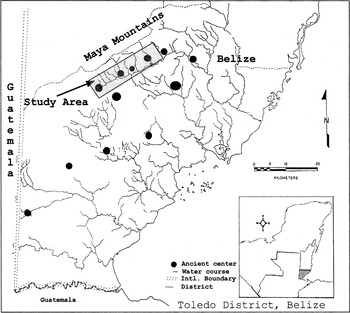
Map showing the location of the study area in the southern Maya Mountains of Belize, with major pre-Columbian centers in the region.
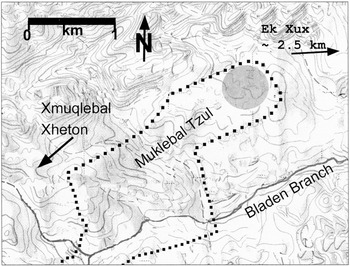
Map showing the location of Xmuqlebal Xheton cave in relation to the Muklebal Tzul site core and settlement. Muklebal Tzul is a substantial regional center, with two stelae plazas and more than 300 residential structures. The dotted line shows the extent of the settlement; the shaded area is the site core (modified after Director General of the Military Survey 1993).
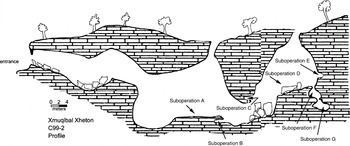
Profile view of Xmuqlebal Xheton cave. All of the areas in which cultural materials were found are located below the 15-m vertical drop.
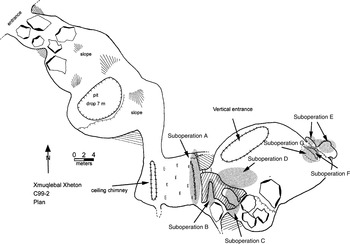
Plan view of Xmuqlebal Xheton cave showing the locations of all suboperations. The figurine was recovered from Suboperation A.
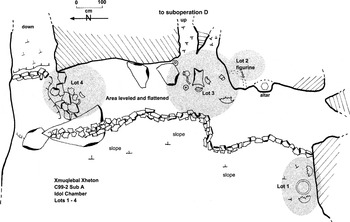
Detailed plan of Suboperation A showing the location of Lots 1–4. The figurine was found in a small crevice in the wall and was designated Lot 2.
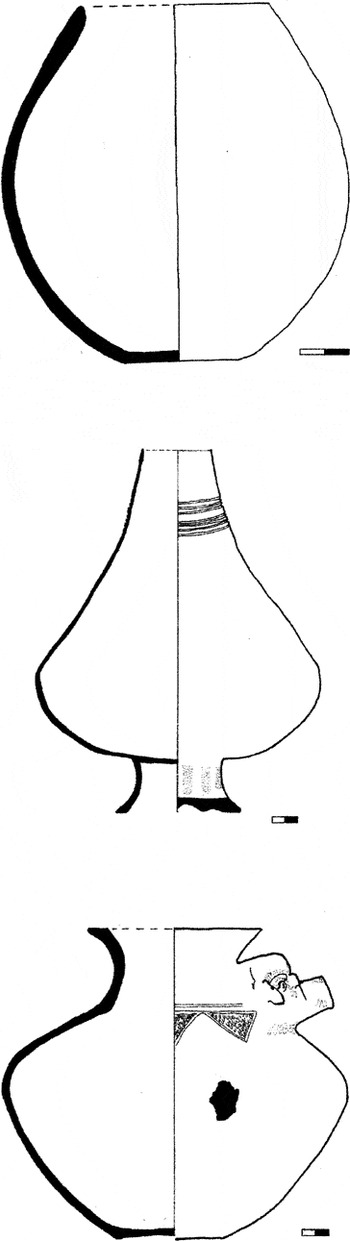
Three Late Classic-period vessels recovered from Suboperation A, Lot 3, located directly below the niche where the figurine was found.
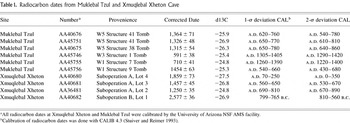
Radiocarbon dates from Muklebal Tzul and Xmuqlebal Xheton Cave
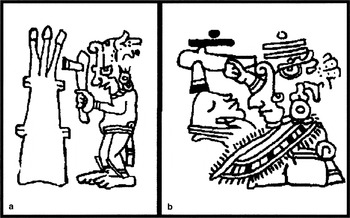
Examples from the Madrid Codex showing (a) cutting of trees with axes (Madrid Codex, page 89c); and (b) carving of figurines (Madrid Codex, page 96d, after Villacorta and Villacorta 1930).
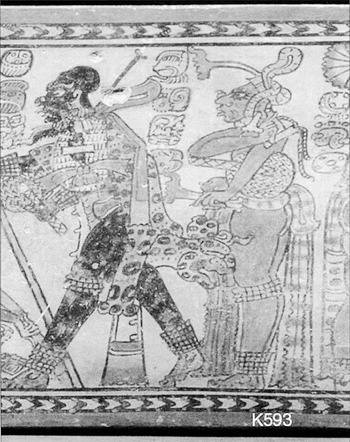
Detail from a vessel depicting an individual holding a woven palm fan. The vessel is from Chama, located in Alta Verapaz, Guatemala (modified after Kerr File K-593; Justin Kerr, 1976).
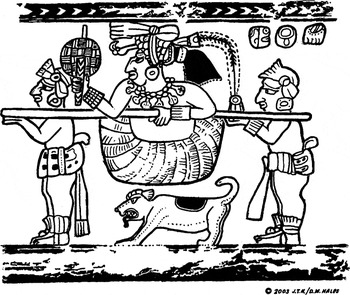
The Ratinlinxul Vase, Chixoy Valley, Guatemala, showing detail of processional scene of an individual being carried in a litter and holding a palm-frond fan (illustration courtesy of John T. Hales and Donald M. Hales, 2003).
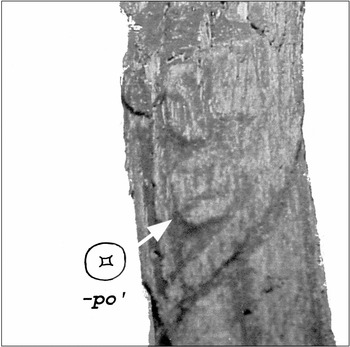
Detail of the garment of the Xmuqlebal Xheton figurine from a photograph taken during its recovery from the cave and before conservation. Note the possible glyphic element -po'. The elements directly above -po' may be a phonetic spelling of -aj, but the surface is too eroded to say for certain.
 You have
Access
- 10
- Cited by