Clostridioides difficile infection (CDI) has been identified by the US Centers for Disease Control and Prevention (CDC) as an “urgent threat” to human health.1Clostridioides difficile is now the most common pathogen causing healthcare-associated infections in the United States.Reference Magill, O’Leary and Janelle2 In 2017, ~223,900 cases occurred among hospitalized patients, causing 12,800 deaths.1 Nearly all antibiotics have been implicated as risk factors for subsequent CDI, but certain classes, such as extended-spectrum cephalosporins (ESCs) and fluoroquinolones (FQs), have been associated with the highest risk for disease due to causing greater disruption of the intestinal microbiome.Reference Brown, Langford, Schwartz, Diong, Garber and Daneman3 These disruptions can persist, and predispose to CDI for weeks to months after the antibiotic is stopped.Reference Kuntz, Chrischilles, Pendergast, Herwaldt and Polgreen4 Thus, minimizing the frequency and duration of higher-risk antibiotic therapy is an important CDI prevention strategy.Reference McDonald, Gerding and Johnson5,Reference Kazakova, Baggs and McDonald6
Several studies have found that stewardship interventions that focus on reductions in ESC and FQ prescribing can lead to decreased CDI,Reference Dancer, Kirkpatrick, Corcoran, Christison, Farmer and Robertson7–Reference Dingle, Didelot and Quan12 although more research is needed to establish a robust evidence base.Reference Feazel, Malhotra, Perencevich, Kaboli, Diekema and Schweizer13 Targeted stewardship interventions include restrictive (preauthorization) and persuasive (postprescription review and feedback) approaches to change the prescribing behavior of clinicians. To bolster the success of stewardship, it is critical to incorporate knowledge about the social, cultural, and psychological dynamics that underpin antibiotic decision making into the design, implementation, and evaluation of interventions.Reference Charani, Edwards and Sevdalis14–Reference Charani and Holmes16
Research on antibiotic choice suggests that clinicians often do not follow antibiotic selection guidelines,Reference Werner, Hecker, Sethi and Donskey17,Reference Braykov, Morgan and Schweizer18 choosing second- or third-line agents when more targeted drugs are indicated. The unnecessary use of broad-spectrum antibiotics in hospitalized patients is well documented.Reference Fridkin, Baggs and Fagan19 Although some of this unnecessary use may be driven by lack of clinician knowledge of the guidelines that specify optimal antibiotic selection for common infections,Reference Salsgiver, Bernstein and Simon20 deeper sociobehavioral factors that structure the logic of clinical practice also play a role.Reference Broom, Kirby, Gibson, Post and Broom21,Reference Broom, Broom and Kirby22 Qualitative methodologies, particularly in-depth interviews, can be used to generate knowledge on the symbolism and ritual of pharmaceutical practice.Reference Nichter and Vuckovic23 Previous qualitative research has considered the reasons why clinicians may overuse broad-spectrum antibiotics in general,Reference Krockow, Colman and Chattoe-Brown24 but less is known about specific classes of antibiotics like ESCs and FQs. Our objective in this study was to understand how clinicians perceive ESCs, FQs, and the risk of CDI in the context of a targeted stewardship intervention being implemented in the inpatient setting.
Materials and Methods
Study design, setting, and participants
We conducted semistructured interviews with a purposive sample of prescribers and antibiotic stewardship stakeholders from 4 hospitals in the United States. The hospitals were in the preimplementation phase of a CDC-funded study to improve the use of ESCs or FQs to prevent CDI. This study involved the implementation of a set of targeted interventions including clinical decision support, education, and postprescription review with feedback. Hospitals customized the target of the intervention based on local antimicrobial use data. Three hospitals focused their intervention on FQs, especially levofloxacin or ciprofloxacin, and the other hospital focused on ESCs, specifically ceftriaxone.
This inductive qualitative study was led by a medical sociologist with expertise in mixed-methods research on antibiotic stewardship.Reference Szymczak, Newland, Barlam, Neuhauser, Tamma and Trivedi25 At each hospital, we recruited 2 distinct groups of respondents: frontline clinicians (physicians, nurse practitioners, physician assistants, and nurses) and antibiotic stewardship stakeholders (infectious diseases physicians and pharmacists). To recruit respondents, we worked through a key contact involved in implementing the targeted stewardship intervention at each hospital site. The key contact provided us with a list of clinicians in specialties likely to be impacted by the intervention including hospital medicine, emergency medicine, intensive care, general surgery, and stewardship staff. The study team recruited respondents by e-mail. We did not include key contacts in this process, although 2 were interviewed. Respondents were assured that their data would not be shared with key contacts beyond a report of de-identified aggregated themes. Our protocol was approved by the University of Pennsylvania Institutional Review Board.
Data collection
Data were gathered during April and May 2018 prior to the implementation of the intervention at each site. Interviews were conducted in-person by 2 trained interviewers. Two semistructured interview guides were created (see Supplementary Materials online). Questions were designed to be open-ended to elicit in-depth responses from clinicians with minimal prompting.Reference Weiss26 All interviews were, with permission, recorded. Interviewers wrote data collection memos at the conclusion of each interview to identify recurrent themes and patterns across cases.Reference Malterud, Siersma and Guassora27,Reference Birks, Chapman and Francis28 We monitored for thematic saturation throughout data collection by tracking themes that emerged in response to each question.Reference Kerr, Nixon and Wild29 Respondents were recruited until no new insights were generated in response to each question.
Data analysis
All audio files were transcribed and uploaded into NVivo version 12 software30 for coding. Data were independently analyzed using a flexible coding approach by 2 coders.Reference Deterding and Waters31 Themes were systematically identified in a 2-stage process. First, a code book based on the interview guides was developed and a review of the data collection memos was conducted. Codes were defined clearly and were discussed among the team. Second, the coders applied the code book to the transcripts. Intercoder reliability was monitored throughout, and modifications were made to the coding procedure to ensure that agreement exceeded 95%. Once line-by-line coding was complete, we utilized a framework matrix to identify higher-order patterns across codes, respondent classifications, and hospitals.Reference Gale, Heath, Cameron, Rashid and Redwood32 The themes reported were expressed by at least half of each group of respondents, so the perceptions described represent shared understandings and are not the opinions of isolated individuals.
Results
Characteristics of respondents
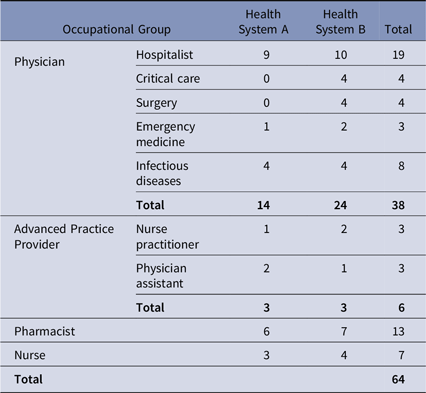
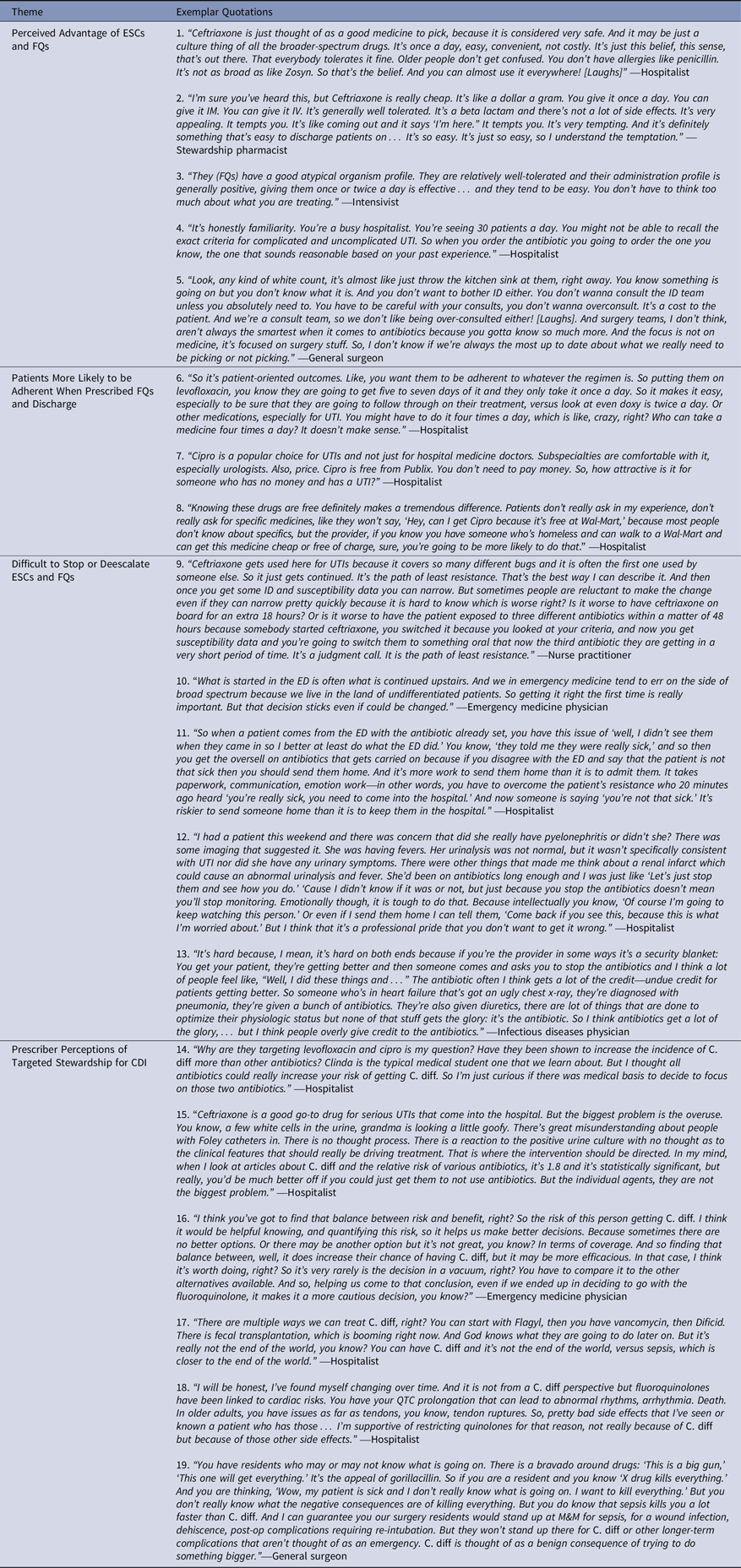
Of the 102 clinicians recruited to participate in the study, 64 were interviewed, for an overall response rate of 62.7%. Interviews ranged in length from 14 to 69 minutes, with a median of 36.5 minutes. Table 1 lists the characteristics of participating respondents. Of the 64 respondents, 43 were frontline clinicians and 21 were antibiotic stewardship stakeholders: 8 infectious diseases physicians and 13 pharmacists. Table 2 lists key themes with selected exemplar quotations (Q#) for each.
Characteristics of Respondents

Themes and Exemplar Quotations

The perceived advantage of ESCs and FQs
Both prescribers and stakeholders perceived that, especially in the setting of clinical uncertainty and time pressures, ESCs and FQs are a good choice to treat common suspected bacterial infections in hospitalized patients, using words like “comfortable,” “appealing,” “tempting,” “attractive,” and even “addicting” to describe them. When prompted to elaborate why ESCs and FQs are thought of in this way, prescribers would enthusiastically describe the benefits of the drug, including infrequent dosing, breadth of coverage, and ease of transition from intravenous to oral administration (Q#1). Stakeholders stated that they understood the perceived advantages of ESCs and FQs from the perspective of prescribers (Q#2).
The idea that ESCs and FQs are “easy” drugs was repeated across respondents. Some prescribers stated that using these drugs was appealing because they required little to no thought (Q#3). Stakeholders described these drugs as “decerebrate” and “mindless.” Prescribers explained that the low cognitive effort required to make a decision about ESCs or FQs is appealing in the context of a heavy workload and time pressures (Q#4). The decision to prescribe an antibiotic in the first place, and then select which antibiotic is most appropriate, are only 2 of many choices a clinician makes in the course of a day. Respondents explained that decisions about antibiotics can be perceived as less interesting, less important, or too time-consuming compared to other clinical decisions (Q#5).
Patients more likely to be adherent when prescribed FQs
A second major reason prescribers gave for why they favored FQs in particular is because they perceived that patients would be more likely to be adherent to these drugs after discharge because of infrequent dosing (Q#6) and low cost (Q#7). Prescribers suggested that they did not experience pressure from patients for FQs because of low cost, but that in their own consideration of a patient’s economic circumstances, the availability of a medicine did weigh on their decisions (Q#8). The likelihood that a patient would be adherent to a prescribed regimen was a major motivator for prescribers because they wanted to avoid treatment failure and readmission. They stated that in caring for patients whom they did not think could handle multiday dosing, selecting an FQ was “comfortable” and “reassuring.”
Difficult to stop or de-escalate ESCs and FQs
Prescribers stated that even when an ESC or FQ could be discontinued or switched to a more appropriate drug following the receipt of culture and sensitivity data, this was very difficult in practice. Two reasons were given by respondents for this difficulty. First, they were reluctant to change decisions about antibiotic therapy made by other clinicians due to inertia and uncertainty (Q#9). Making changes to antibiotics started in the emergency room (ER) was described as particularly challenging (Q#10). A patient being admitted through the ER may have multiple prescribers making decisions about their care across a short period of time, with those seeing the patient a few days into a hospitalization reluctant to modify a prescription they “inherited” from a clinician who saw the patient at their sickest. Some hospitalists described feeling pressure to continue the antibiotic selection made by prescribers in the ER, even if it appears suboptimal from a stewardship perspective, to justify the admission (Q#11).
Second, many respondents stated that discomfort with “changing what is working” for fear of a bad outcome is another reason why it is difficult to deescalate or discontinue ESCs or FQs. Respondents described how it can sometimes be emotionally challenging to stop an antibiotic even if it makes sense intellectually, because of a strong desire to minimize the risk associated with being wrong (Q#12). In the setting of making a recommendation to a prescriber to stop an antibiotic, stewardship stakeholders described the challenges they face in countering the emotional drive to keep a patient on antibiotics as a “security blanket” (Q#13).
Prescriber perceptions of targeted stewardship for CDI
All respondents were asked their opinion of intervening on the use of ESCs and FQs with the goal of preventing CDI. Although prescribers expressed support for the overall goals of stewardship, many expressed confusion or skepticism about targeting ESCs and FQs. Some prescribers did not understand the rationale behind the drugs selected for the intervention (Q#14). Other prescribers believed that focusing on specific drugs was the wrong strategy; they believed that the focus should be on getting clinicians to think carefully about when and how to use all antibiotics (Q#15). Other prescribers described uncertainty about swapping one drug for another and the potential of developing resistance to the substitute drug. One hospitalist stated, “I think stewardship is good, but specifically targeting third- and fourth-generation cephalosporins, though? I sometimes think of stewardship as whack-a-mole, in that you pound one down and something else pops back up.”
In sharing their opinions about the ultimate goal of stewardship to prevent CDI, prescribers described navigating a delicate balance between risk and benefit (Q#16).
All prescribers expressed a belief that the risk of a negative outcome from undertreating a bacterial infection was a higher priority and a more concerning development than the risk of CDI (Q#17). Frontline prescribers did not perceive CDI to be a serious outcome: “It’s not the end of the world” or “I’ll deal with diarrhea.” In discussing reductions in FQs prescribers did mention that they perceived these to be risky drugs for some patients, but because of cardiac risk, not CDI (Q#18). As an outcome CDI was not particularly salient to prescribers in our study (Q#19).
Discussion
Given the considerable morbidity, mortality, and excess cost caused by CDI among hospitalized patients, prevention of this infection is a critical public health priority in the United States.1 In addition to environmental disinfection and reduction of transmission via healthcare workers, targeted antibiotic stewardship interventions that focus on improving the use of drugs that are higher risk for causing CDI such as ESCs and FQs are a core component of CDI prevention.Reference McDonald, Gerding and Johnson5 As the evidence base for these targeted stewardship interventions grows and efforts to implement them broadly continue, research is needed to identify the social and behavioral determinants that drive the overuse of high-risk antibiotics.Reference Rzewuska, Charani and Clarkson15 We conducted a qualitative study to understand how prescribers and stewardship stakeholders perceived ESCs and FQs, barriers to optimal use, and their association with CDI.
Our study is one of the few qualitative investigations of the perceptions that US-based prescribers and stewardship stakeholders working in the inpatient setting hold about antibiotic decision makingReference Livorsi, Comer, Matthias, Perencevich and Bair33–Reference Laake, Bernabe, Peterson and Liappis35 and the only study to focus on specific classes of drugs. In general, our findings are consistent with the international literature examining the reasons behind overuse of broad-spectrum antibiotics.Reference Krockow, Colman and Chattoe-Brown24 As has been demonstrated previously, respondents in our study expressed a perception that ESCs and FQs are a particularly powerful and safe choice in the face of clinical uncertainty,Reference Broom, Kirby, Gibson, Post and Broom21,Reference Livorsi, Comer, Matthias, Perencevich and Bair33,Reference Om, Daily, Vlieghe, McLaughlin and McLaws36 can be prescribed quickly with little cognitive effort,Reference Broom, Broom and Kirby37,Reference Broom, Broom, Kirby, Gibson and Post38 and are difficult to stop or deescalate once started.Reference Livorsi, Comer, Matthias, Perencevich and Bair33,Reference Livorsi, Comer, Matthias, Perencevich and Bair34
Our study makes three novel contributions. First, our findings illustrate how the choice to use a particular antibiotic is shaped by the demands present in the context in which care is delivered. Respondents in our study described ESCs and FQs as uniquely appealing medications because of their perceived low risk of adverse drug reactions, ease of administration, broad coverage, simple dosing, and low cost. In describing them as “addictive,” respondents referred to the low cognitive effort required to use these drugs. But it is not simply a matter of laziness, disengagement, or lack of capacity to engage in complex decision making on the part of the prescriber. Instead, ESCs and FQs are seen as superior tools for the treatment of infection within the context of a busy inpatient setting. These drugs not only produce a microbial outcome, they produce organizational, interpersonal, and workflow outcomes that may be just as important, if not more important, to the prescriber in the course of delivering care.Reference Krockow, Colman and Chattoe-Brown24 In clinical settings characterized by time pressure, incentives to reduce readmissions, concern about patient adherence, multiple teams of professionals caring for the same patient, and bureaucratic requirements to justify admission, ESCs and FQs are attractive because they are perceived to achieve multiple goals simultaneously.
Second, our study shows how prescribers consider the impact of their antibiotic choices on patients after hospital discharge. FQs were seen as particularly appealing because of infrequent dosing and low cost. Prescribers believed that patients were more likely to be adherent to their medication regimen as a result. Poor patient adherence to medication regimens is a pressing concern across all diseases states. Investigations of adherence to antibiotic regimens following hospital discharge have found adherence rates ranging from 50% to 57% via self report, which are likely to be inflated.Reference Faure, Leguelinel-Blache, Salomon, Poujol, Kinowski and Sotto39,Reference Eells, Nguyen, Jung, Macias-Gil, May and Miller40 Some evidence shows that, as our respondents believed, adherence to antibiotic regimens is higher when an antibiotic is administered once rather than multiple times per day.Reference Falagas, Karagiannis, Nakouti and Tansarli41 Understanding how to best incorporate patient-centered outcomes into inpatient antibiotic stewardship is an area in need of further research,Reference Ewers, Knobloch and Safdar42 and it is one that will become increasingly important as interventions targeting the quality of prescribing at hospital discharge are developed.Reference Vaughn, Gandhi, Conlon, Chopra, Malani and Flanders43
Third, our study demonstrates that for prescribers, CDI is not of particular concern in relation to ESC and FQ use. Even when CDI was recognized as a risk of ESCs or FQs, it was considered an acceptable risk in the moment of caring for sick patients, especially those worried about sepsis. Most of our respondents indicated that risk of CDI was not a high priority factor influencing their prescribing decisions. Livorsi et alReference Livorsi, Comer, Matthias, Perencevich and Bair33 found a similar perception about the risks of CDI and antibiotic use in a 2015 qualitative study of the prescribing decisions of hospitalists. Even though CDI is direct patient harm that can be traced back to antibiotic use, prescribers may not see it as much of a concern given that CDI can often be successfully managed. Therefore, it is a risk worth taking in comparison to the risks associated with undertreating a bacterial infection.
The findings reported here have clear implications for the development of targeted stewardship interventions. Although restrictive targeted stewardship interventions (prior approval) are more effective than persuasive strategies at reducing CDI,Reference Feazel, Malhotra, Perencevich, Kaboli, Diekema and Schweizer13 these approaches are resource intensive and not always feasible to implement across a wide variety of settings. Our findings suggest ways that persuasive stewardship could be more impactful. First, education on the risks of ESCs, FQs, and CDI will likely be necessary but not sufficient to make sustainable change, especially given the perceived advantages of these drugs. Second, intervention design should focus on making the optimal choice the easiest choice for prescribers. Behavioral “nudges” embedded in the electronic health record may help prescribers overcome the “path of least resistance” and be more thoughtful about their choices.Reference Vaughn and Linder44 Third, efforts to make CDI a motivating outcome to prescribers are needed. Whether through incentives, organizational initiatives, or the circulation of narratives about patients harmed by CDI, more work needs to be done to amplify the salience of this adverse event.
Our study has several limitations. First, because we adopted a qualitative approach our findings may not be generalizable beyond the settings we studied, although our alignment with the findings of previous studies suggests this limitation is minimal. Second, despite explicit efforts to minimize their effects, our sample may be biased. It is possible that the respondents who agreed to participate to an interview possessed systematically different characteristics that influenced their willingness to participate and shaped their perceptions compared to those not interviewed. We were unable to assess the characteristics of respondents versus nonrespondents. It is also possible that interview respondents did not honestly share their perceptions about ESCs, FQs and antibiotic stewardship to please the interviewer. Given that we heard critical statements and admission of antibiotic overuse, we believe the impact of social desirability bias to be minimal.
In conclusion, prescribers in this study perceived that ESCs and FQs are convenient and easy to use under conditions of time pressure and clinical uncertainty. The many perceived advantages of these drugs, coupled with a willingness to accept the risk of CDI suggests that targeted stewardship interventions must consider prescriber perceptions and the contextual features in which they practice to make sustainable change.
Acknowledgments
None.
Financial support
This study was supported by funding from the US Centers for Disease Control and Prevention’s investments to combat antibiotic resistance (grant no. 200‐2016‐91944) and the Cooperative Agreement (FOA no. CK16-004) with the Epicenters for the Prevention of Healthcare-Associated Infections.
Conflicts of interest
All authors report no conflicts of interest relevant to this article.
Supplementary material
To view supplementary material for this article, please visit https://doi.org/10.1017/ice.2020.183