1 Introduction
Phonological vowel reduction is the diminution in the number of vowel contrasts in certain positions, notably unstressed syllables, resulting from the neutralisation of vowels in the language's inventory. The full range of contrasts is manifested in other positions, such as stressed syllables. The genesis of phonological vowel reduction is commonly explicated in terms of phonetic vowel reduction, i.e. the diminution of the acoustic vowel space (Fourakis Reference Fourakis1991) in those self-same positions in which phonological vowel reduction is found, commonly correlated in articulatory terms with undershoot, the failure to reach the configuration required for a canonical rendition of a given contrastive sound. Mediating between phonetic and phonological reduction is perception: the reduced vowel space in phonetic vowel reduction might render a vowel contrast insufficiently discriminable for the listener to perceive that contrast, leading to its neutralisation over time, as listeners then do not implement the non-apprehended contrast in their own production. This would be a purely diachronic account of (phonological) vowel reduction (e.g. Blevins Reference Blevins2004). A speaker might also be aware of the poor discriminability of the contrast, through a form of ‘phonetic knowledge’ (Kingston & Diehl Reference Kingston and Diehl1994), and hence not attempt to maintain the difference between two vowels, leading to speaker-controlled neutralisation. As this constitutes the introduction of a consistent and categorical replacement of one sound for another in a given context in an individual's grammar, it might be interpreted as synchronic (phonological) vowel reduction, which might then lead to a diachronic sound change, if a speech community implements such a replacement speaker by speaker and/or item by item.
Typological surveys (e.g. Crosswhite Reference Crosswhite2001, Barnes Reference Barnes2006) have found that both phonological and phonetic vowel reduction occur more often in some contexts than in others. Most importantly, reduction occurs in unstressed syllables, while phonological reduction is unlikely in stressed syllables, presumably because of the robust perceptual cues to vowel quality afforded by the common phonetic correlates of stress, such as increased duration and intensity. Other influences can be considered to be probabilistic (van Bergem Reference Bergem1995); for example, reduction is more likely to occur in more frequent words than in less frequent ones, and in function words more than in content words (possibly as a result of a correlation with frequency). Syllable shape is also occasionally found in the literature as a factor: vowel reduction is reported to be more common in open syllables than in closed ones (van Bergem Reference Bergem1995: 91). Whereas the other influences can be easily interpreted in phonetic terms (e.g. more frequent words are often pronounced with less precision), this factor appears to require further investigation if it is found to be relevant in a language. Closed syllables are often heavy in quantity-sensitive systems: VC rhymes pattern with Vː and diphthongal rhymes in many languages with respect to syllable weight (see Gordon Reference Gordon2004, Reference Gordon2006).Footnote 1 Given that heavy syllables commonly attract stress – the weight-to-stress principle – a straightforward interpretation for the more common occurrence of reduction in open than closed syllables would be that closed syllables bear stress. The distinction could then be reduced simply to stressed: unstressed.
Is this the correct account of the open vs. closed syllable distinction? Archaic Latin (seventh to third centuries BC) provides an intriguing test case, as syllable shape is a factor in conditioning the result of reduction, but the absence of primary phonetic data renders a secure reconstruction of intensity and duration difficult. Latin follows the pattern identified by van Bergem: word-internal open syllables show more extreme reduction than closed syllables (see §2). Miller (Reference Miller1972) interprets this less extreme reduction in closed syllables as the result of secondary stress on internal closed syllables, since these were heavy for the purposes of stress placement later in classical Latin (first century BC to first century AD), under the Penultimate Law of stress placement. As hypothesised above, stress on internal heavy syllables is therefore posited to motivate the pattern of vowel reduction, on the basis of the vowel-reduction pattern itself. Clearly, independent evidence for such a position would be more satisfactory, especially as Miller's interpretation is difficult for one key reason: the classical Latin Penultimate Law came into force long after vowel reduction occurred, and although internal heavy syllables undoubtedly bore secondary stress in the immediately preceding period, there is no evidence for reconstructing such a stress in the early archaic period, when vowel reduction appears to have occurred. On the contrary, there is evidence (discussed in §5.1 below) which suggests that internal syllables never bore stress in early archaic times, both from vowel reduction itself and from patterns in those instances of syncope which happened in early archaic times.Footnote 2
If, then, internal heavy syllables did not bear stress when Latin vowel reduction occurred, another motivation for the pattern needs to be reconstructed. This problem becomes particularly acute if one considers that vowel duration has been shown to be the primary factor in undershoot, the phonetic root of phonological reduction (Lindblom Reference Lindblom1963, Flemming Reference Flemming2002, Reference Flemming2004, Padgett & Tabain Reference Padgett and Tabain2005). If a speaker does not expend the energy required for faster articulatory displacement in prosodically conditioned contexts of reduced duration, such as unstressed syllables, the articulatory targets for achieving the canonical phonetic location (or window) in the vowel space are not attained. Faster displacement might be motivated in ‘hyperspeech’ (Lindblom Reference Lindblom, Hardcastle and Marchal1990), a speaker-controlled variety of speech, conditioned by social, geographical and contextual factors, for example, as adopted by a newsreader. Otherwise, the motivation for attaining targets in casual speech appears to be a language-specific decision, with phonetic vowel reduction occurring in a given language where the ‘ambition’ to reach articulatory targets and maintain contrasts is low (e.g. English), as opposed to high (e.g. Italian; Burzio Reference Burzio2007).
Why should this factor render the closed syllable resistance of reduction problematic? Maddieson (Reference Maddieson1985) reports that vowels in closed syllables are near universally shorter than those in open syllables, a phenomenon he labels Closed Syllable Vowel Shortening (CSVS). Given this pattern, the phonetic basis for phonological reduction predicts the opposite pattern: reduction should be more common in closed than in open syllables, if closed syllables do not attract stress in a given language. If closed syllables in archaic Latin did not bear stress, why did vowels in this position reduce to a lesser extent than open syllable vowels?
Maddieson (Reference Maddieson1985) finds no clear counterexamples to CSVS, after considering Japanese and other languages as possibilities. However, both earlier and more recent investigations have identified languages which seem to show precisely the opposite pattern: closed syllable vowels are longer in duration than those in open syllables. Examples of such languages are Finnish (Lehtonen Reference Lehtonen1970), Turkish (Jannedy Reference Jannedy1995, Kopkallı-Yavuz Reference Kopkallı-Yavuz, Sumru Özsoy, Akar, Nakipoğlu-Demiralp, Erguvanlı-Taylan and Aksu-Koç2003) and (Maddieson's concerns notwithstanding) Japanese (Smith Reference Smith1991, Reference Smith, Connell and Arvaniti1995, Han Reference Han1994). Does such a typologically uncommon pattern explain archaic Latin vowel reduction? That is, can we reconstruct for archaic Latin a pattern whereby closed syllable vowels were longer than open syllable ones, all other things being equal? All the evidence we can glean about the phonetics of archaic Latin from its phonological behaviour argue that we can. The typologically unusual pattern is manifested not only in the vowel-reduction pattern, but also affects vowel and consonant quantity developments in the phenomena of classical compensatory lengthening, the development CVːCV > CVC, inverse compensatory lengthening (the ‘littera-rule’), and ‘superheavy’ degemination (VːCCV > VːCV).
2 Latin vowel reduction
Vowel reduction in Latin is manifested by the raising of short vowels, leading to the total neutralisation of contrasts in internal open syllables, and a lesser degree of raising and neutralisation in closed syllables.Footnote 3 For example, securely reconstructed *kekadai>cecidī ‘I fell’ (cf. cadō ‘I fall’) in an open syllable, but *perfaktos>perfectus ‘completed’ in a closed one.Footnote 4 Vowel reduction in internal syllables in Latin can be reconstructed to around the sixth to fifth centuries BC, the early archaic period, based on inscriptional evidence supported by similar trends in Etruscan and syncope in the Sabellian languages (e.g. Oscan and Umbrian), allowing us to form a picture of areal phonological traits (Meiser Reference Meiser1998: 66). The majority of the evidence for unreduced forms comes from secure, and generally agreed, etymologies, based on comparative Indo-European evidence. Unreduced vowels are often found in morphologically related forms where the vowel is in the initial, stressed syllable, thus cadō vs. cecidī, a reduplicated perfect tense form, and factus ‘made’ vs. perfectus. The earliest inscriptions show unreduced vowels (e.g. ‘Fibula Praenestina’ CIL12.2 numasioi for classical Numeriō ‘for Numerius’; see §2.2), whereas reduced internal vowels are very settled by early Latin (third to first centuries BC), to judge from inscriptions and the reconstructed autographs of literary texts (e.g. Plautus' comedies) dating from that period.
Reduction has been ascribed to an archaic Latin period of initial syllable stress, based on arguments from phonological typology, a technique regularly used to facilitate our understanding of historical phenomena. Observed premises imply reconstructions by inductive reasoning: if current forms of languages display a certain pattern with an identified motivation, and the behaviour of a linguistic phenomenon in a non-current language is very similar, we can conclude that the non-current language shares the characteristics of the current languages that motivate that phenomenon. Thus current languages which show reduction and/or syncope in all non-initial syllables have initial syllable stress (see Barnes Reference Barnes2006: 28–29, 174–177), and archaic Latin shows reduction and syncope in all non-initial syllables, with little or no modification in initial syllables (see §2); we can therefore conclude that Latin had initial syllable stress in this period. The reconstruction of archaic initial stress in Latin by Corssen (Reference Corssen1858–59) is an early example of the success of employing contemporary typological evidence. This archaic pattern is argued to have persisted until the fourth century BC (Meiser Reference Meiser1998: 53, 67–69), when it came to be replaced by the familiar Penultimate Law found in classical Latin: the penult was stressed if heavy, otherwise the antepenult bore stress, thus per.ˈfec.tus, but per.ˈfi.ci.ō ‘I complete’.
(1)


Vowel reduction affected only short vowels and the first element of diphthongs; long vowels were immune.Footnote 5 The phenomenon was sensitive to surrounding segments, in particular the postvocalic consonant (§2.2), and syllable structure (the focus of this article), with more thoroughgoing neutralisation in open syllables than in closed ones.
2.1 Unconditioned developments
The neutralised vowel resulting from reduction in Latin was as high as the consonantal environment permitted, thus in the absence of intervening phonetic conditions or analogical pressures all vowel contrasts in internal open syllables were neutralised to /i/.
(2)
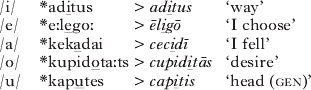
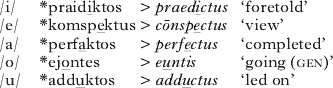
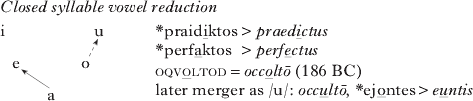
In closed syllables, the reduction of short vowels was much constrained (Meiser Reference Meiser1998: 70). Essentially, a back vs. front distinction remained, but the three vowel heights (high /i u/, mid /e o/ and low /a/) were reduced to two by the neutralisation of /a/ and /e/. The high vowels remained distinct, thus the vocalic contrasts in closed syllables were back vs. front and high vs. non-high, yielding an inventory /i u e o/. In the back series (/u o/) the two height levels were later conflated (in the second century BC), merging as the high /u/.Footnote 6
(3)
2.2 Some conditioned developments
In certain environments, short-vowel distinctions were totally neutralised, but the neutral vowel was not /i/. The following consonant in particular often had a conditioning effect, presumably by the phonologisation of coarticulatory effects, but again syllable structure appears to have played a role, as some such total neutralisations occurred in both open and closed syllables, but others occurred only in open ones. I consider both types below.
2.2.1 Before /r/
Before /r/, all short vowels in internal open syllables were neutralised as /e/ (Meiser Reference Meiser1998: 68; see Lindau Reference Lindau1985: 158 on vowel lowering before /r/). This also occurred before the rhotic that came about through intervocalic ‘rhotacism’ (*VsV > VrV).
(4)
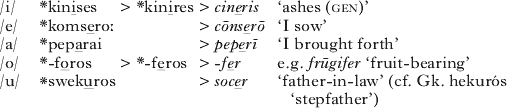
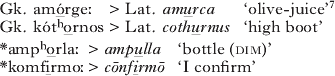
This conditioned development did not occur in closed syllables, where the vowel simply underwent the usual closed syllable reduction seen in (3) above. The neutralisation as /e/ of internal short vowels before /r/ was therefore an open syllable development only. The evidence for closed syllable reduction, and not ‘r-conditioning’, comes from original /i o u/ + /r/ sequences, given the unconditioned merger of /e/ and /a/ in closed syllables. Examples come mainly from the adaptation of early loanwords.
(5)
Footnote 7
2.2.2 Before labial consonants
Before a labial consonant (/p b f m w/), the open syllable vowel was written consistently as <i> in some words (e.g. *adkapioː>accipiō ‘I receive’), consistently as <u> in some words (e.g. *deːpawioː>dēpuviō ‘I beat thoroughly’)Footnote 8 and showed variation between <i> and <u> in others (Leumann Reference Leumann1977, Meiser Reference Meiser1998: 68).Footnote 9
(6)
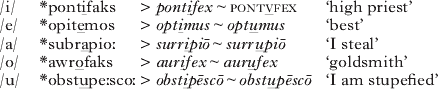
The reduced vowel was therefore plausibly realised sometimes as more front and/or unrounded and sometimes more back and/or rounded (possibly depending on the environment, e.g. the /i/ in the third syllable of accipiō had a fronting effect on the vowel of the second syllable vs. morphologically related occupō ‘I occupy’), but otherwise as a high, slightly labialised vowel, plausibly similar to central rounded [ʉ] or lax front rounded [ʏ] (see Allen Reference Allen1978: 59).
The vast majority of examples of this treatment is found in open syllables, and indeed Leumann (Reference Leumann1977: 87) states the rule as an open syllable development. However, he goes on to acknowledge (1977: 88) that in closed syllables before a labial consonant, there is variation between the unconditioned /e/, and /u/, the latter presumably the result of earlier */o/ after the second-century raising, suggesting that the labial consonant had a colouring effect in closed syllables also. Thus we find (7).
(7)

However, there are few examples of such a colouring effect in closed syllables, and furthermore those that exist are in the minority compared to forms with /e/. In conclusion, labial colouring is much more likely to indicate the presence of an open syllable than a closed one; the vowel was again more likely to be affected when in an open syllable, and maintain its features in a closed one.
2.2.3 Before dark /l/
A third colouring effect can be seen where the vowel was followed by a dark /l/, found consistently in coda position in Latin, to judge from grammarians' statements and the colouring of preceding vowels (see Lindsay Reference Lindsay1894: 89–90, 92, Leumann Reference Leumann1977: 140–142, Sommer & Pfister Reference Sommer and Pfister1977: 131–132, Sihler Reference Sihler1995: 174, Niedermann Reference Niedermann1997: 9, Meiser Reference Meiser1998: 52). Onset /l/ was also contextually darkened in a gradient fashion correlating with the backness of the following vowel (Sen forthcoming): all vowels which were not /i/ had a relatively dark preceding onset /l/, which coloured the preceding open syllable vowel. The reduced vowels in this environment merged as /o/ after archaic vowel reduction, which became /u/ after the second-century raising. In open syllables, we find the examples in (8) (Meiser Reference Meiser1998: 68–69).
(8)

We find the development of all vowels, front or back, to /u/ before coda dark /l/ in closed syllables, with little evidence of a chronologically intermediate /o/ (possibly oqvoltod below), a gap in the evidence which is perhaps only coincidental, but which could indicate that coda /l/ was darker than contextually darkened onset /l/ (Sen forthcoming).
(9)
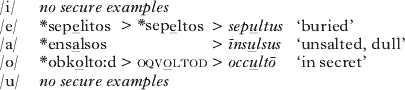
Therefore, the colouring of preceding vowels by dark /l/ was without question found in both open and closed syllables. The effect is even seen in initial syllables, which would have been stressed in archaic Latin, thus *weloː>volō ‘I want’. This sets it apart from the other two contexts which we have considered in this section, the /e/-colouring effect of following /r/ in unstressed open syllables only, and the rounding effect of following labial consonants, which certainly took place in unstressed open syllables, but may also have occurred in closed ones. The pattern can be interpreted as evidence for a sufficiently dark /l/ in Latin to colour a preceding vowel regardless of syllable structure, with perhaps a darker coda /l/ than a contextually darkened onset /l/. Further evidence for this interpretation is discussed in Sen (forthcoming), where coda /l/ is argued to bear a phonologically specified velar dorsal gesture, whereas the dorsal gesture of onset /l/ is underspecified, permitting gradient darkening.
2.3 Summary
Long vowels were immune to reduction. Short vowels in internal open syllables underwent ‘extreme reduction’ to /i/ (10), except in certain conditioning environments in which the quality of the vowel was entirely predictable from its phonetic environment (11). Therefore, raising resulted in the neutralisation of phonological contrasts in internal open syllables with short vowels.
(10)
(11)
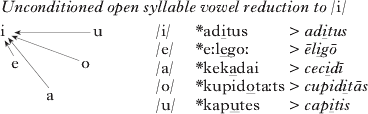

In internal closed syllables, the reduction of short vowels was much constrained, as shown in (12). The change *a > /e/ neutralised the contrast between low and mid front vowels. In the back series, /o/ and /u/ remained unchanged at an early stage, merging later as the high /u/ in the second century BC (Meiser Reference Meiser1998: 70), in the same way as in the open syllable development before [lɤ]. High front vowels remained distinct.
(12)
3 The phonetic basis of Latin vowel reduction
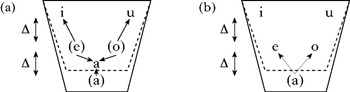
Phonological vowel reduction results in a reduced inventory of vowels in certain positions. The neutralisation of contrasts is usually ascribed to the smaller perceptual vowel space in such positions, compromising the discriminability of the vowels in the inventory, as a minimum perceptual distance (Δ) is not achieved (e.g. Flemming Reference Flemming2002, Reference Flemming2004, Padgett & Tabain Reference Padgett and Tabain2005). In order to maintain such a distance, the vowels in the inventory can either disperse to the edges of the reduced vowel space, or vowels which are no longer in the reduced space merge with the nearest vowels within the space. This is illustrated in Fig. 1.
Merger in a reduced vowel space: (a) dispersion in the reduced vowel space; (b) merger of vowels outside the vowel space with those within.

The reduced vowel space in environments such as unstressed syllables, indicated by the dashed lines, results in the failure to maintain a minimum perceptual distance (Δ) for the preservation of a three-height contrast in a given language. Figure 1a predicts that the /a/ found in the reduced inventory (possibly merged with /e/ and/or /o/, if these do not merge with /i u/ respectively) should be acoustically different from the /a/ of the full inventory, as it resides within the reduced vowel space. Padgett & Tabain (Reference Padgett and Tabain2005) find this to be the case for Russian vowels in prestressed syllables (i.e. those immediately preceding stressed syllables), where the inventory is reduced from /i e a o u/ to /i ɐ u/, the non-high vowel being a central vowel with a lower F1 than stressed /a/. Figure 1b suggests that there is a choice if a reduced inventory of four vowels with two vowel heights results: /a/ can merge either with /e/ or with /o/. In Latin closed syllables, we find merger of /a/ and /e/, but both patterns are well attested (Crosswhite Reference Crosswhite2001). The selection of the vowel with which /a/ is merged is presumably due to small cross-linguistic differences in the phonetic realisation of the lowest vowel, with the phonetically closest mid vowel being the end result of the merger (as suggested by Padgett & Tabain Reference Padgett and Tabain2005: 19 regarding the merger of the mid vowels in Fig. 1a with either /a/ or /i u/).
There are several different attested types of vowel reduction not expressed by Fig. 1, as discussed by Crosswhite (Reference Crosswhite2001). Whereas phonological studies have traditionally been concerned with the contrasts present before and after reduction within a vowel system, without great consideration of the phonetically reduced vowel space, Flemming (Reference Flemming2002, Reference Flemming2004) and Padgett & Tabain's (Reference Padgett and Tabain2005) Adaptive Dispersion Theory analyse reduction patterns precisely along these lines, and find acoustic and perceptual evidence for the hypothesis that the vowel space in vowel reduction sites is reduced. In particular, Padgett & Tabain (Reference Padgett and Tabain2005: 43) find that the reduction in the vowel space which results in vowel reduction in Russian occurs primarily from the raising of the floor; that is, the F1 of vowels is reduced. A drop in the vowel-space ceiling would also reduce the space, increasing the F1 of high vowels; Padgett & Tabain find some evidence for this after non-palatalised consonants, but conclude that the floor-raising is the most significant and consistent effect.
This leads to the question of why the F1 of phonetically reduced vowels should be lower. The most commonly found account is based on Lindblom (Reference Lindblom1963): the failure to attain the acoustic target is the result of articulatory undershoot. All things being equal, low vowels are longer in duration than high vowels, as they require greater opening of the upper vocal tract and concomitant narrowing of the pharynx, producing a higher F1 (e.g. Lehiste Reference Lehiste1970). However, in certain weak prosodic positions, such as unstressed and monomoraic settings,Footnote 10 the time allotted by the prosody of the language for the articulation of a vowel may be reduced, prompting speakers to articulate that vowel in such a way that it falls short of its targets. Instead of expending the effort required to articulate a lower vowel in the time available, speakers may only achieve an articulatory configuration more similar to that for higher vowels (with smaller upper vocal tract displacement from the relatively closed jaw position for most oral consonants, and consequently lower F1). This may result in the perception by listeners of that vowel as a high vowel (Flemming Reference Flemming2002, Reference Flemming2004, Crosswhite Reference Crosswhite2004: 213, Barnes Reference Barnes2006: 29–30).
This account posits that it is specifically short duration which causes the acoustic undershoot seen in phonetic vowel reduction, and underlying phonological vowel reduction. The position that formant undershoot is an automatic result of short duration has been challenged, not least by Lindblom himself (e.g. Lindblom Reference Lindblom, Hardcastle and Marchal1990, Moon & Lindblom Reference Moon and Lindblom1994). Several acoustic studies (e.g. Kuehn & Moll Reference Kuehn and Moll1976) find that undershoot does not always result from short duration, as the speaker may decide to expend additional energy to achieve the target in a shorter time. If the stiffness of the articulators and the energy expended are kept constant, shorter duration will result in undershoot, but reduced stiffness or greater energy can both counteract this effect. The most salient point is that speakers exert a degree of control over whether articulatory, and consequently acoustic, targets are met. Lindblom's (Reference Lindblom, Hardcastle and Marchal1990) H&H Theory expresses this fact: in ‘hypospeech’, a sociolinguistically guided ‘casual’ variant at one end of a continuum, speakers will not expend additional energy to meet all targets, whereas at the ‘hyperspeech’ end of the continuum, speakers will show greater ambition in achieving targets, even in reduced timespans. Some speakers may use hyperspeech more than others, often according to their social status or the register being adopted: for example, a more hyperspeech variant would be used when delivering a formal lecture, or by a newsreader.
Reduction is deemed more likely at the hypospeech end of the continuum than at the hyperspeech end (e.g. van Bergem Reference Bergem1995: 14, 91–92). As we know that vowel reduction occurred in Latin, we can hypothesise that its beginnings were not phonetically arbitrary, but began in a ‘pool of synchronic variation’ (Ohala Reference Ohala, Masek, Hendrick and Miller1981), consisting of unraised hyperspeech and raised hypospeech tokens. The hypospeech tokens, in which speakers' ambition to attain targets was not as great, then spread across the speech community, presumably for sociolinguistic reasons we cannot recover.
Ambition appears to be a cross-linguistic variable, presumably with roots in sociolinguistic factors. Burzio (Reference Burzio2007) contrasts English and Italian vowels in this way: Italian speakers deem it more important than English speakers to maintain distinct vowel qualities, and hence show greater ambition in attaining the targets for vowels. As a result, vowel reduction does not occur in Italian, but does in English. If Latin speakers did not display great ambition in hypospeech variants, they would not adopt the strategies discussed by Lindblom (Reference Lindblom, Hardcastle and Marchal1990) to attain targets in contexts of reduced duration, such as expending greater energy to achieve the required displacement in a shorter space of time. This leads us to further conclusions and a hypothesis.
(13)

The hypothesis above is hardly controversial, as duration is a common correlate of stress, so we might have reached the hypothesis above by inductive reasoning.
(14)
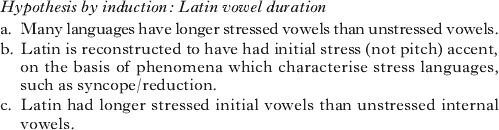
On this account, Latin vowel reduction can be analysed as a direct result of shorter duration in unstressed syllables, essentially returning to Lindblom's (Reference Lindblom1963) account of vowel reduction, while acknowledging that other factors identified in the literature (e.g. van Bergem Reference Bergem1995: 14, 91–92) may have been relevant during the history of the phenomenon, but ultimately, the reduced vowel variants offered in the ‘pool of variation’ by contexts of reduced duration won out. Barnes' (Reference Barnes2006) diachronic account of vowel reduction is explicitly duration-based, rejecting the notion that it is ‘unstressedness’ that causes reduction. Flemming (Reference Flemming2002, Reference Flemming2004) and Padgett & Tabain (Reference Padgett and Tabain2005) also adopt duration-based approaches to reduction. In Crosswhite's (Reference Crosswhite2001: 53–54) ‘two-pattern vowel reduction’ (e.g. in Italian), where some syllables show ‘contrast-enhancement’ reduction, i.e. dispersion of vowels to the edges of the reduced space, and other syllables ‘prominence-matching’ reduction, i.e. raising, the more extreme reduction (raising) always occurs in the ‘most durationally impoverished’ syllables, with ‘moderate’ reduction where those particular unstressed syllables have slightly greater duration.
This leads us to an intriguing question: why did Latin vowels reduce more in open syllables than in closed ones? Two alternative accounts immediately present themselves on the basis of the above discussion.
(15)
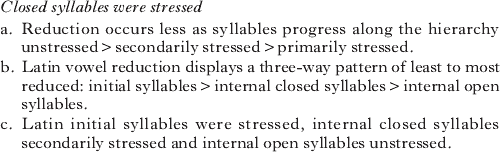
Such an account is compatible with, but not identical to (16).
(16)
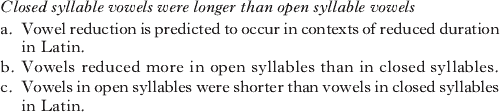
In (15), the greater duration of vowels in closed syllables is ascribed to the presence of a secondary stress; in (16), it is not attributed to anything other than the syllable shape itself. If closed syllables were not stressed, an account would have to be provided for why closed syllables had longer vowels. Such a position would be particularly curious in the light of the more general pattern precisely to the contrary, discussed in Maddieson (Reference Maddieson1985): vowels in closed syllables are shorter in duration than vowels in open syllables. Maddieson demonstrates how the shorter duration of vowels in closed syllables can be phonologised in the form of CSVS, and claims that on the basis of this uniformity, vowel duration is a reliable phonetic cue to the syllabification of a following consonant. Although Maddieson never explicitly claims that this phenomenon is universal, he states that it appears to occur in ‘the broad generality of languages’ (1985: 216).
(17)
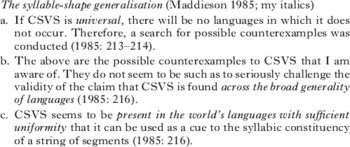
This generalisation is clearly at odds with any interpretation of the Latin pattern which claims that vowels in closed syllables were longer than those in open syllables in Latin, in the absence of any other conditioning factors, such as stress. If vowels in closed syllables are generally shorter in duration, and it is specifically short duration that is responsible for raising through undershoot, why was vowel reduction in closed syllables in Latin less extreme than in open syllables, when vowels are supposedly longer in the latter? Were Latin internal closed syllables therefore secondarily stressed? We return to this question in §5, but first we further examine the syllable-shape generalisation.
4 Vowel duration and vowel reduction in open and closed syllables
4.1 Duration and reduction according to the syllable-shape generalisation
Maddieson's (Reference Maddieson1985) syllable-shape generalisation is supported by duration measurements of vowels before geminates vs. before singletons in several languages. A number of studies report that vowels are shorter before geminates (closed syllables) than before singletons (open syllables), such as Lahiri & Hankamer (Reference Lahiri and Hankamer1988) for Bengali, Esposito & Di Benedetto (Reference Esposito and Benedetto1999) and Pickett et al. (Reference Pickett, Blumstein and Burton1999) for Italian, Pind (Reference Pind1995) for Icelandic, Local & Simpson (Reference Local and Simpson1999) for Malayalam, Cohn et al. (Reference Cohn, Ham and Podesva1999) for Buginese, Madurese and Toba Batak, Keane (Reference Keane2001) for Tamil, and Ohala (Reference Ohala, Solé, Beddor and Ohala2007) for Hindi.Footnote 11 If a language's speakers display little ambition to attain vowel targets in settings of reduced duration, we might expect undershoot, and consequently vowel reduction, to be more extreme in closed syllables than in open syllables. Such a pattern is reflected in the synchronic reduction pattern of Hausa. Barnes (Reference Barnes2006: 79–81) reports that the word-final syllable is the sole licensor of the full array of vocalic contrasts in the language. In other positions, short /e o a/ are neutralised to a reduced vowel transcribed [ə], but in fact with a great deal of coarticulatory conditioning.
(18)
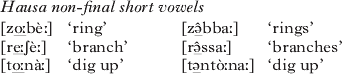
Not only do the underlined open syllable long vowels on the left shorten in the closed syllables derived forms on the right, they also reduce to [ə]. Recalling Maddieson's (Reference Maddieson1985) CSVS, the vowel shortening arguably results from the reduced time allotted for vowels in closed syllables, and presumably a reduced perceptual discriminability between phonologically long and short vowels. Furthermore, the schwa in the closed syllables above might be expected if reduced duration leads to more difficult vowel quality, as well as quantity, discriminability, as a result of target undershoot.
A discussion on the influence of syllable shape is conspicuously absent in recent studies of vowel reduction. Crosswhite (Reference Crosswhite2001) considers the factors of contrast enhancement – maintaining perceptual distance by dispersing vowels to the edges of the reduced vowel space in unstressed syllables – and prominence-matching – the desire to match more prominent vowels to more prominent prosodic positions; her scale for vowel prominence is a≫ε, ɔ≫e, o≫i, u≫ə. In prominence-reducing vowel reduction, the more prominent vowels reduce in less prominent positions, where stressed syllables are more prominent than unstressed syllables. It is nowhere claimed that closed syllables are more prominent than open syllables, although as suggested above, we might consider this to be the case if closed syllables, as heavy syllables, bore secondary stress. Barnes (Reference Barnes2006) analyses vowel reduction from a purely duration-based diachronic viewpoint, but again, there is little discussion of the general influence of syllable shape on vowel reduction, aside from in his discussion of Uyghur (see §4.2 below).
4.2 Duration and reduction contrary to the syllable-shape generalisation
Evidence for the pattern contrary to the syllable-shape generalisation – vowels in closed syllables are longer than their open syllable counterparts – is also found in research into geminates. Hansen (Reference Hansen, Agwuele, Warren and Park2004) finds that vowels preceding geminates are consistently longer than those preceding singletons at the same speaking rate in Tehrani Persian, and that ‘average syllable duration’ is the best indicator of the singleton–geminate contrast.
Lehtonen (Reference Lehtonen1970: 124–125) finds that gemination has a statistically strongly significant influence on the duration of the preceding vowel in Finnish: the vowel is consistently longer before geminates than before singletons in all of the word structures investigated where a short vowel preceded the consonant.Footnote 12 The same pattern was found in the two word pairs where a long vowel preceded either a geminate or a singleton, giving the word-shape pair CVːCV–CVːCCV (muuta–muutta ‘he hurried’, kiiti–kiitti ‘he thanked’).Footnote 13 With regard to intervocalic consonant clusters as opposed to geminates, Lehtonen (Reference Lehtonen1970: 99–102) reports that the temporal behaviour of the two types is very similar, in that the duration of the consonantal interlude depends on the length of both the preceding and following vowel. Although there is no explicit comparison of vowel durations in CVCV or CVCCV (singleton or geminate) vs. CVCiCjV (cluster), the results are reported together in the structural pair comparisons for CVCCV–CVCCVː and CVCiCjV–CVCiCjVː (1970: 112–113, 120), with very similar durations of the first vowel and the consonantal interlude (geminate or cluster), and similar sensitivity to the length of the following vowel. A short vowel preceding a geminate consonant has a mean duration of 77 ms in a CVCCV structure; before a cluster, the mean duration is 85 ms, but before a singleton, the different comparisons found durations of between 63 and 66 ms for the duration of the first vowel in CVCV structures. We can tentatively conclude on the basis of these data that vowels in closed syllables in Finnish are longer than their open syllable counterparts, and that this is reflected in the behaviour of vowels before geminates, which form a coda–onset structural sequence.
Several studies have reported longer vowels preceding geminates than preceding singletons in Japanese (e.g. Smith Reference Smith1991, Reference Smith, Connell and Arvaniti1995, Han Reference Han1994, Campbell Reference Campbell1999, Kawahara Reference Kawahara2006, Idemaru & Guion Reference Idemaru and Guion2008). Idemaru & Guion (Reference Idemaru and Guion2008: 181–182) find that preceding vowel duration is perceptually salient in the singleton–geminate contrast, reaching close to 70% accuracy in discrimination even without the primary cue of consonant duration.
This pattern in Japanese raises intriguing questions as to the influence of a language's rhythmic organisation on vowel duration. Most of the analyses above (e.g. Han Reference Han1994, Idemaru & Guion Reference Idemaru and Guion2008; see also Jannedy Reference Jannedy1995) conclude that the durational pattern is the result of mora timing in Japanese. Idemaru & Guion (Reference Idemaru and Guion2008: 183–184) follow Ham (Reference Ham2001) in arguing that mora-timed languages tend to have robust singleton–geminate consonantal durational differences (a 1:3 ratio was found in their study), and to lack the durational inverse between the stop and preceding vowel. Conversely, syllable-timed languages, such as Italian, are argued to have less robust singleton–geminate durational differences (Ham reports 1:1·85 for Italian) and to show a durational inverse between the stop and preceding vowel.Footnote 14 The authors suggest that this is a typological regularity between languages employing these different timing strategies. Bengali evidence might support this position: Hankamer et al. (Reference Hankamer, Lahiri and Koreman1989) note that shortening of pregeminate vowels is not consistently found, whereas consonant duration is a reliable cue to the contrast, and Savithri (Reference Savithri2009) finds quantitative evidence from raw and normalised Pairwise Variability Index computations to classify Bengali as a mora-timed language.
If ‘mora timing’ is indeed related to the structural unit ‘mora’, and not merely a convenient label for languages with high proportion of time devoted to vocalic intervals (%V) and low standard deviation of consonantal intervals (ΔC) (Ramus et al. Reference Ramus, Nespor and Mehler1999), we might hypothesise a motivation for a longer vowel in mora-timed languages: as vowels in syllable nuclei and consonants in codas are both moraic, they both contribute one time unit in a mora-timed language; if there is a tendency for duration to be manifested on vowels to a greater degree than on consonants, as expected where consonants are difficult to prolong due to aerodynamic constraints (e.g. voiced obstruents), then the time unit contributed by the consonantal coda might result in greater duration of the vowel before a coda consonant than before an onset. The pattern may then be generalised to include all VC combinations. The question remains open as to whether we might therefore reconstruct archaic Latin to have been mora-timed at an early stage if it had a similar pattern of vowel duration. Vowel reduction and syncope are more characteristic of stress-timed languages, but we might hypothesise a period during which the language's rhythmic organisation was undergoing a change. Further research is required into establishing the synchronic typology of phonological systems of languages showing these different timing patterns, and the diachronic typology of how languages change in their rhythmic organisation (e.g. stress-timed Latin to syllable-timed Spanish).
The clearest exception to the syllable-shape generalisation is Anatolian Turkish. Lahiri & Hankamer (Reference Lahiri and Hankamer1988) find that vowels in open syllables where there is a following onset consonant are practically the same length as vowels in syllables closed by geminate occurrences of that same consonant; if anything, those before geminates are marginally longer. The stronger conclusion, that vowels in closed syllables are significantly longer, is reached by Jannedy (Reference Jannedy1995) and Kopkallı-Yavuz (Reference Kopkallı-Yavuz, Sumru Özsoy, Akar, Nakipoğlu-Demiralp, Erguvanlı-Taylan and Aksu-Koç2003). Jannedy (Reference Jannedy1995: 69–71, 79–80) tested vowels in closed syllables both before consonant clusters and before geminates, and found that ‘significantly longer vowels in closed syllables in Turkish are a robust effect’ (1995: 71). The durational difference has the effect of causing more vowel devoicing in open than in closed syllables. She offers two possible, and not incompatible, explanations for this unusual pattern. First, ‘consonantal gestures following a vowel within a syllable have a later onset phase target with regard to the preceding vowel in comparison to when a syllable boundary is intervening between the vowel and the consonant’ (1995: 79), hence abstract phonological structure drives the timing of motor programs. This account restates the duration pattern in terms of gestural organisation rather than attempting to explain it in terms of evolution or function. Secondly, Jannedy (Reference Jannedy1995: 80) offers a functional explanation: ‘vowels might be longer in closed syllables with a C1VC2·C3 structure so that consonant clusters or consonant sequences like C1C2·C3 or C1·C2C3 are prevented after devoicing [of a vowel] or deletion and resyllabification’. Jannedy concludes by speculating whether the similar behaviour of Turkish to Japanese can also be attributed on the basis of its organisation around the mora, but notes that further evidence is required.
The syllable-shape generalisation is therefore not universal, but language-specific. Duration-based undershoot predicts the opposite pattern of reduction in these languages to those obeying the syllable-shape generalisation, and this is precisely what we find. Barnes (Reference Barnes2006: 94) notes that ‘the shorter duration characteristic of open syllables in Turkish has the result of conditioning frequent reduction of /a/ to [ə] in ordinary speech’. Perhaps the best evidence of such a pattern comes from diachronic vowel reduction in the Turkic language Uyghur:
In Uyghur, raising applies only to non-initial low vowels in open syllables … In Turkish … and the closely-related Turkmen … , it has been shown that vowels in word-initial syllables, regardless of the placement of stress, are realized with longer phonetic durations than the vowels of comparable word-internal syllables. Additionally, in Anatolian Turkish, contrary to near-universal expectations, all things being equal, vowels in closed syllables are longer than vowels in comparable open syllables … If these two durational regularities are found also in Uyghur [or at least were found at the time of the development of the raising process (note)], then raising can be seen to fail specifically in initial syllables, closed syllables, syllables with (underlying) long vowels, and phrase-final open syllables; these are all positions in which vowels would have characteristic additional phonetic duration (Barnes Reference Barnes2006: 94; my italics).
Data from Uyghur are given in (19) (from Hahn Reference Hahn1991: 52; IPA is used instead of Hahn's transcriptions (see Hahn Reference Hahn1991: 38–39, 43)).
(19)

These facts match the Latin data to near perfection: in both languages, the syllables in which the vowels were sufficiently long to resist reduction, at least to some degree, were (i) initial syllables (stressed in archaic Latin; unstressed but arguably phonetically longer in Uyghur), (ii) syllables with phonologically long vowels and (iii) internal closed syllables.Footnote 15 Does this parallel indicate that Latin was indeed a member of the group of languages which have longer vowels in closed syllables than in open ones?
5 Possible explanations for Latin vowel reduction
I consider four approaches to explaining the Latin pattern: (i) non-initial closed syllables in Latin bore secondary stress (§5.1), (ii) a tautosyllabic coda consonant following the vowel provided cues for its accurate perception, hence more vowel-height contrasts were phonologically licensed in a closed syllable than in an open one (§5.2), (iii) a vowel in a closed syllable needed to be longer to provide cues to a following unreleased coda consonant (§5.3) and (iv) the syllable-shape generalisation does not hold in this case, and vowels in closed syllables in archaic Latin were longer in duration than those in open syllables (§5.4).
5.1 Internal closed syllables bore secondary stress
In classical Latin, CVC was heavy and hence attracted stress to the same degree as CVː, obeying the weight-to-stress principle (heavy syllables attract stress). Under the Penultimate Law of stress assignment, operative in Latin from the fourth century BC onwards, penultimate syllables bore primary stress if heavy (e.g. per.ˈfec.tus), otherwise the antepenult was stressed (e.g. per.ˈfi.ci.ō), regardless of its shape. Within the typology of foot parameters found in the world's languages (see Hayes Reference Hayes1995), classical Latin can be analysed using moraic trochees (i.e. left-headed foot types (ˈLL) and (ˈH)), final-syllable extrametricality (i.e. the final syllable is not parsed into a foot), right-to-left foot formation (i.e. unparsed material is restricted to the left edge of the word) and ‘the head foot is the rightmost’ (i.e. the last foot in the word contains the primarily stressed syllable; other feet assign secondary stresses to their heads). The classical Latin Penultimate Law of stress assignment is easily analysed this way: stress falls on the penult if heavy (i.e. a bimoraic trochee, hence a well-formed foot on its own: (ˌper).(ˈfec).{tus}), and the antepenult if the penult is light (i.e. the head syllable of the final trochee: (ˌper).(ˈfi.ci).{ō}).
However, as noted in §2, we reconstruct for archaic Latin a primary stress accent fixed on the initial syllable of the word, regardless of its shape, thus *ˈper.fak.tos, but also *ˈke.ka.dai>ce.ci.dī. From a metrical perspective, archaic Latin words therefore uniformly began with a left-headed foot. The change in accent position occurred as a result of a change in the designation of the head foot from the leftmost to the rightmost (Jacobs Reference Jacobs and Holt2003a, b), suggesting that before the change occurred, the penult or antepenult was a foot-head bearing secondary stress, thus *(ˈper).(ˌfak).{tos}, *(ˈper).(ˌfa.ki).{oː}. We must therefore consider whether closed syllable vowels in archaic Latin showed resistance to reduction because they always constituted a well-formed bimoraic trochaic foot in themselves, and therefore always bore secondary stress, increasing the duration of their vowels.
Van Bergem (1995: 14, 91–92) lists ‘syllable type’ as one of the factors conditioning vowel reduction, with the phenomenon supposedly more likely to occur in open than closed syllables. However, van Bergem's single citation for this finding is Miller (Reference Miller1972), which specifically discusses the Latin pattern of reduction. Miller (Reference Miller1972: 487) asks the ‘puzzling question’: ‘why is it that the open medial syllables apparently favor reduction and closed syllables disfavor it?’. She reaches no firm conclusions, but suggests that internal heavy syllables bore ‘minor stress’, while the initial syllable bore main stress, based on an analogy with the internal, closed ‘half-stressed’ syllables of Old English. She therefore hypothesises that the sensitivity of the reduction rule to syllable closure was really a sensitivity to degree of stress, and not the syllable shape itself. Accordingly, ‘syllable shape’ should perhaps not appear independently in van Bergem's list of influences, but rather be conflated with ‘stress’.
However, several pieces of evidence indicate that secondarily stressed internal closed syllables are not the correct account for Latin, and these are discussed in the following subsections. Evidence from syncope and reduction suggest that in an early archaic period, the word-initial, stress-assigning foot was the only foot constructed in each word by the phonology of archaic Latin (§5.1.1). Secondly, positing secondary stresses on all internal heavy syllables appears to be untenable, given that the heavy syllable in word-initial LH seems to have been unstressed, but behaved identically to other internal heavy syllables in its reduction pattern. This identity in reduction suggests identical unstressedness (§5.1.2). Therefore, an account whereby closed syllable vowels were simply phonetically longer is a more plausible alternative.
5.1.1 A single foot in early archaic Latin
Two pieces of evidence from Latin syncope (see Mester Reference Mester1994, Jacobs Reference Jacobs2004, Sen Reference Sen, Probert and Willi2012) suggest that a sequence such as HLLσ (heavy – light – light – heavy or light) was footed (ˈH)LLσ in early archaic Latin, with only the stressed syllable parsed, not (ˈH)(ˌLL)σ, with more parsing and secondary stress on the first light syllable. First, syncope commonly targeted the open syllable vowel of the first light syllable in the sequence, indicating that syncope occurred regardless of whether such syllables would have been foot-heads if footed, thus *(ˈam).bʰi.kʷo.los>an.cu.lus ‘manservant’, not **(ˈam).(ˌbʰi.kʷo).los, and *(ˈjou).sa.gi.om>iur.gi.um ‘quarrel’ (with regular intervocalic rhotacism before syncope), not **(ˈjou).(ˌsa.gi).om. Rhotacism, the phonotactic contexts for syncope in words of this shape (Sen Reference Sen, Probert and Willi2012) and the persistence of initial stress together indicate that syncope occurred in these particular forms in the mid to late archaic period, i.e. around the fourth century BC. We can conclude that internal LL sequences were still not footed at that stage, and were therefore also not footed at the time of vowel reduction in the sixth to fifth centuries, given that initial stress was present in that earlier period.
Secondly, both light-syllable vowels in HLLσ sequences were sometimes syncopated, where phonotactic constraints permitted, suggesting no metrical structure beyond the stress-assigning foot, thus *(ˈdek).si.te.ros > *dekst s (>dexter) ‘right’, *(ˈmre).wi.se.ma > *browisema>brūma ‘midwinter’. We would expect an internal foot to have shielded a secondarily stressed syllable from syncope: **(ˈdek).(ˌsi.te).ros.
A third piece of evidence for the absence of internal feet in early archaic Latin comes from vowel reduction itself. Reduction in internal light syllables was insensitive to position within the word, hence open syllable vowels still underwent full reduction even where they would have been stressed according to the Penultimate Law, e.g. early archaic HLLσ *ˈper.fa.ki.oː > classical per.ˈfi.ci.ō, suggesting a parse *(ˈper).fa.ki.oː, not **(ˈper).(ˌfa.ki).oː.
In optimality-theoretic terms (Prince & Smolensky Reference Prince and Smolensky2004), a single stress-assigning foot is brought about by the ranking of AllFt-L above Parse-σ.
(20)

The alignment constraint (McCarthy & Prince Reference McCarthy and Prince1993) is violated by every foot that is not initial in PrWd. Violations therefore occur in any word of more than one foot in a gradient fashion, each foot being judged by its distance in syllables from the specified word edge. However, as long as Parse-σ is higher ranked than the alignment constraint, feet will be formed in an apparently iterative directional manner. If, however, the alignment constraint is ranked above Parse-σ, non-iterative footing is the result, with only a single stress-assigning foot constructed. This appears to be the case in early archaic Latin.
The above constitutes good evidence to deny the existence of secondary stress on internal light open syllables at the time of reduction, as they were unparsed, but can the same be said of heavy closed syllables?
5.1.2 Internal heavy syllables
If the weight-to-stress principle (WSP) was higher ranked than the alignment constraint, then all internal heavy syllables would be parsed as well-formed bimoraic trochees in themselves, and attract a secondary stress, thus *(ˈper).(ˌfak).{tos}. Internal heavy syllables could then have been footed and secondarily stressed, but not internal light syllables, thus *(ˈper).(ˌfak).{tos}>per.fec.tus, but *(ˈper).fa.ki.{oː}>per.fi.ci.ō.
Evidence against this position arises from comparing the heavy syllable in the word-initial configuration #LH to other internal heavy syllables. Indications discussed in §5.1.2.1 suggest that the H in this sequence was unstressed. However, the vowel in this H shows precisely the same pattern of reduction as other closed syllables, strongly suggesting that their level of stress was identical, i.e. unstressed (§5.1.2.2).
5.1.2.1 Initial LH
In the archaic period of initial stress, we might consider three possible parses for an initial light–heavy sequence.
(21)
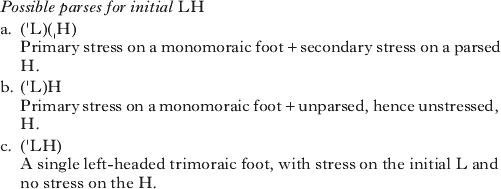
Parse (a) is compatible with the hypothesis that all internal heavy syllables were secondarily stressed, motivating the reduction pattern. Parses (b) and (c) both posit an unstressed H, but differ as to whether or not the H is parsed: in (b) it is unparsed, but in (c) it is in the weak position of a foot.
Parse (a) is dispreferred on three grounds. Firstly, on general typological grounds and therefore not compellingly, languages with moraic trochees tend to allow trimoraic feet more readily than monomoraic feet, as long as the foot is binary on the syllabic level (i.e. HL or LH), a preference made explicit in the optimality-theoretic constraint FtBin: ‘feet are binary at some level of analysis [either syllabic or moraic]’ (Prince & Smolensky Reference Prince and Smolensky2004: 56).Footnote 16 This would also suggest a preference for parse (c) – (ˈLH) – over (b) – (ˈL)H. At a later period, when we can be more confident of metrical reconstructions, Latin indeed seems to show a dispreference for monomoraic feet. The optional ‘iambic shortening’ in early Latin verse (third to first centuries BC) lightened the H in a disyllabic word of LH shape, for example, *ˈamoː > ˈamo ‘I love’ (Lindsay Reference Lindsay1894: 129–130, 201–202, 207–215, Allen Reference Allen1973: 179–185, Leumann Reference Leumann1977: 108–109, Mester Reference Mester1994). This appears to indicate a dispreference for the parse **(ˈa).moː, which would respect final-syllable extrametricality, but contain a monomoraic foot. Binary branching (ˈa.mo) was preferred in early Latin, and in this case a trimoraic foot was also eschewed through iambic shortening. Classical Latin, on the other hand, still dispreferred the monomoraic parse, but permitted trimoraic (LH) to give (ˈa.mō) (Sen Reference Sen2011b).Footnote 17 Although these facts do not constitute definitive evidence for archaic Latin metrical structure, there is at least no evidence in favour of monomoraic feet in later periods of Latin.
Secondly, the related phenomenon of ‘word-initial iambic shortening’ in longer words (references above) tells us something of the treatment of initial LH at a slightly later period of Latin, and we can reconstruct no independent reason for a different parse at an earlier stage. Initial iambic shortening in early Latin verse (third to first centuries BC) lightened the H in a word-initial LH sequence when the syllable following LH bore primary stress, as by that time the Penultimate Law was in force. The lightening occurred either by shortening a long vowel (e.g. *ka.leː.ˈfa.ki.oː>ca.le.ˈfa.ci.ō ‘I warm’), or by treating a coda consonant as non-moraic (e.g. *wo.lup.ˈtaː.tem>vo.lŭp.ˈtā.tem ‘pleasure (acc)’, where the breve indicates a light syllable). The phonological reality of both types of iambic shortening is confirmed by (i) shortened LH > LL forms continued as standard in classical Latin: bene ‘well’, modo ‘only’, ego ‘I’, sibi ‘him (dat)’ (from benē, etc.), and (ii) classical forms where vowels which underwent iambic shortening subsequently syncopated, e.g. *ka.leː.ˈfa.ki.oː>ca.le.ˈfa.ci.ō>calˈfaciō.
Iambic shortening seems to indicate that such words began with parse (c), an initial foot of the shape (ˈLH), the weak position of which was the target for the lightening to yield the bimoraic trochee (ˈLL), thus *(wo.lup) (Sen Reference Sen2011b, in keeping with Jacobs 2003a in this respect). An alternative starting parse (ˈL)H is possible, with iambic shortening triggered by a dispreference for both monomoraic (L) and also trimoraic (LH), but note the reservations above. A starting parse (ˈL)(ˌH) is less likely on several grounds. Firstly, the contrastive phonological length of a vowel might be expected to be more robust in a stressed syllable than in an unstressed one, resulting in few phonetically short tokens which we might consider prerequisites for phonological shortening. Secondly, a parse *(ka).(leː).(fa.ki).{oː} provides little motivation for shortening in the second syllable, given that this syllable is a well-formed bimoraic trochee in its own right. A high-ranking clash constraint cannot on its own provide a motivation, as long vowels before stressed syllables were permitted in all other configurations aside from initial LH (e.g. mōˈrōsus ‘hard to please’, amāˈbāmus ‘we loved’). In contrast, shortening in (ka.leː).(fa.ki).{oː} or (ka).leː.(fa.ki).{oː} allows a word-initial bimoraic trochee to be constructed: (ka.le).(fa.ki).{oː}. Thirdly, syncope in calˈfaciō suggests no stress on the original second syllable. Finally, a unified metrically based account of several contemporaneous early Latin phenomena (Sen Reference Sen2011b) appears to demand a parse with an initial foot (ˈLH). We must account for syncope, cretic shortening and early Latin stress placement (e.g. stress must fall on the H of the initial LH in trisyllabic words), and we must restrict iambic shortening to the H in pre-stress initial LH, rather than simply all pre-stress Hs, or the H in non-pre-stress LH.Footnote 18 The heavy syllable in such configurations therefore bore no secondary stress, and probably appeared in the weak position of a foot, as iambic shortening seems to have been driven by metrical structure constraints.
A final, and arguably most compelling, piece of evidence for the parse (ˈLH) in archaic times comes from syncope. As we have seen, all early archaic Latin words contained a single left-headed foot, placing stress on the initial syllable, with the rest of the word left unparsed. This foot need not even have been quantity-sensitive: both initial light and heavy syllables bore stress. However, the introduction of quantity-sensitivity (i.e. some correlation between stress and heavy syllables) triggered the first wave of syncope – archaic SWP syncope (Sen Reference Sen, Probert and Willi2012).
The greater prominence of the initial syllable through fixed stress seems to have resulted in a pressure to reinforce the strong stress with syllable weight, a phenomenon formalised by the stress-to-weight principle, and seen in languages such as modern Italian, where every stressed syllable must be heavy. The raising of SWP above MaxV (‘an underlying vowel must be parsed’, i.e. no vowel deletion) resulted in second-syllable syncope in initial LL sequences, as the onset of the second syllable came to form a coda of the first. Words of the shape LLσ/LLLσ therefore syncopated to Hσ/HLσ, but only under tight phonotactic restrictions, e.g. *sekatos>sectus ‘cut’.
(22)
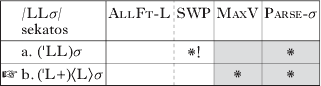
Most relevant to our investigation is that archaic SWP syncope even occurred in heavy syllables in LH-initial words to achieve a heavy initial (again under tight phonotactic constraints), thus *mo.nes.trom>monstrum (>mōnstrum) ‘portent’, *jo.wes.tos>iūstus ‘just’. Again, this would not be expected if initial LH was parsed (ˈL)(ˌH), where the heavy syllable would presumably have been shielded from syncope by secondary stress. No account of Latin syncope (e.g. Mester Reference Mester1994, Jacobs Reference Jacobs2004, Sen Reference Sen, Probert and Willi2012) posits syncope in a stressed syllable,Footnote 19 and vowel loss in stressed syllables is typologically uncommon, presumably due to the robustness of the vowel cues afforded by increased duration and intensity, common correlates of stress. Deletion of the second-syllable vowel yielding a heavy first syllable suggests an initial stressed + unstressed parse for LH in early archaic Latin, at the same time that vowel reduction was occurring.
In conclusion, the evidence afforded by a variety of phenomena in Latin suggests that word-initial LH was a stressed + unstressed sequence, and that this was arguably a single left-headed trimoraic foot (ˈLH).
5.1.2.2 Identity in reduction implies identity in stress
Unstressed closed syllables in initial ˈLH show precisely the same pattern of reduction as other closed syllables, and do not undergo the ‘extreme’ reduction to /i/ seen in open internal syllables (which we have seen were unparsed), thus *(ˈfe.nes).tra>fe.nes.tra ‘window’, not **fe.nis.tra, and *(ˈju.wen).taː.tem>iu.ven.tā.tem ‘youth (acc)’, just like *ˈkom.spek.tus>cōn.spec.tus ‘view’. Since the pattern of reduction is identical, we might deduce that all internal closed syllables were unstressed (weak position or unparsed), thus *(ˈkom).spek.tus, not **(ˈkom).(ˌspek).tus.
Further evidence for the usual closed syllable reduction in initial (LH) comes from the early Greek loan /ko.tʰor.nos/, treated as *(ˈko.tʰor).nos>co.thur.nus ‘high boot’, with the usual closed syllable retention of /o/, which subsequently raised to /u/ (12), instead of *co.ther.nus, with the open syllable development to /e/ before /r/ (11a). Furthermore, *(ˈla.teb).ra>la.te.bra ‘hiding-place’, *(ˈte.mas).rai>te.ne.brae ‘darkness’ and *(ˈke.ras).rom>ce.re.brum ‘brain’ all show closed syllable reduction, indicating that the stop + liquid sequence was heterosyllabic in archaic Latin, even though it became tautosyllabic by early Latin, according to the scansion of early Latin verse (e.g. Plautus).Footnote 20
Therefore, the same closed syllable reduction in the H of LH-initial words as in other internal closed syllables indicates that syllable shape itself and not stress motivated the degree of reduction. The hypothesis that closed syllables bore secondary stress at the time of reduction in archaic Latin is therefore unlikely.
5.2 Licensing by Cue of closed syllable vowels
The Licensing by Cue approach (Steriade Reference Steriade1999b), one form of the phonetically grounded linear approach to phonotactics, is recapitulated succinctly by Barnes (Reference Barnes2006: 6):
features are licensed preferentially in positions in which phonetic conditions make them maximally robust perceptually, and are likewise eschewed in positions where they would be less perceptually robust, and hence easily overlooked. It is not then the position itself which licenses or bans features, but rather the concrete phonetic cues which are important for those features' perception.
As the factor distinguishing closed from open syllables is the presence of a tautosyllabic consonant following the vowel, we could argue that in Latin more vowel features were licensed in closed syllables because the language's coda allophones provided conditions where they were more robustly cued than when the vowel was before an onset.
The main acoustic cue for the perception of vowel height is F1. However, Wright (Reference Wright2004: 41–42) observes that in naturally spoken language, formants of vowels juxtaposed by consonants rarely achieve a steady state, but rather fall short of values seen in hyperarticulated speech, as a result of undershoot (Fant Reference Fant1960, Stevens & House Reference Stevens and House1963). Under these conditions, identification of vowels from formant transitions is more reliable than identification based on steady-state values. Therefore, closed syllable vowels in Latin could have been more resistant to reduction than open syllable ones if formant transitions to coda consonants provided better cues than those to onset consonants.
Latin possessed two classes of consonantal allophones whose distribution was governed by syllable structure and not linear sequence. Firstly, Latin /l/ was always dark in coda position (unless in a geminate), and only contextually darkened by a following non-front vowel when in an onset (see §2.2.3 and Sen forthcoming). The conditioned vowel-reduction pattern seen in §2.2.3 provides evidence for this.
This syllable-based allophonic distribution provides strong counterevidence to the hypothesis that coda allophones provided better formant-transition cues to the quality of the preceding vowel, as precisely the opposite state of affairs held: instead of licensing features in the preceding vowel, dark /l/ coloured it as a back vowel, thus *en.sal.toː > īn.sul.tō ‘I leap upon’. Latin coda dark /l/ can be interpreted as having a high ‘degree of articulatory constraint’ (Recasens et al. Reference Recasens, Pallarès and Fontdevila1997), where a high value for the constraint implies that a sound will be more resistant to coarticulation, and more likely to cause coarticulation on neighbouring sounds.
Secondly, Sen (Reference Sen, Cairns and Raimy2011a) argues that the sonorants /r l m n/ were phonologically specified as [+voice] only in syllable-initial position, and were underspecified for voice in the coda or when in second position in a complex onset. Hence, we see regressive voice assimilation triggered by a syllable-initial sonorant in *nek-legoː>neglegō ‘I neglect’, *sekmentom>segmentum ‘piece’, cosmis > [kozmis] (cf. CIL 12.4 cosmis) (> cōmis) ‘friendly’. Conversely, the voice contrast is maintained before sonorants in the second position of complex onsets, e.g. ve.hi.clum ‘vehicle’, not *vehiglum,Footnote 21ācrī ‘sharp (dat)’ vs. agrī ‘field (gen)’ and planta ‘shoot’ vs. blanda ‘flattering (fem)’, and after a sonorant in coda position, e.g. verpa ‘penis’: verba ‘words’, mulceō ‘I soothe’: mulgeō ‘I milk’ and pontus ‘sea’: pondus ‘weight’.
Syllable-initial sonorant voicing cannot have been responsible for resistance to reduction in closed syllables. Firstly, phonological voicing of /r/ ceased to occur at a very early, prehistoric stage, since voice assimilation before /r/ can be reconstructed to be a very early sound change (*fuːnesris > *fuːneðris>fūnebris ‘funereal’; see Stuart-Smith Reference Stuart-Smith2004, Sen Reference Sen, Cairns and Raimy2011a), which ceased to occur by the time of vowel reduction. The voicing phenomenon cannot be generalised beyond sonorants as a systematic difference between onset and coda allophones in Latin, as a voice contrast in obstruents still remained in codas (after /r/ ceased to trigger voice assimilation), thus *kom.sak.roː>cōn.sec.rō ‘I dedicate’ vs. *en.tag.rom>in.teg.rum ‘whole (acc)’, where closed syllable reduction confirms that /k g/ were in coda position. Furthermore, vowels are commonly longer before voiced obstruents than voiceless ones, though not universally (Keating Reference Keating1985: 120), predicting that, if anything, reduction might be expected to be less extreme before voiced allophones than before voiceless/underspecified ones, not the opposite, as in Latin, where reduction is less extreme before coda sonorants underspecified for voice.
There is thus no evidence to suggest that Latin vowels were more robustly cued before coda consonants than before onsets. The hypothesis that vowels in closed syllables resisted thoroughgoing reduction due to the licensing-by-cue of their features by a tautosyllabic coda consonant is therefore untenable.
5.3 Licensing of coda consonants by vowels
A third hypothesis is that closed syllable vowels resisted extreme reduction in Latin as a result of the pressure upon them to provide robust perceptual cues to the nature of the following coda consonant, which did not benefit from release cues.
Burzio (Reference Burzio2007) invokes such an explanation for patterns of vowel reduction in English. The reduced energy (resulting primarily from short duration) of English unstressed vowels triggers their neutralisation to [ə], and the loss of all vowel-quality contrasts where reduction occurs. He acknowledges that a main contributor to the cross-linguistic likelihood of reduction is the difference in duration between stressed and unstressed vowels. Thus, the first and third vowels in the name Amanda are reduced in English [əˈmændə], but unreduced in Italian [aˈmanda], as English demands a greater durational difference between stressed and unstressed vowels, without concomitant ‘ambition’ to attain the articulatory targets in the reduced time. For analogous reasons, long vowels are immune to reduction in English (papyr[ə]s ∼ papyr[iː]). Therefore, it is the reduced energy levels in unstressed positions which compromise the perceptibility of vowel contrasts, leading to the suppression of articulatory activity that yields these compromised perceptual cues (a ‘synchronic’ account).
Vowel reduction in English is inhibited in certain closed syllables, where consonant-place identification is reliant on VC formant-transition cues, in the absence of a following vowel (i.e. when the coda consonant is unreleased). Unstressed vowels with short durations yield poor dynamic transition cues to C-place. Burzio notes that such an account predicts consonant-place neutralisation in codas as a result of vowel neutralisation, and argues that the neutralisation of place in Lardil codas to coronals, the unmarked place, illustrates such a pattern. The unmarked status of coronals is further supported by reduction in English before coronal coda stops, but not labials or dorsals, thus Adirond[æ]ck, exp[ε]ctation, aut[ɒ]psy vs. Connectic[ə]t. Coronals are argued to be ‘pre-neutralised’ for place.
Sonorant codas exhibit reduction regardless of place, thus cont[ə]mplation, comp[ə]nsation. There is some (much discussed) lexical/free variation (cond[ε/ə]nsation∼cond[ε]nse), but the key point is that reduction is permitted. [s] codas behave similarly to sonorants (orch[ə]strate, but det[ε]station). It is noteworthy that sonorants and sibilants have robust internal cues to manner and place, and are therefore less dependent on a preceding vowel than stops and non-sibilant fricatives. Hence Burzio argues that vowel reduction is inhibited when an unstressed vowel is required to provide robust VC formant-transition cues to the nature of a following consonant, i.e. when that consonant is a non-coronal stop or non-sibilant fricative.
Is this the correct account for the resistance to reduction of Latin closed syllable vowels? Is Latin reduction sensitive to stop place and consonant manner, like English? The answer is clearly ‘no’: the same closed syllable reduction occurred before any manner or place, and there is no trace of neutralisation to coronal place in codas.
(23)
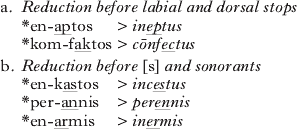
Unstressed closed syllables therefore showed the same reduction regardless of the environment, indicating that the consistent duration of closed syllable vowels was caused by syllable shape itself and not the following consonantal environment. The perceptual advantage of sonorants and [s], and the pre-neutralised place of coronal stops, had no effect on the reduction of the preceding vowel. Therefore, the pressure to provide robust cues to the place and manner of a following consonant cannot be the immediate reason for the resistance to extreme reduction in closed syllables in Latin.
This discussion raises an interesting dilemma which often surfaces in historical phonetic investigation: does phonetics condition phonology or phonology condition phonetics? Was vowel duration (phonetics) governed by syllable shape (phonology), or did the helpfulness of duration in aiding both vowel and consonant perception (phonetics) cause closed syllable vowels to be longer than open syllable ones (phonology)? In our Latin problem, we can posit the primacy of phonological structure, as we can isolate contexts with relatively long duration arguably without perceptual gain (e.g. closed syllable vowels before [s], sonorants and coronal stops).
5.4 Closed syllable vowels were longer
This leaves us with one hypothesis: vowels in closed syllables were phonetically longer than their counterparts in open syllables, contrary to the syllable-shape generalisation. The adoption of such a phonetic reconstruction is, as we have seen, not unparalleled, and the near-perfect parallel between Latin and Uyghur vowel-reduction patterns strongly indicates that Latin was indeed a member of the group of languages which have longer vowels in closed syllables than in open ones.
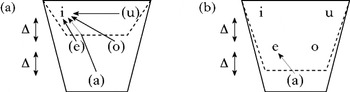
The shorter duration of vowels in internal open syllables triggered the ‘extremely’ undershot vowel variants through phonetic vowel reduction, providing the tokens for phonological vowel reduction from the pool of phonetic variation.Footnote 22 The significantly shorter duration of vowels in internal closed syllables than in stressed initial syllables still triggered vowel reduction, but the more restrained phonetic vowel reduction resulting from the greater duration in closed syllables created a large enough phonetic space to maintain a two-height contrast. The vowel space was large enough to maintain a minimum perceptual distance between the two heights.
Phonetic and phonological vowel reduction in Latin open and closed syllables: (a) open syllables: reduction to /i/; (b) closed syllables: *a > /e/.

If closed syllable vowels in archaic Latin were indeed longer than their open syllable counterparts, we might expect there to be further evidence of this from phenomena involving vowel quantity as opposed to vowel quality. We now turn to these other supporting indications.
6 Further supporting evidence
6.1 Classical compensatory lengthening
The position that vowels in closed syllables were longer in duration than their open syllable counterparts in archaic Latin finds some support in diachronic changes in vowel quantity as well as quality. Kavitskaya (Reference Kavitskaya2002) argues that listener-oriented change is responsible for the phonologisation of phonetic vowel length in compensatory lengthening processes. Notably, the typologically common shorter duration of vowels in closed syllables (the syllable-shape generalisation) is invoked as the basis for CVCV > CVːC compensatory lengthening, since the phonetic length of the first vowel in an open syllable is reinterpreted as phonological by the listener after the loss of the conditioning environment for the length, that is, the open syllable. When the final vowel is not parsed, the first syllable is reinterpreted as closed.
On this basis, we might expect to find the opposite patterns in Latin. The predicted changes are schematised in (24).
(24)

(24a) is an instance of Hayes' (Reference Hayes1989) ‘classical compensatory lengthening’, which has instantiations in several languages, all or most of which presumably have phonetically longer vowels in open syllables than in closed syllables, opposite to the proposed Latin pattern. In Kavitskaya's (Reference Kavitskaya2002) phonologisation model, the observation that this kind of compensatory lengthening occurs only where the consonant which is not readily perceived (and therefore lost) has relatively long vocalic transitions (such as a glide) indicates that the perception of the vowel as long arises from the reinterpretation of those vocalic transitions as vocalic length. This length is then phonologised when the consonant is no longer perceived, as the conditions for the cause of the length are not recoverable by the listener.
Kavitskaya demonstrates how her analysis covers the attested processes, accurately predicting where lengthening should not take place. However, the analysis does not acknowledge that the expected shorter duration in closed syllables legislates against such a process: if a vowel in a closed syllable develops into a vowel in an open syllable by coda loss, we should expect the unexpectedly short duration of that open syllable vowel to be interpreted as phonologically short, not precisely the opposite, as seems to occur. This seems to be a flaw in the duration-based argument, unless it can be demonstrated that long vocalic transitions affect perceived vocalic length to a significantly greater degree than syllable shape.
However, we can hypothesise that in the set of languages where closed syllable vowels are phonetically longer than those in open syllables, ‘classical compensatory lengthening’ would be supported further by the phonologisation of the unexpected length after coda loss. In this light, it is perhaps unsurprising that Turkish, a language in which we find this phonetic peculiarity, shows this type of compensatory lengthening in abundance. Loss of the coda consonants [j w h ɤ] can all result in lengthening of the preceding vowel (Kavitskaya Reference Kavitskaya2002: 195). Perhaps, therefore, the compensatory lengthening of this type found in archaic Latin as a result of the loss of coda nasals and /s/ (>[z] > [ɦ]) (Kavitskaya Reference Kavitskaya2002: 60–61, 74–75) can be seen as having significant support from the fact that closed syllable vowels were longer than open syllable vowels. The two processes are illustrated below.
(25)
Footnote 23
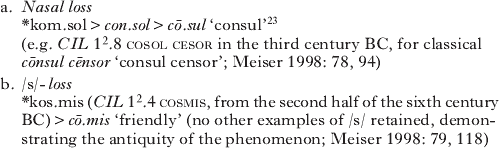
Note that compensatory lengthening through /s/-loss occurred only before voiced obstruents and sonorants, via the voicing of /s/ to [z] and thence a voiced glottal approximant [ɦ] (de Chene & Anderson Reference de Chene and Anderson1979: 512). As vowels are often phonetically longer before voiced obstruents and sonorants, the vowel preceding the voiced approximant could be perceived as phonetically long on three counts: (i) the approximant noise after the vowel could be interpreted as the vowel itself, (ii) the vowel would be longer before a voiced approximant than before a voiceless obstruent and (iii) the vowel would be longer in a closed syllable, the structure intended by the speaker, but interpreted by the listener as an open syllable.
6.2 Closed syllable shortening
Kavitskaya (Reference Kavitskaya2002: 106–108) argues that the typologically not uncommon development *CVCV > CVːC has its basis in the greater duration of vowels in open syllables than in closed ones. Thus, when listeners fail to parse the second vowel, they reinterpret the phonetic length of the first vowel as phonological length in a closed syllable, not phonetic length in an open one.
In a language such as Latin, where we hypothesise that closed syllable vowels were longer than open syllable ones, we therefore might expect to find the opposite development: *CVːCV > CVC, where the first vowel, phonologically long and in an open syllable to begin with, is reinterpreted as a phonetically long, but phonologically short vowel in a closed syllable. Evidence for such a development in archaic Latin can perhaps be seen in the development *a.ni.maː.li>a.ni.mal ‘animal’: the attested classical Latin animal shortened the final-syllable vowel after apocope, precisely the development *CVːCV > CVC. We can extend this analysis to the whole group of neuter i-stems showing this development, such as lupānar ‘brothel’, exemplar ‘model’ and others, which have long vowels in the rest of the paradigm, demonstrated by the genitive singulars animālis, lupānāris, exemplāris.
A potential problem with such an analysis lies in the fact that long vowels in final syllables closed by the vowels /r l t/ all shortened in words of more than one syllable in early Latin, without concomitant apocope. Thus the vowel shortening in animal can be attributed to this other process, probably brought on by a final weakening effect such as devoicing (Barnes Reference Barnes2006: 115–125), which could have affected the vowel before a voiceless consonant such as /t/. Resistance to shortening before /s/ (e.g. amās ‘you love’) can perhaps be attributed to the relatively long duration of the final fricative, preventing final devoicing from affecting the preceding vowel. Shortening of the vowel in words ending in liquids would have to be explained by positing devoicing (or non-attribution of voice if underlyingly unspecified) of the word-final liquids and also a portion of the vowel. We could interpret /r/ in particular as having more stop-like qualities if realised as a tap word-finally.
However, it is certainly plausible that the phenomenon of final-syllable shortening began in the i-stems with concomitant apocope, a position which is supported by the fact that the loss of final /i/ clearly occurred earlier – no such forms are attested (Meiser Reference Meiser1998: 74) – than the regular widespread shortening in other formations – around 200 BC, with unshortened forms appearing in early Latin verse (Meiser Reference Meiser1998: 77). The synchronic pattern that consequently arose in the i-stems – nominative animal: genitive animālis – may then have influenced the phonological shortening in other formations without original final /i/, once final weakening had provided tokens with phonetically shorter final vowels in these (e.g. victor, genitive victōris ‘victor’).Footnote 24 CVːCV > CVC compensatory lengthening might therefore present support for the hypothesised vowel-duration pattern.
6.3 Inverse compensatory lengthening
The theory that closed syllable vowels were longer than open syllable vowels also allows us to reanalyse some recalcitrant phonological problems in Latin.
The sporadic early Latin littera-rule (Sen forthcoming) is an example of ‘inverse compensatory lengthening’ according to Hayes' typology (Reference Hayes1989). The development can be schematically represented as *VːC > VCC, thus *liː.te.ra>lit.te.ra ‘letter’. Sen (forthcoming) concludes that three separate phonetic processes were at work, of which only one was a clear diachronic development of the type *VːC > VCC. The phonetic environment for this development was ‘high vowel + voiceless obstruent’. Note that high vowels are phonetically the shortest in duration, and voiceless stops are the most amenable to gemination, given the absence of any aerodynamic difficulty. Therefore, if vowels in closed internal syllables were phonetically longer, then the process can be viewed thus: when the phonetically shortest long vowels (high vowels) were realised in the phonetically shortest environment (before voiceless obstruents), they were most susceptible to being reanalysed as short vowels in closed syllables, since such a short vowel could have been roughly equal in length to the phonologically long open syllable vowel.
(26)
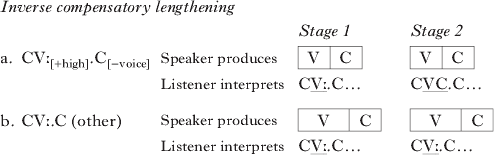
This analysis furthermore suggests that it was not only the abstract desire to retain mora count that led to the gemination of the consonant, but also the perception of the vowel as a short one in a closed syllable. The only segment which could be causing the closure would be the following consonant, which was therefore realised as a geminate (i.e. coda + onset). Perhaps, therefore, the preservation of syllable weight did not play as great a role in this phenomenon as might initially be suspected, in keeping with Kavitskaya's phonologisation model of compensatory lengthening (2002).
6.4 Degemination
The sequence ‘long vowel (or phonetic diphthong) + long consonant’ (VːCC) was simplified over time in Latin to VːC, not to VCC, e.g. *seːpparoː>sēparō ‘I separate’, *gluːmma>glūma ‘chaff’. Maddieson (Reference Maddieson1985) explains closed syllable vowel shortening as a result of the more common pattern of vowel duration: because closed syllable vowels are shorter, a phonologically long vowel in this context can be reinterpreted as a short vowel, due to the reduced duration available for the articulation of the vowel. Presumably in such a case, the language's closed syllable vowel is so short as not to be able to maintain a clear distinction between lengths (a minimal duration perceptibility threshold is not met). Almost predictably, Latin shows the opposite pattern to closed syllable vowel shortening: because there was adequate duration to maintain a length distinction in a closed syllable, such a vowel did not shorten, but the dispreferred superheavy sequence was rather resolved by shortening the following consonant, thus removing the coda. Perhaps this was supported by the absence of a noticeable difference in duration between phonologically long vowels in open and closed syllables, a hypothesis supported by their otherwise identical behaviour in Latin, where both phonological lengths are permitted in stressed and unstressed syllables. The roots of covariation of vowel and consonant length as found in modern Italian might be seen here, as degemination results in long vowel + short consonant, whereas other long consonants survived where there was a preceding short vowel.
7 Conclusions
There is a fair body of evidence to support the plausibility of our hypothesis that, all things being equal, vowels in closed syllables in Latin were longer than their open syllable counterparts, contrary to near-universal expectations. This pattern underlies the vowel-reduction patterns in open and closed syllables, as well as phenomena involving vowel quantity. The analysis also raises some interesting questions regarding the temporal organisation of Latin in difference periods: several modern Romance languages are syllable-timed (e.g. Spanish, Catalan, French, Italian), but archaic Latin syncope and reduction suggests stress-timing. However, there is some evidence to suggest (§4.2 above) that the unusual vowel-duration pattern is more characteristic of mora-timed languages, inviting us to contemplate such a reconstruction for prehistoric Latin, and question what further phenomena such a reconstruction would predict in the development of Latin from Proto-Italic.
Phonological vowel reduction in Latin can be analysed as having had its roots in the diminution of the acoustic vowel space in unstressed syllables, as a result of the reduced time allotted to such positions by the prosodic organisation of the language. That is, stressed syllables were articulated with greater duration than unstressed ones by Latin speakers to reinforce their prominence, a common pattern in the world's languages. This durational asymmetry is also correlated with the instantiation of the type of vowel reduction seen in Latin, in that raising in unstressed syllables is reported to be especially common in languages with a significant durational difference between stressed and unstressed syllables (Barnes Reference Barnes2006: 29). The prosodically conditioned reduced duration combined with the language-specific choice not to expend additional energy to attain articulatory targets in such environments (low ‘ambition’) resulted in articulatory undershoot, the cause of the reduction in the acoustic vowel space. The perceptual robustness of cues to height contrasts was compromised by the much-reduced F1 range in unstressed vowels, leading either to the neutralisation of the contrasts over time, as listeners did not implement the non-apprehended contrast in production (diachronic reduction), or to speakers not implementing the poorly discriminable contrasts in production (synchronic reduction, which might then lead to a diachronic sound change).
A parallel language-specific pattern whereby closed syllable vowels were longer than their open syllable counterparts permitted speakers greater duration to attain articulatory targets in closed syllables, resulting in a two-height contrast remaining perceptually discriminable, since the reduction in the vowel space was much constrained. This led to a two-pattern vowel-reduction system in Latin, in which vowels in open and closed syllables behaved differently in a consistent fashion, despite there not being any difference between them (e.g. stress), other than their own particular shape (CV vs. CVC). The reconstruction of the typologically unusual vowel-duration pattern is corroborated by evidence from three types of compensatory lengthening, and degemination as the repair for superheavy sequences, as opposed to closed syllable vowel shortening.