





Violence exposure remains a pressing global health crisis that profoundly disrupts adolescents’ developmental trajectories and psychological well-being (Fowler et al., Reference Fowler, Tompsett, Braciszewski, Jacques-Tiura and Baltes2009). While much of the empirical literature has centered on U.S. urban contexts (Santacrose et al., Reference Santacrose, Kia-Keating and Lucio2021; Sullivan et al., Reference Sullivan, Farrell and Kliewer2006), the escalation of organized crime and structural instability in Latin America has created a unique context of chronic insecurity (Sabina et al., Reference Sabina, Mariscal, Weber, Medrano, Flores, Agorde, Elliot, Valencia Gonzalez and Restrepo2025). In Mexico, the dramatic rise in narco-related violence over the past two decades has normalized community violence exposure (CVE; Magaloni & Razu, Reference Magaloni and Razu2016), characterized by witnessing or experiencing acts such as gun violence and assaults (Kennedy & Ceballo, Reference Kennedy and Ceballo2014). Critically, CVE rarely occurs in isolation. Applying a poly-victimization framework (Finkelhor et al., Reference Finkelhor, Shattuck, Turner, Ormrod and Hamby2011), recent scholarship suggests that adolescents often navigate overlapping threats that compound psychological distress.
Among these, sexual street harassment, or unwanted behaviors of a sexual nature occurring in public spaces, has emerged as a pervasive yet underexamined form of violence in neighborhoods (Medrano & Ceballo, Reference Medrano and Ceballo2025). Indeed, Mora and colleagues (Reference Mora, Ceballo and Cranford2022) demonstrated that neighborhood-based sexual harassment may exert a psychological toll comparable to, or even exceeding, traditional forms of CVE. Extending this work, the present study addresses two critical gaps. First, we examine the additive effects of CVE and street harassment on depressive and post-traumatic stress disorder (PTSD) symptoms within a high-risk urban city in Michoacán, Mexico concurrently. Cumulative poly-victimization in this case is operationalized as recurrent exposure to various kinds of violence (Lambert et al., Reference Lambert, Nylund-Gibson, Copeland-Linder and Ialongo2010). These Mexican adolescents are exposed to everyday neighborhood violence and looking at both CVE and street harassment simultaneously, as well as the accumulation between the two, provides more complexities to the lives of these adolescents than only examining a single type of violence. Second, drawing on the cultural importance of familismo, we longitudinally investigate whether family cohesion serves as a protective buffer against these dual stressors across two time points. By centering on a Mexican adolescent sample, this study aims to cross-validate U.S.-centric models of poly-victimization and identify culturally situated factors of resilience.
Community violence exposure
Scholarly work categorizes CVE into three types: hearing violence, witnessing violence, and direct victimization, also referred to as personal victimization (Fowler et al., Reference Fowler, Tompsett, Braciszewski, Jacques-Tiura and Baltes2009). These exposures occur at both micro and macro levels, encompassing acts such as gang violence, homicide or attempted homicide, physical threats, and weapon-related incidents (Gitterman & Heller, Reference Gitterman and Heller2011). While traditional research in Mexico has often used one form of exposure to contextualize another (Altman et al., Reference Altman, Gorman and Chávez2018; Valdés-Cuervo et al., Reference Valdés-Cuervo, Yañez-Quijada, Parra-Pérez and García-Vázquez2023), this approach fails to account for the unique psychological burden of navigating a state of chronic insecurity. By examining these exposures through a poly-victimization lens (Finkelhor et al., Reference Finkelhor, Ormrod and Turner2007), we can better understand how the accumulation of distinct threats, rather than the severity of a single event, drives trauma symptomatology in youth. The current study is situated in a city in Michoacán, Mexico that represents the extreme of community violence volatility (Dresser, Reference Dresser2025), consistently ranking as one of the most violent cities globally (Seguridad Justicia y Paz, 2023). Indeed, the escalation of narco-related violence at the site of the current study has progressed to a point where the National Guard is frequently deployed to curtail criminal activity and protect its residents (Gobierno de México, Reference de México2023). For adolescents, this environmental instability means that violence exposure is not merely an occasional event, but a normalized developmental context.
Recent scholarship highlights the pervasiveness of this violence for youth. For example, Esparza-Del Villar and colleagues (Reference Esparza-Del Villar, Chavez-Valdez, Montañez-Alvarado, Gutiérrez-Vega and Gutiérrez-Rosado2022) found that high school students in Northern Mexico reported higher prevalence rates for knowing victims of violence than for personally experiencing violence. This suggests that social violence reflects a broader community of volatility that disrupts the sense of safety essential for healthy adolescent development. Furthermore, while interpersonal violence is prevalent across age groups, younger adolescents navigating these environments may be uniquely susceptible to the compounding effects of multiple forms of neighborhood violence. One study found, for example, that in larger Mexican municipalities, over 20% of youth aged 12–29 experienced some form of interpersonal violence in their community (Pérez-Sastré et al., Reference Pérez-Sastré, García-Peña, Ramos-Lira and Ortiz-Hernández2024). Consequently, research must move beyond singular definitions of CVE to capture the totality of the dangerous environments youth navigate.
Sexual street harassment
Sexual harassment is defined as unwanted behavior of a sexual nature, spanning verbal, physical, or electronic domains (Medrano et al., Reference Medrano, Medina, Davila, Adame Montelongo, Sgourakis Jenkins, Pina, Vazquez, Leonard, Dupree, Martinez, Kabir and Wah Figueroa2026; Reed et al., Reference Reed, Salazar, Behar, Agah, Wong, Silverman, Rusch and Raj2023). Within low-income and high-risk urban environments, sexual harassment frequently co-occurs with CVE, resulting in compounded victimization for developing youth (Medrano & Ceballo, Reference Medrano and Ceballo2025; Mora et al., Reference Mora, Gutiérrez and Ceballo2024). However, despite the high prevalence of both forms of violence, sexual harassment is rarely examined alongside CVE within poly-victimization frameworks (Mora et al., Reference Mora, Ceballo and Cranford2022). While sexual harassment can manifest in various forms, including unwanted touch or sexual comments (Reed et al., Reference Reed, Salazar, Behar, Agah, Wong, Silverman, Rusch and Raj2023), the present study focuses specifically on street harassment. Street harassment is characterized by sexual acts committed by strangers in public or shared spaces and are typically unidirectional interactions that elicit feelings of discomfort or fear (Gurrola-Peña et al., Reference Gurrola-Peña, Armando Esparza del Villar, Balcázar-Nava, Montañez Alvarado and Moysén-Chimal2022). These acts are pervasive across Latin America, sparking widespread social mobilization like the Ni Una Menos movement, which addresses gender-based violence particularly among young urban women in Mexico (Edmé, Reference Edmé, Chandra and Erlingsdóttir2020). The scale of this issue is stark: Mexico City was ranked the fourth most dangerous global city for women regarding sexual violence in 2017, with 75% of women reporting fear when using public transit due to harassment risks (Morelli, Reference Morelli2021).
The developmental impact of street harassment begins early. Among urban high school students in Querétaro, Mexico, for example, half reported experiencing street harassment by age 11, with girls targeted three times more frequently than boys (Meza-de-Luna & García-Falconi, Reference Meza-de-Luna and García-Falconi2015). In Mexicali, over 100 adolescent girls reported daily exposure to harassment, including catcalling, sexual looks, and whistling in public spaces and on transit (Almanza Avendaño et al., Reference Almanza Avendaño, Romero-Mendoza and Gómez San Luis2022). The current study builds on this by examining street harassment not merely as a social annoyance, but as a primary driver of psychological distress.
Community violence, street harassment, and psychological outcomes
While distinct bodies of literature have established that both CVE and street harassment negatively impact adolescents’ psychological well-being, these forms of violence are rarely examined together. This separation creates a significant gap in our understanding of the adolescent neighborhood experience (Camacho-Thompson & Vargas, Reference Camacho-Thompson and Vargas2018). Research consistently links CVE to anxiety, depression, and PTSD symptoms in Latina/o youth (Santacrose et al., Reference Santacrose, Kia-Keating and Lucio2021) and Mexican public-school students (Mora et al., Reference Mora, Gutiérrez and Ceballo2024). Similarly, sexual street harassment has been independently associated with psychological distress and depression across Mexican populations (Gurrola-Peña et al., Reference Gurrola-Peña, Armando Esparza del Villar, Balcázar-Nava, Montañez Alvarado and Moysén-Chimal2022). However, viewing these stressors in isolation fails to account for the entirety of the hostile surroundings adolescents face (Ceballo et al., Reference Ceballo, Alers-Rojas, Mora and Cranford2022).
Adopting a poly-victimization framework is essential to correct these oversights. This framework posits that the accumulation of different types of victimization, rather than the severity of a single type, is a primary driver of trauma symptoms (Finkelhor et al., Reference Finkelhor, Shattuck, Turner, Ormrod and Hamby2011). By failing to use a poly-victimization lens, researchers risk misrepresenting the true burden of neighborhood violence, particularly regarding gender. For instance, reliance on general CVE measures (e.g., witnessing fights or weapon use) may obscure the specific burden of sexual violence that disproportionately affects girls (Bott et al., Reference Bott, Guedes, Subrahmanian, Chowdhury, Rumble and Aznar Daban2020). Conversely, focusing solely on sexual harassment may fail to account for the high rates of physical confrontation and structural community violence often directed at boys. Crucially, however, these experiences are not mutually exclusive. Adolescents of all genders frequently navigate neighborhoods where both physical danger and sexual victimization are present (Mora et al., Reference Mora, Gutiérrez and Ceballo2024). Consequently, examining one form of violence without the other creates a fragmented view of adolescents’ psychological impact. The current study applies a poly-victimization framework to the co-occurrence of CVE and street harassment in urban Mexico, aiming to uncover their complex, cumulative effects on the mental health of both boys and girls. Poly-victimization is tested through not only simultaneous inclusion of both types of violence in the model to account for unique contributions, but also by examining the cumulative burden that exists between CVE and street harassment, with CVE being broken down into distinct categories.
Family cohesion and familismo
Although poly-victimization can exacerbate negative psychological outcomes, factors such as family cohesion may buffer these effects. Cohesion represents the emotional bond family members share, specifically the degree to which relatives understand and support one another (Martínez-Pampliega et al., Reference Martínez-Pampliega, Merino, Iriarte and Olson2017; Olson et al., Reference Olson, Portner and Bell1982). Family cohesion is a significant asset within Latina/o families, protecting against problem behaviors and stressors (Marsiglia et al., Reference Marsiglia, Parsai and Kulis2009). For example, among 200 adolescents in the State of Mexico, family cohesion was associated with decreased anxiety symptoms, even in the face of severe family conflict (Davila et al., Reference Davila, Martinez and Medrano2025). Previous research has examined whether parent–child cohesion moderates the link between violence exposure and PTSD and depressive symptoms among urban, low-income Latina/o adolescents with mixed results. Mora and colleagues (Reference Mora, Ceballo and Cranford2022) found that cohesion exacerbated PTSD symptoms for those experiencing gender-based harassment in the neighborhood setting, while Medrano and Ceballo (Reference Medrano and Ceballo2025) found no significant longitudinal moderating effects. However, focusing solely on parent–child relationships may limit our understanding of the Mexican family unit, where nearly one-third of households included extended family as of 2017 (Instituto Nacional de Estadística y Geografía, 2020). Examining the broader family system provides insight into the wider support network Mexican adolescents rely on.
Family cohesion is closely linked to familismo, a central cultural value in Latina/o communities emphasizing collective decision-making and prioritizing family well-being (Kapke et al., Reference Kapke, Grace, Gerdes and Lawton2017; Marsiglia et al., Reference Marsiglia, Parsai and Kulis2009; Smith-Morris et al., Reference Smith-Morris, Morales-Campos, Alvarez and Turner2013; Stein et al., Reference Stein, Gonzalez, Cupito, Kiang and Supple2015). Among Latina/o adolescents who live in low-income urban neighborhoods, familismo is associated with decreased violence exposure and moderates the relation between violence and depressive outcomes (Kennedy and Ceballo, Reference Kennedy and Ceballo2013). Unsurprisingly, family is incredibly important for Latina/o adolescents, widely linked to behavioral and psychological outcomes within this population (Lorenzo-Blanco et al., Reference Lorenzo-Blanco, Meca, Unger, Romero, Gonzales-Backen, Piña-Watson, Cano, Zamboanga, Des Rosiers, Soto, Villamar, Lizzi, Pattarroyo and Schwartz2016; Piña-Watson et al., Reference Piña-Watson, Ojeda, Castellon and Dornhecker2013; Sabina et al., Reference Sabina, Mariscal, Weber, Medrano, Flores, Agorde, Elliot, Valencia Gonzalez and Restrepo2025). Specifically in Mexico, familismo has been tied to decreased stress (Galaz et al., Reference Galaz, Ayala, Aragón, Garcia and Loving2013), with cohesion contributing to better family functioning (Fontes et al., Reference Fontes, Heredia, Peñaloza, Cedeño and Rodríguez-Orozco2012). However, there is also evidence that being close to family can itself create stress among Mexican youth due to expected familial responsibility (Bravo & Cárdenas, Reference Bravo, Cárdenas and Cárdenas2026). Similarly, studies on familismo within Mexican American families have revealed complex findings. White and Roosa (Reference White and Roosa2012) examined perceived neighborhood threat in relation to Mexican fathers’ parenting and their adolescents’ internalizing symptoms culturally and contextually. They found that fathers high in familismo engaged more in harsh parenting and less warmth when confronted with perceived danger. At face value, these findings may situate familismo as a risk factor. However, when examined through a cultural lens, it may be that fathers who emphasize family more may engage in these behaviors to protect their loved ones and do not contemplate the potential psychological risks to their adolescents. In White and Roosa (Reference White and Roosa2012)’s study, family cohesion served as a significant mediator, not a moderator. Greater perceived neighborhood threat was associated with lower levels of family cohesion, which then led to worse internalizing symptoms for their adolescents. Similar findings emerged when studying Mexican American mothers living in objectively risky neighborhoods, with family cohesion instead displaying a moderated mediation effect (White et al., Reference White, Roosa and Zeiders2012). Seemingly, absence of a sole significant moderating effect of family cohesion may signal that cohesion is fundamentally important within Mexican families and neighborhoods.
These findings suggest that, when examining Mexican families in neighborhood contexts, family-wide factors, such as family cohesion, may be more relevant than dyadic-level factors and may benefit adolescents living in stressful environments. Given similar patterns among Mexican fathers and mothers high in familismo, it is equally important to examine the effects of adolescents’ own familismo. Researchers Kho et al. (Reference Kho, White, Zhao, Knight and Roche2023) did just that in their five-wave longitudinal study examining familismo and mental health outcomes among Latinx-origin adolescents. A significant finding emerged: adolescents with higher levels of familismo initially and with slower declines over time had less internalizing and externalizing symptoms years later. These findings held true for both boys and girls, highlighting familismo as a protective factor longitudinally and across genders.
Theoretical framework
García Coll et al.’s integrative model
Drawing from the integrative model of ethnic minority children (García Coll et al., Reference García Coll, Lamberty, Jenkins, McAdoo, Crnic, Wasik and García1996), we consider the diverse strengths of adolescents and families that are not regularly studied in the face of adverse environmental factors, specifically family dynamics. Due to this study taking place in a distinct urban setting in Mexico, a nuanced framework is needed to completely capture the context of these students’ lives. Unlike other models, the Integrative Model also posits that different social position variables (e.g., social class) can then lead to specific hardships (e.g., oppression) for ethnic minority children, thereby excluding them within distinct environments and affecting their development. Similarly, this current study assesses the link between various social factors and the outcomes of multiple forms of neighborhood violence on urban Mexican adolescents. The integrative model also emphasizes adaptive cultures, which refer to values that differ from the dominant culture. Most research on child development has historically taken place in Western contexts (Nsamenang, Reference Nsamenang1992); however, Mexico has its own dominant traditions and beliefs that play a large role in shaping children’s developmental trajectories, such as familismo (Smith-Morris et al., Reference Smith-Morris, Morales-Campos, Alvarez and Turner2013). As previously mentioned, familismo is highly interconnected with family cohesion, instilling an even greater importance of the family unit in the lives of these adolescents. The extent to which adolescents are bonded to their families and rely on them during difficult times can then impact psychological processes within them. Previous work with Mexican American families has found that those more strongly tied to their culture tend to be more resilient in the face of neighborhood dangers (García Coll & Marks, Reference García Coll and Marks2012). Those born in Mexico might be more deeply rooted in family cohesion, leading to greater benefits (Nair et al., Reference Nair, White, Zeiders and Roosa2012). Therefore, while this model has been used in research with Latina/o adolescents facing multiple stressors in the U.S. (Montoro & Ceballo, Reference Montoro and Ceballo2021), this study further extends it to Latin American populations.
In our specific moderation model, the social position variables we include are age, gender, and school. As stated before, gender can play a significant role in the types and rates of violence a certain adolescent experiences, with girls being exposed to sexual harassment at much higher rates than boys (Bott et al., Reference Bott, Guedes, Subrahmanian, Chowdhury, Rumble and Aznar Daban2020). In line with García Coll’s model which posits that social position shapes developmental outcomes through experiences of discrimination and oppression, we hypothesized that girls would have worse psychological outcomes, particularly in the context of sexual harassment. Age is also a marker of social position as research in Mexico has shown that adolescents’ first exposures to neighborhood violence occur around this age range (Meza-de-Luna & García-Falconi, Reference Meza-de-Luna and García-Falconi2015). Similarly to gender, age may shape adolescents’ vulnerability within violent environments, as younger adolescents often have less autonomy and fewer resources to navigate or remove themselves from stressful contexts (Kingston et al., Reference Kingston, Regoli and Hewitt2003). Thus, we hypothesized that younger students would report greater depressive and PTSD symptoms. Additionally, the inclusion of the two schools allowed us to account for differences in adolescents’ daily social environments. Although both schools are located within the same urban region of Mexico, they differ in neighborhood context and access to resources. Consistent with the Integrative Model, which emphasizes how social position interacts with broader structural factors to shape segregated and inhibiting environments, the outer city school is located in a lower-resourced neighborhood and has fewer school-based supports. Given these contextual differences, we hypothesized that depressive and PTSD symptoms would differ across schools. The family cohesion moderator was greatly informed by the adaptive culture component of García Coll’s model to highlight and shed some insight on familismo. Family cohesion provides a more relational measure on family dynamics (Roman et al., Reference Roman, Balogun, Butler-Kruger, Danga, Therese de Lange, Human-Hendricks, Thelma Khaile, October and Olabiyi2025) and may be even more pronounced in Mexican adolescents, whose cultures are rooted in family values from a young age. Thus, we hypothesized that family cohesion will serve as a protective factor and diverse strength of Mexican families within this context. Overall, the importance of studying the moderating effect of family cohesion on the interplay between violence and psychological health, specifically in Mexican adolescent samples, is further emphasized.
Current study
Building on prior research with Latina/o adolescents in the United States (Mora et al., Reference Mora, Ceballo and Cranford2022), the present study extends the examination of the effects of CVE and street harassment on mental health into an urban Mexican context. Specifically, the present study expands this prior work to examine whether cohesion at the family level, rather than within dyadic parent–adolescent relationships, functions as a protective factor against worsening mental health in the context of violence exposure. Drawing on cultural frameworks emphasizing familismo, we conceptualize family cohesion as a collective sense of emotional unity, mutual support, and shared responsibility that extends beyond individual parent–adolescent bonds. Within Mexican culture, familismo has been identified as a central value shaping emotional interdependence and support within the family system (Cahill et al., Reference Cahill, Updegraff, Causadias and Korous2021), potentially buffering youth from stressors in external contexts. In the present study, we specifically investigate (1) the concurrent and longitudinal links between adolescents’ experiences with CVE and street harassment and their depressive and PTSD symptoms, and (2) the concurrent and longitudinal moderating effect of family cohesion in these links. Consistent with poly-victimization and ecological resilience frameworks, we expected that greater exposure to both forms of violence would be associated with worse psychological symptoms cross-sectionally and longitudinally (H1). We further hypothesized that adolescents reporting higher levels of family cohesion would display lower depressive and PTSD symptoms in the face of elevated violence exposure (H2). By focusing on urban Mexican adolescents, this study also responds to the need for culturally and contextually relevant research of violence exposure in Latin America, where community violence and gender-based harassment are pervasive yet underexamined in relation to adolescent mental health.
Method
Procedure
Data was drawn from the survey component of the MAPI Study (Linking Neighborhood Violence to Mexican Adolescent Psychological and Immune Health Study), a two-wave multi-method study conducted in collaboration with two public middle schools in an urban city in Mexico. Prior to data collection, the co-Principal Investigator of the study met with principals at each middle school to describe the study’s purpose, procedures, and ethical safeguards. Following local and institutional approvals, recruitment announcements were made during class periods, and informational flyers were distributed throughout each school. Parents signed consent forms and adolescents signed assent forms in accordance with University of Pittsburgh Institutional Review Board guidelines to participate. At Wave 1 (November 2024), surveys were administered by trained undergraduate and graduate researchers in Spanish using tablets in group classroom settings. Participants received 100 Mexican pesos (∼$5.00 USD) for their time. Only adolescents who participated in Wave 1 were invited to participate in Wave 2, which was conducted approximately seven months later. Retention across waves was 79.2%. Data collection procedures for Wave 2 were identical to those used at Wave 1, and participants again received 100 Mexican pesos (∼$5.00 USD) as compensation.
Sample
The sample included 346 adolescents, comprised of 47.9% girls (n = 162) and 52.1% boys (n = 176). Students also identified as nonbinary (0.6%; n = 2) and other (1.7%; n = 6). The mean age was 13.02 years old (range: 11–16; SD = 0.98). Most participants were in their first year of middle school (39%; n = 135), followed by those in their second (31.5%, n = 109), and third year (29.5%; n = 102). As additional demographic background, father’s highest level of education was reported. Participants reported having fathers who completed elementary school (9.4%; n = 32), middle school (17.3%; n = 59), high school (5.3%; n = 18), university (5.3%; n = 18), and a professional degree (6.7%; n = 23). Around 6% of students had fathers who did not go to school (n = 21).
Measures
Community violence exposure
To assess past-year frequency of violence exposure, we used the Survey of Exposure to Community Violence (Brennan et al., Reference Brennan, Molnar and Earls2007). This 23-item scale has shown adequate validity and reliability among U.S. Latina/o youth in the United States (Ceballo et al., Reference Ceballo, Cranford, Alers-Rojas, Jocson and Kennedy2021; Jocson et al., Reference Jocson, Alers-Rojas, Ceballo and Arkin2020). It includes two subscales: witnessing violence (13 items; e.g., seeing someone chased by gangs) and personal victimization (9 items; e.g., personally been beaten up or mugged). Adolescents reported the frequency of their violence exposure from (0) Never to (7) 7 times or more. Items were summed, with higher scores indicating greater exposure. Because this measure functions as a checklist of distinct, non-redundant violence exposure events rather than as indicators of a single homogeneous latent construct, Cronbach’s alpha was not computed. Coefficient alpha assumes that scale items are interchangeable manifestations of one underlying attribute (Streiner, Reference Streiner2003a), an assumption that does not hold for index-type measures composed of conceptually distinct items, such as checklists of qualitatively different violence exposures (Streiner, Reference Streiner2003b).
Sexual street harassment
Adolescents’ experiences of street harassment were assessed utilizing the Mexican Sexual Street Harassment Questionnaire, which was created for and validated with Mexican adolescents (Gurrola-Peña et al., Reference Gurrola-Peña, Armando Esparza del Villar, Balcázar-Nava, Montañez Alvarado and Moysén-Chimal2022). Adolescents reported the frequency with which they experienced 18 incidents of street harassment from (0) Never to (4) Very frequently. Sample items include “someone catcalls you” and “someone touches an intimate part of your body.” Items were summed, with higher scores on this questionnaire indicative of more frequent experiences of sexual harassment in the community. As with the CVE measure above, Cronbach’s alpha was not computed for this checklist-style measure for the same psychometric reasons (Streiner, Reference Streiner2003a, Reference Streiner2003b).
Poly-victimization
To capture the cumulative burden of exposure across violence domains, a poly-victimization count variable was created separately from the frequency-based scores described above. Following a domains-based approach to operationalizing poly-victimization (Radtke et al., Reference Radtke, Wretman, Fraga Rizo, Franchino-Olsen, Williams, Chen and Macy2024), each item within the witnessing violence, personal victimization, and sexual street harassment scales were first dichotomized to reflect whether the adolescent had ever experienced that specific incident (0 = never, 1 = has experienced at least once) and these dichotomized items were summed within each domain to create a breadth-of-exposure score (witnessing violence range 0–13; personal victimization range 0–9; sexual street harassment range 0–18). Adolescents were then classified as having elevated exposure on a given domain if their breadth score met or exceeded a threshold reflecting a meaningful accumulation within that domain (witnessing violence ≥ 6, personal victimization ≥ 2, sexual street harassment ≥ 5). These three binary elevated-exposure indicators were summed to create a poly-victimization count ranging from 0 (no elevated exposure on any domain) to 3 (elevated exposure on all three domains). Thresholds were determined empirically from each domain’s breadth-score distribution in this sample: the sample median for witnessing violence and sexual street harassment, and a threshold of 2 or more incidents for personal victimization, whose median fell near the floor of its distribution and would not have discriminated meaningfully among adolescents.
Family cohesion
To assess the quality of family dynamics, a Spanish version of the Family Cohesion Scale adapted from the Family Adaptability and Cohesion Evaluation Scales (FACES-II; Martínez-Pampliega et al., Reference Martínez-Pampliega, Iraurgi, Galindez and Sanz2006) was utilized. For this study’s purposes, eight items of the original 20 assessing past month frequency of various familial situations were asked on a scale of (1) Almost never or never to (5) Almost always or always. Sample items include “our family did things together” and “family members felt very close to each other.” The FACES-II has shown reliability and validity among Mexican American (Jenchura, Reference Jenchura2019) and Latina/o-immigrant adolescents and parents (Marsiglia et al., Reference Marsiglia, Parsai and Kulis2009). In the current sample, internal consistency at W1 was good (α = 0.85).
Depressive symptoms
To assess adolescents’ depressive symptoms, a Spanish version of the Patient Health Questionnaire (PHQ-9) was utilized (Díaz de León Castañeda & Díaz-Castro, Reference Díaz de León Castañeda and Díaz-Castro2025; Kroenke et al., Reference Kroenke, Spitzer and Williams1999). Adolescents reported on the frequency to which they experienced nine issues during the past two weeks on a scale from (0) Not at all to (3) Nearly every day. A follow up question was then utilized if the adolescent positively selected any of the issues to assess the level of difficulty these problems had on the adolescents’ social and personal lives on a scale of (1) Not difficult at all to (4) Extremely difficult. Sample items include “little interest or pleasure in doing things” and “feeling down, depressed, or hopeless.” Items were summed and scoring higher on this measure indicated more depressive symptoms. Cronbach’s alpha in the current sample was excellent across both waves (W1 α = 0.92; W2 α = 0.91).
PTSD symptoms
PTSD symptoms were assessed utilizing a previously validated Spanish version of the Post Traumatic Stress Disorder Checklist-Civilian Version (PCL-C; Miles et al., Reference Miles, Marshall and Schell2008). Adolescents reported the degree to which 17 distinct symptoms related to a stressful event had bothered them in the past month on a scale ranging from (1) Not at all to (5) Extremely. Higher scores were indicative of higher posttraumatic symptoms. Sample items include “loss of interest in things that you used to enjoy” and “trouble falling or staying asleep.” The PCL-C has showcased adequate reliability among diverse Latin ethnic subgroups, including: Haitian adolescents (Derivois et al., Reference Derivois, Mérisier, Cénat and Castelot2014), adolescents from the State of Mexico (Mora et al., Reference Mora, Gutiérrez and Ceballo2024), and Chilean youth (Campos et al., Reference Campos, Núñez, Bravo, Fresno and Olff2023). In the current sample, internal consistency was excellent at both W1 (α = 0.95) and W2 (α = 0.95).
Covariates
Three demographic variables (age, gender, and school site) were assessed as covariates based on previous links between violence exposure, experiences of street harassment, and psychological outcomes. Age was coded in years, and gender was coded as (0) Girl and (1) Boy. School site indexed the neighborhood context in which each participating school was located, one situated in an outer-city neighborhood and one in an inner-city neighborhood in Uruapan. It was included as a covariate to account for potential neighborhood-level differences in violence exposure and psychological symptoms, coded as (0) Outer city school and (1) Inner city school.
Data analysis
To prepare the data to run our proposed hypotheses, we first conducted preliminary normality checks and ran correlations between all variables of interest. To test the main and moderating effects of our observed variables, we conducted a moderated path analysis in MPlus Version 9 (Muthén & Muthén, Reference Muthén and Muthén1998–Reference Muthén and Muthén2017) using the MLR estimator. Specifically, we examined two complementary operationalizations of poly-victimization: (a) a cumulative poly-victimization count reflecting the number of violence domains on which adolescents reported elevated exposure, and (b) the unique contributions of witnessing violence, personal victimization, and sexual street harassment when modeled simultaneously. For both operationalizations, we examined whether family cohesion moderated the associations between violence exposure and psychological outcomes, specifically depressive and PTSD symptoms. Drawing from prior mixed findings on the differing effects of family dynamics cross-sectionally versus longitudinally (Medrano & Ceballo, Reference Medrano and Ceballo2025; Mora et al., Reference Mora, Ceballo and Cranford2022), analyses were conducted both cross-sectionally and longitudinally (W1 and W2).
For the longitudinal models, Wave 1 psychological outcomes were included as covariates to control for baseline psychological symptoms, thereby estimating change in symptoms across the academic year. Predictor and moderating variables were mean centered using the DEFINE command in MPlus (Aiken & West, Reference Aiken and West1991) and interaction terms were created (e.g., personal victimization × family cohesion, witnessing violence × family cohesion, sexual street harassment × family cohesion, and poly-victimization count × family cohesion). Models were specified to retain the full set of theoretically hypothesized paths rather than using data-driven model trimming (MacCallum et al., Reference MacCallum, Roznowski and Necowitz1992), as the primary aim was to estimate the unique and moderating associations of each violence exposure domain while accounting for their co-occurrence. Because all models were fully saturated (0 degrees of freedom), conventional fit indices (e.g., X 2, Comparative Fit Index, Tucker–Lewis Index, Root Mean Square Error of Approximation, and Standardized Root Mean Square Residual), were not informative for evaluating model fit and are not reported. Missing data were handled using full information maximum likelihood (FIML) estimation under the MLR estimator. FIML incorporates all available data on the outcome variables; however, consistent with Mplus’s default treatment of covariates, cases with missing data on any predictor were excluded from a given model (Enders, Reference Enders2010). Analytic sample sizes therefore varied by model and are reported in the notes to Tables 2 and 3. Both unstandardized and standardized coefficients were reported, along with robust standard errors and 95% confidence intervals. Significant interaction terms were probed using simple slopes analyses, estimating the conditional association between each risk factor and outcome at low (−1 SD), mean, and high (+1 SD) levels of family cohesion. Statistical significance tests of each conditional slope were used to determine whether associations differed significantly from zero. Given our final analytic sample sizes, we also conducted sensitivity power analyses (G*Power 3.1) to estimate the smallest association our longitudinal models were powered to detect.
Results
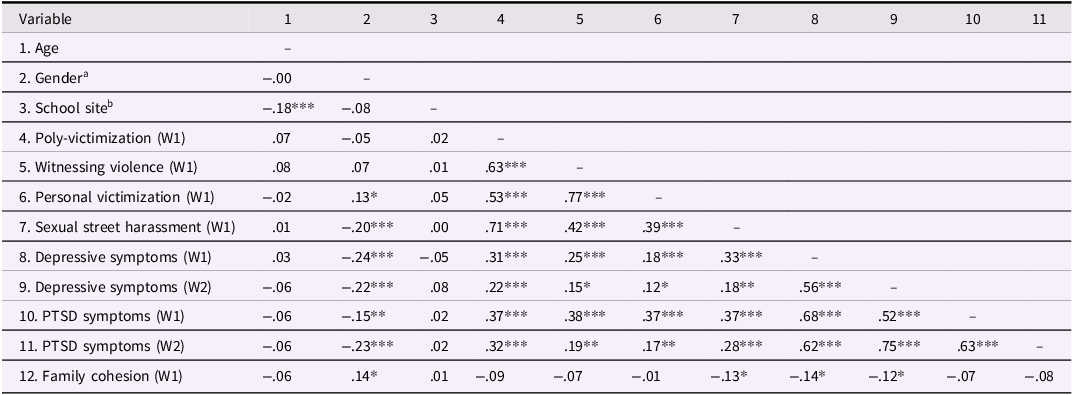
As expected, preliminary bivariate correlation analyses revealed that Wave 1 (W1) and Wave 2 (W2) symptoms of depression and PTSD were strongly and positively correlated (rs ranging from 0.52 to 0.75, p < .001; see Table 1). Sexual street harassment at W1 was significantly associated with increased depressive and PTSD symptoms at both time points, while witnessing violence and personal victimization were significantly associated with increased symptoms at W1 and with PTSD symptoms at W2; their associations with depressive symptoms at W2 remained significant but were comparatively weaker (r(328) = .15, p = .013 for witnessing violence; r(264) = .12, p = .045 for personal victimization). Sexual street harassment at W1 revealed slightly higher correlations with depressive symptoms (r(327) = .33, p < .001) than witnessing violence (r(328) = .25, p < .001) or personal victimization (r(325) = .18, p < .001), consistent with prior evidence on the strong psychological effects of sexual harassment (Mora et al., Reference Mora, Ceballo and Cranford2022). Additionally, family cohesion at W1 was associated with lower depressive symptoms at W1 (r(327) = −.14, p < .05) and W2 (r(264) = −.12, p < .05), as well as lower levels of sexual street harassment (r(338) = −.13, p < .05).
Bivariate correlations among study variables

Table 1. Long description
The table presents bivariate correlations among various study variables. It has 12 rows and 11 columns. The rows are labeled with variables such as Age, Gender, School site, Poly-victimization (W1), Witnessing violence (W1), Personal victimization (W1), Sexual street harassment (W1), Depressive symptoms (W1), Depressive symptoms (W2), PTSD symptoms (W1), PTSD symptoms (W2), and Family cohesion (W1). The columns are numbered from 1 to 11. Each cell contains a correlation value. Notable trends include strong positive correlations between Wave 1 and Wave 2 symptoms of depression and PTSD, and significant associations between sexual street harassment at Wave 1 and increased depressive and PTSD symptoms at both time points.
Note: N = 257–346. W1 = Wave 1; W2 = Wave 2. PTSD = posttraumatic stress disorder symptoms. Poly-victimization reflects the count of elevated violence domains (witnessing, personal victimization, street harassment), range 0–3. Depressive symptoms were assessed via the Patient Health Questionnaire. PTSD symptoms were assessed via the Post Traumatic Stress Disorder Checklist-Civilian Version.
a Gender was coded 0 = girl, 1 = boy.
b School site was coded 0 = outer city school, 1 = inner city school.
* p < .05. **p < .01. ***p < .001.
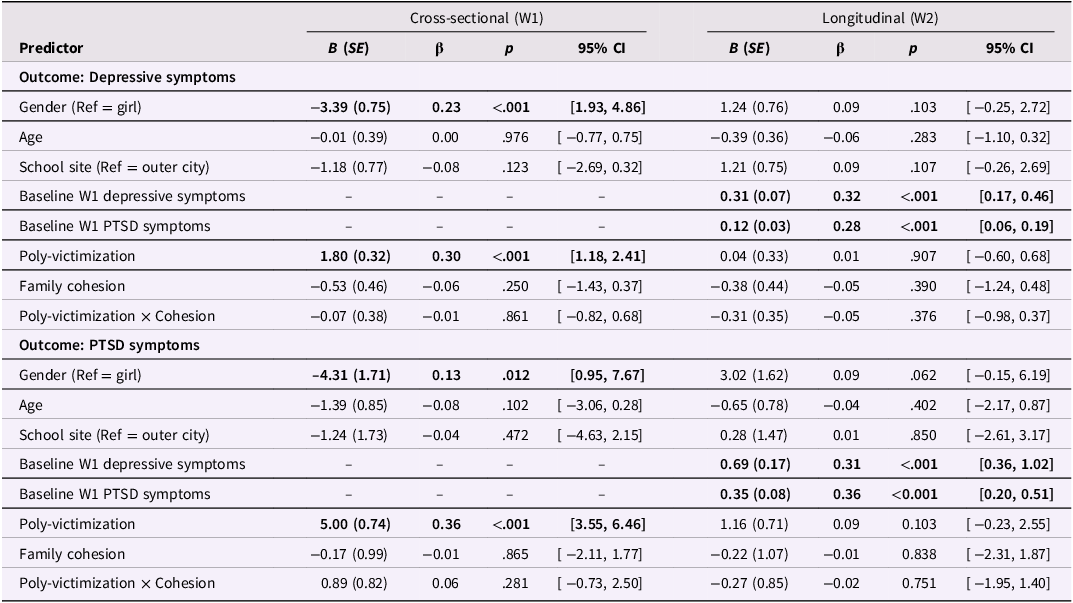
We first conducted a moderated path analysis using a cumulative poly-victimization count to test whether the accumulation of elevated exposure across violence domains was associated with adolescent mental health, and whether family cohesion moderated this association, both cross-sectionally at W1 and longitudinally at W2 (see Table 2). The longitudinal model controlled for baseline symptom levels to estimate change in distress over the academic year. Both models were saturated (df = 0), therefore fit indices are not informative and were not reported (Kline, Reference Kline2023).
Primary path models examining associations between cumulative poly-victimization and mental health outcomes

Table 2. Long description
The table presents data on predictors of depressive and PTSD symptoms, divided into cross-sectional (W1) and longitudinal (W2) analyses. It includes columns for unstandardized coefficients (B), standard errors (SE), standardized coefficients (β), p-values (p), and 95% confidence intervals (95% CI). The table is organized into two main outcome sections: Depressive symptoms and PTSD Symptoms. Each section lists various predictors such as Gender, Age, School site, Baseline W1 depressive symptoms, Baseline W1 PTSD symptoms, Poly-victimization, Family cohesion, and Poly-victimization x Cohesion. For Depressive symptoms, notable predictors include Gender with a significant negative coefficient in W1 and Poly-victimization with a significant positive coefficient in W1. For PTSD Symptoms, Poly-victimization shows a significant positive coefficient in W1. The table provides detailed statistical information for each predictor’s impact on the outcomes.
Note. N = 321 for cross-sectional models; N = 247 for longitudinal models. Models estimated with the MLR estimator in Mplus. B = unstandardized coefficient; SE = standard error; β = standardized coefficient; CI = confidence interval. Boldface indicates p < .05. Gender was coded 0 = girl, 1 = boy. School site was coded 0 = outer city school, 1 = inner city school. Em dashes indicate the predictor was not included in the cross-sectional model.
In the concurrent model, poly-victimization was significantly associated with both depressive symptoms (B = 1.80, β = 0.30, p < .001, 95% CI [1.18, 2.41]) and PTSD symptoms (B = 5.00, β = 0.36, p < .001, 95% CI [3.55, 6.46]), such that adolescents with elevated exposure across more violence domains reported higher symptom levels of both types. Family cohesion did not significantly moderate the association between poly-victimization and either outcome at this concurrent level, and family cohesion’s main effect was not significantly associated with either outcome. The full model accounted for a meaningful proportion of variance in both outcomes (depressive symptoms: R 2 = .16, p < .001; PTSD symptoms: R 2 = .15, p < .001). In the longitudinal model, poly-victimization was not significantly associated with either W2 depressive or W2 PTSD symptoms, and family cohesion did not significantly moderate either association over time. The only significant longitudinal predictors of W2 symptoms were baseline symptom levels, reflecting the general stability and co-occurrence of psychological symptoms across the academic year. The full longitudinal model explained a substantial proportion of variance in both outcomes (depressive symptoms: R 2 = .37, p < .001; PTSD symptoms: R 2 = .48, p < .001), though this was driven primarily by the stability of baseline symptoms rather than by poly-victimization or family cohesion.
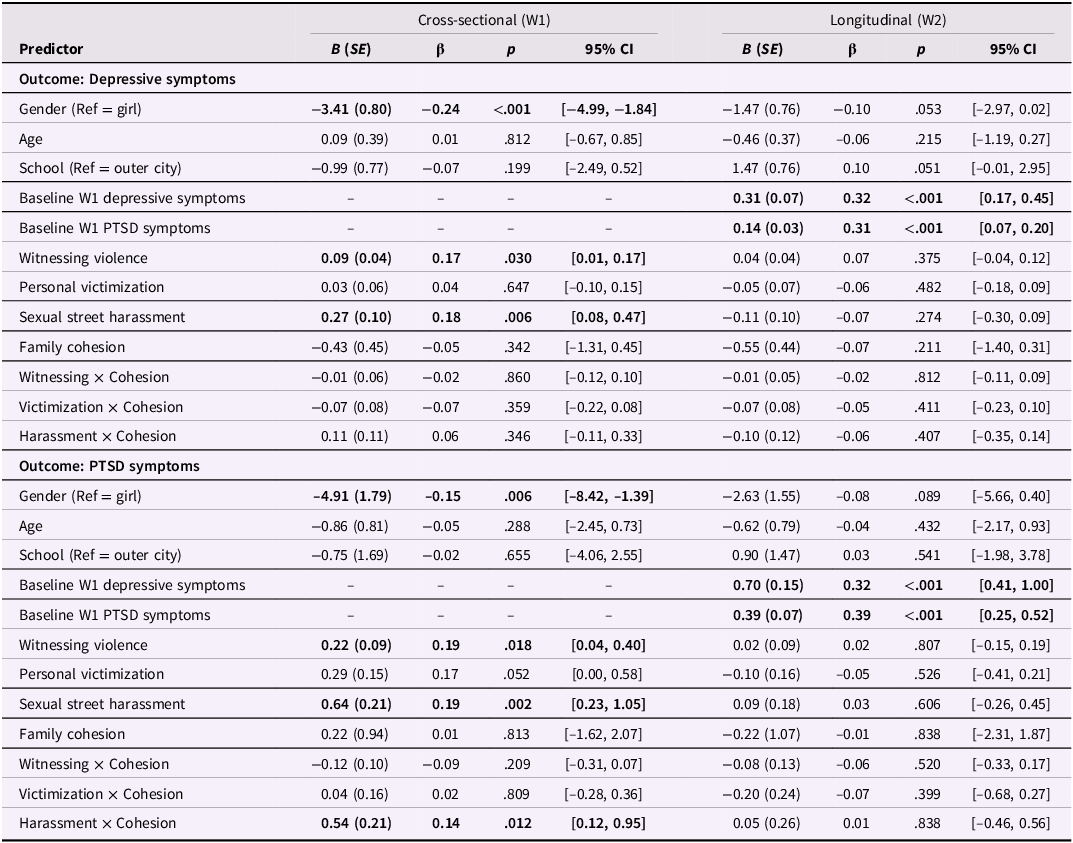
To further probe which specific forms of violence exposure contributed to this cumulative pattern, we also conducted a path analysis examining the unique contributions of witnessing violence, personal victimization, and sexual street harassment when modeled simultaneously alongside family cohesion, again both cross-sectionally and longitudinally (see Table 3).
Path models examining associations between unique contributions of victimization subtypes and mental health outcomes

Table 3. Long description
A table with two main outcomes: Depressive symptoms and PTSD Symptoms. The table is divided into two sections: Cross-sectional (W1) and Longitudinal (W2). Each section lists predictors, their coefficients (B), standard errors (SE), standardized coefficients (β), p-values (p), and 95% confidence intervals (CI). The predictors include gender, age, school, baseline symptoms, witnessing violence, personal victimization, sexual street harassment, family cohesion, and interaction terms between victimization types and family cohesion. The table has 18 rows and 11 columns. Each row represents a different predictor, and each column provides statistical values for the cross-sectional and longitudinal models. Notable trends include significant associations between gender, witnessing violence, sexual street harassment, and both depressive and PTSD symptoms. Family cohesion and its interactions with victimization types also show varying levels of significance.
Note. N = 322 for cross-sectional models; N = 248 for longitudinal models. Models estimated with the MLR estimator in Mplus. B = unstandardized coefficient; SE = standard error; β = standardized coefficient; CI = confidence interval. Boldface indicates p < .05. Gender was coded 0 = girl, 1 = boy. School site was coded 0 = outer city school, 1 = inner city school. Em dashes indicate the predictor was not included in the cross-sectional model.
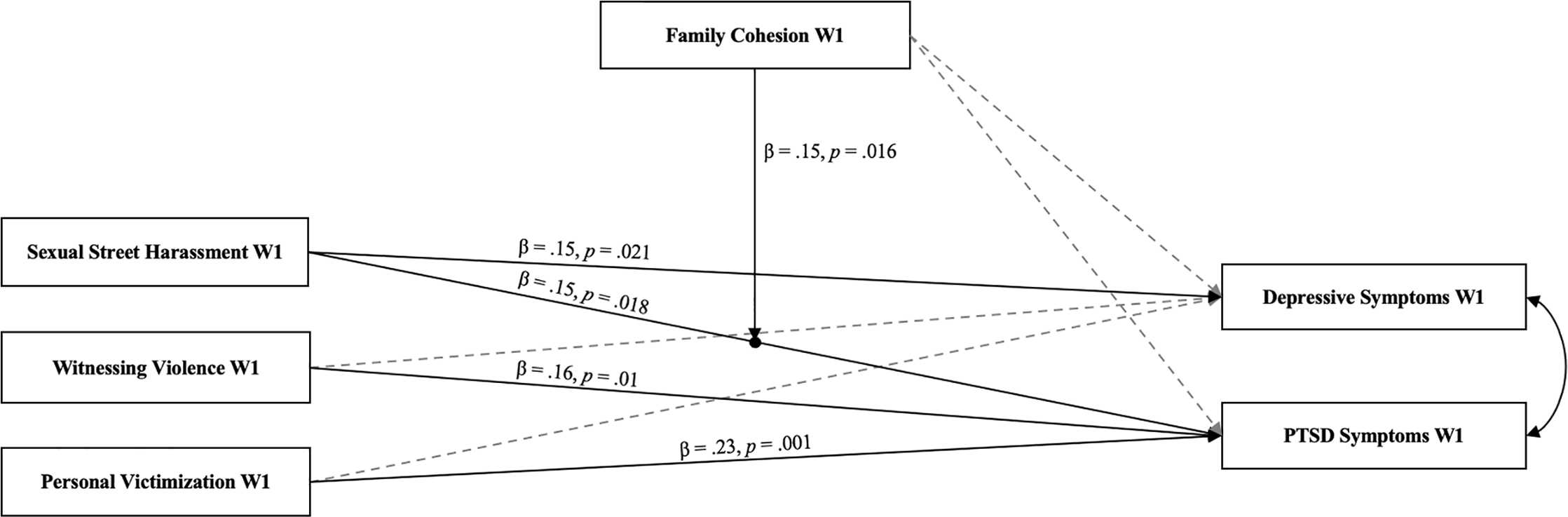
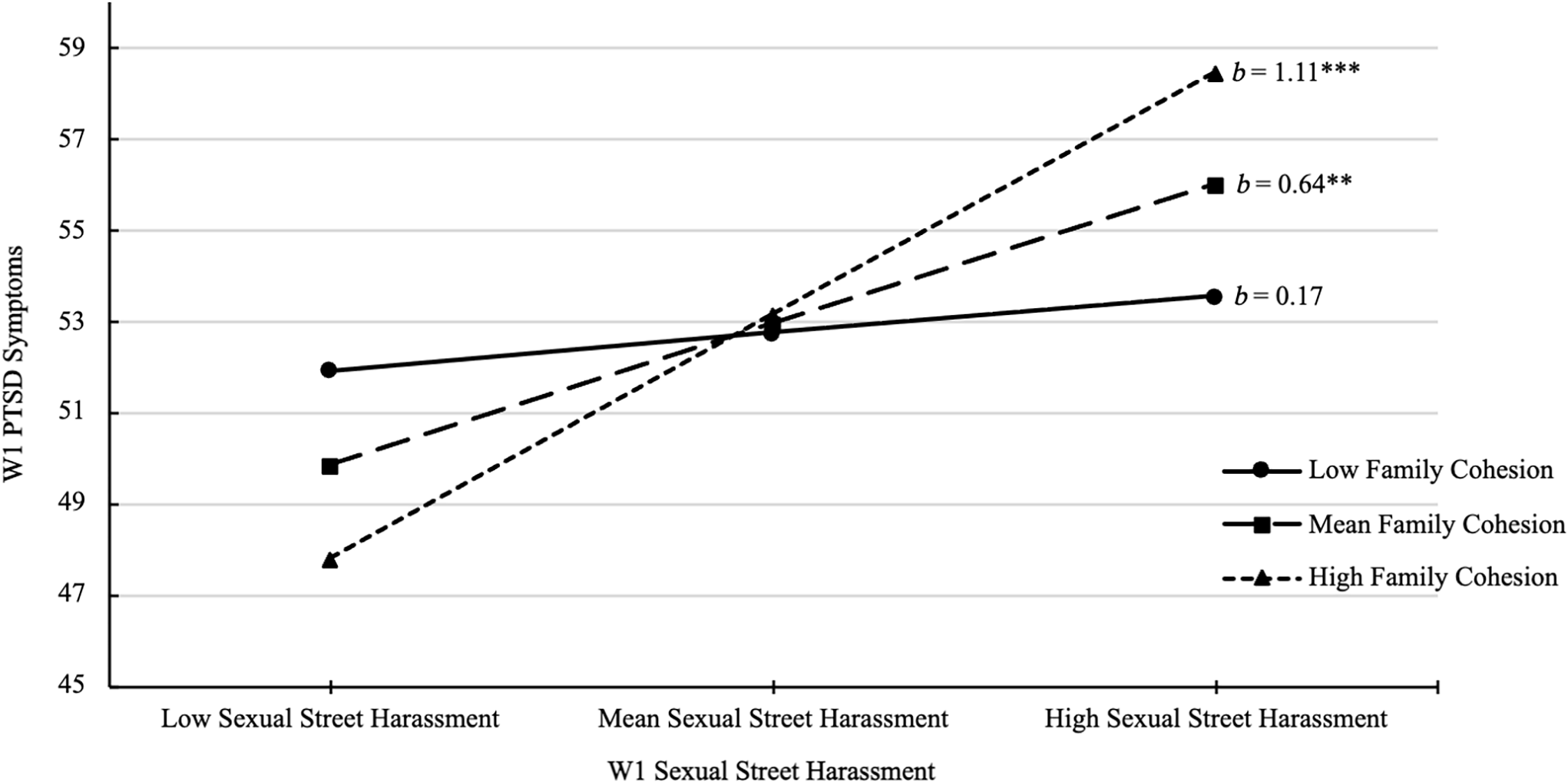
In the concurrent model (see Figure 1), sexual street harassment emerged as a significant correlate of both depressive symptoms (B = 0.27, p = .006) and PTSD symptoms (B = 0.64, p = .002). Witnessing violence was also significantly associated with both depressive symptoms (B = 0.09, p = .030) and PTSD symptoms (B = 0.22, p = .018). Personal victimization was not uniquely associated with either depressive symptoms (B = 0.03, p = .647) or PTSD symptoms (B = 0.29, p = .052) once witnessing violence and sexual street harassment were accounted for. At this concurrent level, family cohesion did not significantly moderate the association between witnessing violence or personal victimization and either outcome. However, the interaction between sexual street harassment and family cohesion was significant for PTSD symptoms (B = 0.54, p = .012). Simple slopes analyses indicated that sexual street harassment was not significantly associated with PTSD symptoms at low levels of family cohesion (b = 0.17, SE = 0.31, p = .582). In contrast, sexual street harassment was positively associated with PTSD symptoms at mean levels of family cohesion (b = 0.64, SE = 0.21, p = .002) and at high levels of family cohesion (b = 1.11, SE = 0.25, p < .001), with the magnitude of the association increasing as family cohesion increased (see Figure 2). This pattern indicates that family cohesion did not moderate the association between sexual street harassment and PTSD symptoms; rather, higher cohesion was associated with a stronger positive association between harassment and PTSD symptoms. Family cohesion’s main effect was not significantly associated with depressive or PTSD symptoms in this model. The full model accounted for a meaningful proportion of variance in both outcomes (depressive symptoms: R 2 = .19, p < .001; PTSD symptoms: R 2 = .23, p < .001).
Path analysis diagram: Note. Standardized path coefficients are presented. Solid lines indicate significant paths (p < .05); dashed lines indicate non-significant paths. Age, gender, and school site were included as covariates in the model but are omitted from the diagram for visual clarity. Interaction terms were tested using mean-centered product terms. For clarity, only the significant interaction between Sexual Street Harassment and Family Cohesion is shown. Covariances among exogenous predictors and residual error terms for endogenous variables were estimated but are omitted from the visual display to reduce clutter. The model was saturated; therefore, fit indices are not reported.

Simple slopes of the interaction between W1 sexual street harassment and W1 family cohesion on W1 PTSD symptoms: Note. Family cohesion is plotted at low (−1 SD), mean, and high (+1 SD) levels. **p < .01. ***p < .001.

In the longitudinal model, none of the violence exposure variables (witnessing violence, personal victimization, sexual street harassment) were significantly associated with W2 depressive or PTSD symptoms. Family cohesion also did not significantly moderate these associations over time. The only significant longitudinal predictors of W2 symptoms were baseline symptom levels: W1 depressive and PTSD symptoms significantly predicted their respective W2 counterparts as well as each other (ps < .001). The full longitudinal model explained a substantial proportion of variance in both outcomes (depressive symptoms: R 2 = .38, p < .001; PTSD symptoms: R 2 = .48, p < .001).
As a supplemental analysis, we tested whether gender moderated the associations between each form of violence exposure and mental health outcomes. None of the gender interaction terms (witnessing violence, personal victimization, or sexual street harassment × gender) reached statistical significance at conventional thresholds for either depressive or PTSD symptoms (see Table S1), suggesting that the associations between violence exposure and psychological symptoms did not differ meaningfully between boys and girls in this sample.
Discussion
The present study assessed whether family cohesion buffers the mental health consequences of poly-victimization, specifically CVE and sexual street harassment, among urban Mexican adolescents. By integrating a poly-victimization framework with culturally grounded models of resilience, this study analyzed multiple and distinct types of neighborhood violence on psychological symptoms. In addition, it examined the role of family cohesion as a prospective protective factor (Tillyer et al., Reference Tillyer, Ray and Hinton2018), both cross-sectionally and longitudinally. Most importantly, it extends U.S.-centric models of neighborhood violence and resilience to an understudied Latin American context characterized by chronic structural insecurity (Benavides Morales et al., Reference Benavides Morales, Lopez Santander and Rengifo Montenegro2025).
Consistent with prior poly-victimization research and in line with our hypothesis, results showed that adolescents exposed to cumulative poly-victimization reported elevated depressive and PTSD symptoms concurrently. These findings align with extensive evidence that cumulative exposure to multiple forms of violence is strongly linked to psychological distress than any single exposure alone (Adams et al., Reference Adams, Moreland, Cohen, Lee, Hanson, Danielson, Self-Brown and Briggs2016; Finkelhor et al., Reference Finkelhor, Ormrod and Turner2009). Additionally, when these forms of violence were included separately in the model, witnessing violence and sexual street harassment were uniquely associated with higher PTSD and depressive symptoms. However, longitudinally, none of these associations persisted for cumulative poly-victimization or when the forms of violence were examined separately.
The lack of longitudinal associations between CVE and street harassment and subsequent depressive and PTSD symptoms may reflect several factors. Although depressive and PTSD symptoms increased on average over time, adolescents with greater symptoms at W1 tended to report greater symptoms at W2, suggesting continuity in psychological functioning across the study period. Thus, after accounting for prior depressive and PTSD symptoms, victimization experiences explained little additional variability in subsequent symptoms over the relatively short follow-up period. The timing of our assessments may have further constrained our ability to detect prospective associations, as the assessment windows for victimization experiences and psychological symptoms did not fully correspond. Most notably, in line with prior work, baseline depressive and PTSD symptoms were strongly associated with subsequent symptoms (Liu et al., Reference Liu, Liu, Ren, Zhang and Peng2024), suggesting substantial stability in adolescents’ psychological functioning across the study period. Moreover, although sensitivity analyses indicated that our longitudinal models were adequately powered to detect associations of approximately r = .18 or larger, smaller longitudinal effects may have gone undetected. Together, these findings suggest that the null longitudinal associations should not be interpreted as evidence that victimization has no longer-term implications for adolescent mental health, but rather that its unique prospective contribution beyond adolescents’ prior psychological functioning may be relatively small or difficult to detect over a short period. A more tentative possibility is that chronic exposure to violence may alter adolescents’ responses to subsequent victimization. In contexts where violence is frequent, adolescents may increasingly perceive such experience as normative or expected (Medrano & Ceballo, Reference Medrano and Ceballo2025), potentially contributing to desensitization over time. Future longitudinal research should directly assess desensitization and related adaptations to chronic violence exposure to determine whether they help explain changes in psychological consequences of victimization over time (Jiménez et al., Reference Jiménez, Mafud, Cappello and Sescosse2022; McCart et al., Reference McCart, Smith, Saunders, Kilpatrick, Resnick and Ruggiero2007).
Gender also emerged as a significant cross-sectional predictor for psychological outcomes, with girls reporting higher depressive and PTSD symptoms than boys, consistent with previous literature (Jaycox et al., Reference Jaycox, Stein, Kataoka, Wong, Fink, Escudero and Zaragoza2002; Suarez-Morales et al., Reference Suarez-Morales, Mena, Schlaudt and Santisteban2017). This pattern may be tied to traditional Mexican norms, such as machismo, which consists of male dominance, control, and caballerismo, or the responsibility of being the head of one’s household (Medrano et al., Reference Medrano, Medina, Harvey, Ganu and del Carmen2026). Adolescent boys living in Mexico may place expectations on themselves to not show emotion and, instead, internalize or suppress it, which could contribute to their comparatively lower reported symptom levels (Medrano et al., Reference Medrano, Davila, Labrousse, Adame Montelongo and Williams2025). Despite gender’s significant main effect, gender did not significantly moderate the associations between any form of violence exposure and either psychological outcome in supplemental analyses, suggesting that while boys and girls may differ in overall symptom levels, the strength of the link between violence exposure and psychological distress did not differ meaningfully by gender in this sample.
Based on García Coll et al.’s (Reference García Coll, Lamberty, Jenkins, McAdoo, Crnic, Wasik and García1996) integrative model of ethnic minority children, we hypothesized that the diverse strengths and adaptive cultures such as family cohesion (tied to familismo in Latina/o families) can buffer from the negative psychological sequalae of violence exposure. Contrary to our hypothesis, cohesion did not buffer associations at the concurrent or longitudinal level. Instead, an unexpected moderation emerged for the cross-sectional association between sexual street harassment and PTSD symptoms. Specifically, sexual street harassment was not linked to PTSD symptoms at low levels of family cohesion but was positively associated with PTSD symptoms at mean and high levels of cohesion, with the association becoming stronger as cohesion increased. This is particularly striking, given that cultural values linked to familismo have appeared to operate as adaptive resources that mitigate certain stressors for Mexican American adolescents (Kho et al., Reference Kho, White, Zhao, Knight and Roche2023; Romero et al., Reference Romero, White, Anguas, Curlee and Rodas2020; White et al., Reference White, Liu, Nair and Tein2015). Some studies have also found null (Medrano & Ceballo, Reference Medrano and Ceballo2025) or even exacerbating effects (Mora et al., Reference Mora, Ceballo and Cranford2022) of parent–child cohesion, further highlighting family cohesion functions in a nuanced way as well.
The present study’s focus on family-level cohesion is particularly important in the Mexican context, where family-wide support often plays a central role in adolescents’ daily lives (Smith-Morris et al., Reference Smith-Morris, Morales-Campos, Alvarez and Turner2013; White et al., Reference White, Roosa and Zeiders2012). Importantly, however, family processes may function differently within contexts of chronic neighborhood danger. Prior research with Mexican-origin families suggests that familismo and family cohesion can promote positive adjustment in high-risk environments, but their effects are not uniformly protective (White et al., Reference White, Roosa and Zeiders2012, Reference White, Liu, Nair and Tein2015,). For example, parenting behaviors that may otherwise confer risk can function adaptively in dangerous neighborhoods when they reflect parents’ efforts to protect adolescents from environmental threat (White et al., Reference White, Liu, Nair and Tein2015). Thus, the meaning and developmental consequences of family processes cannot be separate from the broader contexts in which families are adapting.
This contextualized perspective may help explain our unexpected finding that family cohesion strengthened, rather than buffered, the concurrent association between sexual street harassment and PTSD symptoms. Consistent with the adaptive cultures framework, culturally and contextually adaptive processes can carry both benefits and costs for development (White et al., Reference White, Nair and Bradley2018). Greater family cohesion may represent an important source of connection and support in violent environments without necessarily protecting adolescents from the psychological consequences of specific victimization experiences. Indeed, strong family connectedness may also carry heightened expectations and obligations toward family members (Bravo & Cárdenas, Reference Bravo, Cárdenas and Cárdenas2026). In the context of a sensitive experience such as sexual harassment, greater family involvement could therefore introduce additional emotional or interpersonal demands alongside the support it provides. For example, adolescents in more cohesive families may be more likely to disclose victimization or become concerned about its effects on family members. Although these processes were not assessed in the present study and remain speculative, they underscore why greater family cohesion should not necessarily be expected to uniformly attenuate the psychological consequences of violence exposure.
Family processes must also be considered alongside adolescents’ broader social environments. Prior work suggests that familismo and neighborhood cohesion may each contribute to positive adaptation among adolescents navigating disadvantaged or dangerous neighborhoods (Romero et al., Reference Romero, White, Anguas, Curlee and Rodas2020). Thus, family cohesion alone may be insufficient to offset the psychological consequences of victimization when adolescents remain embedded within broader environments characterized by violence and limited support. This interpretation is also consistent with prior studies in which family cohesion did not moderate associations between neighborhood danger and adolescent adjustment (Medrano & Ceballo, Reference Medrano and Ceballo2025; White & Roosa, Reference White and Roosa2012; White et al., Reference White, Roosa and Zeiders2012). Taken together, these findings suggest that family cohesion may be an important cultural and relational resource without functioning as a universal protective factor. Its implications for adolescent adjustment likely depend on the type of stressor experienced and the broader family and neighborhood contexts in which that stressor occurs.
This significant moderation also underscores the importance of conceptualizing sexual street harassment as a distinct and psychologically consequential form of violence within adolescents’ ecological environments (Mora et al., Reference Mora, Gutiérrez and Ceballo2024). Witnessing violence and sexual street harassment may also differ qualitatively in how adolescents experience these events; street harassment is often direct and personal, whereas witnessing violence may be experienced more indirectly (Borg et al., Reference Borg, Rabinak and Marusak2023). However, because these constructs were measured via self-report and differ in item content and response scaling, we interpret this distinction cautiously rather than as evidence that one form of violence is inherently more psychologically salient than the other. Traditional CVE measures may obscure distinct forms of neighborhood harm that are particularly salient for mental health (Ceballo, Reference Ceballo2024). While our findings do not establish that family cohesion mitigates the dangers of neighborhood violence, they indicate that cohesion does severely impact adolescents’ psychological outcomes in the face of chronic exposure, making it a cultural factor worth examining in distinct contexts.
Strengths and limitations
Several strengths enhance the contribution of this study. The use of a two-wave longitudinal design allowed for the examination of change in psychological symptoms over time, strengthening inferences about prospective associations. The inclusion of both CVE and sexual street harassment within a single analytic framework offers a more comprehensive depiction of adolescents’ neighborhood experiences. Additionally, the focus on family cohesion advances culturally grounded developmental research, which has not been studied as extensively in this field (Causadias & Cicchetti, Reference Causadias and Cicchetti2018; García Coll et al., Reference García Coll, Akerman and Cicchetti2000). Moreover, although our hypotheses were not supported as we expected, we believe these results add to the nuance of adaptive cultures. Rather than shying away from our findings, we hope to contribute to work that situates adaptive cultures as highly contextual and evolving (White et al., Reference White, Nair and Bradley2018). Nonetheless, limitations warrant consideration. All measures relied on adolescent self-report, which may introduce shared method variance or reporting bias. The sample was drawn from a single urban region in Mexico, potentially limiting generalizability to rural areas or other national contexts with different sociopolitical conditions. Although the longitudinal design strengthens temporal inference, two waves may not be sufficient to examine desensitization to violence among these adolescents (Kennedy & Caballo, Reference Kennedy and Ceballo2016). The exclusion of gender diverse youth also poses a limitation on gender-based analysis, thereby further restricting the generalizability of claiming harassment is a gendered phenomenon. As a result, inferences cannot be made about gender diverse youth experiencing higher rates of violence and poorer mental health outcomes. Finally, the study did not directly assess mechanisms (e.g., communication, coping strategies) through which family cohesion may exert its effects. Future studies should explore these possible underlying mechanisms.
Implications
The findings have important theoretical and applied implications. Theoretically, they underscore the need to expand poly-victimization frameworks to explicitly include sexualized forms of neighborhood violence (Mora et al., Reference Mora, Ceballo and Cranford2022). Doing so may help reconcile inconsistent findings in the CVE literature and better capture adolescents’ lived experiences (Ceballo, Reference Ceballo2024). Moreover, violence exposure measures used in adolescent research and surveillance efforts should incorporate validated measures of public sexual harassment to more accurately characterize poly-victimization risk profiles and to inform intervention targeting. Additionally, prevention efforts in high-violence urban settings should explicitly address sexual street harassment rather than treating it as peripheral to broader violence prevention. School-based interventions in Mexico suggest that multilevel approaches addressing gender norms and sexual violence among students while strengthening school-wide responses may reduce experiences of sexual victimization (Sosa-Rubi et al., Reference Sosa-Rubi, Saavedra-Avendano, Piras, Van Buren and Bautista-Arredondo2017). Given the central role of families in adolescents’ lives, family-based approaches may also provide opportunities to strengthen communication and support surrounding experiences of violence (González, Reference González2014; Morales Alvarado & Medina, Reference Morales Alvarado and Medina2025). However, our findings also suggest that family cohesion alone should not be assumed to protect adolescents from the psychological consequences of victimization. Trauma-informed prevention efforts may therefore benefit from simultaneously strengthening family and school supports while directly addressing the broader contexts in which adolescents experience sexual harassment and community violence.
Conclusion
Urban Mexican adolescents navigate overlapping forms of neighborhood violence that carry distinct implications for mental health. This work extends poly-victimization frameworks by not only examining distinct forms of exposure cumulatively, but also simultaneously via their unique contributions. In this study, family cohesion did not protect against violence, but instead worsened adolescents’ short-term adjustment, exacerbating the cross-sectional association between sexual street harassment and PTSD symptoms. These findings highlight the need to continue studying the interplay and nuance between culture and context among distinct populations within developmental research.
Supplementary material
The supplementary material for this article can be found at https://doi.org/10.1017/S0954579426102107.
Data availability statement
Data is not publicly available; however, de-identified participant data is available upon reasonable request made to the senior author.
Acknowledgments
We thank the Pitt Momentum Funds for their funding support and Dr. Gloria Margarita Gurrola-Peña for sharing the Mexican Sexual Street Harassment Scale we used in this study. We also thank our amazing participants, community partners, and the CREAR Lab team for their extensive support. Lastly, the first author wants to thank her family and friends for believing in her, as well as her beautiful dogs, Lily and Jesse, for their endless love.
Funding statement
This research was supported by the Momentum Priming Grant from the University of Pittsburgh awarded to the third and fourth authors.
Competing interests
The authors declare none.
Pre-registration statement
The present study was not preregistered to protect the confidentiality of the participants given the sensitive nature of the questions asked in the survey (i.e., child abuse, sexual harassment), in addition to the sociopolitical climate of the setting in which data collection took place.


 Open access

