Introduction
The International Seed Testing Association (ISTA) defines seed quality as a ‘concept made up of different attributes’ (ISTA, 2007). These include moisture content, germination, vigour, vitality, health and purity. Furthermore, Thomson (Reference Thomson1979) describes that the uniformity of the seed size in a seed lot needs to be considered a measure of seed quality, especially for a seed lot containing a range of seed sizes. Unfortunately, for spinach seed lots (Spinacia oleracea L.), this non-uniformity raises many issues regarding seed quality (Thomson, Reference Thomson1979), the ability to measure seed quality and the subsequent production and establishment of spinach plants. A uniform seed size is an advantage for obtaining even sowing rates across a field, which would be favourable for the even establishment of baby leaf spinach production. Due to the relatively short time from sowing to harvest in this crop, there are great benefits of uniform germination/establishment for a homogeneous harvest time. Delpratt (Reference Delpratt, Adkins, Ashmore and Navie2007) made a comment that an uneven seed lot can be difficult to sow mechanically, often rendering issues with uneven sowing rates and subsequent establishment.
Vigour and even establishment is influenced by the rate of germination, mean germination time (MGT) as well as final germination of seed lots. This was demonstrated in cucurbit crops under stress conditions (Mavi et al., Reference Mavi, Demir and Matthews2010), in pepper in transplant modules (Demir et al., Reference Demir, Ermis, Mavi and Matthews2008) and in maize in soil (Khajeh-Hosseini et al., Reference Khajeh-Hosseini, Lomholt and Matthews2009). Significant correlations were found between MGT and rate of emergence, measured as mean emergence time (MET), final emergence and seedling size uniformity. Like all members of the Chenopodiaceae family, spinach has an indeterminate growth pattern (Sherry et al., Reference Sherry, Eckard and Lord1993). This indeterminate nature can cause numerous issues with seed production and quality. Within a plant, seeds vary in size, even on a single branch. This difference is the result of differing levels of carbohydrate resources allocated to the seeds, depending on their location (Baskin and Baskin, Reference Baskin and Baskin1998). Lomholt (Reference Lomholt2000) found that swathing spinach inflorescences as early as 35 d after initial flowering, did not affect either germination rate or total germination. This study suggests that the translocation of carbohydrate resources was sufficient for the seeds to germinate at the time of swathing, or was able to fulfil the necessary resources when in the swath – all swathing times after this point did not affect seed quality. TeKrony and Egli (1997) have shown that several horticultural crops have maximum vigour at physiological maturity when seeds were to dry on the inflorescences. As a result of the varying seed development pattern, seeds of different maturity levels will be harvested during a single harvest operation. In most cases, on any given plant, not all seeds will have reached maturity by harvest, with the remaining proportion having a limited germination ability and seedling vigour.
Spinach seeds have a structure similar to seeds of sugar beet (Beta vulgaris L.). The ‘seed’ of spinach is a fruit, consisting of an embryo surrounding the perisperm, micropylar endosperm, testa and pericarp, as described by Hermann et al. (Reference Hermann, Meinhardz, Dobrec, Linkies, Pesek, Hess, Machácková, Fischer and Leubner-Metzger2007). The spinach perisperm primarily contains starch as the food reserve (Sifton, Reference Sifton1927) and this tissue can be monitored by cracking open or squeezing the seed to visually assess the stage of perisperm development. The perisperm and embryo must be fully developed to produce vigorous, viable seeds. Large spinach seeds have a thicker pericarp and show a slower and reduced germination rate at high temperatures, as compared to smaller seeds (Nonogaki, Reference Nonogaki2006).
Numerous authors have studied the effect of seed size in relation to germination in spinach. Lomholt (Reference Lomholt2000) concluded that large spinach seeds have a slower germination rate than smaller seeds and could therefore be expected to have a poorer field emergence. While the speed of germination might be slower for larger seeds (Lomholt, Reference Lomholt2000), Nonogaki (Reference Nonogaki2006) commented that larger spinach seeds produce more vigorous plants and can directly influence the yield of the leafy vegetable. Similarly, Pandita and Randhawa (Reference Pandita and Randhawa1996) found a positive benefit of larger spinach seeds, as sowing these seeds improved the seed yield for the subsequent generation; this can be applied to the example of baby leaf spinach production.
The most common method for obtaining a uniform seed lot in spinach is via seed cleaning and processing procedures (Brocklehurst, Reference Brocklehurst1985), where seeds are divided into different size fractions and empty seeds are removed by density sorting. Another way of seed sorting is based on visual colour intensity parameters, and new technologies now offer more opportunities for sorting seeds based on other seed characteristics, such as chlorophyll level in the outer layer of the seed coat (testa or pericarp). Jalink et al. (Reference Jalink, Frandas, Van der Schoor and Bino1998) described a chlorophyll fluorescence (CF) testing technique in which the chlorophyll a molecules are excited by light and the reflecting chlorophyll fluorescence is measured by a photodiode. In their study, the measurements were conducted on a seed lot of white cabbage (Brassica oleracea var. capitata L.), showing a wide distribution of CF signals. Germination results were compared with the unsorted seed sample and it was clear that the germination capacity was increased in the two seed samples with low and medium CF and germination capacity was decreased in the subsample with a high CF. Similar studies were conducted to correlate CF signal with seed germination of deteriorated cabbage seeds (Dell'Aquila et al., Reference Dell'Aquila, Van der Schoor and Jalink2002) and to determine the maturity of barley grains (Konstantinova et al., Reference Konstantinova, Van der Schoor, Van der Bulk and Jalink2002). So far, no studies have evaluated the use of the chlorophyll fluorescence testing technique on seeds with a fruit coat (pericarp), as in spinach, and in an inhomogeneous seed lot, in which CF sorting is employed in combination with seed size sorting.
Our study was conducted to test whether chlorophyll sorting (based on CF) could be used to remove low-vigour, immature seeds from spinach, and how this might relate to the size of the seeds. Thus the following research questions were addressed in this study. How does spinach seed with varying size and chlorophyll content germinate in terms of mean germination time and germination percentage? Is it possible, by combining chlorophyll sorting and seed size grading, to improve seed quality in spinach?
Materials and methods
Seed material, growth conditions and sampling
Hybrid spinach seeds were produced from parental lines sown on 14 April 2009 (female) and 14 April/7 May (male), at a female:male ratio of 3:1. The male line was sown at two time intervals to provide sufficient pollen for the entire flowering period. Fertilizer was applied at a rate of 140 kg N ha− 1, split between 60 kg N ha− 1 at the sowing of the female line and 80 kg N ha− 1 on 7 May 2009. During the growing season the plants were sprayed against aphids and fungi, as and when required. Onset of flowering was registered on 11 June 2009; flowering ended on 26 June.
Spinach plants from five different developmental stages (13, 22, 24, 28 and 31 July 2009) were harvested, and studied. The first harvest (13 July – H1) was performed 3 weeks prior to the predicted harvest date (the predicted harvest date, 1 August 2009 was calculated to be 35 d from when the flowering ended). Nine days later, harvest 2 (22 July – H2) was performed; and subsequently harvests 3, 4 and 5 were undertaken 2–4 d apart until the predicted harvest date.
Eight metres of spinach plants, at each respective harvest time were cut at soil surface, during early morning. Plant numbers were recorded from each row. Harvested plants were divided into four fractions – top, middle and base of the main stem (divided equally depending on height), and side stems. The data presented here originate from the side stems in order to secure enough seed material of all analysed seed sizes (referred to below as S1–S4).
Evaluation of maturity of the harvested seeds
The developmental stage of the harvested spinach seeds was evaluated using the growth stage scale for cereals (BBCH Monograph; Meier, Reference Meier1997). Scoring was based on the development of fruit (stages 71, 73, 75 and 77) and ripening (83 – early dough; 85 – content soft but dry, fingernail impression not held; 87 – content solid, fingernail impression not held; 89 – fully ripe, hard content, difficult to divide with nail). For this study, phenological growth stages and BBCH identification keys of cereals were used as the indicators for development stage instead of the scale for leafy vegetables not forming heads (Meier, Reference Meier1997). Evaluation by the leafy vegetable (not forming heads) fails to consider the evaluation of the seed based on seed structure.
Chlorophyll fluorescence measurements and seed size sorting
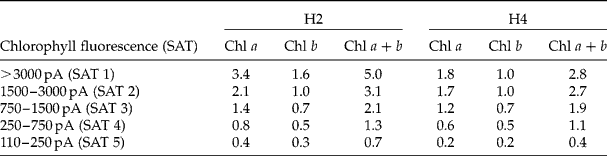
A chlorophyll seed analyser (Satake USA Inc., Houston, Texas, USA) was used to measure chlorophyll fluorescence (CF), allowing sorting of individual seeds according to CF range levels (Jalink et al., Reference Jalink, Frandas, Van der Schoor and Bino1998). The equipment was set to sort into five CF fractions ranging from SAT1 (>3000 pA), SAT2 (1500–3000 pA), SAT3 (750–1500 pA), SAT4 (250–750 pA) to SAT5 (110–250 pA; Table 1). Seed extracts of each SAT fraction were evaluated spectrophotometrically. Two grams of seeds were placed in ethanol (96% v/v) and incubated overnight at 60°C in a dark room, during which samples were shaken several times. The samples were cooled and subsequently centrifuged. Chlorophyll content of the extract was assayed spectrophotometrically (Heλios β spectrophotometer; UNICAM, Redwood City, California, USA) at 470 nm, 648.6 nm, 664.2 nm and 750 nm with 96% ethanol used as a reference. After CF sorting, seeds were further divided into four seed size classes; S1 ( < 2.5 mm), S2 (2.5–3.25 mm), S3 (3.25–3.75 mm) and S4 (3.75–4.25 mm), using sieves. The sizes and grading were selected based on seed company recommendations. As a normal procedure, seeds below 2.5 mm and seeds above 4.0 mm were graded out in the cleaning process (Deleuran et al., Reference Deleuran, Gislum and Boelt2005).
Sorting scheme for hybrid spinach seeds. Each harvest time (H1–H5; not shown) was divided in five chlorophyll fluorescence (CF) levels (SAT1–SAT5; SAT1 is the highest CF and SAT5 is the lowest CF). Each SAT level was further divided into four seed sizes (S1–S4; S1, small seed, to S4, large seed)

Germination
In order to have sufficient seed in each seed size fraction and SAT fraction for germination analysis, H2 and H4 were selected for further analysis. In harvest H1, no seeds were found in SAT5; likewise in H5, limited seeds were found in SAT1. Due to sorting overlaps, H3 was excluded to enable a clear distinction between H2 and H4, namely for SAT fractions. Four replicates of 25 seeds were assessed for germination capacity using the ‘between paper method’ (ISTA, 2007). Seed boxes were placed in a germination cabinet at 15°C under an 8-h light/16-h dark cycle (ISTA, 1996). Seeds were visually inspected and recorded for germination sensu stricto after 3, 7, 14 and 21 d (Perino and Côme, Reference Perino and Côme1991). On the basis of the known structure of sugar beet seeds, as described by Hermann et al. (Reference Hermann, Meinhardz, Dobrec, Linkies, Pesek, Hess, Machácková, Fischer and Leubner-Metzger2007), non-germinating seeds were evaluated for the presence of perisperm and embryo after 21 d. If a perisperm or embryo was not found, the seed was characterized as empty. Seeds with perisperm and embryo were characterized as ‘undeveloped seeds’.
The mean germination time (MGT) was calculated for each lot using a modified description following Ellis and Roberts (Reference Ellis, Roberts and Hebblethwaite1980), where n is the number of seeds that germinate on day D, and D is the number of days counted from the beginning of the germination test. In our calculations of MGT we used hours instead of days:
 $$\begin{eqnarray} \end{eqnarray}$$
Statistical analysis
Data were analysed using the procedure PROC GLM within Statistical Analysis System, version 9 (SAS, 2010). Only two seed fractions, H2 and H4, were analysed separately for percentage germination, actual number of germinated seeds and seed germination character, due to their complete sample sets.
Results
Seed maturation
On average, seed maturity of the side stems of four spinach plants were 83, 86, 87, 89 and 89 for H1, H2, H3, H4 and H5, respectively, as per the cereal BBCH scale (Meier, Reference Meier1997). Accordingly, the first harvest (H1) was performed when the seeds were at stage 83 (early dough); and the last harvest (H5) at stage 89 when the perisperm was hard and difficult to divide with a nail.
Seed size distribution
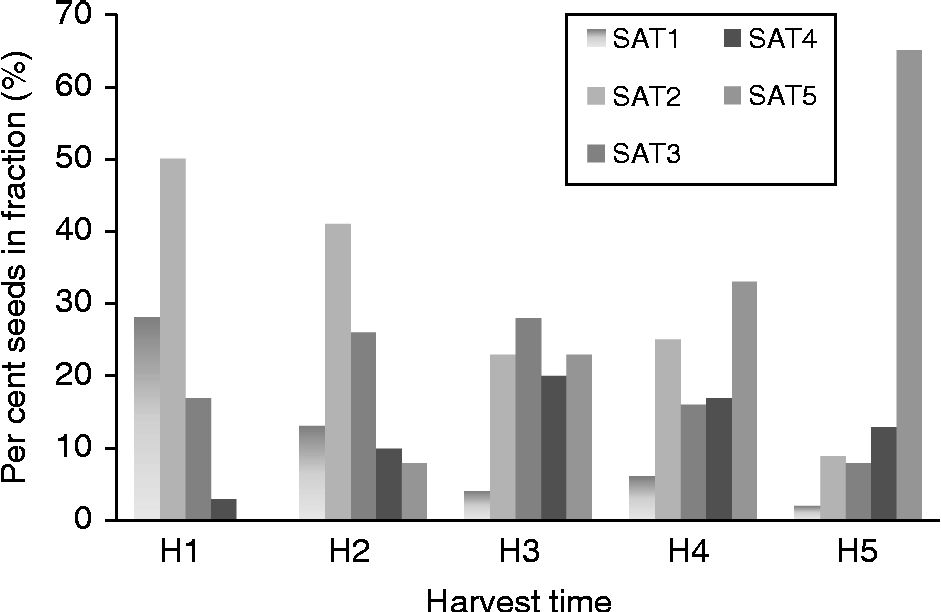
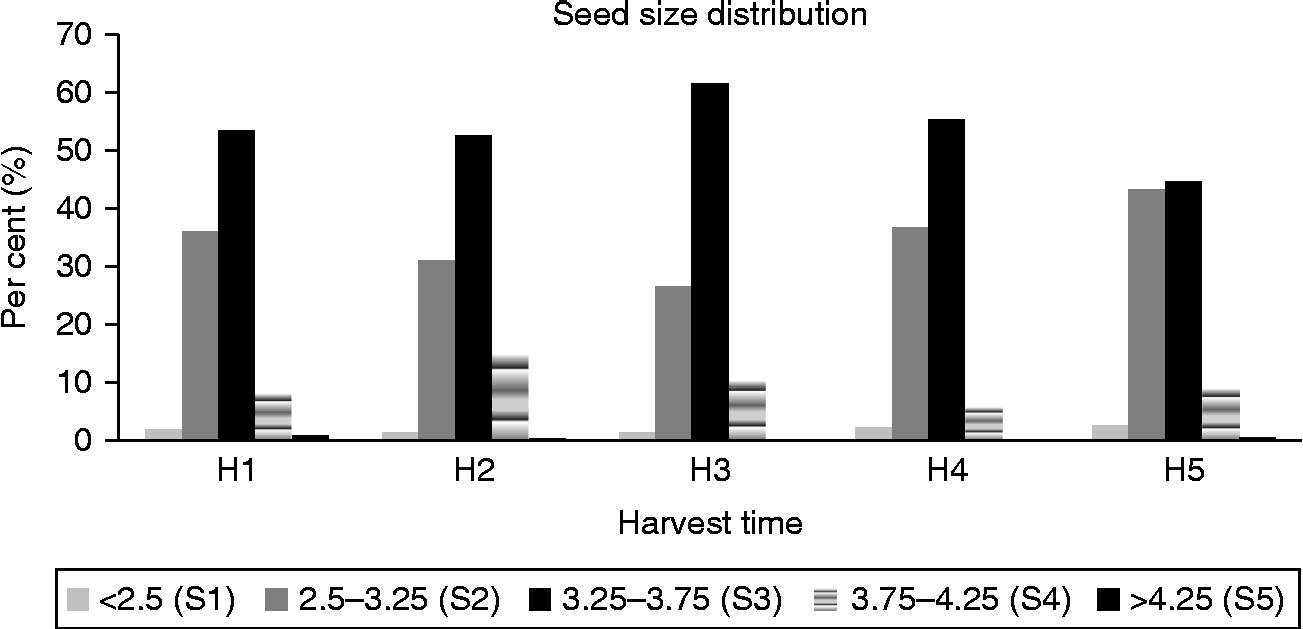
Spinach seeds from H1 displayed the maximum percentage of seeds in SAT1 (28%) compared with H5, which had the lowest percentage in SAT1 (2%; Fig. 1). Conversely, H5 had the greatest percentage of seeds present in SAT5 (65%) compared with H1, which recorded no seeds in SAT5 (Fig. 1). Seed size distribution followed a generalized ‘normal distribution’ pattern. For all harvest times, the greatest fractions of seeds were within the middle seed size (3.25–3.75 mm; S3) with 45–65% of total seeds recorded (Fig. 2). For all harvest times, limited numbers of seeds ( < 2.5% of total) were recorded in the smallest ( < 2.5 mm; S1) and largest (>4.25 mm; S5) seed size classes.
Percentage of hybrid spinach seeds in SAT fractions (SAT1, SAT2, SAT3, SAT4 and SAT5) at five harvest times (H1, H2, H3, H4 and H5).

Hybrid spinach seed size distribution in five seed sizes [ < 2.5 mm (S1); 2.5–3.25 mm (S2); 3.25–3.75 mm (S3); 3.75–4.25 mm (S4) and >4.25 mm (S5)] at five harvest times (H1, H2, H3, H4 and H5).
Empty and ‘immature’ seeds at harvest time 4 (H4)
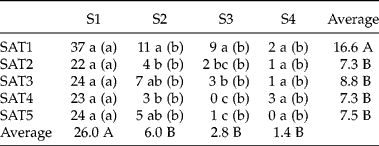
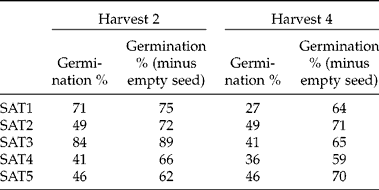
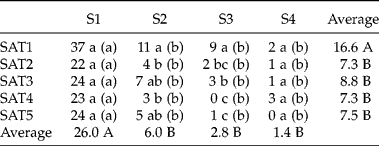
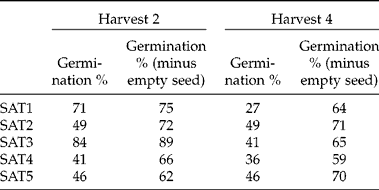
Further analysis of H4 revealed that many of the non-germinating seeds were empty (33% of total), especially in the smallest seed fraction (S1 across all SAT ranges; data not shown). Seed fraction S1 had a significantly higher percentage of undeveloped seeds (26%), as compared to the overall seed size classes (S2 through S4 averaging 3%; P< 0.01; Table 2). Among all SAT fractions for S1, there were no significant differences for values obtained in SAT (averaging 26%; Table 2). In S2 and S3, a weak trend indicated an increasing percentage of undeveloped seeds at the SAT fractions displaying the highest CF range (SAT1); however, this effect was non-significant (Table 2). Table 3 displays the germination percentages in S1 after deduction of the empty seeds. Especially in H4, all germination percentages increased after removal of the empty seeds.
Percentage of undeveloped hybrid spinach seeds in different seed size fractions [S1, S2, S3 and S4; S5 (>4.25 mm) was excluded due to few seeds] and CF levels (SAT1, SAT2, SAT3, SAT4 and SAT5) for harvest time 4 (H4). Letters indicate significant differences at 5% level within a column; and letters in parentheses indicate significant differences at the 5% level within rows. Capital letters indicate significant differences of main effects
Germination (21 d) of the S1 seeds before and after removal of empty seeds
Seed germination
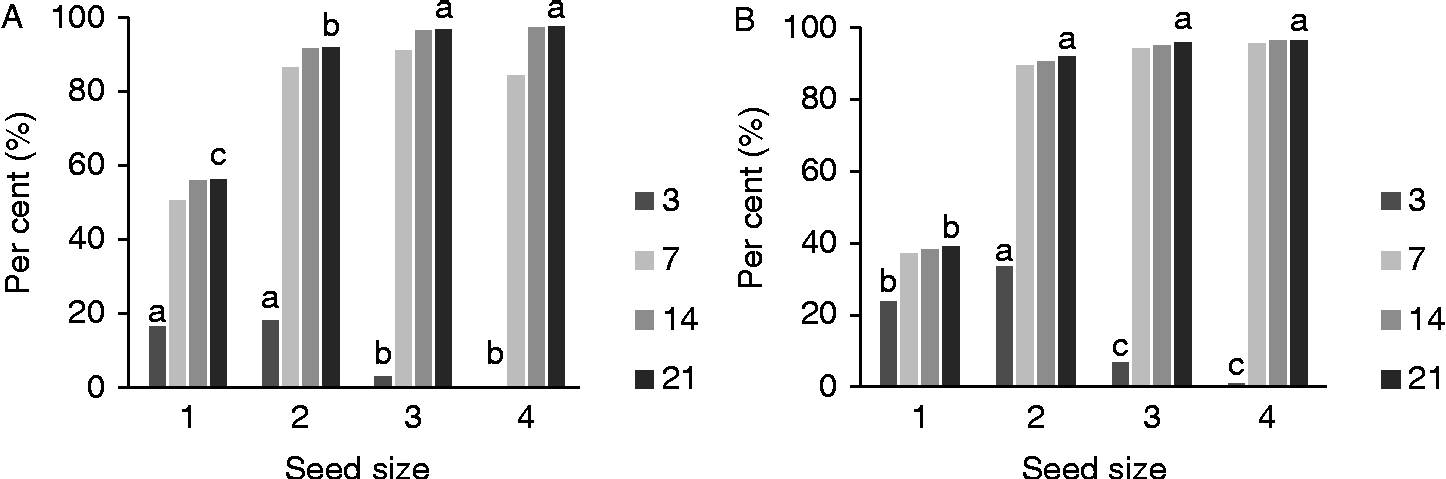
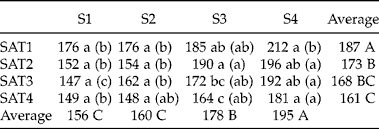
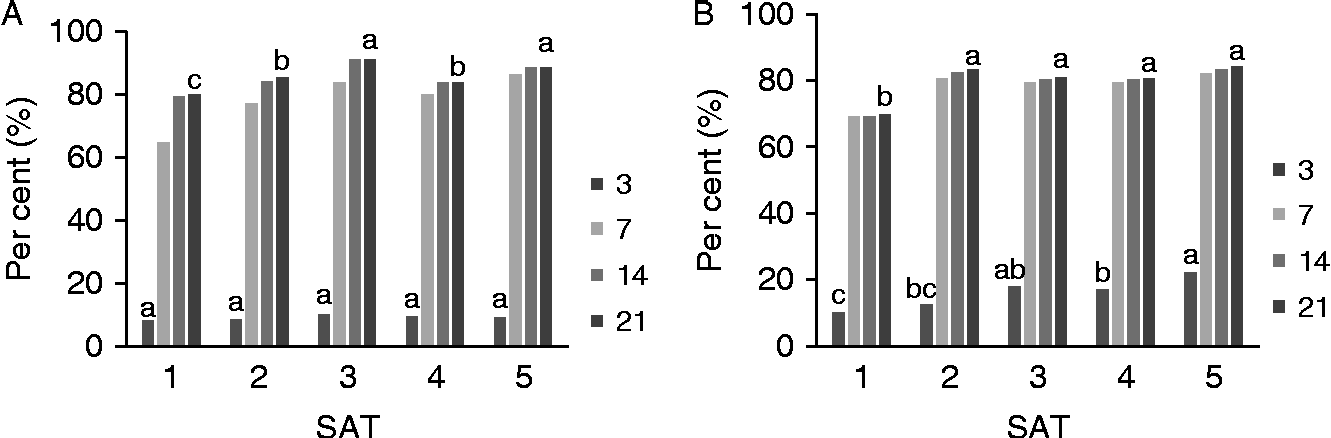
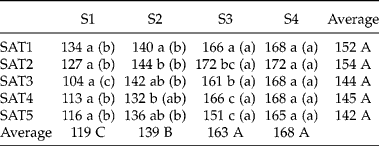
Germination data would suggest that seeds initiated germination at a slightly superior rate (MGT 147 h; Table 4) when harvested close to the ‘grower recommended’ optimum harvest date (H4, Fig. 3B), in comparison with seeds harvested early (H2, Fig. 3A; MGT 172 h; Table 5). However, the final germination score (at day 21) across both times had similar values (90–95% germination; Fig. 3A and B). The overall germination percentage, corrected for empty seeds, of the two lots were 87 and 81%, for H2 and H4, respectively. Interestingly, there was a greater germination rate and final germination score (57% at day 21) for smaller seeds in harvest time 2 (H2, seed size 1: < 2.5 mm; Fig. 3A), as compared to those of the same seed size in harvest time 4 (H4; final germination of 40% at day 21; Fig. 3B). At H4, seeds from the lowest CF level (SAT5) initiated germination faster than seeds with a higher CF level (SAT1 and SAT2). At H2 no difference among SAT fractions was observed (Fig. 4).
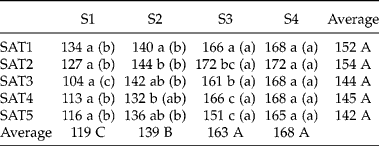
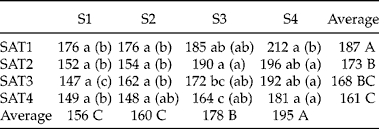
Mean germination time (MGT; h) for hybrid spinach seeds in different seed size fractions [S1, S2, S3 and S4; S5 (>4.25 mm) was excluded due to few seeds] and CF levels (SAT1, SAT2, SAT3, SAT4 and SAT5) from harvest time 4 (H4). Different letters indicate significant difference at the 5% level within a column and following letters in parentheses indicate significant differences at the 5% level within rows. Capital letters indicate significant difference of main effects
Influence of hybrid spinach seed size (1, 2, 3 and 4) on germination rate (3, 7, 14 and 21 d counts) for harvest times H2 (A) and H4 (B). Different letters within the same day count indicate significant differences at the 5% level. No letters, as for days 7 and 14, indicate no differences.
Mean germination time (MGT) in hours in seeds in different seed size fractions [S1, S2, S3 and S4; S5 (>4.25 mm) was excluded due to few seeds] and CF levels (SAT1, SAT2, SAT3 and SAT4; SAT5 was excluded due to few seeds) from harvest time 2 (H2). Different letters indicate significant difference at the 5% level within a column and following letters in parentheses indicate significant differences at the 5% level within rows. Capital letters indicate significant differences of main effects
Influence of hybrid spinach chlorophyll fluorescence levels (SAT) on germination rate (3, 7, 14 and 21 d counts) for harvest times H2 (A) and H4 (B). Different letters within the same graph indicate significant differences at the 5% level.
Mean germination time
All SAT fractions corresponding to S1 and S2 for harvest time 4 (H4) displayed a significantly lower MGT than S3 and S4 (average of 129 h compared to an average of 166 h, respectively; Table 4). Irrespective of SAT fractions, S1 (119 h) had a significantly lower MGT than S2, S3 and S4 (157 h average; Table 4). Similarly, significant differences were found between S2 (139 h) compared with both S3 and S4 (166 h average; Table 4) – there were no significant differences between S3 and S4 (Table 4). On average of seed sizes, no differences were observed among SAT fractions. If seeds were harvested at an earlier stage (H2), the mean germination time was significantly longer than at H4 (Table 5). The overall mean germination time of the two lots equalled 172 and 147 h for H2 and H4, respectively. In H2 there were not enough seeds in SAT5 in all seed sizes and the data were therefore not considered in the statistical analysis.
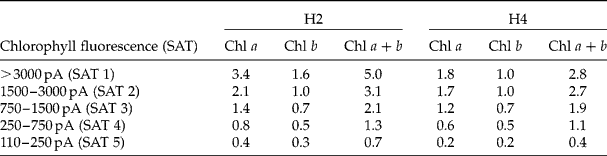
Chemical analysis of total chlorophyll levels showed some interesting trends. Seeds from SAT1 for H2, had an approximately twofold greater level of chlorophyll a+b (5.0) than did the respective seeds for H4 (2.8) (Table 6). A smaller variation was found in all other SAT levels. For example, within SAT5, the chlorophyll level ranged from 0.4 to 0.7 for H4 and H2, respectively (Table 6).
Average chemical analysis of chlorophyll a and b (for two replicates) and their sum (Chl a+b) of H2 and H4 hybrid spinach seed harvest
Discussion and conclusion
Once spinach seeds are harvested and processed based on size and density, small differences in maturity level will still remain. One potential option for removing these immature seeds is by employing fluorescence-based detection methods, as shown in the present study. Typically, the smallest seed fraction is discarded during (or shortly after) seed processing, lowering saleable seed yields and income for the seed producer. When spinach seeds are harvested close to the optimal harvest date (deemed here to be H4), they initiate germination faster than those harvested early. Although the rate of germination was faster, the final germination percentages were similar, regardless of harvest time, suggesting that vigour differences can be noted.
For spinach seed quality, Nonogaki (Reference Nonogaki2006) has demonstrated that seed size may affect germination rate and Jalink et al. (Reference Jalink, Frandas, Van der Schoor and Bino1998) have shown that CF levels may influence germination rate in B. oleracea. Here we show that mean germination time (MGT) was related to seed size. The smallest seed sizes (S1 and S2) displayed a lower MGT than seeds of larger size (S3 and S4) (Tables 4 and 5). Additionally, it was found that seeds with the highest CF level (SAT1) display a higher MGT and germinate to a lower percentage than seeds with a lower CF level (SAT2–SAT5). The CF level also presented some differences among harvest times in all SAT levels. This was particularly clear for SAT1, where values of 5.0 and 2.8 were obtained in H2 and H4, respectively. However, as the scale is not linear, and the SAT1 fraction is the largest, this explains the variance. During maturation, chlorophyll levels of spinach seeds decline. As noted in Table 6, chlorophyll levels were reduced more from harvest time 2, than those from harvest time 4. In general, we did not observe great variance in CF levels in the spinach seeds. Our seed lot was not selected based on variance in CF levels whereas the seeds in the study by Jalink et al. (Reference Jalink, Frandas, Van der Schoor and Bino1998) were constructed to display greater variance in CF level.
Earlier studies in spinach seed production have shown great variation from year to year with respect to seed weight/seed size distribution (Lomholt, Reference Lomholt2000; Deleuran et al., Reference Deleuran, Gislum and Boelt2005). A general consensus within the production community is that if it is a dry year during the vegetative phase, branch number tends to be lower, as compared to those in a wet year. With reference to subsequent seed production, plants with fewer branches are able to allocate more resources to the individual seeds; therefore seeds tend to have a larger size and seed weight. Danish growers and seed consultants have reported that in some mainly wet years more than 20% of a harvested seed lot might be discarded due to small seed size ( < 2.25–2.5 mm). Depending on the individual year, it could therefore be speculated that the cost of a CF sorting could be economically feasible for sorting the smallest seed fractions. Besides the variation between years, there may be an interesting perspective for the smallest seed fractions in terms of use in baby leaf vegetable production. Thus, with simple modifications, e.g. including a proportion of the 2.25–2.5 mm seeds, in standard seed cleaning procedures plus CF sorting, saleable seed yields may increase.
In this study, the chemical analyses were performed on whole spinach seeds, including the pericarp. Indeed, it is expected that the CF signals change due to the chlorophyll level on the outside of the seed, in our study the pericarp. Therefore, in future studies it will be of interest to address how the chlorophyll levels of the seeds, with and without pericarp, differ during maturation.
Our results demonstrate that chlorophyll sorting could be useful in seed lots harvested at an early stage or in a typically wet season, when many seeds are likely to be found in the fractions of smallest seed sizes. The potential use of CF sorting would be to identify small, immature seeds with low seed quality, versus small seeds with high quality. One limitation in this CF sorting technology is the speed of sorting and, from a practical point of view, the CF grading should be seen as a final grading after cleaning, density and seed size sorting.
In conclusion, the CF sorting approach would be applicable in selected seed lots (or more specifically, fractions of seed lots) where quality problems are observed due to either a particular season where many small seeds are generated or where poor seed quality can be associated with immature seeds.
Acknowledgements
The authors wish to thank Simon Abel for critical reading of the manuscript and the technical team at AU, Seed Science and Technology for their assistance. We especially thank Ida Ludvigsen at Maribo Seed for CF sorting of the seeds. This work was performed with financial support from The Danish Seed Council, Aarhus University and The Danish Fish Agency.