INTRODUCTION
In Tunisia, several benthic community studies have been undertaken to examine the spatio-temporal development of marine ecosystems as well as the distribution of communities such as: Azzouz, Reference Azzouz1971; Ben Alaya, Reference Ben Alaya1972; Zaouali & Baeten, Reference Zaouali and Baeten1985; Boudouresque, Reference Boudouresque1997; Ben Souissi, Reference Ben Souissi2002; Ayari & Afli, Reference Ayari and Afli2003; Ben Mustapha et al., Reference Ben Mustapha, Boury-Esnault, El Abed, Zarrouk and Souissi2003; Zaâbi & Afli, Reference Zaâbi and Afli2005, Reference Zaâbi and Afli2006; Afli et al., Reference Afli, Ayari and Zaabi2008 and Zaâbi et al., Reference Zaâbi, Gillet, Afli and Boumaiza2009. Other studies of benthic species in the three Tunisian gulfs (Tunis Gulf, Hammamet Gulf and Gabès Gulf) were last undertaken during the years 2001–2002 in the context of the national research studies. These studies were concerned with several marine benthic groups but not specifically polycheatous annelids. As the last polychaete inventory was over 20 years ago (Ben Amor, Reference Ben Amor1984), there is an obvious lack of ecological polychaete data.
The main objective of this paper was to actualize the Tunisian polychaete fauna checklist and provide the polychaete distribution along the eastern coast of the Cap Bon Peninsula (north-east coast of Tunisia).
MATERIALS AND METHODS
Study area
The study area is situated on the north-east coast of Tunisia and on the eastern coast of the Cap Bon Peninsula. It extends over approximately 50 km of coastline, from Kerkouane to Menzel Horr. The coast between Kerkouane and Kélibia is rocky and from Kélibia to Cap Kapudia (Hammamet Gulf) there is a wide sandy offshore bar of 40 m. This area has a Mediterranean climate characterized by prolonged periods of sunny weather; a hot summer followed by fog and then during the winter sporadic rain as well as short heavy showers (Gaamour, Reference Gaamour1999).
Sampling and laboratory procedures
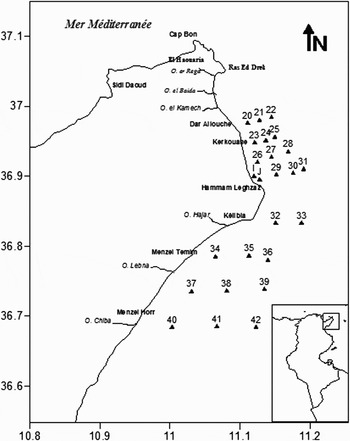
The polychaete fauna were sampled at 25 sites (Figure 1) during May and August 2006. The depths of stations investigated varied between 8.3 m and 74.4 m. Aboard the RV ‘Hannibal’, a Charcot dredge was deployed and samples were washed through a 1-mm mesh sieve (Grall & Glémarec, Reference Grall, Glémarec and Alzieu2003; Borja et al., Reference Borja, Franco and Pérez2000; Dauvin et al., Reference Dauvin, Ruellet, Desroy and Janson2007) and fixed in 7% seawater formaldehyde for identification. In the laboratory, samples were rinsed in fresh water and preserved in 70% ethanol and then the polychaetes were identified at species level and counted. Samples for faunal study were also sorted in fresh water, on a square mesh of 1-mm (Hily, Reference Hily1984; Grall & Glémarec, Reference Grall, Glémarec and Alzieu2003; Borja et al., Reference Borja, Franco and Pérez2000).
Map with location of the 25 sampling sites from the eastern coast of the Cap Bon Peninsula, Tunisia.

At each site, a sediment sample was taken to determine the grain size. The sediment sample was dried for 48 hours at 60°C, then washed through a 63-μm sieve in order to eliminate the fine fraction (silt and clay) (Afli & Chenier, Reference Afli and Chenier2002; Zaâbi & Afli, 2005). The residual was dried again at 60°C, after which all the samples were sieved on AFNOR succession meshes. Taking into account three fractions (fine particle or silt (Ø < 63 µm), fine sand (63 µm < Ø < 500 µm) and combined coarse sand–gravels (Ø > 500 µm)), different groups of stations were classified according to the biosedimentary classification of Chassé & Glémarec (Reference Chassé and Glémarec1976).
Data analyses
An index was worked out for each sample according to the abundance of polychaetes (N), species richness (S), the Shannon–Weaver diversity index H′ (log2 basis) (Shannon & Weaver, Reference Shannon and Weaver1963) and Pielou's evenness J′ (Pielou, Reference Pielou1966). The DIMO, Diversity Model proposed by Quinghong (Reference Quinghong1995) was used in order to represent specific richness (Log2 S), Pielou's evenness (angle α) and the Shannon–Weaver diversity index (H′) in a two-dimensional space.
The polychaete community structure at the sites was examined by cluster analysis, using PRIMER v.6 software (Clarke & Gorley, Reference Clarke and Gorley2005). A dendrogram was produced using the group average linkage method based on the Bray–Curtis similarity (Bray & Curtis, Reference Bray and Curtis1957) calculated from the polychaete abundance that was found on all sites.
RESULTS
Sediment
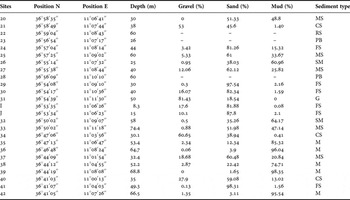
The study of particle size composition shows that the sediment ranged from mud to coarse sand (Table 1). It is constituted principally of mud, sand, and at other sites Posidonia beds were present. According to the Chassé–Glémarec classification (Chassé & Glémarec, Reference Chassé and Glémarec1976), there are five types (coarse sand, fine sand, muddy-sand, sandy-mud and mud).
Location and sediment type of 25 sampling sites from the eastern coast of the Cap Bon Peninsula, Tunisia.

FS, fine sand; CS, coarse sand; MS, muddy-sand; SM, sandy-mud; M, mud; RS, rocky sediment; PB, Posidonia bed; G, gravel.
Fauna
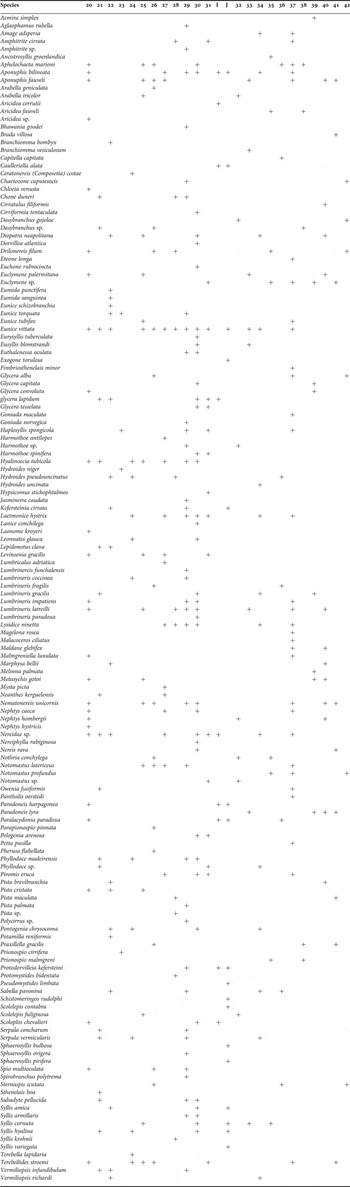
The faunal analyses of samples taken from the eastern coast of Cap Bon Peninsula (north-east of Tunisia) yielded a total of 150 polychaete species belonging to 22 families (Appendix). Of these, 47 species (24% of the total number of species) and six families are new records for the Tunisian polychaete fauna.
New additions to the Tunisian polychaete fauna
Among 150 polychaete species, 47 species and six families, Acoetidae, Amphinomidae, Chrysopetalidae, Paraonidae, Paralacydoniidae and Pilargidae, are new additions to the polychaete fauna of Tunisia. The nomenclature used for species identification is primarily based on Fauvel (Reference Fauvel1923, Reference Fauvel1927), Fauchald (Reference Fauchald1977, Reference Fauchald1992), Pettibone (Reference Pettibone1966), Zibrowius (Reference Zibrowius1968, Reference Zibrowius1970–1971) and Paxton (Reference Paxton1986). The list of new polychaete species for the Tunisian coasts is cited according to the new classification proposed by Fauchald & Rouse (Reference Fauchald and Rouse1997), Rouse & Fauchald (Reference Rouse and Fauchald1997) and Wilson et al. (Reference Wilson, Hutchings and Glasby2003):

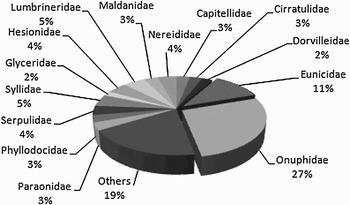
Onuphidae, followed next by Eunicidae, ranked highest for number of individuals which accounted for 27% and 11% of the total number of specimens, respectively (Figure 2), and Syllidae in terms of number of species (14 species). The families represented by only one species in the area are Oweniidae (Owenia fusiformis Delle Chiaje, 1841), Chrysopetalidae (Bhawania goodei Webster, 1884), Amphinomidae (Chloeia venusta Quatrefages, 1865), Acoetidae (Panthalis oerstedi Kinberg, 1855), Pectinariidae (Petta pusilla Malmgren, 1866) Pilargidae (Ancistrosyllis groenlandica McIntosh, 1879), Paralacydonidae (Paralacydonia paradoxa Fauvel, 1913), Trichbranchiidae (Terebellides stroemi Sars, 1835). The most widespread species, Aponuphis bilineata, was present at six sites in the area and with high abundance at coastal Site 1 (70.64%). Aponuphis fauveli, Hyalinoecia tubicola, Eunice vittata, Kefersteinia cirrata and Lumbrineris latreilli were also commonly found in the area with greater abundance. The largest number of species were found at Site 30 (37 species) and Site 29 (36 species) (Figure 3) and the most populated sites in terms of individuals were 1 and 30.
Relative dominance of the polychaete families by number of individuals.

Fluctuation of mean number of species (S) and individuals (A) at each sampling site from the eastern coast of the Cap Bon Peninsula, Tunisia.

The results of the cluster analysis based on the abundance data of the species collected are illustrated in Figure 4. According to these analyses, there are five distinct species associations (A–E) in the area and their leading species were identified using the abundance data of the principal species.
The cluster analysis of 149 polychaete species collected from the eastern coast of the Cap Bon Peninsula.

Group A were located near the region of Kélibia and consisted of five muddy sites (32, 35, 36, 38 and 42). This group had an abundant set of species but was not as numerically important as some species, e.g. Dasybranchus gajolae, Onuphis conchylega, Aphelochaeta marioni, Aricidea assimilis and Sternaspis scutata. This group has less relative abundance and a moderately high diversity against other groups (D and E) (4.481 bits/ind) (Table 2).
Faunal assemblage characteristics on the eastern coast of the Cap Bon Peninsula.

Group B located in the area between Menzel Temim and Mezel Horr, included mud (Site 39) and coarse sand (Site 40), with the lowest number of species (17) and the lowest relative abundance (Table 2). Sites 39 and 40 formed this heterogeneous sediment group, with a high similarity level of 50%, and were dominated in terms of abundance by the carnivorous species Aponuphis fauveli (19.4%) and the surface deposit-feeder Metasychis gotoi (16.13%).
Group C were located at Hammem El Ghezaz and consisted of two fine sediment sites (I and J) both at a 25% similarity level. This assemblage was characterized by the lowest diversity (2.957 bits/ind) and low species richness (21 species). Carnivorous species such as Aponuphis bilineata dominated at Site 1 with 70.27% of the total abundance which was the most populated site; Kefersteinia cirrata and Protodorvillea kefersteini are also dominant in this fine sediment group.
Group D, which stretch from Dar Allouche to Menzel Temim, included eight sites (21, 22, 24, 27, 29, 30, 31 and 34), with an average similarity value of 20%. This assemblage included sites with a fine sand bottom (24, 29 and 30), muddy-sand (27), coarse sand (34 and 21), gravel (31) and rocky substratum (22). This is the sandiest group and gives it the highest values of species richness (93 species) and diversity (5.607 bits/ind).
Group E, which stretch from Dar Allouche to Menzel Horr, included four muddy-sand sites (20, 25, 33 and 37), one sandy-mud (26), one fine sand (41) and a Posidonia bed (28). The most abundant species in this group and in all other groups is the Onuphidae Aponuphis fauveli followed by Aponuphis bilineata, Eunice vittata, Lumbrineris latreilli, Nematonereis unicornis, Notomastus profundus, Notomastus latericeus, Levensenia gracilis and Terebellides stroemi. This group gives a relatively high species diversity (4.983 bits/ind) and species richness (71).
Among families, Onuphidae ranked highest in terms of numbers of individuals in Groups A and D, accounting for 11% of the total number of individuals in each group, respectively (Figure 5). Next, Eunicidae and Dorvilleidae families had the highest number of individuals in Groups B and C (20% and 13% of the total number of individuals in each group, respectively).
Polychaete family distribution from the eastern coast of the Cap Bon Peninsula, Tunisia.

The families represented by only one species in the area were Acoetidae (Panthalis oerstedi Kinberg, 1855), Paralacydonidae (Paralacydoni paradoxa Fauvel, 1913), Amphinomidae (Chloeia venusta Quatrefages, 1865), Chrysopetalidae (Bhawania goodei Webster, 1884), Pilargidae (Ancystrosyllis groenlandica McIntosh, 1879), Hesionidae (Kefersteinia cirrata (Keferstein, 1862)), Magelonidae (Magelona rosea Moore, 1907), Pectinariidae (Petta pusilla Malmgren, 1866), Oweniidae (Owenia fusiformis Delle Chiaje, 1841) and Sternaspidae (Sternaspis scutata (Ranzani, 1814)).
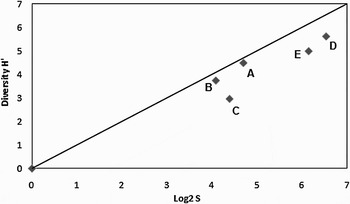
The DIMO Model (Quinghong, Reference Quinghong1995) representing the three indices S, H′ and J′ (Figure 6) confirms the results found by cluster analysis and defines five groups (A, B, C, D and E). This model illustrates the transition from Group C to Group D which is accompanied by an increase in the diversity index and Pielou's evenness.
Position of different site groups according to the specific richness and the diversity index H′; the diagonal line represents the maximum Pielou's evenness (J′ = 1) for the polychaetes from the eastern coast of the Cap Bon Peninsula, Tunisia.

DISCUSSION
Taxonomic richness of polychaete
The last polychaete checklist was produced in 1984 (Ben Amor, Reference Ben Amor1984). Since then several ecological works have been undertaken on Tunisian macrobenthic fauna groups but without adding to the species inventory. This included Zaâbi & Afli (Reference Zaâbi and Afli2005, Reference Zaâbi and Afli2006) who studied the general polychaete structure in the Tunisian Gulf and its ecological significance; Ben Mustapha et al. (Reference Ben Mustapha, Riveill and El Abed2002) on the Posidonia bed, coraligenenous substratum biodiversity and demospongiae in the Tunisian Gulf; Gharbi & Zarrad (Reference Gharbi and Zarrad2002) on the halieutic resources on the eastern coast of Tunisia; Afli (Reference Afli2001) on the benthic community in the Hammamet Gulf.
The faunal analyses show that the area is diverse and shelters many new species. The polychaetes species composition encountered is similar to those previously reported from other Mediterranean Sea soft-bottom communities (Simboura & Nicolaidou, Reference Simboura, Nicolaidou, Dauvin, Laubier and Reish1994; Arvanitidis, Reference Arvanitidis2000; Ergen et al., Reference Ergen, Dora and Çinar2002a, Reference Ergen, Çinar, Dagli and Kurt2006).
The present study reports the settlement of non-indigenous species such as Metasychis gotoi, Eunice tubifex, Bhawania goodei and Scoloplos (Leodamas) chevalieri. These species are considered as lessepsian migrants introduced from the Red Sea to the Mediterranean Sea through the Suez Canal (Çinar, Reference Çinar2007). The absence of this species among the extensive material previously collected from the Tunisian coasts supports this hypothesis. The status of the lessepsian migrant species established in the Mediterranean Sea was previously analysed by many authors such as Zibrowius & Bitar (Reference Zibrowius and Bitar1981), Ergen et al. (Reference Ergen, Çinar, Dagli, Kurt, Ozturk and Basusta2002b), Arvanitidis et al. (Reference Arvanitidis, Bellan, Drakopoulos, Valavanis, Douanas, Koukouras and Eleftheriou2002), Simboura & Zenetos (Reference Simboura and Zenetos2005) and Zenetos et al. (Reference Zenetos, Çinar, Pancucci-Papadopoulou, Harmelin, Furnari, Andaloro, Belou, Streftaris and Zibrowius2005).
Carnivorous polychaete species belonging to the Onuphidae, Eunicidae and Dorvilleidae families were well represented in terms of abundance, such as Aponuphis bilineata (1090 individuals), Aponuphis fauveli (910 individuals), Eunice vittata (750 individuals) and Protodorvillea kefersteini (210 individuals) and inhabited sandy bottoms (fine sand to muddy-sand). Their abundance is suggestive of a well-established community with an evolved food chain and reflecting a relatively stable environment (Barrio Froján et al., Reference Barrio Froján, Kendall, Paterson, Hawkins, Nimsantijaroen and Aryuthaka2006).
The fine substrate is favourable for the settlement of tubiculous polychaetes as the main constituent for tube building in agglomerated sand. This is the case for carnivorous species that are protected from predators in tubes such as the onuphid A. fauveli. Their abundance can also be related to sediment characteristics, including their texture and organic matter content (Pérès, Reference Pérès1961). Simboura et al. (Reference Simboura, Nicolaidou and Thessalou-Legaki2000) also considered the type of substrate and the hydrodynamics as major factors controlling polychaete distribution.
Faunal assemblages
The use of multivariate analysis offers a more precise way of detecting changes in benthic assemblages in space and time rather than the use of diversity indices (Gray et al., Reference Gray, Clarke, Warwick and Hobbs1990). The result of the cluster analyses derived from the Bray–Curtis similarity showed that five groups (A to E) were present on the eastern coast of Cap Bon. The greatest number of species and diversity were recorded in Group D (93 species and 5.607 bits/ind) and the carnivorous Eunice vittata was the most abundant species. These sites showed a greater sedimentary structural complexity due to a mixing of the fine, muddy and coarse sand with the presence of gravel (Site 31 mostly broken shells) and rocky substratum (Site 22). Simboura et al. (Reference Simboura, Nicolaidou and Thessalou-Legaki2000) and Moreira et al. (Reference Moreira, Quintas and Troncoso2006) also found high polychaete diversity values and maximum number of species in mixed sandy bottoms with biogenic fragments. According to Gray (Reference Gray1974), greater faunal diversity is mostly associated with greater grain size heterogeneity, in contrast to more homogeneous, coarse or fine sediment. Two of the polychaete communities were affected by organic enrichment from the Hadjar and Lebna rivers.
On the other hand, Group C had the lowest number of species with diversity evenness. The lowest value of diversity noted in this group shows a dominance of the limited number of species of high abundance. In fact, more than 78% of the total abundance was due to four abundant species: Aponuphis bilineata, Kefersteinia cirrata, Protodorvillea kefersteini and Caulleriella alata. The weak values of evenness (0.67) in Group C show that the community was in a moderate disturbed state according to the Pielou's evenness threshold (0.80 ≥ J > 0.65) for macrobenthic communities (Daget, Reference Daget1979; Glémarec & Hily, Reference Glémarec and Hilly1981) and testify the dominance of a limited group of polychaete species with high abundance (Rebzani-Zahaf, Reference Rebzani-Zahaf1992).
According to Gray (Reference Gray1974) and Hutchings (Reference Hutchings1998), distribution of soft-bottom polychaetes in general has been related to the particle size of sediment, water depth, temperature and salinity. Our results suggest that sedimentary composition plays a major role in determining polychaete distribution on the eastern coast of Cap Bon. The most diverse groups (A, D and E) consist of sites with finer sediments (fine sand, muddy-sand and mud). Consequently, fine sedimentary textures promote tubicolous worm proliferation such as Aponuphis bilineata, Aponuphs fauveli and Eunice vittata. This result endorses the work of others in Izmir Bay, eastern Mediterranean (Ergen et al., Reference Ergen, Çinar, Dagli and Kurt2006) who found that sediment structures and water depth seem to be the main factors governing the distribution of polychaetes. Numerous other authors have also emphasized the importance of these factors (Mackie et al., Reference Mackie, Parmiter and Tong1997).
Sampling depth can also be an important factor in distribution. The highest number of species richness and abundance (e.g. 36 species; 750 individuals at Site 29) occurred at the depth of 30–40 m. Whereas at 75 m (Site 33) we noted a decrease in both parameters S and A (7 species, 100 individuals). These results can be explained by the fact that the shallow bottom sites are richer in organic matter and pelagic organisms are more diverse (Pérès, Reference Pérès1961). It has been observed that some polychaete species are only present at shallow depths (8–35 m) such as Acmira cerutii and Caulleriella alata. In the present study, we have counted 17 species including Paradoneis harpagoneus, Harmothoe lunulata, Jasmineira caudata, Magelona rosea, Maldane glebifex, Caulleriella alata and Paradoneis lyra from shallow waters. On the other hand, some other species seem to be present at all depths such as Aponuphis fauveli, Aponuphis bilineata and Eunice vittata. Hydrodynamic factors can also play a role in polychaete distribution in the eastern part of the Cap Bon due to complex current flows from the eastern and western Mediterranean at the same time. This enhances the turbidity and consequently secondary factors such as the water's clarity and the suspended sediment which has the most influence on polychaete distribution (Bellan, Reference Bellan1964).
Although these results reflect the lack of Polychaete studies in Tunisia there are still clear conclusions. Polychaete species distribution on the eastern coast of Cap Bon seems to be controlled mainly by particle size sediment, hydrodynamism and water depth.
ACKNOWLEDGMENTS
This paper forms part of the EBHAR research project (Etat du Benthos et des Habitats Remarquables) undertaken under the auspices of the research activities of the laboratory of ‘Biodiversité et Biotechnologies Marines’ financed by the Tunisian Ministry of Higher Education, Scientific Research and Technology. We would like to thank S. Chambers for her review and improvements to the manuscript.
List of polychaete species found on the east coast of the Cap Bon Peninsula (central Mediterranean).