Drylands, which typically include hyperarid, arid, semiarid, and dry subhumid habitats, are vast regions of the world, covering more than 40% of the land and hosting more than a third of the world’s population (Feng and Fu, Reference Feng and Fu2013; Fitzsimmons, Reference Fitzsimmons2017). These areas are highly vulnerable to climate change and human activities, especially when considering the scarcity and variability in precipitation and accelerated soil degradation that characterized these settings (Huang et al. Reference Huang, Yu, Guan, Wang and Guo2016; Fitzsimmons, Reference Fitzsimmons2017). Further complications arise when contemplating the role of biodiversity loss and variations in plant composition and structure on desertification (Hughes and Diaz, Reference Hughes and Diaz2008; Ravi et al., Reference Ravi, Breshears, Huxman and D’Odorico2010). From instrument-based climate observations and model simulations, Feng and Fu (Reference Feng and Fu2013) concluded that dryland regions have increased in area since the 1950s and are expected to further increase in dryness and area in the coming decades under current climate scenarios. Monitoring dryland territories around the world is therefore pertinent to present and future human societies (Sivakumar, Reference Sivakumar2007). Observations from instrumental climate records alone, however, do not offer sufficient temporal context to understand the total range of natural climate variability and landscape evolution (Hughes and Diaz, Reference Hughes and Diaz2008). To adequately assess the effects of climate change and surficial processes on drylands in space and time, there is a need to develop and apply paleoenvironmental proxies from sedimentary records that offer a longer-temporal perspective and broader spatial coverage (Fitzsimmons, Reference Fitzsimmons2017). Case studies allow for detailed site investigation to adequately assess environmental changes through time. Regional and supraregional studies offer the opportunity to assess environmental shifts in space. An interesting aspect still minimally investigated is the transition of a system or landscape (region) from one state into the next by adapting, collapsing, suffering, and changing through space and time. This transition concept emerged through scientific discussion at the international symposium “Eolian Dynamics, Paleosols and Environmental Changes in Drylands” that was held in March 13–16, 2017, on the semiarid island of Fuerteventura from the Canary Archipelago, Spain.
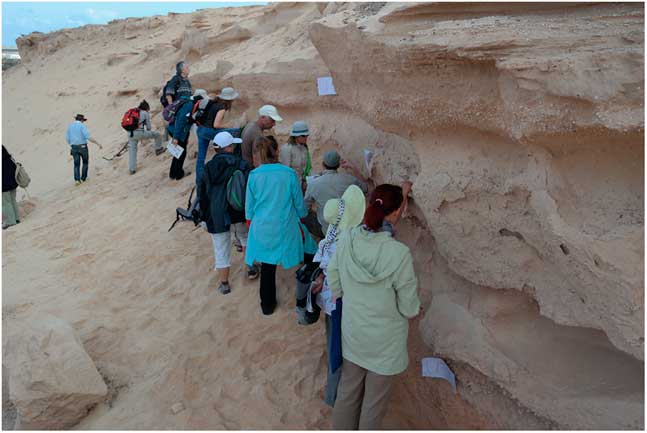
Participants of the international symposium on “Eolian Dynamics, Paleosols and environmental Changes in Drylands” at one of the field trip stops in Cantera de Melián eolian section collecting samples (photograph courtesy of Amelie Demmer).

Drylands and particularly desert margins can be regarded as transitional areas that are very sensitive to environmental change (Fitzsimmons, Reference Fitzsimmons2017). Their sedimentary records, therefore, inform us about the rate and mode of response to climate shifts (i.e., fast or slow, abrupt or gradual). Moreover, drylands are among the most sensitive areas in the world increasing dramatically in space (Feng and Fu, Reference Feng and Fu2013). In combination with different transition scenarios, these areas probably will become the most fragile landscapes on our planet (Fletcher et al., Reference Fletcher, Faust and Zielhofer2013). To remedy this situation, much research is still needed to investigate the linkages between environmental shifts and consequent dryland system responses both in space and time. One complexity to consider is that different dryland geocomponents (e.g., eolian, loess, fluvial, alluvial, colluvial, cave, vegetation, and faunal) may respond in a different tempo and fashion to environmental change. When humans are involved, predictions of system responses become even more complex. Increasing research on these environmentally sensitive areas utilizing different sedimentary records and paleoclimate proxies is therefore crucial to fully comprehend present and perhaps predict future scenarios of disparate geocomponents in dryland regions.
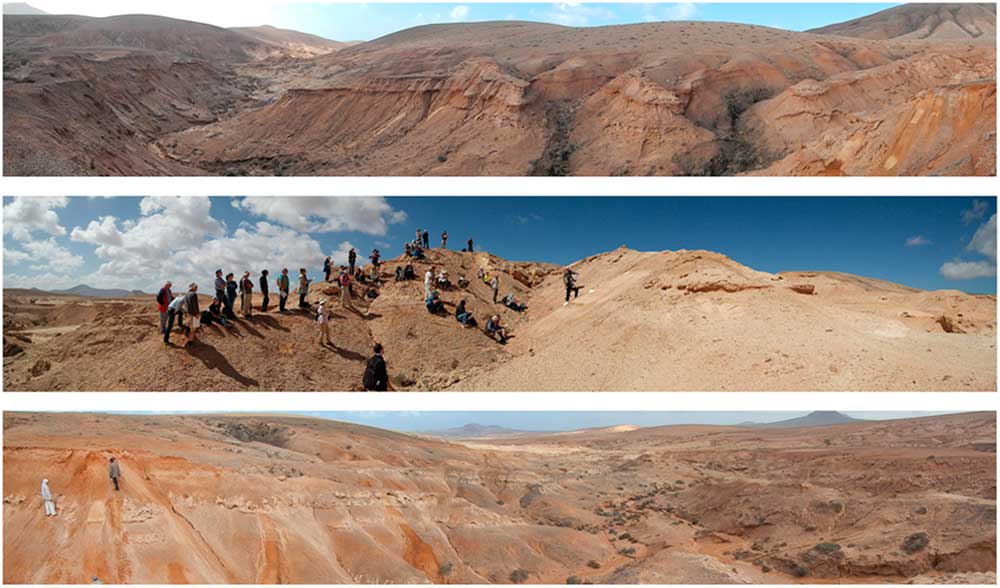
General view of Quaternary eolian sand dune deposits from Fuerteventura, Canary Islands, where the international symposium on “Eolian Dynamics, Paleosols and environmental Changes in Drylands” was held. Upper two photographs depict a general view of dunes from Barranco de los Encantados section. Lower photograph illustrates eolian sand deposits from Barranco del Jable (photographs courtesy of Philipp Baumgart and Amelie Demmer).

To tackle the complex nature of environmental change in drylands and specifically the transitional phenomena highlighted at the international symposium “Eolian Dynamics, Paleosols and Environmental Changes in Drylands,” researchers were invited to submit full-length manuscripts to this special issue of Quaternary Research. This thematic set of papers consists of seven articles total on sedimentary processes, paleoenvironmental reconstruction, and environmental impact on prehistoric human societies across relevant dryland regions around the world.
The first two articles of this thematic set (Roettig et al. and Stauch) discuss new approaches, data, and models to improve the study and interpretation of eolian dune sequences. Roettig et al. present a rigorous and intense field and laboratory analysis of several carbonate-rich Quaternary eolian sequences from northern Fuerteventura, Canary Islands, and discuss their formation process. The authors propose that alternations of eolian dunes and reddish dust episodes are primarily driven by differing sediment sources (i.e., sand from the shelf vs. Saharan dust) rather than glacial-interglacial climate cycles. This study suggests that the reddened layers traditionally interpreted as strong soil-formation processes seem unlikely, challenging previous interpretations of these records. Stauch points to difficulties in unraveling eolian archives by using a conceptual model from a semiarid high- mountain environment from Tibet. This study postulates that even though the highest eolian activity takes place during dry (glacial) cycles, the preservation of eolian sediments is minimal at those times. The proposed conceptual model provides an interesting approach that can be applied to mountain and desert margin areas that have limited sediment availability. These two case studies examine the system transition concept and explore the challenges when studying these records, which are not always properly preserved (Stauch) and can lead to misinterpretations in the field (Roettig et al.).
The degree of production, transport, and deposition of eolian dust has been correlated to changes in climate over multimillennial time scales. The study by Menéndez et al. tackles this thematic set of papers by analyzing Pleistocene paleosols from the island of Gran Canaria of the Canary Archipelago. The authors examine the relationship between Saharan dust input and climate change by studying quartz content preserved in paleosols. Their investigation suggests that Saharan dust input in the Canary Islands intensified during the late Pleistocene compared with the early Pleistocene but continued throughout the Quaternary regardless of glacial and interglacial climate fluctuations. These data challenge the traditional model that dryland landscape reactivation and expansion only occurred during glacial phases.
Desert wetland deposits are valuable archives informing about hydrologic shifts at high temporal resolutions. The two articles by Pigati et al. and Tully et al. in this thematic set of papers offer new geochronological and sedimentary data from desert wetland regions. The study by Pigati et al. investigates the response of desert wetland ecosystems to past abrupt climate changes in the Mojave Desert and southern Great Basin, North America. The authors illustrate that in areas where sedimentation rates are unusually high, wetland deposits track hydrologic shifts on centennial, and even decadal, time scales, pertinent to human civilization, a faster response to climate change never noticed before. Tully et al. studied desert wetland deposits as fluvial terraces that record past changes of the water table in the hyperarid Atacama Desert, Chile. The authors show that streams with in-stream wetlands appear to be useful proxies to document past megadroughts in arid and hyperarid regions, which, in turn, affect human sustainability. This study recorded several dry and wet cycles at the millennial time scale throughout the Holocene and discuss their impact on prehistoric societies.
Continental paleoclimate proxies that track the timing and magnitude of drought events are particularly important to understand gradual and abrupt transitions in the hydrologic balance affecting drylands. The last two articles of this thematic set present new paleoclimatic inferences derived from continental records from drylands. The article by Opała-Owczarek and Niedźwiedź presents original paleoclimate data inferred from tree-ring-width chronology to reconstruct drought events over the last millennia in the climate-sensitive area of the Pamir Mountains, central Asia. Paleoprecipitation estimates suggest that this semiarid area has experienced significant dry and wet shifts over the most recent millennia, including a wet Little Ice Age episode and a dry Medieval Climate Anomaly event. Khokhlova et al. (in this thematic set of papers) studied a multilayered geoarcheological record of the Turganik settlement in the Tok River valley, in the steppe area of the Cis-Urals, Orenburg, Russia. The authors use an integrated paleopedological and paleobotanical approach to reconstruct fluctuations in flooding and vegetation from the middle to late Holocene. Their findings suggest that humans occupied and abandoned the site during arid and flooding events, respectively, and illustrate a link between human occupation and climate change at millennial time scales.
All in all, sedimentary and paleoenvironmental archives from drylands are arguably one of the most limited and incomplete continental records, difficult to understand and with poor preservation potential. Yet, when accessible, these records offer important opportunities to investigate the linkages among landscape transitions, climate change, and human interference in these climate-sensitive regions that are heavily populated. This volume compiles a range of articles from disparate geographic regions that illustrate the complexities and virtues of studying and interpreting dryland records. Many of the geographic regions in these studies have not been thoroughly investigated for this purpose before, and the articles incorporate vivid discussions and fresh perspectives on system transition processes and paleoenvironmental proxies and debate societal resilience in the context of increasing aridification.
ACKNOWLEDGMENTS
The German Research Foundation (DFG; FA239/18-1) financially supported D.F. and the international symposium “Eolian Dynamics, Paleosols and Environmental Changes in Drylands.”