It is widely accepted that childhood externalizing behavior problems, defined as aggressive, destructive, and oppositional behaviors, are associated with a host of difficulties in adolescence and adulthood (Broidy et al., Reference Broidy, Tremblay, Brame, Fergusson, Horwood, Laird and Vitaro2003; Campbell, Reference Campbell2002; Odgers et al., Reference Odgers, Moffitt, Broadbent, Dickson, Hancox, Harrington and Caspi2008). Although externalizing behaviors typically peak around age 2 and show a normative decline across early childhood (Hartup, Reference Hartup1974; Kopp, Reference Kopp1982), considerable evidence indicates that some children continue to show high levels of externalizing behaviors beyond childhood (e.g., Campbell, Spieker, Vandergrift, Belsky, & Burchinal, Reference Campbell, Spieker, Vandergrift, Belsky and Burchinal2010). These children who show continued high levels of externalizing behaviors are at the greatest risk for later indicators of maladjustment, such as social difficulties, school failure, and delinquent behavior (e.g., Fergusson, Lynskey, & Horwood, Reference Fergusson, Lynskey and Horwood1996; Loeber, Farrington, Stouthamer-Loeber, Moffitt, & Caspi, Reference Loeber, Farrington, Stouthamer-Loeber, Moffitt and Caspi1998). Thus, the identification of subgroups of children who consistently engage in higher levels of externalizing behaviors as compared to those engaging in more transient, age-related difficulties is key.
In addition to identifying children who engage in specific patterns of externalizing behaviors, it is vital to identify intraindividual correlates of these longitudinal patterns. The development of children's self-regulatory abilities, in particular, is likely associated with differences in developmental trajectories of externalizing behavior problems (Calkins & Perry, Reference Calkins, Perry and Cicchetti2016). This is expected because the development of the self-regulatory system is critical for the successful negotiation of childhood challenges and adaptive functioning across various environmental contexts that are characterized by increasingly complex social, emotional, and cognitive demands. Unfortunately, existing empirical work assessing children's self-regulatory skills and externalizing behaviors has largely focused on only one self-regulatory process at a given time; as such, this work is unable to address which specific self-regulatory abilities (i.e., physiological, attentional, emotional, and behavioral) are most strongly associated with varying patterns of children's externalizing behaviors.
The current study had two aims. The first aim was to add to the relatively small body of literature examining children's externalizing trajectories by confirming the existence of developmental patterns of externalizing behaviors across six time points from infancy into adolescence. Although prior work has examined developmental trajectories of externalizing symptoms such as physical aggression, few studies include a broad measure of externalizing behavior problems that include other symptoms such as delinquency and rule breaking. Moreover, very few studies follow children over several developmental periods. Thus, although the work on physical aggression has added to our current knowledge of externalizing trajectories, examining patterns of externalizing behaviors from age 2 to age 15 significantly contributes to the current body of literature. The second aim was to examine the influence of domain-specific self-regulatory skills simultaneously to identify which individual components of the self-regulatory system during early childhood are most salient in the prediction of externalizing trajectories.
Trajectories of Externalizing Behaviors Across Childhood and Adolescence
Moffitt (Reference Moffitt1993) addressed the etiology of externalizing behaviors and outlined two life-course patterns of antisocial behavior: one that originates in childhood and persists across time (life-course persistent), and another that begins in adolescence and ends by young adulthood (adolescence limited). According to Moffitt's theory, the life-course persistent group is small and may be rooted in intraindividual risks early in life (i.e., hyperactivity and subtle cognitive deficits). In contrast, externalizing behavior that emerges in late childhood and adolescence is believed to be characterized by developmentally normative, short-lived antisocial behavior that develops alongside puberty.
Recent longitudinal studies employing person-centered methodological approaches have supported Moffitt's original theory by empirically identifying groups of children who follow a life-course persistent and an adolescent-onset pattern of externalizing behaviors from childhood through adolescence. In addition, a “childhood limited” group of individuals who demonstrate high levels of externalizing behaviors in childhood but not in adolescence has been identified, as well as a group of individuals characterized by displaying low levels of externalizing behaviors across time (e.g., Broidy et al., Reference Broidy, Tremblay, Brame, Fergusson, Horwood, Laird and Vitaro2003). It is important to note that there is also a body of work that suggests more nuance to these patterns of externalizing behaviors, depending on the age of the sample, measure of externalizing behaviors/aggression, and methodology employed (i.e., Bongers, Koot, van der Ende, & Verhulst, Reference Bongers, Koot, van der Ende and Verhulst2004; Brame, Nagin, & Tremblay, Reference Brame, Nagin and Tremblay2001; Nagin & Tremblay, Reference Nagin and Tremblay2005).
In one study, Odgers et al. (Reference Odgers, Moffitt, Broadbent, Dickson, Hancox, Harrington and Caspi2008) identified four antisocial behavior trajectories from age 7 to age 26: life-course persistent, adolescent onset, childhood limited, and a low trajectory. When compared to the adolescent-onset group of individuals, children in the life-course persistent group were identified by social, familial, and neurodevelopmental risk factors in childhood. Individuals in the adolescent-onset group were also identified as having childhood risk factors, although to a lesser extent than the life-course persistent individuals. In another study, Roisman, Monahan, Campbell, Steinberg, and Cauffman (Reference Roisman, Monahan, Campbell, Steinberg and Cauffman2010) found five varying externalizing groups of individuals from kindergarten through age 15: low, moderate, childhood limited, adolescent onset, and early onset/persistent. Consistent with other research and Moffitt's (Reference Moffitt1993) theory, the early-onset/persistent group experienced greater contextual difficulties and higher intraindividual disadvantages during childhood than children in the other groups.
These studies demonstrated that all children who showed elevated externalizing behaviors had greater childhood intraindividual disadvantages relative to children with consistently low externalizing behaviors (Odgers et al., Reference Odgers, Moffitt, Broadbent, Dickson, Hancox, Harrington and Caspi2008; Roisman et al., Reference Roisman, Monahan, Campbell, Steinberg and Cauffman2010). Thus, it is crucial to identify early developmental antecedents that are associated with a greater likelihood of engaging in maladaptive behavioral patterns over time. Although the ability to self-regulate during early childhood is widely accepted to be influential for the development and display of externalizing behaviors, it is far less understood which specific self-regulatory skills are most strongly associated with distinct externalizing behavior patterns. Thus, the current study sought to replicate and extend prior work by substantiating the existence of externalizing trajectories from infancy through adolescence, while also identifying specific self-regulatory processes that may predict these trajectories.
Self-Regulation and Externalizing Behaviors
Self-regulation refers to the ability to modulate arousal and behavior in the context of environmental demands. Self-regulatory functioning has been conceptualized as a system in which adaptive self-control can be observed across physiological, attentional, emotional, behavioral, and cognitive domains. These individual self-regulatory processes continuously build upon one another such that earlier developing self-regulatory mechanisms are thought to provide the basis for more advanced self-regulatory processes that account for the more sophisticated behavior we observe as children mature (Calkins & Fox, Reference Calkins and Fox2002; Cicchetti & Rogosch, Reference Cicchetti and Rogosch1996). This viewpoint suggests that deficits in the early acquisition of self-regulatory skills may constrain later functioning in other domains, subsequently impacting children's displays of problem behaviors (Calkins & Fox, Reference Calkins and Fox2002). Previous work has theorized that the normative decline in externalizing behaviors from infancy through early childhood may be a function of these emerging self-regulatory abilities (e.g., Calkins & Dedmon, Reference Calkins and Dedmon2000; Cicchetti, Ganiban, & Barnett, Reference Cicchetti, Ganiban, Barnett, Garber, Dodge, Garber and Dodge1991).
Infants rely mostly on automatic physiological mechanisms to modulate arousal. During the preschool years, however, children become increasingly effortful in their use of regulatory strategies, gain greater control of their impulses, and become aware of factors that can influence their attention, arousal, and behavior such as motivation and distractions (Miller & Zalenski, Reference Miller and Zalenski1982). Thus, by the end of early childhood there has been rapid maturation of self-regulatory processes across domains that allow children to initiate and organize their behavior in an adaptive and flexible manner (Cicchetti, Ackerman, & Izard, Reference Cicchetti, Ackerman and Izard1995); these important developmental gains may allow children to transition to school with less frustration, learn more efficiently, and develop better interpersonal relationships with parents, teachers, and peers, thus decreasing the likelihood of displaying externalizing behaviors. In contrast, children who are aroused easily and do not develop the self-regulatory skills needed to modulate their emotions, redirect and focus their attention, and inhibit impulsive responses, will be less efficient in controlling their behavior, and may therefore be more likely to be defiant or act aggressively. Therefore, the extent to which children have acquired self-regulatory skills during the early childhood period may play a particularly important role in understanding adjustment and maladjustment across the school years.
Concurrent and longitudinal empirical work has supported this notion by linking physiological, attentional, emotional, and behavioral self-regulatory indicators with the display of externalizing behavior problems. When assessing children's physiological capabilities, a primary measure of interest has been baseline respiratory sinus arrhythmia (RSA), or the variability in heart rate that occurs at the frequency of breathing. Researchers have described RSA as an index of neural control of the heart that underlies regulatory abilities necessary for behavioral control (Doussard-Roosevelt, Porges, Scanlon, Alemi, & Scanlon, Reference Doussard-Roosevelt, Porges, Scanlon, Alemi and Scanlon1997). While some empirical work demonstrates no association between baseline RSA and children's behavior problems (e.g., Calkins, Graziano, & Keane, Reference Calkins, Graziano and Keane2007; Fortunato, Gatzke-Kopp, & Ram, Reference Fortunato, Gatzke-Kopp and Ram2013), the majority of empirical studies have linked lower levels of baseline RSA with increased externalizing behaviors, supporting its association with appropriate engagement with the environment and behavioral regulation (e.g., Beauchaine, Gatzke-Kopp, & Mead, Reference Beauchaine, Gatzke-Kopp and Mead2007; Crowell, Beauchaine, Gatzke-Kopp, Sylvers, & Mead, Reference Crowell, Beauchaine, Gatzke-Kopp, Sylvers and Mead2006).
Attention regulation refers to children's ability to allocate attention to different stimuli, focus attention when faced with distraction, and keep a task in memory (Posner & Rothbart, Reference Posner and Rothbart2000). Individual differences in these skills not only influence children's ability to regulate their behavioral responses across contexts but also contribute to the development of more sophisticated executive functions, and allow for the modulation of reactivity to environmental stimuli (Garon, Bryson, & Smith, Reference Garon, Bryson and Smith2008; Reck & Hund, Reference Reck and Hund2011). Thus, attentional regulation not only allows for greater behavioral control and subsequently fewer externalizing behaviors (e.g., Belsky, Pasco Fearon, & Bell, Reference Belsky, Pasco Fearon and Bell2007) but also serves as a fundamental building block for the development of emotional and more advanced cognitive self-regulation.
The inability to regulate emotion is considered a core symptom for children who display externalizing behavior problems (Gilliom & Shaw, Reference Gilliom and Shaw2004). The prevailing perspective on the relation between the two is that children who are quicker to experience intense anger without the ability to effectively reduce that arousal are more likely to engage in destructive behavior or act aggressively (Vitaro, Brendgen, & Tremblay, Reference Vitaro, Brendgen and Tremblay2002). Extensive work has indicated that children high in anger but lacking the ability to self-regulate are more likely to display peer conflict and behavioral maladjustment, including externalizing behaviors (Deater-Deckard et al., Reference Deater-Deckard, Beekman, Wang, Kim, Petrill, Thompson and DeThorne2010; Eisenberg et al., Reference Eisenberg, Cumberland, Spinrad, Fabes, Shepart, Reiser and Guthrie2001).
In addition, children's behavioral inhibitory control is thought to be a critical self-regulatory ability associated with behavior problems. Behavioral inhibitory control involves withholding responses that, although may be prompted, may not be appropriate for the current situation (Rueda, Posner, & Rothbart, Reference Rueda, Posner and Rothbart2005). Because successfully controlling behavior across contexts requires children to effectively inhibit inappropriate responses, it is not surprising that a number of studies have linked deficits in inhibitory control with the display of externalizing behaviors across childhood (e.g., Buss, Kiel, Morales, & Robinson, Reference Buss, Kiel, Morales and Robinson2014; Hardaway, Wilson, Shaw, & Dishion, Reference Hardaway, Wilson, Shaw and Dishion2012).
In addition to investigating the longitudinal associations between individual aspects of self-regulatory functioning and subsequent externalizing outcomes at a single time point, empirical studies using group-based trajectory modeling have also found associations between externalizing group membership and self-regulatory processes (e.g., Aguilar, Sroufe, Egeland, & Carlson, Reference Aguilar, Sroufe, Egeland and Carlson2000). Two studies using the same sample as the current study have assessed early self-regulatory predictors of children's externalizing trajectories from age 2 to age 5. In the first study, poor emotion regulation and inattention at age 2 predicted membership in the chronic-clinical profile for girls, whereas socioeconomic status and inattention at age 2 predicted membership in the chronic-clinical profile for boys (Hill, Degnan, Calkins, & Keane, Reference Hill, Degnan, Calkins and Keane2006). In the second study, a high disruptive behavior profile was associated with higher reactivity when combined with higher maternal control or when lower regulation was combined with lower maternal control (Degnan, Calkins, Keane, & Hill-Soderland, Reference Degnan, Calkins, Keane and Hill-Soderlund2008).
This brief review of the literature supports the notion that self-regulatory processes across multiple domains are associated not only with one another in complex ways but also with children's engagement in externalizing behaviors. Central to the aims of the current study, this work has largely focused on only one dimension of self-regulation at a time and has not considered the influence of multiple processes in the context of one another for developmental patterns of externalizing behaviors. As highlighted above, self-regulation has been conceptualized as a system because adaptive control across domains build upon one another and are greatly intertwined (Calkins & Fox, Reference Calkins and Fox2002); self-regulation in any given domain cannot be effective without bolstering from other self-regulatory processes within the self-regulatory system. For example, regulation of emotion requires the regulation of physiological systems, the focusing of attention, and the inhibition of behavior. Because individual self-regulatory processes do not function in isolation, their associations with the development of externalizing behaviors are not independent. Empirical work considering these interdependences may elucidate which specific self-regulatory processes are most strongly associated with various externalizing behavioral patterns across time and is therefore a critical next step in advancing our understanding of the development of behavioral maladjustment.
The Current Study
The first aim of the study, preliminary in nature, was to substantiate the existence of distinct trajectories of externalizing behaviors from age 2 to age 15. Consistent with prior work, we hypothesized that four distinct patterns would emerge: a group of children who continuously display low levels of externalizing behaviors (stable/low), a group of children who decrease in externalizing behaviors across early childhood and continue to show low levels in late childhood and adolescence (childhood decreasing), a group of children who show increases in externalizing behaviors at the onset of adolescence (adolescent onset), and a group of children who continuously display high externalizing behaviors (stable/high).
The second aim was to assess whether specific self-regulatory skills across domains at age 2 and age 5 were associated with membership in the externalizing group-based trajectories. We chose to assess self-regulatory functioning at both ages given the considerable maturation in self-regulatory skills that occurs from infancy to early childhood (Kopp, Reference Kopp1982). On average, externalizing behaviors are the highest for children at age 2, and thus assessing age 2 self-regulation may provide valuable insight regarding the way in which very early self-regulatory skills may be associated with developmental patterns of externalizing behaviors from toddlerhood into adolescence. However, self-regulatory skills are relatively rudimentary in infancy and toddlerhood, likely related to the greater incidence of externalizing symptoms at age 2, and there are rapid gains in self-regulatory functioning occurring across all levels of analysis across early childhood (e.g., Kochanska, Coy, & Murray, Reference Kochanska, Coy and Murray2001). Further, given that it is not until age 5 or 6 that children are capable of true self-regulation (e.g., Bronson, Reference Bronson2000), in our model we include indicators of self-regulation both before (age 2) and after this rapid period of self-regulatory growth (age 5).
We sought to extend previous empirical work by identifying which self-regulatory skills are most strongly associated with group membership of externalizing patterns, a goal that has significant implications for intervention efforts targeting children's behavior problems. We hypothesized that even after accounting for their associations with one another, physiological, attentional, emotional, and behavioral self-regulatory processes across ages would be associated with group membership, although the effect of each self-regulatory predictor would likely depend on the behavioral pattern being predicted.
Methods
Participants
This study utilized data from three cohorts of children who are part of an ongoing longitudinal study of social and emotional development. The goal for recruitment was to obtain a sample of children who were at risk for developing future externalizing behavior problems, and who were representative of the surrounding community in terms of race and socioeconomic status (SES). All cohorts were recruited through child day care centers, the County Health Department, and the local Women, Infants, and Children program. Potential participants for Cohorts 1 and 2 were recruited at 2 years of age (Cohort 1: 1994–1996 and Cohort 2: 2000–2001) and screened using the Child Behavior Checklist (CBCL; Achenbach, Reference Achenbach1992), completed by the mother, in order to oversample for externalizing behavior problems. Children were identified as being at risk for future externalizing behaviors if they received an externalizing T score of 60 or above. Efforts were made to obtain approximately equal numbers of boys and girls. This recruitment effort resulted in a total of 307 children. Cohort 3 was initially recruited when infants were 6 months of age (in 1998) for their level of frustration, based on laboratory observation and parent report, and were followed through the toddler period (see Calkins, Dedmon, Gill, Lomax, & Johnson, Reference Calkins, Dedmon, Gill, Lomax and Johnson2002, for more information). Children from Cohort 3 whose mothers completed the CBCL at 2 years of age (N = 140) were then included in the larger study. Of the entire sample (N = 447), 37% of children were identified as being at risk for future externalizing problems at age 2. There were no significant demographic differences between cohorts with regard to gender, race, or 2-year SES.
Of the 447 originally selected participants, 6 were dropped because they did not participate in any data collection at 2 years old. An additional 12 families participated at recruitment, did not participate at 2 year, but did participate at later years. At 4 years of age, 399 families participated. Families lost to attrition included those who could not be located, moved out of the area, declined participation, or did not respond to phone and letter requests to participate. There were no significant differences between families who did and did not participate at each age in terms of gender, race, 2-year SES, or 2-year externalizing T scores unless otherwise noted. At age 5, 365 families participated, including 4 that did not participate in the 4-year assessment. At 7 years of age, 350 families participated, including 19 that did not participate in the 5-year assessment. Families with lower 2-year SES, t (432) = –2.61, p < .01, were less likely to participate in the 7-year assessment. At age 10, 357 families participated, including 31 families that did not participate in the 7-year assessment. At age 15, 327 families participated, including 27 families that did not participate in the 10-year assessment. Boys were less likely to participate in the 15-year assessment, χ2 (1, N = 447) = 9.31, p = .002.
The sample for the current study included 443 children (52% girls, 48% boys) who had available externalizing behavior data for at least one time point (6% of children, N = 29, had data available at only one time point); 67% of the sample was European American, 27% African American, 4% biracial, and 2% identified as other. In addition, 4 participants were dropped from the current study due to developmental delays. Families were economically diverse based on Hollingshead (Reference Hollingshead1975) scores at the 2-year assessment, with a range from 14 to 66 (M = 39.57, SD = 10.92), thus representing families from each level of social strata typically captured by this scale. Hollingshead scores that range from 40 to 54 reflect minor professional and technical occupations considered to be representative of middle class.
Procedures
Children and their mothers participated in an ongoing longitudinal study beginning at age 2. The current analyses include data collected when children were 2, 4, 5, 7, 10, and 15 years of age. Measures of externalizing behaviors at each time point and measures of self-regulatory processes at ages 2 and 5 were utilized. At each laboratory visit, mothers completed questionnaires that included the CBCL (Achenbach & Edelbrock, Reference Achenbach and Edelbrock1983) and other developmentally appropriate questionnaires assessing children's social, emotional, and behavioral functioning. Children were videotaped participating in tasks designed to elicit emotional and behavioral responding (partially derived from the Laboratory Temperament Assessment Battery [Lab-TAB]; Goldsmith & Rothbart, Reference Goldsmith and Rothbart1993). Videotapes were used for behavioral coding. Only the measures relevant for the current study are reported here.
Measures
Indicators of externalizing trajectories
The CBCL (Achenbach & Edelbrock, Reference Achenbach and Edelbrock1983) externalizing subscale, which includes items measuring aggressive, destructive, and oppositional behaviors, was used as an index of parent report of externalizing behavior problems at each age. When the children were 2 years old, mothers completed the CBCL for 2- to 3-year-olds (Achenbach, Reference Achenbach1992). When the children were 4, 5, and 7 years of age, mothers completed the CBCL for 4- to 18-year-olds (Achenbach, Reference Achenbach1991). When children were 10 and 15 years of age, mothers completed the CBCL for 6- to 18-year-olds (Achenbach & Rescorla, Reference Achenbach and Rescorla2001). Achenbach and colleagues (e.g., Achenbach, Reference Achenbach1992; Achenbach, Edelbrock, & Howell, Reference Achenbach, Edelbrock and Howell1987) found these scales to be a reliable index of externalizing behavior problems across these developmental periods. The mother indicated how true the statement was of her child on a scale of 0 (not true) to 2 (often true) for each version. Mean scores of externalizing behaviors at each age were used in analyses.
Self-regulatory predictors of externalizing trajectories
2- and 5-year baseline RSA
Baseline/resting RSA was obtained at age 2 and age 5 while children watched a 5-min segment of a neutral “Spot” video about a puppy that explores its neighborhood. Although this task was not a true baseline, as children's attention was engaged, it has been used in multiple studies (e.g., Hastings & De, Reference Hastings and De2008), and was sufficient to gain a measure of RSA while children were sitting quietly and showing neutral affect. Given the age of these children, such a stimulus was necessary in order to limit movement artifact in the heart rate data. In work utilizing this sample, the data obtained during the baseline video task differed significantly from tasks requiring active engagement (Calkins, Graziano, Berdan, Keane, & Degnan, Reference Calkins, Graziano, Berdan, Keane and Degnan2008).
To obtain heart rate data, an experimenter placed three electrodes in an inverted triangle pattern on the child's chest. The electrodes were connected to a preamplifier, the output of which was transmitted to a vagal tone monitor (VTM-I; Delta Biometrics, Inc., Bethesda, MD) for R-wave detection. The vagal tone monitor displayed ongoing heart rate and computed and displayed an estimate of RSA every 30 s. A data file containing the interbeat intervals (IBIs) for the entire period of heart rate collection was saved on a laptop computer for later artifact editing (e.g., resulting from child movement) and analysis.
The MXEDIT software (Delta Biometrics, Inc., Bethesda, MD) was used to analyze and edit IBI files. The Porges (US Patent No. 4,510,944, Reference Porges1985) method of analyzing the IBI data was used to calculate RSA. This method applies an algorithm to the sequential heart period (HP) data. The algorithm uses a moving 21-point polynomial to detrend periodicities in HP that are slower than RSA. Then, a bandpass filter extracts the variance in HP within the frequency band of spontaneous respiration in young children (0.24–1.04 Hz). The natural log of this variance is taken (ln[ms]2). To edit the files, the data were scanned for outlier points, relative to adjacent data, and the outliers were replaced by dividing or summing them so they would be more consistent with the surrounding data. Only data files in which less than 10% of the data required editing were included in the current study (36 files were removed at age 2; 69 files were removed at age 5).
2-Year attention
At age 2, two coders watched videotapes of children attending to the “Spot” video and recorded the total amount of time the child spent looking at the video. The proportion of time spent looking at the video in relation to the total time of the task was utilized in the current study. Coders were trained by working together on 15% of the videotapes and independently scoring another 15% for reliability. The intraclass correlation coefficient was 0.98.
5-Year attention
The attentional focusing subscale of the Children's Behavior Questionnaire—Short Form (Putnam & Rothbart, Reference Putnam and Rothbart2006) was used at age 5 to assess attention. This parent-reported measure was chosen over the laboratory attention task because it captured children's attentional control skills across multiple contexts and showed significantly more variability at age 5 than the video attention task. The attentional focusing subscale includes six items measuring the tendency to maintain focus on a particular task. The mean of the items was calculated to obtain the subscale score. Internal reliability was acceptable (α = 0.72).
2-Year emotion regulation
Children's observed emotion regulation abilities were indexed by a measure of global regulation during the high chair task, which was defined as the use of behavioral skills (e.g., distraction and sucking) in an effort to decrease distress. During the high chair task, children's arms were held down by their sides to restrict movement. The scale ranged from 0 (no control of distress across the task) to 4 (regulation of distress during most of the task). Two coders trained by working together on 15% of the videotaped sessions and independently scoring another 15% for reliability purposes. Cohen's κ was 0.96.
5-Year emotion regulation
Children's observed emotion regulation abilities were indexed by a measure of global regulation during the “I'm Not Sharing” task (Lab-TAB version 2.0; Goldsmith & Rothbart, Reference Goldsmith and Rothbart1993), a task designed to elicit child frustration. During this task, the experimenters divided candy between themselves and the child. The experimenters gave themselves more candy than the child and also took the child's candy and ate it. Observed regulation was defined as the use of behavioral skills in an effort to decrease distress. The scale ranged from 0 (child demonstrates no control of distress to stimuli) to 4 (the child seems to completely regulate distress or distracts away from distress most of the time). Two coders trained by working together on 15% of the videotaped sessions and independently scoring another 15% for reliability purposes. The Cohen κ value was 0.78.
It should be noted that the observational tasks used in the current study to assess emotion regulation were designed to elicit frustration or anger from children, thereby confounding emotional valance with emotion regulation. For example, it would be inaccurate to assess the level at which a child displays negative emotions or the extent to which they employ regulatory strategies if the child did not find the task to be emotionally upsetting (for a discussion, see Cole, Martin, & Dennis, Reference Cole, Martin and Dennis2004). Although we are not able to disentangle children's feelings of anger from their regulation of anger during our laboratory tasks, we include the maternal reported anger proneness subscale of the Toddler Behavior Assessment Questionnaire at age 2 (Goldsmith, Reference Goldsmith1996) as a covariate in our model to index a traitlike measure of children's anger.
The emotion regulation subscale of the Emotion Regulation Checklist (Shields & Cicchetti, Reference Shields and Cicchetti1997) was used to assess parent report of children's broader emotion regulation abilities at age 5. The emotion regulation subscale is composed of eight items assessing children's ability to articulate and display their emotional arousal such as “displays appropriate negative emotions,” “is cheerful,” and “can voice when feeling sad, angry, or afraid.” Thus, this subscale provides a measure of children's ability to regulate both their positive and negative emotions across a variety of contexts. Mean scores were created and used in the current analyses. Internal reliability was acceptable (α = 0.63).
5-Year behavioral inhibitory control
Behavioral inhibitory control was assessed using the inhibitory control subscale of the Children's Behavior Questionnaire—Short Form (Putnam & Rothbart, Reference Putnam and Rothbart2006). The inhibitory control subscale is composed of six items measuring the capacity to plan and to suppress inappropriate approach responses under instructions or in novel or uncertain situations. The mean of the items was calculated to obtain an inhibitory control subscale score. Internal reliability was acceptable (α = 0.70).
Analytic strategy
Semiparametric group-based methods (Nagin, Reference Nagin2005) were used to identify the number and shape of distinct trajectories of externalizing behaviors across six time points from age 2 to age 15. A semiparametric group-based method is a data-driven technique that utilizes a clustering algorithm to identify groups that follow similar patterns of behavior across time and are distinctly different from one another. Using this group-based modeling technique, we were able to estimate the probability that each individual belongs to a particular group (representing different trajectories) based on the data and the derived maximum-likelihood parameter estimates associated with group membership (i.e., posterior probabilities of group membership). Individuals were then assigned to groups based on the posterior probabilities. Because raw scores are thought to be ideal for growth modeling (Seltzer, Frank, & Byrk, Reference Seltzer, Frank and Bryk1994), models were estimated with raw externalizing scores using Mplus version 7 (Muthén & Muthén, Reference Muthén and Muthén2012) via latent class growth analysis. Given the prior theoretical and empirical work suggesting up to five distinct trajectories (e.g., Campbell et al., Reference Campbell, Spieker, Vandergrift, Belsky and Burchinal2010; Odgers et al., Reference Odgers, Moffitt, Broadbent, Dickson, Hancox, Harrington and Caspi2008; Roisman et al., Reference Roisman, Monahan, Campbell, Steinberg and Cauffman2010) of externalizing behaviors across early childhood and adolescence, up to a five-class solution was examined. Evaluation of the best fitting model was based on consideration of the following criteria: (a) the Bayesian information criterion (BIC), (b) the Lo–Mendell–Rubin adjusted likelihood ratio test (LMR-LRT), (c) and conceptual clarity. To test the predictive significance of each of the self-regulatory covariates for membership in the externalizing trajectory groups, the classes in which individuals were assigned were saved and used as the dependent variable in a single multinomial logistic regression model in SPSS version 18 (SPSS, Chicago).
We chose the high/stable trajectory as the reference group given its association with the most serious maladjustment (Fergusson et al., Reference Fergusson, Lynskey and Horwood1996). Researchers have theorized that the development of self-regulatory skills during early childhood strongly contributes to the normative decreases we see in externalizing behaviors during that same developmental time period. By using the high/stable group as the reference group, we are better able to address whether the important decreases in externalizing behaviors across childhood are predicted by children's greater self-regulatory skills, and elucidate which self-regulatory skills may be particularly important in differentiating children who continue to display high externalizing behaviors and those who are able to minimize these problems over time.
Missing data for the predictor variables used in the multinomial logistic regression were imputed using multiple imputation (Schafer & Graham, Reference Schafer and Graham2002). Demographic and family characteristics, along with longitudinal child characteristics, were used as predictors in the imputation data set to estimate missing data accurately. Schafer and Graham's recommended procedure, an iterative expectation maximization algorithm, was used. Ten data sets were created in which all observed data was represented and missing data estimated. The pooled results across data sets were used in the final regression analyses. Full information maximum likelihood was used to handle missing data in the latent class growth analysis analyses conducted in Mplus. Full information maximum likelihood estimation utilizes all available information to account for missing data and does not exclude participants with partial data, resulting in unbiased parameter estimates and appropriate standard errors (Schafer & Graham, Reference Schafer and Graham2002).
Results
Table 1 contains descriptive statistics and correlations among all externalizing variables and self-regulatory variables. As indicated in Table 1, externalizing behaviors across ages were highly correlated, reflecting expected stability in problem behavior over time. As expected, self-regulatory skills showed low to moderate correlations across early childhood, reflecting stability in self-regulatory skills within each domain while also providing support for the great deal of change hypothesized to take place across the preschool years. Correlations among individual self-regulatory abilities within each age also emerged, providing support for the broader self-regulatory construct across domains. Finally, self-regulatory skills at each level were negatively correlated with children's displays of externalizing behaviors, supporting the notion that greater self-regulation within multiple domains is associated with children's increased ability to behave in socially acceptable ways.
Correlations and descriptive statistics
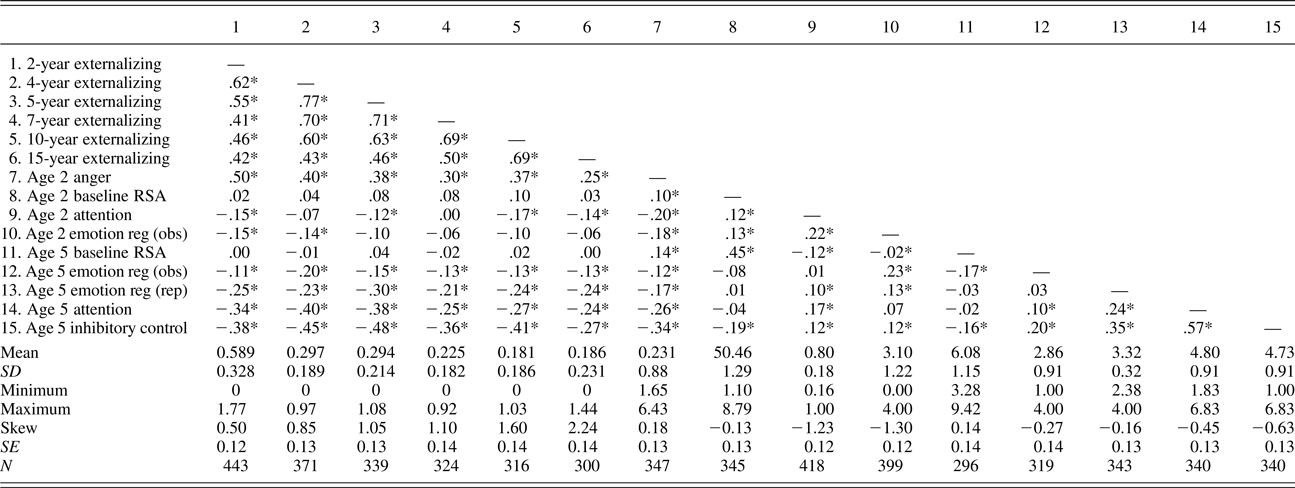
Note: Values reported prior to standardizing. RSA, respiratory sinus arrhythmia; obs, observed; reg, regulation; rep, parent reported.
*p < .05.
Identifying the externalizing group-based trajectory model
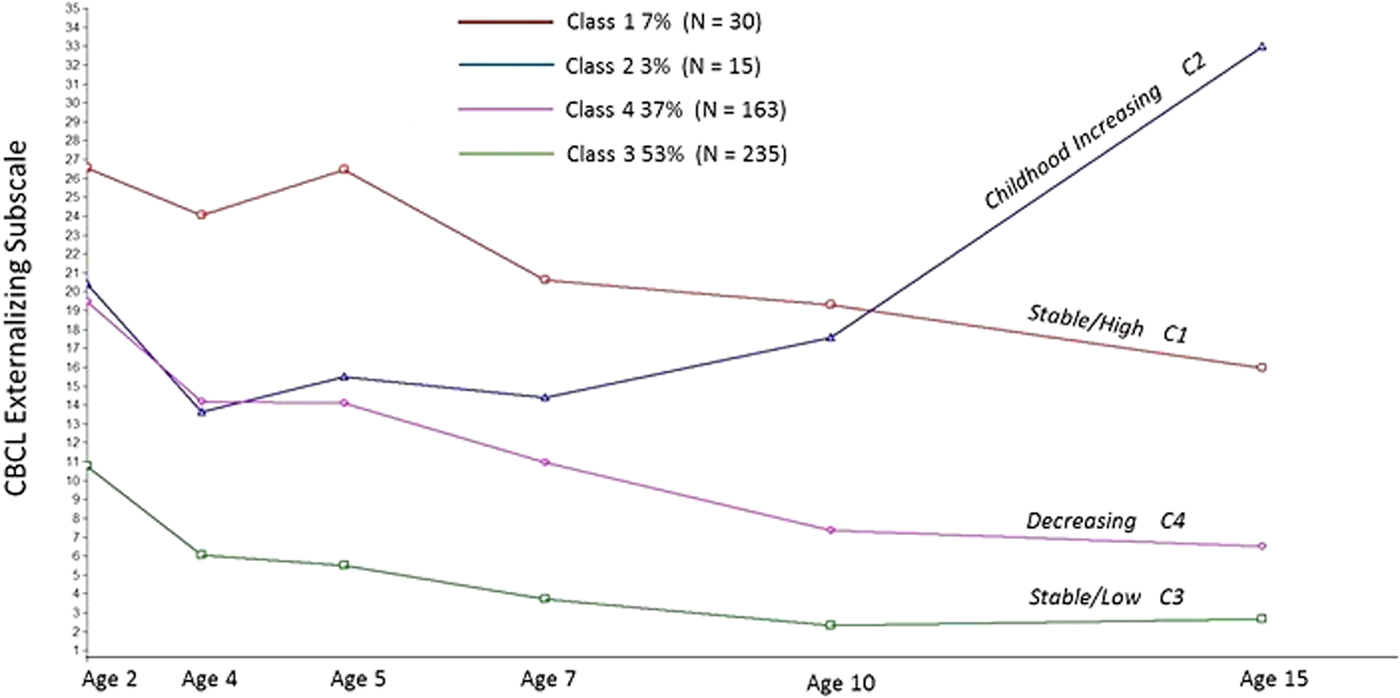
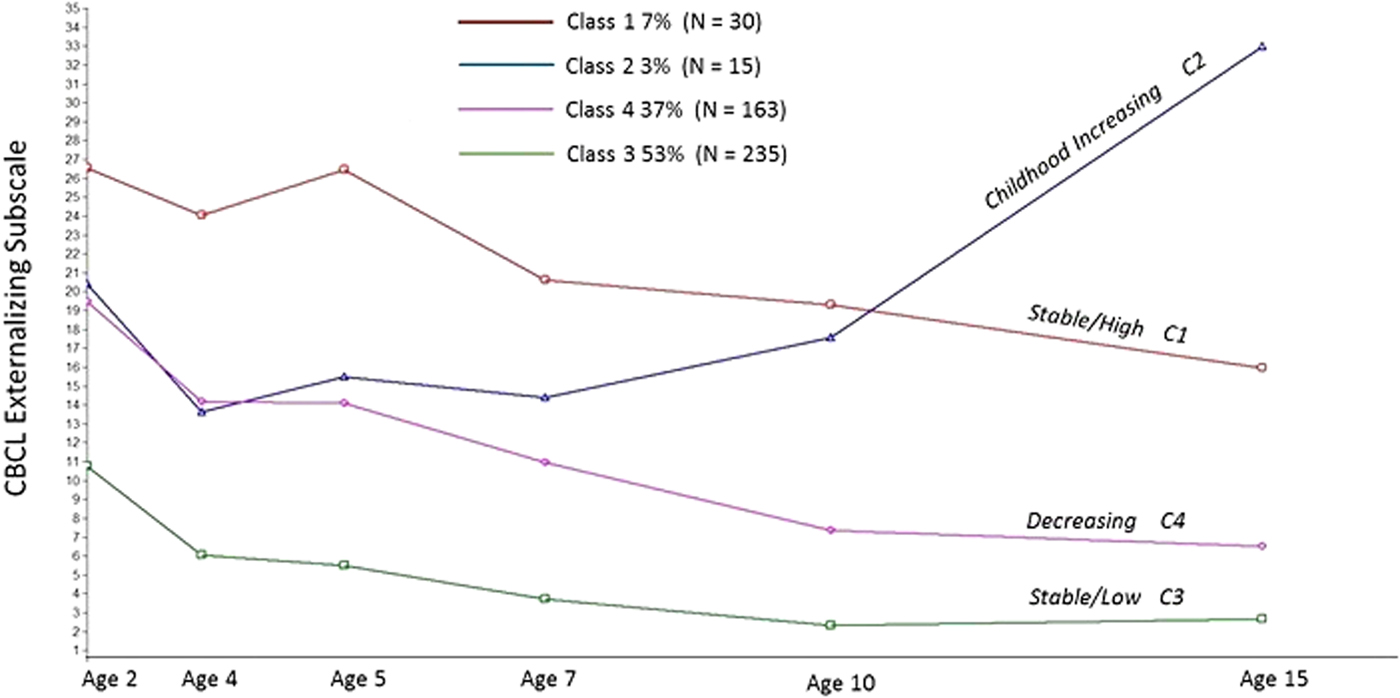
Fit indices for a one-trajectory model (BIC = –186.69; LMR-LRT, not applicable), two-trajectory model (BIC = –843.10; LMR-LRT, p < .05), three-trajectory model (BIC = –1,086.85; LMR-LRT, p < .05), four-trajectory model (BIC = –1,209.88; LMR-LRT, p < .05), and five-trajectory model (BIC = –1,208.91; LMR-LRT, p = .51) were compared. Taken together, evaluation of model fit statistics suggested that a four-class solution was empirically and theoretically justified (see Figure 1). In the four-class trajectory model, the majority of children demonstrated a low/stable level of externalizing behaviors across childhood and into adolescence (53% of the sample, n = 235; 56% female), with the second largest group following a decreasing pattern across early childhood and remaining low (37% of the sample, n = 163; 44% female). The third largest group followed an elevated or high/stable pattern of externalizing behaviors across childhood and adolescence (7% of the sample, n = 30; 60% female). Finally, the smallest group displayed an increase in their externalizing behavior starting at age 7 and into adolescence (3% of the sample, n = 15; 60% female). Prior work examining patterns of externalizing trajectories has typically found increases beginning at the onset of adolescence. However, because increases appear to take place from age 7 onward for this small subgroup of children, we chose to label this pattern childhood increasing. Although the childhood increasing group only comprised 3% of the sample, we chose to retain this group and keep the four-class solution because it was a better statistical fit to the data (i.e., lower BIC and significant LMR-LRT) and because it was in accordance with previous literature identifying a pattern of increased externalizing symptoms in late childhood and adolescence when examining trajectories of externalizing behaviors across development (Odgers et al., Reference Odgers, Moffitt, Broadbent, Dickson, Hancox, Harrington and Caspi2008; Roisman et al., Reference Roisman, Monahan, Campbell, Steinberg and Cauffman2010). Examination of the posterior probabilities indicated that individuals were well matched (Nagin, Reference Nagin2005) to their group (.93 for the high/stable trajectory, .92 for the adolescent-onset trajectory, .86 for the decreasing trajectory, and .92 for the low/stable trajectory).
(Color online) Four-class group trajectory model of externalizing behaviors from age 2 to age 15.
Self-regulatory predictors associated with externalizing trajectory group membership
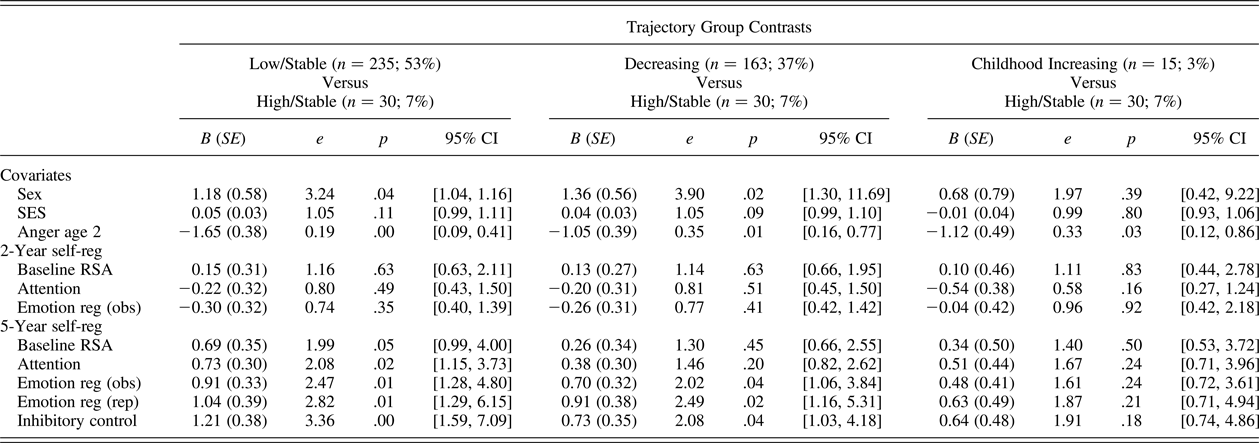
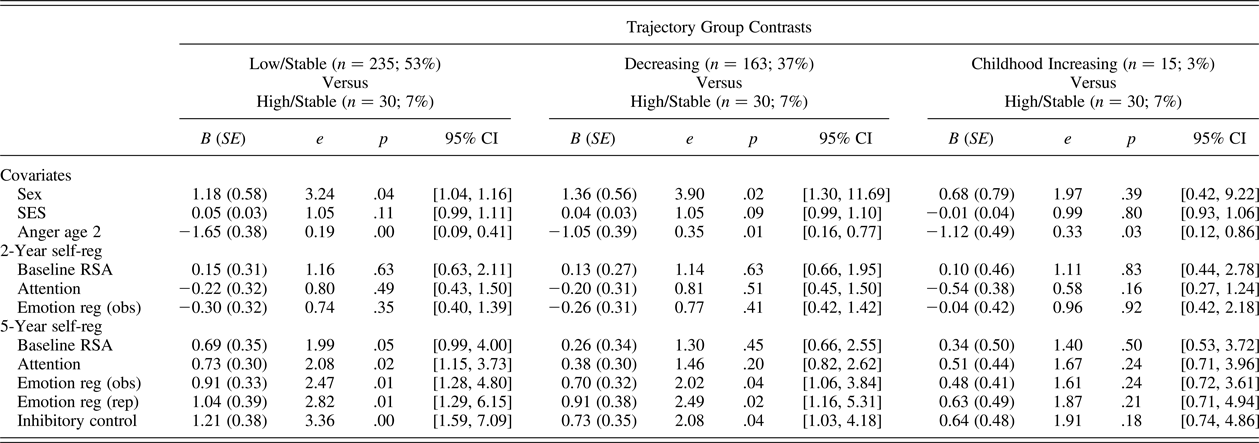
To examine whether 5-year self-regulatory abilities across domains might differentially be associated with membership in the externalizing trajectory groups, we simultaneously estimated the effect of each self-regulatory variable in a single multinomial logistic regression model (see Table 2). Because self-regulatory indicators were set on different scales, standardized z scores for each self-regulation variable were used in the model for greater interpretability. As previously indicated, the self-regulatory predictors were moderately correlated with one another, indicating that they were part of a larger self-regulatory construct reflecting children's overall ability to regulate themselves in a variety of contexts across multiple developmental domains. By including self-regulatory predictors at each level in the same model, and thereby accounting for their shared variance, we had increased confidence that any significant associations that emerged between our self-regulatory variables and externalizing trajectories were unique to that domain-specific self-regulatory skill.
Multinomial logistic regression of externalizing behavior trajectory groups with self-regulatory abilities at age 5
Note: All variables are standardized for interpretability. SES, socioeconomic status; reg, regulation; RSA, respiratory sinus arrhythmia; obs, observed; rep, parent reported.
Because there were differences in the proportion of boys and girls in the externalizing trajectory groups, the predictive significance of each self-regulatory covariate was examined in combination with child sex to determine any potential interactive associations. No interactions between sex and self-regulation emerged. Thus, interaction terms were removed from the model for parsimony, and child sex was included as a covariate. Given the previously reported relations between SES and behavior problems (e.g., Hinshaw, Reference Hinshaw1992), SES via the Hollingshead (Reference Hollingshead1975) was also included as a covariate in the model. The results indicated being male (male = 1, female = 0) slightly increased children's odds of being classified in the low/stable and the childhood decreasing group as compared to the high/stable group although the effect size was small (see Table 2). There were no sex differences for the childhood increasing trajectory.
It is interesting that none of the self-regulatory indicators at age 2 were uniquely associated with membership in any of the trajectory groups. However, greater maternal-reported traitlike anger proneness was significantly associated with a lower likelihood of being in the low/stable, 0.18, 95% confidence interval (CI) [0.09, 0.41], decreasing, 0.35, 95% CI [0.16, 0.77], and childhood increasing, 0.33, 95% CI [0.12, 0.86], groups when compared to the high/stable group (see Table 2).
In contrast, greater 5-year self-regulatory skills across domains were uniquely associated with membership in the low/stable trajectory group when compared to the high/stable group. Specifically, for every 1 SD change in baseline RSA at age 5, the odds of being in the low/stable group, as compared to the high/stable group, increased by 1.99, 95% CI [0.99, 4.00], suggesting that as physiological self-regulatory abilities increase, children were about 2 times more likely to follow a low/stable externalizing trajectory. For every 1 SD change in 5-year observed emotion regulation during the frustration task, the odds of being in the low/stable group, as compared to the high/stable group, increased by 2.47, 95% CI [1.28, 4.80], suggesting that as observed emotion regulation increases, children were about 2.5 times more likely to be classified in the low/stable externalizing trajectory group. Parental report of emotion regulatory skills was also a significant predictor; for every 1 SD change in parental report of children's emotion regulation, the odds of being in the low/stable group as compared to the high/stable group increased by 2.82, 95% CI [1.29, 6.15], suggesting that as the ability to regulate both positive and negative emotions, as well as express emotions appropriately, increases children were about 3 times more likely to be classified in the low/stable externalizing trajectory group. Parent-reported attentional and behavioral inhibitory control were also uniquely associated. For every 1 SD change in children's attentional and behavioral inhibitory control, the odds of being in the low/stable group as compared to the high/stable group increased by 2.08, 95% CI [1.15, 3.73], and 3.36, 95% CI [1.59, 7.09], for attentional and behavioral inhibitory control, respectively. These findings suggest that for 1 SD change in attentional skills children are about 2 times more likely to be in the low/stable group compared to the high/stable group, and 3 times more likely to be in the low/stable group compared to the high stable group for 1 SD change in inhibitory control abilities.
When examining predictors of the decreasing group as compared to the high/stable group, only emotion regulation and behavioral inhibitory control were uniquely associated with belonging to the childhood decreasing externalizing trajectory. For every one unit increase in observed and reported emotion regulation, the odds of being in the childhood decreasing group, as compared to the high/stable group, increased by 2.02, 95% CI [1.06, 3.84], and 2.49, 95% CI [1.16, 5.31], for observed regulation of frustration and broader emotion regulation abilities, respectively. These findings indicate that children were about 2 times more likely to be in the childhood decreasing group compared to the high/stable group as their ability to behaviorally regulate frustration goes up, and about 2.5 times more likely to be in the childhood decreasing group as compared to the high/stable group as more general parent-reported emotion regulation abilities increased. Finally, as behavioral inhibitory control increased one unit, the odds of being in the childhood decreasing group increased by 2.08, 95% CI [1.03, 4.18], suggesting that as children's inhibitory control abilities increased they were about 2 times more likely to be in the childhood decreasing group. There were no unique self-regulatory predictors of the adolescent-onset group when compared to the high/stable trajectory group.
Discussion
We aimed to replicate and extend the existing work on the development of externalizing behavior problems by substantiating the existence of distinct patterns of externalizing trajectories across six time points from infancy to adolescence. The large majority of studies examining externalizing behavioral patterns across childhood do not have infant data available and therefore are not able cover all developmental periods as is done in the current study. Thus, we have the unique opportunity to extend the current literature on externalizing trajectories in a meaningful way. As hypothesized, and consistent with other work on externalizing trajectories, we identified four distinct trajectories of externalizing behaviors: high/stable, low/stable, childhood decreasing, and a small subset of children who increased during middle childhood and adolescence. The majority of children were classified as low/stable, and showed a low and stable pattern of externalizing behavior problems from early childhood into adolescence. The second largest group, labeled childhood decreasing, showed the normative decline in externalizing behavior problems across early childhood and remained low into adolescence. The third largest group demonstrated an elevated pattern of externalizing behavior problems across childhood and adolescence and was thus labeled high/stable. This group is very similar to the life-course persistent group that is found consistently in other studies (e.g., Odgers et al., Reference Odgers, Moffitt, Broadbent, Dickson, Hancox, Harrington and Caspi2008; Roisman et al., Reference Roisman, Monahan, Campbell, Steinberg and Cauffman2010). Finally, there was a group of individuals, childhood increasing, showing a significant increase in externalizing behavior problems starting at age 7 through adolescence.
It was interesting that we saw no association between childhood SES and externalizing group membership. Child sex, however, was a significant predictor, such that females were slightly less likely to be in the low/stable and decreasing group than in the high/stable group. The effect sizes are small and likely emerged because of the somewhat larger percentage of females in the high/stable trajectory (63% female). Although the majority of work in this area demonstrates that males are more likely to display high and stable levels of externalizing behaviors across development, prior work has shown that it is not uncommon for females to also display this pattern (e.g., Broidy et al., Reference Broidy, Tremblay, Brame, Fergusson, Horwood, Laird and Vitaro2003). Specifically, when trajectory models of antisocial behavior are conducted separately for males and females across childhood, similar behavioral patterns are found (Odger et al., Reference Odgers, Moffitt, Broadbent, Dickson, Hancox, Harrington and Caspi2008). Thus, although we did not expect more females to follow a high/stable pattern, our findings are consistent with work indicating that self-regulatory predictors of externalizing trajectories function similarly for both sexes (Roisman et al., Reference Roisman, Monahan, Campbell, Steinberg and Cauffman2010).
Although it is important to validate the developmental trajectories of externalizing behaviors over time, the next step in this area of work is to better understand the correlates of these distinct trajectories. Thus, the second aim of the current study was to identify which specific self-regulatory abilities were most strongly associated with distinct patterns of externalizing behaviors. Given the theoretical link between self-regulatory development and normative decreases in externalizing behaviors (Calkins & Perry, Reference Calkins, Perry and Cicchetti2016), we hypothesized that variation in self-regulatory abilities across multiple domains (i.e., physiological, emotional, attentional, and behavioral) would serve to discriminate among children on varying developmental externalizing trajectories. To date, there is little empirical evidence that sheds light on which specific self-regulatory processes are associated with the various patterns of externalizing behaviors. This study is the first of our knowledge to examine self-regulatory processes across domains at multiple time points during early childhood to better understand how domain-specific self-regulatory processes might be uniquely associated with specific developmental patterns of externalizing behaviors.
Because such substantial gains in independent self-regulatory abilities are made from toddlerhood to early childhood, we considered multiple self-regulatory indicators at age 2 and at age 5 as correlates of externalizing behavior trajectories. Only the 5-year self-regulatory indicators were associated with externalizing trajectory group membership; no associations between 2-year self-regulatory abilities and externalizing patterns emerged. We hypothesized that 2-year self-regulatory processes were not associated with patterns of externalizing behaviors over time because most children's self-regulatory abilities are poorly developed during infancy and toddlerhood (Kopp, Reference Kopp1982). For example, from age 2 to age 5 attention abilities rapidly develop (Rothbart, Reference Rothbart, Kohnstamm, Bates and Rothbart1989) and significantly contribute to the maturation of behavioral control and emotion regulation during that time period (Calkins, Reference Calkins, Olson and Sameroff2009). Thus, self-regulatory skills by the end of early childhood, a time during which self-regulatory development slows and most children transition to the academic environment, may be more strongly associated with externalizing trajectories over time than self-regulatory abilities in toddlerhood when these abilities are underdeveloped. That is, greater self-regulatory abilities by kindergarten may reflect appropriate and important self-regulatory gains that occur across early childhood. These increased skills may help to facilitate children's ability to learn and interact positively with teachers, parents, and peers, and therefore may be associated with differing patterns of behavioral adjustment. In contrast, lower self-regulatory abilities by school entry may reflect deficits in the acquisition of self-regulation during early childhood. Children with poor self-regulatory skills may find school more frustrating and have fewer social supports, likely contributing to greater externalizing behavior problems across childhood and adolescence.
When examining specific probabilities of group membership, we found that children with greater 5-year self-regulatory skills across physiological, attentional, emotional, and behavioral domains were more likely to be in the low/stable group when compared to the high/stable group. These findings are expected given the sizable literature outlining the negative association between each of these self-regulatory abilities and the presence of externalizing behavior problems (e.g., Gerstein et al., Reference Gerstein, Pedersen y Arbona, Crnic, Ryu, Baker and Blacher2011; Martel et al., Reference Martel, Nigg, Wong, Fitzgerald, Jester, Puttler and Zucker2007). We also found that self-regulatory abilities across all domains were not uniquely associated with membership in the childhood decreasing group when compared to the high/stable group; instead only emotion regulation and behavioral inhibitory control were associated with a decreasing externalizing trajectory. Given that aggressive, destructive behaviors characterize externalizing problems, it is logical that the ability to regulate emotion and behavior would be significantly associated with the decline of these problematic behaviors over time.
Similarly, children who can control behavioral impulses are less likely to act out or be defiant. There are significant changes in the prefrontal cortex that occur across early childhood and are believed to be associated with children's increased inhibitory control skills (Carlson & Wang, Reference Carlson and Wang2007), which have been found to be associated with a decrease in externalizing behaviors (e.g., Eisenberg et al., Reference Eisenberg, Valiente, Spinrad, Cumberland, Liew, Reiser and Losoya2009). Further, inhibitory control is shown to be a promising skill to foster in interventions aiming to decrease behavior problems. For example, inhibitory control abilities mediated the effect between the Promoting Alternative Thinking Strategies Curriculum and decreases in externalizing behavior problems (Riggs, Greenberg, Kusché, & Pentz, Reference Riggs, Greenberg, Kusché and Pentz2006).
Finally, no unique self-regulatory predictors of the childhood increasing group emerged when compared to the high/stable trajectory group. It is possible that significant differences in self-regulatory abilities between children who increase in their behavior problems during childhood and adolescence and a life-course persistent pattern in externalizing behaviors may not be as evident given that individuals showing both patterns are known to have early difficulties that distinguish them from individuals who demonstrate decreasing and low externalizing behaviors over time (e.g., Odgers et al., Reference Odgers, Moffitt, Broadbent, Dickson, Hancox, Harrington and Caspi2008). Further, although significant findings between adolescent-onset and high/stable groups have been identified (e.g., Roisman et al., Reference Roisman, Monahan, Campbell, Steinberg and Cauffman2010), these differences are minimal in number (i.e., difficult temperament and having a single parent). Regardless, it is possible that we did not have enough power to detect significant associations between the levels of self-regulatory functioning and group membership due to the small number of individuals within our childhood increasing group. Thus, it is important to consider this when interpreting the lack of findings presented here. Future work testing these associations with a larger subset of childhood increasing individuals is needed.
Limitations and future directions
Despite the many methodological and theoretical strengths of this study, it is not without limitations. First, data was not collected between the 10- and 15-year time points. Thus, externalizing behaviors throughout late childhood and early adolescence did not contribute to the patterns of externalizing behaviors identified in the current study. However, given that previous work utilizing early adolescent time points when assessing externalizing trajectories has identified similar developmental patterns (e.g., Broidy et al., Reference Broidy, Tremblay, Brame, Fergusson, Horwood, Laird and Vitaro2003; Roisman et al., Reference Roisman, Monahan, Campbell, Steinberg and Cauffman2010), externalizing behaviors at the 15-year time point may be a sufficient indicator of children's likely trajectory of externalizing behaviors during this developmental gap.
Second, another limitation is the small number of individuals identified as members of the childhood increasing group. In our sample, a smaller number of individuals were classified in this group as compared to the existing work on externalizing behavior trajectories. The small percentage of individuals classified in this group likely limited our ability to identify unique self-regulatory predictors of adolescent-onset group membership. Yet, the four-class solution that included the adolescent-onset trajectory was statistically a better fit to the data than the three-class solution, and this group has been repeatedly identified in existing work. Thus, we believe the inclusion of this group in the current study is the best decision both empirically and theoretically.
Third, given our focus on the influence of multiple intraindividual self-regulatory predictors, we did not consider the multiple environmental factors that are likely to contribute to differences in externalizing behavioral patterns over time, such as familial factors or social supports. Investigating the effects of specific parenting behaviors may be a particularly important avenue for future work examining the links between self-regulatory functioning and patterns of externalizing behaviors. Differences in parenting have been not only found to be associated with changes in externalizing behaviors over time (e.g., Galambos, Barker, & Almeida, Reference Galambos, Barker and Almeida2003) but also linked to the development of self-regulatory processes (e.g., Grolnick & Farkas, Reference Grolnick, Farkas and Bornstein2002). Therefore, it is possible that parenting behavior is indirectly related to externalizing trajectories through its influence on children's self-regulatory development.
Fourth and finally, because self-regulatory abilities at age 5 were used as predictors of externalizing trajectories from age 2 to 15, the results must be interpreted without inferring causal associations. Specifically, given the lack of temporal precedence, the results of the current study do not suggest that self-regulatory skills at age 5 cause differences in the trajectories of externalizing behaviors over time. Instead, children's self-regulatory skills at age 5, which in combination with the age 2 measures reflects the growth in children's self-regulation from age 2 to age 5, may help us differentiate which externalizing trajectories children are more likely to follow. This work has both intervention and prevention implications. Specifically, the results from this study suggest that the developmental changes that occur by age 5 in emotion regulation and inhibitory control are associated with the likelihood that children may follow varying patterns of externalizing behaviors; as such, the assessment of these skills during the transition to school may allow preventive intervention programs to target children most at risk while also providing specific skills that may be most effective for behavioral adjustment.
The current study highlights the importance of employing a multidomain perspective of self-regulation and provides greater insight into which specific self-regulatory processes are the most salient predictors of externalizing trajectories from early childhood to adolescence. Assessing domain-specific self-regulatory skills is necessary to parse out the unique role of self-regulatory mechanisms for the development of various externalizing behavioral patterns. Identifying which self-regulatory processes differentiate individuals who decrease in their externalizing behaviors from those who continue to demonstrate high levels of externalizing behaviors into adolescence has important practical implications for the implementation of preventive intervention programs during early childhood, and underscores the need to focus intervention efforts on specific self-regulatory abilities.