Positive experiences have an important protective and promotive role in reducing the possible effects of negative childhood experiences and other negative environmental conditions in individuals’ lives (Arslan et al., Reference Arslan, Allen and Tanhan2020; Masoom Ali et al., Reference Masoom Ali, Yildirim, Abdul Hussain and Vostanis2020). Positive childhood experiences include, for example, being in a positive interactive environment with parents, growing up in a safe environment, having opportunities for social engagement, and learning emotional competencies (Alshehri et al., Reference Alshehri, Yildirim and Vostanis2020; Sege & Browne, Reference Sege and Browne2017). Research shows that positive childhood behaviours are associated with decreased emotional problems in adulthood and increased wellbeing (Richards & Huppert, Reference Richards and Huppert2011). Furthermore, positive childhood experiences are associated with job satisfaction, positive relationships with family and friends, and engagement in social activities (Richards & Huppert, Reference Richards and Huppert2011; Yildirim et al., Reference Yildirim, Iqbal, Khan, O’Reilly and Vostanis2020). Therefore, individuals who have healthy childhoods are more likely to have positive reflections of these experiences in later years (Bethell et al., Reference Bethell, Jones, Gombojav, Linkenbach and Sege2019; Oliviera et al., Reference Oliveira, Ferreira and Mendes2016; Özaslan & Yıldırım, Reference Özaslan and Yıldırım2021). Additionally, childhood experiences are positively associated with middle-age wellbeing and happiness, which help individuals to cope with mental health problems (Richards & Huppert, Reference Richards and Huppert2011).
Individuals who spend their childhood under difficult conditions can experience adversities and challenges during their adolescence and adulthood (Anda et al., Reference Anda, Croft, Felitti, Nordenberg, Giles, Williamson and Giovino1999; Chapman et al., Reference Chapman, Whitfield, Felitti, Dube, Edwards and Anda2004; Petrucelli et al., Reference Petruccelli, Davis and Berman2019; Sonu et al., Reference Sonu, Post and Feinglass2019). Negative childhood events, including trauma and losses, are often the focal point of studies examining childhood experiences and their effects on various psychological structures (Bonanno, Reference Bonanno2004; Cicek, Reference Cicek2020; Domhardt et al., Reference Domhardt, Münzer, Fegert and Goldbeck2015). More broadly, the effects of physical, social, emotional, cognitive and behavioural traumas, and negative experiences in lifelong development are associated with various factors such as social support, emotional competence, coping, social attachment, and optimism (Bonanno, Reference Bonanno2004; Domhardt et al., Reference Domhardt, Münzer, Fegert and Goldbeck2015; Elmore et al., Reference Elmore, Crouch and Chowdhury2020). Similarly, the contribution of positive experiences of childhood to adulthood should be evaluated from a positive psychology perspective to gain a more comprehensive insight regarding psychological health (Tanhan, Reference Tanhan2019; Tanhan et al., Reference Tanhan, Yavuz, Young, Nalbant, Arslan, Yıldırım, Ulusoy, Genç, Erol Uğur and Cicek2020; Yıldırım & Tanrıverdi, Reference Yıldırım and Tanrıverdi2021). Focusing on positive childhood experiences may be important in terms of examining the possible effects of positive conditions of childhood to mental health outcomes. Thus, this study focused on the relationship between positive childhood experiences and positive psychological constructs of self-esteem and psychological resilience.
There are various challenges and stress caused by childhood trauma. To use effective coping strategies and methods in the face of these challenges and stressful situations, individuals must be psychological healthy (Compas et al., Reference Compas, Connor-Smith, Saltzman, Thomsen and Wadsworth2001). Psychological resilience is defined as the ability to show positive reactions and use effective coping skills to overcome adversities, despite adverse life events that may pose a serious threat to the development of individuals (Masten, Reference Masten2001). Negative experiences and traumas experienced in childhood can negatively affect individuals’ psychological resilience during adulthood (Özaslan et al., Reference Özaslan, Yıldırım, Güney, Güzel and İşeri2021; Turk-Kurtca & Kocaturk, Reference Turk-Kurtca and Kocaturk2020). Research suggests the examination of childhood problems in relation to psychological strengths should include resilience (Masten, Reference Masten2014). The effects of positive childhood experiences can occur in various aspects of young adulthood, such as social sensitivity, production, responsibility, interpersonal connections, and physical exercise (Kosterman et al., Reference Kosterman, Mason, Haggerty, Hawkins, Spoth and Redmond2011). However, problematic behaviours, such as substance use in adolescence, decrease positive functionality in young adulthood (Newcomb & McGee, Reference Newcomb and McGee1991). Research in this regard reported that experiences such as academic achievement and positive peer relationships in childhood and adolescence are associated with the psychological resilience of individuals in early adulthood (Skodol et al., Reference Skodol, Bender, Pagano, Shea, Yen, Sanislow, Grilo, Daversa, Stout, Zanarini, McGlashan and Gunderson2007). Positive childhood experiences are related to psychological resilience in individuals, while negative childhood experiences and low psychological resilience are associated with a higher level of depression (Elmore et al., Reference Elmore, Crouch and Chowdhury2020; Yildirim & Balahmar, Reference Yildirim and Balahmar2020).
Another psychological variable that is closely related to childhood experiences is self-esteem. Individuals who receive support from their families and develop positive peer relationships in childhood have higher self-esteem (Franco & Levitt, Reference Franco and Levitt1998). However, there are significant and negative relationships between negative childhood experiences and various psychosocial and physical factors, such as sexual abuse and neglect, and parental violence (Matsuura et al., Reference Matsuura, Hashimoto and Toichi2009; Özaslan & Yıldırım, Reference Özaslan and Yıldırım2021). There are also findings suggesting that self-esteem plays a mediating role in the relationships between physical neglect, emotional abuse and important mental health outcomes, including depressive symptoms and subjective wellbeing (Yildirim et al., Reference Yildirim, Alshehri and Aziz2019; Yoon et al., Reference Yoon, Cho and Yoon2019). The available evidence typically suggests that adverse life experiences have a negative impact on self-esteem. Positive childhood experiences, on the other hand, play an important role in developing self-esteem and resilience. As such, this study examined positive childhood experiences as predictors of self-esteem and psychological resilience.
Present Study
It is important to understand the associations between positive childhood experiences, self-esteem, and psychological resilience in university students as emerging adults. Individuals who experience positive childhood experiences have positive experiential results in the following years (Bethell et al., Reference Bethell, Jones, Gombojav, Linkenbach and Sege2019; Oliviera et al., Reference Oliveira, Ferreira and Mendes2016; Richards & Huppert, Reference Richards and Huppert2011). Many positive experiences during childhood can strengthen the individual psychologically later in life. Furthermore, school is a significant element of positive childhood experiences for children and youth for contributing to individual psychosocial development such as building a sense of belongingness to the school, encouragement, supportive relationships, and involvement in sports activities or clubs (Baglivio & Wolff, Reference Baglivio and Wolff2021; Lee & Schafer, Reference Lee and Schafer2021). As such, school psychologists and school counsellors should be aware of the supportive factors related to positive experiences that may play a significant role in children’s development throughout their schooling.
In predicting psychological resilience, childhood trauma, loss, neglect and abuse, and being bullied are found to be related each other. However, examining the associations between positive experiences, such as healthy interactions with parents, protective social relationships, supportive environmental conditions, self-esteem and psychological resilience, will make a substantial contribution to the literature. In light of extant evidence, this study aimed to examine whether positive childhood experiences predict psychological resilience and are negatively related to psychological resilience through the mediating role of self-esteem. We generated the following hypotheses:
Hypothesis 1 (H1): Positive childhood experiences would significantly predict psychological resilience.
Hypothesis 2 (H2): Positive childhood experiences would significantly predict self-esteem.
Hypothesis 3 (H3): Self-esteem would significantly predict psychological resilience.
Hypothesis 4 (H4): Self-esteem would mediate the relationship between positive childhood experiences and psychological resilience.
Method
Research Design
The present study used a correlational design that aims to determine the strength of the change between two variables (Creswell, Reference Creswell2012). The relationships between positive childhood experiences, self-esteem, and resilience were examined within the proposed model, and the hypotheses of the study were tested by structural equation modelling (SEM).
Participants and Procedure
A total of 570 university students (M age = 22.50 years; SD age = 4.41 years; 63.7% female) took part in this study online. Participants were recruited by a convenience sampling approach using social networking sites. Of the participants, 65.6% stated their socio-economic level as moderate. In addition, 29.1% of participants reported being the first child, followed by 50.4% a middle child, and 19.8% the last child. The completion of surveys in Turkish took approximately 15 minutes.
Instruments
Positive Childhood Experience Scale
The scale consists of 22 items that measure positive childhood experiences of individuals before the age of 11 (Dogan & Aydin Reference Dogan and Aydin2020). It includes three dimensions: positive family and peer relationships, growing up safely, and positive mood during childhood. Items are rated on a 5-point, Likert-type scale from 1 (never agree) to 5 (totally agree). Some sample items are: ‘I had many friends as a child’ and ‘I was an optimist as a child’. The overall score ranged between 22 to 110, with higher scores indicating greater positive childhood experiences. In our sample, the Cronbach’s alpha internal consistency coefficient of the scale was .96.
Rosenberg Self-Esteem Scale
This scale was developed by Rosenberg (Reference Rosenberg1965) to measure one’s overall attitudes and beliefs towards the self (Rosenberg et al., Reference Rosenberg, Schooler, Schoenbach and Rosenberg1995). The scale consists of 10 items answered on a 4-point, Likert-type scale ranging from 1 (strongly disagree) to 4 (strongly agree). Some sample items are: ‘I think I have some positive traits’ and ‘I have a positive attitude towards myself’. A total score can be obtained by summing all items on the scale, with higher scores referring to greater self-esteem. A Turkish adaptation study conducted by Cuhadaroglu (Reference Cuhadaroglu1986) reported good evidence of reliability and validity for the scale. In the present study, Cronbach’s alpha internal consistency coefficient of the scale was .89.
Brief Resilience Scale
Resilience is the ability to adapt to difficulties and significant ongoing life stress (Masten, Reference Masten2001) and coping outcomes in response to stress and adversity (Compas et al., Reference Compas, Connor-Smith, Saltzman, Thomsen and Wadsworth2001). Accordingly, the Brief Resilience Scale (Smith et al., Reference Smith, Dalen, Wiggins, Tooley, Christopher and Bernard2008) was developed to measure the ability to ‘bounce back’ from stressful situations. The scale is a 5-point, Likert-type scale consisting of six items whose response format ranged from 1 (strongly disagree) to 5 (strongly agree). Some sample items are ‘I have difficulty coping with stressful events’ and ‘I can recover quickly after difficult times’. High scores indicate a higher level of psychological resilience in the individual. The scale was adapted to Turkish by Dogan (Reference Dogan2015). In the adaptation study, the internal consistency coefficient of the scale was .83, and Cronbach’s alpha reliability was .81 in the present study.
Data Analysis
SEM was used to test the proposed model in the present study. First, the correlation between positive childhood experiences, self-esteem, and psychological resilience was calculated using Pearson product moment correlation. Normality of variables, homoscedasticity and multicollinearity assumptions were tested for the variables prior to testing the main model. Furthermore, items on the scale were parcelled, with a total of three parcels for each scale. Confirmatory factor analysis was performed before testing the structural model. Therefore, the measurement and structural models were evaluated using multiple statistics and their corresponding values, including the relative chi-square index (CMIN), the goodness of fit index (GFI), the comparative fit index (CFI), the normed fit index (NFI), and the root mean square error of approximation (RMSEA) (Byrne, Reference Byrne2016; Hu & Bentler, Reference Hu and Bentler1999). All data have been analysed using SPSS v.24 and AMOS v.24 for Windows.
Results
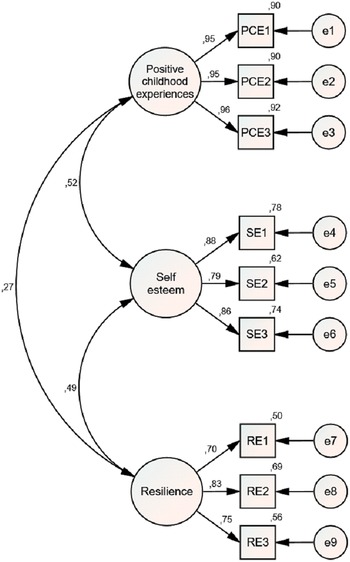
Table 1 presents the descriptive statistics, such as mean, standard deviation, tolerance factor (TF) and variance inflation factor (VIF) and correlation results. There was a significant and positive correlation between positive childhood experiences and self-esteem (r = .52, p < .001), positive childhood experiences and psychological resilience (r = .27, p < .001), and self-esteem and psychological resilience (r = .49, p < .001).
Descriptive statistics and correlations among the variables

Note: TF, tolerance factor; VIF, variance inflation factor.
To test the assumptions of SEM, distribution of the variables, homoscedasticity and multicollinearity are provided in Table 1. Besides, the items in the scales were parcelled with new dimensions. To do this, an explanatory factor analysis was run for each scale. According to item-total correlations, all items were ranged from the highest score to the lowest score.
All the scales in the present study were split up into three parcels. Aligned with the item parcelling process, the items with the highest item-total correlation coefficients were assigned parcel one, the second highest to parcel two, and the third highest to parcel three. After that, the fourth highest was assigned to parcel three, the fifth to parcel two, and the sixth to parcel one. This process was completed by assigning all items to every three parcels for each variable. There are some advantages of the parcelling procedure for testing the theoretical model, including producing higher reliability and goodness of fit indices in SEM (Little et al., Reference Little, Cunningham, Shahar and Widaman2002; Little et al., Reference Little, Rhemtulla, Gibson and Schoemann2013).
Before testing the models through SEM, the measurement model was initially tested. According to this, the relative CMIN, GFI, CFI, NFI and RMSEA were calculated (see Table 2 and Figure 1). Fit values of measurement model were as follows: CMIN/df = 2.50, p < .001, GFI = .98, NFI = .99, CFI = .99 and RMSEA = .051, suggesting good data model fit.
Measurement model results

Note: *Hu and Bentler (Reference Hu and Bentler1999); CMIN, relative chi-square index; GFI, goodness of fit index; NFI, normed fit index; CFI, comparative fit index; RMSEA, root mean square error of approximation.
Measurement model of variables.

In the theoretical model, the same fit statistics were used to evaluate the proposed model. The results showed that positive childhood experiences significantly predicted self-esteem (H1) and psychological resilience (H2). Self-esteem also significantly affected psychological resilience positively (H3).
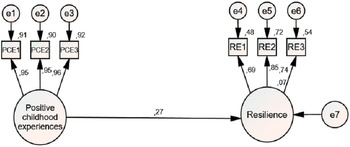
In the first model (see Figure 2), positive childhood experiences had a direct effect on resilience positively (R 2 = .071 B = .27 p < .001). The model fit indices were as follows: CMIN/df = 2.50, p < .001, GFI = .98, NFI = .99, CFI = .99 and RMSEA = .051 (see Table 3).
Structural equation modelling with the direct effect of positive childhood experiences on psychological resilience.

The results of structural equation modelling

Note: *Hu and Bentler (Reference Hu and Bentler1999); CMIN, relative chi-square index; GFI, goodness of fit index; NFI, normed fit index; CFI, comparative fit index; RMSEA, root mean square error of approximation.
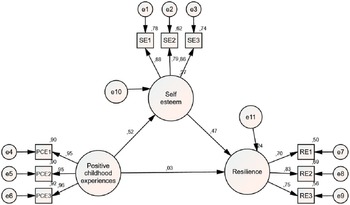
In the second model (see Figure 3), the mediating effect of self-esteem in the relationship between positive childhood experiences and psychological resilience was examined and regression coefficient, standard error, critical ratio, p value and R 2 values are given in Table 4 (R 2 = .237, B1 = .517, B2 = .472, B3 = .028, p < .001). When self-esteem was included in the model as a mediator, the effect of positive childhood experiences on psychological resilience decreased from .27 to .03, and there was no significant relationship between these two variables. According to this model, positive childhood experiences significantly predicted psychological resilience with a full mediation role of self-esteem. Therefore, the fourth hypothesis of the study was also accepted.
Structural equation modelling with the mediation of self-esteem on the relationship between positive childhood experiences and psychological resilience.

Mediating effect of self-esteem in the relationship between positive childhood experiences and psychological resilience

Discussion
In the present study, a positive and significant relationship was found between self-esteem, psychological resilience, and positive childhood experiences. According to the results obtained from the first model, positive childhood experiences had a significant direct effect on self-esteem and psychological resilience. Self-esteem also mediated the relationship between positive childhood experiences and psychological resilience. Positive childhood experiences were mostly related to the development of self-esteem predicted by psychological resilience. In sum, positive childhood experiences of university students explained the variance in their self-esteem and psychological resilience.
Both positive and negative childhood experiences may have deep and lasting connections with future living. However, previously many researchers focused on this issue by taking only negative aspects of childhood experiences into consideration. We have shown that examination of positive childhood experiences is an important research avenue. Specifically, our results support the notion that positive childhood experiences were significantly and positively related to self-esteem and psychological resilience, which are the two critical developmental constructs.
Our findings show that there was a positive and significant relationship between psychological resilience and self-esteem. A higher level of self-esteem is related with a higher level of psychological resilience level. Our findings support earlier work (Arslan, Reference Arslan2019; Guloglu & Karairmak, Reference Guloglu and Karairmak2010; Kalafat, Reference Kalafat2018; Karairmak & Sivis-Cetinkaya, Reference Karairmak and Sivis-Cetinkaya2011; Yildirim, Reference Yildirim2019; Zhao et al., Reference Zhao, Fu and Zhou2020). For example, Kapikiran and Acun Kapikiran (Reference Kapikiran and Acun-Kapikiran2016) found a positive and significant relationship between psychological resilience and self-esteem in their study in university students, suggesting that self-esteem is an important predictor of psychological resilience. In a study conducted by Lee et al. (Reference Lee, Kim and Park2017) with university students, a positive and significant relationship was found between psychological resilience and self-esteem. Similarly, the study of Harikrishnan and Ali (Reference Harikrishnan and Ali2018) reported a high link between psychological resilience and self-esteem. These findings are consistent with the results of our study.
Another result of the current study is that a positive and significant relationship was found between positive childhood experiences and psychological resilience. Our findings are consistent with those of previously reported findings (Dogan & Yavuz, Reference Dogan and Yavuz2020); However, studies have reported a significant negative relationship between negative childhood experiences and psychological resilience (Aziz & Yıldırım, Reference Aziz and Yıldırım2020; Howell et al., Reference Howell, Miller-Graff, Schaefer and Scrafford2020; Kelifa et al., Reference Kelifa, Yang, Herbert, He and Wang2020; Poole et al., Reference Poole, Dobson and Pusch2017; Savi Cakar, Reference Savi Cakar2018). These results show that both positive and negative childhood experiences affect the development of psychological resilience.
The result that individuals with positive childhood experiences have higher levels of self-esteem is consistent with findings reported in the literature (Cheng & Furnham, Reference Cheng and Furnham2004). For example, Coffey et al. (Reference Coffey, Warren and Gottfried2015) found that positive experiences during childhood have a positive effect on individuals’ self-esteem, wellbeing and happiness. Similarly, Marta-Simões et al. (Reference Marta-Simões, Ferreira and Mendes2018) found a positive and significant relationship between positive childhood memories and psychological and social wellbeing. In the study conducted by AlShawi and Lafta (Reference AlShawi and Lafta2015) with people aged between 18–59, a positive and significant relationship was found between children’s strong and positive bonds with their parents during childhood and self-esteem. This result can be indirectly evaluated as an indicator that positive childhood experiences positively influence development of self-esteem.
Individuals’ positive experiences in childhood are a supportive function for strong self-esteem and psychological resilience. To the best of our knowledge, there is no study explicitly examining the mediating role of self-esteem on the relationship between positive childhood experiences and psychological resilience. However, the literature shows that self-esteem is an important mediator variable between variables such as loneliness and psychological and subjective wellbeing (Cicek, Reference Cicek2021), life satisfaction and social exclusion (Arslan, Reference Arslan2019), life satisfaction and emotional intelligence (Zarei et al., Reference Zarei, Akbarzadeh and Khosravi2019), life satisfaction and loneliness (Civitci & Civitci, Reference Civitci and Civitci2009), social support and subjective wellbeing (Savi Cakar & Tagay, Reference Savi Cakar and Tagay2017), stress and psychological wellbeing (Xiang et al., Reference Xiang, Tan, Kang, Zhang and Zhu2019), and psychological bullying and loneliness (Luo et al., Reference Luo, Liu and Zhang2020). There are many studies showing variables that affect negative childhood experiences, such as posttraumatic stress disorder (Terock et al., Reference Terock, Van der Auwera, Janowitz, Spitzer, Barnow, Miertsch, Freyberger and Grabe2016), depression (Huh et al., Reference Huh, Kim, Lee and Chae2017), hopelessness (Gaskin-Wasson et al., Reference Gaskin-Wasson, Calamaras, LoParo, Goodnight, Remmert, Salami, Mack and Kaslow2017), mobbing (Jantzer et al., Reference Jantzer, Resch and Kaess2019), and mistreatment (Dovran et al., Reference Dovran, Winje, Øverland, Arefjord, Hansen and Waage2016). The results of this study also provide further evidence to the relevant literature by focusing on how positive childhood experiences affect self-esteem and psychological resilience. Positive experiences in childhood are an important predictor of individuals’ psychological resilience and self-esteem, and they support individuals to have protective psychological resources stronger.
Limitations and Recommendations for Future Research
There were a few limitations of the present study. First, we sampled university students; as such, young adults who did not attend university were not included. Differences between students and nonstudents could be taken into account in future studies for comparison. In this study, the participants were asked to respond by thinking about their positive childhood experiences before the age of 11. Factors such as false memory recall about childhood experiences (Hyman et al., Reference Hyman, Husband and Billings1995), the confounding effect of the current mood (Sheikh, Reference Sheikh2019), and subjective evaluation of the past imagination can make it difficult to remember these experiences. Further, the lack of studies on positive childhood experiences in the literature has limited the discussion section. It has been suggested that Online Photovoice (OPC), as one of the most recent comprehensive research methodologies, should be used, especially to elucidate adverse experiences and strengthen people with such difficult experiences by writing expressive captions on photos (Tanhan & Strack, Reference Tanhan and Strack2020). These measurement tools are oriented towards evaluating the lives of younger children, and qualitative methods such as the OPC will also contribute to the field. Finally, to make the effect of positive childhood experiences more visible, it is thought that it would be appropriate to conduct comparative studies on middle-aged individuals for comparison of groups.
The current results have implications for school psychologists and school counsellors. First, school psychologists and counsellors should work together with school administrators and teachers to create a positive school environment, including more positive experiences for students. Second, it would be appropriate for school psychologists and school counsellors to apply different therapeutic techniques to improve the positive aspects of students in group counselling practices. Third, the school psychologist and psychological counsellor could organise a ‘positive life activity’ for a certain time of the week in the classroom for students to share their positive experiences. Fourth, to strengthen students’ self-esteem and psychological resilience, students should be informed about psychological resilience and self-esteem, and shown practical ways to achieve this. Fifth, activities aimed at improving students’ social skills, together with classroom teachers, should be tailored to improve students’ ability to express their positive aspects.
In conclusion, our study showed that self-esteem mediates the relationship between positive childhood experiences and psychological resilience. The results indicated that positive childhood experiences positively predicted both self-esteem and psychological resilience. In addition, a positive and significant relationship was found between psychological resilience and self-esteem. Importantly, these results show that positive childhood experiences are a positive and powerful psychological resource for individuals later in their life on their psychological health and their positive self-evaluation.
Ethics declaration
The research was approved by the Batman University Ethics Committee (Code: 2020/3-19). All procedures performed in the study involving human participants were following the ethical standards of the 1964 Helsinki Declaration.
Informed consent
Informed consent was obtained from all participants included in the study.
Conflict of interest
None.