1. INTRODUCTION
Whose needs and concerns are reflected in the decisions of government? Political philosophers have contended that “everyone affected by the operation of a particular domain of civil society should be presumed to have a say in its governance. This follows from the root democratic idea that the people appropriately rule over themselves” (emphasis added).Footnote 1 In this study, we are interested in the democratic representation of three groups’ views: (1) perceived majorities, (2) those who cannot participate in elections, and (3) those who hold minority viewpoints. Do all of these groups factor into government decision making in some manner? Before we reach that question, though, for each of these groups, what is the normative case for the group's democratic representation?
With respect to majorities, “although majority rule finds ready acceptance whenever groups make decisions, there are surprisingly few philosophically interesting arguments in support of it.”Footnote 2 Among the earliest arguments for decision making by majority is Locke's Second Treatise on Government, which binds majority rule to social contract theory, as well as Locke's “right of revolution.”Footnote 3 Majority rule also is supported by the Aristotelian argument, reflected in Condorcet's Jury Theorem, of the wisdom of the multitude.Footnote 4 In addition, Downs and Black demonstrated that a group using a majoritarian procedure will maximize overall satisfaction with the group choice (in a single dimension).Footnote 5 Finally, May proved that majority rule is the only method for a group to decide between two options that satisfies four attractive properties—anonymity, neutrality, monotonicity, and decisiveness.Footnote 6 Given these proposed virtues of group decision making by majority, it is perhaps not surprising that the principle is closely associated with democracy. This obtains at the institutional level: “Any governing body that makes decisions by combining the votes of more than half of those eligible and present is said to be democratic, whether that majority emerges within an electorate, a parliament, a committee, a city council, or a party caucus.”Footnote 7 It also applies to the mass level: “In the use of elections to control … powerful policymakers, it is the citizen majority that should, normatively, prevail over a minority that supports the opposition. It is the domination of the majority that gives such a vision its status as a democracy.”Footnote 8 In sum, as Tocqueville put it, “The very essence of democratic government consists in the absolute sovereignty of the majority.”Footnote 9
With respect to the disenfranchised, democratic theorists emphasize that democracies should consider the needs and concerns of all, even those who cannot participate in elections. As Verba put it, “One of the bedrock principles in a democracy is the equal consideration of the preferences and interests of all citizens.”Footnote 10 Ordinarily, the mechanism to ensure equal consideration of citizens’ interests is the opportunity to politically participate. The “affected interests” principle contends that “everyone who is affected by the decisions of a government should have the right to participate,”Footnote 11 because “political activity is the means by which citizens make their needs and preferences known to governing elites and induce them to be responsive.”Footnote 12 By excluding many of its residents from elections for much of its history, the United States has in this way been deeply undemocratic. The relatively open access to the ballot box most contemporary citizens enjoy stands at the end of a long and often circuitous road.Footnote 13 In light of this exclusion, there has been an impulse to find a way to represent the interests of the disenfranchised, such as through “virtual representation” or “someone taking steps to represent in the government an interest excluded from formal suffrage ties.”Footnote 14 And yet, when groups “lack voting rights, it is easy for political parties, candidates, and elected officials to ignore them.”Footnote 15 In sum, “democracies are sounder when the reason why some lose does not rest on the fact that they are invisible to those who make decisions.”Footnote 16
Finally, political philosophers from MillFootnote 17 to MadisonFootnote 18 have made the case for representing minority viewpoints—recognizing that majorities, especially when they are apathetic or ephemeral, may sometimes be normatively problematic as a guide for policy. “A definition of democracy that ties it firmly to majority rule defeats useful argument about what democracy is and how it might be improved.”Footnote 19 Or as legal scholar Jeremy Waldron has pithily stated, “The fact that some option attracts more supporters than another is no guarantee that it is right.”Footnote 20 Thus, “political theory has understood that democracy owes something to political minorities.”Footnote 21 And, as Giovanni Sartori has contended, “majority rule” actually only implies “limited majority rule.”Footnote 22, Footnote 23 Thus, we might want to not only harness elected officials to the public weal, but also buffer policy decisions from public opinion in order to protect the interests of minorities.Footnote 24
Having made the normative case that democracies should at once give voice to majorities, the disenfranchised, and minority viewpoints, what is the evidence that the American political system represents the views of all three groups? Typically, the studies that address this question tend to examine one group in isolation from the others. In this study, we evaluate the democratic representation of all three groups using thirty-six U.S. Senate roll call votes related to the practice of slavery between 1835 to 1847. Situating our analysis in the Senate and in the 1800s offers a number of analytical advantages which we discuss below.
Employing these data, we model senators’ roll call representation of perceived majorities measured as the prevalence of antislavery petitions sent to Congress over the same period from each state's residents,Footnote 25 while accounting for other influential factors.Footnote 26 Moreover, because we know whether each of these petitions was signed exclusively by women, we can investigate whether the petitions of women were (equally) influential on senators’ behavior despite women's disenfranchisement in the era. Finally, the historical character of this study allows us to evaluate not only the degree to which officials represented minority views but also to differentiate between two types of state-level minorities—those whose preferences prevailed in the end (i.e., Southern abolitionists) and those whose did not (i.e., Northern defenders of slavery).
Upon conducting these analyses, we observe considerable and systematic senator representation of perceived majorities’ antislavery views, even after accounting for potential confounding factors such as region (South/non-South) and senator party affiliation. Thus, for reasons we develop below, even when senators were not directly elected and were frequently rotated in office,Footnote 27 they were attentive to perceived majorities’ preferences on the question of abolishing slavery. There also is some evidence that the representation of women-only petitions relative to mixed-gender petitions varied by party, and in ways that are not altogether surprising given the parties’ disparate stances on mobilizing women. Finally, we observe some evidence of the representation of minority viewpoints, apparently motivated by ambition to attain the presidency.
As we discuss below, these findings also are significant for our understanding of American political development. First, our findings contribute to an ongoing discussion concerning the effect of indirect elections on democratic representation.Footnote 28 Second, our finding that women's petitions were represented even before this group gained the franchise shows that not only did political activity in the antebellum era teach women political skills and help them build political networks,Footnote 29 the experience of being rewarded for their participation may have contributed to the group's sense of political efficacyFootnote 30 and demonstrated to the group the rewards of enfranchisement.Footnote 31 And, finally, these findings demonstrate that political ambition, which may be an incentive for the representation of minority viewpoints, can serve as a vehicle for policy evolution.Footnote 32
2. BACKGROUND AND EXPECTATIONS
This study builds upon prior work on the question of democratic representation of perceived majorities, the disenfranchised, and minority views in the United States. The discussion of these studies will focus on two questions: (1) Why might we expect (or might we not expect) elected officials to represent each of the three groups. (2) What is the extant evidence that officials do so? We divide our discussion into two parts, first focusing on analyses of representation in the contemporary period (i.e., since the advent of public opinion surveys and the full enfranchisement of women and African Americans) and then discussing studies situated, as ours is, in the nineteenth century.
2.1. Contemporary Representation of Perceived Majorities
The institutions of the American political system stack it in favor of majorities. “Two centuries of actual practice make clear that the bedrock constitutional principle within [Congress and the Court] is simple majority rule.”Footnote 33 Arguing for the ratification of the new Constitution, Hamilton critiqued the Articles of Confederation for contradicting “the fundamental maxim of republican government, which requires that the sense of the majority should prevail” and Madison contended that a simple majority of the legislature should be sufficient for it to conduct business, else “the fundamental principle of free government would be reversed. It would be no longer the majority that would rule: the power would be transferred to the minority.”Footnote 34 The majority principle also is manifest in the Rules of the U.S. House of Representatives: “The voice of the majority decides; for the lex majoris partis is the law of all councils, elections, &c., where not otherwise expressly provided.”Footnote 35 At the mass level, plurality election, a close cousin of majority decision making, is the most common form of voting in the United States.
There is of course no shortage of evidence that government policies are indeed generally representative of perceived majority preferences. Most studies of political representation are interested in the responsiveness of public officials to variation in the policy preferences of the public.Footnote 36, Footnote 37 These studies find that more liberal constituencies tend to be represented by more liberally voting representatives. In this way, the political system as a whole is said to represent differences in opinion across the electorate. Other studies find that the majority-preferred policy direction is adopted by elected representatives, even after accounting for other factors.Footnote 38
Why might elected officials also represent the views of individuals who cannot vote? The Constitution (as enforced by the courts) may require it: References in the document to “the people” in the Preamble, the 5th and 14th Amendments, and so forth, have been interpreted to mean that the government is created by, and accountable to, the entire populace, not just the enfranchised. This is reflected in decisions such as Plyler and Zadvydas, which protect the rights of noncitizens.Footnote 39 Alternatively, through the process of “virtual representation,” individuals under the age of 18, disenfranchised felons, and other nonvoters may have their interests represented through the political activity of voters, so long as their interests align.Footnote 40 We also know that those who cannotFootnote 41 or do not choose toFootnote 42 vote nevertheless may engage in nonelectoral forms of participation.Footnote 43 This is consequential, because nonvoting acts of political participation such as contacting elected officialsFootnote 44 can affect politicians’ behavior. Finally, some disenfranchised residents might hold a special position in the eyes of politicians. For instance, women in the 1800s may differ from other disenfranchised groups in that many women lived with voters and shared the same socioeconomic status and race or ethnicity as voters. These women's views might have been a clue as to what voters were thinking even if these women could not vote. This is different from, say, a disenfranchised racial or economic minority, where the signal could be weaker due to greater social distance. Relatedly, if politicians sense that a group may soon be enfranchised, there will be incentive to curry favor with the group.
Are the preferences of nonvoters (that is, the disenfranchised) reflected in policy decisions? There is some evidence that members of Congress are attentive to the needs and concerns of noncitizens.Footnote 45 The close cousins of the disenfranchised, voluntary nonvoters, are often represented virtually, because their preferences regularly align with those of voters.Footnote 46 However, Griffin and Newman find little evidence that voluntary nonvoters are represented at all in senators’ roll call choices, once the preferences of voters are accounted for.Footnote 47 Notably, most of these studies focus on the contemporary era, when nonvoting is often a choice rather than legally proscribed.
How might minority viewpoints get represented? American democracy has embedded within it a variety of institutions to advance minority viewpoints including the Bill of Rights, representative government, the malapportionment of the U.S. Senate, judicial review, supermajority requirements to amend the Constitution and to override a presidential veto, the electoral college, and federalism.Footnote 48 These institutions can amplify the voices of those with minority viewpoints, by allowing for the possibility that outcomes need not comport with the majority viewpoint or by requiring that those holding the majority view entice some number of those who hold the minority view to join them. And importantly, shifts in public opinion can convert minorities into majorities (as when inattentive publics begin to pay more attention to an issue),Footnote 49 and the decisions of officials to support minority viewpoints may have some role in this happening.Footnote 50
Are minority views represented? Although there is much more evidence of minority exclusion than inclusion,Footnote 51 studies of minority representation indeed find that the views of numerical minorities are to at least a modest degree politically incorporated. For instance, we know that on issues that are differentially salient for racial and ethnic minorities, the impact of their views can rival that of whites.Footnote 52 Racial minorities also can effect change via the courts.Footnote 53 In the practice of direct democracy, it is rare that a majority of racial and ethnic minorities find themselves on the losing side of the issue.Footnote 54 These studies point up instances in which minority views can carry some weight, at least in the modern era.
2.2. Representation in the 1800s
In the nineteenth century, how might a different institutional configuration have altered the representation of these groups? There are reasons to expect that majority influence might have been weaker than it is today. First, there has been considerable interest in whether the adoption of the 17th Amendment's direct election of senators in 1913 appreciably improved senator representation of public sentiment.Footnote 55 Second, several additional factors may have driven senators to view their political futures beyond the chamber: (1) In the antebellum era, attaining state rather than national office was a higher priority for politicians,Footnote 56 perhaps because “much of the action in political-economic development prior to the Civil War occurred at the state and local levels.”Footnote 57 (2) Senate salaries in the nineteenth century were often lower than those for state offices, with several attempts to raise remuneration ultimately unsuccessful.Footnote 58 (3) Senators were subject to a norm of rotation in office under which their state's party leaders could decline to renominate them.Footnote 59 Combining these factors, it would not be unreasonable to expect that the representation of perceived majority sentiment in the first half of the nineteenth century may have been weak or even nonexistent.
Conversely, why might representational linkages have persisted despite the absence of now-familiar linkages between citizens and senators? Broadly speaking, Carson and Jenkins make a compelling case that many of the preconditions for the “electoral connection”Footnote 60 between national legislators and constituents reach back into the antebellum era, at least in the U.S. House of Representatives.Footnote 61 Extending this thinking to the Senate, we can imagine two avenues by which the potential impediment to democratic representation that indirect elections presented might have been at least partially overcome. The first avenue requires voters to choose like-minded state representatives and then for state representatives to choose like-minded U.S. senators.Footnote 62 The second avenue to enhance representation in the context of indirect elections is for the proximate contest to stand in for the secondary contest; this is indeed what appears to have taken place in the 1800s as state legislative elections often became proxy contests for U.S. Senate races.Footnote 63
Turning to the representation of the disenfranchised in the nineteenth century, including in particular women, we might expect to observe some degree of representation in the 1800s, despite the fact that women had few rights of any kind. We first anticipate such representation because women often were related to, and friends and neighbors with, eligible voters (albeit in indirect elections). That is, by engendering good will among women, senators might think that this would inure to their benefit due to the conversations some women would inevitably have with voters.Footnote 64 In addition, in the 1800s women's rights were quite dynamic, and parties and their senators might have considered women to be potential future voters.Footnote 65 If politicians anticipated that women might become voters in the near future, this would incentivize politicians to reflect women's expressed needs and concerns.Footnote 66
Whatever the reason, the growing involvement of women in nonelectoral forms of political participation in the 1800s would be cause for senators to pay the group greater attention.Footnote 67 The abolition movement in particular led women to become more openly involved in politics.Footnote 68 The 1840 elections were a watershed in this regard, with women more involved in the largely “peripheral” aspects of the presidential race such as parades, rallies, and picnics.Footnote 69 This was particularly true for Whig candidates, because the party mobilized women to engage in nonelectoral politics.Footnote 70 Women's political activities continued after the Civil WarFootnote 71 and increasingly focused on their own formal exclusion from the polling booth. We move beyond these descriptions of women's political activity to ask whether senators represented the viewpoints expressed in the nonvoting political activities of women.
Finally, all of the factors posited above to weaken the influence of majorities in the 1800s (indirect election, rotation, etc.) relative to today would be expected, as a corollary, to result in groups that constituted numerical minorities being somewhat better represented. That is, weak majorities usually make for stronger minorities.
2.3. Our Contribution
We ask whether the American political system in the 1800s mirrored the views of perceived majorities, the disenfranchised, and those with minority viewpoints, and we have pointed to both theoretical pathways by which this might occur and to the present evidence. In doing so, we make several contributions to our understanding of political representation and to the course of American political development.
First, rarely if ever have these three facets of democratic representation been studied together. This is important because, for example, a study may find that legislators represent what they perceive to be the majority view in one policy domain, while another study may find that minority views are represented in a different policy domain, and a third study may find that disenfranchised groups are represented in a third domain. This approach does not account for trade-offs or a conceptualization that these groups may be represented, at least in some fashion, simultaneously. We examine the representation of all three groups in the same domain, indeed on the same votes. Somewhat paradoxically, we show that all three groups can be represented, to some degree.
Second, we study democratic representation in a historical context, which is less common. This offers several advantages that are critical for our aims: (1) we can study representation of perceived majorities under a very different configuration of institutional incentives; (2) we can study representation of the disenfranchised when sizeable portions of the population (women and African Americans) were not permitted to vote; and (3) we can study representation of minority viewpoints retrospectively, after history has played out, and in a manner that treats minority views differently, based on whether the view eventually prevailed and became the majority view.
Third, compared to previous, historically focused studies of representation, we offer a new measure of perceived public opinion. Faced with the absence of survey data, most historical studies of democratic representation have turned to two-party presidential vote share to proxy public opinion.Footnote 72 While this approach is certainly justifiable, normalized vote share can be a crude stand-in for opinion. For example, Kernell showed that the medians of district preferences can only be ranked ordinally based on presidential vote share if researchers are willing to assume equal variance across districts.Footnote 73 In contrast, we adopt an opinion-based measure of perceived popular sentiment—petitions submitted to Congress.
3. DATA
We take as our unit of analysis U.S. senators’ reflection of their states’ abolition petitions in the 24th to 29th Congresses (1835–47). We situate our study in the 1800s and in the U.S. Senate for several reasons. As already noted, in this period senators were not directly elected, senators were usually subject to a norm of rotation in office, and the electorate was limited to free white males, which allows us to shed light on the importance of these institutional features on democratic representation. More practically, our focus on the U.S. Senate makes the process of geographically mapping public preferences onto officials’ behavior much more straightforward.Footnote 74
The Senate also played a central role with respect to the politics of slavery in this period.Footnote 75 Much of the regional division over slavery manifested in debates over statehood and whether newly admitted states would be “slave” or “free.” Not only were these disagreements ideological, they were consequential for the regional balance of power in the Senate itself. Moreover, once the Constitution's prohibition on the congressional regulation of slavery expired in 1808, there were frequent votes on slavery-related matters in the Senate, despite the efforts of the South to keep this question off the legislative agenda.Footnote 76
Finally, in connection with our interest in the representation of minority viewpoints, in our constitutional design the Senate, with its indirect selection mechanism, longer terms, and higher age threshold, was thought to stand as a buffer between public opinion and government policy. As James Madison put it in Federalist 62, the Senate would not “yield to the impulse of sudden and violent passions.”Footnote 77 The longer terms enjoyed by senators were thought to insulate them from short-term, dramatic changes in public opinion, because they would not have to stand for re-election soon after crossing the public. Thus, if we are to find evidence of congressional representation of minority viewpoints on the question of slavery, it would more likely be in the Senate.
We focus on the politics of slavery because this issue, and its descendant civil rights, have been a key fault line in American political and economic development.Footnote 78 As Hutchings and Valentino put it, quoting Dubois, “the ‘problem of the twentieth century is the problem of the color line.’ In many areas of politics, his statement is as true today as it was 100 years ago.”Footnote 79
We model 1,533 decisions of individual senators on thirty-six roll call votes related to the regulation or abolition of slavery taking place in the 24th to 29th Congresses.Footnote 80 The roll calls include votes concerning statehood, abolition of slavery in the District of Columbia, and tabling abolition petitions. For a full enumeration of the roll call votes we include in our analysis, see the Appendix, Table A.1. One potential critique of our sample is that some of the votes were procedural in nature. However, given the salience and urgency of this issue, we expect sincere voting even on procedural votes; indeed, after John Calhoun's failed attempt to impose a gag rule on the Senate considering antislavery petitions in 1836, the chamber began a practice of deciding whether to accept the question of receiving the petition, that is, the crucial votes in the Senate became procedural.Footnote 81
Measuring how senators perceived public opinion concerning abolition in the early 1800s presents a special challenge. Most studies of democratic representation that focus on time periods that precede the advent of reliable opinion polling utilize the voting behavior of citizens in presidential or statewide elections to approximate voters’ preferences.Footnote 82 However, it can be risky to infer opinion from election outcomes.Footnote 83 Citizens’ voting decisions are only imperfectly correlated with their policy preferences, because elections are contested over many issues. What is more, aggregate opinion measures based on voting do not reflect the attitudes of those not eligible to vote, of special concern at a time when women and African Americans lacked voting rights. In sum, historical studies have seldom used citizens’ expressed opinions to model legislators’ behavior and in this regard even our imperfect measure, described immediately below, is a considerable advance.
To measure senators’ perceptions of citizens’ slavery opinions, we use Carpenter and Moore's count of antislavery petitions forwarded by individuals or associations to Congress from 1833 to 1845.Footnote 84 A few characteristics of the petitions are worth noting. First, petitions tended to be composed of signatories residing in a single town or county, often preprinted with the location left blank. We are not aware of any petition that straddled a state border, making pooling them by state straightforward. Second, petitions either were signed by women only, had columns for men and women signatories, or interspersed signatories by gender. Petitions were usually submitted by mail to state legislators and members of Congress. Procedurally, “the daily business of Congress began with the reading by each state of its petitions.”Footnote 85 These petitions were in most instances then referred to a committee for consideration. Finally, in terms of magnitude, “petitioning was a common and highly legitimized form of political activity in the antebellum U.S. republic, more common in many contexts than the use of the franchise.”Footnote 86 That said, the process of preparing, canvassing, and submitting petitions meant that some citizens had greater access to them. For instance, in 2018 dollars the postal rate for a single-sheet letter in 1830 would have been between $1.43 and $5.95, depending on the sender's distance from Washington. If a petition's signatures ran to two pages, the rate doubled (and so on).Footnote 87 In addition, many petitions were circulated door-to-door, which was very time consuming. Finally, it is reasonable to expect that most signatories were literate, although Carpenter documents that some signatures were applied to petitions by canvassers. Taken together, these factors suggest that the ability to canvas and mail petitions would have been more accessible to the affluent, and that senators would have viewed petitions through this lens.
We expect that senators observing fewer abolition petitions directed to Congress from their state would perceive that their residents were less supportive of abolition. More precisely, we anticipate that a senator representing a state from which no abolition petitions were submitted to Congress, out of the more than 8,000 received, would perceive that a majority of the state's citizens opposed abolition. This seems unobjectionable. It is more difficult to predict the number of petitions that would cause a senator to perceive that there was majority support for abolition in the state. It was obvious to at least one congressman that it would be unreasonable for a majority of citizens to petition to convey the district's intent.Footnote 88 In a state of 300,000 residents (such as Vermont in the 1830s), would almost 400 petitions received by 1845 suggest a majority for abolition? How about the nearly 2,000 petitions sent from Massachusetts, which had 600,000 residents? We know that members of Congress are particularly sensitive to “attentive publics,” the subset of their constituency with intense preferences on an issue.Footnote 89 As well, petitions may signal the likely direction opinion was moving, for one of the understood aims of petitions was to shape opinion.Footnote 90 For reference, compare the number of petitions to Congress emanating from states and their own efforts to ban slavery within their borders. For example, in 1780 Pennsylvania's General Assembly adopted an Act for the Gradual Abolition of Slavery providing that all children born of slaves in Pennsylvania would be free persons. In 1847, the state legislature banned slavery outright. In 1783, slavery was prohibited in Massachusetts as a violation of the state's Constitution. New York passed a law in 1817 that freed all the state's slaves in 1827. It is hard to imagine these formal declarations of opposition to slavery without majority support for abolition. And we know the number of petitions to Congress from these states—1,023 from Pennsylvania, 1,888 from Massachusetts, and 1,762 from New York by 1845. Taken together, these indicators give us some sense of how petitions reflected state majority opinion.
To our knowledge, ours is the first study of its kind—that is, to employ citizen petitions to operationalize perceived public opinion in a study of congressional roll call voting. Moreover, what our petitions measure is not simply a carbon copy of two-party presidential vote share.Footnote 91 Any measurement error introduced by using petitions to proxy public opinion will attenuate their observed effect on senator voting relative to their true effect, as long as the error is random, so our estimates represent a lower bound on the actual level of representation.
Scholars have recognized the informational component of petitioning. “In communities that lacked developed media or party structures and that provided limited suffrage, petitioning supplied vital information to assemblies. Few representatives were trained as legislators; most were farmers, holding short terms of office and busy with private responsibilities. They had neither time nor expertise to discover independently the colony's woes or to determine solutions.”Footnote 92 Senators such as Thomas Morris (D-OH) also treated petitions as evidence of public opinion—“The honorable senator (referring to Henry Clay) has said the petition (to prohibit the abolition of slavery in the District of Columbia) … is the fair expression of the opinion of the District. As such I treated it.” In the House of Representatives, Robert Rhett (D-SC7) contended that “our fathers were neither ignorant nor unmindful of the right of petition. They knew its inestimable value in a government like ours for the great purpose[] of popular information.”Footnote 93 Henry Laurens Pinckney of South Carolina (D-SC6) claimed, albeit implausibly, in 1837 that “The spirit of the people everywhere was against abolition. It was manifestly going down. … This was clearly proved by the comparative fewness … of the memorials presented to the House this session.”Footnote 94 On the other hand, Aaron Vanderpoel (J-NY8) contended that “petitions formed the most fallacious evidence in the world of public opinion.”Footnote 95
In terms of this measure's validity, Carpenter and Schneer used petitions to measure public opinion on the National Bank and to model support for Whig candidates and the development of Whig Party organization.Footnote 96 Such petitions of course are the antecedent of modern-day calls, letters, and emails to legislators’ offices, and in the modern context we know that “contacting makes a difference.”Footnote 97 That is, contacting legislators affects their subjective perceptions of constituents’ opinions and alters legislators’ behavior.
More precisely, we use the population-weighted, natural log of cumulative petitions aggregated by Congress from 1833 onward.Footnote 98 We weight the petitions by population to reflect the different impact that the same number of petitions would be expected to have on senators from Virginia and Rhode Island, for example, in terms of their perception that citizens advocated abolition. Our decision to use cumulative petitions reflects an intent to capture the information that senators had available to them and thought relevant. We think it reasonable that senators were aware of, and informed by, the petitioning history of their state over multiple congresses. The alternative, for example, to only use the petitions submitted in the three congresses prior to the roll call vote, would discard potentially valuable information, and our measure is equivalent to such a measurement scheme in half our cases. Adopting this approach would also result in the truncation of our sample in the study's early years (1835–39). To account for the possibility that the natural increase in cumulative state petitions over time may be related to any rising tendency among senators to become more abolitionist, we include year dummies in the models that follow. We also probed the robustness of our results using petitions by state only in the year prior. Upon doing so, we find that previous-year petitions more weakly predict roll call behavior, consistent with our expectations (see Online Appendix). Finally, logging the number of petitions reflects the thinking, for instance, that a state with 500 petitions is more attitudinally alike a state with 1,000 petitions than it is a state with zero petitions, or that the effect of petitions on the probability of a senator supporting the antislavery position is not linear.
In compiling the data, Carpenter and Moore did not capture proslavery petitions, as these were extremely rare; slavery advocates preferred the gag rule strategy.Footnote 99 All the petitions in the data set were sent directly to the U.S. House of Representatives, 8,647 petitions in all. We see no reason to believe that the petitions submitted to the Senate were proportioned differently across states or were more (or less) likely to advocate in favor of slavery. We also expect that senators will have been well aware of the nature and number of abolition petitions directed to the House from their state's residents. For instance, “it was not unusual for a substantial portion of a state's [congressional] delegation to gather under the same roof” to reside together in this era, and “[w]ithin the congressional messes, senators and Representatives mixed freely.”Footnote 100 One complicating factor is that petitions were sometimes submitted to the senators of states not representing the petitioners.Footnote 101 This much is evident in the opening remarks of Thomas Morris (D-OH) in a floor speech February 9, 1839: “I rise to present for the consideration of the Senate numerous petitions, signed by, not only the citizens of my own state, but citizens of several other states.… These petitioners, amounting in number to several thousand, have thought proper to make me their organ in communicating to Congress their wishes and opinions.” We think it likely that senators were made aware of these petitions submitted by their constituents to other senators as well.
The data also indicate the ratio of petitions originating from a state that were signed exclusively by women, permitting us to analyze the effect of gender and voting rights on senator representation. We opted for this approach rather than to utilize the ratio of female signatures in each state because we did not expect that senators focused on individuals within petitions as much as the number and general makeup of petitions themselves. One concern is that the gender composition of petitions may reflect gender norms of the state, which may be correlated with pro-abolition views. That is, senators may not be more sensitive to the petitions of women as compared to men, but instead may be predisposed to support abolition in the same states where women are more likely to participate in the petition process. To address this concern, we disaggregate our analysis by senator party affiliation, because both parties during most of this period were comprised of cross-regional coalitions. If we find that the senators affiliated with a party appear to respond more (or less) to women-only petitions, in other words, we can be more confident that it is not owing to the dominance of norms (or parties) in particular regions.
Our models also account for various confounding factors such as senator region (South/non-South, with South defined as the eleven states of the eventual confederacy) and senator party affiliation. Because senators were chosen by their state's legislature, we also incorporated the state legislative upper chamber's party composition.Footnote 102,Footnote 103
As for methodological considerations, we employ a conceptual model of representation termed “responsiveness”Footnote 104 and a probit estimator due to the binary nature of our dependent variable. We cluster the model estimations on each U.S. senator because individuals will appear multiple times in the data set—once for each roll call in which they participated. We also tested for heteroscedasticity in the data because measures of cumulative petitions in later years may contain less error than cumulative petition measures in earlier years. Our dependent and key explanatory variables are coded such that higher values indicate greater opposition to slavery, so positive parameter estimates for logged petitions will be indicative of senators representing what they perceive to be majority sentiment.
4. RESULTS
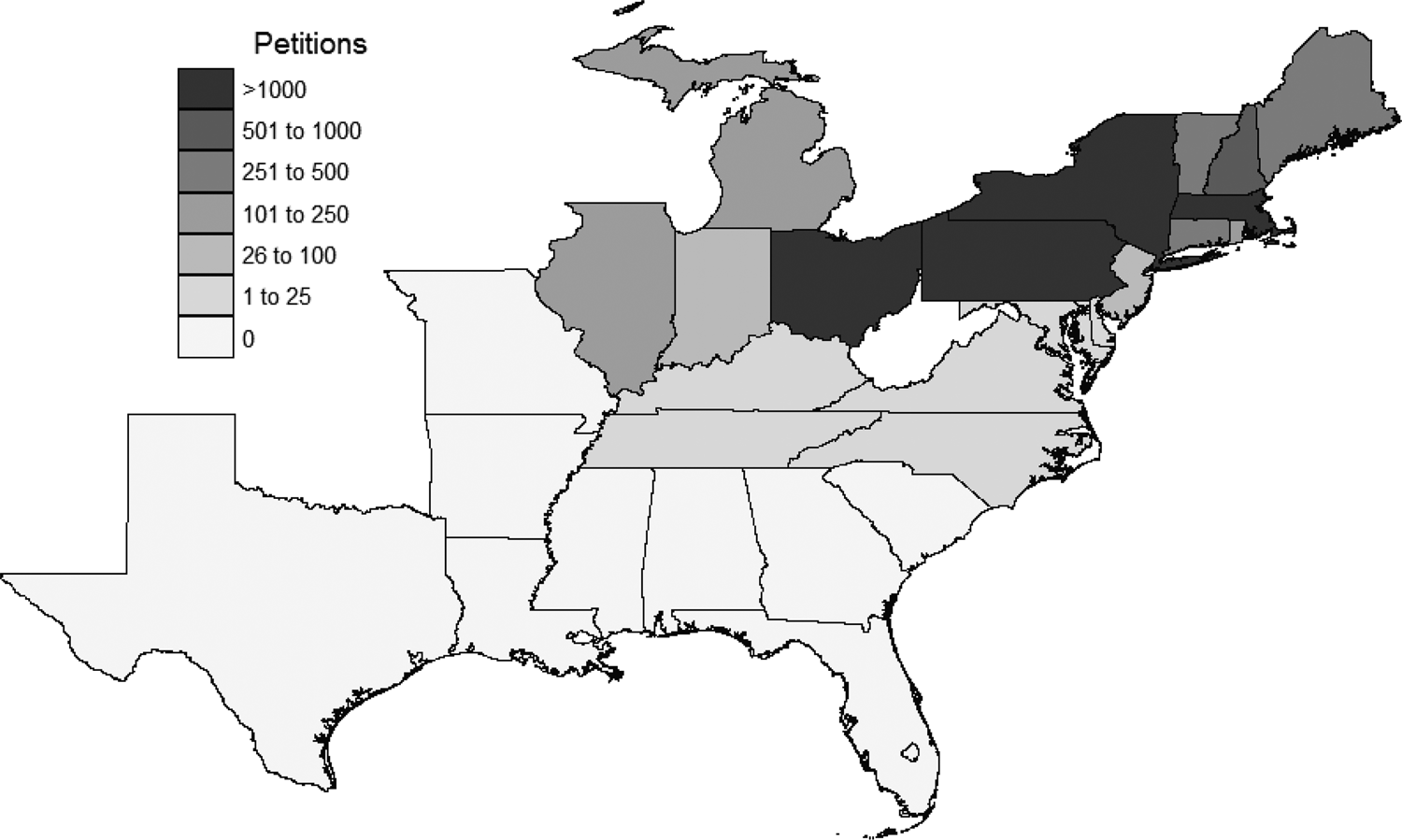
To illustrate the geographic distribution of abolition petition activity in the 1830s and 1840s, Figure 1 maps the United States where states submitting more abolition petitions are shaded darker. In the (eventual) Confederate South, petitions were extremely rare (Tennessee, North Carolina, and Virginia) or altogether nonexistent (South Carolina, Alabama, Mississippi, Arkansas, Georgia, Louisiana, and latecomers Texas and Florida). In the border states of Delaware, Kentucky, and Maryland, petitioning activity was somewhat more prevalent, but not so in Missouri. By far the most petitioning activity occurred in Ohio, New York, Pennsylvania, and Massachusetts—all with more than a thousand petitions conveyed by the advent of 29th Congress. The remaining New England states and the western states were also quite active.
Geographic Distribution of Abolition Petitioning Activity, 1833–45.

Next, we investigate whether senators’ voting behavior mapped onto this geographic pattern. This is not a foregone conclusion, for some have questioned the force of petitions on legislator behavior. For instance, we can look to the words of Henry Clay, who “got rid” of a petition by residents of Lewis County, Kentucky to abolish slavery in the District of Columbia because he was “quite sure these petitions do not express the sentiment of any large number of persons in the county from which they come, or any other county in Kentucky.”Footnote 105 Aaron Vanderpoel (J-NY8), trying to assuage Southerners that Northern Congressmen were not blindly faithful to petitions and did not support the right of slaves to petition, stated, “how deceptive is that evidence of public opinion which is derived from petitions” and “Did the number of petitions, and the number of petitioners whose names are paraded to us here, form any just criterion by which to determine their strength?… Sir, you can get thousands of signatures in every community to almost any petition, praying for the most preposterous objects in nature.”Footnote 106 And yet, Sampson Butler (D-SC4) stated, “What, sir, could induce Members of Congress, gentlemen of intelligence and character, to present Abolition petitions to this House, and demand reference to a committee, but being slaves to local opinion?”Footnote 107
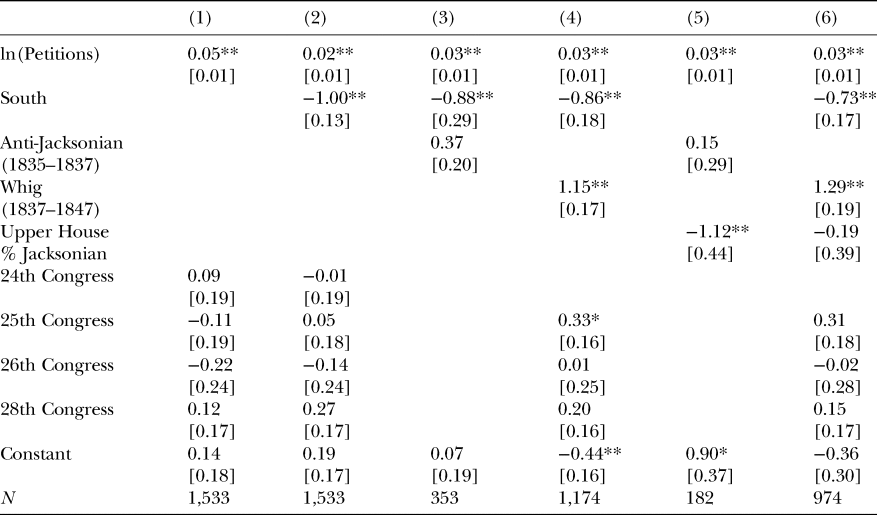
Our first finding is that even though senators in the 1830s and 1840s were not directly elected, their roll call behavior closely corresponded to the perceived abolition preferences of their state's residents as expressed via the petition process (see Table 1). This relationship between petitions and roll call behavior is seen in a bivariate model (model 1), when we account for region (model 2), and when we categorize the data by senators’ party affiliations (models 3 and 4). To directly account for the selection of senators by state legislatures, we also include state legislature party composition, and this does not alter our conclusions (models 5 and 6, with some loss of observations due to missing data).
Abolition Petitions and Senator Roll Call Voting on Slavery Bills

Notes. **p < .01; *p < .05. Cell entries are probit estimates. Clustered standard errors in brackets. Note that columns 3 and 4 do not sum to 1,533 due to a handful of senators not affiliated with the two major political parties. The 29th Congress is the excluded temporal category.
Students of congressional representation may note the absence of a control for senators’ ideologies in these models. Due to the difficulty of measuring legislators’ personal preferences, studies of representation usually do not account for this factor. Some studies do attempt to measure legislator ideology and to incorporate it.Footnote 108 Recognizing the limitations of available measures of senator ideology, we probed the robustness of our models in two ways. First, we added controls for senators’ first- and second-dimension W-NOMINATE scores.Footnote 109 We interpret these scores as the weighted outcome of all potential influences on legislators’ roll call voting patterns on both the economic and most pressing noneconomic dimension of the time, including personal ideology, party pressure, constituent influence, and lobbying. We are mindful of the tautology of modeling “votes with votes,”Footnote 110 but because senators’ W-NOMINATE coordinates are calculated using hundreds of votes and we are using these to model a single vote, and as a control rather than our main explanatory variable, on balance we think the virtue of testing the robustness of our results outweighs the risk to model specification. Upon adding these controls to Table 1, model 2, the parameter estimate for logged petitions is unchanged (.02), and remains statistically significant (p < .001; see Online Appendix). Next, as an additional robustness check following Levitt,Footnote 111 we regressed the W-NOMINATE coordinates on senator party affiliation and state legislative party composition and incorporated the residuals of these models to re-estimate Table 1, model 2.Footnote 112 The parameter estimate for logged petitions in these models (.017) is somewhat smaller than that reported in Table 1 but still statistically significant (p = .03). Note that these models only apply to the Democratic-Whig period when state legislative composition data are available.
Substantively, a senator representing a state with the median number of logged petitions exhibited a 44 percent probability of supporting antislavery legislation, while a senator whose state forwarded 1 standard deviation above the median number of petitions exhibited a 56 percent probability of supporting antislavery legislation. By way of comparison, the probability of a Southern senator supporting these roll calls (17 percent) was about one-third that of a Northern senator (50 percent). Whigs were on balance more supportive of limiting slavery than were congressional and statehouse Democrats; Anti-Jacksonians were not consistently more opposed to slavery than Jacksonian Democrats.
These quantitative conclusions are also reflected in the qualitative history. For example, on February 9, 1939, Thomas Morris (D-OH) shared on the Senate floor: “What sir, can there be to induce me to appear on this public arena.… Nothing, sir, nothing but a strong sense of duty, and a deep conviction that the cause I advocate is just; that the petitioners whom I represent are honest, upright, intelligent, and respectable citizens” (emphasis added).
Ordinarily, we might next conduct a placebo test by modeling antislavery roll call voting prior to the advent of wide-scale petitioning in the 1830s, such as the Missouri Compromise in 1820, using the petitioning behavior that followed. However, in our conceptualization petitions are an indication of antislavery public sentiment, a sentiment that predated the petitions themselves even if we have no good measure of it in 1820. So, we would expect that the petitioning activity in the 1830s would indeed predict roll call behavior in the earlier period (and it does). Instead, as an initial placebo test we controlled for senator voting on the Missouri Compromise (zero supporting, one of two supporting, or both supporting) in our initial model reported in Table 1. Upon doing so, we continued to find that petitioning behavior predicts senator roll call voting.
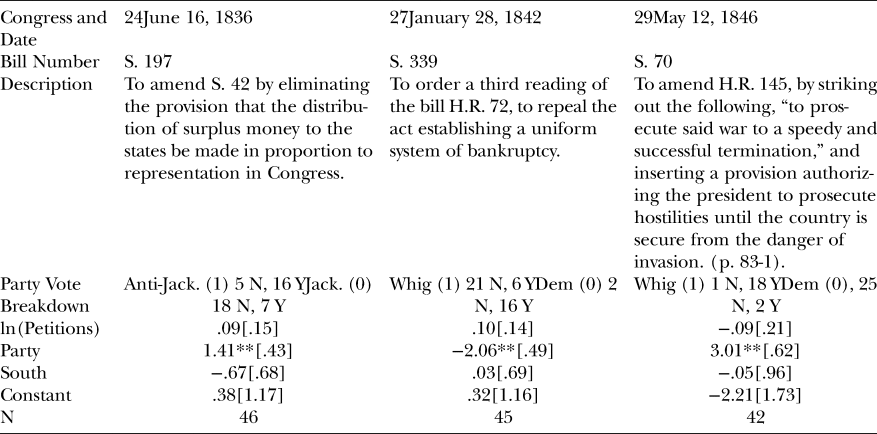
As an alternative placebo test, we modeled votes unrelated to slavery during this period using the logged, population-weighted cumulative petition measure. If abolition petitioning behavior explains senator voting in completely different policy domains, our interpretation of the findings in Table 1 may be erroneous. To examine this possibility, we modeled Senate roll call voting on an amendment to the Act to Regulate the Deposits of Public Money in 1936 (also known as the surplus lands bill), a failed attempt to repeal the Second (1841) Bankruptcy Act, and a bill regarding the war with Mexico (see Table 2). One scholar has described the surplus bill as follows, “No event in the financial experience of the United States government has ever matched the exciting episode centering around the Distribution of the Surplus in 1837.”Footnote 113 Backed chiefly by Northern Whigs, the 1841 Bankruptcy Act followed the Panic of 1839 and the subsequent recession and was the country's second major attempt at a uniform system of bankruptcy. However, the interregional Whig alliance almost immediately broke down, leading to the act's eventual repeal in 1843. We model an early attempt to repeal the act, even before it took effect in February 1842. On May 12, 1846, the U.S. Senate voted to go to war with Mexico. Before final passage, Northern Whigs offered an amendment that would have limited the American role to “repelling the invasion,” which failed by a vote of 20–26. Once that amendment (which we model below) failed, however, most of the Whigs switched their vote to favor the declaration of war.Footnote 114
State Petitioning Behavior Is Not Systematically Related to Nonslavery Roll Call Votes
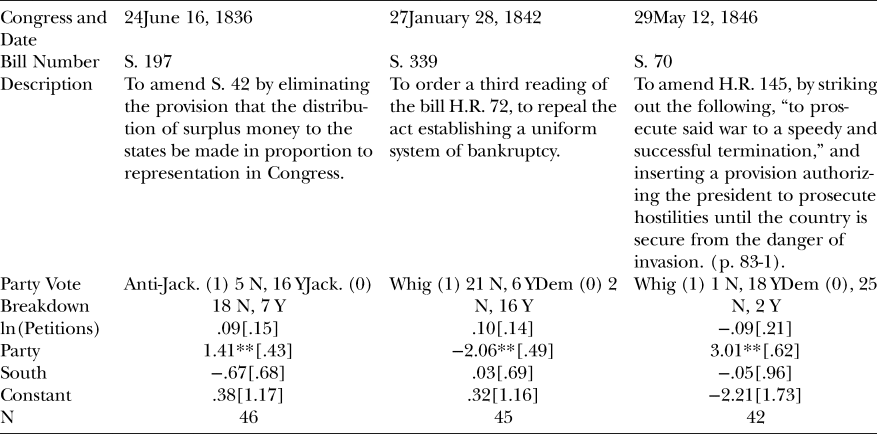
Notes. **p < .01; *p < .05. Cell entries are probit estimates. Clustered standard errors in brackets.
In none of the three placebo models does the abolition petitions measure systematically predict senator voting behavior, accounting for legislators’ party affiliations and their region (South/non-South). These results provide some reassurance that the petitions measure is not proxying some general state sentiment that affects all senator behavior. Finally, note that although the party indicator is statistically significant in all three models, in two of the models there are substantial intraparty divisions, so it is not the case that party affiliations are accounting for all the variance. What is more, if we omit the party indicator from the third (Mexico) model, given the relative rarity of party defections on that vote, state petitioning behavior still is not systematically related to senator voting (p = .30).
In Table 3, we report the results of models that probe for party differences in representation in the models reported in Table 1. When we interacted a Whig indicator with the logged petitions measure, we found that the effect of petitioning activity on senator voting was greater among Whigs than among Democrats. Similarly, when we interacted the Anti-Jacksonian indicator for the early stages of the second party system with the logged petitions measure, we found that the effect of petitioning activity on senator voting was greater among anti-Jacksonians than among Jacksonians.
Senate Party Differences in Representation, Slavery Roll Calls

Notes. **p < .01; *p < .05. Cell entries are probit estimates. Clustered standard errors in brackets. The 29th Congress is the excluded temporal category.
This finding comports with the argument made most famously by Key that one of the tools that the Democratic Party and its Jacksonian forebears employed to protect the institution of slavery was extraordinarily high levels of party cohesiveness on this issue.Footnote 115 Of all the Senate office holders in the South in the second party system, fully 80 percent were Democrats, so it was indeed up to that party to protect the institution of slavery. By comparison, the parties were much more evenly balanced in the North—54 percent Democrats and 46 percent Whigs. Similarly, in the early stages of the second party system, 70 percent of Southern senators were affiliated with the Jacksonian Democratic Party. By comparison, only 51 percent of Northern senators were Jacksonians.
Democrats also voted more cohesively as a party. Despite considerable variation in the petitioning behavior across states represented by Democratic and Jacksonian Democratic senators, the roll call behavior of these senators did not mirror this variation. The standard deviation of Democratic senators’ logged petitions (13.5) actually exceeded the standard deviation of Whig senators’ logged petitions (10.1). Despite Democratic senators’ somewhat more varied constituencies as reflected in these numbers, they were somewhat more cohesive as a party voting bloc. On 76 percent of all votes cast in the 25th, 26th, 28th, and 29th Congresses, Democratic senators adopted the proslavery position; in contrast, on 70 percent of votes cast, Whig senators adopted the antislavery position. In sum, Democrats’ state constituencies were more diverse than were Whigs’ state constituencies, but their roll call voting was more cohesive. Democrats also were not more likely to be “mismatched” with their states—16.7 percent of Whig senators represented states that transmitted no cumulative petitions. By comparison, 15.6 percent of Democrats hailed from states that transmitted more than 1 standard deviation greater than the median number of petitions.
In the early stages of the second party system, Jacksonian Democrats represented somewhat less diverse states (logged petitions had a standard deviation of 5.5, compared to 6.1 for anti-Jacksonians). Compared to this modest difference in the diversity of each party's state coalition, however, Jacksonian Democrats were much more cohesive. Of all votes cast in the 24th Congress by Jacksonians, 71 percent supported the proslavery position. In considerable contrast, of all votes cast by anti-Jacksonians, 53 percent took the antislavery position.
What does this all add up to in terms of the magnitude of the differences in party representation? Democratic senators were about half as representative as were Whig senators (parameter estimates .02 and .04, respectively). This pattern may be related to a greater commitment on the part of radical Whigs to the principle of direct democracy.Footnote 116 Jacksonian Democrats were not systematically representative of state variation in petitioning behavior at all.
4.1. Representation of the Disenfranchised
Our next finding concerns the effect of petition signatory gender composition on senator representation. We know that a variety of disenfranchised groups exercised the right of petition: “Not only the enfranchised population, but also unrepresented groups—notably women, felons, Indians, and, in some cases, slaves represented themselves and voiced grievances through petitions.… The right to petition vested these groups with a minimum form of citizenship: petitioning meant that no group in colonial society was entirely without political power.”Footnote 117 And the Senate took note of petitioner gender—as one example: “Mr. Webster presented twelve petitions of a number of women of the county of Philadelphia, Pennsylvania; … and the petition of a number of women of North Yarmouth, in the State of Maine, severally praying the abolition of the domestic slavetrade [sic].”Footnote 118 However, did senators’ roll call behavior systematically reflect the sentiments of women?
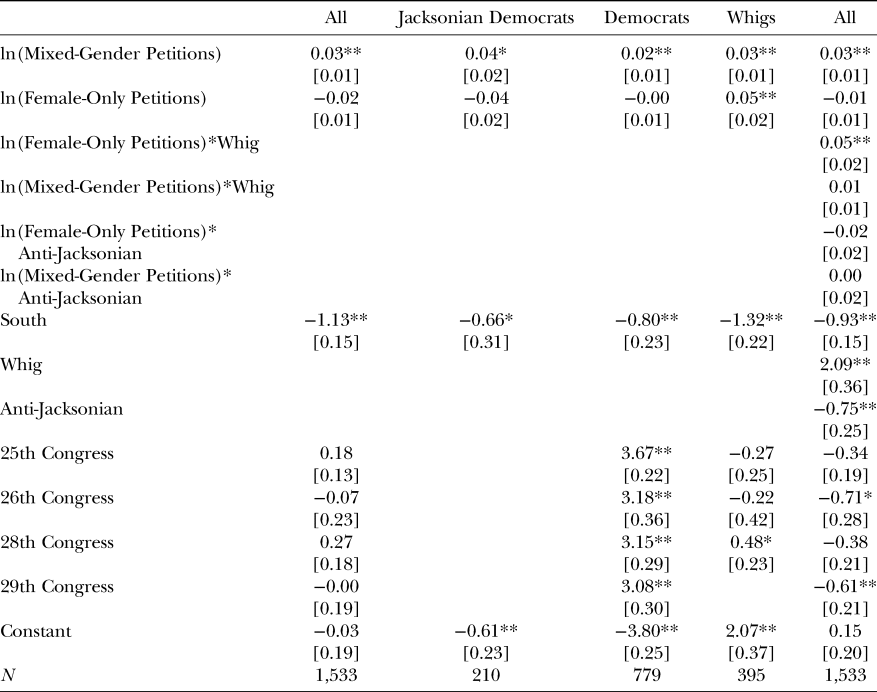
We examine this question by modeling senator roll call decisions using the logged count of population-weighted petitions signed exclusively by women and the remaining logged petitions. We also estimate separate models for each party's senators to account for the possibility that parties might have different expectations about the rewards of cultivating support among women. On first examination, we observe that petitions signed only by women had a lesser impact, holding the total number of petitions fixed (Table 4, column 1). Senators generally appeared to represent mixed-gender petitions but not female-only petitions; indeed, there is some sign that where women-only petitions were more prevalent, senators were less abolitionist in their roll call behavior (p = .055). To probe the robustness of this result given the possibility of collinearity in mixed-gender and female-only petitions, we also modeled senator voting as a function of the difference in mixed-gender and female-only petitions. We found that as the number of mixed-gender petitions increased relative to the number of female-only petitions, senators opposed slavery more, indicating that mixed-gender petitions carried more weight.
Gender Composition of Signatories and Senator Voting on Antislavery Bills
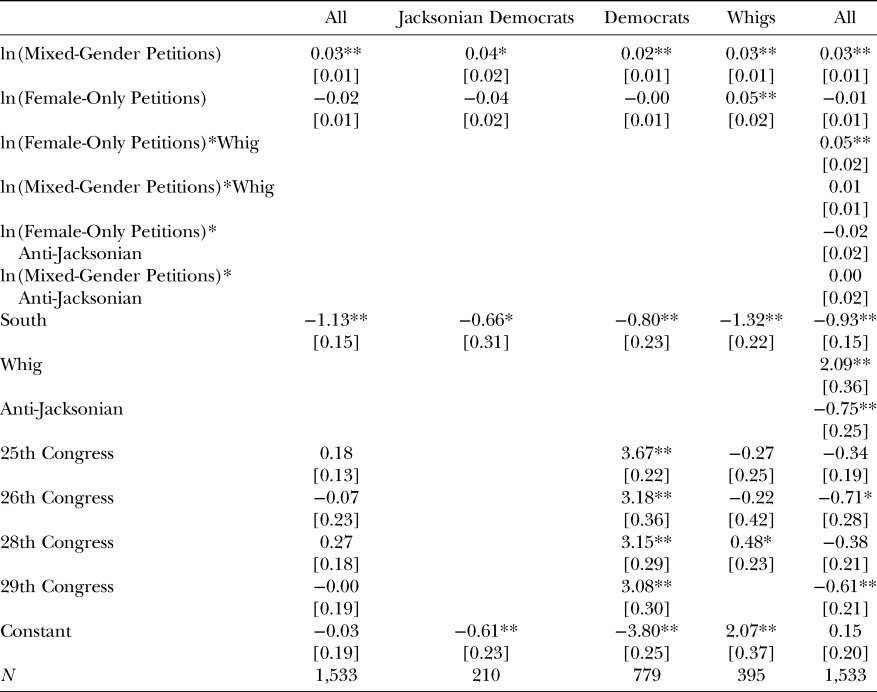
Notes. **p < .01; *p < .05. Cell entries are probit estimates. Clustered standard errors in brackets. For Whigs, the 29th Congress is excluded category. For Democrats, the 24th Congress is excluded category. All roll calls employed in column 2 took place in the 24th Congress.
Turning to the models by party, we observe the same general pattern among both Jacksonian Democratic senators in the 24th Congress (Table 4, column 2) and Democratic senators in the third-party system (column 3). In considerable contrast, Whig senators appeared to represent the preferences of both men and women as expressed via petitions (column 4). This is also borne out in a pooled model with party affiliation and the petitions measure interacted as well as when we modeled senator voting as a function of the difference in the logged count of mixed-gender and female-only petitions (see Online Appendix).
The qualitative record corroborates this pattern. In the House of Representatives, Jacksonian Democrat James Garland (JD-VA7) remarked on the floor, “These women undertake to petition Congress to redress grievances of which they know nothing and of a people to whom they are utter strangers. Yes sir, the grievances of the superstitious, ignorant, and oppressed people of this District are to be poured into our ears by a few school misses and factory maids” (emphasis in original).Footnote 119 Aaron Vanderpoel (J-NY8) spoke of the North having “a few … officious women” (191).Footnote 120 Democrat Henry Laurens Pinckney of South Carolina (D-6) advocated that petitions be discounted when signed by women “with only two or three exceptions, all are signed by women and children. This is a remarkable fact and well worthy of attention. Last year there were upwards of 20,000 male signatures, now we have scarcely anything but female.”Footnote 121 On the other hand, Garrett Dorset Wall of New Jersey, who would vote for Whig Francis Granger for Vice President a month later, remarked to the Senate that all members of the “community” have a right to petition.Footnote 122
That we observe party differences in representation of women's political activity tends to suggest that women's familial relationships to those who are eligible to vote do not explain, or entirely explain, why lawmakers might represent the views of women. The reason, of course, is that women were related to and acquainted with supporters of all the parties. Instead, this pattern of findings comports with the notion that some but not all parties viewed women as potential future voters. As the party more opposed to slavery, the Whig Party could rightly expect that women, if enfranchised, would disproportionately vote for the party, due to greater support for abolition among women.Footnote 123 This may be why the Whigs mobilized women to engage in nonvoting forms of electoral participation, especially during the election of 1840.Footnote 124 After the Log Cabin campaign, which acted as a catalyst for the involvement of women in Whig political activity, women were invited to participate in public events, and their engagement in political discussion was encouraged by prominent party members.Footnote 125 Even in the South, the Whig Party reached out to women and these overtures were met with enthusiasm, as women became active partisans in conventions, parades, and dances.Footnote 126 In contrast, and as reflected in our results, the Democratic Party expressly disapproved of Whig tactics to mobilize women politically and did so well into the mid-1840s.
4.2. Representation of Minority Viewpoints
Finally, these historical data afford us an opportunity to evaluate how the antebellum configuration of electoral institutions facilitated the representation of minority viewpoints. For instance, when they argued against selective consideration of petitions by the House, “Adams and others declared that minority political expression would be silenced if petitioning were confined only to those subjects approved by a majority in Congress.”Footnote 127
Conceptually, senators who represented states fully supportive of slavery (zero petitions) who nevertheless were not uniformly supportive of slavery in their voting behavior constitute one group of officials representative of minority viewpoints, a group we might admire because a consensus among the public eventually developed opposing slavery. Indeed, some have defined a pattern of this sort as “true leadership.”Footnote 128 Senators who represented states that were the most opposed to slavery but who often upheld it in their voting behavior were also reflecting minority viewpoints, albeit views that did not eventually prevail. Turning to our roll call data, we see evidence of both patterns.
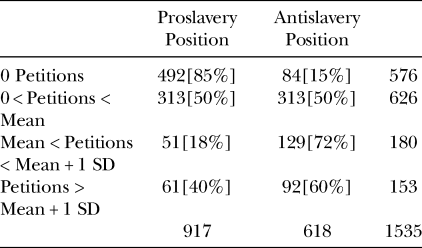
In Table 5, we tabulate state petitioning behavior and senators’ aggregate voting behavior on slavery-related roll calls. We are most comfortable interpreting the data in Table 5 at the extreme values of the petition distribution—where states had no petitions or greater than 1 standard deviation above the mean number of petitions. As Table 1 would suggest, there is plenty of evidence here of representation—senators representing states that transmitted no petitions to Congress cast a vote supporting slavery 85 percent of the time. At the other end of the petitioning spectrum, representation was somewhat weaker but still evident—senators representing states submitting greater than a standard deviation more than the mean number of petitions opposed slavery 60 percent of the time.
Reflection of Minority Viewpoints on Slavery Roll Calls
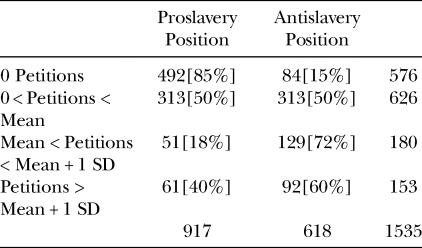
When given the opportunity to represent a minority viewpoint, senators representing states supportive of slavery did so 15 percent of the time (84 of 576 votes cast). One of the senators who repeatedly exhibited this voting pattern was Thomas Hart Benton (D-MO). From 1821 to 1844, Benton “reigned supreme as Kingpin of Missouri politics.”Footnote 129 He was a close advisor to Whig Henry Clay, who was a cousin of Benton's. However, Benton's career took a distinct downturn as the issue of slavery rose to the fore. Though a southerner and slave owner, Benton became “equally opposed to the abolitionists and the secessionists.”Footnote 130 In 1849, he declared himself “against the institution of slavery,” contrary to popular opinion in his state.Footnote 131 In 1851, Benton was denied a sixth term by the Missouri legislature; the polarization of the slavery issue had made it impossible for a moderate and unionist to hold that state's senatorial seat.Footnote 132 In 1852, he successfully ran for the United States House of Representatives, but his opposition to the Kansas-Nebraska Act may have led to him being turned out of office in 1854. He ran for governor of Missouri in 1856, but lost.Footnote 133
Returning to Table 5, senators representing more abolitionist states cast votes supportive of slavery 40 percent of the time. Two senators who repeatedly exhibited this voting pattern would go on to become president of the United States. The first, James Buchanan (D-PA), represented a state that forwarded 679 abolition petitions prior to his service in 25th Senate. Said Buchanan, “We have just as little right to interfere with slavery in the South, as we have to touch the right of petition.”Footnote 134 The other senator was Frankin Pierce (D-NH). There were 504 petitions submitted by New Hampshire residents prior to his service in the 25th Congress. Nevertheless, when abolitionists proposed that slavery end in the District of Columbia, where Congress had jurisdiction, Pierce supported a resolution by John C. Calhoun against this proposal, which Pierce considered a dangerous stepping stone to nationwide emancipation.Footnote 135
Why Buchanan and Pierce supported the institution of slavery is a matter of some debate. What appears to be the prevailing view is that, needing Southern support for their ambitions to secure the Democratic Presidential nomination, Buchanan and Pierce both ended up reflecting minority viewpoints in their states. That is, their voting was strategic. Another view is that both Buchanan and Pierce had consistent, well-articulated, and sincere stances not to disrupt the institution of Southern slavery. For our purposes, we need not get to the bottom of this. What we do know is that whether it be principle or ambition, minority views in Pennsylvania and New Hampshire were reflected in their senators’ roll call behavior even if, in time, these men would be adjudged to be on the losing side of history.
5. CONCLUSION
The findings we report advance our understanding in a number of domains. For scholars of democratic representation, or the reflection of perceived majority views in policy, the electoral connection, it appears, can overcome many obstacles. While other studies reach the same conclusion,Footnote 136 ours is the first study of congressional representation in the 1800s to employ attitudinal measures of public opinion. One contemporary implication of this finding is that if current advocates of the 17th Amendment's repeal surprisingly prevail, Senate representation may be diminished, but we would not expect that it would altogether disappear.Footnote 137
For scholars of political incorporation of the disenfranchised, we have learned that the influence of women's nonelectoral political engagement prior to the 19th Amendment could be considerable. Influence varied substantially by party, however. Only the Whigs represented both women and mixed-gender petitions, as we might have expected given the party's mobilization of women in the second-party system. Even disenfranchised constituents can affect the behavior of elected officials through other forms of political participation. Perhaps because nonvoters and those without voting rights are potential voters, elected officials are incentivized to assess the benefits of being attentive to their concerns.
Our finding that minority viewpoints were represented in this story is a reminder that in order to identify representation of perceived minority viewpoints, it is important to take the long view. That is, even if in a particular vote the minority view is (by definition) on the losing side, after history has played out, minority views can become majority views, and the public officials who championed them from the start can be said to have “shirked”Footnote 138 in a manner that we might find laudable in hindsight.Footnote 139
Our findings also have implications for our understanding of the political development of the United States. First, in parsing the degree and kind of representation delivered by Congress during the Jacksonian period, this study sheds light on the course of American political development. Our finding that citizens’ antislavery views were represented in the 1800s Senate raises questions about the effects of electoral institutions on representation and specifically the necessity of direct elections for legislative responsiveness. That is, other studies claim that the pre-17th Amendment Senate was less responsive to the public than was the chamber was after 1913.Footnote 140 That may be true, but we show that it would be a bridge too far to say that it was not responsive to citizens at all.
Our study also speaks to how the political construction of social divisions has altered the American liberal democratic regime. The failure to extend political rights to women until 1920 stands as one of the greatest stains on America's political development. Prior studies had shown that despite being disenfranchised, women participated in nonelectoral political activities in the 1800s.Footnote 141 Our finding that women's antislavery attitudes expressed via petitions were represented by Whig senators suggests that not only did women learn political skills and develop valuable networks as abolition canvassers,Footnote 142 women experienced their participation being effectual. This may have enhanced women's sense of external efficacy and boosted their desire to become enfranchised.Footnote 143 It would not be surprising then if this experience contributed to women seeking full enfranchisement in the decades to come.
Our finding that minority viewpoints are sometimes represented, particularly by ambitious politicians, illustrates one pathway by which public policy evolves. If the office an ambitious politician seeks is elected by a constituency with a majority opinion that differs from her current constituency, in trying to appeal to the new constituency, the politician will be representing the minority view from the perspective of her current constituency. This behavior, combined with the effect of elite position taking on public opinion, also known as opinion leadership, can alter public opinionFootnote 144 and eventually spur change in policy.
As for future research that this study invites, scholars wanting to dig deeper into the phenomena examined herein could analyze the effect of petitions in state legislatures such as Massachusetts, where Carpenter has collected the data.Footnote 145 Or scholars might examine how much the reflection of majority, disenfranchised, and minority viewpoints we observe today turns on the current configuration of formal and informal electoral institutions. Future work could also investigate other policy domains using a similar approach. We also invite scholars to examine the political influence of other disenfranchised and minority viewpoints in America's political development.
Supplementary material
The supplementary material for this article can be found at https://doi.org/10.1017/S0898588X20000097
Appendix
Senate Roll Call Votes Employed in Study