Catecholaminergic polymorphic ventricular tachycardia is a rare entity that can occur in children without cardiac disease and with a normal QT interval. It can cause syncope, convulsion, and sudden death during physical activity or emotional distress.Reference Leenhardt, Lucet, Denjoy, Grau, Ngoc and Coumel1–Reference Leite, Ponzi Pereira, Alessi and de Paola4 The arrhythmia is characterized by polymorphic ventricular tachycardia, which can reproducibly be induced during exercise or by infusion of catecholamines.Reference Celiker3 The tachycardia mainly appears in childhood, with the mean age at the onset of symptoms reported as 8 years.Reference Leenhardt, Lucet, Denjoy, Grau, Ngoc and Coumel1, Reference Celiker3, Reference Francis, Sankar, Nair and Priori5, Reference Lahat, Eldar and Levy-Nissenbaum6 Familial occurrence is common, and characterized by autosomal dominant inheritance.Reference Sumitomo, Harada and Nagashima2, Reference Francis, Sankar, Nair and Priori5 Approximately one-third of patients have a family history of sudden death or exercise-induced syncope.Reference Sumitomo, Harada and Nagashima2, Reference Francis, Sankar, Nair and Priori5 We report here the clinical features, treatment, and clinical follow-up of 16 children with this diagnosis, emphasizing the potentially fatal nature of the disease.
Material and methods
We evaluated the clinical features, treatment, and clinical follow-up of 16 children with the diagnosis of catecholaminergic polymorphic ventricular tachycardia seen between 1995 and 2007.
Physical examination, telecardiography, echocardiographic examinations, and laboratory tests were normal in all patients. After routine laboratory evaluation with resting electrocardiography and 24-hour Holter monitoring, the diagnosis was confirmed by treadmill exercise testing and infusion of isoproterenol. The patients were subsequently followed by electrocardiography, clinical evaluation, Holter monitoring and treadmill exercise testing at each appointment.
The heart rate, along with the corrected measurement of the QT interval, was obtained from the resting electrocardiogram. We evaluated ventricular and atrial ectopies, along with the length and frequency of attacks of the tachycardia, as they occurred on Holter monitoring. The treadmill exercise test was controlled manually to achieve maximal heart rate. We looked for the heart rates at which the ventricular ectopies and the polymorphic ventricular tachycardia started. We also observed disappearance of these features during the phase of recovery as the heart rate decreased. We also looked for any atrial tachycardia seen during treadmill exercise testing.
We performed electrophysiological studies in 7 patients. We placed two electrode catheters during the study, achieving programmed stimulation in the right atrium and the apex and outflow tract of the right ventricle during the basal state and after infusion of isoproterenol. We performed the isoproterenol test in all patients. We started isoproterenol to achieve the maximal heart rate and observed ventricular ectopies and polymorphic ventricular tachycardia at a dosage of 0.001 microgram/kilogram/minute and increased to 0.005 microgram/kilogram/minute. When ventricular tachycardia appeared, we immediately stopped the infusion, observing the patient until the ventricular tachycardia had stopped and the ectopies had disappeared.
After making the diagnosis, we commenced treatment with propranolol in order to decrease the maximal heart in all patients. Dosage started with 2 milligram/kilogram/day, and increased to 4 milligram/kilogram/day according to the clinical findings and the results of exercise testing and Holter monitoring. The criterion for effectiveness was a blunted response of the heart rate to less than 120 beats per minute, and a significant decrease, or even the disappearance, of the ventricular tachycardia on exercise, and disappearance of the attacks of ventricular tachycardia during Holter monitoring. We switched to verapamil when propranolol was ineffective. If there is no response to verapamil, a combination of beta-blockers was used. If this therapy also failed we started nadolol therapy, since nadolol is not readily available in our country. In cases of poor compliance of the patient to multidrug therapy, we changed propranolol with atenolol, since the latter agent can be given as a single dose during the day. We implanted a cardiac defibrillator if we could not control the disease with the combination of beta-blockade and blockage of the calcium channels, and in those patients with frequent attacks of polymorphic ventricular tachycardia and a bad family history.
Results
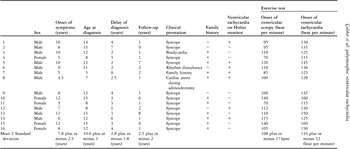
We diagnosed 16 children, 11 boys and 5 girls, with catecholaminergic polymorphic ventricular tachycardia. Age of onset of symptoms was 7.8 plus or minus 2.5 years, with a range from 4.5 to 12 years, and a median age of 8 years. The mean age of the patients was 10. 6 plus or minus 3.5 years, with a range from 5 to 15 years, and a median age of 11.5 years, at the time of diagnosis. The delay between the appearance of symptoms and diagnosis was a mean of 2.8 plus or minus 1.8 years, with a range from zero to 7 years, and a median of 2 years. The patients were followed over a period of 2.5 plus or minus 2 years, with a range from 1 to 9 years (Table 1).
Demographic properties and clinical and labarotory findings of patients.

Initial clinical presentations of patients were syncope in 11 patients, family history with catecholaminergic polymorphic ventricular tachycardia in 3 patients, and bradycardia and cardiac arrest during adenoidectomy each in 1 patient. Of the patients, 7 (44%) were initially considered to be epileptic, and were treated as such for several times without control of the attacks. Family history was positive in 12 patients (75%), albeit that 5 of the patients came from 2 families.
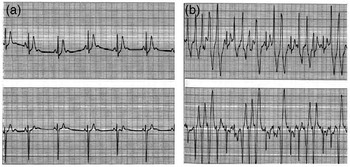
Resting electrocardiography (Fig. 1)
Bradycardia according to ages was present in 10 patients, with a heart rate on the resting electrocardiogram between 45 and 60 beats per minute. Measurements of the corrected QT interval were between 360 and 440 milliseconds. There were no ectopic beats noted during resting electrocardiography.
The electrocardiogram (a) in a 15 year-old child with catecholaminergic polymorphic ventricular tachycardia shows bradycardia according to his age. The corrected QT interval is 410 miliseconds. The treadmill exercise test of the same patient (b) induced polymorphic ventricular tachycardia.

Holter monitoring
The mean heart rate of the patients was 74 plus or minus 13 beats per minute. During monitoring, we observed short runs of polymorphic ventricular tachycardia in ten patients (62.5%). Premature ventricular contractions were noted in all of them, albeit at low frequency.
Treadmill exercise testing (Fig. 1)
Polymorphic ventricular tachycardia was inducible in all patients, albeit that bidirectional ventricular tachycardia was not seen in any patient. We observed that ventricular ectopies started at a mean heart rate of 108 beats per minute, with a range from 70 to 140 beats per minute, and that ventricular tachycardia started at a mean heart rate of 134 beats per minute, with a range from 115 to 160 beats per minute.
Electrophysiologic study
In the 7 patients in whom we performed electrophysiological studies, we were unable to induce any atrial or ventricular tachycardia with programmed stimulation at basal state. We did not perform electrophysiological studies in the other patients because of definite clinical findings and family history.
Genetic study
We detected a mutation in RyR2, specifically Ala 2498 Val in exon 49, in a child who was found dead in his bed at the age of 15 years whilst being treated with propranolol. Genetic studies of the other patients are incomplete.
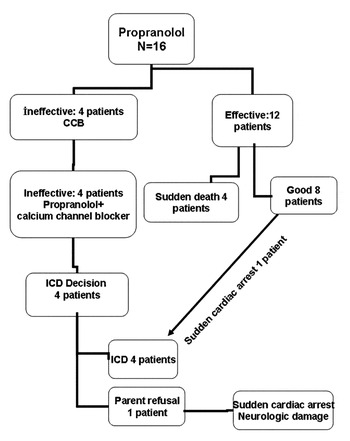
Treatment and Follow-up (Fig. 2, Table 2)
Pharmacologic treatment. During the follow-up, the syncopal attacks disappeared in 12 of the patients subsequent to adjustment of the dosage of propranolol on the basis of exercise testing. During the period of follow-up, one patient experienced syncope, and another 3 had long attacks of polymorphic ventricular tachycardia during exercise testing. We changed propranolol to verapamil in these patients, but we were unable to control the attacks of ventricular tachycardia, so we combined verapamil with propranolol. Despite this, in 1 of these patients we were still unable to control the tachycardia with combination therapy, so we implanted a defibrillator. In this patient, we started nadolol and stopped the other drugs. After treatment with nadolol, we achieved good control both on exercise testing and Holter monitoring.
Algorithm for the treatment of catecholaminergic polymorphic ventricular tachycardia.

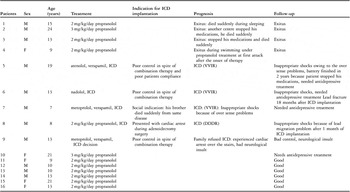
Current form of treatment modalities and prognosis of patients.

ICD: intracardiac defibrillator; M: male; F: female; mg/kg: milligram/kilo.
)
Implantation of defibrillators. During follow-up, we implanted cardioverter-defibrillators transvenously in 4 patients. The indications were poor control of the tachycardia in spite of combined treatment in 2, cardiac arrest during adenoidectomy in 1, and as primary prophylaxis in the other. Of these children, 1 was 6 years old at the time of implantation. We decided to implant the defibrillator in this child since his brother had died suddenly when he was 13 years old, and his parents were very anxious. In another patient with severe attacks of ventricular tachycardia despite combination treatment, we recommended implantation of a defibrillator, but the family did not accept our recommendation.
We observed appropriate shocks in 3 patients. Replacement of the battery was needed in 1 patient after 2 years due to poor response to drug treatment and frequent shocks. Another patient had appropriate shocks because he was very active during the day, and experienced attacks of ventricular fibrillation. We also observed inappropriate shocks in 3 of the 4 patients with implanted defibrillators. These were due to oversensing of the T waves and a response to high heart rates in 2 patients. We controlled them by sensitivity programming and adjusting the device to work only during ventricular fibrillation. One of these patients again suffered inappropriate shocks 18 months after implantation because of lead fracture. The last patient experienced inappropriate shocks because of migration of the lead one month after implantation. In both these patients, we extracted the lead and revised the procedure. Because of the aesthetic concerns, and multiple shocks, all patients with implanted defibrillators experience signs of depression and anxiety, and required psychological support.
Death and sudden cardiac arrest. Of our patients, 4, 3 male and 1 female, died suddenly, giving a rate of mortality of 25%. Of this group, 1 patient died suddenly after the discontinuation of the treatment in another centre at the age of 24. Another discontinued propranolol himself, and was found dead at the age of 15 years. A third patient was found dead in bed at the age of 15, with a good control noted using treatment with propranolol. The final patient died during swimming at her first attack after the onset of treatment with beta-blockers.
Another patient suffered a sudden cardiac arrest. This was a 13 year old boy, with bad control with combination treatment. The decision had been made to implant a defibrillator when he suffered a cardiac arrest while climbing stairs in school. He was successfully resuscitated, albeit suffering severe neurological damage.
Discussion
In this study, we report 16 children with clinical findings of catecholaminergic polymorphic ventricular tachycardia. This tachycardia is one of the most malignant ventricular arrhythmias.Reference Massin, Leroy, Mission and Lepage7 The patients all experienced syncope related to exercise and or emotion. The best therapeutic approach is control of the increased heart rate using beta-blockers.Reference Leenhardt, Lucet, Denjoy, Grau, Ngoc and Coumel1–Reference Celiker3 Nadolol, a long-acting beta-blocker, is a useful drug for prevention of polymorphic ventricular tachycardia, and has been very effective clinically.Reference Francis, Sankar, Nair and Priori5 This treatment may prevent polymorphic ventricular tachycardia during exercise and real life.
Recent experience has revealed a genetic origin for the disease, with descriptions of mutations of RyR2 with autosomal dominant inheritance, and CASQ2 in autosomal recessive forms.Reference Fischer, Krikler and Haalidie-Smith8 We detected a mutation in RyR2 in a child who was found dead in his bed at the age of 15 years under propranolol therapy. Although genetic studies of our patients are not complete, the positive family history supports a genetic origin for the disease. Familial occurrence has been noted in about one-third of the cases.Reference Leenhardt, Lucet, Denjoy, Grau, Ngoc and Coumel1 We found a significantly higher family history, probably because 5 of our 16 children were from two families.
Syncope related to exercise or emotion is key to the diagnosis in the absence of structural cardiac disease and prolongation of the QT interval.Reference Leenhardt, Lucet, Denjoy, Grau, Ngoc and Coumel1, Reference Lahat, Eldar and Levy-Nissenbaum6 The tachycardia occurs during exercise, and if it deteriorates to ventricular fibrillation, then syncope occurs. Sudden death and ventricular fibrillation may occur in untreated patients. In our study, all patients experienced syncope related to exercise. The syncopal attacks usually start after the age of three.Reference Leenhardt, Lucet, Denjoy, Grau, Ngoc and Coumel1 Our smallest patient experienced the first attack at the age of four. As with an earlier study,Reference Leenhardt, Lucet, Denjoy, Grau, Ngoc and Coumel1 half of our patients had previously been treated with the diagnosis of epilepsy. Since the tachycardia is a potentially lethal disease, and responds well to beta-blockers in most cases, delay of diagnosis after the onset of the symptoms must be avoided.Reference Francis, Sankar, Nair and Priori5 To prevent misdiagnosis, and to ensure adequate treatment, every effort must be made to make an early diagnosis, as otherwise this disease is highly fatal.
Resting electrocardiography shows a normal QT interval in all patients,Reference Leenhardt, Lucet, Denjoy, Grau, Ngoc and Coumel1, Reference Celiker3, Reference Lahat, Eldar and Levy-Nissenbaum6, Reference Massin, Leroy, Mission and Lepage7 with the interval failing to prolong during exercise testing.Reference Leite, Ponzi Pereira, Alessi and de Paola4 These electrocardiographic findings allow differential diagnosis from congenital long QT syndromes, since exercise-induced bidirectional ventricular tachycardia or catecholaminergic polymorphic ventricular tachycardia is the same clinical entity in both cases. Bradycardia is a common finding in patients with catecholaminergic polymorphic ventricular tachycardia. Up to two-thirds of patients have signs of sinus bradycardia on resting electrocardiography. This may well be misdiagnosed as sick sinus syndrome, with implantation of a pacemaker mistakenly recommended. For definite diagnosis, it is also necessary to exclude structural cardiac disease.Reference Leenhardt, Lucet, Denjoy, Grau, Ngoc and Coumel1, Reference Celiker3, Reference Lahat, Eldar and Levy-Nissenbaum6, Reference Massin, Leroy, Mission and Lepage7 This was done in all of our patients.
The main diagnosis depends on the induction of the tachycardia by increasing the heart rate, thus requiring an exercise test or infusion of isoproterenol. The ventricular ectopy gradually turns to polymorphic ventricular tachycardia during these tests. Infusion of isoproterenol can also be achieved during electrophysiological study. The latter study, however, is not necessary for diagnosis, because programmed stimulation does not induce the tachycardia.Reference Fischer, Krikler and Haalidie-Smith8 We performed electrophysiologic study in 7 of our patients, without inducing the tachycardia in any. An association has been noted of atrial arrhythmias and sinus nodal dysfunction in patients with the tachycardia,Reference Sumitomo, Harada and Nagashima2 although we could not induce any atrial tachyarrhytthmia by atrial programmed stimulation in our electrophysiologic studies.
The effectiveness of beta blockade is well described.Reference Leenhardt, Lucet, Denjoy, Grau, Ngoc and Coumel1, Reference Massin, Leroy, Mission and Lepage7 The criterion for effectiveness is a blunted response of the heart rate, with a significant decrease, or even disappearance, of the ventricular tachycardia during exercise, and disappearance with the attacks of the tachycardia during Holter monitoring if they were present before the onset of therapy. The goal is to reduce the heart rate below 120 beats per minute during maximal exercise.Reference Celiker3 This may prevent the tachycardia caused by an increase of catecholamines during exercise and real life. The disadvantage of this method of treatment is the chance of an attack occurring when a single dose of the drug is missed.Reference Leenhardt, Lucet, Denjoy, Grau, Ngoc and Coumel1, Reference Celiker3 Poor compliance of the patients to pharmacological therapy may also be a reason for an incomplete therapeutic result. Of our patients, 2 died suddenly because of drug withdrawal. Another patient on beta-blocker therapy died whilst swimming, and yet another receiving beta-blockers died suddenly in his bed. Although the family is not sure that he took his medication at that day, we must also consider nonmedical treatments.
Some studies have shown the beneficial effects of verapamil. Calcium channel blocking drugs suppress both the exercise-induced ventricular ectopy and the polymorphic ventricular tachycardia.Reference Leenhardt, Lucet, Denjoy, Grau, Ngoc and Coumel1 It has been suggested that beta-blockers and calcium channel blockers could be better than beta-blockers alone for preventing exercise-induced arrhythmias.Reference Rosso, Kalman and Rogowski9 During the follow-up of our 4 patients with inappropriate results on propranalol, we switched the treatment to verapamil. Single therapy with verapamil was not effective, so we added beta-blockers. Such combination therapy remained ineffective in 3 of the patients. Nadolol, a long acting beta-blocker, is a useful drug for prevention of polymorphic ventricular tachycardia, and has been very effective clinically.Reference Francis, Sankar, Nair and Priori5 In one patient resistant to combined therapy, therefore, we started nadolol as a single drug and obtained good control.
Implantation of defibrillators is infrequent in children, since the incidence of sudden cardiac death is very low compared to adults. The major indication in children is mostly structural cardiac diseases, but disorders of the cardiac ion channels are becoming increasingly important as an indication. If an electrical disorder, such as polymorphic ventricular tachycardia, can easily cause ventricular fibrillation, implantation of a defibrillator in combination with treatment with beta-blockers or calcium channel blockers may well be the best choice.Reference Priori, Napolitano and Memmi10 There is no data about follow-up, complications, and problems in programming defibrillators in children with catecholaminergic polymorphic ventricular tachycardia, although appropriate shocks were reported in half one group of patients followed over a period of two years with beta-blocker resistant catecholaminergic polymorphic ventricular tachycardia.Reference Priori, Napolitano and Memmi10 The possibility of inappropriate discharge is higher in children, and the need for the defibrillator over a lifetime exacerbates the problems of the lead and generator. Maximally tolerated doses of beta-blockers should be used to reduce the number of shocks, and the possibility of inappropriate shocks and arrhythmic storms.Reference Leenhardt, Lucet, Denjoy, Grau, Ngoc and Coumel1, Reference Celiker3 We experienced inappropriate shocks in three-quarters of our patients with implanted defibrillators. It is also important to control the heart rate when programming the defibrillator. Adjusting the device to respond only to defibrillation may prevent inappropriate shocks and arrhythmia storms. Inappropriate shocks are very distressing in these patients, with our patients experiencing depression and anxiety. The patients need psychiatric support both during the follow-up, and before and after implantation of the defibrillator. Home usage of an external automatic defibrillator should be considered in small children for this purpose.
The estimated mortality of untreated cases of catecholaminergic polymorphic ventricular tachycardia ranges between 30 and 50% before the age of 20 to 30 years.Reference Sumitomo, Sakurada and Taniguchi11 The rate of mortality in our experience was 25%, as with another study.Reference Sumitomo, Harada and Nagashima2 The reasons for death were similar. Patients and their families must be well-informed about the disease, and the need to use medications, with details given of the potential side effects. Patients must be convinced to live a sedentary life, and always to take their medications at appropriate times. Physicians must determine accurately the time for implantation of a defibrillator, since the outcome may prove fatal if the decision is made too late. We emphasize the potentially fatal nature of the disease. Elective implantation of intracardiac defibrillators in teenagers, particularly in the setting of bad family history, can prevent sudden death. Males may have a worse prognosis compared to females.
In conclusion, the catecholaminergic polymorphic ventricular tachycardia must be considered in the differential diagnosis of syncope in children without cardiac disease and with a normal QT interval, especially when episodes of syncope are related to physical effort or emotion. Medical treatment with beta-blockade may decrease the incidence of the arrhythmia. Implantation of cardioverter defibrillators must be considered in the treatment, especially in adolescent male patients. Delay in diagnosis, and inadequate therapy, can result in sudden cardiac death.