I. INTRODUCTION
Al–Zn–Mg–Cu alloys, especially 7075 alloy, have been generally applied to aviation industry due to their satisfactory mechanical properties. Reference Ma, Wen, Hu, Topping, Isheim, Seidman, Lavernia and Schoenung1–Reference Rajakumar and Balasubramanian4 Because of the limit on solid solubility, gain size and so on, it is difficultly to be increased that the strength of 7075 alloys prepared by conventional casting technique until spray forming was used on 7075 alloy in 1990s, Reference George and Knutsen5–Reference Hu, Ma, Topping, Schoenung and Lavernia8 the strengths are elevated to over 730 MPa. Reference Su, Qu, You and Li9–Reference Shi, Yan, Su, Chen, Zhu and Chen12
Many papers have reported the effects of heat treatments on 7075 alloys which belong to aging strengthening aluminum alloy. Silva et al. Reference Silva, Rivolta, Gerosa and Derudi13 and Ricker et al. Reference Ricker, Lee, Taylor, Lei, Pregger and Lipnickas14 report that the both high strength and corrosion sensibility are improved in 7075 aluminum alloys after T6 treatment. Zhang et al., Reference Zhang, Chen, Zhu, Chen, Zhai and Guo15 Fooladfar et al., Reference Fooladfar, Hasnemi and Younesi16 and Arnold et al. Reference Arnold, Schubbe, Moran and Bayles17 find the loss of strength of about 10–15% after T73, T74, or T76 treatment in their studies of over aging on corrosion resistance of 7075 alloys. To solve the contradiction between strength and corrosion resistance, Cina Reference Cina18 present a three-stage treatment (retrogression and re-aging, RRA). In next researches, Peng et al. Reference Peng, Chen, Chen and Fang19 and Reda et al. Reference Reda, Abdel-Karim and Elmahallawi20 find that the strength can be maintained at T6 level by RRA treatment and the stress corrosion resistance is close to T7 at the same time. Su et al. Reference Su, Qu, You and Li21,Reference Su, Qu and Li22 report the RRA treatment can also improve the intergranular and exfoliation corrosion sensibility of a spray formed 7075 alloy.
RRA treatment consisted of pre-aging, retrogression, and re-aging. Ohnishi and Shiota Reference Ohnishi and Shiota23 consider that the peak aging is the best pre-aging in RRA process. And this type of pre-aging has been used until now. In recent years, scholars reported some different opinions. Lin et al. Reference Lin and Kersker24 mentioned that the peak aging is not a perfect pre-aging in a U.S. patent.
In studies on corrosion resistance of Al–Zn–Mg–Cu alloy, it is accepted that because corrosion resistance is positive correlated with electric conductivity, the electric conductivity can reflect corrosion resistance of alloy. Reference Lin and Kersker24 So to offer a data for optimize aging treatments on spray formed 7075 alloy and references for next step research, this paper studies RRA treatment on microstructure, mechanical, and conductivity properties of spray formed 7075 alloy by transmission electron microscope (TEM), tensile test, and conductivity test.
II. EXPERIMENTAL
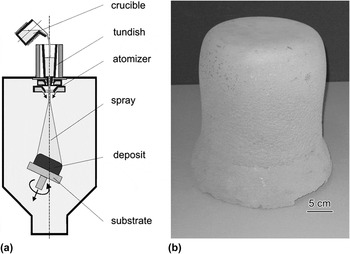
The 7075 alloy with alloying elements of 5.48 wt% Zn, 2.21 wt% Mg, 1.48 wt% Cu, 0.189 wt% Cr, 0.371 wt% Fe, and 0.121 wt% Si were spray formed with atomization gas of nitrogen (N2), spray distance of 370–380 mm, substrate eccentricity of 60–65 mm, conduit bore of 3.6 mm, incidence angle of 37–39°, spray temperature of 770–780 °C, crucible temperature of 735–745 °C, horizontal velocity of 0.15 mm/s, and vertical velocity of 0.18 mm/s. Then resulting bar was extruded at temperature of 400 °C, ratios of 30:1, and feeding rate of 1.5 mm/s (Fig. 1).
The process of spray forming (a) and manufactured 7075 aluminum alloy ingot (b).

The test samples were cut from the as-extruded bar for the two-stage solid solution, i.e., 450 °C for 1 h and 475 °C for 2 h, respectively, after which the samples were water quenched to room temperature. And these samples were variously aged.
The microstructures for the samples after different aging treatments were observed by TEM. The 3 mm diameter disks for TEM observation were punched out directly from samples which were mechanically ground down to 60 μm thickness after aging. These disks were electropolished using a twin-jet electropolisher with a 30% nitric acid solution in methanol at −30 °C.
The tensile samples conformed to ISO 6892-1:2009 with gauge length of 25 mm and diameter of 5 mm were tested by using a universal tensile tester with 10−4 s−1 of strain rate.
III. RESULTS
A. Conventional RRA treatments
In conventional RRA treatments, the peak aging (T6) is usually used to be the pre-aging and re-aging, high temperature and short time are adopted on retrogression. The peak aging for Al–Zn–Mg–Cu alloy is almost at 120 °C for 24 h. Reference Peng, Chen, Chen and Fang19,Reference Islam and Wallace25 Table I show that the tensile properties and conductivities of spray formed 7075 alloy after various aging treatments. Comparing with the T6, T73, and T76 processes from Table I, it can be found that big losses of the strength of the alloy are produced by over aging (T7x) treatments.
Properties of the alloy after different aging treatments.

In conventional RRA treatments, the retrogression temperatures are frequently used at 200–280 °C. Reference Sha and Cerezo26,Reference Berg, Gjønnes, Hansen, Li, Knutson-Wedel, Waterloo, Schryvers and Wallenberg27 The tensile properties of the alloy retrogressed (R) at 200 °C for 10 min and re-aged are listed in Table I. It can be obviously seen that the ultimate tensile strength (UTS) and yield strength (YS) are 758 MPa and 711 MPa respectively, which is very close to the T6 level. Comparing with T6 process, it can be found that the loss of the UTS after T76, T73, and conventional RRA are 11.2, 7.0, and 0.4% respectively.
According to the above-mentioned table, the conventional RRA treatment for spray formed 7075 alloy is pre-aging at 120 °C for 24 h, retrogression at 200 °C for 10 min and re-aging at 120 °C for 24 h. On the basis of this experimental result, all the parameters of the RRA are to be investigated within the next stage.
B. Pre-aging treatments
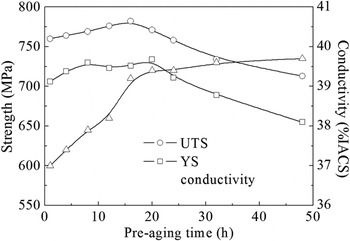
Pre-aging is the first stage of the complicated RRA treatment. In this research, the Pre-aging temperature is set as 120 °C, and then pre-aging time is adjusted. According to above-mentioned retrogression (200 °C for 10 min) and re-aging (120 °C for 24 h) processes, the strengths and conductivities of the alloy after RRA at different pre-aged times are shown in Fig. 2.
UTS, YS, and conductivity curves of the alloy for different pre-aging times.

From Fig. 2, it can be seen that the UTS and YS of the alloy are 782 MPa and 726 MPa respectively and the conductivity is 39.2% international annealed copper standards (IACS) after RRA treatment at pre-aged at 120 °C for 16 h. At this time, these are both peak strength and nice conductivity of the alloy. According to the aforementioned pre-aging treatment (120 °C for 16 h) and the compatible re-aging (120 °C for 24 h), the properties of the alloy during three retrogressions and after corresponding re-aging treatments are tested and exhibited in Fig. 3.
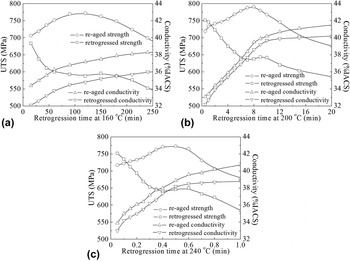
UTS and conductivity curves at different temperature and retrogression time on RRA process: (a) 160 °C; (b) 200 °C; (c) 240 °C.

C. Retrogression treatments
Figure 3 shows the UTS and conductivities of the alloy during retrogression at 160, 200, and 240 °C and corresponding re-aging. From Fig. 3, it can be seen that all the UTS curves of retrogression decline abruptly at first, and then obviously rise after falling to a certain degree, and finally declined again. Three UTS curves during retrogression have the similar characteristics, but the times reached to minimum and peak UTSs are different, which depend on retrogression temperature. Because the diffusion rate of solute and vacancy are positive to correlation with retrogression temperature, which implies the time is shortened by high retrogression temperature.
The UTS curves during RRA are also similar. With the retrogression time extension, the UTS increases firstly and then reduces after peak value. With retrogression temperature increasing, the time reaches to peak UTS is obviously shortened after RRA. And the UTSs are also influenced by retrogression temperature. When the samples are retrogressed at 160 °C, the peak UTS of the alloy after RRA process is 772 MPa. With the retrogression temperature increasing, UTS of the alloy increases gradually. When the samples are retrogressed at 200 °C, the peak UTS of the alloy after RRA process is 791 MPa. And then, when the retrogression temperature is increased to 240 °C, the peak UTS of the alloy after RRA process is only 773 MPa, which is less than that with using retrogression at 200 °C.
It also can be seen that incipiently the conductivities are raised sharply and then flatted gently with the retrogression time extension. And the regularity of conductivities is also influenced by retrogression temperature. When the samples are retrogressed at 160 °C, the rangeability of conductivity is narrow. But as the retrogression above 200 °C, the amplification of conductivity is obvious. The conductivities can be improved to 40% IACS and more.
D. Re-aging treatments
From Fig. 3, it can also be known that the preferable properties of the alloy are obtained at retrogressing at 200 °C for 8 min. With the process of retrogression and aforementioned pre-aging, the effects of re-aging process on temperature and time are investigated in the following, and the properties of the alloy are shown in Fig. 4.
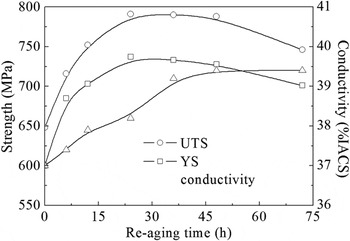
UTS, YS, and conductivity curves of the alloy for different re-aging times.

From Fig. 4, it can be seen that the main effect on properties of the alloy is due to the early stage of the re-aging at 120 °C for 24 h. And in this period, the strength and conductivity of the alloy are increased sharply. Once the alloy re-aged over 24 h, although the properties are retained to a high level and conductivity is still increased, the tensile properties of the alloy and the increased rate of the conductivity all are declined. After re-aging for 72 h, the tensile strength of the alloy is decreased 6% and the conductivity is only increased 1%. It is thus obvious that the 24 h is the perfect time of the re-aging at 120 °C in RRA treatment of the spray formed 7075 alloy.
According to the experimental verification, the mechanical properties and conductivity of spray formed 7075 alloy pre-aged at 120 for 16 h, retrogressed at 200 for 8 min and re-aged at 120 for 24 h are increased simultaneously. The UTS, YS, and conductivity are 791 MPa, 736 MPa, and 39.5% IACS respectively.
Comparing with different temperatures, the mechanical property of the alloy re-aged at 100 °C for 60 h is similar to that at 120 °C for 24 h, e.g., the UTS and YS are 790 MPa and 734 MPa respectively, but the conductivity is only 38.9% IACS. With the re-aging at 140 °C for 12 h, the conductivity of the alloy is reached to 39.8% IACS and the UTS and YS is decreased to 764 MPa and 702 MPa, respectively.
IV. DISCUSSION
There is a closer relationship between the microstructure and properties of Al–Zn–Mg–Cu alloys. The properties of the alloys depend on matrix precipitates (MPt), grain boundary precipitates (GBP), and precipitate free zones (PFZ). According to selecting optimized heat treatment process, comprehensive property can be obtained by a combination of above-mentioned microstructures.
The strength of the alloy mainly relies on MPt during the whole aging process, the strength of the alloy changes with characteristics of Guinier-Preston (GP) zone, η′ and η. The best strength depends on fine homogeneously dispersive MPt. Plasticity, toughness, and corrosion resistance of the alloy are remarkably influenced by structure and chemical property of GBP. There is a popular belief that continuous GBP are harmful to properties of the alloy. Because relative movement of crystalline grains in deformation process has been impeded by continuous GBP, plasticity and toughness of the alloy are completely injured. On the other hand, the continuous GBP are preferentially dissolved as anodes in anodic dissolution. Because the potential of GBP, PFZ, and matrix is −1.05 V, −0.85 V, and −0.75 V respectively, the potential difference (PD) between GBP and PFZ is less than the PD between GBP and matrix. With regard to corrosion resistance of the alloy, widening PFZ can remit the corrosion sensibility and improve corrosion resistance of alloy.
A. Effects of pre-aging on microstructure
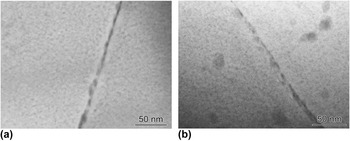
Figure 5 shows the TEM images of the alloy after different pre-aging treatments, from Fig. 5(a), it can be found that the MPt are small and rare after under-aged at 120 °C for 16 h, the precipitation is deficient, and the GBP are small, continuous, and semicontinuous.
TEM images of alloy after different aging treatments: (a) under aged at 120 °C for 16 h; (b) T6, peak aged at 120 °C for 24 h.

The high strengths treated via pre-aging in RRA treatment are always deemed to satisfy the next heat treatment, so the T6 process is usually used to be the pre-aging. But after T6 process (120 °C for 24 h), the MPt are dispersively distributed, most sizes are 1–2 nm, but some big size precipitates are more than 10 nm, which are formed by growing precipitates during aging, as shown in Fig. 5(b), GBP are discrete, but close, like a chain. There are few PFZ at grain boundaries after pre-aging treatments.
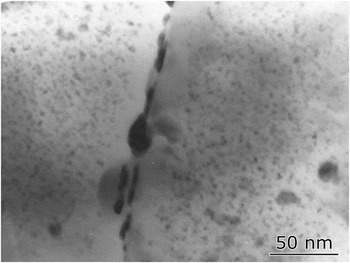
B. Effect of T73 treatment on microstructure
Figure 6 shows the TEM images of the alloy after T73 treatment. From Fig. 6, it can be found that the MPt after T73 process are bigger and more agminated than those after T6 process. Volume fraction of MPt decreases and size of MPt is 3–5 nm. At grain boundaries, GBP are interrupted separately and PFZ are widened to 25 nm. The tensile strengths of the alloy are immediately influenced by size and volume fraction of MPt. After T6 treatment, abundant tiny precipitates keep the UTS at 760 MPa (Table I). After T73 process, because the MPt grow up and volume fraction of precipitates decreases, the UTS of the alloy is only 676 MPa. Because the GBP are preferentially dissolved as anodes, the galvanic corrosions formed by aluminum matrix and continuous GBP lead to bad corrosion susceptibility of the alloy after T6 process. After T73 process, discrete GBP can constitute an obstacle to form the galvanic corrosions and improve corrosion resistance of the alloy. The effects of PFZ still have different opinions in academia. But, as the result of this experiment, wide PFZ can improve corrosion resistance of the alloy. Because the matrix near the grain boundaries is replaced by PFZ, which can improve the PD between the GBP and matrix.
TEM images of the alloy after T73 treatment.

C. Effects of pre-aging and retrogression on microstructure
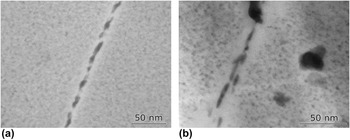
Figure 7 shows TEM images of alloy after retrogression with different pre-aging treatments. With the preaging at 120 °C for 16 h and retrogression at 200 °C for 8 min, the TEM image of the alloy after RRA is shown in Fig. 7(a), it can be seen that most of MPt have been redissolved in matrix after retrogression at 200 °C, parts of GBP have been redissolved, and others grow up along the grain boundaries. GBP are long and discrete. From Fig. 7(b), after pre-aging at 120 °C for 24 h and retrogression at 200 °C for 10 min, the big size MPt have not been redissolved in matrix, conversely, these MPt are aggregated and grown up. The GBP are gradually discrete, but some GBP remained continuous or approximate continuous.
TEM images of the alloy after different pre-aging and retrogression treatments: (a) pre-aged at 120 °C for 16 h and retrogressed at 200 °C for 8 min; (b) pre-aged at 120 °C for 24 h and retrogressed at 200 °C for 10 min.

D. Effects of RRA on microstructure
During the re-aging, there is a common phenomenon called secondary strengthening Reference Fooladfar, Hasnemi and Younesi16 in the strengths of the alloy retrogressed at different temperatures. Because the retrogression temperatures are all higher than pre-aging or re-aging temperatures, parts of the MPt are redissoluted in matrix during retrogression and separated out again at the re-aging treatment.
The strength of the alloy is improved by the small size of the MPt. Because the MPt grow up quickly in a high temperature, the effect of the secondary strengthening on high re-aging temperature is unsatisfactory. And re-aging time is also a main factor in secondary strengthening, the peak strength is reached by reasonable time. If the re-aging time is too short, the MPt are separated insufficiency. If the re-aging time is too long, there are some big sizes MPt in matrix. The strengths of the alloy are all influenced by these aforementioned situations.
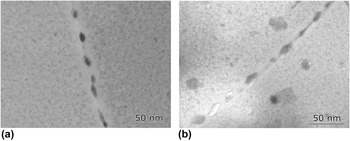
Figure 8 show the TEM images of the alloy after the new RRA and conventional RRA. With the new RRA treatment, the TEM image of the alloy after RRA is shown in Fig. 8(a). From Fig. 8(a), it can be found that the tiny homogeneously dispersive precipitates are separated out again in matrix, which are seemed like Fig. 5(a), but the size of MPt is a little big (about 2 nm). The precipitated phases on grain boundaries are rounded and discrete obviously. The average size and spacing of the GBP are 5–7 nm and more than 10 nm respectively. Those discrete GBP are analogous to those after T73 process and can be constituted an obstacle to form the galvanic corrosions and improve corrosion resistance of the alloy. After the new RRA treatment, the alloy has strength and increased corrosion resistance.
TEM images of the alloy after different RRA treatments: (a) the new RRA, pre-aged at 120 °C for 16 h, retrogressed at 200 °C for 8 min and re-aged at 120 °C for 24 h; (b) conventional RRA, pre-aged at 120 °C for 24 h, retrogressed at 200 °C for 10 min and re-aged at 120 °C for 24 h.

After conventional RRA, as shown in Fig. 8(b), because big size MPt are formed at T6 process and then are sequentially grown up and consumed a part of the alloying elements redissolved during retrogression stage. The quantity, size, and distribution of MPt are not very optimum, comparing with the new RRA treatment [Fig. 8(a)], the strength of the alloy is maintained at a general good level, but this level is really not the best. (e.g., after conventional RRA, the UTS and YS are 758 MPa and 711 MPa; after the new RRA treatment, the UTS and YS are 791 MPa and 773 MPa).
V. CONCLUSIONS
-
(1) After T6 process, the tensile strength of the alloy reaches up to 760 MPa due to abundant tiny precipitates. However because the GBP are preferentially dissolved as anodes, the galvanic corrosions formed by aluminum matrix and continuous GBP lead to bad corrosion susceptibility of the alloy. After T73 process, discrete GBP can constitute an obstacle to form the galvanic corrosions and improve corrosion resistance of the alloy.
-
(2) After conventional RRA process, the alloy has both strengthened and increased corrosion resistance, the tiny homogeneously dispersive precipitates separated out again in grains lead to the tensile strength reach to 758 MPa. And precipitated phases on grain boundaries are thick and discontinuous, which are constituted an obstacle to form the galvanic corrosions. Big size MPt may result in a decline of mechanical property of alloy.
-
(3) The MPt are small and rare, and the GBP are small, continuous, and semicontinuous after under aged at 120 °C for 16 h. After retrogression at 200 °C, most of MPt have been redissolved in matrix, parts of GBP have been redissolved and others grow up along the grain boundaries. After re-aging, the MPt are fine, homogeneous, and dispersive, and GBP are round and discrete. The tensile strength, YS, elongation, and conductivity of the alloy are 791 MPa, 736 MPa, 8.5%, and 39.5% IACS respectively after new RRA treatment with the under pre-aging.
ACKNOWLEDGMENTS
This research was financially supported by the National Natural Science Foundation of China (51574167) and Program for Innovative Research Team in University of Liaoning Province (LT2015020).