Introduction
Late-life depression (LLD) is associated with a more chronic course, higher level of relapses, medical comorbidities, cognitive impairment, treatment resistance, and mortality compared to depression in younger patients.Reference Alexopoulos 1 Older adults with depression show reduced response rates to antidepressantsReference Tedeschini, Levkovitz, Iovieno, Ameral, Nelson and Papakostas 2 and experience more side effects.Reference Álamo, López-Muñoz, García-García and García-Ramos 3 Treatment resistance to first-line pharmacotherapies in LLD ranges from 55% to 81% with remission having been observed in as low as 23%.Reference Alexopoulos 1 , Reference Tedeschini, Levkovitz, Iovieno, Ameral, Nelson and Papakostas 2 , Reference Lenze, Sheffrin and Driscoll 4 –Reference Knochel, Alves and Friedrichs 8 Psychotherapeutic interventions for LLD have not been extensively studied. Although electroconvulsive therapy (ECT) is effective, this procedure is not widely available because of technical challenges, and cognitive side effect being major concern in late life. In this context, there is a pressing need to improve alternative forms of treatment and one of them is repetitive transcranial magnetic stimulation (rTMS).
Although the efficacy of rTMS is clearly established in the adult population with depression, only a few controlled studies have investigated the effects of rTMS in older adults with depression. Initial studies of rTMS in older patients showed highly variable results with response rates ranging from 18% to 58.5%.Reference Sabesan, Lankappa, Khalifa, Krishnan, Gandhi and Palaniyappan 9 –Reference Kaster, Daskalakis and Noda 11 Initial randomized controlled trials (RCTs) concluded that age was a poor predictor of response, with lower response rates in elderly patients.Reference Jorge, Moser, Acion and Robinson 12 , Reference Mosimann, Schmitt and Greenberg 13 Recent systematic review which included 7 RCTs and 7 uncontrolled trials found substantial variability in clinical response ranging from 6.7% to 54.3%. The authors highlighted the large heterogeneity among the studies and indicated the need as well as the potential for optimizing TMS dosage and protocol in LLD.Reference Cappon, den Boer, Jordan, Yu, Metzger and Pascual-Leone 10
Several innovations in TMS techniques have been used over the past several years to optimize the benefit of TMS. Priming is one such technique, where high-frequency (usually 6 Hz) rTMS is being administered immediately before administering low-frequency rTMS, to enhance the neural response to low-frequency rTMS.Reference Fitzgerald, Hoy and McQueen 14 –Reference Rothärmel, Quesada and Husson 16
Till-date, there has been no guideline, recommendation, or consensus with regards to the rTMS protocol to be used in LLD. High-frequency rTMS over left DLPFC is the US FDA (United States, Food and Drug Administration) approved protocol for major depression in adultsReference McClintock, Reti and Carpenter 17 and also it is the most studied protocol in LLD, but has yielded mixed results. Low-frequency rTMS over right DLPFC is also found to be having probable efficacy in major depression in general adult population and better side effect profile but the effect size is relatively less.Reference Lefaucheur, André-Obadia and Antal 18 Similarly, there is paucity of literature that discusses the relevance of priming as an adjunctive measure to low-frequency rTMS in LLD. In this context, it is important to develop methods to enhance response to low-frequency rTMS treatment of LLD. One of such new stimulation techniques is priming stimulation.
Rationale for the study
rTMS is being considered for treatment of LLD in clinical settings, especially when conventional pharmacotherapy yields partial or poor results. Studies on effectiveness of rTMS in LLD give inconclusive results.
Priming rTMS is a novel stimulation method which has been studied in other conditions like stroke, auditory verbal hallucinations, and adult depression giving positive results.Reference Nongpiur, Sinha, Praharaj and Theta-Patterned 19 –Reference Zhang and Fong 21 Old age is reported as a predictor of poor response to rTMS in earlier studies. However, the recent studies have come up with contradictory findings of higher age being the better predictor of response.Reference Valiengo, Maia and Cotovio 22 Fear of side effects in old age is one of the concerns. Consensus recommendation for clinical application of TMS in depression has recommended that HF-rTMS be avoided in patients with risk of seizure like history of stroke, electrolyte imbalance which occur more frequently among elderly.Reference McClintock, Reti and Carpenter 17 Low-frequency rTMS is relatively safer but less efficacious.Reference Berlim, Van den Eynde and Jeff Daskalakis 23 In this circumstance, priming is a paradigm which can be used to improve the efficacy of low-frequency rTMS at the same time improving the tolerability compared to high-frequency rTMS, which makes it conceptually ideal for LLD but there has been no published study in this area till-date. In view of the inconsistent results with different TMS protocols in treatment of LLD and promising results of priming stimulation in adult depression, a study to assess the effect of priming rTMS over right DLPFC in treatment of patients with LLD is warranted.
Methods
Aim
To assess the effect of theta (6 Hz) priming on adjunctive 1 Hz repetitive Transcranial Magnetic Stimulation (rTMS) over right DLPFC in LLD.
Objective
To compare the effect of adjunctive theta (6 Hz) priming vis-a-vis no priming rTMS over the right DLPFC, on treatment of LLD.
Null hypothesis
There will be no significant difference between the effects of active priming vis a vis no priming on adjunctive 1 Hz rTMS over right DLPFC in treatment of LLD.
Study design
It is a prospective, hospital-based, single-blind, randomized, parallel group, sham-controlled study. The protocol has been approved by the institutional ethics committee and registered in clinical trials registry India on 19/08/2020 (Trial registration no.: CTRI/2020/08/027230).
Study setting
This study will be conducted in the departments of Geriatric Mental Health, Postgraduate Department of Psychiatry, which is equipped with the facility of rTMS and the department of Neurology, King George’s Medical University(KGMU), UP, Lucknow.
Study population
Patients suffering from depressive episode [F32] or Recurrent depressive disorder [F33] as per ICD 10 DCR 24 criteria attending any of the 3 departments mentioned above.
Inclusion criteria
-
• Diagnosis of moderate (F32.1/F33.1) or severe (F32.2/F33.2) depressive episode, the latter should be without psychotic symptoms according to Diagnostic Criteria for Research (DCR) of International Classification of Diseases-tenth edition(ICD-10).
-
• Patients of either sex, aged 50 years and above.
-
• Right-handed patients.
-
• Patients giving written informed consent.
-
• Patients with treatment resistance operationally defined for the purpose of this project.
Operational definition for treatment resistance: At least one adequate antidepressant trial for 6 weeks, adherent to treatment and continuing to have HAMD score of 15 and above.
Exclusion criteria
-
• Any comorbid alcohol or other substance dependence (except for nicotine and caffeine) according to ICD-10, DCR.
-
• Comorbidity of severe medical or surgical illness.
-
• Unconscious patients or who are incapable of participating in study.
-
• History of epilepsy or seizure.
-
• Patients on drugs lowering seizure threshold, like Bupropion above the dose of 300 mg/day, Mirtazapine above 45 mg/day, and Venlafaxine above 225 mg /day.Reference Alper, Schwartz, Kolts and Khan 25 , Reference Kanner 26
-
• Patients with cardiac pacemakers or other metal parts in the body.
-
• Patients who have received ECT in the past 6 weeks.
Sampling technique and randomization
Purposive sampling with random allocation of subjects into two groups using block randomization. Computerized block randomization procedure was implemented using www.sealedenvelope.com with a block size of 4. This has been done to ensure the treatment groups are balanced at the end of every block. Group allocation will not be disclosed to the subjects.
Sample calculation
Sample calculation has been done using G*Power version 3.1.9. Keeping in view the methodology of the protocol the test family assumed to be used is taken as F-test with Repeated Measure ANOVA (within-between interactions). Effect size of 0.25 (moderate) and power of 0.95 is kept with 95% confidence interval (level of significance at 0.05, two-tailed). For the 2 groups which would be assessed for 4 observations, a total sample size of 36 is calculated. Accordingly, the total number of patients proposed to be recruited would be 40 (at least 18 in each group).
Description of tools
Hamilton rating scale for depressionReference Hamilton 27
Hamilton rating scale for depression (HAMD) is the most widely used clinician-administered depression assessment scale containing 17 items pertaining to symptoms of depression experienced over the past week. Each item on the questionnaire is scored on a 3 or 5-point scale, depending on the item. It is an accepted outcome measure for evaluating the severity of depressive symptoms. A score of 0-7 is generally accepted to be within the normal limits.
Hamilton rating scale for anxietyReference Hamilton 28
Hamilton rating scale for anxiety (HAMA) was one of the first rating scales developed to measure the severity of anxiety symptoms and is still widely used today in both clinical and research settings. The scale consists of 14 items, each defined by a series of symptoms, and measures both psychic anxiety and somatic anxiety. Each item is scored on a scale of 0 to 4, with a total score range of 0-56, where <17 indicates mild severity, 18-24 mild to moderate severity, and 25-30 moderate to severe.
Geriatric depression rating scaleReference Yesavage, Brink and Rose 29
Geriatric depression rating scale (GDS) is a 30 item questionnaire in which participants are asked to respond yes or no to questions about how they felt last week. It has the highest correlation with depressive symptoms in validation studies. 0-9 is considered normal, 10-19 indicates mild depression, and 20 and above indicates severe depression. Hindi Version of Geriatric Depression Scale -30Reference Ganguli, Dube, Johnston, Pandav, Chandra and Dodge 30 with cut off of 13 is reported to be having sensitivity of 97.8% and specificity of 91.1%.Reference Mehra, Agarwal, Bashar and Grover 31
Somatic symptom scale 8Reference Gierk, Kohlmann and Kroenke 32
Somatic symptom scale 8 (SSS 8) is a brief self-report questionnaire used to assess somatic symptom burden. It has a 5-point response option and a 7 day time frame. Validity and Internal consistency are demonstrated. 0-3 normal, 4-7 low, 8-11 medium, 12-15 high, and 16-32 very high severity of somatic symptom burden.
Clinical global impression
Clinical global impression (CGI), measures illness severity and response to treatment based on total experience with the specific patient population to which the patient belongs. Severity of illness as well as global improvement is rated on a 7-point scale. Each item on the CGI is rated separately and there is no overall score. Reliability for severity of illness rating ranges from 0.41 to 0.60, whereas reliability for global improvement scores is relatively less (0.35-0.51). The CGI is useful in situations where change over time is to be assessed.
Hindi mental status examinationReference Ganguli, Ratcliff and Chandra 33
Hindi mental status examination (HMSE) is the Indian Hindi adaptation of Mini-Mental Status Examination (MMSE), used extensively in the Indian population both in clinical as well as research settings to measure cognitive impairment. A score of 24 or more is considered normal. It is also deemed fit to be used in illiterate elderly people.
A screening standard questionnaire for rTMS candidatesReference Rossi, Hallett, Rossini and Pascual-Leone 34
This screening questionnaire comprises 15 standard questions used to screen rTMS candidates. The questions represent the basic information required. Affirmative answers to one or more of questions 1-13 would not represent absolute contraindications to TMS, but the risk/benefit ratio must be carefully balanced.
rTMS: side effects checklistReference Slotema, Blom, Hoek and Sommer 35
This side effect checklist comprises 14 side effects reported in more than 1% of patients receiving rTMS among the patient population. This side effect checklist was specially formulated for a previous study and its reliability and validity are yet to be established. This is used to assess side effects of rTMS after each session.
Handedness preference schedule, Hindi versionReference Mandal, Pandey, Singh and Asthana 36
To determine the handedness of the patients selected for the study, the Handedness Preference Schedule, Hindi version was used. There are 15 items in a questionnaire where subjects are asked to indicate their hand preference for an activity on a 5-point rating scale.
MedStim MS-30 by medicaid for rTMS
It performs repetitive transcranial magnetic stimulation (rTMS) and runs many complex protocols. It produces a biphasic waveform with stimulation capacity up to 100 pulses per second. System operation control is via a built-in computer, eliminating the need for an external computer to set up and control the timing of stimulus sequences. The stimulation coil is a figure of 8 shaped angular coil, designed for demanding stimulation protocols, requiring a high number of stimuli without the need for external cooling. It is equipped with a trigger button to support clinical operation. This was used for calculating resting motor threshold (RMT) and delivering rTMS.
Procedure
Patients with diagnosis of moderate or severe depressive episodes without psychotic symptoms either first or recurrent episodes according to ICD-10 DCR, willing to give written informed consent, will be included in the study. A semi-structured interview and physical examination will be carried out to confirm the clinical diagnosis and apply the selection criteria. The patients will then be assessed for handedness using Handedness Preference Schedule and screened on the standard questionnaire for rTMS. Finally, 40 patients of LLD fulfilling inclusion and exclusion criteria will be recruited for the study after taking the written informed consent.
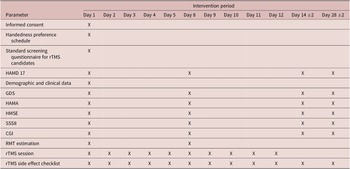
Sociodemographic and clinical data including age, sex, education, duration of illness, number of episodes, and treatment history will be ascertained during initial history taking and from patient’s previous medical records and recorded on a customized case record form. Further, they will be divided into 2 groups, that is, Group 1[G1] (Active Priming rTMS) and Group 2[G2] (Sham Priming rTMS) using block randomization technique. Patients will remain blinded about the group allocation. On the first day, all the patients will be assessed using HAMD, GDS, CGI scale, HAMA, and somatic symptom scale 8 along with Hindi mental status examination. Time schedule of enrolment, intervention and assessments is tabulated in Table 1 using SPIRIT (Standard Protocol Items: Recommendations for Interventional Trials) guideline.Reference Chan, Tetzlaff and Altman 37
Time Schedule of Enrolment, Intervention, and Assessments

Abbreviations: CGI, clinical global impression; GDS, geriatric depression rating scale; HAMA, Hamilton rating scale for anxiety; HAMD, Hamilton rating scale for depression; HMSE, Hindi mental status examination; RMT, resting motor threshold; rTMS, repetitive transcranial magnetic stimulation; SSS 8, somatic symptom severity scale 8.
Estimation of motor threshold
The right thumb movement visualization methodReference Pridmore, Fernandes Filho, Nahas, Liberatos and George 38 will be used to determine the RMT by stimulating the left primary motor cortex. Motor threshold is defined as the minimal single pulse TMS energy required to observe abductor pollicis brevis (APB) contraction.Reference Herwig, Satrapi and Schönfeldt-Lecuona 39 In order to find the hand area of the motor cortex, the center of the figure-of-eight TMS coil will be positioned 5 cm lateral to the vertex on the inter auricular line and the handle will be angled 45° away from the sagittal plane.Reference Speer, Kimbrell and Wassermann 40 The stimulations will be given at 1 Hz, and the coil will methodically be moved across the right frontoparietal region of the cranium centered at the above-indicated point until the motor cortex for the APB is located. Beginning at 50% intensity, it will be increased by 2% and the procedure will be repeated until APB Contraction is achieved and that intensity will be noted as the RMT.
TMS stimulation procedure
After estimating the RMT, patients in the active priming group will receive 80% RMT, 6 Hz rTMS over the right DLPFC for 10 minutes using a figure of 8 coils (20 trains of 5 seconds duration), total of 600 stimulations. This will be followed by 100% RMT 1 Hz rTMS over right DLPFC for 21 minutes (60 pulses, 20 trains with 5 seconds intertrain interval, total 1200 pulses) in each session. Patients with sham priming rTMS group (G2) will receive 100% RMT, 1 Hz rTMS for a total of 21 minutes similar to G1 preceded by 10 minutes of sham stimulation using sham coil. The rTMS site, that is right DLPFC, is the lateral part of Brodmann area 9 and 46. It is around 5 cm lateral and anterior to vertex which corresponds to F4 of the 10-20 international system of electrode placement. Patients will remain on stable doses of antidepressant(s) during the study period.
Assessments
Both the groups will receive a total of 10 sessions, over 2 weeks. rTMS side effect scale will be applied after every session of rTMS. All the patients will be assessed again at the end of 1 and 2 weeks (±2 days) using CGI scale, HAMA, HAMD, GDS, somatic symptom scale 8, and HMSE. Fourth and final assessments will be done after 4 weeks (±2 days) of initiation of rTMS treatment using the same scales.
Primary outcome measures
Change in the total scores of symptom severity scales from baseline to week 1, 2, and week 4 between the two groups are the primary outcome measures to achieve the objective of the study. Depression symptom severity scale HAMD is used along with GDS in this study as the latter one being a scale which is specifically designed for geriatric population. Anxiety and somatic symptom severity scales HAMA and SSS 8 respectively are being used considering the relatively higher prevalence of anxiety and somatic symptomatology in geriatric patients with depression. HMSE will also be assessed as depression is known to affect cognitions negatively. CGI Scale will be used to assess the global improvement over time between two groups.
Secondary outcomes
To see the efficacy of intervention in two groups response rate (defined as 50% reduction in HAMD score from baseline)Reference Frank 41 and remission rates defined as a stringent criteria of HAMD Score <8Reference Ballenger 42 as well as HAMD Score <11Reference Alexopoulos 43 , Reference Nierenberg and Wright 44 will also be calculated. This is being done as in geriatric depression, the first occurrence of achieving a score of HAMD ≤10 has been proposed as definition of remission.Reference Alexopoulos 43 Number needed to treat will be calculated to reach remission as well as response.
Result
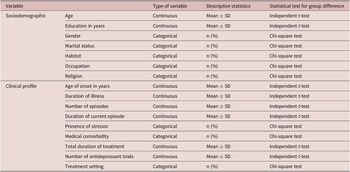
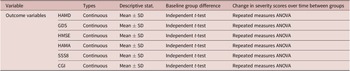
The data will be analyzed using the computer software program, Statistical Package for Social Sciences (SPSS) with an intention to treat (ITT) design and last observation carried forward (LOCF) approach. Patient enrolment, allocation to groups as well as follow-up details well be described following the CONSORT 2010 flow diagram.Reference Schulz, Altman and Consort 45 Details of variables and statistical tests used are tabulated (Tables 2 and 3) and steps of analysis are described below.
-
• Step I: Description of sample characteristics will be done with descriptive statistics: percentage, mean, and standard deviation.
-
• Step II: Baseline sociodemographic and clinical characteristics will be compared between the groups with independent t-test and chi-square test. Continuous variables like age, number of years of education will be compared with independent t-test and categorical variables like gender with chi-square test (Table 2 shows the summary of variables with plan of analysis).
-
• Step III: As repeated measures, ANOVA will be used to measure within-group and between-group interaction, normality of distribution will be assessed, Mauchly’s test of sphericity will be done, followed by greenhouse Geiser correction as applicable.
-
• Step IV: To test the hypothesis, comparison between the two groups will be done using repeated measures ANOVA through General Linear Modeling (GLM) with treatment as between-group factor and time as within-group factor.
-
• Step V: To test the effect size and power of the test, partial eta squared will be calculated and a value of >0.5 will be assumed as large, 0.2-0.5 as moderate effect size and <0.2 as mild effect size. Observed power will be computed using alpha = 0.05 and tabulated accordingly.
-
• Step VI: To see the efficacy of intervention in two groups response rate (defined as 50% reduction in HAMD score from baseline)Reference Frank 41 and remission rates defined as HAMD Score <11Reference Alexopoulos 43 , Reference Nierenberg and Wright 44 as well as a stringent criteria of HAMD Score <8Reference Ballenger 42 will be calculated using the contingency table for each group. Comparison between the groups will be done using chi-square test. Similarly, number needed to treat will also be calculated.
-
Level of significance will be taken as <0.05.
Summary of Baseline Variables and Plan of Analysis

Abbreviation: SD, standard deviation.
Summary of Primary Outcome Variables and Plan of Analysis

Abbreviations: ANOVA, analysis of variance; CGI, clinical global impression; GDS, geriatric depression rating scale; HAMA, Hamilton rating scale for anxiety; HAMD, Hamilton rating scale for depression; HMSE, Hindi mental status examination; SD, standard deviation; SSS 8, Somatic symptom severity scale 8.
Discussion
This is a proof-of-concept single-blind randomized parallel group sham-controlled protocol aimed to study the effect of adjunctive priming rTMS in patients with LLD. Patients in both the groups will be on a stable dose of medications for at least 6 weeks and the medication regime will be kept constant throughout the study period. We have kept an operational definition for treatment resistance of at least stage I as per Thase and Rush staging of treatment resistance with modification.Reference Thase and Rush 46 Few other TMS studies in LLD have considered dose stabilization 4 weeks before randomization as criteriaReference Kaster, Daskalakis and Noda 11 , Reference Trevizol, Goldberger and Mulsant 47 but we have kept it as 6 weeks following the adequate duration as defined in previous seminal articles.Reference Fava 48 , Reference Fava and Davidson 49 Patients in both the groups will receive conventional adjunctive 1 Hz rTMS over right DLPFC which is found to be effective in depression. To achieve the objective only “priming” will be replaced by sham in the comparison group. Selection criteria ensures that patients in both groups receive a stable dose of medications for at least 6 weeks and the antidepressant regime will be constant throughout the study period. Any form of psychological therapy was not offered to the patients during the 4 weeks of the study period to minimize the confounders.
The patients in the present study will be assessed for severity of psychopathology at baseline, at the end of weeks 1, 2, and 4 (ie. correlating to 2 weeks after the completion of rTMS sessions) so as to assess whether the effects of rTMS, with or without priming, persisted after the sessions ended. The results of this proof-of-concept RCT is hoped to broaden the horizon of TMS paradigms in treatment of LLD.
Conclusion
The study’s findings will shed light on the potential function of priming in enhancing the effect of low-frequency rTMS in LLD, which may help clinicians for the better management of patients with LLD.
Author Contributions
Conceptualization: K.L.V., S.S., B.S., S.K.K.; Literature search: K.L.V., S.S., S.K.K.; Writing—Original draft: K.L.V., S.S., B.S.; Writing—Review and editing: K.L.V., S.S., B.S., S.K.K.
Disclosure
The authors declare none.