INTRODUCTION
In tropical forests, frugivore species are embedded in a complex plant–animal network that strongly influences composition, diversity and structure of plant species communities. From 70% to more than 90% of woody species rely on animals for seed dispersal (Beaune et al. Reference BEAUNE, BRETAGNOLLE, BOLLACHE, HOHMANN, SURBECK and FRUTH2013a, Gautier-Hion et al. Reference GAUTIER-HION, DUPLANTIER, QURIS, FEER, SOURD, DECOUX, DUBOST, EMMONS, ERARD, HECKETSWEILER, MOUNGAZI, ROUSSILHON and THIOLLAY1985, Janson Reference JANSON1983, Jordano Reference JORDANO and FENNER2000, Muller-Landau Reference MULLER-LANDAU2007, Wright et al. Reference WRIGHT, STONER, BECKMAN, CORLETT, DIRZO, MULLER LANDAU, NUÑEZ ITURRI, PERES and WANG2007). Frequently, many frugivore species interact with one woody plant species but the disperser species differ in their effectiveness, i.e. the ‘number of new adults produced by the dispersal activities of a disperser’ (Schupp Reference SCHUPP1993). The seed-dispersal effectiveness (SDE) is affected by the number of seeds dispersed (quantity) and the quality of dispersal, i.e. the probability that a dispersed seed produces a new adult (Schupp et al. Reference SCHUPP, JORDANO and GOMEZ2010). The quality of dispersal is strongly influenced by the treatment of the seed during the feeding/digestion process and by the quality of seed deposition including dispersal distance. Many characteristics of the frugivore such as its feeding behaviour and physiology, its diet, and its spatial movement, may influence SDE (Schupp et al. Reference SCHUPP, JORDANO and GOMEZ2010). Among frugivores, large-bodied mammals are considered as major seed dispersers because of their diet diversity (tens to hundreds of species), the large quantities of dispersed seeds, and because of their capacities to feed on large fruits or large seeds (Vidal et al. Reference VIDAL, PIRES and GUIMARÃES2013). In particular, plants producing large seeds depend on large-bodied vertebrates for their dispersal and regeneration (Poulsen et al. Reference POULSEN, CLARK and SMITH2001, Vanthomme et al. Reference VANTHOMME, BELLÉ and FORGET2010, Vidal et al. Reference VIDAL, PIRES and GUIMARÃES2013, Wright et al. Reference WRIGHT, STONER, BECKMAN, CORLETT, DIRZO, MULLER LANDAU, NUÑEZ ITURRI, PERES and WANG2007). Large mammals are also involved in long-distance dispersal (LDD) that influences survival and genetic patterns of plant species, with an ultimate effect on forest structure (Bohrer et al. Reference BOHRER, NATHAN and VOLIS2005). However, animals are extracted from African tropical forests at about six times the sustainable rate (Fa et al. Reference FA, RYAN and BELL2005). This ‘bushmeat crisis’ generates myriads of cascading effects on the mutualistic tree-disperser network that will critically affect the Central African forest ecosystems (Brodie et al. Reference BRODIE, HELMY, BROCKELMAN and MARON2009, Fa et al. Reference FA, RYAN and BELL2005, Milner-Gulland & Bennett Reference MILNER-GULLAND and BENNETT2003, Muller-Landau Reference MULLER-LANDAU2007). The plight of vertebrate communities generates an obvious modification of the spatio-temporal dynamics of seedling diversity in the forest regeneration and this worldwide process is termed ‘defaunation syndrome’ (Howe & Miriti Reference HOWE and MIRITI2004, Redford Reference REDFORD1992, Wright et al. Reference WRIGHT, STONER, BECKMAN, CORLETT, DIRZO, MULLER LANDAU, NUÑEZ ITURRI, PERES and WANG2007). The great ape species of the African forests (chimpanzee, bonobo and gorilla) are considered as key dispersers of woody species but little is known concerning the relationship between the diversity of their fruit diet and SDE (Chapman & Onderdonk Reference CHAPMAN and ONDERDONK1998, Effiom et al. Reference EFFIOM, NUÑEZ-ITURRI, SMITH, OTTOSSON and OLSSON2013, Gross-Kamp & Kaplin Reference GROSS-CAMP and KAPLIN2011, Voysey et al. Reference VOYSEY, MCDONALD, ROGERS, TUTIN and PARNELL1999, Wrangham et al. Reference WRANGHAM, CHAPMAN and CHAPMAN1994). However, this information is important in order to assess whether or not the dispersal service provided by these species could be compensated for, at least partially, by other frugivore species (Effiom et al. Reference EFFIOM, NUÑEZ-ITURRI, SMITH, OTTOSSON and OLSSON2013).
In the present study, we investigate fruit consumption of one bonobo community in order to assess SDE. First, we estimate the dispersal curve/kernel (the function that describes the probability of dispersal to different distances from the source, Nathan & Muller-Landau Reference NATHAN and MULLER-LANDAU2000). Second, we assess the ecological importance of bonobos in the ecosystem by investigating the plant community's diversity, abundance and ability to recruit without seed dispersal. Third, we compare seed rain resulting from dispersal by bonobos with that produced by other seed dispersers by reviewing the literature. We hypothesize that several plant species are adapted to endozoochory through the bonobo gut and that these passed seeds germinate better than do unpassed seeds.
MATERIALS AND METHODS
Study site and species
Least is known for the bonobo (Pan paniscus Schwarz 1929), the last of the three African great ape species (family Hominidae) discovered. It is endemic in the Democratic Republic of Congo (DRC) and lives south of the Congo River. More than 50% of the diet of the bonobo is fruit, characterizing the bonobo as an important fruit consumer, but little is known about its role in seed dispersal (Beaune Reference BEAUNE2012, Idani Reference IDANI1986, Tsuji et al. Reference TSUJI, YANGOZENE and SAKAMAKI2010). The role of this species as seed disperser is of particular interest due to its critical conservation status (Hart et al. Reference HART, GROSSMANN, VOSPER, ILANGA, Furuichi and Thompson2008). Population estimates of this threatened species currently fluctuate between 15000 and 20000 animals (Fruth et al. Reference FRUTH, WILLIAMSON, RICHARDSON, Mittermeier, Rylands and Wilson2013).
Fieldwork took place between September 2009 and June 2011 at the research site LuiKotale (LK) (2°47′S–20°21′E), located at the south-western fringe of Salonga National Park, Democratic Republic of Congo (DRC) (Hohmann & Fruth Reference HOHMANN and FRUTH2003). The study site consists of > 100 km2 of primary evergreen lowland tropical rain forest (for details see Beaune et al. Reference BEAUNE, BRETAGNOLLE, BOLLACHE, HOHMANN, SURBECK and FRUTH2013a, Reference BEAUNE, FRUTH, BOLLACHE, HOHMANN and BRETAGNOLLE2013b, Reference BEAUNE, BRETAGNOLLE, BOLLACHE, HOHMANN, SURBECK, BOURSON and FRUTH2013c; Fruth Reference FRUTH2011). Studies of the members of the Bompusa bonobo community are ongoing since 2002. The community consists of 33–35 mature individuals inhabiting a home-range of about 40 km2. They are fully habituated to human observation since 2007. Bonobos are individually known by physical traits such as limb deficiencies, form, structure and colouration of genitals and face. The study group is free ranging; all methods of data-collection are non-invasive. Researchers did not constrain, contact or interact with their study subjects. Animal welfare had greater priority than scientific interests. The methods used to collect data in the field are in compliance with the requirements and guidelines of the Institut Congolais pour la Conservation de la Nature, and adhere to the legal requirements of the host country, the Democratic Republic of Congo.
Bonobo feeding behaviour
From September 2009 to June 2011, behavioural data were recorded for bonobos over 22 mo, corresponding to 1879 h of observations over 315 d. Bonobos live in a fission–fusion society in which, depending on season and time of day, the community splits up into smaller foraging subgroups called parties. As parties are largely cohesive (most animals conducting the same activities at the same time), we considered group activity to be that of the majority (> 50% of the bonobos) of the visible animals during a continuous record of feeding activities (i.e. continuous focal sub-group; Altmann Reference ALTMANN1974, Beaune et al. Reference BEAUNE, BRETAGNOLLE, BOLLACHE, HOHMANN, SURBECK, BOURSON and FRUTH2013c). The continuous record stopped when the group went out of view or contact was lost. In order to record the part of feeding sessions (starting with the first hand-to-mouth movement, stopping with another behaviour) in daily activities and among feeding sessions we analysed interactions with consumed plants (i.e. granivory, herbivory, frugivory with positive or neutral seed-dispersal effect). We recorded the duration of the feeding session, the item consumed and seed processing such as spitting, handling and swallowing. Food items were classified into five categories: (1) fruits (including either the whole fruit ingested with its seeds or the pulp without its seeds), (2) leaves/stem/bark/gum, (3) seeds, (4) animals and (5) other items (honey, mushrooms, soil).
Dispersal distance
Actual bonobo dispersal distances were calculated from direct observations. Whenever possible, bonobos were followed daily from nest to nest (c. 05h30–17h30). Daily travel routes of parties were tracked with a GPS (Garmin® 60CSX) using one point position every 5 min for georeferencing. Whenever an individual bonobo swallowed the fruit of a species not eaten in the previous 36 h, its seed was considered as a marker seed and the individual was monitored continuously (but not at night) until the seeds of the newly ingested species were found in its faeces. The straight-line dispersal distance was calculated with GPS positions from the parent tree to the georeferenced seed deposition. When several bonobos of the group had ingested new marker seeds, only one random individual was included in the dispersal model to avoid bias in the dispersal distance, while all were included in the calculation of transit time. We estimated the dispersal curve/kernel using a mechanistic model based on empirical movement georeferenced with a mean transit time of 24 h for free-ranging bonobos (Beaune et al. Reference BEAUNE, BRETAGNOLLE, BOLLACHE, HOHMANN, SURBECK, BOURSON and FRUTH2013c, Nathan & Muller-Landau Reference NATHAN and MULLER-LANDAU2000). This curve is frequently used as a quantitative descriptor of seed dispersal in plants because it combines information on movements (distances, positions) and gut passage time.
Plants ingested
Plants ingested by bonobos were identified by vernacular name and determined post hoc with data from the herbarium collection of the long-term project The Cuvette Centrale as Reservoir of Medicinal Plants, consisting of 7300 vouchers by May 2010 (Fruth Reference FRUTH2011). If unknown, samples were recorded as NID (non-identified), and collected for later species identification. All feeding plants (trees, lianas and shrubs) were marked. Plant species were considered as dispersed by endozoochory when seeds were observed to be swallowed and defecated intact. Such cases were classified as frugivory with seed-dispersal mutualism and constituted our list of bonobo-dispersed species. Seeds that were not ingested but spat out in place without primary horizontal dispersal we classified as frugivory without endozoochory. Bonobo-dispersed plant species of the LK community were compared with those of communities from Wamba (Kano & Mulavwa Reference KANO, MULAVWA and Susman1984) and Lomako (Badrian & Malenky Reference BADRIAN, MALENKY and SUSMAN1984), the two long-term field sites for bonobo research, to assess cross-site similarities.
Representation of bonobo-dispersed trees
To assess the impact of bonobo seed dispersal on the forest tree community, we calculated both relative diversity and abundance of bonobo-dispersed species (effectively dispersed as determined in the other paragraphs) within 12 plots set up in heterogeneous primary forest on terra firme soil. Plots were positioned randomly within the home range of the bonobo community. From February to June 2011 all trees > 10 cm dbh were censused in these 12 plots of 1 ha (100 × 100 m) each. Relative diversity was calculated as the number of species within the plot observed at least once to be effectively dispersed by bonobos, divided by the total number of species found in the plot. Relative abundance was calculated as the total number of individual trees of all species dispersed by bonobos, divided by the total number of trees in the plot.
Seed dispersal/viability/germination/survivorship
Bonobo faeces were collected at the study site between April 2002 and June 2011 (N = 1152). Faeces and seeds therein were weighed (fresh mass); the number of seeds per faeces was counted for each species. To test germination viability of seeds that passed the bonobo digestive tracts, we extracted seeds from faeces collected between January 2010 and June 2011. Seeds were packed in leaves of Haumania spp. and deposited in a nursery within the same day. The nursery was an elevated platform (height 170 cm) in situ under natural canopy cover. It was 200 cm long × 100 cm wide, filled with natural soil (6 cm deep), and secured with predator-proof table legs. Each seed was marked and observed daily. We recorded emergence of the radicle (germination) (Beaune et al. Reference BEAUNE, BOLLACHE, MUGANZA, BRETAGNOLLE, HOHMANN and FRUTH2013d) and viability ratio (proportion of seeds that germinated).
To assess the influence of either seed manipulation or ingestion on germination, we compared the germination percentage of seeds collected on the same parental tree submitted to three different treatments mimicking three dispersal modes: (1) by barochory (seed embedded in its pericarp (fruit)); (2) by seed-spitting zoochory (seed with pericarp removed); and (3) by swallowing endozoochory (seeds collected after gut transit on bonobo). When bonobo were observed to ingest a new species, some fruits were directly collected from the parent tree and submitted to barochory and seed-spitting zoochory treatments. Ingested seeds (swallowing zoochory) were collected the next day in the faeces from identified bonobos. Seeds were marked, alternately positioned in line in the nursery platform (mixing local effects) the evening of collection (D0), and monitored daily until they rot or germinate.
To assess actual viability and recruitment of seeds embedded in bonobo faeces in situ, 45 faeces defecated between January 2010 and May 2011 (and not collected for the above experiments) were monitored from 1 to 18 mo. Seed species composition was determined by visual inspection of the dung. Seedling recruits were counted once a week.
Seed rain
The daily seed rain dispersed by bonobos was calculated according to Poulsen et al. (Reference POULSEN, CLARK and SMITH2001):
Seed rain = number of seed deposited per faecal clump × defecation rate × bonobo density
Population density was taken from Mohneke & Fruth (Reference MOHNEKE, FRUTH, Furuichi and Thompson2008) where it was calculated to be 0.73 bonobos km−2. Defecation rate was calculated on the basis of defecation records deriving from continuous follows of individual bonobos, resulting in an average number of dung piles per individual per day. The number of seeds deposited was calculated as the average of seeds found from dung piles collected (N = 157). Influences of sex and age (adult, sub-adult) were tested with analyses of variance (ANOVA), with factors considered as fixed effects.
Functional overlap – the primate community
In addition to the bonobo, 41 other species of frugivorous vertebrates were recorded in LuiKotale, including birds, fruit bats, civets, monkeys and others (Beaune et al. Reference BEAUNE, BRETAGNOLLE, BOLLACHE, HOHMANN, SURBECK and FRUTH2013a). We assessed seed handling and overlap in food-plant species among seven species of the diurnal primate community of LK from February to June 2011. Observations were simultaneously performed by two teams (one observing bonobos, the other monkeys). In contrast to bonobos, monkeys were not habituated (Bourson Reference BOURSON2011). Feeding and seed handling were assessed by the above-mentioned protocol. The functional overlap was calculated using the Jaccard similarity coefficient (Real & Vargas Reference REAL and VARGAS1996).
RESULTS
Bonobo food identified and quantified
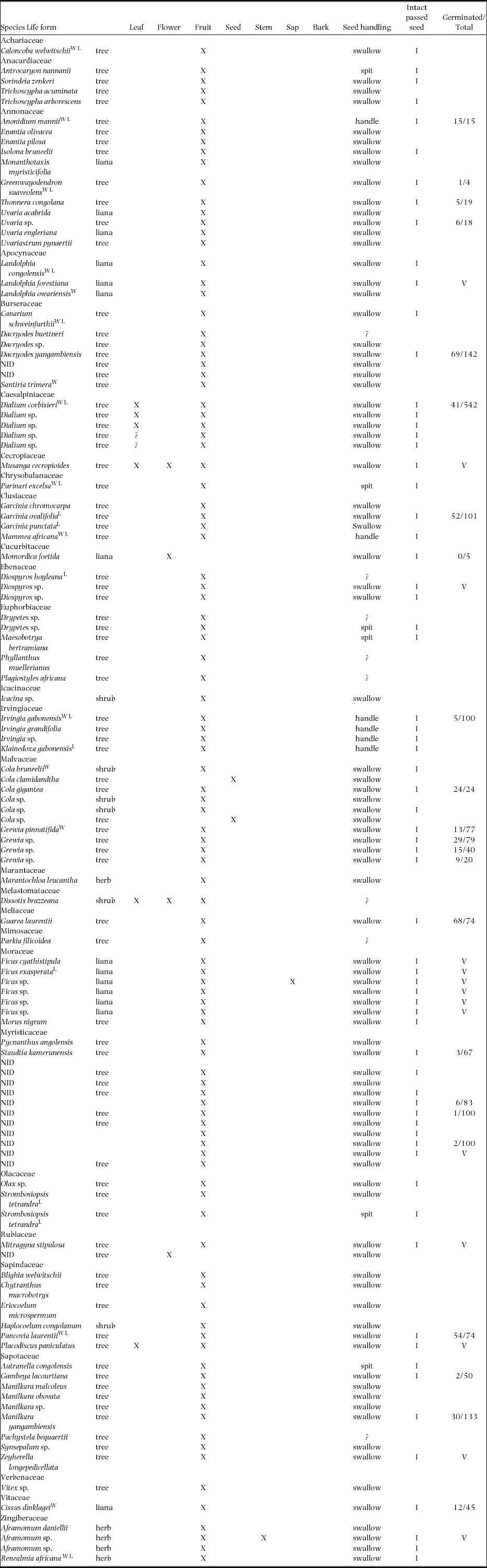
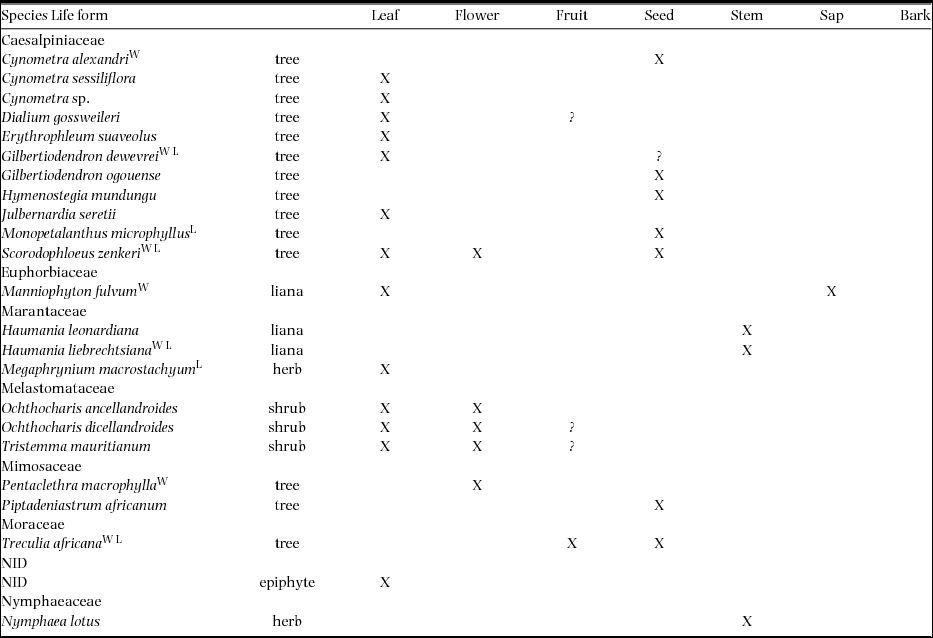
A total of 133 plant species were recorded in the bonobo diet during the 22-mo study period (Appendices 1 and 2). Of these, 107 species (80%) had fruit ingested by bonobos. Feeding behaviour represented 992 h of continuous records (from 1879 h of observation). The bonobo group spent (mean ± SE) 52.8% ± 1.1% of its daily activity engaged in feeding sessions. During the 315 d with an average observation time of 6 h d−1 (without difference between morning and afternoon data), we observed 4129 feeding sessions. We recorded fruits of 91 species being ingested with their seeds being swallowed. These species belonged to 45 genera of 25 plant families. Seeds of 56 of these species were found intact in faeces, confirming endozoochory.
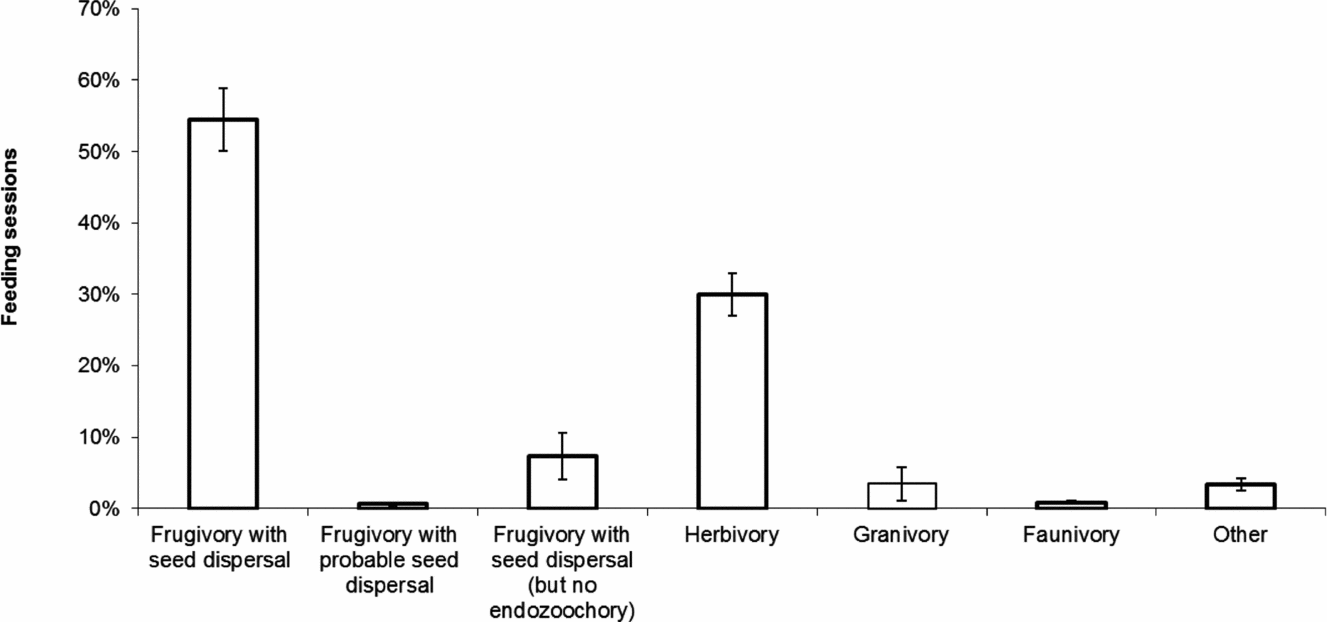
Of these feeding sessions, 54.5% ± 4.4% included the ingestion of fruit with subsequent seed dispersal (i.e. frugivory with seed ingestion and deposition observed, Figure 1), 0.6% ± 0.2% included the ingestion of fruit but deposition of seeds was not confirmed (insufficient data) and 7.3% ± 3.0% consisted of the ingestion of fruit but with large seeds that were not swallowed (e.g. Mammea africana with average seed size = 62 ± 1 mm, Anonidium mannii = 42 ± 2 mm, Irvingia gabonensis 55 ± 2 mm) (for each of these species measured, N ≥ 10). Transport of these large seeds over distances of about 100 m by hand or mouth (max = 426 m) were opportunistically observed. Ingestion of food other than fruit such as leaves, terrestrial herbaceous vegetation, flowers, stems and bark consisted of 30.0% ± 3.3% of the feeding sessions. The remainder could be attributed to granivory (3.4% ± 2.4%), carnivory (squirrels, monkeys: Procolobus tholloni, bird chicks, duikers: Cephalophus spp.) (0.9% ± 0.2%) and other foods (honey, termite soil, digging session for truffles and probably insect larvae, etc.) (3.3% ± 0.9%).
Percentage of each bonobo interaction (herbivory, faunivory, frugivory including seed dispersal service, etc.) during the feeding sessions (22 mo; 1879 h of continuous group scans); Error bars indicate SE. Other = honey, mushrooms, soil and unknown. Location is LuiKotale, DRC.

Dispersal distance
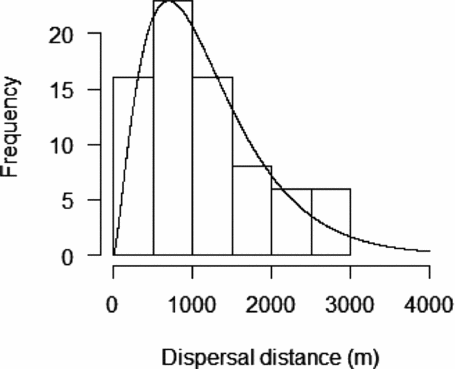
To assess the dispersal distance of seeds, we used georeferenced records of 75 events from 12 different plant species, when observation was continuous from first ingestion to first defecation. The average distance of dispersal from the parent tree was 1183 ± 88 m (CI95% = 1007–1358 m); range = 0–2995 m, Figure 2). The resulting dispersal distance kernel is a probability density function, characterized by a unimodal leptokurtic distribution, with a fat-tailed dispersal kernel (right skewness = 0.63; kurtosis = 2.61). Bonobos disperse seeds over long distances, with 93.3% of the dispersal events longer than 100 m.
Dispersal-distance kernel induced by bonobos in LuiKotale, DRC (N = 75 dispersal events of 12 different plant species recorded).
Seed viability/survivorship
Of the 56 species whose seeds were observed to be swallowed and defecated intact, seeds of 35 species were submitted to a viability census in the nursery (it was not possible to bring samples of the other 21 species due to field conditions). Of these, 97% were viable, that is, we were able to observe emergence of the radicle (n.b. for the ungerminated species only five seeds of Momordica foetida were monitored) (Appendix 1).
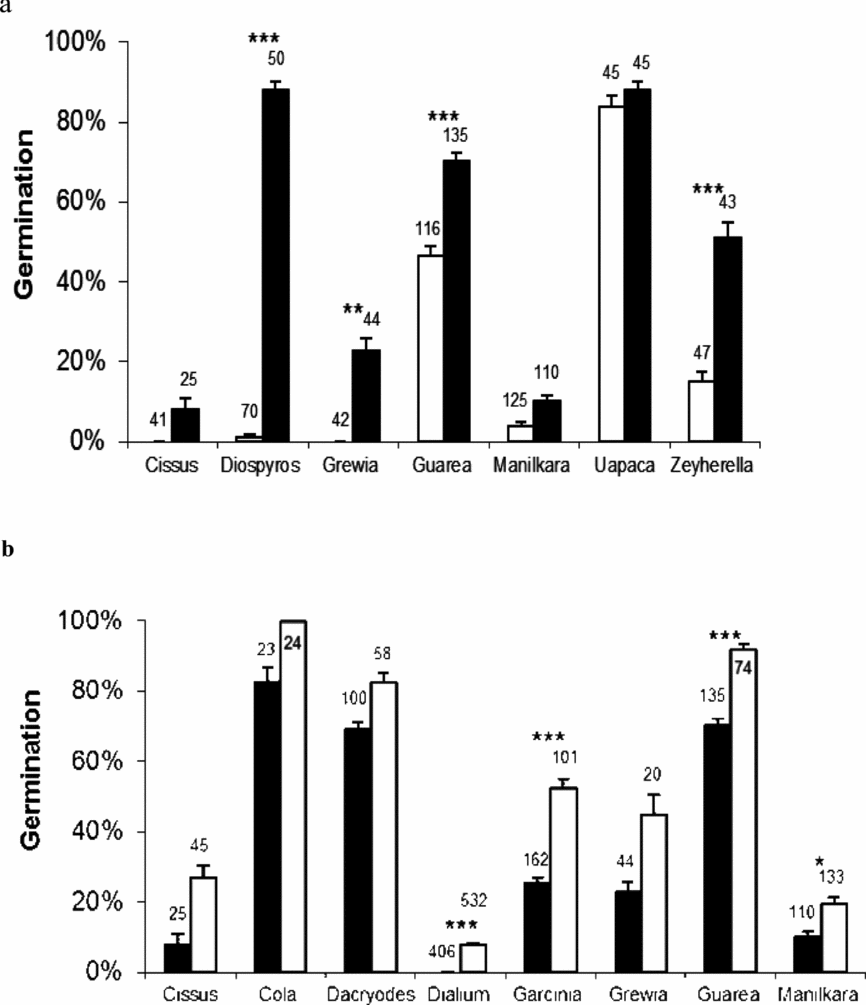
In order to assess the influence of seed manipulation on germination, we first compared manipulated but unpassed seeds and unmanipulated seeds. Overall germination percentage was higher for manipulated than for unmanipulated seeds, although differences were significant for only four out of seven species with sufficient sample size (P < 0.001; power analyses = 100%) (Figure 3a).
Germination percentage of seven species (a) (Cissus dinklagei, Diospyros sp.,Grewia sp., Guarea laurentii, Manilkara yangambiensis, Uapaca sp., Zeyherella longepedicellata) with (white) and without fruit (black bars) and germination percentage of eight species (b) (Cissus dinklagei, Cola gigantea, Dacryodes yangambiensis, Dialium corbisieri, Garcinia ovalifolia, Grewia sp., Guarea laurentii, Manilkara yangambiensis) comparing passed through bonobos (white) and unpassed seeds without fruit (black bars). Location is LuiKotale, DRC. ***: P < 0.001, *: P < 0.05 after t-test. Error bars indicate SE. Numbers on the bars are N.
Second we compared germination percentage of passed seeds and unpassed but manipulated seeds. Overall germination percentage was higher for passed (swallowing endozoochory) than for unpassed seeds (seed-spitting zoochory). Differences were significant for only four out of eight species with sufficient sample size (P < 0.05; power analyses ≥ 99%) (Figure 3b).
To assess the viability of seeds in situ, a total of 45 bonobo faeces (defecated from January 2010 to May 2011 and not collected for the above experiments) was localized, marked and monitored. Each dung pile was monitored for 1–18 mo. Of all these dung piles, 67% ± 8% produced seedlings (CI95% = 53–81%). Overall, we identified seedlings of eight genera. We think it highly likely that faeces continued to yield seedlings after monitoring ceased (the shorter monitoring of a dung lasting 1 mo). In an unpublished experiment we found the following T50 values (time when 50% of the seedlings germinated) for seeds passed in bonobo: Zeyherella longepedicellata, 50 d; Diospyros sp., 7 d; Guarea laurentii, 20 d; Garcinia sp., 63 d; Manilkara yangambiensis, 44 d.
Diversity and abundance of trees dispersed by bonobos
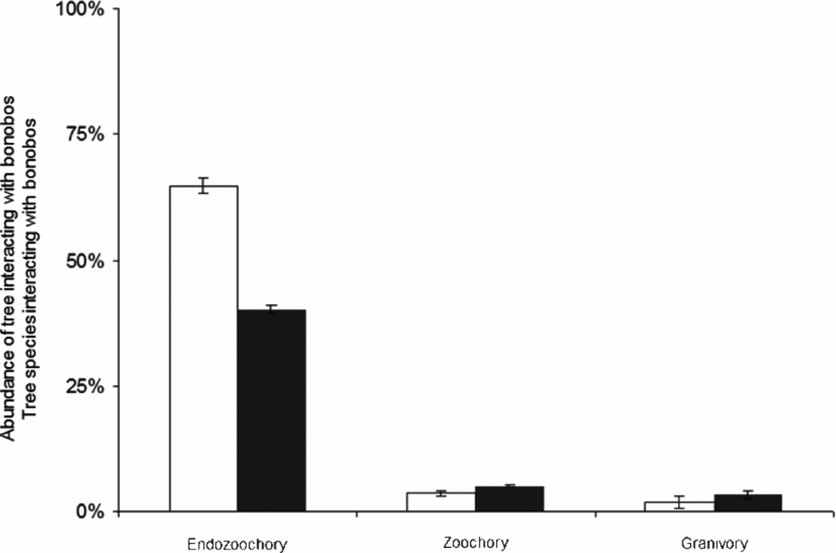
Focusing on trees only, we found 5233 adults in the 12 1-ha plots. A total of 40.1% ± 0.8% of these tree species in these plots are dispersed by bonobos via endozoochory through the gut (Figure 4). These account for a total of 64.7% ± 1.3% of all tree individuals recorded in these plots. Abundance of endozoochorous species is not equally distributed. A few species only account for the majority of individuals, such as Greenwayodendron suaveolens and Dialium spp., which together account for 32% of individual trees.
Tree species richness (black) and abundance of trees (white) affected by bonobo seed dispersal service (endozoochory and zoochory; ‘zoochory’ implies seed dispersal without internal transport) and predation (granivory). The y-axis depicts the average proportion of tree species (diversity) or tree individuals (abundance (N = 12 1-ha plots). Error bars indicate SE. Location is LuiKotale, DRC.
Seed rain
To assess defecation interval, we observed 16 mature individuals, five males and 11 females. A total of 74 defecations were recorded (1 May 2010–31 May 2011), resulting in an average of 7.55 dung piles between dawn and dusk of a day. Thus, the interval of defecation for each individual was on average 95 ± 3 min. We detected no effect of sex (t = 0.244, df = 12.5, P = 0.811) or of age (adult, sub-adult) (t = −0.332, df = 4.38, P = 0.755) on the interval between two defecations. Taking into account bonobo population density, the average seed rain induced by bonobos in the LuiKotale area is estimated to be 441 seeds d−1 km−2. Extrapolating based on their average lifespan in the wild (50–55 y), an individual bonobo disperses 9.1 Mg of seeds or 11.6 million seeds (not including seeds < 2 mm length such as those of Ficus spp. and Musanga cecropioides).
Functional overlap – the primate community
The diurnal primate community of the study area is composed of members of three families: Hominidae: P. paniscus; Colobidae: Colobus angolensis P. Sclater, 1860, Piliocolobus tholloni (Milne-Edwards, 1886); Cercopithecidae: Lophocebus aterrimus (Oudemans, 1890), Cercopithecus wolfi (A. Meyer, 1891), Cercopithecus ascanius (Audebert, 1799), Cercopithecus neglectus Schlegel, 1876 and Allenopithecus nigroviridis (Pocock, 1907). In 16 faeces of C. angolensis that were investigated, and 124 faeces of P. tholloni, we did not discover a single seed. Allen's swamp monkey (A. nigroviridis) and de Brazza's monkey (C. neglectus) are restricted to riparian forests. While the bonobo can visit these habitats and feed on riparian plants, we cannot assume functional overlap due to insufficient data. We investigated 124 dung piles of L. aterrimus. Of these, 11.3% contained intact seeds, 62.9% fragmented seeds. The average number of intact seeds per faeces was 0.19 ± 0.06 (N = 124).The only species indicating food overlap and dispersal of intact seeds was Dialium sp. for C. wolfi, we investigated 78 dung piles. Of these, 17.9% contained intact seeds of six different species. On average, each dung pile contained 0.39 ± 0.99 seeds per faeces. For C. ascanius, we investigated 118 faeces, discovering seeds in 35.2% of them, originating from 16 species. On average, each dung pile contained 2.8 ± 0.15 seeds. Based on direct observations, both species disperse additional species by seed spitting. Thus, the total number of dispersed species during the observation period was N = 18 for C. wolfi and N = 23 for C. ascanius. Based on this 5-mo survey, the values of Jaccard's index show that functional overlap between the monkeys and the bonobo seems to be low. The bonobo shared 17.1% of species dispersed with C. ascanius and 16.1% with C. wolfi. Only 4.8% of the plants dispersed by L. aterrimus were also dispersed by the bonobo.
DISCUSSION
Here we investigated seed dispersal by the bonobo (Pan paniscus), a large, mainly frugivorous, great ape species inhabiting the evergreen lowland forests of the Central Congo Basin, restricted to the area south of the Congo river. For our study site LK we compiled a list of 133 plant species whose fruits were observed to be ingested by bonobos, of which 91 were ingested including seeds. Among these plant species shown to be bonobo-dispersed, trees represented 40% of all tree species found in the area and account for 65% of all adult trees. Examining data from the two other long-term field sites, Wamba and Lomako (Appendices 1 and 2), shows that our findings are in line with plant species observed to be consumed in these sites. Kano & Mulavwa (Reference KANO, MULAVWA and Susman1984) reported 113 species for the Wamba site, representing an overlap of 44% at the generic level with our site. Badrian & Malenky (Reference BADRIAN, MALENKY and SUSMAN1984) reported 81 species for Lomako, of which 40% overlap at the generic level with our site. The fact that the overlap at the species level is small (8% and 9% respectively) merits further investigation, suggesting a much higher diversity across the Congo Basin than usually anticipated.
We are aware that there may be several dispersers per plant species and that primary dispersal can be followed by secondary or tertiary dispersal and followed by post-dispersal predation. Nevertheless, we single out the bonobo to illuminate seed dispersal services performed by a single vector in the extremely complex system of the tropical rain forest under consideration.
Almost all bonobo faeces (98%) contained seeds, which represented over half of the dung's weight (67%), with an average of two species in each dung pile.
With regard to the quality and viability of passed seeds, our results show that ingested seeds remained viable after gut transit (97%). These seeds germinated faster and in higher frequency than unpassed seeds, suggesting removal of coat dormancy and endozoochorous processes shaped by co-evolutionary interactions with the bonobo (Beaune et al. Reference BEAUNE, BRETAGNOLLE, BOLLACHE, HOHMANN, SURBECK, BOURSON and FRUTH2013c, Reference BEAUNE, BOLLACHE, MUGANZA, BRETAGNOLLE, HOHMANN and FRUTH2013d; Howe & Smallwood Reference HOWE and SMALLWOOD1982, Robertson et al. Reference ROBERTSON, TRASS, LADLEY and KELLY2006). Similar results have been documented for all other great ape species, highlighting their determinant role in regeneration of the forests they inhabit (Gross-Camp & Kaplin Reference GROSS-CAMP and KAPLIN2011, Nielsen et al. Reference NIELSEN, JACOBSEN, GRAHAM, MORROGH-BERNARD, D'ARCY and HARRISON2011, Poulsen et al. Reference POULSEN, CLARK and SMITH2001). Although we did not quantify all the aspects of seed-dispersal effectiveness, in particular the probability that a viable dispersed seed survives, germinates and produces an adult tree, our study shows that the bonobo fits many crucial criteria characterizing efficient dispersers of tree species. Like other large primates, the bonobo exploits a large home range and consequently may disperse seeds to relatively long distances from parent plants. Our study shows that the seeds ingested are dispersed to an average distance of 1.2 km from the parental tree. Nevertheless, time of last appearance is longer than 24 h (63 h for chimpanzees; Lambert Reference LAMBERT1998) and other seeds could travel even further. Overall, 93.3% of dispersal events were longer than 100 m. Long-distance dispersal (Nathan et al. Reference NATHAN, PERRY, CRONIN, STRAND and CAIN2003) is of critical importance in plant population dynamics (Cain et al. Reference CAIN, MILLIGAN and STRAND2000) and in LuiKotale, the majority of the adult zoochorous plants dispersed by bonobos (95% of the investigated species: 18 tree and 1 liana species) could not self-recruit without dispersal beyond the parent tree's crown (Beaune Reference BEAUNE2012). This can be due either to the incapacity of seeds to germinate without handling and/or to higher mortality under the parental crown due to density-dependent effects (Beaune et al. Reference BEAUNE, BOLLACHE, BRETAGNOLLE and FRUTH2012a, Reference BEAUNE, BOLLACHE, FRUTH and BRETAGNOLLE2012b, Reference BEAUNE, BOLLACHE, FRUTH, HOHMANN and BRETAGNOLLE2012c, Reference BEAUNE, FRUTH, BOLLACHE, HOHMANN and BRETAGNOLLE2013b; Connell Reference CONNELL, DEN BOER and GRADWELL1971, Janzen Reference JANZEN1970, Schupp Reference SCHUPP1992).
Furthermore, and not reported here, endozoochory by bonobos is in fact often the first stage of diplochorous seed dispersal, with dung beetles as secondary dispersers. Tunnellers such as Catharsius sp. bury seeds to a maximum of 3.5 cm (Beaune et al. Reference BEAUNE, BOLLACHE, BRETAGNOLLE and FRUTH2012a) thereby enhancing the probability that a seed will escape predators, when compared with seeds that remain on the surface (by > 50%, Beaune et al. Reference BEAUNE, BOLLACHE, BRETAGNOLLE and FRUTH2012a). Thus, small changes in predation pressures could affect plant demography (Fenner Reference FENNER2000).
Still a large gap exists between seed production and the growth of a reproductive adult tree (secondary/tertiary/quaternary dispersal, post-dispersal mortality, competition, abiotic and biotic factors, etc.; Forget et al. Reference FORGET, LAMBERT, HULME and VANDER WALL2005, Reference FORGET, JORDANO, LAMBERT, BÖHNING-GAESE, TRAVESET and WRIGHT2011), but we assess here the first steps of the seed-dispersal loop involving the bonobo. According to Schupp's definition, the bonobo seems to be an efficient seed disperser for the majority of fruiting plants in our site. What we found here is probably applicable to other ecosystems in which large primates are important frugivores.
If we compare seed rain produced by the bonobo with that produced by other Afrotropical primates (Poulsen et al. Reference POULSEN, CLARK and SMITH2001), the bonobo outperforms them in seed dispersal. Accounting for density, seed rain effected by the chimpanzee turns out to be less than that effected by the bonobo. With only 96.5 seeds d−1 km−2 chimpanzees at a Cameroonian site dispersed a quarter of what the bonobo dispersed in our study site (441 seeds d−1 km−2). Seed rain reported for the gorilla calculated with the high density of this ape (1.7 indiv. km−2) are similar to our results (465 seeds d−1 km−2). There the entire arboreal monkey community, including four species of Cercopithecidae, disperses 568 seeds d−1 km−2 (Poulsen et al. Reference POULSEN, CLARK and SMITH2001). While our hypothesis is verified, a unique and irreplaceable dispersal service provided by bonobo cannot be proved here. However, the 5 mo of observation of other primates show little functional redundancy for seed dispersal with bonobo suggesting poor functional redundancy in dispersal service. A general correlation is found between body size of frugivores and the size of fruits/seeds that are ingested (Howe & Smallwood Reference HOWE and SMALLWOOD1982), and very few frugivorous animals reach the size of bonobos. Thus, it becomes evident that the bonobo is certainly a key seed disperser for many tree species and can be considered – next to the elephant – as a gardener of the Congo forests.
CONCLUSION
Pan paniscus is the biggest ape within its geographical range and the second-largest frugivore after the elephant. While fleshy fruit species could be dispersed by many frugivorous animals (Beaune et al. Reference BEAUNE, BRETAGNOLLE, BOLLACHE, HOHMANN, SURBECK and FRUTH2013a, Gross-Camp & Kaplin Reference GROSS-CAMP and KAPLIN2011) such as hornbills, ungulates, monkeys and bats, the potential dispersal vectors for fruit with large seeds are scarce, suggesting that the fate of large frugivore species such as the bonobo may disproportionately affect the regeneration process of these plants (Vanthomme et al. Reference VANTHOMME, BELLÉ and FORGET2010). Apes with their medium/large body-size category are specialized in a certain seed size range (Forget et al. Reference FORGET, DENNIS, MAZER, JANSEN, KITAMURA, LAMBERT, WESTCOTT, Dennis, Schupp, Green and Westcott2007). Moreover, the overlap in dispersal services within the LK primate community seems to be low, as we found very few plant species dispersed by bonobo endozoochory also dispersed by monkeys. In addition, monkeys (mainly Cercopithecus) disperse principally by seed spitting, a different mechanism in terms of recruitment (Dominy & Duncan Reference DOMINY and DUNCAN2005), with different effects on seed fate (Gross-Camp & Kaplin Reference GROSS-CAMP and KAPLIN2011). Finally, home range sizes and daily travel distances are different in monkeys and bonobos, with consequences for long-distance dispersal. In Afrotropical forests, birds and primates feed and disseminate plants located in different canopy strata and exhibit low plant species overlap in the seeds they disperse (Clark et al. Reference CLARK, POULSEN and PARKER2001, Fleming Reference FLEMING1979, Poulsen et al. Reference POULSEN, CLARK, CONNOR and SMITH2002). In the absence of functional overlap between the bonobo and other dispersers, the extirpation of this primate from the system is likely to lead to an irreplaceable loss of current ecosystem services. Strategies for the conservation of Congo forests should therefore include strong measures for conserving their key seed dispersers, among which the bonobo represents certainly one of the most important ones.
ACKNOWLEDGEMENTS
We thank the Institut Congolais pour la Conservation de la Nature (ICCN) for granting permission to conduct research at Salonga National Park, and Lompole villagers for granting permission to access the forest of their ancestors. Research at LuiKotale was conducted under the auspices and with the financial support of the Max-Planck-Society, the German Ministry of Education and Research, le conseil régional de Bourgogne, the SFE and SFDP (France). We thank P. Toni and all the international and local staff of LK, and two anonymous reviewers for their valuable comments and suggestions.
Résumé
L'écologie des forêts d'Afrique tropicale dépend non seulement de la protection des habitats, mais également de la protection des espèces qui la composent telle que les primates frugivores, identifiés parmi les disperseurs de graines les plus importants pour de nombreuses plantes. L'étude de la dispersion de graines par des bonobos (Pan paniscus) dans une forêt tropicale humide du bassin du Congo est ici présentée. Les bonobos sont principalement frugivores (66% de toutes les sessions d'alimentation). Ils passent environ 3.5 h/jour à avaler des graines qui sont transportées 24 hrs en moyenne. Pendant l'étude comportementale (22 mois), les graines de plus de 91 espèces de plantes ont été identifiées comme étant dispersées par endozoochorie dans l'estomac à une distance moyenne de 1,2 km de l'arbre-parent. Les graines passées germent plus rapidement, à des taux plus élevés et avec une plus grande survie post-dispersion que les graines non passées par le tube digestif d'un bonobo. L'influence du bonobo dans le réseau écologique devrait affecter 40 % des espèces d'arbres et 65 % des arbres individuels. Puisque les chevauchements fonctionnels avec d'autres frugivores sont faibles, le bonobo en tant que vecteur de dispersion de graines est susceptible d'affecter la structure et la dynamique des forêts. Nos conclusions classifient le bonobo (espèce menacée d'extinction) comme probable jardinier de la forêt du Congo.
Plants consumed by bonobo (X = confirmed consumption) with seed dispersal in LuiKotale, DRC. W indicates that the species exists in and is consumed by bonobos at Wamba (Kano & Mulavwa Reference KANO, MULAVWA and Susman1984); L = same for Lomako (Badrian & Malenky Reference BADRIAN, MALENKY and SUSMAN1984, Fruth, unpubl. data); I = seeds were found intact in faeces, V = seeds were tested and found viable in nursery trials but ratio is not presented because census was interrupted. NID = not identified. Botanical nomenclature follows the African Plants Database (version 3.4.0) from http://www.ville-ge.ch/musinfo/bd/cjb/africa/ and unpublished nomenclature of recently described species (Fruth et al. Reference FRUTH, WILLIAMSON, RICHARDSON, Mittermeier, Rylands and Wilson2013).
Plants consumed by bonobo (X = confirmed consumption) without seed dispersal in LuiKotale, DRC. W indicates that the species exists in and is consumed by bonobos at Wamba (Kano & Mulavwa Reference KANO, MULAVWA and Susman1984); L = same for Lomako (Badrian & Malenky Reference BADRIAN, MALENKY and SUSMAN1984, Fruth, unpubl. data). NID = not identified. Botanical nomenclature follows the African Plants Database (version 3.4.0) from http://www.ville-ge.ch/musinfo/bd/cjb/africa/ and unpublished nomenclature of recently described species (Fruth et al. Reference FRUTH, WILLIAMSON, RICHARDSON, Mittermeier, Rylands and Wilson2013).