The ductus arteriosus is critical for normal fetal circulation. It can lead ~75% of right ventricular output from the pulmonary artery to the aorta.Reference Smith 1 The main factors maintaining patency of the ductus arteriosus in utero are high levels of circulating prostaglandin E2 and locally produced prostaglandin E1.Reference Coceani and Olley 2 Therefore, it has been widely recognised that maternal administration of prostaglandin synthase inhibitors such as non-steroidal anti-inflammatory drugs and corticosteroids could be associated with an increased risk of prenatal closure of the ductus arteriosus.Reference Koren, Florescu and Costei 3 Recently, it has been reported that maternal intake of polyphenol-rich foods such as green tea, mate tea, dark chocolate, and grape juice could be a risk factor for intrauterine ductal constriction.Reference Zielinsky, Piccoli and Luiz 4 The closure of the ductus arteriosus causes elevation of right ventricular afterload, and it finally results in right heart failure and death.Reference Kondo, Kitazawa and Noda-Maeda 5 In contrast, it can also cause volume overload of the pulmonary circulation in fetuses, resulting in persistent pulmonary hypertension in the newborn.Reference Siu and Lee 6
Although a considerable number of case reports on intrauterine constriction or closure of the ductus arteriosus are available, the mortality, prognoses, and prognostic factors are not fully understood. It is very important to realise what kinds of clinical findings such as fetal echocardiographic parameters could affect the prognosis of intrauterine ductal closure, as it can facilitate us in deciding the appropriate timing of delivery after diagnosis. Therefore, in this study, we aimed to clarify the prognostic factors of premature closure of the ductus arteriosus in utero by undertaking a systematic literature review.
Materials and methods
A comprehensive search for studies and case reports on premature constriction or closure of the ductus arteriosus was conducted using PubMed database (from 1975 to 2014). The search was conducted using the following keywords: (“ductus arteriosus” AND “closure” NOT “patent”) or (“ductus arteriosus” AND “constriction” NOT “patent”). The search was limited to human studies published in English. From the literature, we selected relevant studies including fetal and neonatal clinical information and their prognoses, and excluded cases with other CHD – for example, transposition of the great arteries – and congenital systemic anomalies – for example, chromosomal abnormalities. We then extracted data from all the articles, including maternal age, maternal drug history, types of the drugs used, gestational age of diagnosis and birth, fetal echocardiographic findings, presence of fetal hydrops, birth weight, persistent pulmonary hypertension after birth, and their cardiac and neurological outcomes.
We divided the patients into the following three groups: good prognosis without any complication, fetal or neonatal death, and persistent pulmonary hypertension in the newborn. First, we compared the mothers’ age, gestational age at diagnosis, gestational age at birth, and birth weight in each group. Next, we analysed the following prognostic factors by calculating odds ratio and 95% confidential intervals: fetal hydrops, maternal drug administration, and fetal echocardiographic findings including right heart dilatation, tricuspid regurgitation, and complete closure of the ductus arteriosus. Values are expressed as mean±standard deviation. Statistical significance was defined at p<0.05. StatView version 5.0 software was used for statistical analyses.
Results
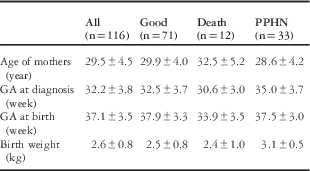
The electronic search yielded a total of 243 articles, of which 39 – including 116 patients – were reports on intrauterine closure and constriction of the ductus arteriosus, containing fetal and maternal clinical information and prognoses.Reference Kondo, Kitazawa and Noda-Maeda 5 – Reference Hayrullah, Zehra and Tamer 43 The mean age of the mothers was 29.5±4.5 years. The mean gestational age at diagnosis was 32.2±3.8 weeks, although six patients were diagnosed after birth. The mean gestational age at birth was 37.1±3.5 weeks, and the mean birth weight was 2.6±0.8 kg. These clinical data were not significantly different among each prognosis – namely, good, death, and persistent pulmonary hypertension of the newborn (Table 1).
Clinical characteristics of the cases (mean±standard deviation).

GA=gestational age; PPHN=persistent pulmonary hypertension of the newborn
Of the 116 cases, 71 mothers (62.8%) had received non-steroidal, anti-inflammatory drugs and/or corticosteroids. The anti-inflammatory drugs included indomethacin (42 cases), nimesulide (10 cases), diclofenac (four cases), and aspirin (two cases). We found no association between the type of drug and the incidence of death or persistent pulmonary hypertension.
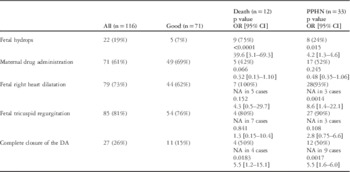
In 86 patients, fetal echocardiographic findings were available for fetal right heart dilatation and tricuspid regurgitation; 60 patients (70.0%) had right heart dilatation, and 67 patients (77.9%) had tricuspid regurgitation. Complete closure of the ductus arteriosus was diagnosed in 19 cases (20.2%) by fetal echocardiography or from autopsy findings of stillborn babies. Fetal hydrops was observed in 22 cases (19.0%) either by fetal echocardiography or by diagnosis at birth.
Table 2 shows the summary of analyses for all groups; eight neonates (7.0%) died after birth – all within 3 days – despite intensive treatments for pulmonary hypertension and right heart failure. Moreover, four fetuses (3.4%) died in utero between 29 and 33 weeks of gestation. In all cases of intrauterine death, fetal hydrops was observed. Of the 22 hydropic fetuses, 12 (54.5%) died in utero or after birth. Fisher’s exact test demonstrated that fetal or neonatal death was significantly correlated with fetal hydrops (p<0.001), but not with maternal drug administration (p=0.066). The odds ratio of fetal hydrops in death was 39.6, with a 95% confidence interval of 4.6–47.8, as compared with good prognosis cases. The relationships between death and fetal echocardiographic findings such as right heart dilatation and tricuspid regurgitation cannot be clearly determined, which might be due to the lack of fetal echocardiographic data in several cases of death; however, the statistical analysis showed that complete closure of the ductus was significantly correlated with the risk of death (p=0.0183; odds ratio 5.5, 95% confidence interval 1.2–15.1).
Prognostic factors for death and persistent pulmonary hypertension after intrauterine closure of the ductus arteriosus.

CI=confidence interval; DA=ductus arteriosus; NA=not available; OR=odds ratio; PPHN=persistent pulmonary hypertension of the newborn
p value was calculated as compared with good prognosis
Persistent pulmonary hypertension of the newborn was observed in 33 cases (28.4%), 14 of which required mechanical ventilation (42.4%), including five patients who received nitric oxide inhalation. Fisher’s exact tests revealed that persistent pulmonary hypertension was significantly correlated with fetal hydrops (p=0.015; odds ratio 4.2, 95% confidence interval 1.3–4.6) and fetal right heart dilatation (p=0.0014; odds ratio 8.6, 95% confidence interval 1.4–22.1), but not with maternal drug administration (p=0.245) and fetal tricuspid regurgitation (p=0.108). Although we found no information for complete closure or constriction of the ductus in nine cases in the persistent pulmonary hypertension group, the statistical analysis showed that complete ductal closure was significantly correlated with persistent pulmonary hypertension (p=0.0017; odds ratio 5.5, 95% confidence interval 1.6–6.0).
Patients who could survive the perinatal period, regardless of persistent pulmonary hypertension, had no neurological or cardiac complications for at least 1–10 months; however, 11 patients (9.5%) had mild right ventricular hypertrophy or tricuspid regurgitation without any clinical symptoms, as detected by follow-up echocardiography at 1–6 months of age.
Discussion
Premature closure of the ductus arteriosus without congenital cardiac defects has been reported by case reports. As most of the studies have focussed on maternal drug history or echocardiographic findings of fetuses, their prognoses and prognostic factors have not been clearly elucidated until now. In this study, we calculated the perinatal mortality of prenatal closure of the ductus arteriosus as 10.3%; however, as the published case reports tended to be limited to more severe cases, mortality may be lower than that indicated by our systematic review. We also found that fetal hydrops, which is usually attributed to severe right heart dysfunction, is a significant risk factor for both death and persistent pulmonary hypertension of the newborn. Notably, 40% of the hydropic fetuses died prenatally or immediately after birth, and more than half of them were affected by persistent pulmonary hypertension even if they could survive during the perinatal period. This finding suggests that hydropic fetuses should be recommended to be delivered immediately after diagnosis, and to prepare for the intensive treatments for pulmonary hypertension such as oxygen therapy, mechanical ventilation, and nitric oxide inhalation. Although there is no statistical significance, death cases tended to have an earlier gestational age at diagnosis and an earlier delivery as compared with the surviving cases (Table 1). As immature and early fetal hearts have less compliance than fetal or postnatal hearts at later gestation,Reference Carceller-Blanchard and Fouron 44 earlier closure of the ductus arteriosus might evoke more severe right heart failure and fetal hydrops. We also found that the other maternal factors and fetal echocardiographic parameters, such as maternal drug administration, types of maternal drugs, fetal right heart dilatation, and fetal tricuspid regurgitation, were not significantly correlated with perinatal death. Nevertheless, in several cases of death, fetal echocardiography was not available because they were already dead at diagnosis; therefore, whether these fetal echocardiographic findings are truly unable to predict fetal or neonatal death is uncertain.
Persistent pulmonary hypertension after birth could be caused by constriction or closure of the ductus arteriosus in utero due to massive volume overload in pulmonary circulation. The constriction or closure of the ductus arteriosus causes most of the right ventricular output to be forced through the premature lungs, which results in endothelial damage and medial wall thickening of the pulmonary vessels, inhibiting the postnatal fall of pulmonary vascular resistance.Reference Morin and Egan 45 In this study, we estimate the incidence of persistent pulmonary hypertension of the newborn as 28.4%. It is significantly correlated with fetal hydrops, fetal right heart dilatation, and complete closure of the ductus arteriosus, but not with maternal drug administration. The severity of pulmonary hypertension seems to be extremely different among the cases – for example, some patients required mechanical ventilation and nitric oxide inhalation, whereas others required only oxygen inhalation for a couple of days. The reasons for this discrepancy are not clear, but previous animal studies have suggested that pulmonary vascular resistance after birth is correlated with the duration of closure of the ductus arteriosus.Reference Morin and Egan 45 Thus, the length of time from the beginning of ductal constriction until delivery might determine the severity of pulmonary hypertension. In addition, considering our fetal echocardiographic findings in the previous report,Reference Ishida, Inamura and Kawazu 42 the maximum velocity of tricuspid regurgitation, which is attributed to high right ventricular pressure, may predict the severity of pulmonary hypertension. As the number of cases in that study was relatively small, we need to include a larger number of cases to confirm these results.
This study suggests that the cardiac and neurological outcomes of premature closure of the ductus arteriosus are favourable if fetuses can overcome right heart failure and persistent pulmonary hypertension during the perinatal period. In postnatal circulation, the closure of the ductus arteriosus obviously does not affect the systemic and pulmonary circulation. Therefore, fetal right heart dysfunction could subsequently be improved after birth, which could in turn result in favourable outcomes.
Limitations
There are several limitations to this study. First, the definition of constriction and closure of the ductus arteriosus could be different among case reports. Second, the fetal echocardiographic parameters including right heart dilatation and tricuspid regurgitation were qualitatively assessed without any common criteria.
Conclusion
The prognosis of premature closure of the ductus arteriosus in utero depends predominantly on the presence of fetal hydrops and complete closure of the ductus arteriosus. Fetal hydrops and complete ductal closure are significant risk factors for both death and persistent pulmonary hypertension in the newborn. The cardiac and neurological outcomes are usually good if they can survive the perinatal period. Hydropic fetuses and/or complete closure of the ductus arteriosus should be recommended to be delivered immediately after diagnosis, and might require intensive care for pulmonary hypertension.
Acknowledgements
The authors thank Dr Shigetoyo Kogaki and Prof. Keiichi Ozono, Osaka University Graduate School of Medicine, for the useful discussions.
Authors contributions: H.I. and N.I. conducted the study and wrote the manuscript. Y.K. and F.K. contributed to the discussion of the results.
Financial Support
This research received no specific grant from any funding agency, commercial, or not-for-profit sectors.
Conflicts of Interest
None.