Introduction
The Roberts Court's campaign finance decisions have generated enormous public controversy. Two cases have drawn particular attention: Citizens United v. Federal Election Commission (2010), which found unconstitutional a provision of the Bipartisan Campaign Reform Act of 2002 (BCRA, also known as McCain-Feingold) limiting corporate expenditures in federal elections, and McCutcheon v. Federal Election Commission (2014), which invalidated overall limits on the total contributions an individual can give in an election cycle. Supporters of the decisions claim that they vindicate First Amendment values (e.g., Abrams Reference Abrams2013; Smith Reference Smith2014), while critics assert that they, and the political forces they have unleashed, undermine democracy and threaten electoral integrity (Post Reference Post2014; Teachout Reference Teachout2014; Neuborne Reference Neuborne2015; Hasen Reference Hasen2016). The decisions have drawn critical editorials and disparaging commentary from political leaders, including former President Barack Obama (Liptak Reference Liptak2010) and 2016 Democratic presidential candidates Hillary Clinton and Bernie Sanders (Gold and Gearan Reference Gold and Gearan2015). They are deeply unpopular with the US public (Confessore and Thee-Brenan Reference Confessore and Thee‐Brenan2015) and have inspired demonstrations (Ehrenfreund Reference Ehrenfreund2015; Liptak Reference Liptak2015; Trujillo Reference Trujillo2015) and proposals to amend the Constitution to overturn the results (Fischer Reference Fischer2014).
Most of the scholarly commentary on these cases focuses on the decisions themselves and the justices who generated them—their reasoning, treatment of precedent, and appreciation for the holdings' consequences. The role of nonjudicial actors in the making of these decisions has received less attention. Robert Mutch (Reference Mutch1988, Reference Mutch2014) has chronicled the history of campaign finance litigation over the past forty years, and Amanda Hollis-Brusky (Reference Hollis‐Brusky2015) has explored the influence of the Federalist Society for Law and Public Policy Studies on campaign finance jurisprudence since the mid-1990s. Ronald Collins and David Skover (Reference Collins and Skover2014) have provided an engaging account of the McCutcheon case, including profiles of the petitioner and the lead attorneys. But we do not yet have systematic research on the lawyers, advocacy groups, and financial supporters involved in advocating for and against campaign finance regulation since John Roberts became Chief Justice in 2005—a period during which the Court has issued a series of momentous decisions ruling against the constitutionality of such regulation.Footnote 1
Scholars' primary focus on the US Supreme Court's part in constructing current campaign finance doctrine is entirely appropriate since the justices have played key roles. Their views and behavior are important elements of any plausible account of the dramatic change in campaign finance jurisprudence over the past decade. Many attribute the marked shift of momentum away from regulating money in politics to the departure of Sandra Day O'Connor and her replacement by Samuel Alito (e.g., Mutch Reference Mutch2014, 175; Hasen Reference Hasen2016, 108); the Court has invalidated or severely limited nearly every campaign finance restriction it has considered since Alito's arrival (Hasen Reference Hasen2016, 29).Footnote 2 Indeed, some have suggested that the sweeping scope of Citizens United and McCutcheon reflects the will and confidence of the Court's activist conservatives, who saw and seized an opportunity to reverse course on campaign finance restrictions (see, e.g., Stone Reference Stone2012; Nichols Reference Nichols2014).
But advocates and their patrons have surely influenced the process even if they have not played leading roles. However eager justices might be to forge constitutional change, they cannot generate rulings without cases to decide. Although the justices sometimes invite litigants to argue for overruling or extending precedent, and did so with respect to campaign finance regulation in cases that preceded Citizens United and McCutcheon (Hasen Reference Hasen2012), even the most activist justices must depend on lawyers to interpret the Court's signals about the kinds of questions they are willing to entertain (Baird Reference Baird2007). They necessarily rely on litigants and lawyers to initiate cases, frame them well, and finance and shepherd them to the Court (Epp Reference Epp1998, 18; Kearney and Merrill Reference Kearney and Merrill2000, 745). Once the cases reach the Court, attorneys for parties and amici may influence outcomes and opinions through the information and arguments they provide (McGuire Reference McGuire1995; Johnson, Wahlbeck, and Spriggs Reference Johnson, Wahlbeck and Spriggs2006) and the frames they employ (Epstein and Kobylka Reference Epstein and Kobylka1992; Wedeking Reference Wedeking2010). Amici sometimes shape decisions through their mere presence, since their participation indicates interests and constituencies potentially affected by litigation (Epstein and Kobylka Reference Epstein and Kobylka1992; Kearney and Merrill Reference Kearney and Merrill2000; Collins Reference Collins2004). Moreover, advocacy groups and their lawyers are part of the audience for judicial decision making—those whose approval the justices care about and who hold them accountable (Baum Reference Baum2006; Baum and Devins Reference Baum and Devins2010). Indeed, the justices may be even more attentive to their reputations with lawyers, the legal academy, advocacy organizations, and the media than they are to their standing with the general public (Schauer Reference Schauer2000; Baum and Devins Reference Baum and Devins2010).
In keeping with new legal realism's emphasis on how actors other than judges influence law on the books (Suchman and Mertz Reference Suchman and Mertz2010), my current research seeks to develop a fuller account of nonjudicial actors involved in major campaign finance cases decided by the Roberts Court. It examines what Charles Epp (Reference Epp1998) has called the “support structures” for constitutional litigation in this area—the organizations that have teed up cases for adjudication, the lawyers who have represented the parties and amici, scholars and interest groups that have cultivated and advanced the ideas adopted in the Court's decisions, and financial backers and advocacy networks that have supported that process and thereby facilitated doctrinal change. It considers the lines of agreement and disagreement, the characteristics and backgrounds of the lawyers, and the advocates' ties to one another and to private firms, political parties, and bar associations. It also investigates whether and how the advocates have coordinated with one another, and what role framing has played in promoting cooperation among coalition partners.
This article focuses on Citizens United and McCutcheon, two of the most significant of the campaign finance cases decided by the Roberts Court thus far. It relies primarily on publicly available data about the organizations, advocates, money, and networks behind these two cases, but it also draws on interviews with some of the lawyers who represented the parties and amici.
The Decisions and the Divided Court
Citizens United
Citizens United involved a conservative political action committee's plan to air a movie that was highly critical of Democratic presidential candidate Hillary Clinton. It was a test case brought by James Bopp, who, as general counsel for the National Right to Life Committee and for the James Madison Center for Free Speech, has challenged a wide range of restrictions on the campaign activities of ideologically motivated nonprofit groups. Bopp is widely credited with leading a long-term litigation campaign to deregulate campaign finance (Mencimer Reference Mencimer2011; Hasen Reference Hasen2016, 116).
The questions presented to the Court were (1) whether Section 203 of the BCRA, which banned corporations and unions from using general treasury funds to pay for “electioneering communications,” applied to spending on a feature-length film produced by a nonprofit corporation that accepted for-profit corporation contributions and distributed the movie to digital cable subscribers through Video on Demand, and (2) whether the BCRA's disclaimer, disclosure, and reporting requirements were constitutional as applied to Citizens United's ads. The Supreme Court could have ruled in favor of the group's right to show the movie without overruling any established precedents,Footnote 3 but it declined to issue a narrow ruling. In the spring of 2009, a majority of the Court was prepared to “go big” in the case and to overrule major precedents even though the parties had not presented the issues or briefed them (Toobin Reference Toobin2012). Upon learning of the majority's intentions, Justice Souter, who had announced that he would retire at the end of the term, prepared a scathing draft dissent (never released) accusing the conservatives of judicial activism (Toobin Reference Toobin2012; Coyle Reference Coyle2014). The Court then asked for another round of briefing and argument in the following term on whether Section 203 was unconstitutional and whether several earlier contrary precedents should be overruled (Toobin Reference Toobin2012; Hasen Reference Hasen2016).
After reargument, Justice Kennedy wrote the opinion for the Court, joined by Chief Justice Roberts and Justices Scalia, Thomas, and Alito, upholding the BCRA's disclaimer and disclosure provisions but finding that Section 203 violated the First Amendment. The Court also held that, with respect to political spending, corporations have the same First Amendment rights as individuals—that they should not “be treated differently under the First Amendment simply because [they] are not ‘natural persons'” (558 US 310, 343). The Court further determined that campaign expenditures could not be regulated for the purpose of limiting corporate access and influence; the only basis for restricting corporate expenditures was to prevent quid pro quo corruption—a direct exchange of money for political favors. Citizens United upset two major precedents. It overruled Austin v. Michigan Chamber of Commerce (1990), which had upheld a Michigan statute limiting the amount that corporations could spend to support or oppose candidates in elections for state offices. It also partially overruled McConnell v. Federal Election Commission (2003), which, in a 5–4 decision, upheld the very provision of the BCRA that the Court found unconstitutional in Citizens United. Justice Stevens wrote a passionate dissent, joined by Justices Ginsburg, Breyer, and Sotomayor, who replaced Justice Souter when he retired.
McCutcheon
The plaintiff in McCutcheon was an Alabama businessman and activist in the Republican Party (Jacobs Reference Jacobs2013). He had already contributed $33,088 to fifteen federal candidates during the 2012 election cycle, but he wanted to donate an additional $75,000 to Republican National Party committees and $60,000 more to candidates (Collins and Skover Reference Collins and Skover2014, 2). The BCRA prohibited him from doing so; it limited the total amount of money an individual could give to all federal candidates and parties. McCutcheon had met conservative election lawyer Dan Backer through conservative circles, and Backer encouraged McCutcheon to file a lawsuit against the Federal Election Commission (FEC) to challenge the BCRA's contribution limits (ibid.). The Republican National Committee (RNC) joined in the lawsuit, and James Bopp argued the case at the district court level (Verified Complaint for Declaratory and Injunctive Relief, US Dist. Ct. DC June 22, 2012). A three-judge court upheld the aggregate limits, finding that they were justified “as a means of preventing corruption or the appearance of corruption, or as a means of preventing circumvention of contribution limits imposed to further its anticorruption interest” (893 F. Supp. 2d 133, 2012).
In a 5–4 decision, the Supreme Court held that the BCRA's aggregate contribution limits violated the First Amendment. As in Citizens United, the Court narrowly defined the type of corruption that would justify campaign finance regulation. It rejected the notion that government may regulate to prevent an individual from exercising the type of outsized political access and influence one might be expected to acquire through contributions to an unlimited number of candidates and political committees: “[G]overnment regulation may not target the general gratitude a candidate may feel toward those who support him or his allies, or the political access such support may afford. Ingratiation and access … are not corruption” (quoting Citizens United).
Citizens United and McCutcheon were 5–4 decisions that generated heated exchanges among the justices. The majority and dissent painted starkly different pictures of the competing stakes. For the majority, campaign spending is political speech, and protecting such speech, from whatever source, is a foundational principle enshrined in the First Amendment. Justice Kennedy's opinion in Citizens United expressed outrage about Section 203's purposes: “Under our law and our tradition it seems stranger than fiction for our Government to make … political speech a crime. Yet this is the statute's purpose and design” (558 U.S. 310, 372). Writing for the majority in McCutcheon, Chief Justice Roberts found that the aggregate limits on contributions “intrude without justification on a citizen's ability to exercise ‘the most fundamental First Amendment activities'” (134 S. Ct. 1434, 1462).
For the dissenters in these cases, the corrupting influence of money in politics is a paramount concern. Reflecting this view, Justice Stevens's dissent in Citizens United asserted that the Court's ruling was “profoundly misguided” and “threatens to undermine the integrity of elected institutions across the Nation” (558 U.S. 310, 382). Justice Breyer's dissent in McCutcheon, joined by Justices Kagan, Ginsburg, and Sotomayor, claimed that the majority “substitutes judges' understandings of how the political process works for the understanding of Congress,” “fails to recognize the difference between influence resting upon public opinion and influence bought by money alone,” and “undermines, perhaps devastates, what remains of campaign finance reform” (134 S. Ct. 1434, 1481).
The justices' fractious views on campaign finance may be linked to the increased role of ideology in the Supreme Court appointment process and to the justices' membership in polarized elite social networks that tend to reinforce their own strong ideological commitments (Devins and Baum Reference Devins and Baum2015, 57). Justice Scalia's death in the winter of 2016 generated a political standoff, as Republicans categorically refused to consider any Obama nominee and declined to hold a hearing or vote on Obama's choice, Merrick Garland. Activists and candidates on both sides made the Court's composition a key issue in the 2016 presidential election.
This project explores whether the advocates, organizations, and patrons involved in campaign finance litigation in the Roberts Court, like the justices, fall into distinct and partisan camps. It also seeks to identify strengths and weaknesses of the competing support structures and how they might have influenced the outcomes in these cases.
Research Design
I identified all organizations that were active in Citizens United and McCutcheon as parties or amici and gathered data about their annual revenues, mission statements, and foundation contributors from the organizations' websites, annual reports, and IRS Form 990s. The Foundation Directory provided information about public foundations' contributions to the organizations from 2003 through 2013. From the Supreme Court briefs, I identified the allies and adversaries among the litigants and identified key words used by parties and amici using the “wordcruncher” (word counting) function of ATLASti, a qualitative data analysis and research program. I also examined how the organizations' positions in the litigation relate to their missions and those of their financial patrons.
Using publicly available information on all lawyers who have filed briefs in these cases, I compiled data on the advocates' practice locations, educational credentials, political contributions in federal elections from 2003–2013, and participation in bar groups. I have interviewed many of the most prominent and active of these lawyers.Footnote 4
The Organizations' Alignments, Missions, and Resources
A. Numbers of Briefs Filed and Alignments
Citizens United
In the first round of briefing in the US Supreme Court, amici filed eleven briefs on the side of Citizens United, and just one in support of the FEC's position. In the second round, on the question of whether Austin and relevant parts of McConnell should be overruled, amici filed twenty-three briefs in support of Citizens United, fourteen in support of the FEC, and four in support of neither party.Footnote 5
This tilt of amicus participation in the challengers' favor reflects a significant change since the last major confrontation over the constitutionality of the BCRA in McConnell v. Federal Election Commission and an even greater change since Austin v. Michigan Chamber of Commerce. In McConnell, five amicus briefs supported Senator Mitch McConnell's challenge to McCain-Feingold, and five organizations—the US Chamber of Commerce, NRA, AFL-CIO, ACLU, and National Right to Life Committee—also challenged the statute in consolidated actions, while sixteen amicus briefs supported the FEC's position. In Austin, the challenge by the Michigan Chamber of Commerce to a state limit on corporate spending on elections received support from trade associations, the ACLU, several nonprofit corporations, and one conservative public interest organization, the Washington Legal Foundation, while Common Cause, the Center for Public Interest Law, and the FEC filed the only amicus briefs in support of the Michigan Attorney General. In the years since Austin, there has been a general increase in amicus participation in Supreme Court litigation (Koshner Reference Koshner1998, 7–11; Kearney and Merrill Reference Kearney and Merrill2000, 751–52) and a large growth in participation by conservative and libertarian groups that claim the public interest law mantle (Southworth Reference Southworth2005, Reference Southworth2013).
Individuals and organizations filing amicus briefs on the challengers' side in Citizens United claimed to speak for a broad range of constituencies. They included Senator McConnell, several business groups, many nonprofit 501c(3) and 501c(4) organizations with libertarian and Tea-Party-oriented agendas, and a few socially conservative groups. Citizens United also received support from several organizations that generally side with Democrats on issues other than campaign finance regulation, including most notably the AFL-CIO and ACLU.Footnote 6
The Solicitor General's office defended the challenged law, and amicus briefs taking the FEC's side included the BRCA's principal sponsors, John McCain, Russell Feingold, and former Representatives Christopher Shays and Martin Meehan, as well as the Democratic National Committee (DNC). Groups filing briefs in support of the FEC's position included the League of Women Voters, Common Cause, Campaign Legal Center, Brennan Center for Justice, US PIRG, Americans for Campaign Finance Reform, Center for Political Accountability, and Constitutional Accountability Center.
Advocacy organizations on Citizens United's side presented a reasonably united front. The amici who filed briefs in the first round generally supported Citizens United's “as applied” challenge,Footnote 7 with many libertarian and social conservative groups focusing primarily on the application of BCRA's disclosure provisions.Footnote 8 But several amici urged the Court to take up larger questions. Senator McConnell's brief argued that the Court should invalidate Section 203 and reverse Austin (Brief Amicus Curiae of Senator Mitch McConnell in Support of Appellant, 2009 WL 2365213). The US Chamber of Commerce, which has led the way in advocating for corporate speech rights in the US Supreme Court since the 1970s,Footnote 9 argued that the Court should overrule Austin and give corporate speech the same protection accorded natural persons (Brief of Amicus Curiae Chamber of Commerce of the United States of America in Support of Appellant, 2009 WL 154011).
After the Court ordered reargument, Citizens United filed a supplemental brief urging the Court to overrule Austin and find Section 203 unconstitutional as applied to Citizens United (Supplemental Brief for Appellant, 2009 WL 2219301). Some amicus briefs filed by libertarianFootnote 10 and socially conservative groupsFootnote 11 asked the Court to overrule Austin and the portion of McConnell upholding Section 203. Other briefs staked out more nuanced positions. The National Rifle Association invited the Court to distinguish between for-profit corporations and not-for-profit advocacy corporations.Footnote 12 The AFL-CIO argued that McConnell should be overruled as to Section 203's constitutionality but that there was no need to overrule Austin, which “aptly distinguished unions from corporations” (Brief of the American Federation of Labor and Congress of Industrial Organizations as Amicus Curiae in Support of Appellant, 2009 WL 2365216).Footnote 13 The ACLU argued that the Court should strike down Section 203, but it took no position on whether Austin should be overruled (Amicus Curiae Brief of the American Civil Liberties Union in Support of Appellant on Supplemental Question, 2009 WL 2365203). The Reporters Committee for Freedom of the Press urged the Court to clarify that Austin and McConnell were constitutional only if they allowed the news media to engage in what would otherwise be regulated as express advocacy by a corporation (Supplemental Brief Amicus Curiae of the Reporters Committee for Freedom of the Press in Support of Appellant, 2009 WL 2219299). State broadcasters objected primarily to the BCRA's exclusive application to broadcasting media (Brief of Amici Curiae California Broadcasters Association and others in Support of Appellant, 2009 WL 2365207).
Six former leaders of the ACLU filed a brief in support of neither party in the second round of briefing, arguing that the case should be decided in Citizens United's favor without overruling Austin or relevant portions of McConnell (Supplemental Brief of Former Officials of the American Civil Liberties Union as Amici Curiae on Behalf of Neither Party, 2009 WL 2365208). The Hachette Book Group, Inc. and Harper Collins submitted a brief for neither side to address the Deputy Solicitor General's response to a question during oral argument about whether books downloaded on a Kindle could be regulated by the FEC; they asserted that books were clearly exempted from BCRA Section 203 and therefore that there was no reason for the Court to overrule Austin or McConnell to guarantee the constitutional protection of electoral speech in books (Brief of Amici Curiae Hachette Book Group, Inc. and HarperCollins Publishers, LLC in Support of Neither Party on Supplemental Questions, 2009 WL 2359475).
A brief filed by twenty-six states urged the Court to resolve the case without overruling Austin; it argued that the states have a strong interest in regulating corporate campaign electioneering to protect the integrity of the political process (Brief of the State of Montana and others as Amici Curiae Addressing June 29, 2009 Order for Supplemental Briefing and Supporting Neither Party, 2009 WL 2365205). The Independent Sector, a nonprofit organization that advocates for charities and foundations, asked the Court to rule for Citizens United under an exemption for nonprofits that decline contributions from corporations or labor unions or accept only de minimis amounts of such money—a distinction approved by the Supreme Court in Federal Election Commission v. Massachusetts Citizens for Life (1986) (Brief of Amicus Curiae Independent Sector in Support of Neither Party, 2009 WL 2359477).
On the FEC's side, amici generally insisted that the Court should not roll back longstanding restrictions on corporate campaign expenditures. One brief argued that overruling Austin and relevant portions of McConnell would adversely affect the selection of state court judges and damage the judiciary's reputation (Brief of Amici Curiae Justice at Stake and Others in Support of Appellee, 2009 WL 2365225). Several nonprofit business groups opposed the US Chamber of Commerce's call to overturn Austin. For example, the Committee for Economic Development, a 501c(3) organization of 200 senior corporate executives and university leaders, stated that “a decision striking down the ban on corporate electioneering expenditures would severely harm corporate interests” by “expos[ing] corporations to corrupt shakedowns for political money” (Supplemental Brief of the Committee for Economic Development as Amicus Curiae in Support of Appellee, 2009 WL 2365230). Other amici focused primarily on defending the constitutionality of the BCRA's disclosure and reporting provisions and similar state statutes (Supplemental Brief of the Sunlight Foundation and Others as Amici Curiae in Support of Appellee, 2009 WL 2365228).
McCutcheon
In McCutcheon, amici on the challenger's side again outnumbered those on the FEC's side; twenty-six organizations filed a total of sixteen briefs on McCutcheon's side, while twenty-five organizations filed a total of eight briefs in support of the FEC.Footnote 14 Amici taking McCutcheon's side included the RNC, Senator Mitch McConnell, and the National Republican Senatorial and Congressional Committees. They also included many of the libertarian and Tea-Party-affiliated groups that took the challenger's side in Citizens United. Amici filing on the FEC's side included Democratic members of the US House of Representatives, various government watchdog groups, and several large membership organizations, but not the DNC. Religious conservative groups, some of which supported appellants in Citizens United, did not file briefs in McCutcheon, nor did any of the business groups that filed amicus briefs in Citizens United.
B. Partisanship
There is a strong partisan flavor to the alignments in both cases. Campaign finance reform has been a target of conservatives since the 1970s, and many of the strongest opponents of the regulations challenged in Citizens United and McCutcheon are either Republican leaders or are otherwise strongly aligned with the Republican Party. Senator Majority Leader Mitch McConnell was represented as an amicus in the oral arguments in both cases. The RNC was a party in the challenge to contribution caps in McCutcheon and participated in the oral argument. The National Republican Senatorial Committee and the National Republican Congressional Committee filed amicus briefs in support of McCutcheon and the RNC. The DNC filed a brief in support of the FEC in Citizens United, as did several Democratic congressmen, including Chris van Hollen, who served as Chairman of the Democratic Congressional Campaign Committee from 2006 through 2010.
Most of the groups that participated in the litigation sided with organizations and individuals who constitute their usual allies in electoral politics. Business, libertarian, social conservative, and Tea-Party-affiliated groups appeared with the RNC and Mitch McConnell on one side, while liberals of various stripes sided with the FEC on the other, reflecting the general view that campaign finance restrictions favor Democrats more than Republicans (Lichtblau and Confessore Reference Lichtblau and Confessore2015).
But partisan allegiances do not neatly capture all aspects of the patterns of alliance and opposition of the parties and amici in these cases. Republican John McCain, one of the sponsors of the BCRA, filed a brief supporting the FEC's position in Citizens United, as did the Campaign Legal Center, a nonpartisan organization founded and led by Republican Trevor Potter,Footnote 15 who served as general counsel to John McCain's 2000 and 2008 presidential campaigns and as deputy general counsel to George H. W. Bush's 1988 presidential campaign.
The Democratic Party's platforms have consistently supported campaign finance reform and specifically endorsed McCain-Feingold in 1996 and 2000, but the DNC did not file an amicus brief in support of the FEC's position in McCutcheon. The ACLU and AFL-CIO are strongly aligned with the Democratic Party, but they filed briefs in support of the challenger in Citizens United. The ACLU's opposition to campaign finance regulation dates back to its defense of sponsors of a New York Times advertisement advocating for the impeachment of President Richard Nixon in 1972; the ACLU successfully defended the ad's sponsors against charges that they had violated the Federal Election Campaign Act of 1971 by failing to file required reports and disclosures.Footnote 16 Several years later, the ACLU represented Democratic Senator Eugene McCarthy, one of the plaintiffs in Buckley v. Valeo (1976), a landmark case that upheld federal limits on campaign contributions but struck down federal limits on campaign spending on First Amendment grounds (Gora Reference Gora2003).
C. Missions
As in most litigation, the parties and amici for both appellants and appellees in these cases professed to be on the side of the angels. Citizens United (n.d.) asserted that it was “dedicated to restoring our government to citizens' control,” and Shaun McCutcheon said that he challenged aggregate contribution caps because he “love[s] [his] country”: “Getting rid of aggregate limits … is about practicing democracy and being free” (McCutcheon Reference McCutcheon2013). In defending the restrictions challenged in these cases, the government argued that it was enforcing Congress's will as reflected in legislative measures enacted to protect the integrity of elections and public confidence in the process.
The amici in Citizens United and McCutcheon included political party committees and advocacy organizations with agendas tied to the economic interests of their members, such as the US Chamber of Commerce on the challenger's side and several unions on the FEC's side. However, they also included many organizations that claim to advance some vision of the public interest.
On the challengers' side in Citizens United, amici were primarily libertarian groups, many of them founded in the 1980s or later. They included organizations active on a broad set of issues—for example, guns, trade, unionism, and affirmative action—but all these groups articulate missions framed in terms of freedom, liberty, or the First Amendment. The Center for Competitive Politics (n.d.), founded in 2005 by former FEC Commission Chairman Bradley Smith, calls itself “the nation's largest organization dedicated solely to protecting First Amendment political rights.” The Institute for Justice (n.d.), which launched a project to challenge campaign finance restrictions around the same time, claims to be “the National Law Firm for Liberty.” The Cato Institute's Center for Constitutional Studies, founded in 1989 and described by one lawyer I interviewed as one of the “usual suspects” in campaign finance litigation, seeks to advance “principles of individual liberty, free markets, and limited government” (Supplemental Brief for Amicus Curiae Cato Institute in Support of Appellant, 2009 WL 2365223). Even several socially conservative groups that participated as amici in these cases use this freedom/liberty/First Amendment frame in their mission statements and identify with what some conservative leaders have called “the freedom-based public interest law movement” (Edwards Reference Edwards2004, 1). For example, the Alliance Defending Freedom (formerly called the Alliance Defense Fund), which opposes abortion and same-sex marriage, advocates “for the right of people to freely live out their faith” (Alliance Defending Freedom n.d.).
Amici on the FEC's side in Citizens United included the Campaign Legal Center (n.d.), which claims to “represent[s] the public interest in administrative, legislative and legal proceedings” on issues relating to money in politics, and the Brennan Center for Justice (n.d.), which seeks to improve “the systems by which our nation is governed.” Democracy 21 (n.d.) is committed “to making democracy work for all Americans, while Common Cause (n.d.) “battl[es] for open, honest and accountable government.”
Most of the amici on the challenger's side in McCutcheon were libertarian groups. Amici on the FEC's side in McCutcheon included many of the same organizations involved in Citizens United. They also included some groups whose agendas do not relate directly to campaign finance but nevertheless are linked to the fate of the Democratic Party, such as the NAACP, People for the American Way, and Sierra Club, as well as several unions—American Federation of Teachers, National Education Association, AFSCME, and Service Employees International Union.
D. Resources and Foundation Patrons
Data on the annual revenue of the organizations filing briefs in these cases—a crude measure of their financial resources—do not reveal any obvious relationship between financial resources and the outcomes of Citizens United and McCutcheon. The total revenues in 2012 of the nonprofit groups filing briefs on Citizens United's side were approximately $925 million, as compared to roughly $75 million for organizations filing briefs on the FEC's side. These figures would seem consistent with an account that ties litigation outcomes to the direct and indirect influence that money can buy in litigation, and, indeed, several very well-funded organizations joined the challenger's side in Citizens United, including the NRA, the Chamber of Commerce, and the AFL-CIO. However, in McCutcheon, the disparities in the aggregate resources of the two sides were reversed—$71.2 million for organizations on McCutcheon's side and $2.74 billion for organizations on the FEC's side, a disparity reflecting participation on the FEC's side by several large membership organizations—the American Association of Retired Persons (AARP) and the Sierra Club—as well as several large unions—the American Federation of Teachers, National Education Association, and Service Employees International Union.
Collectively, the organizations that took opposing sides in Citizens United were roughly evenly matched in their ability to secure public foundation funding for their general operations; supporters of Citizens United's position received a total of $266,406,870 from public foundations from 2003–2013, while those that took the FEC's side received $238,366,087. But in McCutcheon, organizations on Shaun McCutcheon's side received a total of $82,799,394 in public foundation grants from 2003–2013, while those on the FEC's side received $486,972,938.
Even if the organizations' total revenues and the amounts received from public foundations bear no apparent relationship to the outcomes in these cases, identifying the sources of the organizations' financial support may nevertheless shed light on the alignments. Of the top twenty foundation contributors to the organizations that filed briefs in Citizens United,Footnote 17 several foundations—the Open Society Institute, Foundation to Promote Open Society, MacArthur Foundation, Ford Foundation, and Atlantic Philanthropies—were among the top contributors to both categories.Footnote 18 But one organization—the ACLU—accounts for much of the overlap; it draws large contributions from the five foundations that appear on both lists.Footnote 19 When the ACLU is omitted from the analysis, there is no overlap in the largest twenty foundation contributors to Citizens United's and the FEC's sides. In McCutcheon, the largest foundation contributors to organizations taking opposing sides in the litigation are similarly divided. The only foundation among the largest twenty contributors on both sides was the Ford Foundation, which contributed over $64 million to organizations involved in the McCutcheon litigation. Of that $64 million, only $1,714,800 went to organizations on McCutcheon's side.
The two categories of foundations offer different philanthropic visions. Most of the largest contributors to organizations on the challengers' side describe their missions in terms of advancing liberty and free enterprise. They include some of the major long-term supporters of the conservative legal movement over the last several decades, such as the Sarah Scaife Foundation, Lynde and Harry Bradley Foundation, Walton Family Foundation, M. J. Murdock Charitable Trust, and the F. M. Kirby Foundation (Heinz, Southworth, and Paik Reference Heinz, Southworth and Paik2003). They also include several newer foundations whose mission statements espouse the virtues of individual freedom and economic liberty: Dunn's Foundation for the Advancement of Right Thinking, Robert W. Wilson Charitable Trust, and Searle Freedom Trust.Footnote 20
The top foundation supporters of organizations on the FEC's side embrace the goals of strengthening democratic values and reducing poverty and injustice.Footnote 21 They include old-line grant makers such as Ford, Rockefeller, and John D. and Catherine T. MacArthur Foundation, and the Pew Charitable Trusts (the successor to several charitable trusts established by the heirs of Sun Oil founder John Pew). However, they also include newer foundations based on fortunes accumulated more recently, such as Bloomberg Philanthropies, George Soros's Open Society Institute and Foundation to Promote Open Society, Bill & Melinda Gates Foundation, and Google.org.Footnote 22
Despite the difficulty of systematically identifying the financial patrons of campaign finance litigation (as opposed to the less precise category of foundations that supply general operating funds to organizations involved in the litigation), it is possible to identify foundations that have been especially involved on the campaign finance reform side because some foundations specify the purposes of the grants in descriptions made available through the Foundation Center. The Joyce Foundation has provided substantial financial support for campaign finance advocacy by the Brennan Center ($2.02 million), Campaign Legal Center ($1.05 million), Common Cause ($1.79 million), and Democracy 21 ($625k), as well as several state-focused organizations with similar agendas. In 2005, Pew became a major funder of groups monitoring campaign finance (Philanthropy News Digest 2005), making substantial gifts over the next several years to the Campaign Legal Center ($3.7 million), Democracy 21 ($1.8 million), and Brennan Center ($530k) (Pew Charitable Trusts 2005), but it ended the project in 2008.Footnote 23 The Ford Foundation has also been a major supporter of the Brennan Center ($3.91 million), National Institute on Money in State Politics ($2.73 million), Americans for Campaign Reform ($1 million), Common Cause ($970k), and Campaign Legal Center ($350k). The Open Society Institute has given large amounts to the Brennan Center ($6.9 million), Common Cause ($1.65 million), League of Women Voters ($908k), and Public Campaign ($475k).Footnote 24 Other foundations that have played significant roles in funding campaign finance reform advocacy are the Rockefeller Brothers Fund and MacArthur Foundation, which gave the Campaign Legal Center one of its “Creative and Effective Institutions” awards.Footnote 25
Frequently Used Words in Party and Amicus Briefs in Citizens United

| Citizens United's Side N=38 | FEC's Side N=16 | |||
|---|---|---|---|---|
| Word | Count | Mean/Doc. | Count | Mean/Doc. |
| Speech | 1,696 | 44.65 | 172 | 10.75 |
| First Amendment | 818 | 21.53 | 138 | 8.63 |
| Freedom | 233 | 6.13 | 8 | 0.5 |
| Democracy | 55 | 1.45 | 50 | 3.13 |
| Corruption | 405 | 10.66 | 110 | 6.88 |
| Influence | 101 | 2.66 | 112 | 7.00 |
| Integrity | 15 | 0.39 | 35 | 2.19 |
Public records of grants to organizations that have filed amicus briefs opposing campaign finance regulation generally do not indicate whether the grants were to be used for that purpose,Footnote 26 but one can identify some of the primary foundation supporters of the advocacy organizations that have been especially active in opposing campaign finance regulation. The Center for Competitive Politics received substantial support from the Robert W. Wilson Charitable Trust ($1,081,250), Searle Freedom Trust ($600,000), Lynde and Harry Bradley Foundation ($260,000), and Dunn's Foundation for the Advancement of Right Thinking ($130,000). The Institute for Justice received major funding from the same foundations: $9.54 million from Robert W. Wilson Charitable Trust, $1.65 million from Searle, $1.55 million from Bradley, and $3.88 million from Dunn's. The Cato Institute received $1.02 million from Searle, $1.31 million from Bradley, and $4.1 million from Dunn's.
E. Frames
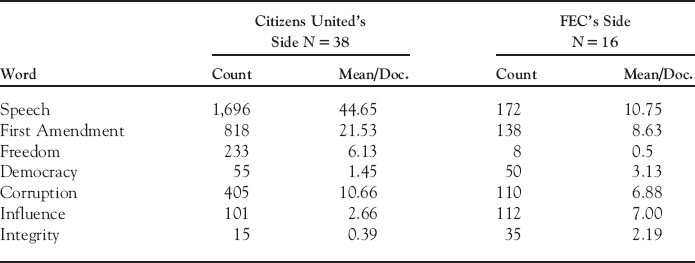
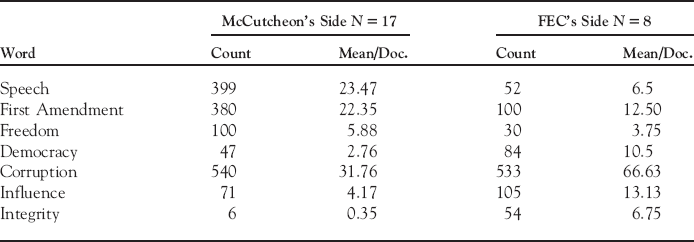
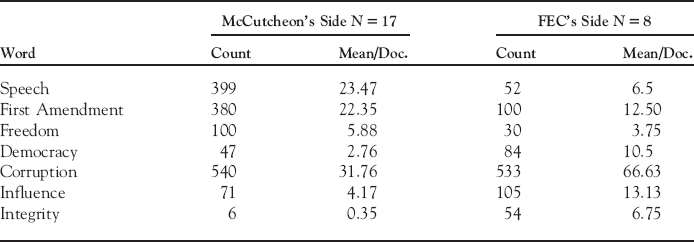
A word frequency analysis of the briefs in the two cases suggests that the competing frames reflected in the Supreme Court justices' majority and dissenting opinions are also competing frames for the litigants and amici. As shown in Tables 1 and Tables 2, the briefs on the challengers' side in both cases used the words “speech,” “freedom,” and “First Amendment” much more frequently on average than those on the FEC's side, while briefs on the FEC's side used “influence,” “integrity,” and “democracy” more often than the challengers did. The briefs on FEC's side used “corruption” less frequently than those on the challenger's side in Citizens United, but more than twice as often on average as those on the challenger's side in McCutcheon, perhaps because the Supreme Court's holding in Citizens United required it to address how the challenged restrictions served the only remaining permissible basis for regulating campaign finance—to prevent quid pro quo corruption. This analysis also suggests that there are no keywords on the FEC's side that capture campaign finance reformers' shared commitments as simply and powerfully as the challengers' keywords do for their side.
Frequently Used Words in Party and Amicus Briefs in McCutcheon
| McCutcheon's Side N = 17 | FEC's Side N = 8 | |||
|---|---|---|---|---|
| Word | Count | Mean/Doc. | Count | Mean/Doc. |
| Speech | 399 | 23.47 | 52 | 6.5 |
| First Amendment | 380 | 22.35 | 100 | 12.50 |
| Freedom | 100 | 5.88 | 30 | 3.75 |
| Democracy | 47 | 2.76 | 84 | 10.5 |
| Corruption | 540 | 31.76 | 533 | 66.63 |
| Influence | 71 | 4.17 | 105 | 13.13 |
| Integrity | 6 | 0.35 | 54 | 6.75 |
The Lawyers' Characteristics and Networks
Lawyers are an important resource for advocacy groups that engage in campaign finance litigation. They are among the founders and leaders of some of the nonprofit advocacy groups that engage in campaign finance litigation, and, in those roles, they have framed the relevant policy concerns, marshaled resources, and, on the challengers' side, recruited plaintiffs. Advocacy skill may not be determinative, but it obviously bears on the success of constitutional litigation campaigns, and such specialized expertise may be especially important in Supreme Court litigation (McGuire Reference McGuire1995; Lazarus Reference Lazarus2008). The advocates' social and professional networks might also influence litigation outcomes, at least indirectly (Paik, Southworth, and Heinz Reference Paik, Southworth and Heinz2007; Hollis-Brusky Reference Hollis‐Brusky2015).
In Citizens United, there were 185 lawyers on the briefs filed by parties and amici: ninety lawyers on briefs taking Citizens United's side, fifty-four on briefs taking the FEC's side, and forty-one on briefs taking neither side (mostly state attorney generals who joined in one brief) (Brief of the States, 2009 WL 2365205). In McCutcheon, there were eighty-nine lawyers on briefs filed by parties and amici: fifty-one on briefs taking McCutcheon's side and thirty-eight on briefs on the FEC's side.
Analyses of some of the characteristics of the lawyers who filed briefs in the Supreme Court in Citizens United and McCutcheon indicate that there are substantial differences in the work locations, educational backgrounds, and party affiliations of lawyers for the opposing sides.
Characteristics of Lawyers Filing Party and Amicus Briefs in Citizens United
| Citizens United's Side | FEC's Side | |||
|---|---|---|---|---|
| (N = 90) | (N = 54) | |||
| # | % | # | % | |
| Location | ||||
| DC | 35 | 39 | 30 | 55 |
| Northeast | 5 | 6 | 14 | 26 |
| South | 22 | 24 | 0 | 0 |
| Midwest | 17 | 19 | 0 | 0 |
| Mountain | 3 | 3 | 4 | 7 |
| Pacific | 8 | 9 | 6 | 11 |
| Law School | ||||
| Elite | 22 | 24 | 33 | 61 |
| Prestige | 24 | 26 | 14 | 26 |
| Regional | 11 | 12 | 5 | 9 |
| Local | 33 | 36 | 1 | 2 |
| Clerkships | ||||
| Federal | 13 | 14 | 17 | 31 |
| Supreme Court | 3 | 3 | 6 | 11 |
| Gender | ||||
| Male | 77 | 86 | 41 | 76 |
| Female | 13 | 14 | 13 | 24 |
| Political Contributions | ||||
| Mean total contributions | $8,131 | $10,076 | ||
| Mean contributions to Republicans | $6,185 | $614 | ||
| Mean contributions to Democrats | $1,669 | $8,614 | ||
| Political Bar Associations | ||||
| Federalist Society | 35 | 39 | 16 | 30 |
| ACS | 18 | 20 | 26 | 48 |
A. Office Locations
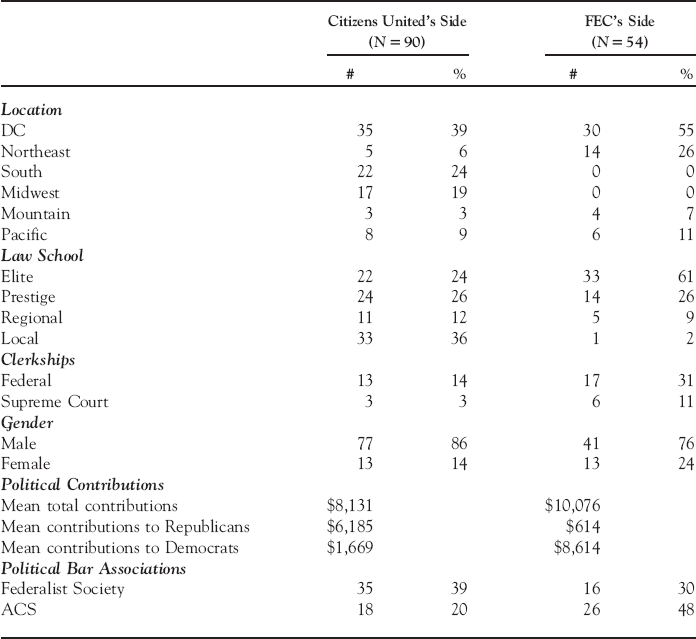
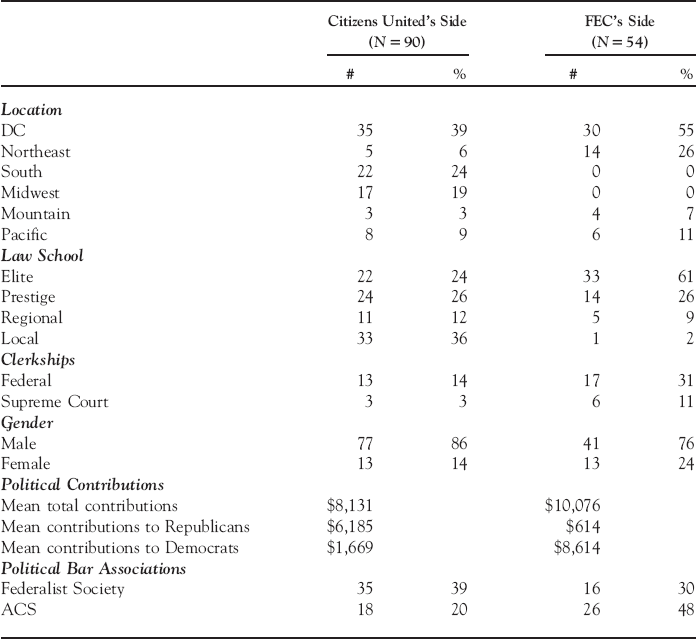
As shown in Table 3, a substantial proportion of lawyers on briefs in Citizens United worked in Washington, DC: 39 percent of lawyers on Citizens United's side and 55 percent on the FEC's side. Almost one-quarter of lawyers on the Citizens United's side worked in the South and another 19 percent in the Midwest, whereas none of the lawyers for the FEC's side worked in those regions.Footnote 27 One-quarter of lawyers on the FEC's side worked in the Northeast, while only 6 percent of lawyers on Citizens United's side did so.
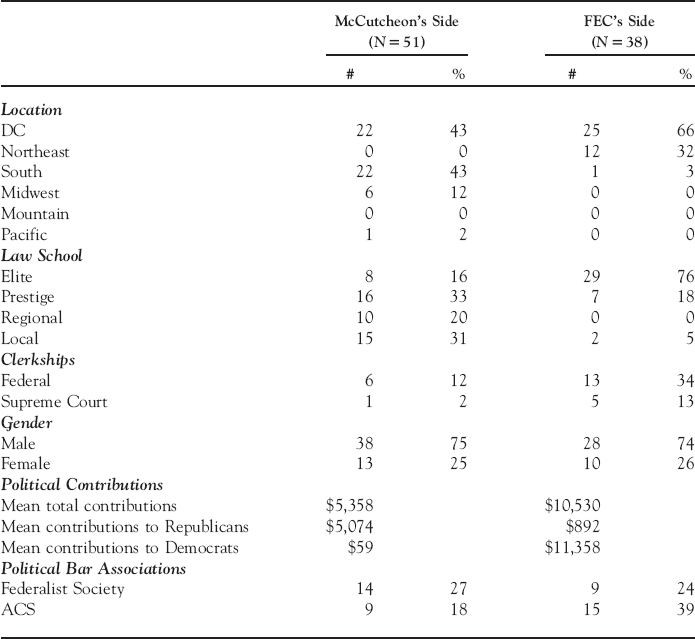
In McCutcheon, 43 percent of lawyers on McCutcheon's side worked in Washington, DC versus 66 percent of those on the FEC's side. Forty-three percent of lawyers on McCutcheon's side worked in the South and 12 percent in the Midwest. Only 3 percent of lawyers on the FEC's side worked in the South, and none of them worked in the Midwest. None of the lawyers on McCutcheon's side worked in the Northeast, while 32 percent of the lawyers on the FEC's side did so. See Table 4.
Characteristics of Lawyers Filing Party and Amicus Briefs in McCutcheon

| McCutcheon's Side | FEC's Side | |||
|---|---|---|---|---|
| (N = 51) | (N = 38) | |||
| # | % | # | % | |
| Location | ||||
| DC | 22 | 43 | 25 | 66 |
| Northeast | 0 | 0 | 12 | 32 |
| South | 22 | 43 | 1 | 3 |
| Midwest | 6 | 12 | 0 | 0 |
| Mountain | 0 | 0 | 0 | 0 |
| Pacific | 1 | 2 | 0 | 0 |
| Law School | ||||
| Elite | 8 | 16 | 29 | 76 |
| Prestige | 16 | 33 | 7 | 18 |
| Regional | 10 | 20 | 0 | 0 |
| Local | 15 | 31 | 2 | 5 |
| Clerkships | ||||
| Federal | 6 | 12 | 13 | 34 |
| Supreme Court | 1 | 2 | 5 | 13 |
| Gender | ||||
| Male | 38 | 75 | 28 | 74 |
| Female | 13 | 25 | 10 | 26 |
| Political Contributions | ||||
| Mean total contributions | $5,358 | $10,530 | ||
| Mean contributions to Republicans | $5,074 | $892 | ||
| Mean contributions to Democrats | $59 | $11,358 | ||
| Political Bar Associations | ||||
| Federalist Society | 14 | 27 | 9 | 24 |
| ACS | 9 | 18 | 15 | 39 |
B. Law Schools Attended and Federal Clerkships
Overall, the professional credentials of the lawyers on the FEC's side are more elite than those of the lawyers on the challengers' side (see Tables 3 and Tables 4). Eighty-seven percent of lawyers on the FEC's side in Citizens United attended law schools in the top twenty in the U.S. News & World Report rankings, as compared to half of lawyers on briefs on Citizens United's side. One-third of lawyers on Citizens United's side attended local law schools, defined as schools ranked below fifty in U.S. News, while just 2 percent of lawyers for the FEC's side attended those schools. A higher proportion of lawyers on the FEC's side clerked for federal judges and for the Supreme Court.Footnote 28 These differences were even more pronounced in McCutcheon, probably because lawyers for the ACLU and several other civil liberties groups that tend to attract elite lawyers and were on the challenger's side in Citizens United did not participate in McCutcheon. Just one of the lawyers on McCutcheon's side clerked for a Supreme Court justice, while five lawyers on the FEC's side did so.Footnote 29
If educational background and career credentials are positively correlated with skill or other types of merit, one might expect the FEC's side to have a distinct advantage in these campaign finance cases. But perhaps overall differences matter less than the skills of the lawyers who play particular roles, such as the lawyers who handle oral arguments and those who represent the parties and key amici.
C. Appellate Advocacy Experience and Connections to the Supreme Court
The parties and key amici on both sides of these cases were represented by experienced appellate advocates. Many worked for law firms with prominent appellate practices, and these lawyers and law firms may have a special type of influence linked to a combination of skill, familiarity with the justices, and political ties (Nelson et al. Reference Nelson, Rishikof, Messinger and Jo2009; Reuters 2015). Ted Olson, counsel for Citizens United, served as Solicitor General under President George H. W. Bush, and now heads Gibson, Dunn & Crutcher's appellate practice group. He has argued sixty-two cases before the Supreme Court—more than all but a handful of appellate advocates of the twenty-first century (Bhatia Reference Bhatia2012)—and he has prevailed in over 75 percent of those cases, including Bush v. Gore (2000). Floyd Abrams, who represented Senator Mitch McConnell in Citizens United, is a senior partner in Cahill Gordon & Reindel and is widely viewed as a leading, if not the leading, litigator of First Amendment issues. He has argued thirteen cases before the Supreme Court (Oyez 2016), and has made his name as an advocate for First Amendment “near-absolutism” (Abrams Reference Abrams2013, 7).Footnote 30
Charles Cooper, who filed amicus briefs on behalf of the National Rifle Association in Citizens United, served as Assistant Attorney General for the Office of Legal Counsel in the Reagan Administration and has argued several times before the Supreme Court, including in defense of California Prop. 8 in Hollingsworth v. Perry (2013) (with Ted Olson on the other side representing the plaintiffs). James Bopp, who represented seven former FEC commissioners and one former chairman in Citizens United and the RNC in McCutcheon, has argued four Supreme Court cases, including two campaign finance cases decided in his favor by the Roberts Court.Footnote 31 Other lawyers on Citizens United's side with substantial appellate experience include Jan Baran, a Wiley Rein partner who represented the US Chamber of Commerce, and Steven Shapiro, then National Legal Director of the ACLU.
On the FEC's side, Deputy Solicitor General Malcolm Stewart, who handled the oral argument in the first round in Citizens United, has argued seventy-three times before the Supreme Court (Oyez 2016).Footnote 32 Elena Kagan (now US Supreme Court Justice) argued for the FEC in the second phase of Citizens United in her first argument as US Solicitor General. Seth Waxman, who represented John McCain, served as Solicitor General from 1997–2001, co-chairs Wilmer Hale's appellate practice, and has handled seventy-five Supreme Court arguments. Paul Smith, who served as counsel for the Committee for Economic Development, led Jenner & Block's appellate practice group until January 2017 and has argued nineteen cases before the Supreme Court, including Lawrence v. Texas (2003), the landmark gay rights case.Footnote 33 Other lawyers on FEC's side with significant appellate experience include Scott Nelson and Randolph Moss,Footnote 34 who served as counsel for Senators McCain and Feingold and other principal sponsors of the BCRA (with Seth Waxman), and Bradley Phillips, counsel for Representatives van Hollen, Price, Castle, and Lewis in Citizens United.
In McCutcheon, Erin Murphy, a young partner in the Bancroft LLP firm and the protégé of former Solicitor General Paul Clement, handled the oral argument for Shaun McCutcheon. Murphy clerked for Chief Justice Roberts in 2008–2009, when Citizens United was first argued. Bobby Burchfield, then head of McDermott, Will & Emery's complex litigation practice, argued for Senator Mitch McConnell.
Arguing for the FEC in McCutcheon was Donald Verrilli, US Solicitor General 2011–2016. Before becoming Solicitor General, he served as Deputy Counsel to President Obama and Associate Deputy Attorney General, and he was previously cochair of Jenner & Block's Supreme Court practice.Footnote 35 He has argued forty-six cases before the Supreme Court (Oyez 2016). Other experienced appellate advocates filing briefs on the FEC's side included Seth Waxman, Scott Nelson, and Randolph Moss (see above) for Representatives van Hollen and David Price, and Paul Smith (see above), counsel for Democratic Members of the US House of Representatives, and Harvard Law Professor Charles Fried, former Solicitor General 1985–1989, who represented Americans for Campaign Reform.
D. Gender
There were no striking gender differences between the sides in these cases. Men vastly outnumber women among the lawyers involved in these cases.
E. Political Party Ties
Among those lawyers who made political contributions, the overwhelming majority on the challengers' side gave exclusively or primarily to Republicans, while those on the FEC's side strongly favored Democrats. Although political contributions are sometimes made for reasons other than party allegiance, including personal motivations (to please friends and acquaintances) or for strategic purposes (to gain business or political support), these data nevertheless suggest that the lawyers, like the parties and organizations involved in this litigation and the Supreme Court justices toward whom they direct their advocacy, are divided by political ideology.
Some of the lawyers involved in Citizens United and McCutcheon have served in party leadership positions, elected office, or appointed positions in government. On the challengers' side, James Bopp was vice-chairman of the RNC from 2006–2012, and Bradley Smith, chairman and founder of the Center for Competitive Politics, served in a Republican-designated seat on the FEC for five years after he was recommended by Senator Mitch McConnell (see Congressional Record 2000, 8769–75). Bobby Burchfield was general counsel of President George H. W. Bush's reelection campaign. Steve Hoersting, counsel for the Center for Competitive Politics in Citizens United and for the RNC in McCutcheon, served as chief counsel for the National Republican Senatorial Committee 2003–2005. Cleta Mitchell, counsel for American Justice Partnership and Let Freedom Ring in Citizens United, served as legal counsel to the National Republican Senatorial Committee and the National Republican Congressional Committee. All the lawyers on the brief of the National Republican Senatorial and Congressional Committees in McCutcheon also had strong partisan ties: Megan Sowards was deputy general counsel to Mitt Romney's 2012 presidential campaign; Jason Torchinsky was deputy general counsel to Bush-Cheney 2004; and Thomas Josefiak was an advisor to Crossroads GPS, a Super PAC established by Karl Rove in 2010 (Hamburger and Gold Reference Hamburger and Gold2014), and served as chief counsel of the RNC from 1995–2007.Footnote 36
On the FEC's side, Robert Bauer, who represented the DNC in Citizens United, served as White House counsel to President Obama and is now general counsel to the DNC. Donald Simon, a lawyer for Representatives van Hollen & Price in Citizens United, has served as an advisor to the DNC, and Andrew Werbrock, one of the lawyers for the Center for Political Accountability, has represented the DNC and the Democratic Senate and House Campaign Committees. J. Gerald Hebert, then director of the Campaign Legal Center, served as general counsel to the National Redistricting Project for Congressional Democrats (1990–2002). Trevor Potter served as general counsel to the McCain 2000 and 2008 campaigns and as FEC commissioner (1991–1995) and chairman (1994).
F. Ties to Politically Aligned Bar Associations
Many of the lawyers involved in Citizens United and McCutcheon have ties to politically aligned bar organizations. The Federalist Society for Law and Public Policy Studies (Federalist Society) is an association of conservative and libertarian lawyers founded in 1982 for the purpose of “reforming the current legal order,” and it has played an important part in nurturing the political commitments of conservative and libertarian lawyers, helping them network with one another and facilitating their involvement in legal advocacy for conservative and libertarian causes (Southworth Reference Southworth2008; Teles Reference Teles2008; Hollis-Brusky Reference Hollis‐Brusky2015).Footnote 37 The Federalist Society's success in mobilizing conservative and libertarian lawyers and creating a network based on shared political identity inspired the creation of the American Constitution Society (ACS), modeled directly on its competitor, in 2001 (Carter Reference Carter2003; Baldas Reference Baldas2004). ACS (n.d.) defines its mission as “shaping debate on vitally important legal and constitutional issues; … building networks of lawyers, law students, judges and policymakers dedicated to those ideas; and … countering the activist conservative legal movement that has sought to erode our enduring constitutional values.” It probably is no coincidence that several of the largest foundation contributors to organizations that filed briefs on the challengers' side in Citizens United and McCutcheon were also among the largest contributors to the Federalist Society during the same years: Lynde and Harry Bradley ($4.2 million), Sarah Scaife ($3.4 million), Searle Freedom Trust ($2.3 million), F. M. Kirby Foundation ($475k), and Dunn's Foundation for the Advancement of Right Thinking ($383k). Similarly, some of the largest foundation supporters of organizations that filed on the FEC's side were major supporters of ACS: Open Society Institute ($6.6 million), Atlantic Philanthropies ($3.2 million), Ford Foundation ($1.15 million), and Foundation to Promote Open Society ($1.3 million).
Federalist Society and ACS ties might provide opportunities and/or a basis for cooperation among lawyers who do not share values and policy priorities (Southworth Reference Southworth2008, 124–48, 184–86; Hollis-Brusky Reference Hollis‐Brusky2015, 66–72). In particular, they might facilitate the coordination of amicus support, a strategically important facet of appellate practice, especially in the US Supreme Court (Collins, Corley, and Hamner Reference Collins, Corley and Hamner2014; Ebner and Conrad Reference Ebner and Conrad2015). Prior research shows that Federalist Society activities may promote understanding and cooperation among lawyers with fundamentally different worldviews and encourage them to find ways to pursue their own agendas without undercutting each other (Paik, Southworth, and Heinz Reference Paik, Southworth and Heinz2007, 897, 907–11; Southworth Reference Southworth2008, 130–41).
Participation in the Federalist Society and ACS might also promote the lawyers' influence with justices who are themselves active in these organizations, and with the justices' clerks (Hollis-Brusky Reference Hollis‐Brusky2015). Four of the justices on the Court when Citizens United and McCutcheon were decided—Alito, Thomas, Roberts, and Scalia—have spoken at Federalist Society national conventions.Footnote 38 Three of them – Justices Scalia, Thomas and Alito – have longstanding ties to the Federalist Society. Indeed, Justice Scalia assisted in organizing one of the first Federalist Society chapters in 1982.Footnote 39 Justices Scalia, Breyer, and Kagan have participated in events cosponsored by the Federalist Society and ACS, and Justices Sotomayor, Ginsburg, Stevens, and Breyer have been featured speakers at ACS National Conventions.Footnote 40
The Federalist Society and ACS do not publish their membership lists, and very few of the lawyers included in this research note their involvement in the organizations in their biographies, but the search engines on the Federalist Society and ACS websites provide some evidence of the lawyers' involvement. Using a very broad measure that includes merely participating in the organization's activities (e.g., leadership roles, participation in speeches, debates, and conferences, and authorship of publications sponsored by the organization), without necessarily endorsing the organization's mission, lawyers on the challengers' side of these cases were more likely than lawyers on the FEC's side to have ties to the Federalist Society, while lawyers on the FEC's side in both cases were more than twice as likely as lawyers on the challengers' side to have ties to ACS.
Many lawyers on the challengers' side hold or have held leadership roles in the Federalist Society. Some participate in the Federalist Society's Free Speech and Election Law Practice Group, which formed in 1996, following the defeat of Congress's first attempt to enact what eventually became McCain-Feingold (Hollis-Brusky Reference Hollis‐Brusky2015, 65–66). James Bopp was cochair of the Free Speech and Election Law Practice Group from 1995 through 2005. The immediate past chair of the Federalist Society's Free Speech and Election Law Practice Group was Allison Hayward, who served as counsel to Bradley Smith at the FEC and filed a brief on behalf of several scholars in Citizens United (Federalist Society, n.d.d).
Other lawyers who participated in Citizens United and McCutcheon and have played prominent roles in the Free Speech and Election Law Practice Group include Anthony Caso (Center for Constitutional Jurisprudence), Reid Alan Cox (Center for Competitive Politics), Bradley Smith (Center for Competitive Politics), William Mauer (Institute for Justice), and Stephen Hoersting (cofounder of the Center for Competitive Politics) (Federalist Society, n.d.d). Ted Olson, counsel for Citizens United, serves on the organization's board of visitors and is a regular speaker at Federalist Society events (Federalist Society n.d.b). Curt Levey, who filed a brief on behalf of the Committee for Justice in McCutcheon, is on the Executive Committee of the Federalist Society's Civil Rights Practice Group (Federalist Society n.d.c). Ilya Shapiro, who filed briefs on behalf of the Cato Institute in both Citizens United and McCutcheon, is a regular lecturer at Federalist Society events (Federalist Society n.d.e). Charles Cooper, counsel for the NRA in Citizens United, has been a frequent speaker at the Federalist Society's national conventions and a regular contributor to its publications since the 1980s (Federalist Society n.d.f).Footnote 41 Edwin Meese, III, on the brief for the Center for Constitutional Jurisprudence in Citizens United, serves on the Federalist Society's board of directors (Federalist Society n.d.a).
Lawyers on the FEC's side of these cases are not as well represented in the leadership ranks of ACS as lawyers on the challengers' side are in the Federalist Society. Paul Smith, lawyer for the Committee for Economic Development in Citizens United and counsel for Democratic members of the House of Representatives in McCutcheon, is a member and former chairman of the ACS's National Board of Governors. Seven other lawyers involved in Citizens United and McCutcheon on the FEC's side have organized speaker panels on election law issues for ACS and/or authored blog posts on the ACS website.Footnote 42
Nine of the lawyers on the challengers' side indicated in their online biographies that they were members or leaders of the Republican National Lawyers Association.
Polarized Support Structures
Both of these decisions resulted from test cases brought by committed conservatives pursuing a long-term, strategic agenda to deregulate campaign finance. The litigation campaign has benefited greatly from the support of organizations and financial patrons with material reasons to oppose campaign finance regulation. However, it has gained momentum through the participation of “second-generation” conservative public interest firms that are ideologically committed to the campaign's goals (Southworth Reference Southworth2005, 1255; Teles Reference Teles2008, 220–64), including several organizations that specialize in defending what they characterize as rights to political expression. They have developed a litigation campaign modeled on the NAACP Legal Defense Fund's campaign to dismantle racial segregation (Ints. 43, 44), and they target what Steven Teles (Reference Teles2008, 264) has called “a structural bias in the American legal system orienting public interest law to challenging governmental discretion … rather than defending it.” The challengers and their supporters have mobilized around the idea that government regulation of money in politics constitutes a grave threat to individual liberty and free speech.
The opponents and defenders of campaign finance regulation are locked in what Bradley Smith has characterized as “long-term ideological warfare” over the role of money in politics (Lichtblau Reference Lichtblau2010, A11). The support structures for the opposing sides in this fight consist of well-defined camps of organizations, financial patrons, and lawyers. Interviews with prominent lawyers indicate that the challengers ramped up their campaign against campaign finance regulation after the passage of McCain-Feingold and the Supreme Court's decision upholding the legislation in McConnell v. FEC.Footnote 43
The alliance on the challengers' side in Citizens United and McCutcheon included all the primary constituencies that stand behind the Republican Party, and it received financial support from longstanding patrons of the conservative law movement, along with newer foundations dedicated to libertarian ideals. Organizations supporting the FEC were progressive organizations that drew financial support from familiar old-line foundations and newer foundations with similar agendas.
On both sides, the attorneys who authored the briefs for the parties and handled oral arguments were almost exclusively elite members of the appellate bar, but the overall statistical profiles of lawyers on opposing sides of these cases were strikingly different. Advocates on the FEC's side were similar to one another in terms of several basic social characteristics; they overwhelmingly worked in DC and the Northeast, attended top-ranked law schools, and supported Democrats. Many of the lawyers on the challengers' side worked in the Midwest and South as well as in DC, and overall they held less elite educational credentials than those on the FEC's side. Most of them supported Republicans.
The organizations on the challengers' side filed more amicus briefs than did organizations on the FEC's side, perhaps in response to the “signal” (Baird Reference Baird2007, 55–58) or “invitation” (Hasen Reference Hasen2012, 785–86) issued in Justice Scalia's concurring opinion in Federal Election Commission v. Wisconsin Right to Life (2007), joined by Justices Thomas and Kennedy, indicating a willingness to overrule Austin and parts of McConnell. The amici on the challengers' side were also more diverse in terms of the constituencies they claimed to represent. That heterogeneity was especially evident in Citizens United, in which the challengers' side drew amicus participation by groups claiming to represent all the constituencies that have coalesced behind the Republican Party in recent decades—business, libertarians, social conservatives—as well as the ACLU and the AFL-CIO, two liberal groups known for consistently producing excellent briefs (Kearney and Merrill Reference Kearney and Merrill2000, 743).
The organizations' interests and/or missions with respect to campaign finance help explain the alignments in these cases. The US Chamber of Commerce has long resisted the regulation of corporate spending on elections (Mutch Reference Mutch2014, 153–54). Libertarian groups find it easy to oppose restrictions on campaign expenditures because that stance coincides with their general mistrust of government. James Bopp's opposition to campaign finance regulation grows out of his work as counsel for the National Right to Life Committee and other Christian conservative groups, which were the targets of FEC investigations in the 1980s and 1990s (Novak Reference Novak2012). First Amendment absolutists, such as the ACLU, have consistently opposed campaign finance regulation on the ground that it suppresses speech (although the ACLU's position on the issue has been controversial within the organization and among its senior staff).Footnote 44 The AFL-CIO argued that the government's interest in regulating corporate electioneering was much more substantial than the interest in regulating union participation, and it has since denounced the Supreme Court's decision in Citizens United on the ground that it “further tilted the playing field in favor of the one percent against the ninety-nine percent” (AFL-CIO 2012). However, the AFL-CIO's overriding objective was to escape the constraints of BCRA's Section 203, which applied to corporations and unions alike.
On the FEC's side, good government groups have consistently championed campaign finance regulation in the name of political equality. The DNC and the Democratic Party's traditional allies generally have been more supportive of campaign finance regulation than their GOP counterparts, perhaps reflecting their disadvantage vis-à-vis Republicans in attracting money from wealthy individuals and corporations (Mutch Reference Mutch2014, 165–69). But the Democratic leadership has not as dependably supported campaign finance regulation as its official position on the issue would suggest. One interviewed lawyer observed that “both parties … have become the party of big money” (Int. 46), and several lawyers noted that the Democratic Party's ambivalence about campaign finance regulation has made it an unreliable ally on the reform side:
The [Democratic] Party's in somewhat of a schizophrenic posture because the Democratic candidates and elected officials are all saying, “We need campaign finance reform,” and their lawyers are all actively fighting against campaign finance laws, challenging and spurring deregulation of money in politics in the courts. There's a major disconnect. At least on the Republican side … they're singing from the same songbook. You have Republican officeholders and candidates all saying, “We don't need any of these limits, they all infringe on the first amendment,” and their lawyers are saying the same thing in court. (Int. 10)
Another lawyer said of the failure of Democratic Party committees to file amicus briefs in McCutcheon: “A successful outcome in McCutcheon on the part of the plaintiffs would have been beneficial to the parties because it would have opened up new sources of financing. So they just kept their mouths shut” (Int. 12). Interviewed lawyers also echoed the views of commentators who have noted that leading Democratic politicians, including presidential candidate Hillary Clinton, were taking full advantage of the fundraising options available after Citizens United and McCutcheon while finding political opportunity in this incendiary issue in an election year (see Clines Reference Clines2015; Haberman and Confessore Reference Haberman and Confessore2015; Hasen Reference Hasen2016, 8–9). A campaign finance reform proponent said: “You wanna know why there's no Wall Street reform? Or why nobody went to jail after the meltdown? It's because Democrats get their same money out of Wall Street as the Republicans do” (Int. 11). A lawyer on the challengers' side asserted that while some populists within the Democratic Party, such as Bernie Sanders and perhaps Elizabeth Warren, might be principled reform advocates, most in the Democratic establishment are “filthy free-riders” (Int. 14).
Interviewed lawyers on both sides of these cases indicated that they participated in the common practice of orchestrating amicus support to maximize their influence on the Court. Well-coordinated amici can enhance a party's chances of prevailing by covering points that the party is unable to address due to page limits, and they sometimes shore up a party's position through the institutional expertise they offer. However, lawyers on the FEC's side in Citizens United reported that the short time between the Supreme Court's call for reargument and the deadline for filing their briefs led to rushed and disorganized amicus participation.Footnote 45 Leading lawyers on the challengers' side in both cases indicated that exceptionally aggressive efforts to discipline amici to address particular needs and to avoid repetition benefited their side. One leading campaign finance opponent noted that while coordinating amici is always important, Citizens United “was one case where we really went at it, and, to be honest, [were] pretty hard with people. I kind of used my influence and ours to say, ‘You've got to write this brief,’ and really pressured some people to write a particular brief and not do what they originally said. … We'd never before done it in that heavy-handed way” (Int. 44). This lawyer claimed that “how we handled the amici was very effective and really helped” (Int. 44).
Influence exercised by Republican Party leaders may have facilitated cooperation on the challengers' side. The RNC and Mitch McConnell have long opposed campaign finance restrictions and have led the fight against them (Mutch Reference Mutch2014, 171). In response to a question about the extent to which campaign finance is a partisan issue, many of the lawyers I interviewed remarked on the role of the Republican Party leadership and, in particular, Mitch McConnell. One lawyer noted that opposition to campaign finance was “an article of theology” for McConnell (Int. 6), and another said of the litigation campaign, “McConnell has driven [it]” (Int. 15). Another observed, “McConnell was at the forefront of challenging [BCRA]. He was at the forefront of Citizens United. He's at the forefront of efforts to prevent new campaign finance legislation from going anywhere” (Int. 7). McConnell helped found James Bopp's group, the James Madison Center for Free Speech (Dyche Reference Dyche2010, 124; Collins and Skover Reference Collins and Skover2014, 30), and the RNC has been a major funder of Bopp's litigation projects (Mencimer Reference Mencimer2011). Lawyers on the challengers' side of McCutcheon noted that the RNC organized the amicus conference (Int. 43) and was “heavily involved” in the amicus strategy (Int. 17).
One might have expected large differences in the policy commitments and social backgrounds of the parties and amici on the challengers' side to make coordination among parties and amici difficult. Other research has documented deep policy disagreements and social tension among advocates for various constituencies that have coalesced behind the Republican Party and that were represented on the challengers' side in this litigation (Southworth Reference Southworth2008). Advocates for business interests, such as the Chamber of Commerce, tend to be uncomfortable with the issue agendas of some of the social conservative and Tea-Party-affiliated groups, and vice versa.Footnote 46 Similarly, the ACLU shares little other policy ground with religious conservative groups, which actively oppose the ACLU's stance on abortion, gay rights, drug policy, and religion in schools. The AFL-CIO and the National Right to Work Committee, an organization dedicated to fighting “compulsory unionism” (National Right to Work Committee n.d.), are bitter adversaries on labor issues.
Moreover, generalizations (above) about the overall professional credentials on opposing sides of these cases mask large differences in the backgrounds and characteristics of the lawyers for the different types of constituencies represented on the challengers' side. In Citizens United, none of the lawyers for the ACLU, the AFL-CIO, or the Reporters' Committee for Freedom of the Press contributed to Republican candidates or committees in federal elections. More than half of the lawyers for business interests and libertarian groups attended law schools ranked in the top twenty, while none of the lawyers for social conservative organizations did. Most of the business advocates practiced in Washington, DC and the Northeast, while none of the advocates for religious conservative groups did so.
Some differences in the values, perspectives, and rhetoric of the different constituencies represented on the challengers' side in Citizens United are reflected in their online biographies and briefs. Although most of the lawyers for business and civil liberties groups tout conventional career achievements in their biographies, lawyers for social conservative and Tea-Party-affiliated groups sometimes emphasized different features of their experience. James Hirsen, lawyer for the Foundation for Free Expression, highlights his frequent guest appearances on the radio and TV shows of Michael Savage, Sean Hannity, Laura Ingraham, and Glenn Beck. The online biography of Deborah Dewart, counsel of record for the Foundation for Free Expression, observes that “‘Deborah’ is a good name for a Christian attorney” because “Deborah—like the ancient judge whose name she bears (Judges 4–5)—loves the law of the Lord.” Herbert Titus, counsel for the Free Speech Defense and Education Fund and Free Speech Coalition, is a Harvard law graduate, but he also served as the founding dean of the Regent University School of Law, which seeks to provide a legal education “taught from a Christian worldview” (Regent University n.d.). He also served on a defense team for Alabama Chief Justice Roy S. Moore in a suit brought by the ACLU and Americans United for Separation of Church and State to remove a Ten Commandments monument from the State Judicial Building in Montgomery, Alabama. Michael Connelly, executive director of the US Justice Foundation, charged President Obama with treason, called for his impeachment (Connelly Reference Connelly2015a), and asserted in a blog post that the “Best Friends Forever” of “Barack Hussein Obama” included Iran's leaders, the Muslim Brotherhood, Communist Cuba, Communist China, LGBT rights groups, and illegal aliens (Connelly Reference Connelly2015b). Similarly, some of the briefs contained apocalyptic rhetoric about the stakes at issue in the cases. The Wyoming Liberty Group and Goldwater Institute's brief, for example, warned that “the hour grows late for this Court to end its compulsion to promulgate obscure and liberty-depriving constitutional standards. … This Court may continue to balance and weigh, fiddling collectively while the Republic burns, or boldly reclaim its place as a guarantor of our rights” (Brief of Amici Curiae the Wyoming Liberty Group and the Goldwater Institute Scharf-Norton Center for Constitutional Litigation in Support of Appellant on Supplemental Question, 2009 WL 1261928).
Evidence of tension among the lawyers on the challengers' side emerged in struggles over who would handle oral arguments. James Bopp represented the plaintiffs in Citizens United until Ted Olson, a lawyer with sterling establishment credentials, took control. (Bopp continued his involvement in the case as counsel to the Committee for Truth in Politics.) In McCutcheon, Bopp argued for Shaun McCutcheon and the RNC at the district court level, but Paul Clement's appellate boutique, Bancroft LLP, replaced Bopp on the merits brief for McCutcheon in the Supreme Court and handled oral argument for both clients (Collins and Skover Reference Collins and Skover2014, 36–39). Bopp is a midwesterner and a social conservative. He was born in Terre Haute, Indiana, attended Indiana University where he led a chapter of Young Americans for Freedom, went to law school in Florida, and then returned to live and work in Terre Haute. He is a fierce abortion opponent and has fought restrictions on the protest and election-related activities of pro-life groups for decades—as general counsel to the National Right to Life Committee since 1978 and as special counsel to Focus on the Family 2004–2012. Bopp is also a true believer in the anti-campaign reform crusade; his goal is to “pretty well dismantle the entire regulatory regime that is called campaign finance law” (Fact Check 2010). But one journalist's account of Bopp's relationship with Washington-based GOP lawyers called it “frosty”: “they were mostly pragmatic business conservatives and very much creatures of the nation's capital, while he was the true-believing Midwestern right-to-lifer” (Novak Reference Novak2012). The RNC, which provided most of the funding for the case at the Supreme Court stage (Collins and Skover Reference Collins and Skover2014, 39), ultimately sided with Washington insiders, Bancroft LLP's lawyers, whose educational backgrounds and career histories are more like those of the justices.Footnote 47 One lawyer said of the decision to have Bancroft lawyers handle the oral argument: “The RNC basically decided, ‘Look we all have to work together, and this is the compromise’” (Int. 14).
The greater diversity of groups on the challengers' side and their ability to find common ground and project consensus despite those differences may have contributed to their success. Just as a large number of amicus briefs might serve as a “crude barometer of public opinion on an issue” (Collins Reference Collins2004, 812; cf. Kearney and Merrill Reference Kearney and Merrill2000), the diversity of constituencies represented in party and amicus briefs might also signal that a position receives broad public support (cf. Goelzhauser and Vouvalis Reference Goelzhauser and Vouvalis2014). Evidence of a varied coalition behind a position might also be useful to the Court in its efforts “to shape public opinion” (Collins Reference Collins2004, 813) by assuring the public that the Court is responsive to the demands of a broad range of constituencies and is not predictably siding with particular interests.
Several of the lawyers I interviewed said that the presence of the ACLU and the AFL-CIO on the challengers' side was useful to their position. One lawyer on the challengers' side observed that “Senator McConnell was always putting his arm around the ACLU. … ‘See, They're with me, okay?’” (Int. 32). A lawyer on the FEC's side said that “the ACLU gave [the deregulatory campaign] protective cover. The ACLU allowed everybody to think that maybe this isn't just a coup by the powerful. Maybe this is a principled defense of an important American value and this is the way it's gotta be if we're gonna have free speech” (Int. 28). Another asserted that the presence of the ACLU and AFL-CIO on the challengers' side helped with the “optics” of the Roberts Court's campaign finance decisions: “By the time this gets to people like Justice Kennedy, there's no way that that's actually making an influence. I think it's just like, ‘How do we market that as something that looks like we're not being as extreme as we're being?’” (Int. 48).
In an earlier campaign finance case, Federal Election Commission v. Wisconsin Right to Life, Inc. (2007), in which Bopp successfully challenged the application of Section 203 to broadcast advertisements protesting filibuster to delay voting on federal judicial nominees, Justice Roberts's majority opinion noted the heterogeneity of organizations on the challengers' side as an indication of the significance of the issues at stake. The penultimate paragraph stated:
These cases are about political speech. The importance of the cases to speech and debate on public policy issues is reflected in the number of diverse organizations that have joined in supporting WRTL before this Court: the American Civil Liberties Union, the National Rifle Association, the American Federation of Labor and Congress or Industrial Organizations, the Chamber of Commerce of the United States of America, Focus on the Family, the Coalition of Public Charities, the Cato Institute, and many others. (551 US 449, 481)
We cannot know whether the diversity of amici actually influenced the outcome in Wisconsin Right to Life, or instead merely supplied the Court with information used after the fact to justify its decision. Whatever role the diversity of amici played in Wisconsin Right to Life, however, it is reasonable to conclude that the equally diverse but even larger coalition assembled in Citizens United in support of the challengers' position might have functioned similarly in that case.
Hollis-Brusky (Reference Hollis‐Brusky2015) has argued persuasively that the Federalist Society network nurtured ideas ultimately adopted by the majority in Citizens United, including arguments about why the Court should abandon precedents in the name of fixing flawed campaign finance jurisprudence. She notes, in this connection, that Justice Kennedy's majority opinion cites the scholarship of Bradley Smith and Allison Hayward, both members of the Executive Committee of the Federalist Society's Free Speech and Election Law Practice Group.
Hollis-Brusky has also observed that all but one of the “diverse” organizations mentioned by Justice Roberts in Wisconsin Right to Life were represented by at least one lawyer active in the Federalist Society, suggesting that the common participation in Federalist Society activities by lawyers for amici on the challengers' side may have played some part in constructing the broad coalition supporting the challenger's position. Data collected in this study demonstrate that nineteen organizations on Citizens United's side had at least one lawyer with ties to the Federalist Society on the brief, lending some support to the notion that the network facilitated cooperation in that case, too, if only indirectly.Footnote 48 A leading opponent of campaign finance regulation whom I interviewed confirmed the importance of the Federalist Society Free Speech and Election Law Practice Group as a site for mobilizing on the challengers' side: “It's our sort of group where we network. It's a very valuable function the society performs” (Int. 44).
The parties, amici, and patrons on the challengers' side find common ground around the idea that campaign finance regulation suppresses core political speech. In interviews, lawyers on the challengers' side generally described what was at stake in these cases in succinct references to the First Amendment and political speech—for example, “a quintessential First Amendment issue—the ability of people to organize, pooling their resources to make their voices heard, speak out” (Int. 8); “whether the government gets to determine who speaks, how much, on what, for how long” (Int. 13); and “whether government can restrict or control what people are able to say about politics” (Int. 25). Several lawyers also offered some variant on this response: “What is hard to understand about the first five words of the First Amendment: ‘Congress shall make no law?’” (Int. 36). One lawyer observed that while groups on the challengers' side varied in their policy priorities and perspectives, what they have in common is that “they don't trust government regulation in the political process” (Int. 16).
While challengers have successfully rallied around the premise that campaign contributions and expenditures are core political speech protected by the First Amendment, defenders of campaign finance regulation struggle to find a shared “alternative frame” (Wedeking Reference Wedeking2010, 620) that does not collide with current Supreme Court doctrine (see Post Reference Post2014; Neuborne Reference Neuborne2015; Hasen Reference Hasen2016). In particular, the parties and amici on the FEC's side have found it difficult to find a promising rationale for regulating campaign finance in the face of the Supreme Court's finding that the only legitimate justification is to prevent quid pro quo corruption. The three-fold increase from Citizens United to McCutcheon in the use of “integrity” and “democracy” in briefs on the FEC's side (see Tables 1 and Tables 2), like Justice Breyer's dissent in McCutcheon, which cited Yale Law School Dean Robert Post's then unpublished manuscript, Citizens Divided (Reference Post2014), on the importance of “electoral integrity” to the fate of American democracy, reflect such attempts to articulate a different constitutional theory to support campaign finance regulation.
In interviews, lawyers on the FEC's side expressed frustration with the difficulty of countering the appeal of the challengers' simple First Amendment frame. In response to my questions about what was at stake in these cases, the lawyers on the FEC's side generally focused on what they found problematic about the Roberts Court's First Amendment analysis. One said: “Yes, corporations deserve some constitutional protections, but there are reasons governments can regulate their speech in ways that they can't regulate individual speech” (Int. 7). Another stated, “I'm not a First Amendment absolutist who believes that any government regulation of speech even through the proxy of money is necessarily inconsistent with the First Amendment values. If there's enough of a demonstration that government regulation is needed in order to maintain a democratic structure, that certain voices don't overwhelm other voices and don't discourage participation, I think that that can constitute a compelling interest to allow the government to regulate in a modest way and limited fashion” (Int. 27). Another lawyer expressed regret that he and other civil liberties advocates had failed to anticipate that “in some deep and troubling sense, the modern First Amendment” would become “locked in as a shibboleth and a kind of inflexible ban on any kind of government regulation—the early twenty-first century equivalent of the substantive due process jurisprudence of the early twentieth century—and it's the same people making the arguments and the same social class benefiting from it” (Int. 28). Another leading advocate on the FEC's side said: “We have lost our way when it comes to analysis of campaign finance. We view it solely via the lens of the First Amendment, and we only look at the purported free speech rights of the donor class, not the rest of the population, or 99 percent who don't participate in making contributions or expenditures in the political process and can't afford to” (Int. 49).
Several lawyers I interviewed confirmed that developing a new jurisprudence to support campaign finance regulation had become a major priority, not necessarily because they believed that new theories would sway the Roberts Court in the short term, but because it might help the reformers gain traction if and when the Court's composition changed: “We know that the new jurisprudence isn't going to pass the [current] Supreme Court, but you want to get the arguments ready in case the Court changes, or when the Court changes, in case you get a more favorable Court” (Int. 11). Another emphasized that “theories, and arguments that are set forth in dissenting opinions, sometimes in the future become the majority opinions. So we think it's important to participate in these cases even when we're losing so long as we're impacting the thinking of dissenting justices, who may one day find themselves in the majority. They will be arguments familiar to them, that they will continue to embrace, and maybe pull along a new colleague or two, and become the majority opinion” (Int. 10). Another said: “So the strategic question is, what can be done to be ready with a constitutional rationale that a new Court with a different makeup could adopt and that you could use to help them adopt it? And people are looking at various things” (Int. 18).Footnote 49
Conclusion
This research suggests a story of competing worlds of advocacy organizations, patrons, and lawyers divided by missions, social characteristics, and political allegiance. It mirrors a larger story in US politics in the past several decades—one of increased polarization of electoral constituencies and political parties (Layman, Carsey, and Horowitz Reference Layman, Carsey and Horowitz2006; McCarty, Poole, and Rosenthal Reference McCarty, Poole and Rosenthal2006; Theriault Reference Theriault2008), media outlets (Sunstein Reference Sunstein2007), and elites (McCarty, Poole, and Rosenthal Reference McCarty, Poole and Rosenthal2006; Graber Reference Graber2013). Most of today's Supreme Court justices hold either strongly liberal opinions or strongly conservative opinions typical of the highly educated, affluent members of their own party (Bonica and Sen Reference Bonica and Sen2015; Devins and Baum Reference Devins and Baum2015). On the issue of campaign finance, the divisions among the justices are deep and strong. This research suggests that the organizations, advocates, and financial patrons in campaign finance litigation, like the justices to whom they direct their advocacy, come from well-defined opposing and partisan camps.
In both Citizens United and McCutcheon, elites dominated the advocacy in the Supreme Court on both sides, but the organizations and lawyers on the challengers' side in Citizens United were more numerous and diverse in terms of their political profiles and social backgrounds. The greater diversity of this coalition may have been one of the keys to the challengers' success, providing a basis for the Court to believe, or at least claim, that its rulings correspond with positions that command broad public support. Ties through the Republican Party and Federalist Society appear to have facilitated cooperation among these groups, while the FEC's side lacked these advantages, perhaps because the Democratic Party and American Constitution Society were less committed to defending campaign finance regulation than Republicans and the Federalist Society were to opposing it. All the organizations on the challengers' side found common ground in a broad reading of the First Amendment, while reformers were stymied in this respect by the Court's rejection of the most compelling alternative frames.
This research does little to challenge the notion that the shift in momentum away from regulating money in politics is attributable primarily to the departure of Justice Sandra Day O'Connor and her replacement by Samuel Alito. Indeed, some of the interviewed lawyers asserted that the Court's composition has been and remains critical to the fate of campaign finance regulation. An opponent of McCain-Feingold who attended the arguments in both McConnell and Citizens United, for example, said that the primary difference between the two cases was that “in one case, the majority was inclined to not listen, and in the other case, the majority was inclined very much to listen” (Int. 32). On the FEC's side, one lawyer called the change from Justice O'Connor to Justice Alito “cataclysmic” and asserted that once that happened, “there was nothing you were going to be able to do about it” (Int. 6). Another said, “what really matters is the ideology of the bench, more than anything” (Int. 10). The election of Donald Trump to the Presidency, and his appointment of Neil Gorsuch to fill Antonin Scalia's seat on the Supreme Court, appears to have reinforced the advantage of those who oppose campaign finance regulation.Footnote 50
But this research also suggests that the support structure for deregulating campaign finance has contributed to the Roberts Court's fundamental reshaping of campaign finance jurisprudence. In response to several bruising defeats in the courts, and especially their loss in McConnell v. FEC, opponents of campaign finance regulation organized to take advantage of an opportunity to reverse course. They served up promising test cases, funded their progress through the courts, attracted skilled appellate advocates to present their positions, coordinated party and amicus support, and projected consensus among varied amici, which gave the Court a basis for finding that a broad range of affected constituencies supported the rulings. Some of the interviewed lawyers also claimed partial responsibility for encouraging the Court in Citizens United to “go big” (Ints. 36, 43).
In addition to whatever influence the support structures may have exerted on the shape of doctrine, they may also have changed the conversation and perceived ideological and partisan stakes of the issue. Campaign finance regulation has always been a partisan issue, but it enjoyed some support from moderate Republicans until recently. The alignments in the litigation challenging McCain-Feingold in Citizens United and McCutcheon were strikingly different from the alignments in Congress during the roll-call vote on the original legislation, which passed with nearly unanimous support from Democrats and a substantial minority of Republicans and was signed by President George W. Bush. Bipartisan support for campaign finance regulation has since collapsed, ensuring that almost all the public criticism of the Roberts Court's decisions has come from Democratic leaders and liberal allies, who must defend themselves against the charge that they are enemies of the First Amendment. A lawyer with a long history of involvement in Supreme Court litigation on the FEC's side said that he thought that “it was enormously important politically, and for litigation purposes, that the Bipartisan Campaign Reform Act was bipartisan—that you had McCain, who's his own guy, and Feingold, who's his own guy but in a different world from McCain, and a majority of the House and a majority of the Senate and signed by George Bush II. It seemed to me that bipartisanship there was critical. And I think it had an unstated impact on the Supreme Court” (Int. 26). The current absence of Republicans willing to support campaign finance regulation severely limits campaign finance reformers' prospects in Congress as well as in the courts. Meanwhile, leading lawyers on the challengers' side show no signs of letting up; they have set their sights on dismantling much of what remains of campaign finance regulation, such as disclosure requirements and contribution limits. One lawyer on the reform side said of the gains and momentum achieved by campaign finance regulation's opponents in recent years: “The goal posts have moved so much, it's just remarkable. … We're just getting steamrolled on this side” (Int. 27). Another observed, “I think they've been emboldened by the Roberts Court to say, ‘Well, let's keep going. We've managed to roll back the restrictions that we really, really didn't like, but let's keep going’” (Int. 10).