Introduction
Methicillin-resistant Staphylococcus aureus (MRSA) infections have been on the rise globally over the past decade. At any given time, about one-quarter of apparently healthy individuals are MRSA carriers.Reference Ayliffe1 Methicillin-resistant Staphylococcus aureus can be hospital-acquired (termed ‘epidemic’ MRSA) or community-acquired. It is widely accepted that epidemic MRSA strains cause different MRSA infections, especially in the hospital setting. One of the main identified risk factors for MRSA infection is previous contact with hospital settings or health care workers.Reference Wang, Chang and Ko2
The incidence of MRSA ear infections has been increasing. These present either following ear surgery or as new cases of ear discharge in the community.Reference Al-Shawwa and Wegner3 Identifying the likely type of MRSA is paramount to effective clinical management, as different types have varying virulence and differing antibiotic sensitivities. Epidemic MRSA is sensitive to commonly used gentamicin-based topical treatment, whilst community-acquired MRSA is resistant to gentamicin but shows sensitivity to fluoro-quinolones and thus to topical ciprofloxacin.
In this study, we reviewed the clinical history of newly diagnosed cases of MRSA ear infection in our local community, and identified their MRSA strain type using a new molecular technique, in an attempt to identify the likely source of the infecting MRSA strain.
Methods
We examined our hospital's electronic laboratory records, using the keywords ‘MRSA’ and ‘ear swabs’. Over a two-year period (2005–2006), we retrospectively identified 42 MRSA specimens from 35 patients. These patients' clinical history, examination findings and co-morbidities were recorded from their hospital case notes. Most patients were known MRSA carriers, with previously identified infection and/or colonisation elsewhere in their bodies.
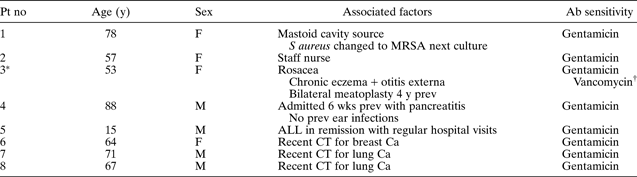
We identified eight patients with newly diagnosed MRSA ear infections, without any previous history of MRSA colonisation. These patients (Table I) were managed initially by their general practitioners with topical and systemic antibiotics. Ear swabs were sent for culture and sensitivity analysis, and the patients were referred to our otolaryngology department.
Clinical history of patients with newly diagnosed MRSA otorrhoea
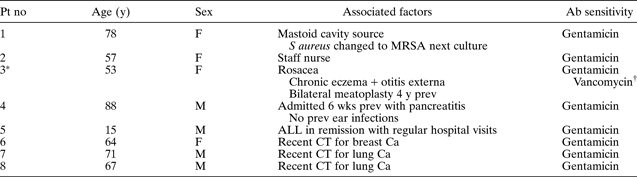
*Only patient requiring systemic antibiotics. †Patient allergic to vancomycin so treated with linezolid. MRSA = methicillin-resistant Staphylococcus aureus; pt no = patient number; y = years; Ab = antibiotic; F = female; M = male; S = staphylococcus; prev = previously or previous; wks = weeks; ALL = acute lymphoblastic leukaemia; CT = chemotherapy; Ca = cancer
The stored isolates from these eight patients were retrieved in order to determine MRSA strain.
We used the spa technique to identify the MRSA molecular type.Reference Koreen, Ramaswamy, Graviss, Naidich, Musser and Kreiswirth4, Reference Malachowa, Sabat, Gniadkowski, Krzyszton-Russjan, Empel and Miedzobrodzki5 This technique involves single locus DNA sequencing of the hypervariable X region of the spa gene encoding protein A, and enables reliable, accurate, discriminatory identification of MRSA types.
The X region of the spa gene was amplified using primers 1113F and 1514R.
Bi-directional DNA sequences were obtained using an ABI 3730 genetic analyser (Applied Biosystems, Life Technologies), and results were interpreted using Ridom Staph type software.Reference Harmsen, Claus, Witte, Rothganger, Claus and Turnwald6
To check the accuracy of our data, we compared our results with those obtained for the same isolates by the Scottish MRSA reference laboratory using pulse field gel electrophoresis.
Results
The MRSA strains of the eight patients with newly diagnosed MRSA otorrhoea were all sensitive to gentamicin.
Seven patients were managed as out-patients by ear micro-suctioning and topical treatment. One patient needed in-patient treatment with analgesia, regular daily ear micro-suctioning and systemic antibiotics. This patient developed a hypersensitivity reaction to vancomycin and was thus treated with oral linezolid. All these patients' initial ear swabs were sent for analysis by their general practitioners, as their infections had started in the community. On reviewing these patients' past clinical history, they were all found to have had contact with a hospital or a health care worker in the weeks preceding the development of their ear infection.
To confirm the likely source of the infecting MRSA strains, we typed the MRSA isolates using the new spa molecular technique. In seven of the eight patients, we isolated types exactly identical to the epidemic MRSA type 15 strain commonly circulating in our hospital. In addition, five of the eight patients had one spa subtype t032 MRSA. The spa t032 subtype is considered the second most common spa subtype deposited on the spa server, and accounts for 9.8 per cent of all the MRSA isolates (I meant the MRSA isolates isolated from the ear swabs of those 8 patients). Spa subtypes t022 and t379 were also identified, in one patient each. Interestingly, one specimen was an unusual strain identified as the local sporadic MRSA subtype pulse field (PF) 118a/d or Sporadic (S) MRSA 118. This strain had a high level of mupirocin resistance and a very poorly expressed mec A gene.
The same MRSA isolates were also sent to the Scottish MRSA reference laboratory for typing using pulse field gel electrophoresis.
Discussion
Methicillin-resistant Staphylococcus aureus otorrhoea is on the increase, and is changing the face of ear infection bacteriology.Reference Von Eiff, Becker, Machka, Stammer and Peters7–Reference Hwang, Chu and Liu9 Such infections have been linked to ventilation tube insertion, acute and chronic otitis media, and otitis externa.Reference Cotticchia and Dohar10, Reference Hunt and Robb11 Both epidemic and community strains of MRSA can cause MRSA otorrhoea; however, community-acquired MRSA otorrhoea is known to have a more aggressive clinical course, with multiple resistance to different antibiotics.Reference Gillet, Issartel, Vanhems, Fournat, Lina and Bes12, Reference Nathwani, Morgan, Masterton, Dryden, Cookson and French13 The latter infections commonly present in the community and show resistance to standard topical gentamicin but sensitivity to fluoro-quinolones and thus to ciprofloxacin.
Therefore, identification of the type and source of MRSA is essential to enable appropriate antibiotic treatment.
Before the development of typing techniques, the place of presentation (i.e. hospital or community) was used to indicate the most likely source and type of MRSA.Reference Hwang, Tsai and Liu14
Currently, the most commonly used typing technique is pulse field gel electrophoresis, often referred to as the ‘gold standard’ for MRSA strain typing. However, the complexity and cost of this technique, and the lack of inter-laboratory standardisation, have lead to the development of alternative methods, many of which are based upon the ability to amplify and sequence sections of the bacterial chromosome.Reference Deurenberg, Vink, Kalenic, Friedrich, Bruggeman and Stobberingh15 In our study, we chose to obtain MRSA strain data using spa typing, a DNA sequence based method that has proved valuable in several epidemiological investigations.Reference Koreen, Ramaswamy, Graviss, Naidich, Musser and Kreiswirth4, Reference Frenay, Bunschoten, Schouls, Van Leeuwen, Vandenbroucke-Grauls and Mooi16, Reference Harmsen, Claus and Vogel17 This technique had been developed as a universal approach for MRSA typing which allows inter-laboratory exchange of information via a standard software analysis package and central internet repository (www.ridom.de).Reference Harmsen, Claus, Witte, Rothganger, Claus and Turnwald6, Reference Frenay, Bunschoten, Schouls, Van Leeuwen, Vandenbroucke-Grauls and Mooi16
To allow better characterisation of the involved MRSA strains, we decided to test only newly diagnosed MRSA strains causing otorrhoea in patients with no known history of infection or colonisation elsewhere in their body. This approach identified a group of eight newly isolated MRSA strains from bacteriology swabs of infected ears. These strains all came from patients presenting in the community with symptoms and signs of ear infection (e.g. pain and otorrhoea). These patients were managed initially by their general practitioners, who sent bacteriology swabs for analysis.
• The incidence of methicillin-resistant Staphylococcus aureus (MRSA) ear infection is increasing; cases occur following ear surgery or as new presentations of ear discharge in the community
• This study aimed to identify bacterial strains involved in newly diagnosed MRSA ear infections in a local population, and to determine risk factors involved in these patients' clinical courses
• Hospital-acquired (‘epidemic’) MRSA sensitive to topical gentamicin was the commonest cause of these MRSA ear infections, even though all patients had initially presented to their general practitioner
• Contact with hospital staff or health care workers is a risk factor for acquiring MRSA otorrhoea in the community
These eight specimens were typed using the molecular spa subtyping technique. We confirmed that seven of these eight strains were epidemic MRSA type 15, and that their subtypes matched those commonly circulating in our local hospital, even though the eight patients had presented in the community. These MRSA strains were sensitive to gentamicin, and most of the patients responded to topical treatment involving aural toilet and topical gentamicin. A review of their clinical records confirmed that all eight patients had had recent contact with the hospital setting or a health care worker in the weeks preceding their presentation.
Recent US studies have suggested an increase in community-acquired MRSA ear infections sensitive to ciprofloxacin, overtaking those due to epidemic MRSA.Reference Saunders, Raju, Boone and Berryhill18
Conclusion
We had shown in this study that newly diagnosed MRSA ear infections in our community in Scotland (UK) were probably secondary to nosocomial infection by hospital-acquired MRSA sensitive to gentamicin, rather than to community-acquired MRSA sensitive to ciprofloxacin. Our findings agree with those of Yang et al. (Korea, 2008), who also found epidemic MRSA to be the commonest source of MRSA otorrhoea in their community.Reference Yang, Kim, Yoon, Kim, Park and Sohn19 These epidemiological and bacteriological differences between different countries and communities should be taken into consideration when choosing antibiotics to treat MRSA ear infections.
Simple, standard hand-washing techniques are still the most effective way of reducing MRSA infections.Reference Mandell, Bennett and Dolin20