Introduction
Complementary and alternative medicine is defined as any treatment or procedure which complements or completely replaces mainstream medicine. Complementary and alternative medicine treatment modalities include botanical and nutritional supplements, Chinese medical practices (e.g. acupuncture), folk medicine, and spiritual healing practices.Reference Kaptchuk and Eisenberg1 The multiplicity of complementary and alternative medicine practices make their study difficult.
The desire to ‘leave no stone unturned’ is a powerful motivator, and renders cancer patients prime candidates for complementary and alternative medicine use. Some complementary and alternative medicine therapies serve to support mainstream medicine, and integration of the two approaches has been seen to have positive effects in cancer patients.Reference Weiger, Smith, Boon, Richardson, Kaptchuk and Eisenberg2 On the other hand, some therapies may hinder mainstream medicine and potentially interact with chemotherapy or radiation used in the treatment of cancers.Reference Cassileth3, Reference White4 Furthermore, in patients who first seek alternative cures, the use of complementary and alternative medicine may unnecessarily delay definitive treatment.
Despite these potential advantages and disadvantages of complementary and alternative medicine use in cancer patients, the use of complementary and alternative medicine is not widely studied, especially in head and neck cancer patients. A telephone survey of 36 000 US households, conducted in 1988 by the American Cancer Society's Committee on Questionable Cancer Management, ascertained that 9 per cent of patients with cancer had used some form of alternative medicine.Reference Lerner and Kennedy5 However, a recent questionnaire survey conducted in UK head and neck cancer patients showed a prevalence of 50 per cent.Reference Shakeel, Newton, Bruce and Ah-See6
In head and neck cancers, both the disease and its treatment may be disfiguring, and basic swallowing, speech and respiration function can be affected. Patients may thus turn to complementary and alternative medicine. Therefore, our study aimed to determine the prevalence and the profile of head and neck cancer patients who use complementary and alternative medicine.
Materials and methods
Interview process
An interviewer-administered questionnaire was completed with 93 consecutive head and neck cancer patients seen at the out-patient cancer clinic of the National University Hospital, Singapore. Each patient was interviewed for 10 to 20 minutes by the same interviewer, either before or after their consultation with their primary physician.
Questionnaire
The questionnaire assessed patient demographics, including their age, gender, highest educational level, marital status and ethnic background. The tumour characteristics (type, pathology and stage), mode of conventional treatment (radiation, chemotherapy and/or surgery) and incidence of recurrence were retrieved from the clinical notes.
For the purpose of our study, the type of complementary and alternative medicine used was divided into four categories: nutritional products (e.g. Gingko biloba and ginseng); traditional physicians (e.g. traditional folk physicians); self-medication (e.g. vitamins); and acupuncture. Acupuncture is a traditional Chinese technique which involves the insertion of needles at particular body sites to unblock the flow of ‘qi’ energy in the body and enhance the body flow of ‘yin and yang’. Harmonious flow of qi in the body is thought to enhance a person's health. This modality of complementary and alternative medicine was thought to be prevalent locally, and was therefore grouped as a separate category.
Patients were asked about their beliefs and perceptions of the effectiveness of complementary and alternative medicine. The reasons for use of such medicine were determined; specifically, we asked who had introduced the patient to complementary and alternative medicine (e.g. family member, friend, physician or the media). The cost of complementary and alternative medicine was estimated, and patients were asked whether the cost of complementary and alternative medicine had prevented them from using it. Finally, we asked patients if they had any regrets regarding their use of complementary and alternative medicine, after considering its cost, lack of research and lack of endorsement by their physicians.
Ethical considerations
The interview was conducted in a separate room either before or after the patient's clinical consultation with their primary head and neck physician. Patients were informed of the aims and purpose of the study, and were assured that information derived from the study would be kept confidential and anonymous. Patients were also informed that their primary head and neck physician would be blinded to the patient's identity as regards study data, and that failure to participate in the study would not affect their healthcare in any way. Following this explanation, consent was obtained and the interview was conducted by the same (medically trained) person (who was not involved in the patient's care).
Results
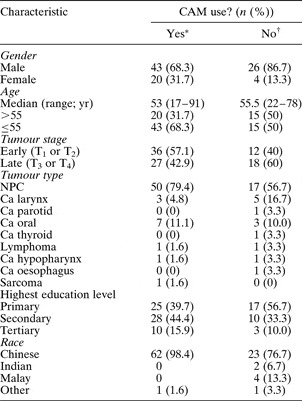
A total of 67.8 per cent (63/93) patients reported using complementary and alternative medicine, and 80.1 per cent of these (51/63) used complementary and alternative medicine concurrently with mainstream medicine. The remaining, approximately 20 per cent of complementary and alternative medicine users took complementary and alternative medicine separately from mainstream medicine. Complementary and alternative medicine users comprised 68.3 per cent (n = 43) males and 31.7 per cent (n = 20) females, with a median age of 53 years (range 17–91 years). The majority of these patients were Chinese, and the commonest tumour was nasopharyngeal cancer. A detailed demographic summary is given in Table I.
Patients’ demographic profile

*n=63; †n = 30. CAM = complementary and alternative medicine; yr = years; T = tumour stage; Ca = carcinoma
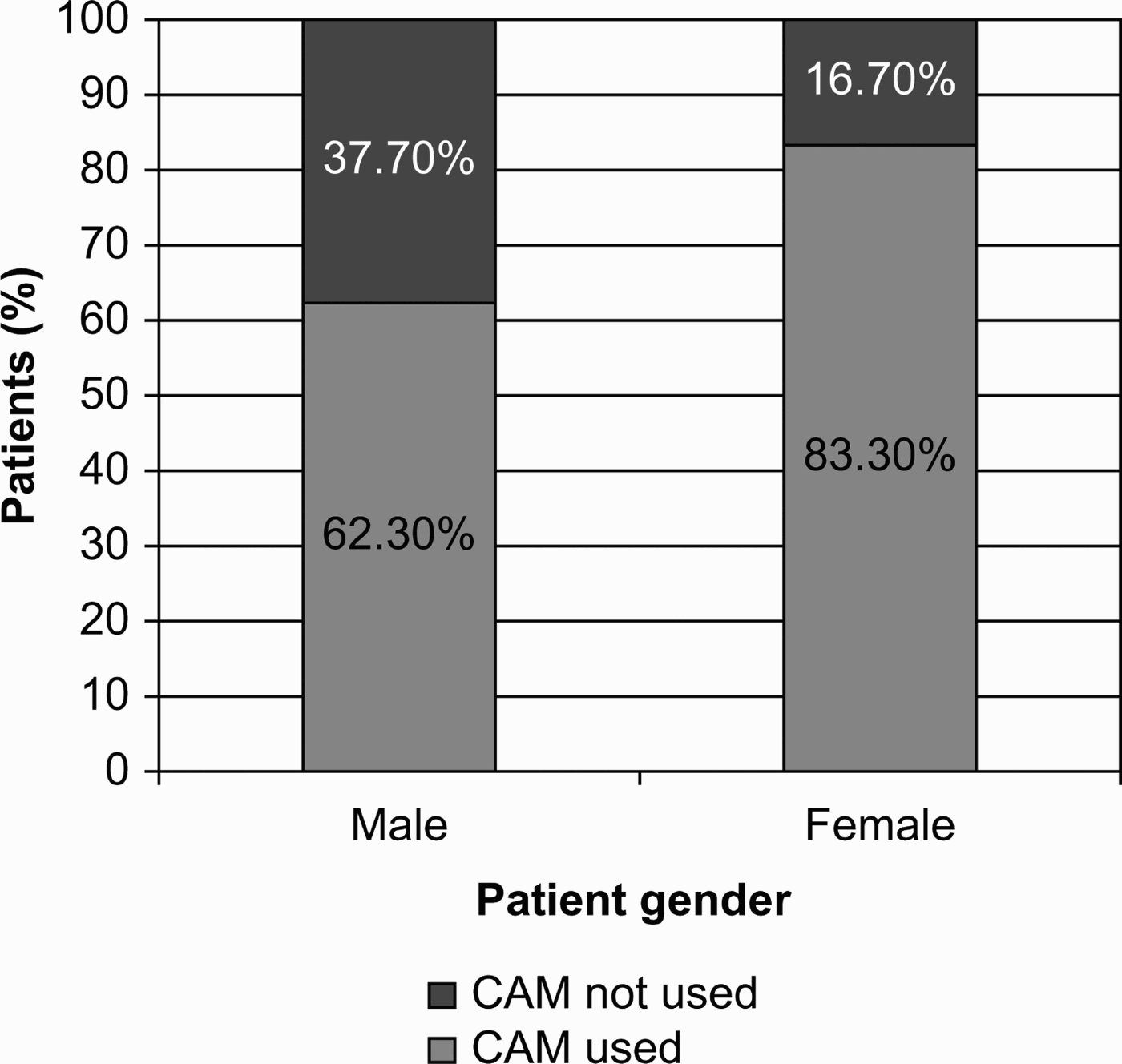
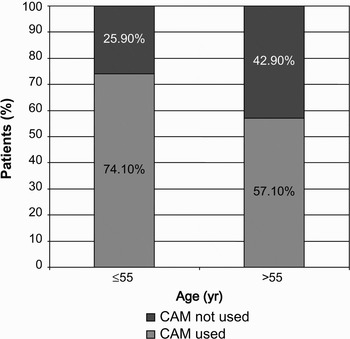
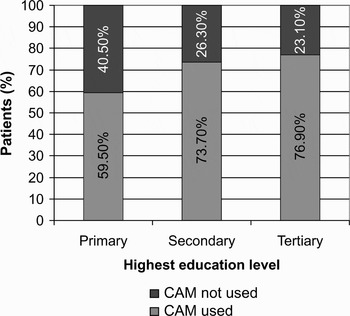
Patients who used complementary and alternative medicine were more likely to be female (Figure 1), younger (Figure 2) and better educated (Figure 3), compared with non-users. Of the complementary and alternative medicine users, 57.1 per cent had early stage cancer (i.e. stage one or two), while 42.8 per cent had late stage cancer (i.e. stage three or four) (Table I).
Complementary and alternative medicine (CAM) users and non-users by gender.

Complementary and alternative medicine (CAM) users and non-users by age group. Yr = years

Complementary and alternative medicine (CAM) users and non-users by highest educational level.

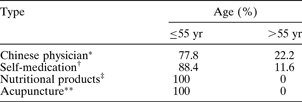
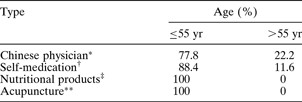
The most common type of complementary and alternative medicine used was self-medication with herbs, pills and herbal drinks. Most users were in the younger age group (i.e. <55 years), for all types of complementary and alternative medicine (Table II). A total of 96.8 per cent (61/63) of complementary and alternative medicine users were introduced to the practice by family and friends.
Type of complementary and alternative medicine used, by patient age
*n=36; †n = 54; ‡n = 4; **n = 4. Yr = years
We analysed the beliefs and perceptions of complementary and alternative medicine users, and found that 82.5 per cent (52/63) perceived complementary and alternative medicine to be effective even though they were aware of the lack of research and lack of endorsement by their physician for such medicine. Almost all complementary and alternative medicine users (98.4 per cent (62/63)) did not regret using such medicine in the course of their head and neck cancer treatment.
Discussion
Previous studies have found a prevalence of complementary and alternative medicine use in cancer patients of 16 to 54 per cent.Reference Shakeel, Newton, Bruce and Ah-See6–Reference Risberg, Lund, Wist, Dahl, Sundstrøm and Andersen10 These studies were conducted mainly in the early 1990s and included a wide variety of cancer types. Warrick and colleagues’ 1999 study reported a 21 per cent prevalence of complementary and alternative medicine users among their head and neck cancer patients.Reference Warrick, Irish, Morningstar, Gilbert, Brown and Gullane11 This study was among the first to comprehensively investigate the use of complementary and alternative medicine in patients with head and neck cancer.
Warrick and colleagues’ figure was significantly lower than our prevalence rate of 67.8 per cent. Several possible explanations could account for this increase. Our patient cohort comprised mainly Asians, a cultural group with various traditional folk medicine practices, and this could have accounted for wider use of alternative medicine practices by these patients.
Another important difference was that our study population comprised mainly patients with nasopharyngeal carcinoma, which was prevalent in our local context. Patients with nasopharyngeal carcinoma are primarily treated with radiation or combination chemoradiation. The adverse effects of these treatments, such as xerostomia, stomatitis and local skin radiation burns, may prompt patients to seek traditional therapies to ameliorate these symptoms.
We found greater use of complementary and alternative medicine among patients who were younger, female and better educated. This trend has also been observed in other cancer patient populations.Reference Lerner and Kennedy5, Reference Cassileth, Lusk, Strouse and Bodenheimer7–Reference Downer, Cody, McCluskey, Wilson, Arnott and Lister9 A possible explanation for this trend could be that younger, better educated patients are more inclined to try alternative cancer treatment modalities, or that they are more exposed to information about other alternative modalities via mass media or ‘word of mouth’. This trend may also be related to this group's greater financial ability to bear the costs of complementary and alternative medicine. Whatever the reason, this finding emphasises the fact that clinicians should be mindful of the need to discuss complementary and alternative medicine modalities during the follow up of younger head and neck cancer patients, to ensure that such medicine is practised appropriately.
Interestingly, complementary and alternative medicine was used equally by patients with early versus late stage head and neck cancer. This finding has not been observed in other cancer populations, in which an increased prevalence of complementary and alternative medicine use was seen in patients with distant metastases treated with palliative intent.Reference Risberg, Lund and Wist8 In our patients, a diagnosis of cancer seemed sufficient reason in itself to seek complementary and alternative medicine, rather than waiting until conventional treatment possibilities had been exhausted.
Despite being aware of the lack of evidence for complementary and alternative medicine, a surprisingly large majority of patients perceived such medicine to be effective and had no regrets about its use. This finding illustrates a general tendency to dismiss research data in favour of personal experience and recommendations by friends and family.
• The use of complementary and alternative medicine is common among head and neck cancer patients, despite lack of evidence of efficacy
• In this study, head and neck cancer patients who used complementary and alternative medicine were more likely to be female, better educated and younger, compared with non-users
• Clinicians should routinely ask patients about their use of complementary and alternative medicine, to facilitate improved communication and ensure appropriate use of such medicine
Whatever the reasons for its use, it is imperative to acknowledge the growing prevalence and influence of complementary and alternative medicine in head and neck cancer patients. We would argue that the use of complementary and alternative medicine in head and neck cancer patients needs to be rationalised. A logical first step would be the systematic classification of complementary and alternative medicine modalities. Each type of complementary and alternative medicine used by patients should be assessed for its efficacy. We recognise that there are many confounding factors which may prevent any useful conclusions. Some types of complementary and alternative medicine may well have beneficial effects. Therefore, such systematic classification may serve to benefit patients in the long term.
Conclusion
The use of complementary and alternative medicine is prevalent among head and neck cancer patients, regardless of their actual efficacy and cost. Complementary and alternative medicine use is more common among patients who are female, younger and better educated. Therefore, treating clinicians should routinely question patients on their use of complementary and alternative medicine; such improved patient communication will hopefully help patients to use complementary and alternative medicines in a safe and appropriate way.