INTRODUCTION
Biodiversity conservation has historically involved complicated tradeoffs between ecological preservation and sustainable community development. When conservation and human development goals do not align, conflict ensues (West et al. Reference West, Igoe and Brockington2006). To mitigate this potential problem, the IUCN (e.g., 2003 World Parks Congress) and the Convention on Biological Diversity (e.g., CBD COP9) have adopted guidelines to ensure that the creation and management of protected areas contribute to sustainable development and benefit local people (Hall et al. Reference Hall, Burgess, Rantala, Vihemaki, Jambiya, Gereau, Makonda, Njilima, Sumbi and Kizaji2014). These recommendations reflect growing global support for community-based natural resource management (CBNRM), which typically involves natural resource and biodiversity protection managed by and/or in conjunction with local communities. Community-based approaches to conservation take on different forms depending on the region, ecosystem and stakeholders involved, but typically feature a local agenda that controls management practices and associated economic benefits (Western & Wright Reference Western and Wright1994). Despite contextual differences, research has revealed a number of advantages (e.g., local ownership and input, positive economic impacts, enhanced ecosystem services) and disadvantages (e.g., inequitable or unsustainable distribution of benefits, conflict among stakeholders) associated with CBNRM (Adams & Hulme Reference Adams and Hulme2001; Salafsky et al. Reference Salafsky, Cauley, Balachander, Cordes, Parks, Margoluis, Bhatt, Encarnacion, Russell and Margoluis2001; Coria & Calfucura Reference Coria and Calfucura2012).
Most advocates of CBNRM tout the economic benefits of conservation, which can theoretically bring much needed revenue and development opportunities to impoverished communities. Economic benefits have been defined by local residents as the greatest benefit of tourism in certain Kenyan communities (Bruyere et al. Reference Bruyere, Beh and Lelengula2009), and they can be key to achieving improved local livelihoods as well as conservation goals across a variety of contexts (Mbaiwa & Stronza Reference Mbaiwa and Stronza2011). The assumption in these situations is that the money flowing into communities will provide incentives to conserve surrounding ecosystems and supplement subsistence lifestyles prevalent in regions where many CBNRM programs are located (Appiah-Opoku Reference Appiah-Opoku2011). Arrangements are often made with local communities to stop exploitative or environmentally destructive behaviours (e.g., illegal hunting/gathering, farming, timber harvest) in exchange for new sources of compensation or conservation-based revenue (e.g., involvement in tourism projects, payment for environmental services, compensation for losses; Bobo & Weladji Reference Bobo and Weladji2011; Dickman et al. Reference Dickman, Macdonald and Macdonald2011; Sommerville et al. Reference Sommerville, Milner-Gulland, Rahajaharison and Jones2010 a ). For example, a study comparing two ecotourism operations in Peru found that increased economic benefits in communities were correlated with enhanced local investment and involvement in the tourism sector (Mitchell & Eagles Reference Mitchell and Eagles2001).
Protected areas also provide less tangible ecosystem services through protection of watersheds, carbon sequestration and biodiversity conservation (Balmford et al. Reference Balmford, Bruner, Cooper, Costanza, Farber, Green, Jenkins, Jefferiss, Jessamy and Madden2002). Local knowledge of these ecosystem services often validates and/or supplements ecosystem data gathered by researchers (Mbile et al. Reference Mbile, Vabi, Meboka, Okon, Arrey-Mbo, Nkongho and Ebong2005). Systems that incorporate local perspectives and input into conservation can foster ownership of environmental resources, and therefore represent another key benefit of CBNRM. For example, community members in Uganda expressed more positive attitudes towards conservation programs run using local input, knowledge and suggestions than state-led programs focused on management plans constructed by park officials (Lepp & Holland Reference Lepp and Holland2006).
Although potential benefits associated with CBNRM abound, many problems also exist. Management at the local level is difficult because communities rarely act as homogeneous units, but are instead a complex conglomerate of values, castes and layered alliances often difficult to identify (Agrawal & Gibson Reference Agrawal and Gibson1999; Oates Reference Oates1999). Additionally, because CBNRM often emerges through bottom-up processes driven by local stakeholders (Gruber Reference Gruber2010), many communities may not be adequately prepared to independently manage environmental resources and conservation-related enterprises (e.g., ecotourism operations) without external support (Kiss Reference Kiss2004; Manyara & Jones Reference Manyara and Jones2007). Though opportunities to build capacity through collaboration may exist, they are frequently stymied by poor communication among community leaders, protected area managers and other key stakeholders (Bruyere et al. Reference Bruyere, Beh and Lelengula2009). When these potential barriers are addressed and the short-term benefits of conservation projects appear promising, community hardships may return and management systems can break down over time. In Ghana, although local community members had been introduced to activities such as beekeeping, woodcarving and snail farming, their participation in such activities was unsustainable because economic support was insufficient and activities did not align with local traditions (Appiah-Opoku Reference Appiah-Opoku2011).
Furthermore, even in cases where communities derive benefits, or perceived benefits, from local conservation programs, those same benefits may not exist at the family or household level (Manyara & Jones Reference Manyara and Jones2007; Sommerville et al. Reference Sommerville, Jones, Rahajaharison and Milner-Gulland2010 b ), and they may dissipate rapidly across different levels of the social hierarchy (Songorwa Reference Songorwa1999). As a result, distribution of CBNRM-related benefits within communities is often inequitable across stakeholder groups (Coria & Calfucura Reference Coria and Calfucura2012). In the Wolong Nature Reserve in China, uneven benefit distribution between foreign and local stakeholders discouraged support for conservation among rural residents, whose actions directly impact pandas in the reserve (He et al. Reference He, Chen, Liu, Bearer, Zhou, Cheng, Zhang, Ouyang and Liu2008). In Kenya, marked differences in perceptions of conservation benefits occur among traditional pastoral communities and those directly involved with locally owned and operated tourism programs (Gadd Reference Gadd2005). Individuals in traditional communities were aware of benefits but did not feel they were beneficiaries; whereas individuals involved with local tourism efforts recognized direct relationships between conservation and financial gains.
Discrepancies in tangible and/or perceived benefit distribution across different groups of stakeholders creates discord that may limit the success of CBNRM projects (Fiallo & Jacobson, Reference Fiallo and Jacobson1995), and often represents a source of controversy and conflict. For example, protected areas specifically designed to conserve natural resources and restrict human impacts often displace communities within protected area boundaries, affecting local traditions and community dynamics (West et al. Reference West, Igoe and Brockington2006). Protected areas may also restrict immediate access to resources (e.g., medicinal herbs, timber products, meat) on which human populations rely for daily subsistence (Adams & Hulme Reference Adams and Hulme2001; Naughton-Treves et al. Reference Naughton-Treves, Holland and Brandon2005). Different viewpoints regarding appropriate levels of resource utilization and extraction can create tension, and unequal distribution and perceptions of conservation-related benefits may generate additional friction among local communities near areas of conservation priority (Somerville et al. Reference Sommerville, Jones, Rahajaharison and Milner-Gulland2010 b; Coria & Calfucura Reference Coria and Calfucura2012). For example, conservation projects across protected areas in Chile have fuelled disputes among indigenous communities, governments and private corporations, resulting in not only economic loss but loss of human lives (Meza Reference Meza2009). As momentum surrounding community-based conservation builds, the ability to recognize and respond to conflicts associated with protected area management is a major challenge facing local residents, researchers and conservation practitioners throughout the developing world (Appiah-Opoku Reference Appiah-Opoku2011).
To manage conflict surrounding CBNRM, it is critical to understand public attitudes toward and perceptions of protected area management. Multiple social science theories suggest that attitudes, generally defined as evaluations of specific objects or issues, help explain the complex cognitive processes that influence behaviour (Ajzen & Fishbein Reference Ajzen and Fishbein1980; Vaske & Donnelly Reference Vaske and Donnelly1999). Consequently, the use of attitude research continues to grow, particularly in developing countries where attitude measurement and prediction are often linked to conservation management and decision making (Browne-Nunez & Jonker Reference Browne-Nuñez and Jonker2008).
Strategies for measuring attitudes often involve a series of belief statements that capture respondents’ judgements about particular conservation issues or outcomes (Akama et al. Reference Akama, Lant and Burnett1995; Gillingham & Lee Reference Gillingham and Lee1999). Using these metrics, studies have revealed a variety of conservation attitude correlates, including household income (Sarker & Røskaft Reference Sarker and Røskaft2011), education (Badola et al. Reference Badola, Barthwal and Hussain2012; Htun et al. Reference Htun, Mizoue and Yoshida2012), availability of resources for extraction (Allendorf et al. Reference Allendorf, Swe, Oo, Htut, Aung, Allendoft, Hayek, Leimgruber and Wemmer2006), degree of foreign investment (Struhsaker et al. Reference Struhsaker, Struhsaker and Siex2005), historical land management practices (West et al. Reference West, Igoe and Brockington2006) and perceptions of conservation-related benefits (Gillingham & Lee Reference Gillingham and Lee1999; McClanahan et al. Reference McClanahan, Cinner, Kamukuru, Abunge and Ndagala2009).
We hypothesize that local involvement in (or exclusion from) CBNRM programs also has a significant impact on public acceptance of conservation practices. Understanding attitudes of local people and the factors influencing them can raise public awareness of critical issues, focus conservation efforts, mitigate conflict, and guide policy and management initiatives, ultimately contributing to sustainable relationships between local people and their environment (Kideghesho et al. Reference Kideghesho, Røskaft and Kaltenborn2006). We explored these relationships in the Gola Forest of rural Sierra Leone. This region, part of the Upper Guinea Rainforests of West Africa, was identified as one of the 25 global biodiversity hotspots with high conservation priority due to high levels of endemism and threatened species (Myers et al. Reference Myers, Mittermeier, Mittermeier, da Fonseca and Kent2000). These tropical forests support approximately 25% of all African mammals; however, less than 5% of the Upper Guinea Rainforests are formally protected, and most areas are increasingly threatened by anthropogenic factors as limited tracts of forest are surrounded by a matrix of human-modified landscapes (Norris et al. Reference Norris, Asase, Collen, Gockowksi, Mason, Phalan and Wade2010). The forests are found in countries (e.g., Sierra Leone) with exceptionally low human development indices, and a majority of the population depends directly on natural resources for daily subsistence (Klugman Reference Klugman2011).
Our study investigated factors affecting the potential for conflict in a CBNRM system by examining the conservation-related attitudes of individuals living in two types of villages near the Tiwai Island Wildlife Sanctuary (TIWS): those involved in a CBNRM program (host villages) and those that were not. We were specifically interested in exploring the potential for conflict stemming from two sources: (1) local residents’ attitudes toward resource use and protection of the area, and (2) local residents’ beliefs about benefits associated with CBNRM.
MATERIALS AND METHODS
Study area
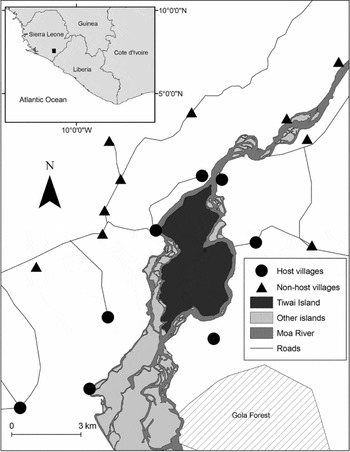
Tiwai Island, a 12 km2 island located on the Moa River in southeastern Sierra Leone (Fig. 1), was granted official status as a Wildlife Sanctuary in 1987 upon requests from members of the local chiefdoms and foreign researchers and volunteers who lived and worked on the Island, all of whom recognized the ecological value of this unique resource (TIWS 2014). The Island rises to 110 m elevation and, like the mainland surrounding it, consists of bush fallow, palm swamps and secondary forest, with growth from abandoned agricultural fields comprising a large portion of the total land area (Davies & Richards Reference Davies and Richards1991). Rural residents in the area rely heavily on slash-and-burn agriculture to clear land for subsistence rice farming and supplemental small-scale cash crops such as palm oil, cocoa, peanut and kola nut (Leach Reference Leach1994). Fish and bushmeat are key sources of protein in local diets (Davies & Brown Reference Davies and Brown2007). These traditional livelihoods highlight the close connection between people and the natural environment in the Tiwai area.
Tiwai Island, Sierra Leone, showing villages along the Moa River surveyed during August–December 2010. Inset displays the location of Tiwai Island within Sierra Leone.

The TIWS was originally owned by six founding communities who shared in annual profits from research and tourism (Whitesides Reference Whitesides1989). After threatening to exploit the Island's resources, two additional villages were later incorporated into the CBNRM profit-sharing structure (Eichenlaub et al. Reference Eichenlaub, Bereten, Oates, Sesay and Palmer1989). When a decade long civil war ended in 2002, the Environmental Foundation for Africa (EFA) established management with a mission to build local capacity, conduct environmental education, and maintain a visitor camp site and research station (EFA 2004). Today, EFA manages TIWS through the Tiwai Island Administrative Committee, which consists of key leaders from the Barri and Koya chiefdoms, other community elders, government officials, several academic institutions and environmental organizations led by EFA. This arrangement, which represents one of the only community-based conservation programs in Sierra Leone, is designed to shelter the island from resource extraction (e.g., logging, mining, poaching) while simultaneously contributing to sustainable community development (UNESCO 2014). Annual tourism revenues are split between chiefdoms, and further divided among the eight ‘host’ communities (three villages in Koya and five in Barri). Other villages in the immediate vicinity of TIWS (i.e., ‘non-host’ communities) receive little or no financial benefits from tourism and research in the protected area.
Data collection
Prior to primary data collection, we conducted a pilot study featuring semi-structured interviews with residents of the eight TIWS host communities (January–April 2009). We used open-ended questions to assess participants’ perceptions of benefits associated with TIWS and their general attitudes towards natural resource use on the Island. Themes emerging from the pilot study interviews were used to inform design of our more extensive survey instrument implemented approximately 18 months later. The mixed methods approach helped to ensure that the broader survey instrument reflected local perspectives.
Following the pilot study, we returned to Sierra Leone during August–December 2010 to survey 368 individuals in 18 villages along the Moa River near TIWS (eight host villages plus ten additional non-host villages in close proximity to the Sanctuary; Fig. 1). Sample sites were chosen based on a reconnaissance evaluation using focus groups in each village that assessed the village's willingness to participate and the logistical feasibility of data collection in the area. All of the villages sampled were within 8 km of TIWS, with host villages ranging from 0.2 to 6.9 km and non-host villages ranging from 2.5 to 7.7 km from the Sanctuary.
Intercept surveys were conducted by three assistants from the area who spoke the local language (Mende) and were trained in survey administration; each assistant collected about one third of the surveys. The use of trained researchers who were respected members of local communities presumably helped to eliminate concerns related to expectancy bias and minimize cross-cultural bias and translation issues, which are common problems for attitude research in Africa (Browne-Nunez & Jonker Reference Browne-Nuñez and Jonker2008). The research team visited 1–2 villages each day, resulting in 13 survey days. Respondents were chosen opportunistically (based on willingness to participate) as the research team moved through households in each village (only one individual per household was surveyed) and survey administrators estimated response rates at approximately 90%. Due to a lack of official census data, village authorities provided an estimate of population size in the region, projecting a total of around 7000 residents in the 18 villages near TIWS. Approximately 5% of the estimated population in each village was surveyed to obtain sufficient representation.
The survey instrument included multiple items related to demographic attributes such as age, gender, education level, occupation and resident status (i.e., native or immigrant based on longevity of family history in the area), and additional questions that assessed respondents’ attitudes toward natural resource use and conservation at TIWS. Respondents were also asked to indicate if they were familiar with EFA, the organization that coordinates the CBNRM program at TIWS and to list the various benefits EFA provides for local communities (an open-ended question).
Items measuring attitudes towards conservation were grouped into two major categories. Four ‘resource use’ items assessed whether respondents agreed, were unsure about or disagreed when asked if various types of natural resource extraction commonly used in the region (e.g., hunting, diamond mining, logging and farming) should be permitted at TIWS. Although all of these activities are forbidden in the Sanctuary, anecdotal evidence suggests each of them – especially poaching and artisanal diamond mining – occur on various scales. After confirming the reliability of the four-item scale, we developed a composite measure of the resource use orientation by calculating the average score for the resource use items.
Based on input from the pilot study and different perspectives regarding the need for more stringent regulation of the Sanctuary, respondents were also asked to indicate whether or not they agreed with the statement ‘TIWS should be protected from people.’ Because of low levels of uncertainty for each of the survey variables (only two responses in this category), data were recoded to reflect agreement (coded as ‘1’) or lack of agreement (coded as ‘0’). Three ‘conservation benefit’ items assessed whether respondents agreed, were unsure about or disagreed with the idea that TIWS (both overall and through tourism- or research-related activities) provided benefits to or helped local communities (e.g., generating income, creating jobs, building infrastructure). After confirming the reliability of the three-item scale (Cronbach's alpha = 0.94), we developed a composite measure of conservation benefit perceptions by calculating the average score for the conservation benefit items.
Data analysis
Data were analysed using SPSS v. 22.0 (SPSS Inc., Chicago, IL, USA). We first compared the demographic attributes of respondents across both the host and non-host villages using non-parametric tests (i.e., Pearson's Χ 2) for discrete choice data and parametric tests (i.e., independent samples t-test) for continuous or scalar data. Non-parametric tests were also used to compare respondents’ knowledge of EFA. We then used OLS regression (for the composite resource use and conservation benefit scales) and logistic regression models (for the binary ‘TIWS should be protected’ item) to evaluate the relative influence of multiple predictors including demographic variables, distance from TIWS and type of village (host or non-host) on attitudes towards natural resource use, conservation benefits and overall protection of TIWS.
We used the Potential for Conflict Index (PCI) to evaluate the potential for conflict based on stakeholder attitudes (Manfredo et al. Reference Manfredo, Vaske and Teel2003). The PCI measure of effect size, which ranges from 0 (minimum potential for conflict) to 1 (maximum potential for conflict) and describes a variable's central tendency, dispersion and shape, can provide insight into stakeholder consensus regarding controversial conservation decisions (Sharp et al. Reference Sharp, Larson and Green2011). We estimated PCI using the PCI2 metric of Vaske et al. (Reference Vaske, Beaman, Barreto and Shelby2010), which represents the average distance between respondents relative to the maximum potential distance between respondents on a given scale. If all respondents are in total agreement, then the PCI2 equals zero. If all respondents are clustered on the two extreme ends of the scale, the PCI2 value approaches one. Statistical differences (d) in PCI2 values between groups were analysed using the method of Vaske et al. (Reference Vaske, Beaman, Barreto and Shelby2010).
RESULTS
Demographic comparisons
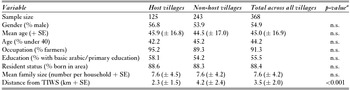
The demographic attributes of respondents in the host villages and non-host villages were similar (Table 1), indicating that any observed differences were likely due to other variables (i.e., village status) rather than demographic composition. On average, respondents living in non-host villages lived slightly further from TIWS, although none of the respondents lived more than 8 km from the Sanctuary. Participation rates were comparable across all villages (ranging from 12 to 30 participants per site). The overall survey sample was comparable to populations in other parts of rural Sierra Leone, where most people are farmers with large families and relatively low levels of education (Klugman Reference Klugman2011).
Demographic characteristics of survey respondents in host and non-host villages around the Tiwai Island Wildlife Sanctuary (TIWS), Sierra Leone. aSignificant differences between host and other villages were examined using Χ 2 tests (for categorical data) or t-tests (for continuous data).

Resource use and protection of TIWS
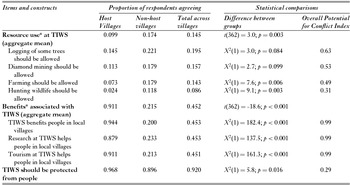
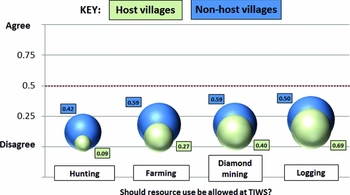
Most respondents (about 80%) believed that resource extraction should not be allowed at TIWS. Acceptance levels were lowest for hunting and farming and slightly higher for diamond mining and logging (Table 2). In all cases, resource extraction was deemed more acceptable by a higher proportion of residents in non-host communities. These differences were significant for two variables: hunting within TIWS and farming within TIWS. The application of PCI to attitude scores suggested general consensus and moderate to low potential for conflict across all types of resource extraction, though logging appeared to be the most controversial activity (Table 2 and Fig. 2).
Rural residents’ attitudes towards resource use and perceptions of conservation-related benefits at Tiwai Island Wildlife Sanctuary (TIWS), Sierra Leone. aAttitudes were rated on the following binary scale: 0 = disagree or unsure, 1 = agree.

Attitudes toward resource use (bubble location) and associated Potential for Conflict Index scores (labelled bubble size) among respondents in host villages (n = 125) and non-host villages (n = 243) around Tiwai Island Wildlife Sanctuary (TIWS).

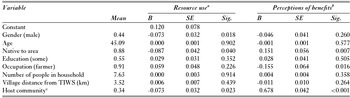
The regression model examining attitudes toward resource use at TIWS displayed relatively weak predictive power (Table 3). The only significant demographic correlates of resource use attitudes were gender and resident status. Males were less likely than females, and native villagers (i.e., those born in the area) were less likely than immigrants to endorse resource use in TIWS. Residents of host villages were also less likely than their non-host counterparts to support resource extraction from within the Sanctuary.
Parameter estimates for OLS regression models examining factors associated with local residents’ attitudes toward resource use and perceptions of conservation-related benefits at Tiwai Island Wildlife Sanctuary (TIWS), Sierra Leone. aMean score for composite resource use measure (logging + diamond mining + farming + hunting) = 0.14 ± 0.26; Scale: 0 = no resource use allowed and 1 = resource use allowed at TIWS; Model Fit Statistics: F(8,350) = 2.5, p = 0.012, adjusted R2 = 0.03. bMean score for composite perceptions of benefits measure (overall + tourism-related + research-related) = 0.46 ± 0.47; Scale: 0 = no perceived benefits and 1 = perceived benefits of TIWS; Model Fit Statistics: F(8,350) = 45.6, p < 0.001, adjusted R2 = 0.50. cHost communities were the eight villages involved in the TIWS community-based conservation program.

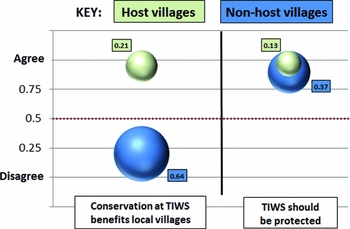
Despite slight disagreements between host and non-host villages with respect to attitudes toward resource use, 90% of respondents in non-host and 97% of respondents in host communities believed Tiwai Island should be protected from people. Because the protection orientation was universally dominant, the logistic regression model examining support for protection did not reveal any significant predictors among the independent variables of interest, including the status of communities as host vs. non-host.
Conservation-related benefits of TIWS
About one half (45%) of the people surveyed believed that conservation-related activities such as research and tourism at TIWS benefited local villages. Significant differences between host and non-host communities emerged with respect to benefit perceptions, demonstrating an exceptionally high potential for conflict (Table 2 and Fig. 3). While 90% of individuals surveyed in the host communities acknowledged benefits, only 20% of those in the non-host communities recognized benefits. Benefit recognition ratings for both groups were similar for overall TIWS protection, research at TIWS and tourism at TIWS.
Perceptions of conservation-related benefits (bubble location), overall attitudes toward protection (bubble location) and associated Potential for Conflict Index scores (labelled bubble size) among respondents in host villages (n = 125) and non-host villages (n = 243) around Tiwai Island Wildlife Sanctuary (TIWS).

The regression model examining benefit perceptions yielded a high level of predictive power (Table 3). The most significant demographic correlates of benefit perceptions were resident status and occupation. Native villagers (i.e., those born in the area) were more likely than immigrants, and farmers were less likely than other residents, to acknowledge benefits associated with TIWS. Although distance from TIWS was not significant in the model, benefit perception generally declined as distance from the Sanctuary increased. For example, among the host communities, the three furthest from TIWS had the lowest proportion of residents acknowledging benefits (74–88%).
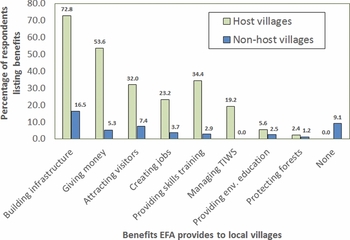
Differences in perceived benefits between host and non-host communities were also reflected in respondents’ knowledge of the organization that manages the CBNRM program at TIWS: the EFA. While 79% of respondents in the host communities had heard of EFA, only 29% of respondents in the non-host communities knew of the organization [X 2(1) = 83.2, p < 0.001]. When asked to list the various things that EFA does for local communities, answers varied (Fig. 4). The most common responses were building infrastructure and giving money. Attracting visitors, and providing employment and training opportunities were also listed by more than 30% of respondents. Host community residents were more likely to identify benefits than people living in non-host communities. In fact, only 16% of respondents in non-host villages listed any benefits associated with EFA.
Perceived benefits provided by the Environmental Foundation for Africa (EFA), the organization that manages community-based conservation at Tiwai Island, to local respondents living in host villages (n = 125) and non-host villages (n = 243) around Tiwai Island Wildlife Sanctuary (TIWS).

DISCUSSION
As CBNRM efforts expand, a growing literature has examined resource use and benefit distributions within host communities. However, few studies have explored the implications of attitudinal divergence and asymmetrical benefit distribution for the potential for conflict between host communities and neighbouring villages not involved in CBNRM programs. Our research revealed marked discrepancies in attitudes and perceptions among local residents that could lead to substantial conflict.
Resource use and protection of TIWS
Most respondents in both types of communities declared that they support protection of TIWS, and most generally opposed extractive resource use in the Sanctuary. Support was lowest for hunting and farming in the Sanctuary, and only slightly higher for diamond mining and logging. Closer analysis revealed that, although differences were less pronounced, individuals living in host communities were significantly more likely to support TIWS protection and less likely to support resource use than those in non-host communities. In many cases, however, alternatives to traditional extractive process are available. CBNRM managers could acknowledge these patterns and use the information to bolster outreach and training that focuses on alternatives to illegal diamond mining and logging in non-host communities near TIWS. As evidenced by PCI scores, individuals in host communities also expressed higher levels of consensus regarding opposition to extractive practices. Similar results have been observed in Tanzania, indicating a relationship between resource use and host community status as well as a need to focus on relating attitudinal studies to resource use and behaviour changes (Holmes Reference Holmes2003).
Other predictors of attitudes toward resource use were gender (males were less likely to support resource use) and resident status (natives to area were less likely to support resource use). Women in the region interact with the environment on a daily basis through extraction of resources such as firewood, water and crops, and women may therefore be more likely than males to support extraction in general (Leach Reference Leach1994). Native residents may feel more compelled to protect TIWS than recent immigrants for multiple reasons. As noted above, native residents typically develop traditional ties to the area and its ecological landscape that are not present in immigrant populations. Furthermore, native residents’ belief systems may be affected by traditional ecological knowledge (TEK) and beliefs that have been passed from one generation to the next for some time. Research has shown this transfer of conservation values, management strategies and knowledge gained from past environmental experiences influences behaviours in younger generations and may foster stronger conservation values and attachment to place (Berkes et al. Reference Berkes, Colding and Folke2000). Transmission of knowledge and beliefs through generations is a fundamental contributor to the longevity of TEK systems (Turner et al. Reference Turner, Ignace and Ignace2000), and it may also influence native villagers’ attitudes toward conservation and resource use, yielding important implications for protected area management. Future research could explore this possibility.
Conservation-related benefits of TIWS
Community status was the best predictor of positive conservation benefit perceptions (Table 2), with individuals living in host and non-host communities expressing very different perspectives regarding benefits derived from an adjacent protected area. Host communities generally recognized benefits related to tourism, research and other activities in TIWS, while non-host communities in close proximity (often less than 2 km) did not. This result was not unexpected given the benefit distribution structure associated with CBNRM programs, but the magnitude of the reported differences was remarkable. PCI scores focused on conservation benefit perceptions indicated a high potential for conflict, both between host and non-host communities and within the non-host communities themselves. These conflicting perspectives were also evident in participants’ beliefs regarding the contributions of the CBNRM program coordinating group, the EFA, to their respective communities. While many individuals in host communities recognized tangible benefits such as infrastructure development, increased revenue, new jobs and skill training (Fig. 4), very few individuals in non-host communities acknowledged these benefits. This type of conflict stemming from protected areas, their management and corresponding benefit distribution is an omnipresent issue facing CBNRM programs around the world (Bobo & Weladji Reference Bobo and Weladji2011).
Other predictors of positive attitudes regarding conservation benefits included occupation (farmers less likely to recognize benefits) and resident status (natives to area more likely to recognize benefits). Given their social status and indirect (or non-existent) associations with TIWS-related revenue, farmers may have fewer opportunities to access the financial and socio-economic resources derived from protected area management. In addition, wildlife-induced damage to crops and other agricultural resources could foster negative conservation attitudes among farmers (Wang et al. Reference Wang, Lassoie and Curtis2006; Infield & Namara Reference Infield and Namara2014). Native residents, on the other hand, may have greater access to these resources stemming from their longstanding connections and links to the local land and social structures. Studies exploring the ecological knowledge and conservation orientations of indigenous people and immigrants (often refugees) in other parts of the world have revealed similar patterns (Spiteri & Nepal Reference Spiteri and Nepal2008). For example, refugee populations in Nepal's Eastern Terai region have put added pressure on resources, instilling a desire in local people to take action to protect those resources (Birendra & Nagata Reference Birendra and Nagata2006).
Implications and recommendations
Although differences in conservation attitudes between host and non-host communities were expected, the magnitude of the discrepancy was surprising. How might these differences be explained? Future research could explore several possibilities. Demographic differences between host and non-host communities were evidently not the primary cause of the observed differences in conservation attitudes. Differential income generation and resource allocation, on the other hand, likely play an important role. Because the current management system at TIWS only provides direct benefits (i.e., enhanced access to financial and socio-economic resources) to host communities, the non-host communities may not experience the same opportunities and quality of life. These differences could lead to resentment, thereby exacerbating the potential for conflict in the region and limiting success of conservation efforts (Kideghesho et al. Reference Kideghesho, Røskaft and Kaltenborn2006). Observed differences between host and non-host communities might be partially attributed to geography. Although differences in spatial proximity to TIWS were trivial (<8 km) among all the villages surveyed, actual travel time may be substantially greater. In addition, although general education levels among all the communities were similar (Table 1), the host network may have provided more access to informal education and training opportunities related to conservation and sustainable livelihoods.
Community cohesion offers another possible explanation for the observed host–non-host discrepancies. The host-community designation could itself foster a sense of community, collaboration and shared norms within host villages, helping these villages build the social capital and capacity needed for conservation progress (Agrawal & Gibson Reference Agrawal and Gibson1999; Gruber Reference Gruber2010). Alternatively, more cohesive communities that are externally and self-recognized as conservation advocates are often the ones to earn the designation of a host community. Indeed, it is a focus on these attributes and historical and customary rights of indigenous people that often leads to CBNRM surrounding protected areas (WWF International 2008). The distinction between these two possibilities (i.e., host status leads to cohesion, or vice versa) is an important consideration in future planning and designation of CBNRM schemes. The ‘host’ designation may also foster a sense of community pride and ownership that typically emerges when beneficiaries have substantial input in the development process, organizations involved represent the interests of host citizens, and there is transparency and accountability among all stakeholders (Campbell & Arja Reference Campbell and Arja2003; Coria & Calfucurua Reference Coria and Calfucura2012). Equity and empowerment are among the social and political factors consistently identified as key aspects of successful CBNRM (Berkes Reference Berkes2004).
Future research could also build upon the models presented here by addressing the limitations to this study. First, the scope of inquiry could be expanded to determine if the host vs. non-host divide is equally prevalent in other geographical or social-ecological contexts. More sophisticated survey instruments or interview techniques could also be developed to gain a deeper understanding of community dynamics (e.g., levels of interactions among villagers, general attitudes/perceptions, existing conflicts, potential solutions) and to examine within-community perspectives (in addition to between-community perspectives) in more detail. Finally, effects of specific interventions such as targeted education and information campaigns on conservation orientations and conflict mitigation could be studied and effective strategies could be developed for use in different situations. For instance, some evidence from the Tiwai Island area suggests conservation education programs provided by EFA may help to generate support for protected area management in host communities (Conway et al. Reference Conway, Hernandez, Carroll, Green and Larson2015), but their effects in other villages is unknown.
CONCLUSION
EFA strives to support community development and long-term eco-tourism in Sierra Leone (UNESCO 2014). If this vision is to be sustained, careful consideration must be given to the role of both host and non-host communities in the execution of plans and programming. Focusing on conflict mitigation strategies between these communities will positively impact the success of CBNRM. If programs can be expanded to include more villages (thereby expanding the reach of benefit distribution to more individuals), caution should be exercised in order to ensure that traditional power structures are respected and existing host communities do not feel slighted or overlooked. If program expansion is not feasible due to limited resource availability or socio-political factors, alternative, non-economic benefit structures and incentives (e.g., public goods and services such as schools, water supplies, health facilities) might be emphasized to serve a broader local area (Stronza & Gordillo Reference Stronza and Gordillo2008). All of these approaches could help to mitigate the potential for conservation-related conflict in villages near protected areas.
Although this study focused on a specific geographical (i.e., small protected area in rural Sierra Leone) and socio-political context (i.e., a community-based conservation program managed by a Sierra Leonean non-governmental organization), lessons could be applied to other CBNRM efforts around the world. Our analytical approach highlights the importance of systematically investigating the potential for conflict among local stakeholders and emphasizes the drastic differences (real and perceived) that often exist between host and non-host communities in close proximity. While specific interventions and management strategies will inevitably be context specific, this general conceptual model might provide a useful foundation that transcends highly localized system dynamics and informs environmental conservation practices on broader scales.
ACKNOWLEDGEMENTS
Funding was provided by the University of Georgia, Conservation International, Mohamed bin Zayed Species Conservation Fund, the Fulbright Program, Riverbanks Zoo Conservation Support Fund, Columbus Zoo and Aquarium Conservation Fund, Oregon Zoo Future for Wildlife grants programme, the Oklahoma Zoo Conservation Action Now small grant programme, IUCN/SSC Hippo Specialist SubGroup and Minnesota Zoo Ulysses S. Seal Fund. The authors also acknowledge the Environmental Foundation for Africa and the Tiwai Island Administrative Committee for logistical support, and the Ministry of Agriculture, Forestry and Food Security for permission and support. The authors thank the survey administrators, Kenewa Koroma I and II, Sulaiman Feika, Mohamed Lahai, Mohamed Koroma, Bockary Koroma and Minah Conteh for their assistance with data collection, and the residents of Barri, Koya, Gallinas Peri and Dama Chiefdoms for their hospitality and cooperation.