Introduction
According to the World Health Organization (WHO), in 2015 there were around 47 million people worldwide with a diagnosis of dementia (WHO, 2015). With no cure on the horizon, much of the care provision focuses on maintaining quality of life (QOL) for people with dementia. The greatest threat to maintenance of QOL is the behavioral and psychological symptoms of dementia (BPSD), which include agitation, anxiety, apathy, depression, and hallucinations. BPSD can be difficult to manage and, importantly, reduce opportunities for meaningful social connections. In particular, apathy diminishes the amount and reciprocity of interactions between people with dementia and their families (Levenson et al., Reference Levenson, Sturm and Haase2014). Furthermore, people with dementia report their concerns about losing social connections linked to their pre-dementia identity (Bunn et al., Reference Bunn2012). Having a diagnosis of dementia can also have a profound impact on relationships placing a person at risk of loneliness and social isolation (Moyle et al., Reference Moyle, Kellett, Ballantyne and Gracia2011). Indeed, a recent report by Alzheimer's Australia (2014) found that 59% of people with dementia believed that families and others avoid spending time with them as a result of their dementia, and 41% wished they had more social contact with people in the community.
A promising avenue for improving QOL of people with dementia and preventing and slowing BPSD is by facilitating positive and meaningful social connection or engagement with others (Huxhold et al., Reference Huxhold, Miche and Schüz2014). The need to belong and be connected with others is intrinsic to mental health and well-being. Loss of social connection is linked to more rapid cognitive decline and an increased risk of dementia (Holwerda et al., Reference Holwerda2014). One means to connect people with dementia to friends and family is through the use of socially assistive robots (SAR) with a videoconference function, also known as telepresence robots (Kachouie et al., Reference Kachouie, Sedighadeli, Khosla and Chu2014).
Socially assistive robots
The field of SAR has had problems with inconsistencies in terminology use within the literature, and this has created problems for users and researchers. In recent years, authors have been encouraged to provide clear definitions of products under investigation and to explain the field and types of robots they are exploring. SAR is a subfield of robotics that encompasses social and service robotics, rehabilitation robotics, and human–robotic interaction. SAR aim to assist human users with various tasks and to engage in life-like social behavior that allows them to assist with social interaction (Feil-Seifer et al., Reference Feil-Seifer and Mataric2005). They can assist humans of any age, although their use has often been with older people, and those with physical and cognitive impairments. SAR can serve a therapeutic function in human–robot interaction (e.g. stroke rehabilitation), or they can assist human-to-human interactions by playing the role of a communication interface between people, their smart home, and the external world, including health professionals (Feil-Seifer et al., Reference Feil-Seifer and Mataric2005). The recognized importance of technologies to foster social connection has resulted in the development of a number of robot types to help older people maintain relationships.
Robinson et al. (Reference Robinson, MacDonald and Broadbent2014) explored and critiqued different types of robots and their impact on health and social care. They identified several types of SAR, including healthcare robots that aim to promote or monitor health in order to prevent further health decline. They acknowledged the importance of rehabilitative robots and their role in being physically assistive systems rather than communicative systems. Rehabilitative robots perform physical tasks or make tasks easier for people with physical function disabilities. Social robots were classified as being both service robots and companion robots. These types of robots are also called emotional robots as they are designed to elicit a therapeutic emotional response. Service robots provide assistance with mobility, household tasks and health monitoring. In contrast, companion robots act as a companion and do not assist with tasks, but rather engage a person with dementia in, for example, robotic pet therapy. However, some robots provide both companionship and assistance, and the development of new types of robots continues as the field of robotics advances. Such developments include telepresence robots.
Telepresence robots
More recently, engineers have moved toward the creation of generic platforms that can be programed to undertake various tasks that focus on improving QOL for older people. As a result, they have created telepresence robots that act as a conduit for socialization (Kristoffersson et al., Reference Kristoffersson, Coradeschi and Loutfi2013). These robots are usually free-standing, wheel-based and feature a videoconferencing system that includes a web-camera, moveable LCD screen, speaker, and microphone. An important quality of such systems is mobility, which involves moving or steering the robot around the space, either from a remote location by a person or by means of space-mapping functions embedded in an autonomously- or semi-autonomously-operated robot. As such, through a sense of shared space, telepresence robots allow a three-dimensional human interaction, which is unique to mobile SAR with a videoconferencing function (compared to technologies with a set screen, such as computers or tablets). This means that with assistance of telepresence robots, companions in remote locations can virtually see into and move around in another space through a two-way camera using a pan and tilt of the video display operated by software on a remote user's computer.
In addition to advancements in social connection, the use of telepresence systems can also contribute to medical assessment of older people in geographically isolated communities. Videoconferencing and video consultation are well-accepted among older users and their healthcare professionals (Ramos-Rios et al., Reference Ramos-Rios, Mateos, Lojo, Conn and Patterson2012), and videoconferencing for telemedicine purposes has been shown to save time and money (Martin-Khan et al., Reference Martin-Khan, Fatehi, Kesilas, Lucas, Gray and Smith2015). Furthermore, videoconferencing has been found to be feasible and advantageous when used for supervision and clinical governance purposes among dementia service staff in regional and remote areas (Doyle et al., Reference Doyle, Jackson, Loi, Malta and Moore2016). The service staff reported improvement in staff and family carers’ stress and greater confidence in managing clients with BPSD.
However, in spite of advancements on telepresence robots being made the evidence on the feasibility and acceptability of telepresence robots for the purpose of encouraging social connectedness between people with dementia and their carers is lacking. Indeed, the use of videoconferencing for therapeutic purposes (e.g. enhancing social connectedness and reducing older adults’ isolation) in people with dementia has only become the focus of empirical investigations more recently (Moyle et al., Reference Moyle, Jones, Cooke, O'Dwyer, Sung and Drummond2014).
Perry and Beyer (Reference Perry and Beyer2012) recognized the potential of technology to enhance social connection of people with dementia through the development of social networking applications. However, they also cautioned that the already limited social contact enjoyed by people with dementia, or those with intellectual disabilities, should not be reduced further by technology (Perry and Beyer, Reference Perry and Beyer2012). A review of technologies for alleviating social isolation also found that information and communication technologies (ICT) can improve social well-being more than non-ICT technologies (Pinto-Bruno et al., Reference Pinto-Bruno, García-Casal, Csipke, Jenaro-Río and Franco-Martín2016). However, Pinto-Bruno et al. (Reference Pinto-Bruno, García-Casal, Csipke, Jenaro-Río and Franco-Martín2016) also acknowledged that without extensive experience in the use of technologies some carers and people with dementia will be challenged by the introduction of new technologies.
The importance and aims of this review
The development of SAR for people with cognitive impairment, such as dementia, has been rising sharply over the past two decades. Such systems have been recognized as potentially valuable by healthcare professionals, formal and informal carers, and people living with dementia themselves (Mehrabian et al., Reference Mehrabian, Extra, Wu, Pino, Traykov and Rigaud2014; Robinson et al., Reference Robinson, MacDonald and Broadbent2014). However, their feasibility and usefulness, especially for people with dementia, has not been well established. Existing reviews of assistive technologies in the care of people with dementia have typically focused on those providing cognitive stimulation or training (D'Onofrio et al., Reference D'Onofrio2016; García-Casal et al., Reference García-Casal, Loizeau, Csipke, Franco-Martín, Perea-Bartolomé and Orrell2016), social assistance (Bemelmans et al., Reference Bemelmans, Gelderblom, Jonker and de Witte2012), or included SAR that enable social interaction with a robot, but not with another human (Mordoch et al., Reference Mordoch, Osterreicher, Guse, Roger and Thompson2013). The only narrative review which included mobile robotic telepresence systems designed to enable human social interaction (Kristoffersson et al., Reference Kristoffersson, Coradeschi and Loutfi2013), explored the use of such robots across all ages, rather than specifically among people with dementia.
The broad objective of this integrative review was to assess the feasibility of interventions, including SAR that is aimed at facilitating social connectedness in people with dementia and their carers. A specific aim was to examine whether SAR that include a videoconferencing function can support social connection between people with dementia and their carers, and thereby, have the potential to reduce social isolation and improve well-being of people with dementia. Given that research on telepresence robots that enable social interaction through a videoconferencing system is a new, emerging topic (Kristoffersson et al., Reference Kristoffersson, Coradeschi and Loutfi2013), a synthesis of existing knowledge from qualitative and quantitative studies seems warranted (Torraco, Reference Torraco2016). The inclusion of diverse methodologies, which is characteristic of an integrative review method (Whittemore and Knafl, Reference Whittemore and Knafl2005), can provide a more holistic understanding of the current evidence and highlight the complexity of issues pertinent to the use of telepresence robots within dementia care. In addition, the integration of different types of evidence allows for the identification of studies (e.g. non-randomized and qualitative), which may have been missed using a systematic review method. By conducting an integrative review, however, we also aimed to identify the factors that may affect the acceptability of telepresence technologies for people with dementia and their carers.
Methods
Search strategy
Articles were identified through systematic electronic searches using Medline, ProQuest, PubMed, Scopus, Web of Science, CINAHL, EMBASE, and the Cochrane library. Keyword searching was performed with the following terms: (dementia OR Alzheimer* OR “cognitive impair*”) AND (older OR elder* OR senior OR geriatric*) AND (robot* OR “assist* technology” OR telecare OR tele-care OR telehealth OR tele-health OR “information communication” OR “information technol*” OR “welfare technol*” OR videoconferenc* OR video-conferenc*) AND (care OR support OR intervention OR assistance OR “social communication” OR “social contact” OR “social network” OR “social support” OR interaction OR company OR engagement OR companionship). The search was limited to English language, and where applicable, to source (i.e. Journals and Conference Proceedings) and document type (i.e. Article, Conference paper, and Article in press). Other document types, such as reviews, editorials, letters, position statements, and conference abstracts, were excluded. In addition, in databases that allow searching for subject headings (i.e. Medline, PubMed, CINAHL, and EMBASE) keyword equivalent headings, including Dementia, Videoconferencing, and Robotics, were used. Full electronic search strategies for the two databases, which yielded the most results (i.e. Scopus and Medline) are presented in the online appendix, available as supplementary material attached to the electronic version of this paper at www.journals.cambridge.org/jid_IPG. A hand search of reference lists of identified articles was also conducted to identify any other potentially relevant articles. In addition, we searched grey literature sources, including Google, Google Scholar, websites of research groups involved in robot technology, such as ExCITE (Active and assisted living programme, 2016), as well as websites reporting on specific robot types (Giraff Technologies AB, 2017), for any additional records. The literature search was not restricted to publication year and was conducted in March 2017.
Inclusion and exclusion criteria
The review assessed qualitative and quantitative studies reporting on the outcomes of telepresence robots designed to facilitate social connection in older adults with dementia. Participants were required to be diagnosed with dementia according to the Diagnostic and Statistical Manual of Mental Disorders, editions IV and V (American Psychiatric Association, 2013) or ICD-10 (World Health Organization, 1992). The devices included were SAR, which, following the classification of assistive robots by Mayer et al. (Reference Mayer, Beck and Panek2012), comprised of service robots and companion robots. While the interventions under consideration included both categories, we focused on telepresence robots that aim to promote real-time communication and social contact with another human, using a computer screen as an interface. Telepresence robots that enable multiple tasks, among which one of them was the promotion of social contact with a person experiencing dementia, were also included. While the focus was primarily on people with dementia, the effects on formal and informal carers were considered as well. The inclusion criteria were as follows:
-
1. Studies including people with a diagnosis of dementia (all types of dementia were included), which may also include their carers, such as family members and healthcare professionals. In samples with mixed diagnostic groups (e.g. people with dementia and those with mild cognitive impairment (MCI)), participants with dementia must have represented at least 50% of the clinical sample.
-
2. Empirical studies that used telepresence robots in the context of dementia care, including descriptive, case-control, before and after studies, and randomized controlled trials (RCTs). No requirements for the number of subjects were specified.
-
3. Studies reporting results based on qualitative, quantitative, or mixed-method studies.
The exclusion criteria were as follows:
-
1. Studies that did not assess the effects of intervention on the users (e.g. studies on architecture and implementation of devices).
-
2. Interventions including devices or robots without a videoconference interface (e.g. telephones), devices that do not enable a verbal and visual interaction with another human (e.g. robotic animals), or non-mobile devices with a set screen (e.g. computers).
-
3. Interventions including telepresence robots that were not designed to promote social connectedness (e.g. those aimed at supporting cognitive problems).
Data extraction and synthesis
The search results from each database were merged using a referencing program, with duplicates excluded. Abstracts and full texts were added automatically or manually to the records. Records were screened based on abstracts and titles, with reasons for exclusion recorded. Full texts of the remaining records were reviewed by two independent reviewers to establish eligibility. The inter-rater agreement was high (κ = 0.61, p < 0.001) and any disagreement was resolved through discussion. Once consensus was reached on the articles to be included in the review, data were extracted from each of them on study method (research approach), participants (total number, age, gender, and diagnostic characteristics), study aim, technology type (characteristics of the robot), setting and user trials (research context, intervention and trial frequency and duration, description of intervention and control conditions if applicable), and key findings (themes identified and significant effects reported).
Outcomes related to the use of telepresence robots were identified for each study, including outcome data pertaining to people with dementia and their formal or informal carers. A narrative synthesis of the findings was then conducted, which considered the context of the intervention, along with any reported findings that identified the perceptions and/or reactions of people with dementia or their carers toward a telepresence robot, or the findings related to the quality of the robot-mediated videoconference experience between users.
Results
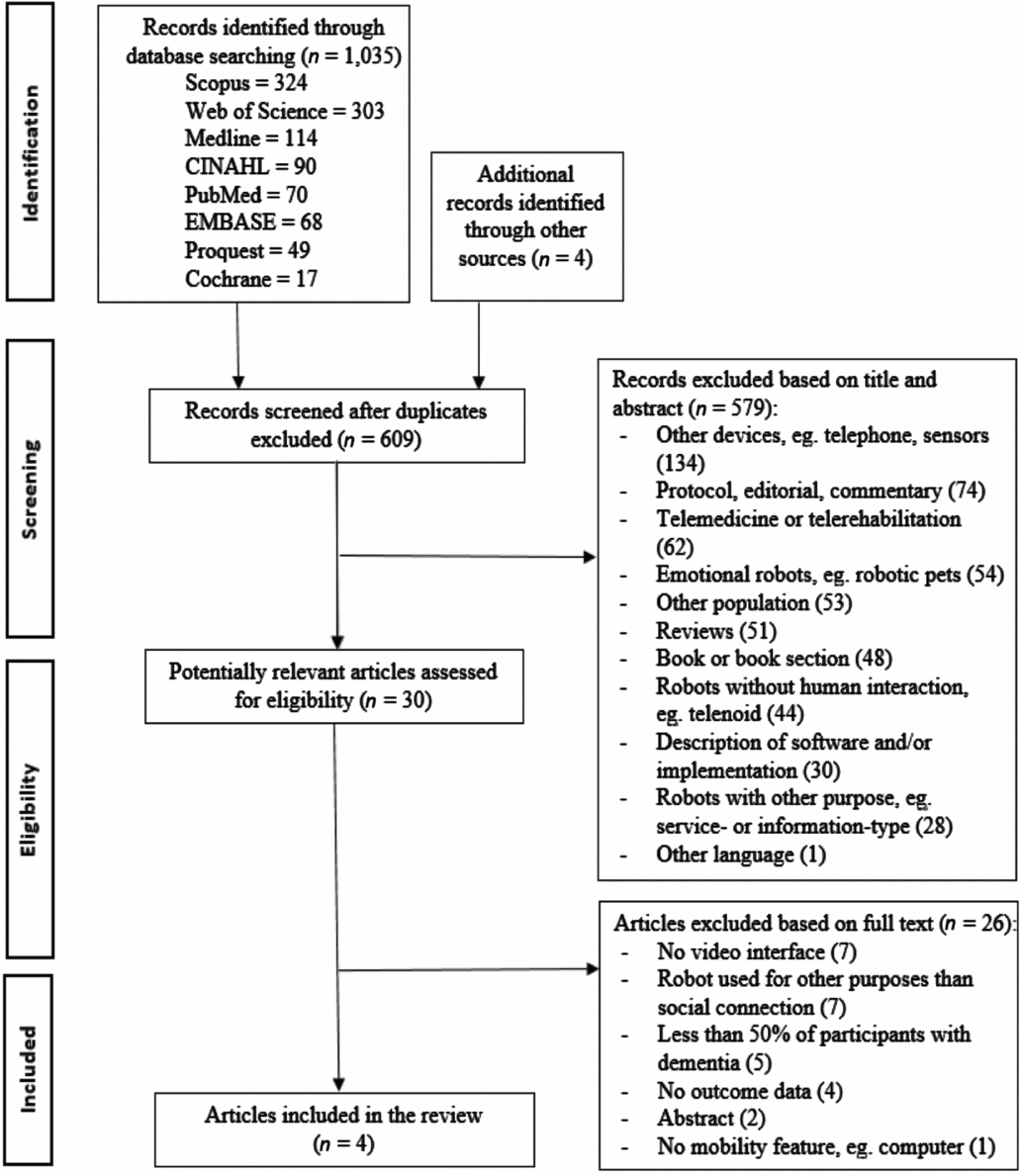
One thousand and thirty-five records were identified, which was reduced to 609 after duplicates were excluded (See Figure 1). An additional 579 records were excluded by title and abstract, with the most frequent reasons for exclusion being the use of other technological devices such as telephones and sensors (n = 134), other types of records such as a study protocol, letter, and commentary (n = 74), and use of videoconferencing for telehealth purposes such as cognitive assessment (n = 62) rather than for social connection. This resulted in 30 records for full-text screening, which was conducted by UA and WM, who independently reviewed selected records, based on the inclusion and exclusion criteria. To assist with determining eligibility of three records, the first authors were contacted to obtain more information, such as details about the diagnostic characteristics of participants and whether the robot enabled video conferencing and if this feature was used in the intervention. The screening process resulted in four publications (two journal articles and two full conference articles) eligible for the current review.
Flowchart of the search process.

Study characteristics
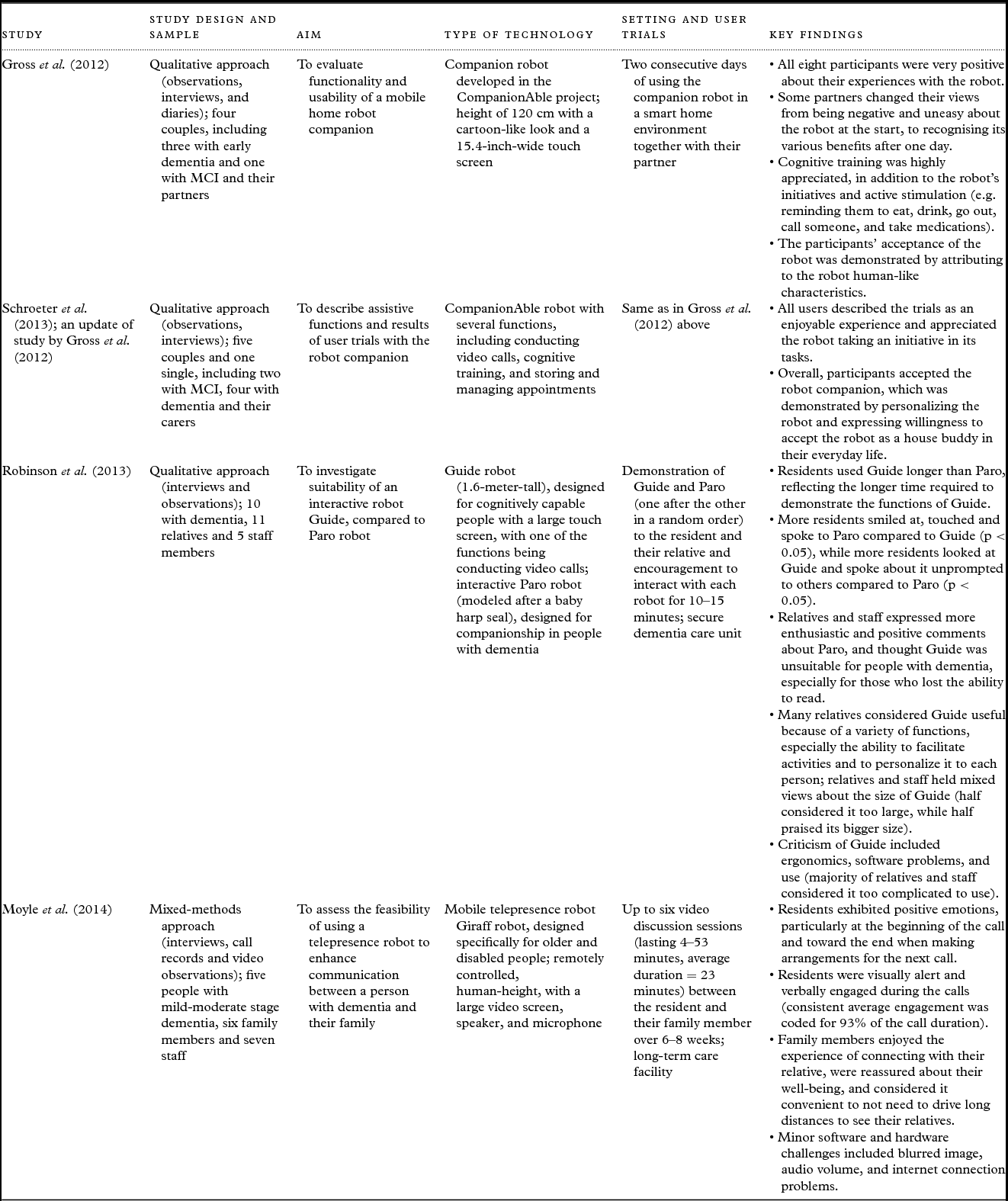
The four publications included in this review described findings from three independent studies. Two publications (Gross et al., Reference Gross2012; Schroeter et al., Reference Schroeter2013) reported outcomes of the same intervention, and with slight differences in the sample sizes. The study by Gross et al. (Reference Gross2012) reported data from four couples (including three people with dementia), while Schroeter et al. (Reference Schroeter2013) reported updated data from five couples and one single person (including four people with dementia). This study was conducted in the Netherlands, while the remaining studies were conducted in Australia (Moyle et al., Reference Moyle, Jones, Cooke, O'Dwyer, Sung and Drummond2014) and New Zealand (Robinson et al., Reference Robinson, MacDonald, Kerse and Broadbent2013). A summary of the study characteristics, including key findings of each study, is presented in Table 1.
Summary of study, type of technology and setting, and key findings

Notes. MCI = Mild cognitive impairment.
Study design
All studies employed a qualitative or mixed-methods research approach, with interviews involving people with dementia and their carers being the main data collection method, followed by video observations. In two studies (Robinson et al., Reference Robinson, MacDonald, Kerse and Broadbent2013; Moyle et al., Reference Moyle, Jones, Cooke, O'Dwyer, Sung and Drummond2014) that used interviews, qualitative data was analyzed with a thematic analysis approach, while observation sheets (for secondary users) and semi-structured diaries (for primary users) were used to inform the discussions during interview sessions by Gross et al. (Reference Gross2012) and Schroeter et al. (Reference Schroeter2013). While the majority of studies focused on the users’ experience of a specific system, Robinson et al. (Reference Robinson, MacDonald, Kerse and Broadbent2013) compared relatives’ and staff members’ experiences in using the Guide robot (human height robot capable of videoconferencing) with Paro, a robotic harp seal companion robot. None of the studies specified the eligibility criteria, while the sample size and participants’ characteristics were described in all of them. Statistical comparison of intervention effects was conducted only by Robinson et al. (Reference Robinson, MacDonald, Kerse and Broadbent2013), who compared observation measures (e.g. the amount of interaction time) between the robots.
Sample characteristics
A total of 19 participants with dementia (9 males; mean age 76.0 ± 3.5 years) and 2 with MCI (1 male; mean age 78.5 ± 2.1 years) were included in three independent studies. In addition, all studies included participants’ family members (n = 22) and two studies (Robinson et al., Reference Robinson, MacDonald, Kerse and Broadbent2013; Moyle et al., Reference Moyle, Jones, Cooke, O'Dwyer, Sung and Drummond2014) also considered perspectives of staff members (n = 12). Most studies included participants in the mild (Gross et al., Reference Gross2012; Schroeter et al., Reference Schroeter2013) or mild-moderate stage of dementia (Moyle et al., Reference Moyle, Jones, Cooke, O'Dwyer, Sung and Drummond2014). The severity of dementia was not specified in one study (Robinson et al., Reference Robinson, MacDonald, Kerse and Broadbent2013).
Robot characteristics
The studies in the review reported outcomes from three different systems (see Table 1 for their descriptions). These systems included an autonomously operated, socially assistive home CompanionAble robot (Gross et al., Reference Gross2012; Schroeter et al., Reference Schroeter2013), the Guide robot (Robinson et al., Reference Robinson, MacDonald, Kerse and Broadbent2013), and a remotely guided mobile telepresence robot Giraff (Moyle et al., Reference Moyle, Jones, Cooke, O'Dwyer, Sung and Drummond2014). All systems were designed specifically for older adults. While the main function of Giraff (Moyle et al., Reference Moyle, Jones, Cooke, O'Dwyer, Sung and Drummond2014) was to promote social interaction between users through a video call, the CompanionAble robot (Gross et al., Reference Gross2012; Schroeter et al., Reference Schroeter2013) and Guide robot (Robinson et al., Reference Robinson, MacDonald, Kerse and Broadbent2013) also included various other functions, such as cognitive stimulation exercises, medicine and task reminders (Gross et al., Reference Gross2012; Schroeter et al., Reference Schroeter2013), entertainment and activity suggestions (Gross et al., Reference Gross2012; Robinson et al., Reference Robinson, MacDonald, Kerse and Broadbent2013; Schroeter et al., Reference Schroeter2013), and vital signs measurement (Robinson et al., Reference Robinson, MacDonald, Kerse and Broadbent2013).
Intervention findings
The studies differed in the amount of exposure and interaction with each robot, ranging from 30 minute sessions (Robinson et al., Reference Robinson, MacDonald, Kerse and Broadbent2013) to two days per person (Gross et al., Reference Gross2012; Schroeter et al., Reference Schroeter2013). Where several functions were evaluated, we reported the findings pertaining to the use of videoconferencing for social connection.
The efficacy of a robot system that allowed videoconferencing relative to Paro, an interactive robot harp seal, was evaluated by Robinson et al. (Reference Robinson, MacDonald, Kerse and Broadbent2013) in one residential facility, involving ten older people with dementia and their relatives (n = 11), and five staff members. During a one-hour group session, Paro and Guide were introduced to residents and their family members (in a random order) in a communal area of the facility. Staff took part in individual sessions. In all sessions, the researchers spent five minutes introducing and demonstrating the robots, with participants then encouraged to interact with both robots for a further 10–15 minutes. Analysis of video observation showed that, during the session, residents used Guide longer than Paro, which was attributed to a longer time being needed to explain and demonstrate Guide's functions. In addition, while more residents were observed to talk, touch, and smile at Paro than Guide (p < 0.05), more residents looked at Guide during the overall session and spoke about it unprompted to others in the facility when compared to Paro (p < 0.05). In post-session interviews, family members and staff considered Guide to be “unsuitable for people with dementia” (p37), with the messages displayed on the robot's screen, a struggle for those that have lost the ability to read. However, many relatives complimented Guide for its ability to personalize activities to each person and considered it useful in terms of providing several functions, among which entertainment (e.g. playing music, showing photographs and offering games) was perceived the most advantageous.
Reported in two conference papers (Gross et al., Reference Gross2012; Schroeter et al., Reference Schroeter2013), a multi-functional robotic system, called CompanionAble, was evaluated within the context of a smart home environment. In both studies, participants received an initial demonstration using the robotic system, after which they were left to engage with the robot as they wished. In the first publication, Gross et al. (Reference Gross2012) reported findings of the user trials with four couples, including people with early stage dementia (n = 3), a person with MCI, and their partners (n = 4). They found that the experience of using CompanionAble resulted in a change from negative, stereotypical ideas about robots to more positive attitudes, perceiving the robotic system as a valuable addition to everyday life and existing care. Quick acceptance of CompanionAble was evident also from participants attributing it human characteristics (e.g. giving it a name and commenting on its mood). The participants appreciated that CompanionAble was able to provide stimulation through cognitive training and reminded them of activities, such as eating, drinking, taking medications, going out, and calling someone via videoconference. The fact that activity suggestions and reminders were initiated by the robot itself was considered an advantage to other types of technology, such as tablets and computers, which do not possess this level of autonomy.
In a subsequent publication, Schroeter et al. (Reference Schroeter2013) evaluated the functionality of CompanionAble with an additional couple and one single person. People with dementia (n = 4) and MCI (n = 2) and their family carers reported that the more functions (e.g. locating the user, suggestions, stimulations and encouragements to stay active or, to make a video call to family or friends, or to do cognitive training) are robot-initiated, the more enjoyable they found it to use. Although interactions with the robot were also user-initiated (e.g. consulting the today screen, asking the robot to follow or manage the items on the to-do list) and externally initiated (e.g. receiving incoming video calls, a secondary user adding, and removing items on the agenda), the ability of CompanionAble to act autonomously and self-initiate a wide range of functions seemed the most appealing to the users. Indeed, while people with dementia rated highly their enjoyment of using the robot, carers rated highly the usefulness, especially its ability to give reminders, which reduced their burden as carers.
The study by Moyle et al. (Reference Moyle, Jones, Cooke, O'Dwyer, Sung and Drummond2014) was the only one to focus on the feasibility of a telepresence videoconferencing system for facilitating communication between a person with dementia (n = 5) in a long-term care and their family member (n = 6) in a remote location. All calls were made from the family member's home and received in the facility, either in the residents’ rooms, or in a quiet communal area, or closed-off room. A member of the research team set-up Giraff before each scheduled call at the facility. Overall, residents, their family members, and staff (n = 7) were generally accepting of the mobile telepresence robot called Giraff (Moyle et al., Reference Moyle, Jones, Cooke, O'Dwyer, Sung and Drummond2014). This was established by the fact that none of the residents demonstrated adverse reactions to Giraff and all dyads actively participated in and maintained video conversations. The average proportion of time in which residents were engaged (i.e. being visually alert and verbally engaged with the person via the telepresence robot) was 93% (SD = 15%) of the call duration. Residents exhibited positive emotions particularly at the start and toward the end of the call and family members reported enjoyment when connecting with their relative. Family members also identified the value of the robot for enabling them to see and speak with their relative without needing to travel long distances. In addition, one family member who lived internationally also suggested that videoconferencing could be used between family members and staff, while staff highlighted the possibility to use Giraff for telehealth consultations.
Discussion
This review identified and summarized the methodology and findings of four studies that examined the use of videoconferencing through telepresence robots in 19 older adults with dementia and their formal and informal carers. Three different systems were used, which provided a range of functions, including cognitive stimulation and training, medications and task management, activities for entertaining, vital signs measurement, and teleconsultation with healthcare professionals. Only one system (i.e. the remotely controlled mobile robot Giraff) was designed specifically for videoconferencing purposes to facilitate social connectedness between a person with dementia and their family members (Moyle et al., Reference Moyle, Jones, Cooke, O'Dwyer, Sung and Drummond2014). All of the reviewed studies reported positive aspects of using videoconferencing to facilitate social connection between a person with dementia and their family and friends (see Table 1).
However, the existing evidence on the use of telepresence technology in the care of people with dementia is limited, based predominately on feasibility and pilot studies, including small samples, no control groups, and a lack of objective outcome measures or statistical comparisons of intervention effects. In addition, the majority of studies did not report eligibility criteria for selection of their participants, which raises concerns about the representativeness of sampling (e.g. possible bias toward selecting participants based on their familiarity with technology).
It is important to acknowledge that the aim of the current review was not to assess the effectiveness of existing interventions, involving the use of telepresence technology for people with dementia, but rather to assess whether telepresence technology is a feasible service delivery method for improving social connectedness with their informal carers. Given that the use of videoconferencing as a more therapeutic function (e.g. reducing the incidence of challenging behaviors and social isolation) has only started to be used in practice more recently, it seems important to learn from the existing experience about telepresence robots in progressing this field further. Therefore, in spite of the paucity of studies included in this review and their methodological limitations, the current review offers some important points to inform the development and implementation of future interventions, using SAR with videoconferencing in the context of dementia care.
These points include the importance of the simplicity of a robot design, the robot's ability to initiate interactions with users autonomously, and the opportunity to foster positive reactions in people with dementia and their family members through the use of videoconferencing. Specifically, it appears that the ability of a robot to function autonomously (interactions with users are robot–initiated) or semi-autonomously (interactions are user initiated or externally initiated) presents one of the key advantages of telepresence robots. Indeed, Robinson et al. (Reference Robinson, MacDonald, Kerse and Broadbent2013) reported that staff and relatives considered the Guide robot too complicated for people with dementia to use, particularly for those with language impairments, and thus thought they would find it challenging to initiate a videoconference. On the other hand, in the Netherlands study (Gross et al., Reference Gross2012; Schroeter et al., Reference Schroeter2013), it was found that the ability of a robot to provide appropriate suggestions, such as establishing a video call with a friend or family member, and to physically move around the space and come to them were among the most appreciated.
These findings highlight the importance of mobility as one of the unique functions of telepresence robots, which distinguishes them from other technologies, such as tablets and computers. For example, in a study by Mehrabian et al. (Reference Mehrabian, Extra, Wu, Pino, Traykov and Rigaud2014), people with dementia and those with MCI evaluated a computer-based telecare system, which included various functions, including videoconferencing. While participants expressed an interest in using the system in order to have a videoconference with family and friends, qualitative data showed that many people with dementia also expressed a preference for using a telephone, which they were used to. However, in the study by Gross et al. (Reference Gross2012), participants praised the CompanionAble robot specifically for its self-initiative functions, including the robot moving around the space and locating the user. This suggests that some operational difficulties can be overcome by designing telepresence robots that possess a certain degree of autonomy, or alternatively, are mobile and can be remotely guided by a carer in order to simplify its use for people with cognitive impairments. Reminders or prompts received from a robot may be useful because prompting was seen as beneficial by older adults with dementia, and their carers particularly for complex and unfamiliar activities, such as initiating a video call (Wang et al., Reference Wang, Mihailidis, Sudhama, Begum and Huq2017). Mobile telepresence robots offer the opportunity to further enhance communication, and a means for remote carers to oversee the person and the environment in which the person with dementia is living (Moyle et al., Reference Moyle, Jones, Cooke, O'Dwyer, Sung and Drummond2014). Importantly, none of the studies included in this review raised concerns about potential risks of a moving robot, such as it falling over near or on the person with dementia. While beyond the remit of this review, these concerns are, perhaps, testament to the focus of these functional features of the robots during the design stage.
Overall, the reviewed studies reported favorable experiences of using videoconferencing in the context of dementia care, which was characterized by people with dementia exhibiting positive emotions as well as good visual and verbal engagement during the call (Moyle et al., Reference Moyle, Jones, Cooke, O'Dwyer, Sung and Drummond2014). Positive acceptance of telepresence systems is consistent with prior studies evaluating videoconferencing programs for health purposes (Ramos-Rios et al., Reference Ramos-Rios, Mateos, Lojo, Conn and Patterson2012) where users and their healthcare providers reported acceptance and satisfaction with such programs. While stable and consistent engagement during the video call is indicative of a good social connection, the outcome measures used in the reviewed studies preclude conclusions to be made about the benefits of videoconferencing on social connectedness of people with dementia. Although the existing results demonstrating the feasibility of telepresence robots for social connection purposes are promising, one recent study that used an assistive robot to help older adults with dementia to perform everyday activities also highlighted concerns that a robot may decrease social contact and in some aspects, replace the carer's role (Wang et al., Reference Wang, Mihailidis, Sudhama, Begum and Huq2017).
Indeed, some studies in this review also identified reservations of people with dementia and their family members (Gross et al., Reference Gross2012) in using telepresence robots. These reservations were related to a lack of experience in using such a system and being accustomed to other modes of communication, such as a telephone. Yet, the findings also reported by Gross et al. (Reference Gross2012), where attitudes toward robot systems became more positive within a day of use, corroborates a recent review on the use of ICT technologies among older adults with dementia (Pinto-Bruno et al., Reference Pinto-Bruno, García-Casal, Csipke, Jenaro-Río and Franco-Martín2016). This review highlighted that experience is necessary for users to become more accepting of new technologies. Although society may be accepting of new technologies, their uptake of robots is thought to be influenced by robots frequently not meeting the needs of end users (Bemelmans et al., Reference Bemelmans, Gelderblom, Jonker and de Witte2012). The co-design of technologies whereby end users and their developers work side by side in the design of the robot and the robotic tasks will help to address this problem. Nevertheless, the benefits of telepresence systems, particularly for reducing isolation and supporting social interactions, are expected to outweigh any technical issues identified in the current review as barriers to using videoconferencing. As argued by Tsai et al. (Reference Tsai, Hsu, Ma, King and Wu2007), the value of telepresence is in enabling a sense of shared space among the users through a three-dimensional human interaction, which is an advantage over traditional modes of communication without the possibility for face-to-face conversation. This is of particular importance in the care of people with severe cognitive impairment, who may not recognize family members’ voice when using telephone only for communication.
Limitations
The review is limited by the small number of studies, compounded by the preliminary nature of the methodology of these studies. The lack of objectively measured outcomes and controlled trials, along with a heterogeneous nature of outcomes demonstrating a robot's feasibility within dementia care, undermined the available evidence and precludes from drawing reliable conclusions about the potential of telepresence robots to actually improve social connection between a person with dementia and their carers. In addition, due to the preliminary nature of the research in this field – which reflects the early stage of development of SAR – it was not appropriate to rate the methodological quality of included studies according to formal criteria (e.g. Tong et al., Reference Tong, Sainsbury and Craig2007). Finally, the studies in the review are limited to participants with early to mid-stage dementia resulting in no understanding of whether such robots could have an impact on those with more severe communication and cognitive impairments. As argued by Sävenstedt et al. (Reference Savenstedt, Zingmark and Sandman2004), cognitive impairment, in particular severe cognitive impairment may in some cases undermine a person's ability to participate in research and to provide a valid account of their experience. However, evaluating the effects of telepresence robots on people in the mild- and mild-moderate stage of dementia may provide valuable insights into the possible benefits of telepresence among those in later stages of dementia.
Implications
Prior reviews demonstrate that there is a range of healthcare robots used in the context of older persons or specifically within dementia care (Mordoch et al., Reference Mordoch, Osterreicher, Guse, Roger and Thompson2013; Kachouie et al., Reference Kachouie, Sedighadeli, Khosla and Chu2014). However, SAR designed for service or companionship purposes have become the subject of research investigation only recently. Given that people with dementia are at risk of social isolation (Moyle et al., Reference Moyle, Kellett, Ballantyne and Gracia2011), the telepresence robots that allow videoconference calls with family may be particularly useful in helping to maintain people with dementia for longer in the community. The studies in the current review show that the empirical research on telepresence robots, which enable videoconferencing between a person with dementia and their family members is still in its infancy. Further research, adopting more rigorous research designs, such as cross-sectional studies and RCTs with objective measures, is therefore needed to determine the benefits of telepresence robots for people with dementia and their carers. In addition, there is a need to investigate the long-term effectiveness of telepresence robots on well-being of the users.
Conclusion
To date, there has been scant evidence on the suitability of SAR that enable videoconferencing calls with family members, as a way of enhancing communication and social connectedness among people with dementia. Preliminary evidence from four studies shows that such novel technologies are generally feasible for supporting social interactions between people with dementia and their carers. However, the methodologies used in these studies limits our understanding of whether telepresence robots can, indeed, improve social connections for people with dementia. In order to improve the evidence-base that could inform the development of SAR, which may have the potential to improve QOL among people with dementia, more controlled trials investigating the clinical efficacy of telepresence robots that allow videoconferencing among people with dementia and their carers are needed.
Conflict of interest
None.
Description of author's roles
Study concept and design: WM & UA. Database search and analysis: UA. Interpretation of data: WM & UA. Drafting of the manuscript: UA & WM. Critical revision of the manuscript: WM, UA, TO, CJ. All the authors read and approved the final version of the manuscript.
Notes
The mean age of participants with dementia included in the reviewed studies was calculated based on reported individual or average ages. However, Robinson et al. (Reference Robinson, MacDonald, Kerse and Broadbent2013) reported only the age range, but not individual ages of participants; therefore, a medium of the range was taken as the mean age of participants in this study.
Supplementary material
To view supplementary material for this article, please visit https://doi.org/10.1017/S1041610217001776