1. Introduction
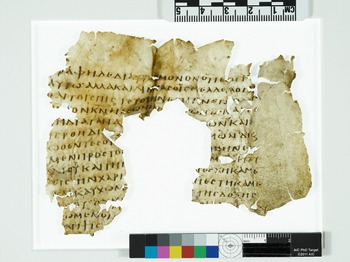
The small parchment leaf known variously as 0220 and the Wyman Fragment (see Figures 1–7 below) has garnered scholarly interest since the initial publication of its recto in 1952 by William Hatch.Footnote 1 Because of its relative antiquity, its general agreement with Codex Vaticanus and the enigmatic hole in the parchment covering the main variation unit in Rom 5.1, 0220 is often seen as an important witness to the text of Romans, and is recorded as a ‘consistently cited [witness] of the first order’ ‘of particular significance because of [its] age’ in the 27th edition of the Nestle-Aland critical textFootnote 2 and as a ‘consistently cited [witness]’ in the 28th edition, where such superlative terminology is generally dropped.Footnote 3
Recto of manuscript

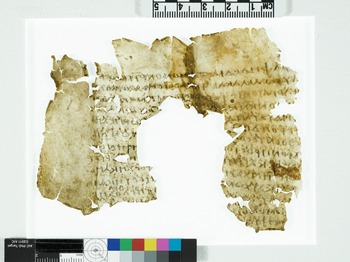
Verso of manuscript

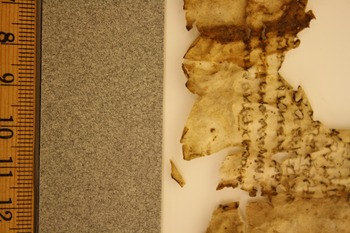
The first portion removed from the manuscript for radiocarbon testing

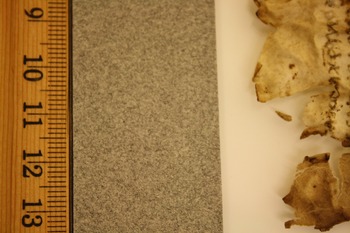
The second portion removed from the manuscript for radiocarbon testing

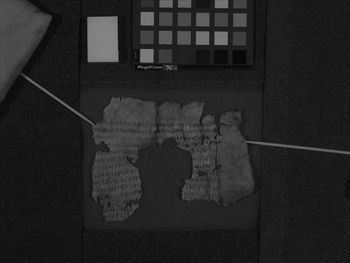
Infrared image of recto

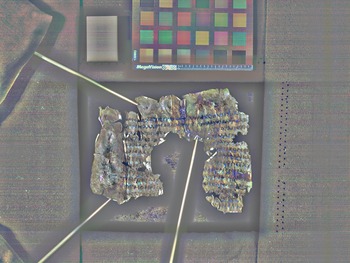
UV pseudo-colour image of verso

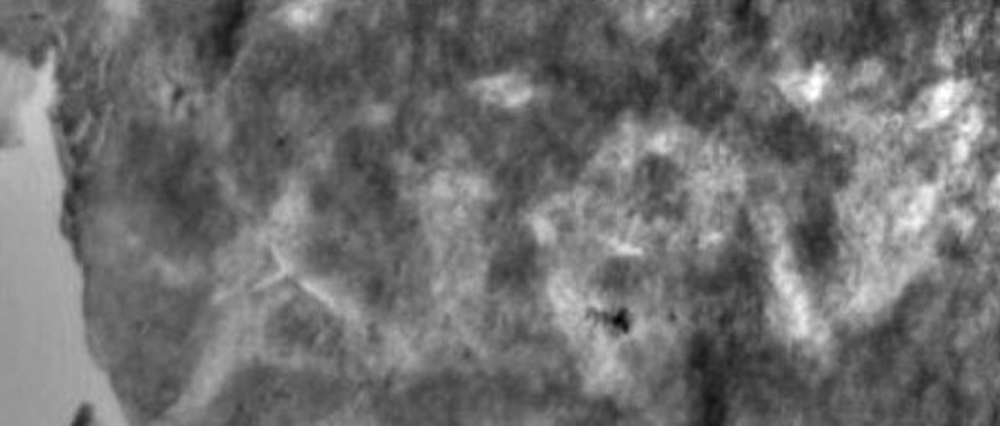
υιου detail from l. 5 of verso

The manuscript itself is about 8.5 × 11.1 cm, although a substantial hole in the centre gives the leaf an arch shape (Fig. 1). Inferring from the extant portion, William Hatch and Donatella Limongi estimated that the size of the original page was around 15 × 13 cm.Footnote 4 The manuscript has been significantly damaged. Not only is there a substantial hole through the centre of the leaf, but there are also numerous holes, tears, folds and warps in the parchment. Additionally, the verso is significantly faded and damaged, so that the letters on the recto are more visible from the verso than those on the verso itself (Fig. 2). Hatch found this insurmountable with the technology of his time, and was only able to read five words securely.Footnote 5 Limongi also commented on the difficulty but produced a generally excellent edition of the verso. She did not comment on what method was used to determine the reading, only commenting that the reading was ‘estremamente difficile, spesso incerta’.Footnote 6
In this article, I will revisit some features of the editio princeps of the recto by Hatch and of the edition by Limongi, which provides an editio secunda of the recto and an editio princeps of the verso,Footnote 7 in light of further autopsy, radiocarbon testing undertaken in 2014,Footnote 8 Multi-Spectral Imaging (MSI) conducted in February 2015 and again in March 2017,Footnote 9 and a comparison of the two editions where they overlap. In addition to these comments, I will present a new edition of the manuscript along with a variety of images to better enable the study of this important manuscript.
2. Provenance and Manuscript History
As has been reported, the fragment was acquired by Leland Wyman, a biologist and anthropologist at Boston University,Footnote 10 on 3 July 1950 in Cairo.Footnote 11 The dealer alleged that it had been found at Fûstat.Footnote 12 It was inherited by a J. Rocks of Boston,Footnote 13 and sold at a Sotheby's auction on 21 June 1988 to Martin Schøyen.Footnote 14 Within the Schøyen Collection, the manuscript was accessioned as MS 113.Footnote 15 It was then purchased, again at a Sotheby's auction, by Hobby Lobby on 10 July 2012 for £301,250.Footnote 16 As a part of the Green Collection, it was accessioned as MS.000566. In 2014, the fragment was donated by Hobby Lobby to Museum of the Bible. Also in 2014, two small portions of the parchment were removed by a curator to be subjected to radiocarbon testing.Footnote 17 In 2015 and again in 2017, the manuscript was imaged by EMEL through multi-spectral imaging techniques.Footnote 18
3. Radiocarbon Testing and Palaeographic Dating
Before the results of radiocarbon analysis are presented, it must first be stated that such results can easily be misused. There is sometimes a tendency towards sensationalism in discussing the ages of New Testament manuscripts, often emphasising the earlier side of assigned dates, both in palaeographic and radiocarbon analysis. Further, since most humanities scholars are unfamiliar with the details of radiometric analysis, only certain parts of the results are often presented (such as the 1-sigma range). Here, I will attempt to set out all relevant results, along with their current interpretation. As the radiocarbon calibration curve is further refined, the interpretation of the data will probably change, as it has indeed changed with an updated calibration curve in 2020. Further, depending on how observed radiocarbon offsets in the southern Levant affect the interpretation of the data, the calendar dates may change somewhat.Footnote 19
In his analysis of the manuscript, Hatch compared the hand to ‘the hands found in Greek papyri of the third and fourth centuries’ and ultimately inclined towards ‘the latter part of the third century rather than early in the fourth’.Footnote 20 After its initial publication, few professional palaeographers have assigned a date to 0220. Eric G. Turner hesitantly assigned a third-century date.Footnote 21 Pasquale Orsini and Willy Clarysse gave a late date of 350–400.Footnote 22 Among New Testament scholars and text critics more generally, Kurt Aland placed it in the third century,Footnote 23 Joseph van Haelst gave a range of third–fourth century,Footnote 24 Philip W. Comfort and David P. Barrett initially gave a range from 275–325,Footnote 25 but then revised that in 2001 to ‘about ad 300’,Footnote 26 and Karl Jaroš gave an early date of 150–200.Footnote 27
The radiocarbon analysis determined that 0220 has a .8000 ± .0021 fraction of modern carbon, or a 14C date of 1790 ± 25 years Before Present (BP).Footnote 28 Using the most recent INTCAL20 radiocarbon calibration curve as hosted by Oxford University,Footnote 29 this provides a 1-sigma confidence interval of 68.3% probability that the parchment dates to either 236–52 ce (25.4% probability) or 290–320 c (42.9% probability).Footnote 30 The 2-sigma confidence interval of 95.4% probability is that the parchment dates to either 216–59 ce (39.2% probability) or 280–330 ce (56.3% probability).
These radiocarbon results should not be viewed as trumping palaeographic analysis, but rather as a separate, independent witness to be weighed alongside palaeographic considerations. Admittedly, the testing can only provide insight on the age of the parchment, not of the text, but, except in the case of palimpsests, there is rarely a large gap between the creation of parchment from animal hide and the copying of a text. These results do suggest, however, that both the earliest (150–200) and the latest (350–400) paleographically assigned dates are unlikely.Footnote 31 It remains most probable to date 0220 to the third or early fourth century, and any smaller range is inadvisable.Footnote 32
4. Previous Editions
Between the two previous editions, there are only two substantial differences. First, in recto l. 1 Limongi reads [ɛγ]ραφɛ,Footnote 33 which must have been a typographic error, as it is patently incorrect. The correct reading, as Hatch has it, is [ɛγ]ραφη.Footnote 34 Second, in l. 12, there is a lacuna in the manuscript which obscures roughly ten letters of space. At the end of this hole, the tops of two letters are visible, the first a closed round letter, and the second a vertical stroke, presumably οι, which the scribe apparently deleted (see below). The solution to this lacuna is rendered difficult by the fact that no known variant could occupy the space.Footnote 35 Hatch suggests a reading of μο[νον δɛ αδɛλφ]οι, while Limongi proposes μον[ον δɛ καυχωμ]ɛ̣[ν]οι.Footnote 36 Hatch's solution matches the average line length of the manuscript, thirty-one letters, whereas Limongi's contains thirty-four.
Whatever occupied the space, there is evidence that the scribe noticed an error at this point. The scribe generally seems concerned with maintaining a right margin. Three times (recto ll. 6, 9, 10) the scribe used space abbreviations to fit syllables or to finish words at the margin without letters intruding far into it.Footnote 37 However, in l. 12, he breaks this general tendency and writes the entire syllable καυ in the margin. This suggests that the scribe became aware of his error earlier in the line and wished not to lose the space fully.Footnote 38 Further, there is a trace of what seems to be ink above and between the omicron and iota, as well as a potential slash through the omicron. These reasonably suggest deletion.
Beyond these two significant differences, the two editions vary only in that Limongi's is closer to a diplomatic edition, whereas Hatch's is normalised, and that Limongi has different confidence in the legibility of letters. In many cases, Limongi dots letters that Hatch places in brackets, but there are several times when Limongi is less confident than Hatch, dotting letters that simply stood in Hatch's text (e.g. ll. 1, 8, 12).
5. Summary of the New Features Identified on the Manuscript
Other than remarking on the fact that it is brown,Footnote 39 previous studies have not discussed the ink of the manuscript. When imaged in the infrared spectrum, the ink in most places fades to transparency, while it becomes vibrant when imaged in the ultraviolet range. This suggests that the ink of the text was plant-based, with a possibility that it is a copper or iron-gall ink, though further scientific tests would need to be done to determine the composition accurately.Footnote 40 There are several places, however, where carbon black ink is revealed by infrared imaging (Fig. 5). Each will be noted in the transcription and commentary below, but they occur in recto ll. 5, 9, 14 and possibly 12. In each of these places, the ink is a correction to the text as copied and suggests that at least one later reader corrected the text with carbon black ink, suggesting that the correction noticed by Hatch as done ‘manu eiusdem aetatis cum scriba’Footnote 41 was in fact done at least some time after the copying of the text, though it could indeed have been of the same time period.Footnote 42 One apparent correction mark in recto l. 12, over the proposed singular reading, appears to have been made in the same ink of the text, however. While there are no discernible carbon black marks on the verso, it is likely that with the manuscript's state of wear, any hypothetical carbon black would have flaked off and left no trace, as it does not penetrate the writing surface, so no judgement can be made as to whether a later reader (or readers) felt the need to correct the text on the verso.
Three previously unmarked instances of high-dot punctuation were observed on the verso, in ll. 1, 4, 9 and 13. In all, this manuscript preserves the beginning of nine modern verses (not counting those which begin in lacunae). Of these, the seven that do not begin with a relative clause (recto ll. 2, 6, 12, verso ll. 4, 9, 13) have high dot punctuation before the new sense unit. Each of these punctuation marks is followed by units marked by conjunctions.Footnote 43 This suggests that the scribe (or his exemplar) intended to relatively consistently mark sense divisions on what could be called a sentence level. In addition to this, there seems to be a high-dot punctuation in recto l. 5Footnote 44 added by a later hand.
Finally, on the recto above the first two letters of l. 1, there is a trace of ink that resembles the diagonally descending bar and the bottom of the loop of an alpha. The parchment immediately to the left of this trace is lost. This trace has not been previously noted. The α is most likely the end of a numeral ending in 1. Because of its position in the upper-left margin of the page, it prima facie seems to be a quire signature rather than a page number, which would normally be placed in the centre or on the right side of the upper margin.Footnote 45 This would suggest that the recto was the first page of a quire, which would lead us to conclude, as we would expect, that the codex was a multi-quire codex, and not a single gathering.
Since it is very unlikely that the numeral represented is simply α (1),Footnote 46 at smallest it would have to be ια (11). If the quires were quaternions, this would imply 160 pages before the extant page, and an additional 160 for every increase in the tens-place of the numeral. If the quires were terniones, this would suggest a minimum of 120 pages before this page. While that is not impossible codicologically, we have no extant third-century manuscript that has non-Pauline texts before Romans (such as Acts, which would take somewhere near 110 pages),Footnote 47 or that places Romans anywhere other than at the head of the Pauline epistles.Footnote 48 In the fourth century, however, whole New Testament and whole Greek Bible manuscripts were produced. There is some evidence that production of long codices was not limited to great uncials, and 0206 (P.Oxy. xi.1353), palaeographically dated to the fourth century,Footnote 49 has a page number on the outer-top margin on the verso that reads either 819 or 829.Footnote 50 This parchment codex, like 0220, is in a single-column format and is roughly similar in size to 0220, with a page size measuring about 13.5 × 10.1 cm.Footnote 51 Obviously, we cannot know the contents of 0206 with any certainty, but the page number suggests that it contained an amount equal to a large portion of the New Testament. While it is possible that the number, added by a later hand,Footnote 52 reflects a later time when the extant portion was made part of a composite codex, there is no evidence for this. 0206 indicates that by the fourth century, codices of Christian documents containing amounts of text equal to at least large portions of the New Testament were being made, and it is not impossible that 0220 was such a piece. If so, it is worth remembering that a common ordering of New Testament books places the Pauline epistles after not only the Gospels and Acts, but also after the catholic epistles. Vaticanus, with which 0220 often agrees, follows this order.
On the other hand, there is always the possibility that the trace α was simply part of a page number ending in 1 placed in an unusual location on the page. With the manuscript in its current state, it is impossible to decide between these options.
6. Editio tertia of Recto and secunda of Verso
My edition of the recto has only some differences from the previous editions. In l. 12, I have left unsupplemented a lacuna, but approximated the number of characters which could have fit within it. Moreover, neither Hatch nor Limongi transcribed the traces that I have identified in l. 15 of both recto and verso, on the basis of which the lacuna of l. 14 on the recto can be securely supplied. My edition of the verso provides a more secure reading of previously difficult to discern letters and a reading of portions of the manuscript that previous editions found illegible (Fig. 6). There remain some folds in the manuscript which bear traces of ink that cannot be certainly identified, principally around ll. 6–8. Physically unrolling these folds would potentially damage the manuscript, and so this has not been done. Hopefully, technology to unfold the portions digitally without damaging the parchment will become readily available.
Recto

Verso

7. Textual notes and commentaryFootnote 53
Recto
L. 2 αυτω: After this, Dc 1241 vgcl syp add ɛιϲ δικαιοϲυνην.
L. 5 παρ̣[α]π̣τ̣[ωματα: Exiguous traces for the middle portion of this word appear on a contorted portion of the parchment, perhaps indicating π̣τ̣, but this cannot be certain, as they could be traces of other letters in this word.
L. 5 η]μ̣ων˙: At this point there seem to be two marks, one a dot immediately above the ascending line of the nu, the other an oblong mark between the two letters. The first dot seems to be some sort of contamination or smudge, as it does not resemble the ink of the manuscript, and the manuscript has many similar grey-brown spots. The oblong mark, which does visually appear to be cracked ink, does not fade in the IR spectrum, suggesting that it is carbon black ink unlike the text, and that it was added by a later hand. It does not seem to be a deletion dot, but rather a high-dot punctuation. This suggests that a later reader read a sense division here that the initial scribe did not.
Ll. 7–8 ɛχ̣ο̣μɛν: So also א1 B2 F G P Ψ 104 365 1241 1505 1506 1739c 1881 2464 l846 pm vgmss; א* A B* C D K 020 33 81 630 1175 1739* pm lat bo; MarcionT have ɛχωμɛν. As Hatch argued, the lacuna only accommodates the indicative reading. Further, a small trace of ink is retained, though it is visible from the verso because of how that portion of the parchment has been warped.Footnote 54 This trace of ink suggests the top of a closed, round letter, thus omicron.
L. 9 ο˖υ: The breathing mark as it stands over the upsilon looks like a plus-sign (+) with the top and left strokes more faded than the bottom and right. When imaged in infrared light, the top and left strokes fade, while the bottom and right are dark black. This suggests that the initial breathing mark took the form of ˼, which a later reader took issue with. This later reader attempted to correct the breathing mark with carbon black ink to ˹, leaving the + as we now see it.
L. 9 ɛϲχηκαμɛ(ν): After this א1 A vgmss have ɛν τη πιϲτɛι, and א*c C K L P Ψ 33 81 104 630 1175 1241 1505 1506 1739 1881 2464  ${\frak M}$ lat have τη πιστɛι.
L. 12 μο̣[±10 ] ̣[[ο̣ι̣]]: The first part of the lacuna can probably be supplied as μο̣[νον δɛ…], which leaves roughly five characters of space left. With the traces of ο̣ι̣, it appears that the manuscript preserves a singular reading. Hatch suggests αδɛλφ]ο̣ι̣.Footnote 55 Limongi suggests καυχωμ]ɛ̣[ν]ο̣ι̣,Footnote 56 which seems to be too long. However, there are two arguments in favour of Limongi's reconstruction. First, the deletion marks (see below) over ο̣ι̣ could plausibly signify that the scribe moved ahead, wrote καυχωμɛνοι and then deleted it upon realising the mistake. Second is the fact that in this line alone the scribe extended a word into the margin, despite his tendency to avoid doing so as noted above.
There is a trace of ink at the location of the tear, under the fold. This could conceivably be a letter or a deletion dot, but it cannot be securely identified. There are marks above the omicron and iota that merit discussion. The first, between and above the omicron and iota, nearer to the omicron, seems likely to be ink. When imaged in infrared light, this dot fades in the same way the ink of the text does. This suggests that it was added as a deletion dot, either by the scribe or a corrector using the same kind of ink as the scribe. The second, almost immediately above the iota, is uncertain. To my eye, it seems to be damage or something on the parchment. It could, however, be ink as well. When imaged in the infrared range, this dot does not fade along with the text. If it is ink, this would suggest that this dot is carbon black, unlike the text of the manuscript, and added by a corrector after the manuscript was copied. Similarly, there is a small mark of what seems to be ink, like the ink of the text, inside the omicron as well, which could suggest a deletion slash.
Ll. 12–13 καυχ̣ωμɛνοι: So also B 365. All other manuscripts read καυχωμɛθα or an orthographic variant thereof (e.g. καυχομɛτα F).
L. 14 θ̣λ[[ɛ]]ιψιϲ: There seems to be a supralinear dot placed to the right side of the epsilon. The epsilon also seems partially effaced. When imaged under infrared light, the ink of the epsilon disappears, but the dot does not. This suggests that it was added by a corrector after the time of composition, using carbon black ink instead of the plant-based ink of the text.
Verso
L. 2 ο̣υν: Omitted in D* F G it; Irlat Ambst.
L. 4 ο]ν̣τ̣ɛ̣ϲ̣: There are traces of ink visible, but it is not discernible to which letters they belong.
L. 5 υ̅ι̅ο̅υ̅ : There seems to be an overlining on at least the first two letters, and possibly over the final upsilon (see Fig. 7), leading to the following possible explanations. (1) It is possible that the scribe intended to write the nomen sacrum as υυ, pronounced this to himself as [i][i] and mistakenly wrote υ̅ι̅. This would require him to then immediately recognise his error and finish out the word. (2) It is also possible that the scribe wrote the word plene initially, then either he or a subsequent corrector noted that it was a reference to Jesus and as such added an overbar.
L. 7: After δɛ̣, D* F G it; Ambst. add τουτο.
L. 7–8 καυ[χ]ω̣μɛ̣ν̣[οι: As Limongi notes, while it is more likely that the reading here agrees with the majority of manuscripts, the variant καυχωμɛθα, found in 020 104 365 630 1241 2464, and the Latin tradition, cannot be decisively ruled out, nor can καυχωμɛν, found in F G.Footnote 57
L. 8 χ̅υ̅: Omitted in B 1739 1881c.
L. 9 ˙δια: There seems to be a high dot immediately before δια. The top of the diagonal stroke of the delta seems to either come just into contact with the dot, or just stop short. The lack of space differs from the other points of punctuation. There is thus the possibility that it is simply an ink dot that fell during the writing of the stroke.
L. 10 ωϲπɛρ: There is a mark on the parchment in some processed images that could lead one to think the π was initially written as a letter with a low, rounded horizontal, such as a mu. However, this seems rather to be a fold in the parchment. Further, that shape does not characterise mu in this hand, which does not form mu in the ‘Alexandrian majuscule’ style.
Ll. 10–11 η αμ]αρτια ɛιϲ τον ⸀κοϲμον: In D E F G and Old Latin manuscripts d e f g, η αμαρτια occurs after ɛιϲ τον κοϲμον.
L. 11 ⸀κοϲμον: In the margin, by the kappa, there seems to be a gamma-like shape. It is unclear what if anything this signifies, and it does not apparently come from bleed-through from the recto. In discussions with colleagues, the possibility that it is a quire number, stichometric number or sense division have all been considered, and found unsatisfactory or without sufficient support. If it is a text-critical mark, it is of uncertain meaning. Further, its overlap with the vertical stroke of the kappa makes it particularly odd. Under certain bands of light, and after processing, the ink of the ‘gamma’ mark appears different from that of the text of the manuscript, suggesting that it was penned at a different time.
Ll. 12–13 ο θαν̣[α][τοϲ: Omitted in D F G 1505 it; Ambst.
L. 14 α̣μ̣αρτ̣[ια: The reading of this word is relatively certain overall, but the alpha and mu form a shape that, in the remaining ink, resembles a nu. Similar junctures, however, appear several times on the recto, e.g. ll. 9, 10.
L. 15 […].ο̣ […]: There is a trace before this omicron, but not enough to determine the letter. The visible omicron fragment is probably either the first or second omicron in the word νομου at the end of Rom 5.13.
Acknowledgements
I would like to thank all those whose work helped me in the production of this article, especially Brian Hyland, Josephine Dru, Michael Holmes and Michael Phelps, along with all of EMEL.
Competing interests
The author declares none.