INTRODUCTION
Biting midges of the genus Culicoides (Diptera: Ceratopogonidae) are potential vectors for a number of viral diseases worldwide including African horse sickness, akabane, bluetongue, bovine ephemeral fever, epizootic haemorrhagic disease, equine encephalosis, oropouche, Schmallenberg and the Palyams (Mellor, Reference Mellor2000; Department for Environment Food and Rural Affairs, 2012). Typically, Culicoides larvae require a moist, semi-solid medium in which to complete their development. Consequently, they are usually found in the wet ecotone between aquatic and terrestrial environments, decaying vegetative material, or in specialized habitats such as dung (Campbell and Kettle, Reference Campbell and Kettle1976). Approximately half of the total Culicoides spp. that vector bluetongue virus fall into the subgenus Avaritia, which breed specifically in dung (European Food Safety Authority, 2007). This behaviour greatly enhances the vectorial capacity of these species, as they are able to complete their life cycle in close proximity to the livestock on which they feed. Consequently, there is a greater likelihood of infection and distribution of disease from these species. Hitherto, there have been a number of studies conducted worldwide to identify the various dung habitats in which Culicoides spp. breed. However, much of this work relates to Australian and African Culicoides species in the dung of cattle (Cannon and Reye, Reference Cannon and Reye1966; Campbell and Kettle, Reference Campbell and Kettle1976; Bishop et al. Reference Bishop, McKenzie, Barchia and Harris1996a,Reference Bishop, McKenzie, Barchia, Murison and Spohrb; European Food Safety Authority, 2007) and wild herbivores (Dyce and Marshall, Reference Dyce and Marshall1989; Meiswinkel, Reference Meiswinkel1989; Nevill et al. Reference Nevill, Venter, Meiswinkel and Nevill2010). Whilst numerous records of Palaearctic Culicoides species breeding habitats are available in the literature, these are often anecdotal, or are represented by a few specimens in the findings of short-term rearing studies rather than from replicated trials over a prolonged time-periods (Kettle and Lawson, Reference Kettle and Lawson1952; Campbell and Pelham-Clinton, Reference Campbell and Pelham-Clinton1960; Dzhafarov, Reference Dzhafarov1964; Boorman and Goddard, Reference Boorman and Goddard1970a; Braverman et al. Reference Braverman, Galun and Ziv1974; Conte et al. Reference Conte, Goffredo, Ippoliti and Meiswinkel2007; Zimmer et al. Reference Zimmer, Haubruge, Francis, Bortels, Simonon, Losson, Mignon, Paternostre, De Deken, De Deken, Deblauwe, Fassotte, Cors and Defrance2008; Ninio et al. Reference Ninio, Augot, Dufour and Depaquit2011). Therefore, it is evident that further research is required to better understand the breeding sites of Culicoides spp. in northwest Europe. Considering the above, the following study was designed to provide baseline information on the potential on-farm breeding substrates utilized by temperate Culicoides groups which could be used as a point of reference for future investigations into the epidemiology of midge-borne diseases and the development of novel vector control strategies.
MATERIALS AND METHODS
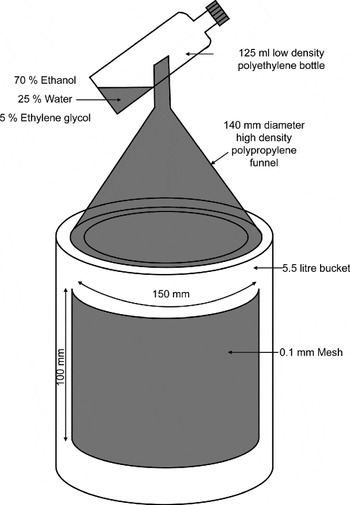
The study was conducted in a field near Hillsborough, Co. Down, Northern Ireland (54·444847° N, 6·070086° W). The experimental area covered approximately 0·25 ha of open pasture and was exposed to sunlight throughout. Prior to the start of the experiment, the grass sward was trimmed to approximately 30 mm length and maintained like this throughout. Treatments were artificial ‘pats’ comprising 300 mL of freshly collected cow dung, cow slurry, horse dung, sheep dung and maize silage. Soil from the field acted as a control to give a background abundance of Culicoides larvae. All dung and soil substrates were collected within 24 h prior to the start of each trial, and stored in sealed jars to exclude insects and reduce evaporation and desiccation. Fresh samples of cattle, sheep and horse dung were collected immediately following evacuation from livestock, which were grazing on fresh pasture. Cattle slurry samples were collected from a sealed slurry pit beneath the dairy housing facilities on the experimental farm. Maize silage was collected from a newly opened silo on a one-off basis prior to the initiation of the trials, stored in sealed plastic bags at ambient temperature, and used as required throughout the duration of the experiment. Soil samples were taken from the top 5 cm of the soil structure within the 0·25 ha experimental plot using a trowel. While analysis was not conducted on individual soil samples, the soil type in the experimental area was surface-water gley class 1 on shale till, with a topsoil texture classified as clay loam – silty clay loam within an organic carbon content of 3–4% (Cruickshank, Reference Cruickshank1997). As substrates were collected fresh from the livestock, directly from a sealed silo or from a closed slurry pit, it was considered that insect contamination would be negligible, and therefore substrates were not frozen or heat treated. The substrates were arranged in a randomized block design consisting of 5 blocks. Within each block, the pats were separated by 1·0 m. Pats were exposed to Culicoides oviposition in the field for 1 week. Following this exposure time, the pats were covered with a bucket emergence trap (Thompson et al. Reference Thompson, Brunt, Loye, Jess and Murchiein press) (Fig. 1) for 4 weeks to capture emerging adult insects. Traps were pressed into the ground to a depth of ∼10 mm to prevent surface migration of larvae into or out of the traps and were anchored in place using 4 standard galvanized tent pegs. Traps were exposed to the prevailing weather conditions throughout the experimental period. Following the removal of the emergence traps after 4 weeks, a soil core (diameter = 100 mm, depth = 60 mm) was taken of each pat, and placed into a Sigma-Aldrich autoclavable tissue-culture bag (450 × 200 × 120 mm, hereafter referred to as ‘biobags’) that included a 60 mm2 sticky trap which was used to capture emerging flying insects. These biobags were heat-sealed and incubated for a further 4 weeks to facilitate midge emergence (incubator settings: temperature 20 °C, humidity 54·1% RH, light regime 16 h light, 8 h dark). Emergent insect counts were analysed following the initial 4-week period within the emergence traps and again following the 4-week incubation period within the biobags. This enabled the determination of the proportion of adult Culicoides emerging within the initial 4-week period. The above procedure was repeated each week for 31 weeks from 4 May to 28 December 2011.
Schematic diagram of a bucket emergence trap.

Due to the difficulties associated with manipulating specimens captured on the sticky traps without irreparable damage, the requirement for a high throughput rate of samples, the abundance of insects captured, and the inherent difficulties in identifying cryptic Culicoides to species level without the ability to slide-mount specimens (Conte et al. Reference Conte, Goffredo, Ippoliti and Meiswinkel2007; Ninio et al. Reference Ninio, Augot, Dufour and Depaquit2011) or molecular analysis (Perrin et al. Reference Perrin, Cetre-Sossah, Mathieu, Baldet, Delecolle and Albina2006; Mathieu et al. Reference Mathieu, Perrin, Baldet, Delécolle, Albina and Cêtre-Sossah2007; Nolan et al. Reference Nolan, Carpenter, Barber, Mellor, Dallas and Piertney2007; Augot et al. Reference Augot, Sauvage, Jouet, Simphal, Veuille, Couloux, Kaltenbach and Depaquit2010), all captured adult Culicoides were identified, using a dissecting microscope, and categorized into the following groups: Obsoletus, Pulicaris, Impunctatus, Nubeculosus, and others, according to the online key of Boorman (Reference Boorman2011). Additionally, the physiological condition of females was assessed using the method described by Dyce (Reference Dyce1969).
An Onderstepoort UV light trap was operated from 1 h before dusk to 1 h after sunrise approximately 500 m from the experimental area (54·452597° N, 6·069667° W) for 1 night per week to monitor adult Culicoides phenology. The UV light trap was set at a height of 1·5 m adjacent to the farm's above-ground slurry tanks, approximately 50 m from a shed which held ∼50 Holstein calves and approximately 200 m from the farm's milking unit that housed the dairy herd, which was a mixture of ∼330 cattle of the Holstein and Swedish Red breed. Meteorological data from the farm's weather station was used as an indicator of the prevailing conditions. As per standard farm practice for the control of internal and external parasites, cattle from which dung was collected were treated with Cydectin® pour-on (5·0 g moxidectin per litre) according to the manufacturer's instructions on 10 June 2011 and 26 August 2011. No treatment was given to any other animal during the experimental period.
To compare differences between the breeding substrates, data for treatments were averaged over the 31 weeks and found to be normally distributed and homoscedastic, in accordance with central limit theorem. Time (week) was therefore not included as a factor in the analysis when comparing substrate types. Data were subjected to a one-way ANOVA for randomized blocks, and differences between individual treatments were determined using Fisher's Least Significant Difference (LSD) test. A chi-square test was used to investigate differences in the Culicoides sex ratio. Additionally, a logistic regression analysis with a logit transformation was used to assess the relationship between the proportion of adult emergence in the bucket traps (initial 4 weeks) and temperature. The effects of wind speed (ms−1), maximum daily temperature (°C), and rainfall (mm) on the number of Culicoides captured by the Onderstepoort UV light trap were analysed using a generalized linear model with a Poisson distribution and a logarithmic link. All statistical analyses were performed using GenStat version 13.2 (VSN International Ltd, UK; www.vsni.co.uk), with statistical significance at the 5% level (P < 0·05).
RESULTS
Culicoides emergence
A wide variety of Diptera (mostly Psychodidae, Ceratopogonidae, Chironomidae, Sepsidae, Tabanidae) and Hymenoptera (Braconidae, Ichneumonidae) emerged from the substrates. In total, 3724 adult Culicoides emerged from the 930 artificial pats placed (155 pats per substrate type) during the course of the experiment. Overall, 39·7% were captured within the bucket emergence traps. Adult midges belonging to the Obsoletus group were the most dominant taxa, representing 93·6% of the total Culicoides spp. captured, while the Pulicaris group represented 6·0%, others 0·3%, and the Impunctatus group 0·1%. All newly emerging female Culicoides captured during this investigation were nulliparous.
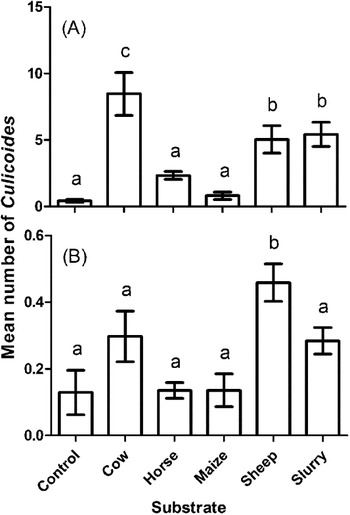
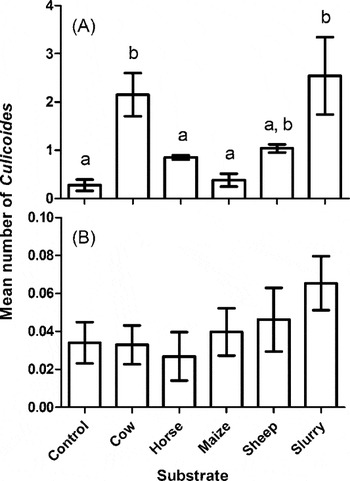
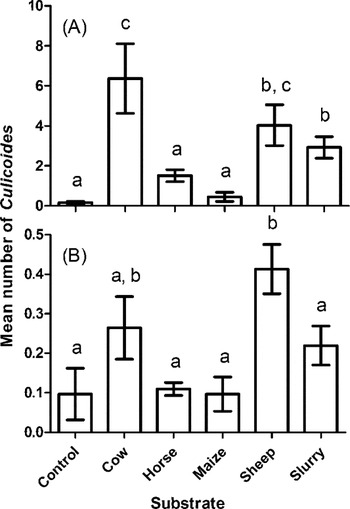
Overall, substrate type was a significant factor in determining the number of Culicoides of the Obsoletus group and Pulicaris group that emerged (F [5,20] = 12·53, P < 0·001 and F [5,20] = 5·12, P=0·003, respectively). Most Obsoletus group emerged from cow dung (mean = 8·46 per 300 mL) and most Pulicaris group from the sheep dung (mean = 0·458 per 300 mL) (Fig. 2). Significant differences were apparent for the newly emerging Obsoletus group Culicoides within both the bucket traps and biobags (F [5,20] = 5·68, P = 0·002 and F [5,20] = 7·90, P < 0·001, respectively) (Figs 3 and 4). By contrast, no significant differences were observed for the Pulicaris group after the initial 4-week incubation under the bucket emergence traps (F [5,20] = 1·93, P = 0·133) (Fig. 3). However, following a further 4-week incubation at 20 °C, a significant difference was observed (F [5,20] = 4·76, P=0·005) (Fig. 4).
Overall mean number of adult Culicoides captured from 300 mL of substrate over the duration of experiment (± standard error of the mean). (A) Obsoletus group, (B) Pulicaris group. Bars with different lower case letters are significantly different according to LSDs derived from ANOVA.

Mean number of adult Culicoides captured from 300 mL of substrate after initial 4-week period under bucket emergence traps in the field (± standard error of the mean). (A) Obsoletus group, (B) Pulicaris group. Bars with different lower case letters are significantly different according to LSDs derived from ANOVA.

Mean number of adult Culicoides captured from 300 mL of substrate following a 4-week incubation at 20 °C (± standard error of the mean). (A) Obsoletus group, (B) Pulicaris group. Bars with different lower case letters are significantly different according to LSDs derived from ANOVA.

Substrate type was a significant factor in determining the sex ratio for the Obsoletus group (χ 2 = 271·6, d.f. = 5, P < 0·001). Overall, a greater proportion of males emerged from cow dung and slurry (65·1% and 61·4% male, respectively), while the soil, horse dung, maize and sheep dung were dominated by females (27·7%, 36·7%, 29·7%, and 36·3% male, respectively) (Table 1). No significant differences were observed for the Pulicaris group (χ 2 = 0·951, d.f. = 5, P=0·966) (Table 1). Insufficient numbers of the remaining groups were captured to perform any meaningful statistical analyses.
Sex ratio of adult Culicoides belonging to the Obsoletus and Pulicaris groups emerging from different substrate types from 4 May to 28 December 2011

Emergence phenology
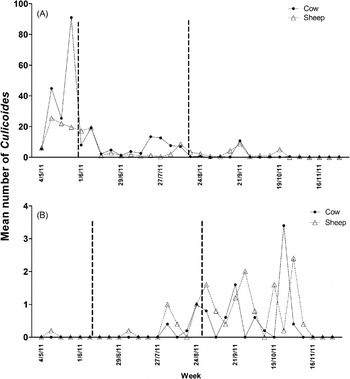
The adult emergence of Culicoides varied greatly throughout the experimental period. Obsoletus group Culicoides emerged from samples exposed from the start of the experiment on 4 May 2011 until 2 November 2011, with most emergence occurring in the early part of the season. The greatest weekly emergence occurred on 25 May 2011 from the cow dung samples (mean = 91 midges per 300 mL, maximum = 175 per 300 mL). Additionally, there appeared to be 1 large, and 2 smaller emergence peaks (in late May, late July and late September 2011), suggesting that the Obsoletus group underwent 3 generations during this experimental period, with a generation time of approximately 8–9 weeks (Fig. 5). Similarly, Culicoides belonging to the Pulicaris group emerged from 4 May 2011 until 9 November 2011. However, the majority of the emergence of the Pulicaris group occurred in the latter part of the season (Fig. 5). The greatest weekly emergence occurred on 26 October 2011 from cow dung samples (mean = 3·4 midges per 300 mL, maximum = 15 per 300 mL). However, insufficient numbers were recorded to make any inferences on the number of generations completed during the experimental period.
Weekly mean number of adult Culicoides captured from 300 mL of cow and sheep dung over the duration of experiment (confidence limits removed for clarity). (A) Obsoletus group, (B) Pulicaris group. Dashed vertical line indicates dates cattle were treated with Cydectin® pour-on.

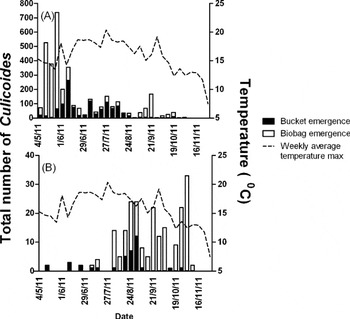
Prior to 1 June 2011, the time taken for Culicoides from the Obsoletus group to emerge was in excess of 4 weeks for the majority of individuals (Fig. 6). However, as the daily temperature increased over the summer/early autumn months, most of the emergence was completed within the initial 4-week incubation period until the beginning of September, after which virtually no emergence was completed within the bucket traps. In comparison, most Pulicaris group Culicoides were recovered from the biobags throughout the experimental period, with the exception of the early weeks. The proportion of Culicoides emerging within the initial 4-week period (i.e. in the bucket traps) increased with temperature for both the Obsoletus and Pulicaris groups (logistic regression deviance ratio = 702·64, d.f. = 1, P < 0·001 and deviance ratio = 7·39, d.f. = 1, P=0·007, respectively).
Proportion of total adult Culicoides emerging weekly from within bucket emergence traps and biobags compared to average weekly maximum temperature (°C). (A) Obsoletus group, (B) Pulicaris group.

Culicoides spp. phenology
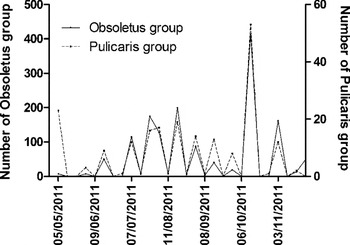
In total, 2268 adult Culicoides were captured by the Onderstepoort UV light trap, of which 96·1% were female. Overall, 80·9% were from the Obsoletus group, 12·3% were from the Pulicaris group, 0·4% were from the Impunctatus group, <0·1% were from the Nubeculosus group and 6·4% were classified as others. The number of Culicoides captured was very sporadic, varying from none to more than 500 per night (13 October 2011) (Fig. 7). This number was positively related to maximum daily temperature (t [3,24] = 21·36, P < 0·001) and negatively related to wind speed (t [3,24] = −17·49, P < 0·001) according to GLM analysis. Due to the sporadic nature of the light trap catches, it was not possible to relate these to emergence data.
Total number of adult Obsoletus (left axis) and Pulicaris group (right axis) caught per night using an Onderstepoort UV light suction trap. All other groups excluded for clarity.

DISCUSSION
The Obsoletus group was the dominant taxa recorded during this study representing 80·9% of the Culicoides captured by the Onderstepoort UV light trap, and 93·6% of the Culicoides that emerged from the various breeding substrates. This is unsurprising as the Obsoletus complex regularly comprises more than 80% of the total species assemblage in agricultural land throughout northern Europe (Meiswinkel et al. Reference Meiswinkel, Baldet, De Deken, Takken, Delecolle and Mellor2008a; Takken et al. Reference Takken, Verhulst, Scholte, Jacobs, Jongema and van Lammeren2008). The Pulicaris group was the second most abundant taxa recorded, representing 6·0% of newly emerging Culicoides, and 12·3% of the Culicoides captured by the UV light trap. This finding is also consistent with previous investigations in northern Europe (Baldet et al. Reference Baldet, Delécolle, Cetre-Sossah, Mathieu, Meiswinkel and Gerbier2008; Meiswinkel et al. Reference Meiswinkel, Goffredo, Dijkstra, Van Der Ven, Baldet and Elbers2008b; Clausen et al. Reference Clausen, Stephan, Bartsch, Jandowsky, Hoffmann-Köhler, Schein, Mehlitz and Bauer2009; Sanders et al. Reference Sanders, Shortall, Gubbins, Burgin, Gloster, Harrington, Reynolds, Mellor and Carpenter2011). To date, there have been no published records of the Culicoides species assemblage within Northern Ireland. However, a recent survey completed by McCarthy et al. (Reference McCarthy, Bateman, Nowak, Higgins, Geraghty, Sheehy, Kirrane, Moran and Lawless2008) investigating the phenology and assemblage of Culicoides species in the Republic of Ireland at 10 index sites, found the Obsoletus and Pulicaris complexes to represent 55% and 35% of the total species assemblage respectively (Obsoletus complex: Culicoides dewulfi 39·9%, Culicoides obsoletus sensu stricto 14·6% and Culicoides chiopterus 0·9%; Pulicaris complex: Culicoides punctatus 13·8%, Culicoides pulicaris 11·6% and Culicoides impunctatus 9·4%).
It has been previously demonstrated that individual species within groups may utilize different niches in which to breed. For example, species associated with the Obsoletus group such as C. obsoletus ss have been reported to breed in large numbers in forest leaf litter (Dzhafarov, Reference Dzhafarov1964), cattle manure (Ninio et al. Reference Ninio, Augot, Dufour and Depaquit2011) and in rotting banana stems (Mellor and Pitzolis, Reference Mellor and Pitzolis1979), while C. scoticus has been reported to breed in open marshy conditions and in rotting fungi (Boorman and Goddard, Reference Boorman and Goddard1970a). Similarly, a number of species grouped together in the Pulicaris complex exhibit a wide variety of breeding habitats. For example C. pulicaris is known to breed in freshwater and vegetated swamps, while C. impunctatus is confined to nutrient-poor peat lands, and a third species, Culicoides halophilus has been reported to breed in coastal salt mud flats (European Food Safety Authority, 2007). Therefore, an obvious shortcoming of the current investigation has been the inability to identify Culicoides breeding in substrates to species level due to previously mentioned experimental limitations. However, the difficulties associated with identifying Palaearctic Culicoides to species level accurately have been previously documented. As such, much of the current research on northern European Culicoides has focused on providing information to group or complex level (Conte et al. Reference Conte, Goffredo, Ippoliti and Meiswinkel2007; Baldet et al. Reference Baldet, Delécolle, Cetre-Sossah, Mathieu, Meiswinkel and Gerbier2008; De Deken et al. Reference De Deken, Madder, Deblauwe, De Clercq, Fassotte, Losson, Haubruge and De Deken2008; McCarthy et al. Reference McCarthy, Bateman, Nowak, Higgins, Geraghty, Sheehy, Kirrane, Moran and Lawless2008; Meiswinkel et al. Reference Meiswinkel, Goffredo, Dijkstra, Van Der Ven, Baldet and Elbers2008b; Clausen et al. Reference Clausen, Stephan, Bartsch, Jandowsky, Hoffmann-Köhler, Schein, Mehlitz and Bauer2009; Baylis et al. Reference Baylis, Parkin, Kreppel, Carpenter, Mellor and McIntyre2010; Sanders et al. Reference Sanders, Shortall, Gubbins, Burgin, Gloster, Harrington, Reynolds, Mellor and Carpenter2011). Therefore, the information provided in the current study is directly comparable with previously published results for northern Europe.
The season for Obsoletus and Pulicaris group emergence (May – early November 2011) was comparable to that observed by Holmes and Boorman (Reference Holmes and Boorman1987) in southeast England (April – November). Additionally, Blackwell et al. (Reference Blackwell, Mordue, Young and Mordue1992) indicated that favourable conditions for Culicoides activity include temperatures above 10 °C with little wind. In the current study, both the daily maximum temperature and wind speed were significant factors in determining adult flight activity, as indicated by Onderstepoort UV light trap catches. Furthermore, temperature was a significant factor in determining emergence rate. The separation of emergence samples into those from the bucket traps and those from the biobags allowed a crude estimation of emergence time as the season progressed. Most Culicoides species required more than 4 weeks to emerge during the early and later part of the season, and no Culicoides emergence was observed once the average weekly maximum temperature fell below approximately 12 °C, providing further evidence that temperature (within favourable limits) is directly related to Culicoides flight activity and rate of development from egg to adult (Edwards, Reference Edwards1982; Mullens and Rutz, Reference Mullens and Rutz1983; Vaughan and Turner, Reference Vaughan and Turner1987; Bishop et al. Reference Bishop, McKenzie, Barchia and Harris1996a; Wittmann and Baylis, Reference Wittmann and Baylis2000).
Substrate type was a significant factor in determining the number of adult Culicoides that emerged. This may be expected as Culicoides larvae are more prevalent in substrates with a high carbon: nitrogen index as this supports the production of humus and ensures good microbial growth for Culicoides larval feeding (Zimmer et al. Reference Zimmer, Saegerman, Losson and Haubruge2010). During this study, midges of the Pulicaris group bred most successfully in sheep dung. Historically, C. pulicaris complex has been reported to breed in marshes, swamps, mud, leaf litter and ponds (Kettle and Lawson, Reference Kettle and Lawson1952; Trukhan, Reference Trukhan1975; Mirzaeva and Glushchenko, Reference Mirzaeva and Glushchenko1976). Midges of the Obsoletus group bred most successfully in cow dung, with sheep dung and cow slurry acting as less favourable breeding substrates. This result is unsurprising as almost half of the worldwide bluetongue vectors fall into the subgenus Avaritia which breed specifically in dung substrates (European Food Safety Authority, 2007). A study conducted in Belgium found that midges of the Obsoletus complex were abundant in maize silage residues (Zimmer et al. Reference Zimmer, Haubruge, Francis, Bortels, Simonon, Losson, Mignon, Paternostre, De Deken, De Deken, Deblauwe, Fassotte, Cors and Defrance2008). However, the current study found no significant difference between the number of adult Culicoides emerging from soil and maize substrates. Furthermore, this study provides evidence that Obsoletus group midges can utilize sheep dung and cow slurry as suitable breeding substrates. This finding contradicts European Food Safety Authority guidelines which state that slurried dung is unsuitable for Culicoides spp. breeding (European Food Safety Authority, 2007). Under the current European Nitrates Directive (91/676/EEC) all organic manures, including slurry, must be stored over the winter months to reduce runoff of nitrates into nearby fresh water systems (European Commission, 1991). For example, in Northern Ireland no slurry can be applied to pasture from midnight 15 October to midnight 31 January (Department of Agriculture and Rural Development, 2011). This process results in vast quantities of slurry (up to 50 000 litres per ha per 3-week period) being applied to grassland in late winter/early spring in close proximity to the beginning of the vector-active period which may provide an ample breeding site for Obsoletus group Culicoides.
In southeast England, Culicoides spp. within the Obsoletus complex complete 3 distinct generations annually with a generation time of approximately 7–8 weeks (Holmes and Boorman, Reference Holmes and Boorman1987). In the present study, Culicoides spp. within the Obsoletus group displayed 1 large, and 2 smaller emergence peaks separated by approximately 8–9 weeks in late May, late July and late September 2011. This slightly extended generation time most likely reflects the fact that Northern Ireland has a slightly cooler climate than southeast England. From June to August, the majority of Obsoletus group midges emerged within 4 weeks, i.e. within the bucket traps and it is considered that the remainder of the generation time comprises the adult cycle of mating, blood-feeding and oviposition-site location. While there is a possibility that these 3 peaks may represent different species within the Obsoletus group, it has been previously demonstrated that while there are slight changes in the relative proportions of each species caught, all of the species represented within the group are present throughout the entire vector-active period (Holmes and Boorman, Reference Holmes and Boorman1987).
The abundance of adult Culicoides captured by the UV light trap was very sporadic but greatest in early October. Conversely, the highest emergence per 300 mL of substrate occurred in late May and the lowest in late August. Taking into account that an adult female Culicoides can deposit between 18 and 450 eggs in a single egg batch (Boorman and Goddard, Reference Boorman and Goddard1970b; European Food Safety Authority, 2007), these results suggest that even the largest sample collected in this investigation (175 midges per 300 mL) could represent the offspring of fewer than 10 gravid females. However, little is known about the survival rate of Culicoides eggs, or the effects of larval competition, predation or parasitism, e.g. by parasitic nematodes (Mullens et al. Reference Mullens, Sarto i Monteys and Przhiboro2008), on larval survival rates. While it is not clear whether the low emergence rate in this investigation was the result of a low oviposition rate or a combination of other factors, there are a number of possible explanations for this apparent decrease in emergence. For example, the application of moxidectin 0·5% pour-on as Cydectin® to the cattle prior to the collection of the dung may have resulted in the death of some Culicoides larvae. Moxidectin is an effective therapeutic treatment for a broad spectrum of endo- and ectoparasites and it is mainly excreted via faeces (Fort Dodge Animal Health, 1997). However, moxidectin exhibits the lowest larvicidal activity of the avermectin family, suppressing horn flies (Haematobia irritans) for no more than 1 week, and having no suppressive effect on house flies (Musca domestica), or stable flies (Stomoxys calcitrans) (Floate et al. Reference Floate, Spooner and Colwell2001, Reference Floate, Colwell and Fox2002). Furthermore, Culicoides emergence from the other treatment substrates mirrored that of the cow dung emergence. As only the cattle were treated with Cydectin®, it is reasonable to assume that this reduction was due to other factors, such as an increase in the availability of breeding sites later in the season as livestock have been out to pasture for a majority of the summer months resulting in ample potential dung breeding sites becoming available, high larval mortality, or that the soil type was unfavourable for Culicoides breeding as it has been previously indicated that C. obsoletus ss favour breeding habitats that do not ever become waterlogged (Conte et al. Reference Conte, Goffredo, Ippoliti and Meiswinkel2007).
Overall, there was a significant difference in the sex ratio of the Obsoletus group observed within the different substrates utilized. Whilst many empirical studies have shown that haplodiploid Hymenoptera can adjust the sex ratio of their progeny in response to environmental conditions (Charnov, Reference Charnov1982; King, Reference King, Wrensch and Ebbert1993; Ode and Heinz, Reference Ode and Heinz2002), diploid insects such as Culicoides (Nunamaker et al. Reference Nunamaker, Brown, McHolland, Tabachnick and Knudson1999) are unlikely to be able to adjust their sex ratio by parental control (Bull, Reference Bull1983; Dorchin and Freidberg, Reference Dorchin and Freidberg2004). A more probable explanation for this difference is differential mortality of male and female larvae within Obsoletus group Culicoides due to differences in water/nutrient content of the various breeding substrates, differing predation/parasitism levels, or changes as the substrate as it ages (e.g. a skin forming on the surface). As males tend to emerge before females in many Culicoides spp. (Blackwell et al. Reference Blackwell, Mordue, Young and Mordue1992), this suggests that faster development may have been advantageous in the substrates with a higher water content (personal observation), as a greater proportion of males emerged from the cattle dung and slurry. Conversely, the other substrates may have become more conducive to midge emergence as they degraded resulting in the longer developmental time of females being advantageous.
In conclusion, this study has furthered the knowledge of the on-farm breeding substrates utilized by temperate Culicoides spp. and provided the first insight into the oviposition preferences for the most abundant Culicoides groups within Ireland. Additionally, it has indicated that slurry can act as a suitable breeding substrate for Culicoides of the Obsoletus group, and that the Pulicaris group may be able to utilize a wider range of breeding substrates than previously demonstrated. Given the current vector status of the Obsoletus and Pulicaris groups in relation to bluetongue (Thompson et al. Reference Thompson, Murchie and Jess2011), and more recently Schmallenberg virus (Department for Environment Food and Rural Affairs, 2012), this attempt to define the breeding substrates utilized by Culicoides spp. and their emergence phenology will provide a point of reference for future studies into the epidemiology of midge-borne diseases.
ACKNOWLEDGEMENTS
We would like to show our appreciation to the staff of AFBI Hillsborough for the provision of a site on which to conduct this experiment, Ian Rea and John Anderson for their assistance in the construction of the bucket emergence traps, Aaron Brunt and Stephen Loye for their field work assistance and Alan Gordon for his valuable statistical advice. Thanks also to an anonymous reviewer who provided important insights into Culicoides larval development and directed us to additional literature.
FINANCIAL SUPPORT
We thank the Department of Agriculture and Rural Development, Northern Ireland, for funding this research as part of its post-graduate agricultural and food studentships and ongoing vector monitoring programme.