

The first commercial Islamic bank appeared in 1975 in Dubai. Today, Islamic finance is a $2 trillion industry present in over 100 countries. But why is there an Islamic finance today—and no other major “religious finance”?
At the heart of Islamic finance is its ban on interest. Islamic finance has other core principles: it avoids excessive speculation, uncertain contractual terms, and sectors such as alcohol, pork, cigarettes, and arms. But most of all, it is the ban on interest that necessitates and justifies a different way of doing finance [Siddiqi Reference Siddiqi1983; Chapra and Ahmad Reference Chapra and Ahmad1985; El-Gamal Reference El-Gamal2006; Pitluck Reference Pitluck, Cetina and Preda2012; Rudnyckyj Reference Rudnyckyj2014]. After all, interest is ubiquitous in capitalist finance.
So why is there an Islamic ban on interest today—but no surviving interest ban in any other religious tradition? This article seeks to answer that question. For over a millennium, Judaism and Christianity banned interest. Yet today, it is only in Islam that a substantial portion of believers consider interest to be impious. Why is Islam different, and what happened to the Jewish and Christian interest bans?
This article first reviews existing hypotheses about the evolution of religious usury bans. It then presents an alternative hypothesis that focuses on a particular social group: religious jurists. My argument is that in any religion, the fate of a systematic interest ban depends on the fate of religious jurists. These are scholars of religious law, such as rabbinical scholars in the Jewish tradition, canonists in the Christian, and muftis in the Islamic. When religious jurists do not exist, no systematic interest ban emerges. When religious jurists emerge and cohere as a professional group, a systematic interest ban emerges. While religious jurists thrive and remain autonomous from heavy interference, the interest ban survives. And when religious jurists come under attack or lose their traditional prestige or role in society, the ban weakens and dies. I review evidence from the history of the three Abrahamic religions—Judaism, Christianity, and Islam—to support this argument.
In the conclusion, I use the evolution of the Abrahamic usury bans to critique Max Weber’s account of the relationship between economy, religion, and law. The evidence confirms Weber’s insistence that material forces alone cannot explain changes in economic morality. It also supports his observation that professionalized jurists are crucial in making law amenable to rational capitalism. Yet it refutes Weber’s characterization of Islamic law as incoherent, substantively irrational, and inflexible. Islamic jurists—like Jewish and Christian jurists—are indeed carriers of tradition. But tradition, contra Weber, is not most fruitfully understood as the antithesis of modernity and change.
Why do usury bans appear and disappear?
Below, I first discuss two types of explanations for why religious restrictions on usury and interest appear, persist, and disappear in different religious traditions: “economic” and “cultural and political” hypotheses. Footnote 1 I then present my own hypothesis: that the survival of the usury ban depends on the survival of religious jurists. My hypothesis is not necessarily at odds with most existing hypotheses. Rather, it specifies the sociological mechanism by which economic pressures external to the religious sphere and doctrinal developments internal to it shape the development of religious usury law. That mechanism is the religious jurists.
Economic Hypotheses
Developmental. The “developmental hypothesis” is the most straightforward of the economic hypotheses. It appears in multiple literatures: institutional economics, law-and-economics, economic history, and sociology. It asserts that as economies develop, usury bans erode and disappear. This happens because commercial activity increases the collective costs of restricting interest-based lending. Merchants and creditors become more powerful, pressuring religious or state authorities into allowing interest. In the developmental hypothesis, credit allocation goes from being socially embedded to socially disembedded. Borrowers increasingly turn to an anonymous market of professional lenders. This correlates with the transition from a primitive, agricultural economy to a modern commercial or maritime economy. A crucial corollary is the “consumption-production axiom.” This is the idea that usury restrictions are stricter in societies where most loans finance consumption and looser where most loans finance production (with “production” construed broadly to include investment, trade, and distribution).
In pre-modern economies, people who need consumption loans are typically in woeful situations: proverbial “widows and orphans” or peasants suffering bad harvests. Moneylenders are predators [Galbraith Reference Galbraith1987: 12; Sombart Reference Sombart and Epstein1915: 249-250]. Where there are vestiges of feudal or semi-feudal production, the same phenomenon persists today. In modern India, some peasants take consumption loans from landlords, remaining perpetually in debt [Bhaduri Reference Bhaduri1973: 122-123]. In modernizing economies, however, commercial and industrial activity increase and credit flows increasingly to production. Lenders can benefit society, or at least act neutrally. Their loans go to capitalists, not to unfortunates.
Promotion of capitalism. Turning the developmental hypothesis on its head, Werner Sombart [Reference Sombart and Epstein1915: 247-50] presents the promotion-of-capitalism hypothesis: that religious figures (in this case, late-medieval Italian scholastics) supported a usury ban because it promoted capitalism. Contra Weber, Catholicism—not Protestantism—provided more fertile ground for the emergence of modern capitalism. With regard to usury, Sombart contends that the later Italian scholastics viewed lending at interest as a way of preventing money from becoming capital, and therefore banned it in the service of capitalist development.
Rent-seeking. Another possibility is that powerful borrowers enforce restrictions on usury to keep their own costs of borrowing low. This is the “rent-seeking hypothesis.” Ekelund, Hébert, and Tollison [Reference Ekelund, Hébert and Tollison1989] portray the medieval church as a thuggish bureaucracy that used administrative coercion and the threat of excommunication to get rich by borrowing at preferential interest rates and lending at high ones. Footnote 2 The medieval church did much borrowing and lending at interest—as during the Crusades—despite publicly promulgating a ban on lending at interest and excommunicating those who did the same. In this view, the pre-Reformation church was a rational-acting monopolist in the salvation business.
Welfare state. Posner, a scholar of contract law, presents the “welfare-state hypothesis [1995].” He asks why limitations on voluntary contracts exist under authorities generally committed to free markets. Such conditions make sense, he says, from the vantage of a welfare state. When a welfare state provides an income floor or some other form of poor relief, individuals have more incentive to engage in risky behavior, including borrowing at high interest rates. Usury ceilings thus limit welfare-state expenditure.
Social insurance. Glaeser and Scheinkman [Reference Glaeser and Scheinkman1998] view usury laws as primitive Pareto-improving social insurance. Individuals tend to borrow when their income is low and lend when it is high. This means the marginal utility of income while borrowing is higher than while lending. Usury laws make this a reality by keeping interest rates artificially low.
Consumption-smoothing. The “consumption-smoothing hypothesis” likewise asserts that usury restrictions are a functional solution to a collective economic concern: the problem of unpredictable income in a pre-modern economy [Reed and Bekar Reference Reed and Bekar2003]. During medieval crises such as “illness, accidents, premature death of bread-winners, fire, robbery, pillage in war, natural disasters, and bad weather” [Dyer Reference Dyer1989: 234], individuals smoothed their consumption using charity from the Church, informal pooling among neighbors and family members, and borrowing from moneylenders. In the authors’ model, the medieval Church’s usury ban served to keep the wealthy involved in pooling and charity.
Cultural and political hypotheses
It is insufficient to argue that certain religious traditions prohibit interest simply because their sacred texts condemn it. After all, the Pentateuch bans not only usury, but trimming beards [Lev. 19: 27] and wearing clothing woven of two kinds of material [Lev. 19: 19]. It even commands death for working on the Sabbath [Exod. 31:14, Num. 15: 32-36]. Sacred texts alone cannot explain how interpretation and observance of such laws has evolved over time and place.
Usury doctrine as deep cultural logic. Some consider usury doctrine a reflection of deep cultural templates. Through these templates, people in a society ascribe moral valences to lending practices and to social relations in general. The templates change with longue durée transformations in social structure, especially from “traditional” (gemeinschaftlich, gift-exchange-based, segmentary) societies to “modern” (gesellschaftlich, contractual/money-exchange-based, individualistic/political) ones.
According to Benjamin Nelson’s “tribal-brotherhood-to-universal-otherhood hypothesis,” for example, the history of usury in Christian Europe traces a fundamental shift in Western morality [1949]. Nelson focuses on Deuteronomy 23: “Thou shalt not lend upon usury to thy brother […] unto a stranger thou mayest lend upon usury; but unto thy brother thou shalt not lend upon usury” [Deuteronomy 23: 19-20].
To Nelson, the transition from a community of common mores to a society of self-interested individuals led to re-interpretation of this passage. Jews took Deuteronomy to ban interest among themselves only. As a universalist Christian self-understanding developed, however, this “tribal brotherhood” changed to “universal brotherhood”—and eventually to “universal otherhood.” Why, wondered Christian exegetes, would a just, loving God apply one rule to some of his children (the Jews) and not the rest? Surely, wrote Ambrose of Milan (340-397), usury was so hurtful that it should only be unleashed “upon him […] whom it would not be a crime to kill” [Ambrose of Milan 1933 (ca. 370): 67, 15.51]. Aquinas (1225-1274) believed God let Jews take usury from foreigners “to avoid a greater evil”: that Jews would take usury from Jews [Aquinas Reference Aquinas1922 (1265-74): ST IIa-IIæ, Q. 78, Art. 1, ad. 2.]. So medieval Christian thinkers insisted that Deuteronomy prohibited usury not only among co-religionists, but among everyone. Between the 16th and 18th centuries, however, the rise of a money economy “bifurcat[ed] […] human relations into distinct spheres”: the “world of friendship and free services” and “the world of commercial intercourse and the economic calculus” [Nelson Reference Nelson1949: 65]. The market became an individualistic realm of “universal otherhood.”
In La grâce du don (“The grace of the gift”), Bartolomé Clavero explains usury’s moral valence in 16th- and 17th-century Spain as a function of a Catholic social logic. Clavero finds the dominant metaphor for social relations to have been familial. The powerful—monarchs, clerics, parents—were duty-bound to protect the powerless. In this society of patron-client relations [Clavero Reference Clavero and Schaub1996: 170-173], the social glue was grace, manifested as uncalculating altruism. The intention of a financial exchange therefore mattered more than its math. Spanish theologians considered usurious any loan in which surplus was coldly determined in advance and “purely economic naked gain” Footnote 3 motivated the lender [65]. However, they smiled upon “warm” exchanges, even if the material outcome was identical to that of an interest-bearing loan: the lender extended an interest-free loan as a gift, and then the borrower, out of gratitude, returned the principal with a sum added as a counter-gift (antidora) [82-85]. Sinfulness depended not on financial outcome, but on intent: merely intending to gain from a loan was “mental usury” [54]. Footnote 4 Usury was not just a sin of avarice, but “incest of money” [180]: the perversion of human nature.
Separation of spheres. Benjamin Nelson’s evolutionary account is a variant of the “separation-of-spheres hypothesis”—the idea that religious usury bans disappear as the religious and the economic spheres differentiate in the transition to modernity. Although this thesis is often attributed to Weber, in the case of usury, Tawney [Reference Tawney1963 (1926)] is its leading exponent.
Economic and demographic changes in late medieval and early modern Europe increased demand for credit and the accumulation of surplus capital. From the 12th to 16th centuries, towns rose, trading circuits expanded, trade fairs flourished, proto-industrial production emerged, and states’ financing needs increased, especially for war-making [Anderson Reference Anderson2013; Mann Reference Mann2012; Tilly Reference Tilly1992].
These shifts disrupted the Church’s hegemony over economic morality. Like Nelson and Weber, Tawney considers the expansion of capitalist credit markets and the rationalization of theology part of the birth of Western modernity. The move into modernity entails a separation of religion and economy: the birth of a world in which “trade is one thing, religion is another” [Tawney Reference Tawney1963 (1926): 4].
Weber: Ethical rationalization and social differentiation. A central theme of Weber’s writings on usury is that the disappearance or relaxation of usury bans is not simply a function of the development of a market economy. In his doctoral dissertation, Weber [Reference Weber2003 (1889)] confronted Sombart, who portrayed religious attitudes toward usury as somewhat epiphenomenal to the transition from feudalism to capitalism [Kaelber Reference Kaelber2004: 52-53]. Weber argued that increasing economic activity did not necessarily correlate with decreasing restrictions on usury. Citing historical records on commerce in late medieval Italy, he said the opposite was sometimes true.
In The Sociology of Religion, Weber again dismisses materialist theories of usury. After all, he notes, the most strenuous usury bans appeared just as capitalist development was accelerating in Europe. He points instead to ethical rationalization. As internal rationalization intensified, the tension between the economic ethos of profit maximization and the religious ethos of caritas became starker, leading to the differentiation of the economic and religious value-spheres in modern life [1978 (1922): 584]. Footnote 5
Dependent political authorities. Jared Rubin [Reference Rubin2011] is one of few present-day scholars who have rigorously compared the Christian and Islamic interest bans. Why did a prohibition on interest that was relatively strict until the 15th century in both faiths persist in Islam but disappear in Christianity? Rubin’s explanatory variable is the degree to which political authorities depended on religious authorities for legitimacy. What I call his “dependent-authorities hypothesis” is that the greater this dependence, the longer economically inhibitive laws are likely to persist.
Rubin aims to show that political authorities relied on religious authorities for legitimacy more in the Islamic world than in Christendom, particularly when commerce was expanding. However, he then treats this difference as an exogeneity with path-dependent effects. While admitting that the medieval papacy had “a significant degree of power over lay rulers between the 11th and 13th centuries,” he asserts that in Islam, creating political institutions separate from the organization of Islam was “hardly conceivable” [ibid.: 1317]. Much scholarship refutes this, including research on the longstanding and essentially secular system of maẓālim courts, which handled matters of land use, taxation, public morality, and criminal law, standing apart from shariah and religious authority [al-Māwardī Reference Al-Māwardī1989 (d. 1058); Tyan Reference Tyan1960; Nielsen Reference Nielsen1985; Zubaida Reference Zubaida2005; Tillier Reference Tillier, Lange and Fierro2009; Rustow Reference Rustow2010].
An alternative hypothesis: Survival of the jurists
The argument of this article is that in each of the three Abrahamic religions, the fate of the usury ban depends on the fate of religious jurists. First, when religious jurists initially appear, usury goes from being merely a sin to being a systematically defined crime against justice. Then, as long as religious jurists remain important in society, the ban survives. Finally, when jurists disappear from a religious system—whether suddenly or gradually—the usury ban dies with it.
Who are religious jurists?
A jurist is a scholar of the law. Her expertise is jurisprudence—“the theoretical component within the discipline of law” [Coper, Blackshield, and Williams Reference Coper, Blackshield and Williams2001]. Jurisprudence extends beyond application of the law to its derivation, reasoning, and notions of justice.
Jurists are defined by scholarship, producing legal commentaries and responsa. They therefore differ from judges, who administer justice, and lawyers, who advocate for clients. In wielding intellectual authority, religious jurists also differ from prophets, who proclaim doctrine by virtue of charismatic authority, and from priests, who “dispense […] salvational goods” by the authority of their religious office [Weber Reference Weber, Roth and Wittich1978 (1922): 439-440].
In Judaism, the religious jurists are the halakhists: rabbinical sages and scholars versed in the Torah, the Talmud, and other sources of Jewish law (halakhah). In Christianity, they are the canonists (i.e. specialists in canon law). In Islam, they are the fuqahā’: experts in fiqh, or Islamic jurisprudence. Footnote 6
When the community of religious jurists emerges as a distinct professional group, it takes on specific features. One is a system of qualification and credentialing passed from master to student. In Judaism, semikhah, the ceremonial “laying on” of hands by the master, acknowledges appointment as a rabbinical scholar. In Christianity, the mid-13th-century appearance of examination-based certificates such as the magister decretorum and doctor decretorum accompanied the emergence of canon lawyers “as a distinctive occupational group” [Brundage Reference Brundage1995: 62]. In Islam, the ijāzah (“authorization”) confirmed that a student of jurisprudence had mastered an important text and was qualified to teach and transmit it.
Another feature of professionalization is the appearance of legal schools. Sometimes these are physical institutions, such as the medieval universities at Salerno, Bologna, and Paris and the great Talmudic academies of Pumbedita, Sura, Tiberias, and Caesarea. In other cases, the schools are juridical traditions with different approaches to legal reasoning and methodology, like the Islamic madhāhib.
A third feature of religious jurists’ professionalization is their fixing of the dominant religio-juridical corpus and establishment of a monopoly on its interpretation. Religious jurists compiled sacred sources such as the Mishnah and Gemara in Judaism during the 3rd to 5th centuries ce, the ḥadīth literature in Islam in the 9th century ce, and comprehensive decretal collections in Christianity from the 11th and 12th centuries ce. The jurists then cemented their monopoly on interpretation of these sources by establishing sciences of exegesis and derivation, including midrash halakhah in Judaism, uṣūl al-fiqh in Islam, and scholastic hermeneutics in medieval Christianity. These new sciences established rules for deriving law from sacred texts that were often vague, using the rulings of past jurists and weighing competing sources of law. These exegetical sciences demanded years of additional study and “raised the bar” for entry into the community of jurists.
The life cycle of religious usury bans and the role of religious jurists
Religious jurists play crucial roles in the birth, life, and death of religious usury bans.
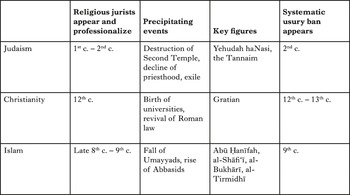
Birth. Religious jurists emerge as a coherent professional group at different moments in different religions, in Judaism in the 2nd and 3rd centuries ce, in Islam in the 8th and 9th centuries ce, and in Christianity in the 12th century ce. The reasons for emergence differ, but in all cases the expansion and compilation of sacred sources beyond foundational scripture is one proximate cause, giving the jurists more raw material from which to produce and theorize law. Also concomitant with the jurists’ rise is the growth of new centers of learning, such as rabbinical academies, medieval universities, and madrasahs.
The edifice of classical religious jurisprudence then emerges. This entails a series of remarkably similar transformations in Judaism, Christianity, and Islam. One transformation is methodological: these new professional legal experts develop a scientific method of exegesis, or rules for deriving sacred law from sacred sources. The second is epistemological: religious law increasingly concerns itself with defining concepts and terms and classifying activities. The third transformation is logical: the jurists adopt carefully structured modes of reasoning—casuistic, dialectical, syllogistic, and sic-et-non, for example. The fourth concerns subject matter: sacred law governing economic exchange expands dramatically. The jurists write extensively about property, ownership, prices, money, contracts, trade, and usury. The corpus of religious law stretches outward, covering more of daily life; it becomes more formal and systematic, more intellectual and theoretical. Footnote 7
Life. While religious jurists remain important, the systematic usury ban survives. Much like carriers of a gene, religious jurists carry the ban through history.
Medieval Jewish, Islamic, and Christian jurists successfully carry the usury ban for centuries because they are good at adapting it to changing circumstances. They do this in two ways. First, they accommodate the evolving needs of those seeking credit. While stressing that usury is sinful, they approve a widening range of financial contracts that serve purposes similar to interest-bearing loans but that stay within the letter of religious law. Over time, they also adjust the definition of what counts as usury. However, such accommodation can threaten jurists’ legitimacy—in the eyes of other religious authorities and of the masses. Thus, religious jurists must develop justification for their accommodations. In other words, they must theorize the usury ban further.
Meanwhile, usurious lending never disappears. In fact, the Abrahamic bans never appear to have stamped out usury anywhere, or even come close. In the Abrahamic traditions, religious jurists’ authority has been primarily epistemic (“being an authority”), not deontic (“being in authority”) [Hallaq Reference Hallaq2005: 165; Sagi Reference Sagi1995; Allsopp Reference Allsopp1996]. Footnote 8 Religious rulings on usury usually lacked state-backed enforcement. So as a general rule, believers obey for psychological reasons (being right with God) and social ones (appearing pious, maintaining good standing), not out of fear of physical or material punishment. Courts have occasionally forced usurers to make restitution; but as an act of mutual consent, usury is difficult to police. Small moneylenders avoid the law’s gaze, while large moneylenders may proffer “cleansing” donations to religious institutions.
Death. When religious jurists decline and disappear, the religious usury ban dies. Religious jurists embody the idea that religious law is an ubiquitous and complete edifice that should govern every venue, from marketplace to bedroom. They also insist that religious law is scientific, and that God’s plan is accessible to human reason. Neusner’s description of rabbinical jurisprudence captures these ideas [2002: 181]:
The Talmud and related literature … are put together with an amazing sense of form and logic, so that bits and pieces of information are brought into relationship with one another, formed into a remarkably cogent statement, and made to add up to more than the sum of their parts.
Likewise, medieval Christian scholastics saw their jurisprudence “as the epitome of applied ratio” [Dedek Reference Dedek2011: 351], the effort to build an intellectual cathedral of taxonomy, classification, and totality [Dedek Reference Dedek2011: 359; Panofsky Reference Panofsky1957]. Fiqh, or Islamic jurisprudence, has been described the same way. Today’s Islamic jurists, stalwart upholders of the usury ban, retain this understanding of religious ethics as science. I spoke with Sheikh Nizam Yaquby, the most famous jurist in contemporary Islamic finance, about the permissibility of a controversial financing structure Footnote 9 that formally avoids interest. “You must have solid ground to say […] [what] is ḥarām (Islamically prohibited) and what is ḥalāl (Islamically lawful),” the sheikh insisted. “Do you have empirical research?” Footnote 10
This analytical approach to religion, and hence the religious usury ban itself, disappears when jurists lose authority and decline as a professional group. But when religious jurists do not disappear, the usury ban survives. This happened in Islam and (in limited form) in Orthodox Judaism.
Judaism
Birth
Usury in the Hebrew Bible and before Rabbinic Judaism
The Torah condemns usury, specifically between Jews:
Deuteronomy 23:20-21: Thou shalt not lend upon interest to thy brother: interest of money, interest of victuals, interest of any thing that is lent upon interest. Unto a foreigner thou mayest lend upon interest; but unto thy brother thou shalt not lend upon interest (JPS 1917 translation) Footnote 11 .
Why does the Tanakh (Hebrew Bible) ban usury, and why among Jews only? Footnote 12 Since usury bans were rare in the ancient Near East [Neufeld Reference Neufeld1955: 361-363], this Jewish innovation is curious. Following the developmental hypothesis, some believe it reflected semi-nomadic pastoralism in the late second millennium bce. Reciprocal exchange [Polanyi Reference Polanyi1977: 39] predominated and loans for trade, industry, and agriculture were rare. Most interest-bearing loans gouged the destitute and desperate [Bertholet Reference Bertholet2004: 221]. Others contend that commercial lending was in fact widespread in ancient Israelite society [Silver Reference Silver1983]. Regardless, by the 8th and 7th centuries bce, usury was a social cancer. As Israel and Judah suffered plagues, natural disasters, foreign invasions, and tribute payments to Assyria and Babylon [Byrne Reference Byrne2003; Holladay Reference Holladay, Dever, Gitin, Wright and Dessel2006], poverty and inequality increased. Poor Jewish farmers were ruined by credit, selling off their land and children to rich landowners and falling into indentured servitude or debt slavery, often to other Jews [Baron Reference Baron1952: 67-70; Adams Reference Adams2014: 106]. Deuteronomy’s ban on usury between Jews may have been written around this time [Noth Reference Noth1981; Lundbom Reference Lundbom2013].
The emergence of rabbinic scholars as a distinct and powerful social and professional group
In Judaism, the religious jurists are the rabbinic scholars. The rise of Rabbinical Judaism was both a gradual consolidation over centuries of a stratum of academic legal specialists and a rapid shift in the 1st through 3rd centuries ce that elevated those specialists to undisputed centrality as the guardians of Judaism. Consequently, usury theory took an immense leap forward in sophistication.
The gradual consolidation of the stratum of Jewish legal scholars began in the Biblical period, when the judicial hierarchy comprised assemblies of elders, scribes, priests, and judges. The judiciary answered to the highest tribal chief or, during the monarchic period (ca. 1020 bce-ca. 582 bce), the king [Wilson Reference Wilson1983; Falk Reference Falk2001: 47-50]. During the Second Temple period (516 bce-70 ce), priests constituted the leading social stratum [Haran Reference Haran1985; Himmelfarb Reference Himmelfarb1997; Klawans Reference Klawans2006].
The rapid rise of the jurists came with Rome’s destruction of the Second Temple in 70 ce, which triggered two centuries of upheaval. In the face of Roman tyranny and discrimination, divisions among rival Jewish sects and legal schools diminished. Exile turned the focus of Jewish spirituality from Temple sacrifice to prayer and study. Rabbis replaced priests as the dominant carriers of Jewish spirituality and knowledge. Footnote 13
As rabbinical scholars became the main guardians of the religion, they professionalized. Rabbis came to enjoy tax exemption. Jurisprudence also started to become a career: some rabbis began getting paid as teachers or receiving patronage from wealthy community members [Stemberger Reference Stemberger, Neusner and Avery-Peck2000].
The gap between jurists’ law and human practice
This article focuses on the persistence of religious doctrine banning usury, not on its enforcement in practice. This is both because reliable transhistorical evidence on actual lending practices is spotty and because the article’s goal is to explain the persistence or disappearence of the usury ban in religious doctrine, not to trace economic outcomes.
Nonetheless, it is important to note that many pre-modern Jews—like many pre-modern Christians and Muslims—simply ignored the religious usury ban. Well before the Mishnah, Biblical and Egyptian sources attest to lending at interest between Jews, even during jubilee years [Nehemiah 5: 1-11, Schwartz Reference Schwartz2009: 68-69]. Economic expediency motivated such arrangements, but the tendency to pursue local Gentile custom in the absence of clear Jewish usury law [Schwartz Reference Schwartz2009: 68-69] made matters worse [Stein Reference Stein1953: 6-7]. Later papyri attest to lending at interest between Jews, as in Egypt in the 5th century bce [Cowley Reference Cowley2005: 29-33] Footnote 14 and late 3rd century bce. Footnote 15 In Greco-Roman times, there are occasional records of Jews’ involvement in moneylending, but no sign of Jewish specialization in that field: the Jewish masses largely lived in abject poverty [Baron Reference Baron1952: 109-110, 194, 264-266]. Nonetheless, the blanket prohibition on interest between Jews often became unrealistic in practice; some even flouted the Roman interest rate maximum of 12% [ibid.: 409]. By the Middle Ages, the Cairo Geniza papers, dating from the 9th century onward, show that in medieval Egypt, both Muslims and Jews lent at interest to Muslims, Christians, and Jews [e.g., Goitein Reference Goitein1967: 257].
Life
The codification of Jewish law spurs systematic jurisprudence and usury theory
Rabbinic Judaism dealt with usury in much deeper, more legalistic, and more theoretical ways than any form of Judaism that preceded it. This movement, which would prove to be the dominant incarnation of Judaism for most of the subsequent two millennia, emerged with the destruction of the Second Temple. Jewish exile spurred legal development. Fearing that the Oral Law would be lost, Rabbi Yehudah haNasi redacted it, producing a legal code of 63 books known as the Mishnah.
As the “founding document of Rabbinic Judaism” [Stemberger Reference Stemberger, Neusner and Avery-Peck2000], the Mishnah launched systematic Jewish jurisprudence. It rationalizes Jewish law into an all-encompassing legal code, with 517 chapters systematically covering topics such as prayer, tithes, agricultural laws, Sabbath laws, marriage and divorce, civil law (including usury law), criminal law, sacrificial rites, dietary laws, and funerary rites. Crucially, the Mishnah also establishes legal study as a science by extending its gaze beyond practical everyday problems into hypothetical cases. Mishnaic contract law advanced as the rabbinical stratum consolidated, far surpassing prior Jewish legal study in its “interest in the wide and systematic application of civil law concepts.”
The early post-Mishnaic evolution of Jewish usury law: elaboration and expansion
Usury was prominent among these concepts [Lapin Reference Lapin1995: 156]. Faced with the need to manage a diversified economy of farmers, traders, and shopkeepers, the Tannaim and the Amoraim expanded the Jewish usury ban’s sphere of application and extended its logic beyond money to food and other goods. They also applied Deuteronomy to sales on credit, mortgages, produce lending, investment partnerships, and advance payment for goods [Gamoran Reference Gamoran2008: 15-24].
The Mishnah is full of “thought experiments” that probe the boundaries between ethical categories. A section on usury begins with a simple question: “What is considered usury [neshek]?” (B. Metz. 5.1). Footnote 16 Each hypothetical example that follows is a brick in the wall of usury theory. For example, may one who extends an interest-free loan stay at the borrower’s home for free? No: “A lender must not dwell in his debtor’s house for nothing, or even for decreased rent, as it is usury” (B. Metz. 5.2). However, “a tenant may offer increased rent in exchange for a loan to improve his field, without fearing that this is of the nature of usury” (B. Metz. 5.5). And so on.
Subsequent generations of jurists elaborated on the Mishnah’s rules concerning usury through extensive commentaries. Following the Tannaim, who authored the Mishnah, the Amoraim (ca. 200 ce-ca. 500 ce) produced the Gemara—further debates and commentaries on the Mishnah, stretching to many times its length.
The Tannaim and the Amoraim were concerned with how usury might creep into transactions. For example, is it acceptable to insist on a higher price for a product if it is sold on credit? No, because the transaction effectively becomes a sale plus an interest-based loan (B. Metz. 5: 3). And if one borrows a unit of wheat when it is worth 25 dinars on the market, and returns the wheat when it is worth 30 dinars, is this a form of interest? The rabbis said yes, and ruled produce lending illegal (B. Metz. 5: 1). By applying reason, the sages of the 1st and 2nd centuries thus expanded the scope of the interest ban.
Talmudic debates ventured into usury scenarios that reflect the particularities of a pre-modern economy and the imagination of the jurists. In the Gemara, the rabbis asked: if one buys fruit on credit and promises to pay a certain number of coins at a future date, “and in the mean time the coins increased in weight,” can one adjust the number of coins paid without risking usury? (B. Metz. 9: 2) Their answers vary. And if a creditor comes to collect from a delinquent debtor who has pledged his estate as collateral, and then “finds his debtor on the day of payment drinking beer” instead of making an effort to find money to pay, may the creditor seize the estate immediately? (B. Metz. 5: 4) Yes, say some of the jurists, but another notes that perhaps “the debtor drinks only to drown his grief.” In rabbinical commentaries on usury, we find solutions to practical problems, but we also encounter what Bourdieu calls the “scholastic point of view”: “the condition for the academic exercise as a gratuitous game, as a mental experience that is an end in and of itself” [Bourdieu Reference Bourdieu and Johnson1998: 128]. The rabbis bridged the ivory tower and the marketplace.
Further evolution of Jewish usury law: accommodation to capitalist needs
Although Abrahamic usury bans were often not enforced, they wrought psychological strain and social opprobrium. Merchants and rabbis therefore devised ways to replicate the economic effects of usury while remaining formally within religious law.
These loopholes grew over time, accommodating wider ranges of activity. For example, between the 2nd and 16th centuries ce, bans on lending produce went from having real teeth to being functionally meaningless. Yet the rabbis always insisted that the ban itself was sacred. Footnote 17
Loopholes appeared everywhere, allowing advance payment for goods, credit sales at a higher price than the cash price, mortgages, and investment structures in which the investor’s return is partly or wholly guaranteed [Gamoran Reference Gamoran2008]. As early as the period of the Amoraim (3rd-5th centuries ce), rabbis whose communities urgently needed credit effectively legalized antichresis, the pledging of land as collateral for a loan in which the fruits of the land substitute for interest. This allowed Jews to evade usury “under the guise of a fictitious sale.” Though most rabbinical scholars disapproved of antichresis, they considered it “merely indirect usury” and therefore legally unsanctionable [Cohen Reference Cohen1950: 202]. In the 11th century, the great French jurist Rashi created yet another loophole, ruling that credit sale at some future price was acceptable as long as the transacting parties did not actually establish a (presumably lower) spot price—a “wink-and-a-nod” approach. This became a leading position for centuries, although debate on the matter continued into the 19th century. By the 20th century, Rabbi Mordecai Breisch of Poland and Switzerland cites “the custom of merchants” of his time to argue that taking a lower price for early payment is acceptable for sales—according to the logic that it is also acceptable for rentals. Evolving local market customs shaped rabbinical opinion.
Accommodation out of necessity: the diasporic condition and medieval persecution
The diasporic condition of the Jewish people had several effects on Jewish jurisprudence and the usury ban. First, from the destruction of the Second Temple onward, there was no centralized bureaucratic religious authority in Judaism, as existed in medieval Christianity (but not in Islam). Decentralization allowed individual rabbinical scholars in far-flung locations to accommodate the economic needs of their communities. Second, after the Seljuq and Mongol invasions between the 11th and 13th centuries dispersed the great yeshivot of Jerusalem, Sura, and Pumbedita, education in Jewish jurisprudence was also autonomized to smaller yeshivot. Finally, the severe persecution that Jewish communities suffered during medieval and modern times—particularly in Europe—led rabbis to accommodate to economic circumstance. As community leaders, rabbis held great responsibility for the economic needs of local Jews. Allowing or disallowing certain forms of moneylending could mean the difference between sustenance and impoverishment. Footnote 18
The heter iska contract: a 16th-century loophole thenceforth widely adopted
The heter iska is a silent partnership that effectively replicates an interest-bearing loan. It emerged in Poland in the late 16th century and was perfected in the 17th, becoming a boilerplate contract amenable to merchants and rabbis alike and facilitating credit between Jews [Katz Reference Katz2000: 55-58].
A heter iska is acceptable according to halakha because it is technically an investment transaction, not a loan transaction. The “borrower” (technically the active partner), effectively guarantees the return of the investment principal to the “lender” (technically the silent partner), plus an expected rate of profit (say 5%). The contract is written so that claiming a lower rate than expected is virtually impossible for the “borrower,” requiring “complete documentation and halachically valid witnesses” [Orlian Reference Orlian2009]. The “lender” waives the right to demand a higher rate than expected.
Eventually, the heter iska became so formalized that parties could simply sign a piece of paper attesting they were entering into one.
Decline (but not quite death)
Jewish reform movements and the irrelevance of usury law to most Jews today
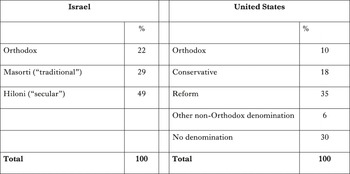
As a result of transformations in modern Judaism, only a minority of Jews today allow halakhah to regulate their daily lives outside of spiritual activity, family life, and diet. This is a dramatic change: from the rise of Rabbinical Judaism in the early first millennium ce onward, observance of sacred law had been a defining feature of Jewish identity. An initial step away from halakhic observance came with the Haskalah (Jewish Enlightenment) of the late 18th and 19th centuries. The Haskalah, together with Jewish Emancipation, led to the inception of the Reform movement in Judaism in 19th-century Europe. Reformers advocated changes such as relaxation or elimination of kashrut (Jewish dietary laws), sidelining of kabbalah (Jewish mysticism), and a more relaxed congregational structure.
This spirit of change eventually gave rise to the Reform and Liberal movements worldwide, which incorporate no usury ban—or other formal regulation of marketplace activity—in their daily practice. Many members of Reform and Liberal congregations consider halakhah to be religious teaching rather than binding sacred law [Sherwin Reference Sherwin1990: 45; Kaplan Reference Kaplan2013: 9].
Jewish adults (18+) who identify as…
Source: Pew Research Center [Lipka Reference Lipka2016].
Notes: Israel survey conducted 2014-2015, US survey 2013.
Together, Israel and the United States account for 83% of the global Jewish population. Footnote 19

The heter iska in 19th- and 20th-century Judaism
Orthodox Jews, however, retain the belief that halakhah is a divine system and its observance central to Jewish life. The practice of heter iska also persists today among certain Orthodox Jews. Indeed, it is widespread enough to arguably constitute a form of “Jewish finance.”
Some rabbinical scholars of the 19th and 20th centuries sought to make the heter iska amenable to modern banking. They developed the general heter iska (heter iska klali), which applied to entire banks, under the logic that anyone who walks into a financial institution agrees to abide by its terms and conditions [Leiner Reference Leiner2003]. Today, banks in Israel operate with a rabbinically authorized general heter iska, sometimes displayed on the wall. This drastically reduces the cost and time associated with halakhic compliance. Israeli banks also offer standardized heter iska documentation for different types of transactions, including credit purchases, prepayment discounts, commodity trading, and the sale of debt [Reisman 407-424].
The heter iska is primarily a matter of concern within Israel, because the Jewish usury ban applies only when both the lender and borrower are Jewish. However, it also appears in the United States. In 2011, the Lakewood, New Jersey branch of First Commerce Bank—which has two rabbis on its board—inserted a heter iska into the bank’s charter [Schneider Reference Schneider2011]. Footnote 20
While the Jewish usury ban is now circumvented using paperwork, it nonetheless represents an ongoing belief in the relevance of rabbinical jurisprudence to financial life. It is a symbolic link between religion and the economy.
Masorti and Conservative Jews adopt a middle path between Reform and Orthodox Judaism [Cohen Reference Cohen2012]. Their rabbis generally treat halakhah as a binding ritual and ethical code, but one sometimes subject to development and flexible interpretation [Neusner Reference Neusner1993: 266]. In the United States, the Conservative movement has achieved an extreme halakhic solution to the problem of usury while still technically banning it. The movement’s leading halakhic authority Footnote 21 ruled in 1988 that a “constructive heter iska” operates in all lending transactions between Jews anywhere [Homolka Reference Homolka2009: 266]. No documents need be signed. We see here the evolutionary limit-point of a usury ban: one so accommodating it is invisible.
Christianity
Birth
Abstract norms and unsystematic edicts: usury in Christianity’s first millennium
The New Testament shows little interest in interest. The term “usury” (τóκος) appears only twice in the New Testament. These passages [Matthew 25: 27 and Luke 19: 23] summarize the Parable of the Talents and do not focus on financial ethics. The Sermon on the Mount [Luke 6: 35] says merely “Lend, hoping for nothing in return.”
So must Christians adhere to Jewish law? Again, the New Testament is ambivalent [Brundage Reference Brundage1995: 5]. Jesus says he has not come to abolish the Law, but to fulfill it [Matthew 5: 17-20]; yet he criticizes the Jewish scribes and Pharisees—precursors of the rabbinical jurists—for meticulously tithing even their kitchen herbs while neglecting “justice, mercy, and faith” [Matthew 23: 23-29]. Paul, especially in Romans, stresses salvation through faith in the gospel of Jesus, not through the law [Romans 3: 25; 5: 11]. Yet what exactly Paul meant by “law” is controversial. Contrary to the traditionally dominant view that Paul was castigating rabbinic legalism, the “new perspective on Paul” notes Paul’s concern with moral behavior prescribed by the Jewish scriptures. Footnote 22
Given this ambiguity, the Church Fathers could take a strong anti-usury stance [Maloney Reference Maloney1973]. They were influenced by the usury ban of the Jewish scriptures and by contemporaries who opposed usury, but also by Greek, Roman, and Jewish philosophers. The Hellenistic Jewish philosopher Philo of Alexandria (20 bce-50 ce), for example, castigates the usurer of money and food as having “a slavish and utterly illiberal soul transformed into savagery and the nature of wild beasts” [On the Virtues XIV: 86-87]. Philo’s arguments reappear in the writings of Clement (r. 88-99), Basil (329/330-379), and Ambrose (340-397) [Moser Reference Moser2000: 30]. Clement decries usury as a contravention of brotherly love [Stromata 2.18.4, ANF]; Cyril (ca. 313-386) condemns witchcraft, necromancy, and licentiousness in the same breath as usury [Catechical Lectures 4.37, NPNF 2 ]. Yet despite the moral condemnation, the early Church took a long time to ban usury outright for lay believers. Leo the Great (r. 440-461) called usury “the death of the soul” and banned priests from dealing in it, but only declared lay usurers guilty of shameful gain (turpe lucrum) [Sermons 17.3, NPNF 2 ].
Thus a systematic theory of usury failed to develop during Christianity’s first millennium. Christian literature condemned usury morally, but lacked abstract concepts and rules for determining the legality of individual cases—and in primarily agrarian economies, few such cases arose. For most of the first Christian millennium, usury remained a sin of avarice, a failure of charity, and contravention of holy writ.
Life
Gratian’s Decretum, the rise of the universities, and the professionalization of canon law
The late medieval era presents a paradox. It was in the 12th and 13th centuries—the age of guilds, trade fairs, and urban growth—that European commerce expanded and demand for credit grew [Lopez Reference Lopez1976: 70-73; Greif Reference Greif1994; Kindleberger Reference Kindleberger2006: 23, 39]. We might expect the Church to have loosened its usury ban. Instead, the ban grew more rigorous and all-encompassing. A complex Christian theory of usury appeared. I argue that this paradoxical outcome depended heavily on the emerging stratum of jurists, who systematized canon law and developed scholastic jurisprudence.
The work most responsible for establishing Christian jurisprudence as a systematic formal science was the Decretum (ca. 1130-ca. 1150) Footnote 23 of Gratian, a Bolognese monk and early Scholastic who became the “father of the science of canon law” [Kuttner Reference Kuttner1941; Noonan Reference Noonan1979; Winroth Reference Winroth2013; Pennington Reference Pennington2014]. The Decretum made several leaps forward relative to the collections that preceded it. First, it not only compiled canon law more exhaustively than any predecessor, but it also applied a more rational system to the jumble of papal decretals and Church Fathers’ writings [Kuttner Reference Kuttner1941: 4-5]. It put these prior sources in debate, highlighting contradictions and resolving them dialectically, deriving abstract principles and juridical concepts from past law [Southern Reference Southern1995: 288–292]. Until Gratian, the history of canon law had primarily been a history of unsystematic collections [Rolker Reference Rolker2010: 59], and while some were formidable, such as those of Burchard of Worms and Ivo of Chartres, none had the rigor and scope of Gratian’s tome [Helmholz Reference Helmholz2010: 2-5]. Second, Gratian integrated Roman law, especially in the form of Justinian’s Corpus Iuris Civilis—already influential in the civilian courts of Italy—more solidly into Christian jurisprudence [ibid.: 17-20]. Third, Gratian and his contemporaries took steps to separate the study of canon law from theology [Brundage Reference Brundage2008: 92, 130, 155]. Fourth, significantly for our story, Gratian prioritized usury as a special topic more than his predecessors [Noonan Reference Noonan1957: 17-19].
Thanks to Gratian and the revival of Roman law, canonical jurisprudence professionalized in a context of economic and administrative expansion. Lawyering as a profession had ceased to exist after the decline of Rome, from around the 5th century ce to the 11th [Brundage Reference Brundage2008: 52-91]. However, well-trained legal thinkers began pooling in centers of European learning, and a new stratum of both civilian and canon lawyers appeared [Brundage Reference Brundage1995: 153]. The juristic profession blossomed in the 12th and 13th centuries in the new universities, including Bologna, Paris, Oxford, and Cambridge. By the 13th century, the Church was also expanding into “a vast administrative machine which needed lawyers to run it,” and canon law now “bristled with technicalities” [ibid.: 153]. An educated canonist therefore had strong career prospects [Haskins Reference Haskins2002: 50]. As a medieval poem quipped, Sic heredes Gratiani/Student fieri decani,/Abbates, pontifices [Hauréau Reference Hauréau1891: 39]. Footnote 24 Indeed, bishops had to know canon law to handle international diplomacy and the lawsuits in which the Church was increasingly embroiled.
Demographic factors also spurred Christian economic jurisprudence [Cotts Reference Cotts2012: 80-106; Hohenberg and Lees Reference Hohenberg and Hollen Lees1995: 22-73]. From the late 11th century, improved agricultural techniques supported urban population growth across Western Europe. Merchants and artisans became more numerous and engaged in increasingly complex commercial transactions [Haskins Reference Haskins1957].
The war on usury
These transformations of the 12th and 13th centuries all triggered what the 21st-century observer might call a “war on usury,” comparable to today’s morally charged, institutionally backed “wars” on drugs and terror. As incipient capitalism bubbled in Europe’s towns, the Church began pursuing usurers with gusto. Around 1150, its penalty for usury increased from denial of communion to exclusion from all church services. Because the Church was at the center of social life, exclusion meant pariah status. In 1179, the Third Lateran Council deemed that any cleric “who gives […] Christian burial” to “notorious” (open and well-known) usurers would be suspended from office [Third Lateran Council c. 25]. This penalty was raised to excommunication at the 1207 Council of Paris. In 1311, Church prosecutors were empowered still further: businessmen accused of usury had to turn over their account books to the ecclesiastical courts [Tan Reference Tan2002: 190]. These innovations in canon law were the rico Acts of their day.
The war on usury was manifested not only in laws, but in moral diatribes and gory imagery. The usurer was a sinner of the worst ilk: greedy, lazy for making money without doing work, and a thief not only of wealth, but of “the time which belongs to God,” as English theologian Thomas of Chobham wrote [de Chobham Reference De Chobham1968 (ca. 1216): 505]. When one dying usurer sought to give away his grain to the poor, the wheat turned into snakes that devoured his body [de Borbone Reference De Borbone and de la Marche1877 [d. 1256]: 368]. For usury was condemned secundum se—an act evil in itself, like blasphemy, prostitution, incest, and sodomy. No circumstance could excuse or justify it [Le Goff Reference Le Goff1988: 50-52].
The medieval concept of interest: making a lender whole
During the late medieval period, the Christian usury ban reached new intellectual and technical heights, leading paradoxically to both stringency and accommodation. The formalization of canon law, the professionalization of Christian jurists, and expanded Church regulation of social life increased jurists’ scrutiny of usury. But this attention to technical detail, against the backdrop of a growing money economy—one in which the Church itself was deeply involved—caused Christian economic theory to evolve toward ever-greater accommodation of capitalist activity. From 1200 to 1500, Church policy tightened against “manifest usurers”: professional moneylenders, pawnbrokers, and others who flouted the usury ban by lending at high interest rates [Noonan Reference Noonan1957]. Yet at the same time, technical justifications for morally and legally acceptable “interest” increased. The new academic freedom of the university also provided an ivory tower in which jurists could theorize and intellectualize these justifications.
Central to the developing economic theory was the idea of interest. Interest, as conceived during the classical and medieval periods, was the making-whole of a lender by compensating her for financial injury. “Interest” stems from id quod interest: in Roman law, “that which I have lost and would have gained,” referring to damages owed because of the nonfulfillment of a contractual obligation [Zimmermann Reference Zimmermann1996: 824-833; Matthews Reference Matthews1921]. When a Roman judge condemned a defendant in quod actoris interest, “the judge had to estimate the claimant’s losses and his material situation which would have resulted if the fact for which the defendant was liable had not occurred” [Berger Reference Berger1953]. Likewise, among 12th-century scholastics, interesse referred to compensation for the party injured by another’s failure to live up to contractual obligations. No less than the patron saint of lawyers—Raymond of Peñafort (ca. 1175-1275)—wrote that “interesse is not gain, but the avoidance of loss” [Summa de casibus poenitentiae 2.7.2]. Footnote 25
The Church’s usury policy went in two directions at once. Penalties for manifest usurers grew even harsher. Yet “extrinsic titles”—justifications for interest—expanded. By the late Middle Ages, the Church regularly approved interest rates of 10-15% per annum.
Common medieval extrinsic titles included the following [Noonan Reference Noonan1957: 100-132]:
Poena conventionalis (“penalty by agreement”) was a penalty for late payment, usually a percentage of the principal. Footnote 26 It applied when repayment was delayed past the due date by a predetermined period—much like a modern credit card.
Damnum emergens (“emergent loss”) referred to atypical losses the lender suffered that arose from the loan itself. For example, a default by the borrower might force the lender to incur the cost of taking out a loan of his own.
Lucrum cessans (“cessant gain”) occurred when a lender, because of a borrower’s late payment or default, missed an opportunity to invest profitably elsewhere. The borrower incurred a previously stipulated penalty.
Periculum sortis (“lot risk”) arose when the lender acted as insurer of capital during a risky venture. The lender agreed not to hold the borrower responsible for the lost capital if the venture failed.
Death
Luther: “I shit on the law of the jurists”
The Protestant Reformation gave rise to divergent stances toward usury. At first, the stormy Martin Luther (1483-1546) condemned usury as “the greatest plague of the German nation” [Oberman Reference Oberman2006: 78]. Luther combined reforming zeal with an initial desire to purge Christianity of jurists (canonists), whom he saw as corrupt, sophistic wordsmiths secreting a cancerous legal formalism:
The canonists… are right chimeras; in the face resembling a fair virgin, the body being like a lion, and the tail like a snake [Luther 1857, “Of God’s word”: §37].
Every jurist is an enemy of Christ.
A jurist should not speak until he hears a pig fart [for only then will his words have a proper climate to be appreciated].
I shit on the law of the emperor, and of the pope, and on the law of the jurists as well [Witte Reference Witte2002: 119].
Luther wanted to strengthen and simplify the ban on usury by returning to first Christian principles of brotherly love and charity. At first, he despised the jurists’ scholasticism. He was also embroiled in disputes with the University of Wittenberg’s law faculty, symptomatic of the centuries-old rivalry between teachers of law and of theology [ibid.: 119].
Yet Luther changed his stance. Until the German Peasants’ War of 1524-1525, he was a populist firebrand, condemning usury. He called the Zinskauf land rents, then a popular circumvention of the usury ban, “the greatest misfortune of the German nation,” invented by the devil and confirmed by the pope [The Christian in Society (I), 44:213]. But after the Peasants’ War and the rise of the left-wing reformers (including the Anabaptists—socialists before their time Footnote 27 ), Luther transitioned from revolutionary to a political leader responsible for social order [Oberman Reference Oberman2006: 205-206]. He tempered his hard line on usury and accepted 5% interest rates in his later years [Nelson Reference Nelson1949: 29-56].
Calvin: opening the door to low interest rates
John Calvin (1509-1564), more than any other figure, helped replace the medieval view of usury with a modern one. “There is no scriptural passage that totally bans all usury,” he wrote in 1545 [Calvin Reference Calvin1991 [1545]: 139]. Putting Deuteronomy in historical context, he permitted usury at low rates so long as it did not harm the borrower:
The situation in which God brought the Jews together… made commerce without usury apt among them. Our situation is quite different. For that reason, I am unwilling to condemn [usury], so long as it is practiced with equity and charity [ibid.: 139].
Calvin also appealed to the ideas of money as capital and of labor as a source of value. “It is lawful to make money by renting a piece of ground, yet unlawful to make it from money? What?” He skewered Ambrose and Chrysostom for believing that usury is money begetting money. “Even children can see […] that if you lock your money in a chest, it will not increase.” Rather, “merchants increase their wealth […] by being industrious… the gain is not from the money but from profit” [ibid.: 141].
Calvin’s reinterpretation of usury was doubly powerful because he simultaneously disrupted the longstanding Christian view that success in commerce was antithetical to piety. Instead, it was a sign of grace [Weber Reference Weber2002 (1905); Troeltsch Reference Troeltsch1958; Tawney Reference Tawney1963 (1926); Bieler Reference Bieler1964].
Calvinism hastened the dissipation of the usury ban in Protestantism, and in the West more broadly, because it justified an individualistic view of economic behavior. Although early Calvinism was strongly communalist, the Calvinism of the late 17th and early 18th centuries—on which Weber focuses in The Protestant Ethic and the Spirit of Capitalism [2002 (1905)]—emphasized the rational pursuit of profit as a deeply personal ascetic endeavor. Calvinist individualism set the stage for homo economicus, a rational, self-interested, atomistic market agent. Homo economicus keeps his religion separate from his financial transactions.
The changing role of jurists in Protestantism
Chaos reigned in the 1540s as the lack of clear laws in Protestant lands led to an increase in robbery, prostitution, and indeed usury. Needing a framework for political control, the Lutherans revived religious jurisprudence.
Yet when jurists returned to Lutheranism, they did so as lawmakers whose main goal was to safeguard order and ascetic morality. Protestantism stripped away the notion that adherence to sacred law was in itself part of the path to salvation. Rather, the job of Protestant jurists was to ensure that believers could focus on living a moral, Christian life. Footnote 28 Eventually, Protestant lawgivers gave way to secular judicial apparatuses.
In Eastern Christendom, a tighter integration between church, state, and merchant class restricts the usury ban to the clergy
In late medieval and early modern Eastern Christianity, debates over usury were “less heated, less acute, and certainly less universally negative” than in the Latin West [Laiou Reference Laiou2003: 210]. Medieval Byzantine canon law generally imposed the usury ban on clergy only; lay believers were free to lend and borrow at interest so long as they adhered to civil law maximums [Laiou Reference Laiou2002: 1140-1141]. Footnote 29 Why were Eastern Christian jurists less critical of usury than Western ones? Buss [Reference Buss1989: 255], following Weber, attributes this to Eastern Orthodoxy’s “indifference to the world,” which meant “few ethical barriers were set up against widespread usury.” Making a less sweeping claim, I would suggest that state, church, and the merchant class were on balance more tightly integrated in medieval Eastern Orthodox lands than in the Latin West. From the 4th century, the Byzantine state exercised significant control over ecclesiastical authorities, and from circa 1000 ce, it invested heavily in long-distance trade [Geanakoplos Reference Geanakoplos1965; Haldon Reference Haldon and Haldon2009: 201 ff.]. Meanwhile, late medieval Eastern Orthodox monasteries such as Chilandar Footnote 30 in Serbia lent money, took deposits, and even financed long-distance wine exports, all with state sanction [Talbot Reference Talbot and Haldon2009: 270-273].
Roman Catholic usury doctrine and Roman Catholic jurists, 1600–1900: fading into obscurity together
The Roman Catholic usury ban persisted well past the Reformation—and then died a slow death. By the early 17th century, Roman Catholic canonists begin to acknowledge that lenders would usually demand interest [Noonan Reference Noonan1957: 347]. A modern understanding of the time value of money also crept into Catholic thought: the Flemish Jesuit Leonardus Lessius (1554-1623) argued that the lack of one’s money was a sacrifice deserving compensation [ibid.: 349], observing without opprobrium that exchange bankers at the Antwerp Bourse “value more the lack of their money for five months than the lack of it for four” [351]. In the first half of the 18th century, popes sometimes reasserted the traditional line banning usury, but as the money economy grew and governments regularly issued bonds, more Catholic thinkers, such as Dutch Jansenist Nicholas Broedersen, felt “moderate profit on loans to businessmen or rich men” was acceptable [357]. Then, in 1745, Benedict XIV’s encyclical Vix pervenit opened the door for a blanket accommodation not unlike the Jewish heter iska klali. While confirming usury’s sinfulness, the pontiff acknowledged that “entirely just and legitimate reasons arise to demand something over and above the amount due on the contract” [Vix Pervenit, §3]. Catholics could now lend and borrow at interest in good conscience.
Over the same period, Catholic jurists descended from the heights of power. In the late Middle Ages, the Church’s massive scale had demanded a legalistic bureaucracy. Effectively, “the medieval church was a state” [Maitland Reference Maitland1898: 100]. Cardinals, archbishops, and popes were often canonists [Brundage Reference Brundage1995: 181-182]. The expansion of the modern state, however, steadily displaced Church bureaucracy and diminished the canonists’ prominence. Canonists focused increasingly on internal Church affairs such as ordination, the censure of wayward priests, and marriage annulments. Canon lawyering as a professional identity became less visible, merging largely into the priesthood. Today, four out of five canon lawyers are also priests [Peters Reference Peters1991].
Islam
Birth
Usury in the sacred sources: clearly condemned but ambiguously defined
God’s prohibition of usury (ribā) is “the moral axis around which the economic thought of Islam revolves” [Ramadan Reference Ramadan2004: 188]. The term refers to unlawful increase from an exchange via excess or delay. Footnote 31 The Quran’s ban on usury is explicit: Footnote 32
Those who devour usury will not stand except as stand one whom the Evil one by his touch Hath driven to madness.
Allah hath permitted trade and forbidden usury (2:275, trans. Yusuf Ali).
Usurers who knowingly repeat their offense will live forever in hellfire (2: 275).
God and His messenger, the Prophet Muhammad, will bring war upon those who do not cease dealing in usury (2: 278-279).
The ḥadīth literature Footnote 33 is the second sacred source for Islamic law after the Quran, and while it gives examples of usury, it does not elaborate a clear economic theory. Over 100 canonical ḥadīth refer to usury. Footnote 34 According to one, the Prophet noted that there are 70 types of usury, of which the least egregious is more sinful than fornicating with one’s mother [Sunan Ibn Mājah 12: 2360]. In other ḥadīths, the Prophet discusses transactions involving gold, wheat, dates, camels, and other goods: some are usurious, others lawful. He declares anyone involved with usury cursed: not only the lender, but also the borrower and even witnesses and recorders of usurious transactions [Ṣaḥīḥ Muslim 1598 (22/132); Sunan al-Nasāʼī 5105 (48/66); Sunan Abī Dā’ūd 3333 (23/8); Jāmi‘ al-Tirmidhī 1206 (14/3)].
All this is far more detail than we find in the Pentateuch and the New Testament—yet it leaves many questions open. Muhammad’s companion and second successor ‘Umar allegedly rued that the Prophet died before explaining usury fully [Sunan ibn Mājah 12/2362]. Contestation over usury’s precise meaning began in the 7th century ce, shortly after Muhammad’s death, and has continued through the history of Islam.
Does all interest count as usury?
Scholars of Islamic law distinguish two types of usury: surplus usury (ribā al-faḍl, literally “usury of excess”) and credit usury (ribā al-nasī’ah, literally “usury of deferment” or “usury of delay”). Although surplus usury is an important topic in Islamic finance, I focus on credit usury, which occurs when two amounts of money or other usurious substance Footnote 35 are exchanged: one immediately and the other with a delay.
As we saw in the Christian case with Calvin, the question of whether all non-zero interest counts as usury is of utmost practical importance. If the answer is yes, jurists can formulate a sophisticated religious finance, embracing various means of avoiding or accommodating interest. If no, the door opens for the pious to accept interest, as Protestants did, and interest eventually ceases to be a religious concern.
For all of Islamic history, a majority of Islamic jurists have considered all non-zero interest to be usury. For example, one contemporary jurist equates modern bank interest with the pre-modern credit usury that the sacred texts ban:
An example [of credit usury] […] is one’s buying a sa’ of wheat in the winter for one and a half sa’s to be paid in the summer; in this scenario, the extra half sa’, which is an increase in the cost, has no counter-value, but is only set against the delay of the debt’s collection…
[…]
The process of today’s banks, in which money is lent on credit, with annual or monthly interest rates of 7, 5, or 2.5 percent, is likewise the forbidden and unjust consumption of people’s wealth [Al Zuhayli Reference Al Zuhayli and Thomas2006: 34-35].
This position is typical of the classical and contemporary orthodoxy, which unequivocally declares ordinary bank interest to be usury [Khalil Reference Khalil and Thomas2006: 55].
But through Islamic history, a minority of jurists have said that Islam bans only certain forms of interest. They point to a practice allegedly once common in Arabia: when a debt matured, the borrower could either pay the full principal (and no interest) now, or increase the principal and pay later [Saleh Reference Saleh1986: 13, 27; Rodinson Reference Rodinson1974: 14; Saeed Reference Saeed1996: 23]. This is called pre-Islamic usury (ribā al-jāhilīyah). Supposedly, the lender sometimes doubled the principal—a brutal practice indeed. The debt could multiply until the borrower found himself enslaved [Warde Reference Warde2010: 53]. So, just as Calvin historicized Deuteronomy, a minority of Islamic jurists historicize the Quran’s usury ban, arguing that it refers specifically to the egregious practice of pre-Islamic usury, not to all interest. Footnote 36
Life
Usury in the real world: widespread and hard to punish
Sometimes, Muslims simply ignored the interest ban and dealt openly in interest. Rodinson finds evidence of this across the Islamic world well before the introduction of western banking: in 9th-century Basrah, for example, a hub of early Islamic civilization; and in 11th- and 12th-century Tunisia among financiers, moneychangers, butchers, and commodity wholesalers [Rodinson Reference Rodinson1974: 39]. In 17th-century Kayseri, Ottoman court records show Muslims regularly paid and received interest—“not just the people of the bazaars but the rural agas, the Ottoman military class, and the ulema as well” [Jennings Reference Jennings1973: 169].
This raises a question. Usury brought hellfire and damnation in the hereafter, but what of earthly punishments? Curiously, there rarely seems to have been punishment beyond nullification of the usurious contract. “When a transaction involving illicit gain comes to court,” writes Gerber, “the only thing that actually happens is that the transaction is made void, and has no legal consequence” [Gerber Reference Gerber1999: 129]. Gerber’s observation addresses 17th- and 18th-century Ottoman legal practice, but its observation is typical. Across space and time, prosecution for usury was rare.
Alternatives to interest-based finance in medieval Islamic economies
Nonetheless, the psychological burden of sin was strong (and remains so). Early and medieval Islamic jurists devised contractual structures to avoid usury, and merchants adopted them.
Partnerships: One such contract was the equity partnership. Commercial partnerships were important around the medieval world, especially in long-distance trade. By the 10th century, partnership law—and commercial law in general—were strikingly advanced in the Islamic world [Kuran Reference Kuran2010: 48-62], both in the Middle East [Udovitch Reference Udovitch1970] and the trade circuits of the Indian Ocean.
Salam: Despite the usury ban, a few credit structures have always been universally sanctioned by Islamic jurists. In salam, a buyer pays in advance for future delivery of a product. A grain merchant, for example, can pay a farmer in the spring for grain to be delivered in the fall. The advance price can be less than the (indeterminate) future market price, meaning salam is essentially a form of credit, but one in which the return is unpredictable. Footnote 37 Salam, accepted by classical jurists on the grounds that the Prophet permitted it [Sunan Abī Dāwūd 3464 (24/49); Ṣaḥīḥ al-Bukhārī 2254, 2255 (35/15)], played an important part in financing agricultural and artisanal production for centuries [Doumani Reference Doumani2006; Cuno Reference Cuno2006; Johansen Reference Johansen2006]. Today, some Islamic financial institutions use salam to structure Islamic commodity derivatives [M. H. Kamali in conversation with the author, 2010; Kamali Reference Kamali2007] and short sales [Calder Reference Calder and Venardos2010].
Pawnbroking: Another alternative to borrowing at interest, at least on a small scale, is pawnbroking. An apparent reference to pawning appears in the Quran [2:282-283]. A ḥadīth attributed to ‘Ā’ishah, the Prophet Muhammad’s third wife, states that the Prophet pawned his iron armor [Ṣaḥīḥ al-Bukhārī 3.453]. Pawnbroking appears to have been relatively common in some Islamic societies, with many references to it in fatwas and books of fiqh over the centuries [Çağatay Reference Çağatay1970, 56]. Footnote 38
Loans secured by land: An older mode of financing common in rural areas of pre-colonial and colonial Islamic Southeast Asia involved the use of land as security. A landowner would pledge his land to a lender in exchange for a loan, and then get the land back when he repaid the debt. In Malaysia, this practice was known as jual janji, Footnote 39 and in Indonesia, hak gadai; Footnote 40 these were established practices in the adat (customary practice) of the Malay world.
Unfortunately, offering land as security did not protect villagers from financial predation. In jual janji, for example, the value at which the landowner temporarily “sold” his land to the moneylender was typically well below market value. As late as the 1980s, jual janji served as a guise for high-rate usury [Jomo Reference Jomo1977: 247, fn. 3].
Non-Muslim moneylenders: hardly a solution
Like Jews in medieval Christendom, some religious minorities in Islamicate lands specialized in moneylending. In the Subcontinent, this included the Bania and the Khatri; along the Swahili Coast and elsewhere in East Africa, as well as Southern Africa and West Africa, other Hindus and Jains—especially Gujaratis; and in Islamic Southeast Asia, the ethnic Chinese and the Chettiar.
Jews also participated in professional moneylending in Islamic lands. Jews were on the whole much better integrated into medieval Islamic societies and economies than they were into Christian ones. This was partly due to Islam’s more accommodating stance toward traders. These factors reinforced “the traversibility of boundaries between Jew and non-Jew” in the medieval Islamic world [Cohen Reference Cohen, Goodman, Cohen and Sorkin2002: 201].
However, most moneylenders in Islamicate societies were not Jewish, and most Jews in Islamicate societies were not moneylenders. Gerber writes:
It is generally assumed that during the Middle Ages and afterwards Jews everywhere were engaged in money-lending as their main occupation. However, this does not appear to have been the case in the Ottoman Empire [Gerber Reference Gerber1981: 100].
Goitein remarks acerbically that readers who assume “the Jews were the Rothschilds of the Islamic world” will be disappointed. Footnote 41
These accounts of non-Muslim moneylenders in Muslim lands suggest strongly that borrowing from non-Muslims was not a generalized, transhistorical solution to the problem of interest in Islam. We cannot attribute the long-term survival of the Islamic interest ban to moneylending by religious minorities.
Ḥiyal: legal stratagems and their ambiguous status among jurists
In addition to the aforementioned accommodations, double sales and other asset transfers constitute another means of circumvention [Ray Reference Ray1997]. These mirror the practices of medieval Christians and Jews. Many Islamic religious scholars considered such measures to be ḥiyal (stratagems)—legal devices that use lawful means to achieve prohibited ends.
Islamic jurists in the classical and medieval periods had mixed views about the permissibility of stratagems in general, and about efforts to circumvent the ban on usury in particular. Of the four major schools of Sunni jurisprudence, the Ḥanafī were most lenient toward stratagems [Schacht Reference Schacht1936; Ismail Reference Ismail2010]. Footnote 42 In the Shāfi‘ī and Mālikī schools, opinions have historically been mixed.
Medieval Arab commentators reported the use of the following types of stratagems—some of which are now widely used in Islamic finance, in similar or identical form, but some of which contemporary jurists deem unacceptable [Al-Zurqānī Reference Al-Zurqānī1978 (d. 1710); Cardahi Reference Cardahi1955: 532–534; al-Khurashī Reference Al-Khurashī1975 (d. 1689/1690); Ray Reference Ray1997: 58]. In the examples, “L” is effectively the “lender” and “B” the “borrower.”
Double sale: “L” sells “B” an object for $10,500 on deferred-payment terms, with the amount payable in three months. “B” immediately sells it back to “L” for $10,000 on spot-payment terms (i.e. cash due on the spot). Known as bay‘ al-‘īnah, this practice was widespread in Malaysian Islamic banking until recently.
Interest-free loan plus sale: “L” grants “B” an interest-free loan (known as a qarḍ ḥasan, which is legal) for $10,000, payable in three months. “L” also sells “B” an item of merely nominal value, such as a pen, for $500 as a substitute for interest.
Sale with agreement to repurchase: “B” owns an asset, such as a home. “B” sells the home to “L” for $10,000, but they agree that “B” will buy it back later for the same price. “B” continues to live in the home she just sold for three months, paying rent (totaling $500) to “L.” After three months, “L” sells the home back to “B” for $10,000 as stipulated.
Credit sale with markup: this arrangement can finance a purchase. “L,” acting as the agent of “B,” buys a car from the dealership for $10,000, with the agreement that “B” will buy the car from “L” three months later for $10,500. Known as murābaḥah, this is the most common contract in Islamic finance today.
Near-death and Revival
The jurists face threats
European colonial rule diminished the significance of the Islamic jurists as an independent, respected social group in the 19th and 20th centuries. In the Indian subcontinent, Islamic Southeast Asia, and across the African continent, British, French, and Dutch administrators imposed European legal codes and court systems. The space of secular law in public life expanded at the expense of Islamic law. Religious jurists’ bailiwick shrank mostly to matters of private law: marriage and divorce, dietary law, and sometimes inheritance and other small-scale economic affairs. Colonial authorities also curtailed the jurists’ role as transmitters of legal knowledge by enacting educational reforms, closing madrasahs, and reorienting curricula away from traditional Islamic studies [Hallaq Reference Hallaq2009: 355-499]. Footnote 43
Outside European-controlled lands, reform movements also weakened the ulama. Footnote 44 In the Ottoman Empire, for example, the Tanzimat reforms of 1839-1876 reorganized the civil and criminal code along French lines, introduced a European-style judiciary, and established European-style institutions of higher education and a ministry of education [Davison Reference Davison1963; Quataert Reference Quataert, İnalcık and Quataert1994].
The rise of Islamic modernism in the late 19th and early 20th centuries also threatened the jurists’ social standing. Unlike secularist reformers, Islamic modernists sought to retain the central role of religion in social life, but re-imagined it to accommodate Western-style education, civil rights, constitutional democracy, nationalism, and rational scientific inquiry [Kurzman Reference Kurzman and Kurzman2002]. Many Islamic modernists considered the “traditional” jurists to be a deadweight that held back Muslim progress. The Islamic modernists also provided a new model for how to be a Muslim intellectual [Moaddel Reference Moaddel2001].
Later, modernizing secularist rulers in the first half of the 20th century, such as Reza Shah and Atatürk, further diminished the power of the jurists by consolidating state control over the judiciary and often undermining the jurists’ traditional allies and patrons, the landowning classes and petty bourgeoisie [Moaddel Reference Moaddel1994: 136-140].
Yet the jurists and the interest ban survive
Nevertheless, the jurists survived. They worked as madrasah teachers, mosque preachers, judges, and legal advisors in Islamic courts handling personal law and small commercial matters. Moreover, colonial and reformist governments understood the jurists’ prestige and sought to bring them under the umbrella of state-controlled institutions. While this diminished the autonomy of the ulama in many cases, it also ensured their survival in the face of expanding state power.
In parallel to the decline of the jurists, the spread of Western-style banking in the Islamic world in the 19th and 20th centuries diminished adherence to the ban on interest. In haute finance, the interest ban had long been dead anyway.
Nonetheless, the interest ban survived among socially conservative fractions less integrated into the process of modernization. Western-style banking’s penetration was limited in rural areas. To the peasantry and urban poor, Western-style banking services were unavailable anyway. And even among the expanding urban middle classes, pious individuals often avoided Western-style banks, preferring to keep their savings at home or invested with family members or local businesses.
Petrodollars, Islamic revivalism, and modern finance: a new home for the jurists and the interest ban
In sum, the jurists and the Islamic ban on interest grew weaker in the 19th and 20th centuries—but never disappeared. They survived until the 1970s and 1980s, when oil revenues, Islamic revivalism, postcolonial developmentalism, and the growing influence of Saudi Arabia led to a resurgence of the classical jurists and reinvigoration of the usury ban via Islamic banking [Warde Reference Warde2010; Calder Reference Calder2014].
Conclusion
The main argument of this article is that a religious usury ban needs vigorous carriers—religious jurists—to survive. When religious jurists first emerge and cohere as a professional group, a systematic religious interest ban emerges. As long as jurists thrive, the interest ban survives. And when religious jurists lose their prestige and significance in society, the interest ban weakens and dies.
This argument is not necessarily at odds with prior hypotheses about the fate of religious usury bans. Instead, it focuses on one meso-level mechanism—the professionalization of the religious jurists. I have shown how jurists mediate between religion and the economy, allowing usury law to survive while making adjustments that accommodate expanding capitalist activity.
In each of the three Abrahamic religions, I have discussed the birth, life, and death or decline of both the profession of religious jurisprudence and a systematic usury ban. A brief review of findings across the three religions follows.
birth: In all three religions, systematic usury bans emerged shortly after the emergence and professionalization of religious jurists (See Figure 2).
Immediately after religious jurists appear and professionalize, systematic usury bans appear

In Judaism, rabbinical scholars cohered as a distinct social group during the age of the Tannaim, after the destruction of the Second Temple (70 ce). With the compilation of the Mishnah, a sophisticated, systematic usury law developed within about a century.
In Western Christianity, canonical jurisprudence was born with Gratian’s Decretum (ca. 1150). Between that time and the middle of the 14th century, systematic usury law developed quickly.
In Eastern Christianity, although systematic jurisprudence emerged at around the same time as in Western Christendom, it appears that religious jurists were not sufficiently autonomous from state power for a systematic usury ban to develop. However, this conclusion requires further research.
In Islam, religious jurists emerged as a distinct professional group (separate, notably, from judges) in the late 8th and early 9th centuries ce. Islamic jurisprudence, including a systematic and robust theory of usury law, developed shortly thereafter with the compilation of the canonical ḥadīth collections and the emergence of the major madhāhib.
life: In all three religions, the survival of the usury ban coincided with the survival of the jurists. In all three cases, non-zero interest rates became de facto acceptable—even to most religious authorities—by the 16th century if they were justified or disguised using religious law. Figure 3 lists some of the structures commonly used to disguise or replicate interest. There is much overlap among the three.
Medieval structures used to disguise or replicate interest

death (or near-death): In all three religions, reform movements and other major trends split or threatened to split the unity of religion and shook the respected status of religious jurists. The outcome of such events had decisive impact on the fate of the jurists and the fate of the usury ban.
In Orthodox Judaism, rabbinical scholarship and halakhah have continued to be important. The Jewish usury ban survives, albeit accommodated by the standardized modern heter iska contract.
In Western Christianity, the usury ban disappeared quickly among Protestants and slowly among Catholics. The Protestant Reformation of the 16th century dramatically shook the status of both religious jurists and the usury ban. Luther sought to retain the usury ban but eliminate juristic legalism—and failed quickly. In contrast, Calvin opened the door to limited usury. Among Roman Catholics, canonists continued to engage in vigorous usury scholarship through the 17th century, but by the 18th and 19th centuries, canon law had less and less to do with the lives of lay believers. The usury ban lingered as a part of Roman Catholic doctrine, almost completely ignored by the 19th century, and disappearing quietly in the 20th.
In Islam, the religious jurists managed to weather several major threats, including colonialism, the gradual étatization of jurisprudence in Ottoman lands, Islamic modernists who viewed them as a conservative deadweight, and modernizing secularists. However, modernizers allowed the ongoing application of shariah in personal law. Colonial administrators often considered the jurists a benign, antiquated presence, which may have helped classical Islamic jurisprudence sustain itself—without forcing it to adapt to 20th-century economic needs. Eventually, in the context of Islamic revival in the 1970s, a petrodollar boom, and economic modernization, an alliance between financial entrepreneurs and jurists re-invigorated the usury ban in modern Islamic finance.
Revisiting Weber, re-imagining tradition
It is impossible to discuss religious law and economic morality without revisiting Max Weber. So how can a comparative-historical sociology of religious usury law help reconstruct Weberian theory?
First, the evidence presented confirms Weber’s observation that economic forces and material incentives alone cannot explain the evolution of economic morality [Swedberg Reference Swedberg1998: 108]. Religious bans on usury were part of everyday morality among Jews, Christians, and Muslims for over a millennium. When those bans eroded, it was not merely because capitalists grew more powerful. Instead, it was due to constant interaction among material interests, status groups and professions, and reform movements. Because of this social complexity, the evolution of usury bans was unpredictable and sometimes discontinuous.
Second, given this, it is no small feat that Weber identified correctly certain potent transhistorical germ-seeds in the economic ethics of the world-religions that shaped the evolution of their usury policies. In Judaism, we find rabbinical accommodation to the trying conditions of “pariah capitalism”: different ethical norms governed commerce with gentiles and commerce among Jews [Weber Reference Weber, Roth and Wittich1978 [1922]: 824]. Yet even this division adapted to ensure the survival of the embattled community [Katz Reference Katz2000]. In Roman Catholicism, we find a tendency toward bureaucratic centralization, which ultimately led to the usury ban’s neglect and atrophy [Weber Reference Weber, Roth and Wittich1978 (1922): 562-563]. In Protestantism, we find a radical ethical rationalization toward the individual [Weber Reference Weber2002 (1905)], culminating in Calvin’s confining the usury ban to cases of selfishness and accepting the usefulness of interest in business [Weber Reference Weber, Roth and Wittich1978 [1922]: 588]. And in Islam, which lacked a monolithic legal authority, institutional decentralization made jurisprudence more flexible [ibid.: 821], protecting the interest ban. Finally, across all three faiths, the intellectual fecundity of pre-modern jurists in developing an accommodative usury theory supports Weber’s observation in his Sociology of Law that legal honoratiores, and eventually professionalized jurists, are crucial in the rationalization processes that eventually make law amenable to modern capitalism [775-864]. Indeed, the religious jurists’ explorations of usury were arguably an incarnation of economics avant la lettre, albeit one deliberately infused with religious conceptions of justice and nature [De Roover Reference De Roover1955; De Roover Reference De Roover1958; Ghazanfar and Islahi Reference Ghazanfar and Azim Islahi1990; Hosseini Reference Hosseini1995; Langholm Reference Langholm1998; Wood Reference Wood2002; Ohrenstein and Gordon Reference Ohrenstein and Gordon2009].
Where the usury story belies Weber is in his characterization of Islamic law as fundamentally incoherent and substantively irrational. While he acknowledges the intellectual importance of the Islamic jurists, Weber chooses to emphasize Islamic judges (qāḍīs) in order to foreground “kadi-justice” as an ideal-type of substantively irrational legal thought [Weber Reference Weber, Roth and Wittich1978 (1922): 823, 976; see Crone Reference Crone, Huff and Schluchter1999]. Where he does discuss the Islamic jurists, Weber still stresses their irrationality: their opinions, “like the opinions of oracles… are given without any statement of rational reasons” [Weber Reference Weber, Roth and Wittich1978 [1922]: 821]. This is simply incorrect: classical Islamic jurisprudence enshrined a robust methodology of legal reasoning (uṣūl al-fiqh)—a self-consciously rational science of deriving correct opinions, in which every Islamic jurist was (and still is) trained [Hallaq Reference Hallaq1997].
Moreover, Weber incorrectly portrays Islamic law after the classical age as allergic to change. He argues that Islamic jurists’ law became stagnant and rigid after the 13th and 14th centuries ce and grew too divorced from practical concerns to keep up with economic innovations [Weber Reference Weber, Roth and Wittich1978 (1922): 819-820]. In making this argument, Weber echoed the leading European Islamicists of his day, such as Snouck Hurgronje and Ignác Goldziher [Schluchter Reference Schluchter, Huff and Schluchter1999: 59]. Yet, as subsequent scholarship has shown, Islamic jurists’ law has in fact been neither stagnant nor disengaged from practical issues. It has been socially constructed and historically contingent, constantly evolving practical solutions to changing circumstances [Johansen Reference Johansen1999; Hallaq Reference Hallaq2005; Masud Reference Masud and Anwar2009].
In sum, my goal is to use Weber to update Weber. I hope to retain his longue durée comparative method; his broad epistemology integrating worldviews, institutions, and social structure; and his foregrounding of ethical rationalization processes and the intricate dance of clashing and decoupling value-orientations [Weber Reference Weber, Gerth and Wright Mills1946 [1915]; Weber Reference Weber, Gerth and Wright Mills1946 [1918-1919]; Bellah Reference Bellah1999; Brubaker Reference Brubaker1984; Habermas Reference Habermas, Passerin d’Entrèves and Benhabib1997; Parsons and Shils Reference Parsons and Shils2001; Schluchter Reference Schluchter1985]. What I propose to discard is Weber’s misunderstanding of Islamic law in its relation to markets—a misunderstanding stemming from the limitations of the European scholarship available to him, but also from his impulse to hold up Protestant Christianity as the flag-bearer of a modern ethical rationality.
One way to achieve this goal may be to jettison the very idea of modernity as an overcoming of its antithesis, tradition. Islamic jurists—like Jewish and Christian jurists—are indeed carriers of tradition. Yet it is a malleable, ever-changing discursive tradition they carry [Asad Reference Asad2009]. Their orthodoxy is not a static body of doctrine, clung to so as to avoid drowning under the rising tide of modern reason. As Talal Asad notes, it is Burke and Weber’s opposition of “tradition” and “reason” that is problematic here [ibid.: 22]. Rather, the jurists’ orthodoxy is a constantly contested “relationship of power to truth” [22], buffeted by struggles in the juristic field [Bourdieu Reference Bourdieu1977; Bourdieu 1990; see also Bourdieu Reference Bourdieu1987] and political, economic, and social forces beyond. In this tumultuous environment, the jurists turn to their texts and their hermeneutic methods as vehicles for spirited conversations across space and time about the correct formation of moral selves. They debate feverishly with the giants on whose shoulders they stand. They are “custodians of change” [Zaman Reference Zaman2010].
Acknowledgements
I thank for their valuable input the EJS board and anonymous reviewer, Nina Aron, Eliana Drescher, Nicole Eaton, Neil Fligstein, Marion Fourcade, Elise Herrala, Mike Levien, John Lie, Nitin Nainani, Alina Polyakova, Srdjan Smajić, Jim Wilcox, and Jakub Wrzesniewski.