INTRODUCTION
Understanding outcomes of children who experience brain injury as infants is complex, and requires balancing evidence of preserved skill with appreciation of increased neuropsychological and psychosocial challenges, particularly as the child develops (Anderson et al., Reference Anderson, Spencer-Smith, Leventer, Coleman, Anderson, Williams and Jacobs2009; Elbers, DeVeber, Pontigon, & Moharir, Reference Elbers, DeVeber, Pontigon and Moharir2013; Westmacott, Macgregor, Askalan, & Deveber, Reference Westmacott, Macgregor, Askalan and Deveber2009). Neuropsychological studies on early brain injury predominantly focus on deficit measurement and associated risks for negative outcome. Formal descriptions of resilience have gone unexplored, with little attention to parent experiences and understanding of their child’s outcome. Given the novelty of this topic, the current study used a mixed-method design to qualitatively examine parents’ definitions of resilience and the factors they believe optimized their child’s early outcome following neonatal brain injury. This was followed by a more traditional quantitative approach considering early developmental and mental health outcomes and their relation to salient biopsychosocial factors.
Among the largest medical groups with neonatal brain injury are hypoxic-ischemic encephalopathy (HIE, 1-8/1000 live births), and neonatal stroke (1/4000 live births; Kurinczuk, White-Koning, & Badawi, Reference Kurinczuk, White-Koning and Badawi2010; Lynch & Han, Reference Lynch and Han2005). Prior researchers documented much diversity in outcomes following these injuries, drawing attention to challenges across neuropsychological skills, as well as elevated mental health concerns (Marlow, Rose, Rands, & Draper, Reference Marlow, Rose, Rands and Draper2005; Max, Bruce, Keatley, & Delis, Reference Max, Bruce, Keatley and Delis2010; O’Keeffe et al., Reference O’Keeffe, Liégeois, Eve, Ganesan, King and Murphy2014; Williams et al., Reference Williams, McDonald, Roberts, Dlamini, deVeber and Westmacott2017). These studies, while noting deficits following early brain injury, highlighted resilience through the number of children without diagnoses or with test scores within normative ranges. To our knowledge, few studies in neonatal brain injury have specifically considered definitions of resilience, nor factors that promote optimal outcomes from this lens.
Operationally defining a resilient outcome is an important task in resilience research, necessitating a specific threshold and definition of success to determine which individuals are deemed resilient and which are not (Masten et al., Reference Masten, Hubbard, Gest, Tellegen, Garmezy and Ramirez1999; Rutter, Reference Rutter2006, Reference Rutter2012; Ungar, Reference Ungar2015). Seminal resilience research focused on the outcomes of children developing amid environmental adverse conditions such as socioeconomic disadvantage (Rutter, Reference Rutter1979), parent mental illness (Masten & Coatsworth, Reference Masten and Coatsworth1998), and maltreatment (Cicchetti, Rogosch, Lynch, & Holt, Reference Cicchetti, Rogosch, Lynch and Holt1993).
In prior work considering childhood medical adversity, resilience was defined as a lack of impairment or psychosocial issue, measured through a variety of neuropsychological tests and mental health ratings. For example, resilience in the context of low birth weight was defined as achieving age-appropriate language scores (Madigan, Wade, Plamondon, Browne, & Jenkins, Reference Madigan, Wade, Plamondon, Browne and Jenkins2014). Resilience among children with sickle cell disease was defined as an absence of depression and anxiety, that is, no symptom scores approaching or within clinical range (Simon, Barakat, Patterson, & Dampier, Reference Simon, Barakat, Patterson and Dampier2009). One study of preterm children took a multidimensional approach, defining resilience as achieving the highest levels of school performance, social and peer relationships, and lowest levels of mental health problems (Poehlmann, Gerstein, Burnson, Weymouth, & Bolt, Reference Poehlmann, Gerstein, Burnson, Weymouth and Bolt2015).
As described above, definitions of resilience often lack uniformity and are influenced by the lens of the researcher, the method of assessment, and thresholds for successful adaptation and adversity (Luthar, Cicchetti, & Becker, Reference Luthar, Cicchetti and Becker2000). An alternative approach is to define resilience considering the perceptions of the individual or family affected. In a qualitative review paper on resilience following stroke during adulthood, resilience was described as “post-traumatic growth,” “a greater appreciation of life,” and “unexpected discovery of personal strength” (de Lima et al., Reference de Lima, de Carvalho Viana, Mariano de Medeiros, Pessoa da Rocha Leal, Ferreira da Costa, Pereira Martins and de Freitas Macedo Costa2016). In another, resilience was defined by adult stroke survivors, caregivers and clinicians as “positive personal characteristics, personality traits or attitudes of the individual in relation to one’s recovery” (Sadler, Sarre, Tinker, Bhalla, & McKevitt, Reference Sadler, Sarre, Tinker, Bhalla and McKevitt2017).
There are many differences between adult and neonatal brain injury, including differing mechanisms and impact within the developing versus mature brain (Dennis, Reference Dennis2010; Dennis et al., Reference Dennis, Spiegler, Juranek, Bigler, Snead and Fletcher2013). For the neonate, premorbid status is unknown and a source of considerable quandary in understanding outcomes. As such, we propose that considering resilience from the perspective of the parent, using both qualitative and quantitative approaches, provides a unique and compelling way to inform our understanding of positive outcomes during the early years.
In the current study, we aligned our research objectives to consider resilience based on parents’ descriptions of “a relatively good outcome” according to historical resilience definitions—that is, a child having fewer difficulties than anticipated, despite the adversity of early brain injury that threatens their child’s well-being both acutely, as well as to their future development (Hilliard, McQuaid, Nabors, & Hood, Reference Hilliard, McQuaid, Nabors and Hood2014; Rutter, Reference Rutter2006, Reference Rutter2012; Ungar, Reference Ungar2015). Given the novelty of resilience work in this population, we purposefully chose this definition to complement objective measurement of substandard developmental and mental health achievement and to consider alternative ways this concept is defined in the early years by parents. This also accounts for the disability paradox where individuals describe a good outcome, such as having a positive quality of life, despite severe disability (Albrecht & Devlieger, Reference Albrecht and Devlieger1999) and allows exploration of the family’s narrative around clinical prognostication in the context of neonatal brain injury (Racine et al., Reference Racine, Bell, Farlow, Miller, Payot, Rasmussen and Wintermark2016). We acknowledge that subjective parent experiences influence these results, yet balance this with the importance of exploring parents’ perceptions of resilience beyond quantitative measurement alone. As such, we explored “resilience” and “at-risk” designations less as categories and more in terms of caregiver perceptions of promotive and protective processes as described in other qualitative resilience studies (Johannessen, Engedal & Thorsen, Reference Johannessen, Engedal and Thorsen2016; Nolan, Taketb, & Stagnitti, Reference Nolan, Taket and Stagnitti2014).
Many studies have examined predictors of individual differences in outcomes following neonatal brain injury (see reviews by Fuentes, Deotto, Desrocher, DeVeber, & Westmacott, Reference Fuentes, Deotto, Desrocher, DeVeber and Westmacott2014; Murias, Brooks, Kirton, & Iaria, Reference Murias, Brooks, Kirton and Iaria2014). One of the most consistent findings is the importance of considering the child’s age at the time of assessment, with increased challenges as the child “grows into deficits” as they mature (Anderson et al., Reference Anderson, Spencer-Smith, Leventer, Coleman, Anderson, Williams and Jacobs2009; Westmacott et al., Reference Westmacott, Macgregor, Askalan and Deveber2009). Findings regarding the influence of specific neurocharacteristics have been mixed but implicate the negative impact of larger lesions and those that involve subcortical (e.g., deep gray nuclei HIE pattern) or combined cortical-subcortical injuries to worse outcomes in early childhood (Hajek et al., Reference Hajek, Yeates, Anderson, Mackay, Greenham, Gomes and Lo2014; Miller et al., Reference Miller, Ferriero, Leonard, Piecuch, Glidden, Partridge and Barkovich2005; Rutherford et al., Reference Rutherford, Malamateniou, McGuinness, Allsop, Biarge and Counsell2010; Westmacott, Askalan, Macgregor, Anderson, & Deveber, Reference Westmacott, Askalan, Macgregor, Anderson and Deveber2010).
Environmental contributions from family and community support are well-established factors in understanding resilient outcomes in pediatric chronic illness and acquired brain injury (Compas & Boyer, Reference Compas and Boyer2001; Wade, Zhang, Yeates, Stancin, & Taylor, Reference Wade, Zhang, Yeates, Stancin and Taylor2016; Yeates et al., Reference Yeates, Bigler, Dennis, Gerhardt, Rubin, Stancin and Vannatta2007). There is growing attention to parents’ mental health and coping following early brain injury and its reciprocal relationship with childhood outcomes (Bemister, Brooks, Dyck, & Kirton, Reference Bemister, Brooks, Dyck and Kirton2014, Reference Bemister, Brooks, Dyck and Kirton2015; Heringhaus, Blom, & Wigert, Reference Heringhaus, Blom and Wigert2013). The influence of socioeconomic resources and other markers of social risk have an identified impact among children with early medical adversity and access to early intervention is highly relevant following neonatal injury (Greenham et al., Reference Greenham, Hearps, Gomes, Rinehart, Gonzalez, Gordon and Anderson2015; Kirton, Westmacott, & deVeber, Reference Kirton, Westmacott and deVeber2007; Miller et al., Reference Miller, Newton, Ferriero, Partridge, Glidden, Barnwell and Barkovich2002; Soufi, Chabrier, Bertoletti, Laporte, & Darteyre, Reference Soufi, Chabrier, Bertoletti, Laporte and Darteyre2017; Treyvaud et al., Reference Treyvaud, Doyle, Lee, Ure, Inder, Hunt and Anderson2016).
Objectives
Using a cross-sectional research cohort of parents of children with histories of neonatal brain injury, the objectives of this study were to: (1) qualitatively explore parents’ descriptions of their child’s resilience, and what they think has helped their child following neonatal brain injury, and (2) quantitatively examine children categorized as “resilient” and “at-risk” based on standardized measures of early mental health and developmental progress and their association with relevant biopsychosocial factors. For this objective, we hypothesized that severe brain injury and older child age would be associated with “at-risk” outcomes and that good parent mental health would be related to “resilient” developmental and mental health outcomes.
Method
Ethical approval was provided by the authors’ institutional research ethics board.
Participants
Inclusion/exclusion criteria
Inclusion criteria were parent or guardian of a child with: (a) diagnosis of HIE or neonatal stroke, (b) reliable neuroimaging (MRI) within the first 4 weeks following birth, (c) ≥35 weeks gestational age and, (d) children between the ages of 18 months of age and 8 years of age. Exclusion criteria were the presence of (a) additional or comorbid major disorders/anomalies of the brain (i.e., neurometabolic disorders, moyamoya disease, sickle cell disease, lissencephaly) or (b) additional or comorbid genetic condition associated with neurocognitive disability (e.g., trisomy 21, fragile X), and (c) parents’ inability to complete questionnaires in English at an approximately grade 5 literacy level.
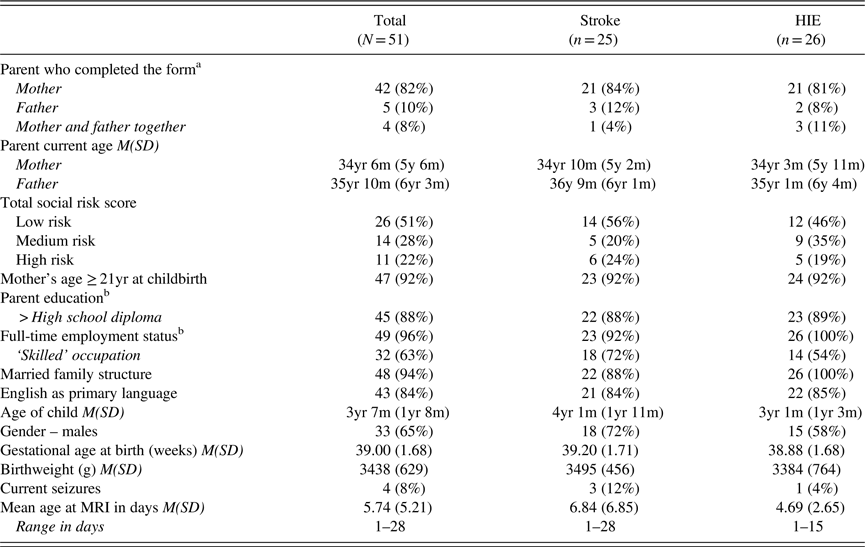
Over a 13-month recruitment phase (June 2017 to July 2018), 78 parents were eligible and invited to participate in the study. Of those, 16 parents declined interest, and 62 consented online and were emailed the questionnaire link. Of these, 51 (65%) parents completed the questionnaires of interest and were included in the final sample. There were no differences in diagnosis, age, or gender of the child between completers or non-completers. Demographics of the parents are summarized in Table 1 along with the child’s current age and neonatal characteristics. Children with history of HIE were younger than children with stroke (t(49)=2.13; p=.04; d=.61) at the time of the study. No other demographic factors differed between the two groups.
Family demographics

Note. The total social risk score is a composite score comprised of six aspects of social status coded as: family structure (0 – two caregivers (nuclear); 1 – separated parents with dual custody, or cared for by other intact family; 2 – single caregiver), education of primary caregiver (0 – tertiary educated; 1 – 11–12 years of formal schooling; 2 – less than 11 years of formal schooling), occupation of primary income earner (0 – skilled/professional; 1 – semiskilled; 2 – unskilled), employment status of primary income earner (0 – full-time employment; 1 – part-time employment; 2 – unemployed/pension), language spoken at home (0 – English only; 1 – some English; 2–no English) and maternal age at birth (0 – more than 21 years; 1 – 18–21 years; 2 – less than 18 years). A total social risk score was computed by summing across the six aspects of social status and then categorized by low social risk (0), medium social risk (1), or high social risk (2+).
a All parents were biological parents.
b Education and employment status were based on primary income earner.
Information about the child’s brain injury was obtained using clinical MRIs during the neonatal period (i.e., first month of life) and corresponding neuroradiology reports (see Table 1 for mean age at imaging). Pattern of HIE injury was confirmed by the study’s neonatal neurologist using standard ratings of typical patterns of HIE (Barkovich et al., Reference Barkovich, Hajnal, Vigneron, Sola, Partridge, Allen and Ferriero1998; Miller et al., Reference Miller, Ferriero, Leonard, Piecuch, Glidden, Partridge and Barkovich2005). Stroke lesions were coded based on previously published coding of characteristics and size, and confirmed by the study’s stroke neurologist (N.D.; Westmacott et al., Reference Westmacott, Askalan, Macgregor, Anderson and Deveber2010). Of the 26 children with HIE, 4 children had normal MRI post-cooling, 5 had a deep gray predominant pattern involving the deep gray nuclei and perirolandic cortex, with an additional 2 children who had this pattern which also extended to the total cortex. Fifteen children were coded with an injury pattern outside of the traditional deep gray/watershed HIE patterns. Seven were described as having focal-multifocal injury, five were described as diffuse white matter edema, and three were coded as “other” (i.e., interventricular or subdural hemorrhage). Twenty-two of the 26 children underwent therapeutic hypothermia. Of the children with stroke, 20 children had arterial ischemic stroke, 4 had cerebral sinovenous thrombosis, and 1 had an intracranial hemorrhage. The strokes were unilateral in 16 cases (6, left; 10, right) and bilateral in 9 cases. The strokes were restricted to cortical regions in 7 cases, subcortical in 5 cases, and encompassed both cortical and subcortical regions in 13 cases. One case had reported brainstem involvement. Fourteen children were coded with large lesions, 7 with medium, and 7 with small lesions.
Procedure
All families were currently being followed in the hospital’s neonatal neurology and/or stroke follow-up clinic, and were approached during clinic visits by the study research coordinator. Interested participants were then emailed consent forms using REDcap and, once consent was provided, parents were sent specific study questionnaires. All questionnaires were completed online using REDcap (Harris et al., Reference Harris, Taylor, Thielke, Payne, Gonzalez and Conde2009). Participants were compensated with a $10 gift certificate.
Measures
Parents’ descriptions of resilience and supporting factors
Parents’ experiences were measured using the Parent Experiences Questionnaire (PEQ), a descriptive 24-item questionnaire that includes open- and closed-ended questions about parent early experiences following neonatal brain injury (Williams et al., Reference Williams, McDonald, Roberts, Westmacott, Ahola Kohut, Dlamini and Miller2018). The questionnaire has good acceptability, online feasibility, stability, and association with current parental mental health and child development. For the purposes of the current study, the following questions were used to explore parents’ descriptions of resilience. First, parents were asked: “In relation to the clinician’s opinion at the time of diagnosis, how has your child done?”. There are initial forced-choice options of: (a) done as expected, (b) had more difficulties, and (c) had fewer difficulties, followed by an open text box. The open text responses of parents who indicated their child had fewer difficulties than expected were qualitatively explored for descriptions of the child’s outcome and parent perspectives on child resilience. To explore the factors parents attributed to their child’s positive outcome, they were asked additional open-ended questions: (1) “What do you think has helped your child through his/her recovery?” and (2) “Please specify what factors you believe are important in your child’s future outcome today”.
Quantitative Measurement of Resilience
Child’s early mental health
To assess the child’s early mental health, two forms of the Child Behavior Checklist (CBCL), were used: the preschool form (ages 1.5 through 5 years) and childhood form (ages 6 through 18 years) as reported by their parents (Achenbach & Ruffle, Reference Achenbach and Ruffle2000). The scales of internalizing and externalizing difficulties (T-scores; M=50; SD=10) were used, merging comparable T-scores across the different forms.
Developmental outcome of child
The Scales of Independent Behaviour Early Developmental Form (SIB-ED) was used to measure current functional independence and adaptive functioning of each child (Bruininks, Woodcock, Weatherman, & Hill, Reference Bruininks, Woodcock, Weatherman and Hill1984). There are 40 adaptive items yielding a total score, which is converted into age-standardized scores (M=100; SD=15).
Biopsychosocial Risk and Protective Factors
Brain injury characteristics
Pattern of injury was coded dichotomously for both groups according to patterns of injury with highest risk of early negative outcomes based on prior research (Barkovich et al., Reference Barkovich, Hajnal, Vigneron, Sola, Partridge, Allen and Ferriero1998; Miller et al., Reference Miller, Ferriero, Leonard, Piecuch, Glidden, Partridge and Barkovich2005; Westmacott et al., Reference Westmacott, Askalan, Macgregor, Anderson and Deveber2010). For HIE, this included children with injuries to basal ganglia/thalamus or a more diffuse pattern of injury. For neonatal stroke, this included combined cortical and subcortical lesions and/or stroke lesions categorized as large. Severity of injury did not differ by group or current age of the child.
Parental mental health
The Depression and Anxiety Stress Scale (DASS) was used to assess current parental depression and anxiety (Crawford & Henry, Reference Crawford and Henry2003). There are 42 items divided into three scales (depression, anxiety, and stress). For the purpose of this study, we included parents’ depression and anxiety mean ratings.
Parental coping
The Response to Stress Questionnaire (RSQ) was used to measure parent coping (Connor-Smith, Compas, Wadsworth, Thomsen, & Saltzman, Reference Connor-Smith, Compas, Wadsworth, Thomsen and Saltzman2000). The current study focused on primary and secondary control coping factors given their positive association with children’s adjustment in other medical populations (e.g., Compas et al., Reference Compas, Bemis, Gerhardt, Dunn, Rodriguez, Desjardins and Vannatta2015).
Demographics and social risk
A brief background questionnaire was given to parents to collect basic demographic information. The total social risk score is a composite score comprised of six aspects of social status (family structure, maternal age at birth, language spoken at home, education of primary caregiver, occupation of primary income earner, and parents’ employment status) each ranked as 0 (low risk), 1 (medium risk), or 2 (high risk). For descriptive purposes, the total social risk score was categorized by low social risk (total social risk score of 0), medium social risk (total social risk score of 1), or high social risk (total social risk score of 2+). For analytical purposes, each family was categorized as low social risk (total social risk score of 0 or 1) or high social risk (total social risk score of 2+). This study used classification methods similar to those applied in other follow-up studies of medically at-risk children (Roberts et al., Reference Roberts, Howard, Spittle, Brown, Anderson and Doyle2008; Treyvaud et al., Reference Treyvaud, Ure, Doyle, Lee, Rogers, Kidokoro and Anderson2013).
Access to early interventions
As part of the PEQ, parents were asked to indicate whether or not their child had engaged in any intervention. The most common therapies accessed included speech and language (45%), occupational (43%), infant development worker (42%), and physical therapy (33%). Participation in any early intervention was coded dichotomously (0/1) as per other studies on service usage (Mussatto et al., Reference Mussatto, Hollenbeck-Pringle, Trachtenberg, Sood, Sananes, Pike and Pemberton2017).
Analysis
Objective 1: Parents’ descriptions of resilience and supporting factors
To examine resilience from a qualitative perspective, the data were approached through the lens that various parent descriptions might reflect childhood resilience following early brain injury. Open-ended responses related to child resilience were extracted from the PEQ where the text was copied verbatim onto separate Microsoft Word documents and entered in the qualitative data management software for analysis (i.e., ATLAS.ti, version 7.5.6). A cross-case thematic analysis was used to examine patterns in the data (Braun & Clarke, Reference Braun and Clarke2006; Miles & Huberman, Reference Miles and Huberman1994).
Data were analyzed according to Braun and Clark’s six thematic analysis phases (Braun & Clarke, Reference Braun and Clarke2006). Based on two a priori overarching ideas for analysis, data were coded inclusively to ensure that context was preserved: (1) definitions of child resilience in the face of early brain injury, and (2) factors/processes parents believe contributed to child resilience. An initial set of codes was produced in a systematic manner following intense familiarization of the data. These codes were examined for overarching concepts, involving a deeper examination and organization of the codes into categories, sub-themes, and higher-level themes as needed. For example, in considering parent definitions of child resilience, one category was titled “My child can walk, run, and jump,” which was defined as “parents describing child’s resilience based on positive motor development without projected deficits,” and within this category, all parents’ responses about their child’s positive motor skill development were captured. This process was applied to all categories.
With respect to inter-rater reliability and the coding process, the second and third author coded five transcripts independently before creating the initial set of codes together (and after reviewing all transcripts). After discussion, the remaining interviews were coded separately before being carefully reviewed and double-coded as a team. Any disagreements were discussed to consensus.
Objective 2: Quantitative measurement of resilience
We created a dichotomous score to identify “resilient” and “at-risk” children. Children were identified as “at-risk” based on caregiver ratings indicating a concern about the child’s early developmental progress, as defined by a standard score <85 on the SIB-ED or a T score >60 on the CBCL Internalizing or Externalizing scale. To quantitatively examine resilience and potentially associated biopsychosocial factors, statistical analyses were performed using SPSS 23 (IBM SPSS Statistics for Windows, Version 23. Armonk, NY: IBM Corp USA). Preliminary descriptive statistics and within group profile analysis (HIE and stroke) were computed to consider pattern of injury specific characteristics with child outcome and predictor variables using one-way analyses of variance, chi square, and Fisher’s exact analyses for continuous and categorical data, respectively. Due to lack of group differences between stroke and HIE children on the mental health and developmental outcome measures, or any predictor variables other than age, these groups were collapsed for subsequent analyses.
Correlation analyses were computed to consider interrelationships among the biopsychosocial variables and CBCL and SIB-ED scores. Given the small sizes of the “resilient” and “at-risk” groups, differences in biopsychosocial variables (child’s age, injury severity, social risk, parent depression and anxiety, parent primary and secondary coping, receipt of early intervention) were considered using t tests and chi-square analyses. For all multiple comparisons, p values were adjusted using the false discovery rate criteria (Benjamini & Hochberg, Reference Benjamini and Hochberg1995) and appropriate effect sizes were provided.
RESULTS
Objective 1
Parents’ descriptions of resilience
Thirty-two parents (64% of sample) reported that their child had fewer difficulties than expected, 13 reported that their child had progressed as expected, and 5 parents reported that their child had more difficulties than expected. One parent did not respond to this question. Among the 13 parents who described their child “to do as expected,” six parents indicated that they were originally provided with an optimistic prognosis, that is, being told to “expect a normal child” or that the “damage appeared in areas that should not affect [their child].”
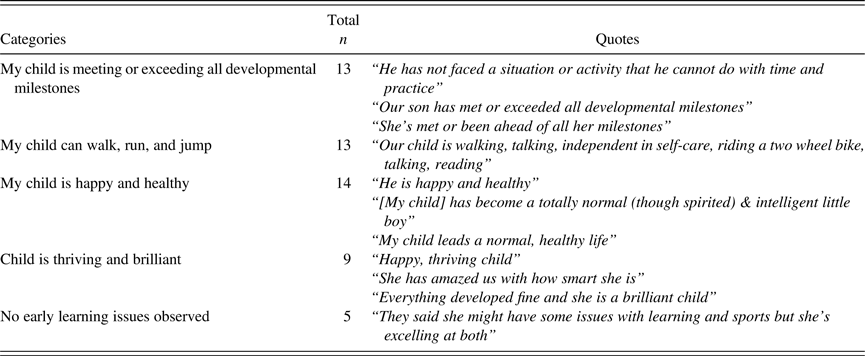
Among the parents who reported that their child had fewer difficulties than expected, as shown in Table 2, five unique categories of resilience descriptions were identified: that their child (1) had surprisingly met developmental milestones, (2) had unexpected good motor development, (3) was happy and healthy, (4) was thriving and especially brilliant, and (5) had no learning issues. For example, many parents commented on their child being able to meet or exceed milestones that they were told may be delayed, and many also specifically noted the child’s motor development as an indicator of success.
“We were told to expect the worst. The term “vegetative state” was used. Our child is [now] walking, talking, independent in self-care, riding a two-wheel bike, talking, reading...etc.”(Parent of a 6-year-old girl with history of HIE – total injury pattern)
Parents’ descriptions of early child resiliency following neonatal brain injury

Fourteen parents described their child’s good health and happiness regardless of his or her early adversity, contrasting it to their expectations and/or clinician prognosis around potential risk to their development. Nine parents gave global glowing descriptions of their child’s developmental and cognitive progress, using words such as “thriving,” “smart,” and “brilliant.” Finally, five parents indicated no signs of learning difficulties or delays.
“In our first discussion with the neonatologist, he said specifically he couldn’t give a prognosis, but it was possible our son wouldn’t walk, talk or go through regular education. . . . Currently he has no observable effects of the stroke.” (Parent of a 7-year-old boy, neonatal stroke)
Supporting factors following neonatal brain injury
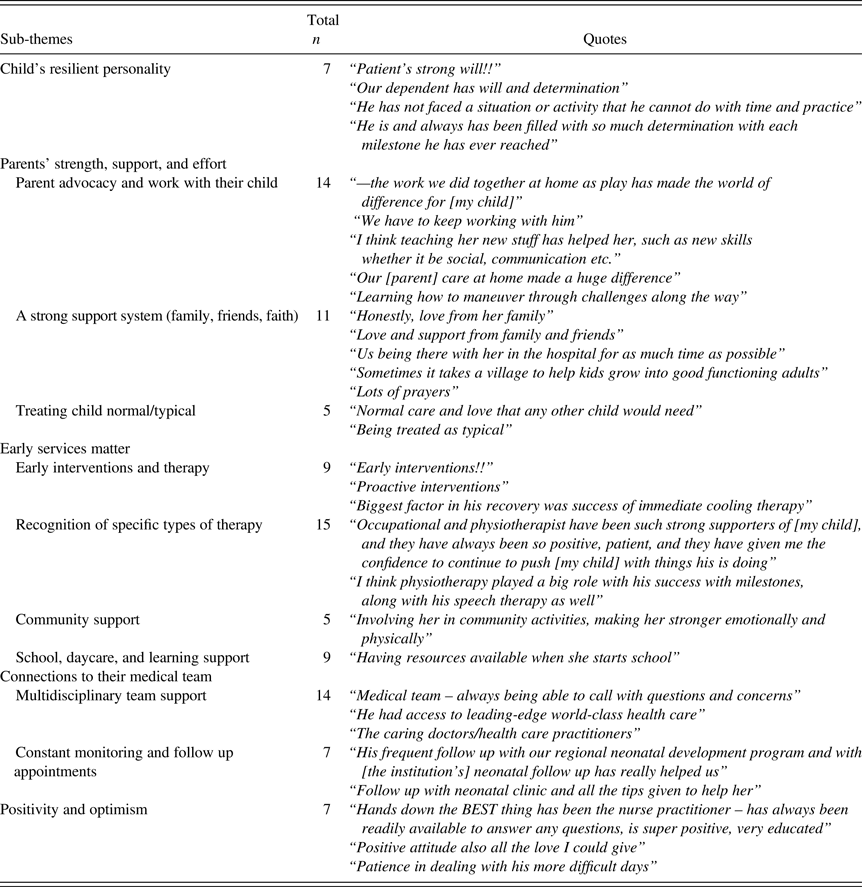
As outlined in Table 3, five sub-themes were identified based on parents’ responses to what they believed was important to their child’s outcome. Several parents made reference to nonspecific internal or personal factors of their child. Parents reflected on their own strength and support from their family and friends as essential to their child’s success. Parents also shared how their parenting approach (i.e., “treating their child as normal”) helped their child achieve their best possible outcome.
Factors parents attribute to their child’s resilience

Note. The total N across variables ranged from 47 to 49 due to missing data.
*p=.05.
**p=.01.
A consistent sub-theme reflected how parents valued early intervention and community engagement to their child’s positive outcome. Parents called attention to specific types of therapy and/or the specific support of their therapists. Several parents referenced general community involvement and engaging their child in social activities. For example, one parent of a 2-year-old girl with HIE history shared the importance of being “involved with many programs at the library, early years centers, music, gymnastics, and swimming lessons.” Parents also referenced specific care provided at school or in their child’s early education setting.
Many parents attributed the ongoing follow-up and expertise of their medical team as essential in helping their child do his or her best. Parents also specifically associated their child’s success to the high frequency of visits and the reassurance they provided. For example, a parent of a 2-year-old with neonatal stroke shared “[at the] last testing at 18 months, we were told there’s a great possibility there will be no repercussions of her stroke.”
The final sub-theme identified from parents’ responses reflected the importance of having optimism and a positive attitude for parents and clinicians. One parent of a 6-year-old with HIE history shared her own outlook and its contribution to her child’s outcome:
“Embrace the diagnosis but understand that it does not define the prognosis or the abilities of your child.”
Parents’ descriptions of resilience and standardized outcome scores
Children reported to be having less difficulties by their parents had similar SIB-ED scores (M =107.18; SD=22.04) to those doing as expected according to parents (M=114.46; SD=12.86) and both groups had higher scores than children described as having more difficulties than expected (M=66.00; SD=45.26), with marked variability in this group. There were no differences on CBCL internalizing and externalizing scores across the three groups. Additionally, there were no differences in age of the child by parents’ perception of their outcome. Given the small number of parents that indicated their child was not doing as well as expected, further statistical analyses were not appropriate.
Objective 2
Preliminary within-group profiles
Within the neonatal stroke group, the SIB-ED and CBCL internalizing and externalizing scores did not differ significantly by lesion location, laterality, or size. Within the HIE group, given small group sizes, pattern of injury was compared dichotomously to contrast children with any abnormalities on imaging to those with normal MRI imaging post cooling, and there were no differences. When comparing the entire sample by severity of neonatal injury on MRI, children coded as high severity had lower SIB-ED scores (M=95.11; SD=28.43) than children with low severity (M=112.50; SD=20.75), t(47)=2.47, p=.02, d=.61.
Correlations among biopsychosocial variables
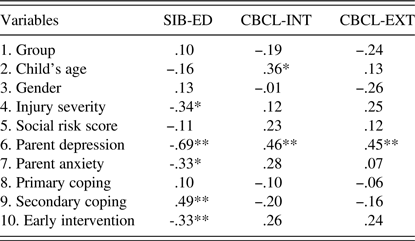
As shown in Table 4, lower SIB-ED scores were associated with severe brain injury, higher parent symptoms of depression and anxiety, receipt of early intervention, and lower parent secondary coping style ratings. CBCL-internalizing and externalizing scores were positively associated with parent depression. Older children were more likely to have higher internalizing scores. No other variables were significantly related to SIB-ED and CBCL scores.
Correlations between biopsychosocial predictors and outcome variables

Note. *p=0.05, ** p=0.01. The total N across variables ranged from 47–49 due to missing data.
Quantitative assessment of resilience
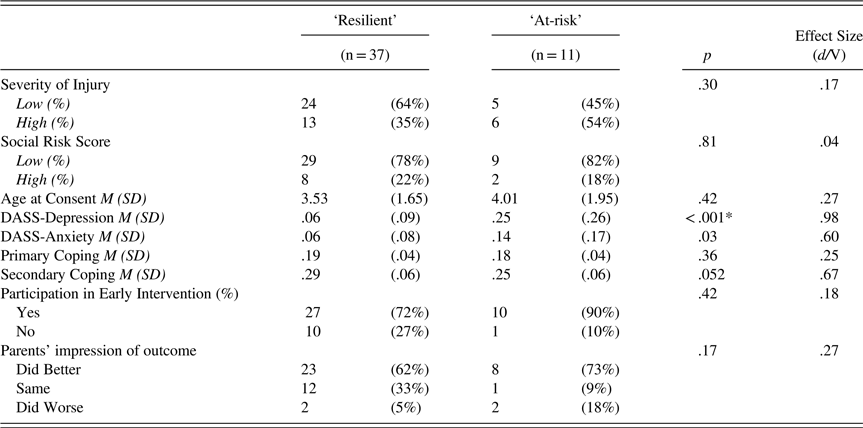
In total, 37 children (77%) had CBCL and SIB-ED scores within normative ranges and were identified as “resilient.” Eleven children (23%) had one or more elevated area of concern and were identified as “at-risk.” As shown in Table 5, these children did not differ by age at assessment, severity of brain injury, early intervention use, or parents’ perception of overall outcome. Parent depression and anxiety was lower among children categorized as “resilient,” t(45)=−3.86, p <.001, d=.98 and t(45)=2.19, p=.03, d=.60, respectively. After controlling for multiple comparisons, only parent depression remained significant with lower parent depression among children categorized as “resilient.”
Factors associated with score-based estimates of resilience

Note. * reflects significant values after controlling for multiple comparisons using the false discovery rate (FDR) criteria. Effect sizes for severity of injury and participation in early intervention used Cramer’s V while the other effect sizes are noted by Cohen’s D; independent T-Tests were conducted for continuous variables and Fisher’s Exact Test for categorical variables. For analyses, total social risk score was categorized as low (<2) or high (2+) as noted in the text.
DISCUSSION
The current study highlighted a rich array of parents’ descriptions and reasons for their child’s positive outcomes, and a high number of children who demonstrate resilience based on parent perspective and quantitative assessment. The five unique categories observed in parents’ descriptions of their child’s resilience reflected success observed across domains of physical and general development, as well as their child’s emerging cognitive engagement. From parents’ perspectives, supporting factors varied, but with common attributions to the close medical follow-up, early intervention, and more intrinsic factors within the child and parent. Finally, the quantitative consideration of biopsychosocial factors associated with early “resilient” and “at-risk” children highlighted the importance of parent mental health across these outcomes.
During the early years many parents focused on their child’s success despite their adversity. Parents commonly described outcomes regarding their child’s general developmental progress and health, physical abilities despite injury, as well as their child’s cognitive engagement and emotional happiness. The categories from this study echo to some extent potential precursors of Masten’s described domains of competence: achievement, conduct, and social engagement, often used as general measures of successful adaptation to adversity among youth (Masten et al., Reference Masten, Hubbard, Gest, Tellegen, Garmezy and Ramirez1999).
These issues also reflect the known range of outcomes following these injuries (Chabrier et al., Reference Chabrier, Peyric, Drutel, Deron, Kossorotoff, Dinomais and Vuillerot2016; Murias et al., Reference Murias, Brooks, Kirton and Iaria2014; Natarajan, Pappas, & Shankaran, Reference Natarajan, Pappas and Shankaran2016). Although in earlier eras, neurological prognosis may have focused more exclusively on motor outcomes such as hemiparesis or cerebral palsy, there is increasing emphasis on helping parents monitor potential learning and behavioral outcomes that are also associated with neonatal brain injury.
Our exploration of factors that parents value in their child’s outcome strongly align with common protective factors examined in resilience research, that of the child’s internal characteristics or inner strength, aspects of the family environment, as well as community resources (Ungar, Reference Ungar2015; Agnafors et al., Reference Agnafors, Svedin, Oreland, Bladh, Comasco and Sydsjö2017). Many parents reflected on their child’s spirit, determination, and persistence as characteristics that helped during the early years of development. Parents also highlighted their own strength and advocacy, as well as the amount of time spent daily to work with their child on intervention targets and involve their child in opportunities that will foster their skills. Parents’ own mindset and attitude was also an identified asset, both in being accepting of the issues their child may face, but also in being optimistic about their child’s potential. This has been observed helpful among other families in the face of childhood disability and chronic health conditions (Compas et al., Reference Compas, Bemis, Gerhardt, Dunn, Rodriguez, Desjardins and Vannatta2015; Heiman, Reference Heiman2002; Thomsen et al., Reference Thomsen, Compas, Colletti, Stanger, Boyer and Konik2002). Parents who have a strong positive belief in their child and their future are likely to adapt more flexibly and mobilize services, advocacy, and general support for their child.
Parents attributed their child’s outcome to many of the common monitoring and early intervention efforts provided following neonatal brain injury and other serious neonatal medical risks (Kirton et al., Reference Kirton, Westmacott and deVeber2007; Mussatto et al., Reference Mussatto, Hollenbeck-Pringle, Trachtenberg, Sood, Sananes, Pike and Pemberton2017; Spittle, Orton, Anderson, Boyd, & Doyle, Reference Spittle, Orton, Anderson, Boyd and Doyle2012). The medical follow-up that is routinely offered was also a contributor to their child’s success according to parents, with no issues in terms of frequency of these visits, drawing attention to the importance of ensuring environmental capacity to provide these resources. Positivity and optimism from their clinicians was additionally helpful to parents and valued in terms of its influence on their child’s outcome. Given the inherent uncertainty regarding prognosis following early brain injury, regular meetings with medical staff can provide parents important psychoeducation around their child’s condition that reassures parents and bolsters optimism and determination for their child (Racine et al., Reference Racine, Bell, Farlow, Miller, Payot, Rasmussen and Wintermark2016). More research is needed to consider how these early intervention experiences may also be reflected in later academic and personal success.
The quantitative approach in the present study served to strengthen what was found qualitatively, largely emphasizing the number of children categorized as “resilient” as well as the importance of parental well-being in early child developmental and mental health outcomes. This is a well-established predictor of long-term outcomes in other chronic health pediatric populations (Okado, Long, & Phipps, Reference Okado, Long and Phipps2014; Rodriguez et al., Reference Rodriguez, Murphy, Vannatta, Gerhardt, Young-Saleme, Saylor and Compas2016; Wade et al., Reference Wade, Cassedy, Walz, Taylor, Stancin and Yeates2011) and is a helpful reminder of its influence among neurologically at-risk young children. Given the genetic association of mental health conditions, this is an essential element to account for in both our understanding of mental health following early brain injury, but also to appropriately support earlier psychosocial interventions (Boat, Filigno, & Amin, Reference Boat, Filigno and Amin2017; Cuthbert & Insel, Reference Cuthbert and Insel2013).
In this study, resilience was defined in different, but complementary ways. Parents’ perception of their child doing well in comparison to prognosis, as explored qualitatively, did not directly align with quantitative assessment of resilience but was certainly suggestive of overlap. This may be attributed to definitional differences, as well as the understandable retrospective bias among parents following a period of extreme stress. Overall, these findings offer important considerations for both clinical and research pursuits in understanding resiliency, with encouragement to consider both age-appropriate skill acquisition but also the possibility of living well with developmental disability.
Age at which the child was assessed did not show as strong of an association with outcomes as we had anticipated. This may reflect the large number of young children in our sample, but there were no obvious differences in reports of concerns among parents of school age children. Certainly, context is crucial in considering resilience, as people may be resilient at one period in their life, but not at others (Rutter, Reference Rutter2006). Asking children and youth themselves at appropriate ages about their own resilience would also offer an additional important lens from which to consider understanding resilience following early brain injury.
Pattern of brain injuries and specific condition (stroke/HIE) were also not associated with mental health outcomes in the current study, other than lower developmental skill among children with high-risk patterns of early injury. These findings fit with other cohorts of children with early brain injury, particularly as they relate to mental health outcomes beyond intellectual and physical disabilities (Lo et al., Reference Lo, Gordon, Hajek, Gomes, Greenham, Perkins and MacKay2013; Williams et al., Reference Williams, McDonald, Roberts, Dlamini, deVeber and Westmacott2017). Of note, several of the children with HIE had normal imaging post therapeutic hypothermia, children with presumably lower, but not null adversity (Cainelli, Trevisanuto, Cavallin, Manara, & Suppiej, Reference Cainelli, Trevisanuto, Cavallin, Manara and Suppiej2018; Rutherford et al., Reference Rutherford, Malamateniou, McGuinness, Allsop, Biarge and Counsell2010). Future work is needed to more sensitively consider severity of injury along a spectrum of adversity and consider models that assess how extent of medical risk may moderate the influence of factors such as family functioning and community supports (Cicchetti & Blender, Reference Cicchetti and Blender2006; Luthar et al., Reference Luthar, Cicchetti and Becker2000).
Despite the notable strengths of this investigation, there are several important limitations to address. First, this study focused heavily on parents’ descriptions of their child’s outcome and supporting factors that as noted above may be biased by the early medical stress. Specifically, parents may not be assessing children’s competence in behavior and adaptive functioning relative to age-appropriate levels, as was captured in the second objective. Furthermore, although parents’ elaborations on their child’s success were fruitful, doing better than the clinician’s original prognosis also contains inherent challenges. Prognosis of children in this institution typically involves a multidisciplinary team of neonatologists, specialized neonatal neurologists, neuroradiologists, and nurse practitioners who review the infant’s prenatal and birth history, clinical presentation, and neuroimaging. As such, neurological prognosis for neonates may be heavily influenced by biological markers without due consideration of interpersonal factors that may be particularly relevant in contexts of lower adversity such as mild to moderate injuries (Racine et al., Reference Racine, Bell, Farlow, Miller, Payot, Rasmussen and Wintermark2016).
The present study was also cross-sectional, and longitudinal follow-up is needed to truly explore resilience and examine the developing brain’s response to early neurological adversity (Cicchetti & Blender, Reference Cicchetti and Blender2006; Rutter, Reference Rutter2012). Given the heightened cognitive and social demands with increasing age and differing capacity of the injured brain, resilience observed by parents at a young age is not the same as how parents or the youth’s themselves will define resilience during school years or later adolescence.
We also recruited a large age range of children in this sample with an emphasis on the early years and chose to be inclusive of different types of neonatal brain injury, including stroke (arterial ischemic stroke and cerebral sinovenous thrombosis) and HIE of varying levels of severity and injury patterns. Identification of severe pathology based on neonatal imaging, although supported in outcome work, was simplistic. More sophisticated imaging that includes volumetrics and connectivity may better measure the extent of injury. Additionally, the small size and heterogeneity of the sample precluded consideration of potentially condition specific early medical risk factors that may have influenced parents’ early experiences and the child’s outcome.
Our sample also included a cohort of children and families actively participating in neonatal clinics, introducing two potential biases. These families are coping well enough to engage in follow-up appointments or conversely, parents attending clinic have heightened concerns about the development of their children (Westreich, Reference Westreich2012). Given the positive early developmental outcomes across groups, the former may be more likely and indicate an overrepresentation of children and families who are doing well, limiting generalizability of our findings to children with more severe early disability. Finally, although practical for recruiting a broad and inclusive research sample, our online methodology of open-ended questions inquiring about parent experiences does not allow for the richness of interactions and elaboration possible during in-person interviews.
Nevertheless, our study is the first of its kind to look at defining resilience in children who experienced neonatal brain injury from the parents’ vantage. Findings emphasized the multiple ways children demonstrate positive outcomes during their initial years despite early neurological adversity. Current models of follow-up and early intervention are valued and clear supporting factors from parents’ perspective, but these results also emphasize the important role of addressing the parent’s well-being on the journey of the infant’s recovery and subsequent rehabilitation. Family support is offered more systematically and with more rigorous research among children with other pediatric conditions such as traumatic brain injury (Narad et al., Reference Narad, Taylor, Yeates, Stancin, Kirkwood and Wade2017), prematurity (Milgrom et al., Reference Milgrom, Newnham, Anderson, Doyle, Gemmill, Lee and Inder2010), and childhood cancers (Kazak et al., Reference Kazak, Rourke, Alderfer, Pai, Reilly and Meadows2007). When infants have acute brain injury, the emphasis is to capitalize on the young brain’s capabilities, providing intensive therapies to foster the child’s motor and language development. Efforts are needed to also bolster the strength of families on these paths so that care is not just for the child, but also for the well-being of the person who is caring for that child. Neonatal brain injury may not be synonymous with good outcomes, but continued exploration of mechanisms that emphasize positive adaptation despite this adversity helps not only further theoretical understanding of recovery, but most importantly directs best steps for optimal care.
ACKNOWLEDGMENTS
The authors thank the families who have informed and directly participated in this work. The authors have no conflicts of interest to disclose. This work is supported by the Medical Psychiatry Alliance, a collaborative health partnership of the University of Toronto, the Centre for Addiction and Mental Health, the Hospital for Sick Children, Trillium Health Partners, the Ontario Ministry of Health and Long-Term Care, and an anonymous donor.