INTRODUCTION
Marine invertebrates often possess two stages including planktonic larval and benthic adult phases, and settlement and metamorphosis of larvae in response to various cues is an important transition of life cycles (Crisp, Reference Crisp and Mackie1974; Conzelmann et al., Reference Coon and Bonar2013). Chemical cues from the natural environment can mediate the process of a pelagic-benthic transition (Pawlik, Reference Pawlik1992; Hadfield & Paul, Reference Hadfield, Paul, McClintock and Baker2001; Hay, Reference Hay2009; Paul et al., Reference Paul, Ritson-Williams and Sharp2011). In the marine environment, natural chemical cues originate from various resources such as biofilms (Bao et al., Reference Bao, Yang, Satuito and Kitamura2007; Ganesan et al., Reference Ganesan, Alfaro, Brooks and Higgins2010; Hadfield, Reference Hadfield2011; Wang et al., Reference Wang, Bao, Gu, Li, Liang, Ling, Cai, Shen and Yang2012; Yang et al., Reference Yang, Shen, Liang, Li, Bao and Li2013a), macroalgae (Walters et al., Reference Walters, Hadfield and Smith1996; Huggett et al., Reference Huggett, de Nys, Williamson, Heasman and Steinberg2005; Yang et al., Reference Yang, Satuito, Bao and Kitamura2007) and conspecifics (Dreanno et al., Reference Dreanno, Matsumura, Dohmae, Takio, Hirota, Kirby and Clare2006; Clare, Reference Clare, Breithaupt and Thiel2011). However, elicitors were fully identified in only a few cases (Yvin et al., Reference Yvin, Chevolot, Chevolot-Magueur and Cochard1985; Pawlik, Reference Pawlik1986; Dreanno et al., Reference Dreanno, Matsumura, Dohmae, Takio, Hirota, Kirby and Clare2006; Tebben et al., Reference Tebben, Tapiolas, Motti, Abrego, Negri, Blackall, Steinberg and Harder2011). Thus, some researchers try to use neuropharmacological agents to elucidate the receptors and related signalling pathways (Clare et al., Reference Clare, Thomas and Rittschof1995; Tran & Hadfield, Reference Tran and Hadfield2012) involved in larval settlement and metamorphosis and to find some potential application in the field of aquaculture, biofouling and antifouling (Dobretsov & Qian, Reference Dobretsov and Qian2003; Alfaro et al., Reference Alfaro, Young and Ganesan2011; Yang et al., Reference Yang, Satuito, Bao and Kitamura2008, Reference Yang, Li, Bao, Yamada and Kitamura2015).
Commercial neuropharmacological compounds are often well-characterized, target-specific substances with known pharmacological profiles in vertebrates, clear chemical-synthesis pathways, and an alternative supply source (Rittschof et al., Reference Rittschof, Lai, Kok and Teo2003). The receptors and signal-transduction pathway involved in larval settlement and metamorphosis may be different in various species of marine invertebrates (Tran & Hadfield, Reference Tran and Hadfield2012). G-protein-coupled receptors (GPCRs) and related pathways facilitate metamorphosis in marine invertebrates, e.g. the hydrozoan, Hydractinia echinata (Müller, Reference Müller1985; Leitz & Müller, Reference Leitz and Müller1987; Schneider & Leitz, Reference Schneider and Leitz1994); the barnacle, Balanus amphitrite (Rittschof et al., Reference Rittschof, Maki, Mitchell and Costlow1986; Clare et al., Reference Clare, Thomas and Rittschof1995; Yamamoto et al., Reference Yamamoto, Tachibana, Matsumura and Fusetani1995); the sea urchin, Strongylocentrotus purpuratus (Amador-Cano et al., Reference Amador-Cano, Carpizo-Ituarte and Cristino-Jorge2006) and the polychaetes, Capitella sp. (Biggers & Laufer, Reference Biggers and Laufer1999) and Phragmatopoma californica (Jensen & Morse, Reference Jensen and Morse1990). With respect to molluscs, metamorphosis of the abalone Haliotis rufescens is not mediated by GPCRs (Baxter & Morse, Reference Baxter and Morse1987), but is facilitated by γ-aminobutyric acid (GABA) and lysine receptors (Morse, Reference Morse1990). In the case of mussels, few researchers focus on the interaction between GPCRs and larval metamorphosis (Yang et al., Reference Yang, Li, Satuito, Bao and Kitamura2011, Reference Yang, Li, Liang, Li, Chen, Bao and Li2014; Young et al., Reference Young, Alfaro, Sánchez-Lazo and Robertson2015).
In China, the mussel Mytilus coruscus Gould, 1860, is a commercially important species in aquaculture and also a biofouling organism (Cai et al., Reference Cai, Chen, Xue and Lu1994; Chang et al., Reference Chang, Liu, Li and Shen2008; Yang et al., Reference Yang, Shen, Liang, Li, Bao and Li2013a). Here, we assessed the effects of neuropharmacological agents including the G protein activators guanosine 5′-[β,γ-imido]triphosphate trisodium salt hydrate (Gpp[NH]p) and guanosine 5′-[γ-thio]triphosphate tetralithium salt (GTP-γ-S), the G protein inhibitor guanosine 5′-[β-thio]diphosphate trilithium salt (GDP-β-S), the non-specific phosphodiesterase inhibitor 3-Isobutyl-1-methylxanthine (IBMX) and theophylline (Thp), the cAMP-specific phosphodiesterase IV inhibitor 4-(3-Butoxy-4-methoxybenzyl)imidazolidin-2-one (RO 20-1724), the cyclic nucleotide analogue N6,2′-O-Dibutyryladenosine 3′,5′-cyclic monophosphate sodium salt (db-cAMP), the adenylate cyclase activator forskolin (Fsk) and the adenylate cyclase inhibitors (±)-miconazole nitrate salt (Miconazole) and 4-Nitroimidazole (Nitroimidazole), which affect GPCRs and related signal-transduction pathways on larval metamorphosis of M. coruscus. The purpose was to determine whether GPCRs and their related signal-transduction pathways mediate and/or regulate the process of larval metamorphosis of M. coruscus, and to obtain potential inducers for future studies on molecular mechanism underlying larval metamorphosis in this species.
MATERIALS AND METHODS
Spawning and larval culture
Adult M. coruscus were sampled from the coast of Shengsi (122°44′E 30°73′N), China. Spawning and larval culture were conducted according to the procedures of Yang et al. (Reference Yang, Li, Li, Liu, Liang, Bao and Li2013b). Pediveliger larvae (35–40 days old larvae) were used in the present bioassays.
Pharmacological compounds
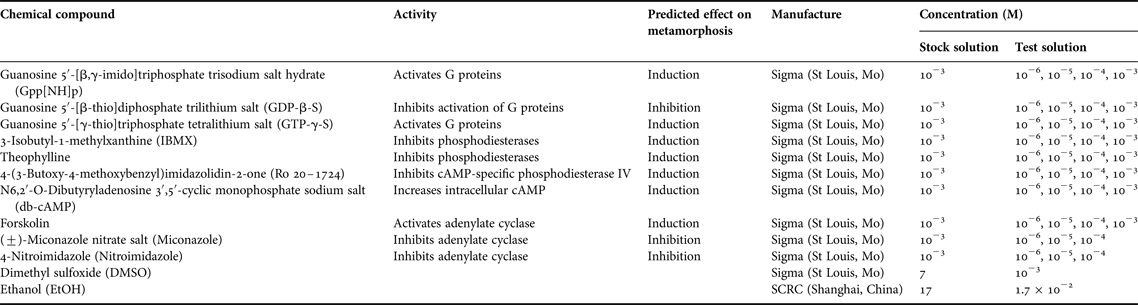
The predicted inducing or inhibiting activity and concentrations of tested neuropharmacological agents including Gpp[NH]p, GDP-β-S, GTP-γ-S, IBMX, Thp, Ro 20–1724, db-cAMP, Fsk, miconazole and nitroimidazole are shown in Table 1. Solutions of Gpp[NH]p were obtained by dissolving the agent in autoclaved filtered seawater (AFSW) with 0.2 ml Milli Q water. Solutions of IBMX and Fsk were obtained by dissolving the agent in AFSW with 0.1 ml 7 M dimethyl sulfoxide (DMSO). Solutions of nitroimidazole were obtained by dissolving the agent in AFSW with 1 ml of 17 M ethanol (EtOH). Except for Gpp[NH]p, IBMX, Fsk and nitroimidazole, solutions of other agents were obtained by dissolving agents in AFSW. The tested concentrations in this study were selected according to the larval assays on a mussel (Dobretsov & Qian, Reference Dobretsov and Qian2003), a polychaete (Holm et al., Reference Holm, Nedved, Carpizo-Ituarte and Hadfield1998) and two corals (Tran & Hadfield, Reference Tran and Hadfield2012).
Pharmacological compounds tested, predicted inducing or inhibiting activity of these compounds and bioassay concentrations.

Larval metamorphosis bioassays
Inducing activities of 10 neuropharmacological agents on larval metamorphosis were examined according to previously reported procedures (Coon & Bonar, Reference Conzelmann, Williams, Tunaru, Randel, Shahidi, Asadulina, Berger, Offermanns and Jékely1987; Satuito et al., Reference Satuito, Natoyama, Yamazaki, Shimizu and Fusetani1999; Yang et al., Reference Yang, Satuito, Bao and Kitamura2008, Reference Yang, Li, Li, Liu, Liang, Bao and Li2013b). Ten pediveligers were kept in each 24-well plate (Ø 15.7 mm × 17.2 mm) containing 1.5 ml of the agent solution in AFSW. In the 24 h exposure assay, pediveligers were added to the 24-well plate containing the test solution for 24 h. After washing with AFSW, pediveligers were transferred to 24-well plates containing 1.5 ml of AFSW. In the continuous exposure assay, pediveligers were maintained in the 24-well plate containing the test solution during the experimental period of 96 h.
In each assay, metamorphosed and dead individuals were determined after 72 and 96 h. Twenty-four well plates containing 10 pediveligers and 1.5 ml of DMSO or EtOH solutions were used as the control. The effect of DMSO and EtOH was assessed because these solvents were used to dissolve IBMX, Fsk and nitroimidazole. Twenty-four well plates containing 10 pediveliger larvae and 1.5 ml of AFSW were used as the negative control (Blank). Each assay was carried out with six replicates per treatment in the dark at 18°C.
Data analysis
Data on post-larvae (%) were arcsine-transformed prior to analysis. Data analysis for tested neuropharmacological agents was conducted through the Kruskal–Wallis test followed by Steel with a Control test. All data were analysed using JMP™ software. Significant difference was considered at P < 0.05.
RESULTS
In the negative control (blank), the pediveliger larvae of M. coruscus did not metamorphose during the experiment period.
Larval metamorphosis in response to agents affecting G proteins
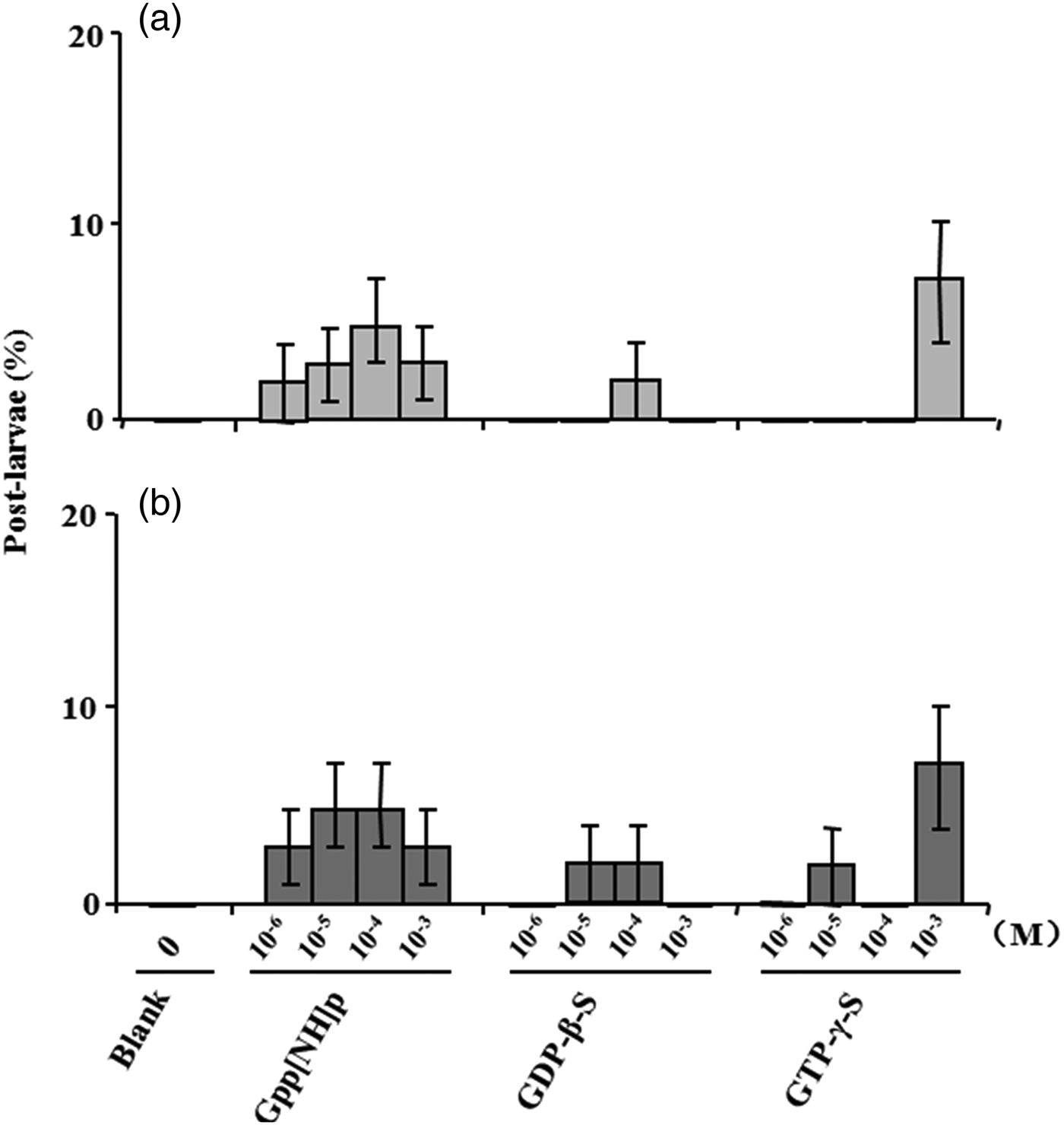
In 24 h exposure assays, Gpp[NH]p, GDP-β-S and GTP-γ-S exhibited no inducing activity when compared with Blank after 72 h (P > 0.05, Figure 1a). Similar findings were also observed after 96 h, and no inducing activity was found in the three compounds affecting G-proteins (P > 0.05, Figure 1b). No dead pediveliger larvae were found when these larvae were exposed to three compounds affecting G-proteins.
Post-larvae (%) of M. coruscus following exposure to compounds affecting G proteins after 72 h (a) and 96 (b) in 24-h exposure assays. Means ± SE (N = 6). * = P < 0.05.

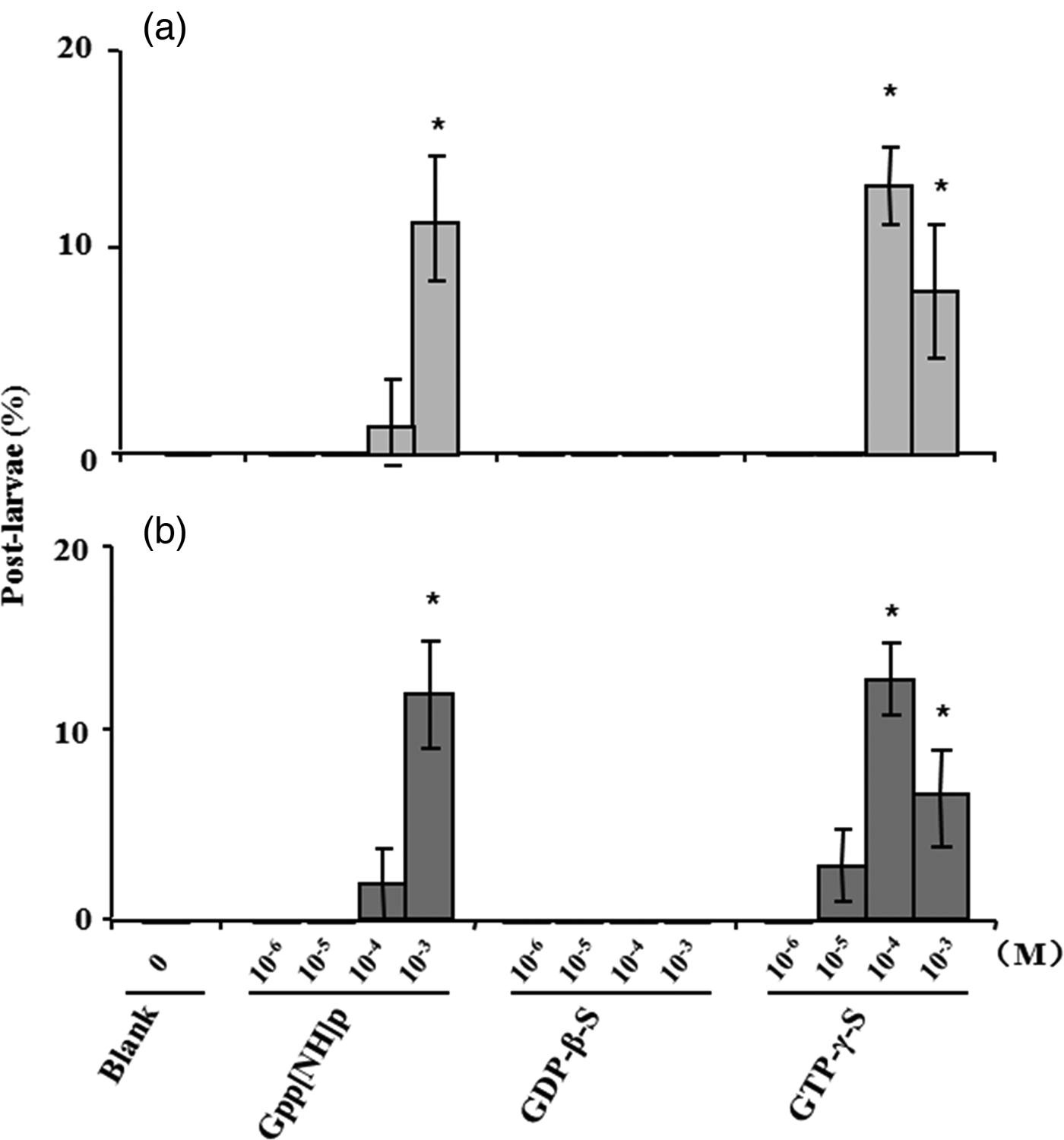
In the continuous exposure assays, after 72 h, Gpp[NH]p (P < 0.01) and GTP-γ-S (P < 0.01) significantly induced larval metamorphosis (Figure 2a). In contrast, GDP-β-S did not show inducing activity even after 96 h and the percentage of metamorphosed larvae was 0% (Figures 2a, b). In the case of continuous exposure assays, no dead pediveliger larvae were found in these three agents.
Post-larvae (%) of M. coruscus following exposure to compounds affecting G proteins after 72 h (a) and 96 (b) in continuous exposure assays. Means ± SE (N = 6). * = P < 0.05.

Larval metamorphosis in response to phosphodiesterase inhibitors
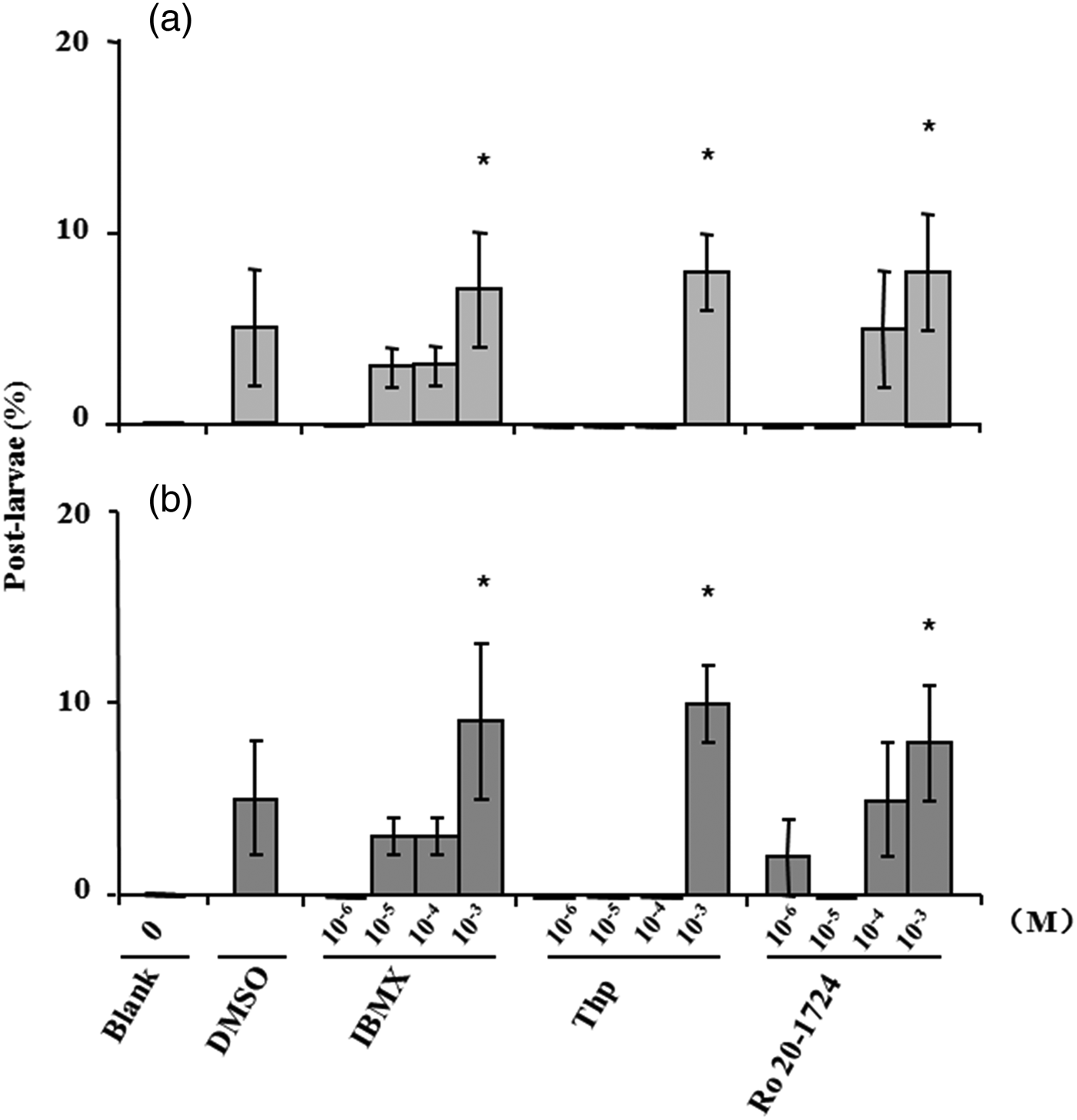
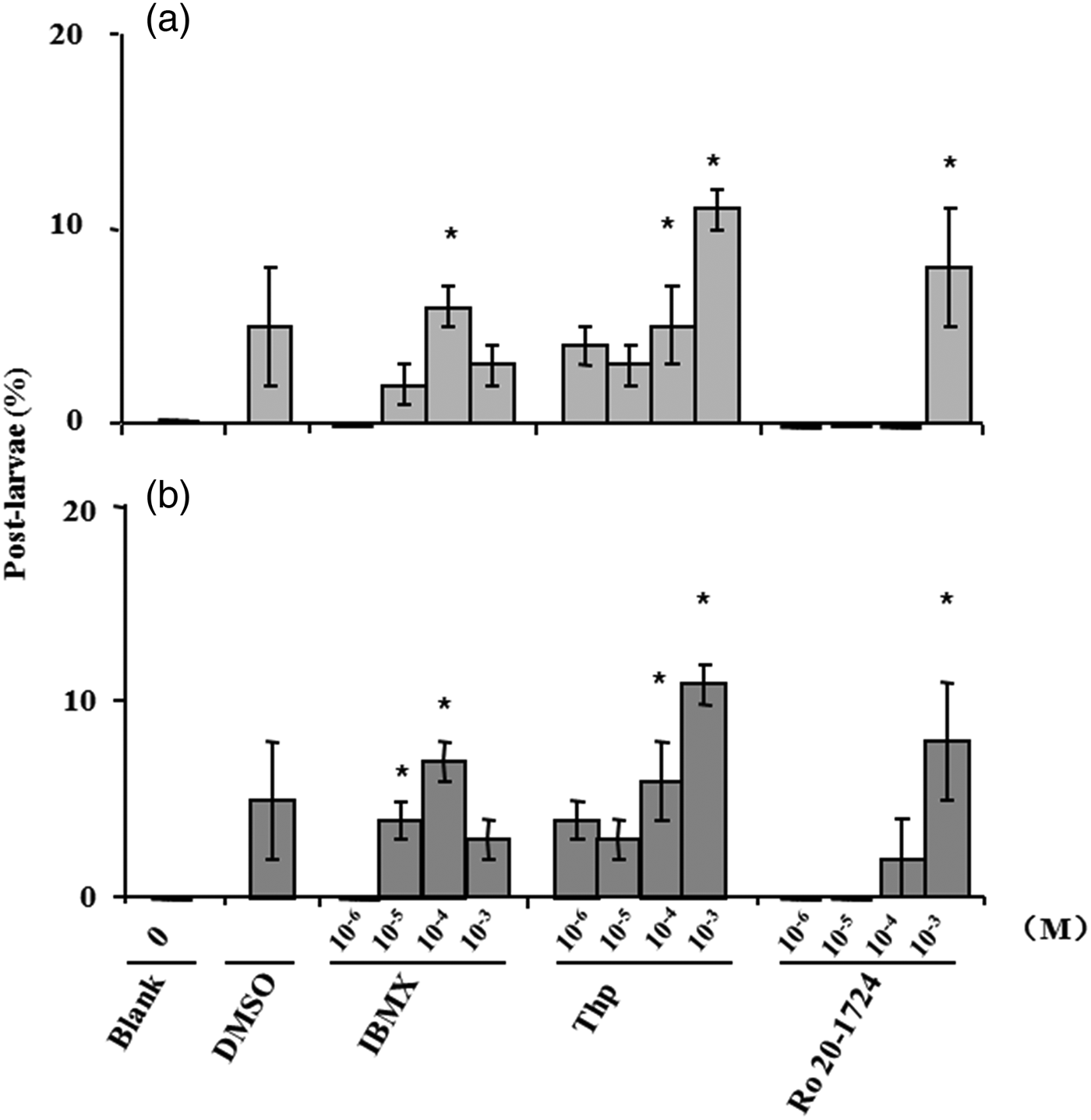
In 24 h exposure assays, IBMX, Thp and Ro 20–1724 exhibited inducing activity after 72 h (P < 0.01; Figure 3a). Similar findings were also observed after 96 h (P < 0.01; Figure 3b). DMSO showed no significant inducing activity even after 96 h (Figure 3b). No mortality of pediveliger larvae was found even after 96 h.
Post-larvae (%) of M. coruscus following exposure to three phosphodiesterase inhibitors after 72 h (a) and 96 (b) in 24-h exposure assays. Means ± SE (N = 6). * = P < 0.05.

In the continuous assays, IBMX (P < 0.01), Thp (P < 0.01) and Ro 20–1724 (P < 0.01) all induced larval metamorphosis after 72 h (Figure 4a). After 96 h, similar results were obtained (Figure 4b). DMSO did not show inducing activity during the 96-h assay period. No larval mortality was found when exposed to these three phosphodiesterase inhibitors even after 96 h.
Post-larvae (%) of M. coruscus following exposure to three phosphodiesterase inhibitors after 72 h (a) and 96 (b) in continuous exposure assays. Means ± SE (N = 6). * = P < 0.05.

Larval metamorphosis in response to db-cAMP
In the 24 h exposure assay, only 2% post-larvae were obtained when exposed to 10−6 M db-cAMP after 72 h and 96 h. In the continuous assays, db-cAMP did not induce larval metamorphosis (P > 0.05, data not shown). No dead pediveliger larvae were found even after 96 h.
Larval metamorphosis in response to compounds affecting adenylate cyclase
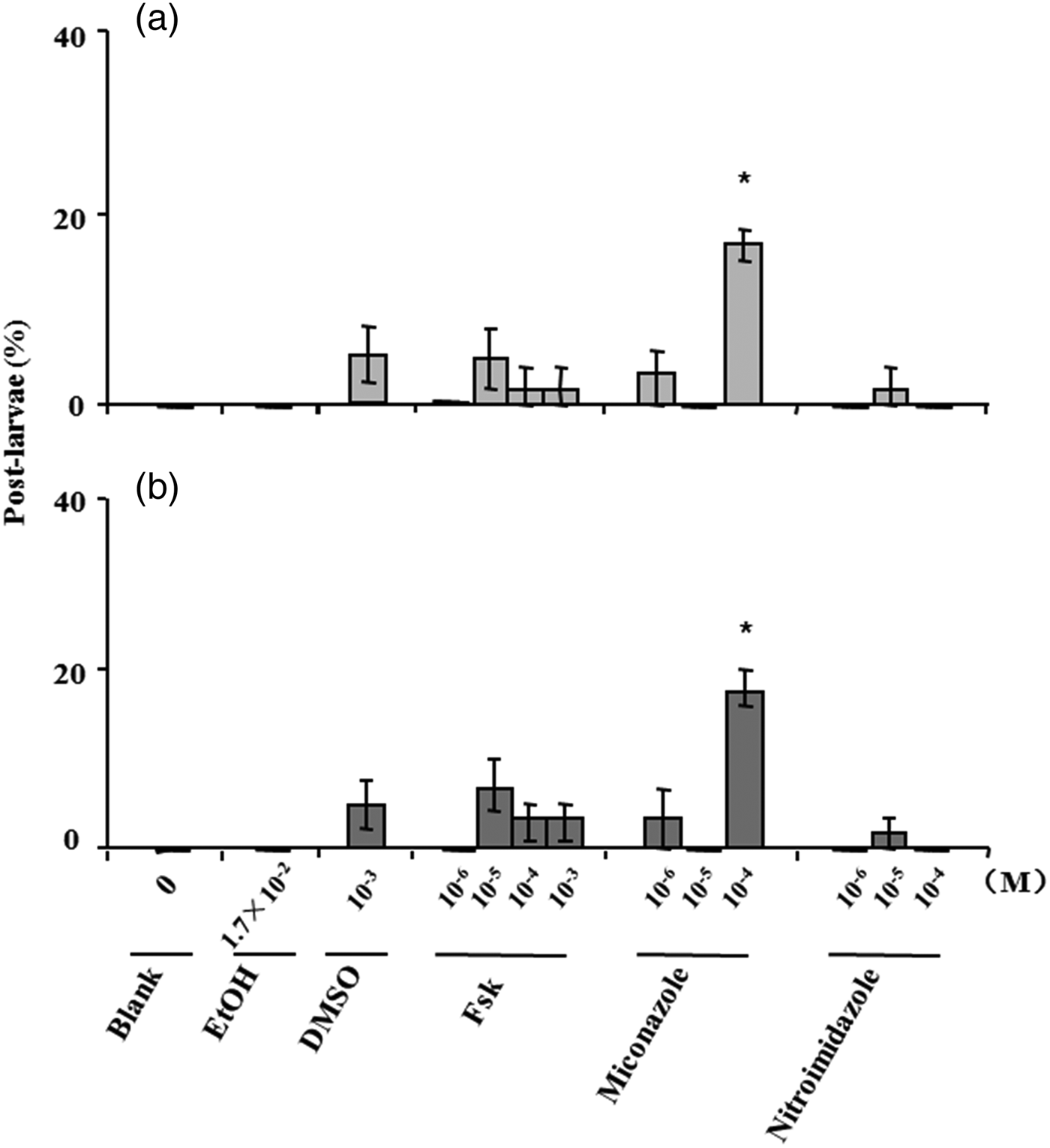
In 24 h exposure assays, only miconazole exhibited inducing activity after 72 and 96 h (P < 0.01, Figure 5). In contrast, both Fsk (P > 0.05) and nitroimidazole (P > 0.05) did not show activity even after 96 h. EtOH (P > 0.05) and DMSO (P > 0.05) showed no inducing activity even after 96 h. No dead pediveliger larvae were found even after 96 h.
Post-larvae (%) of M. coruscus following exposure to compounds affecting adenylate cyclase after 72 h (a) and 96 (b) in 24-h exposure assays. Means ± SE (N = 6). * = P < 0.05.

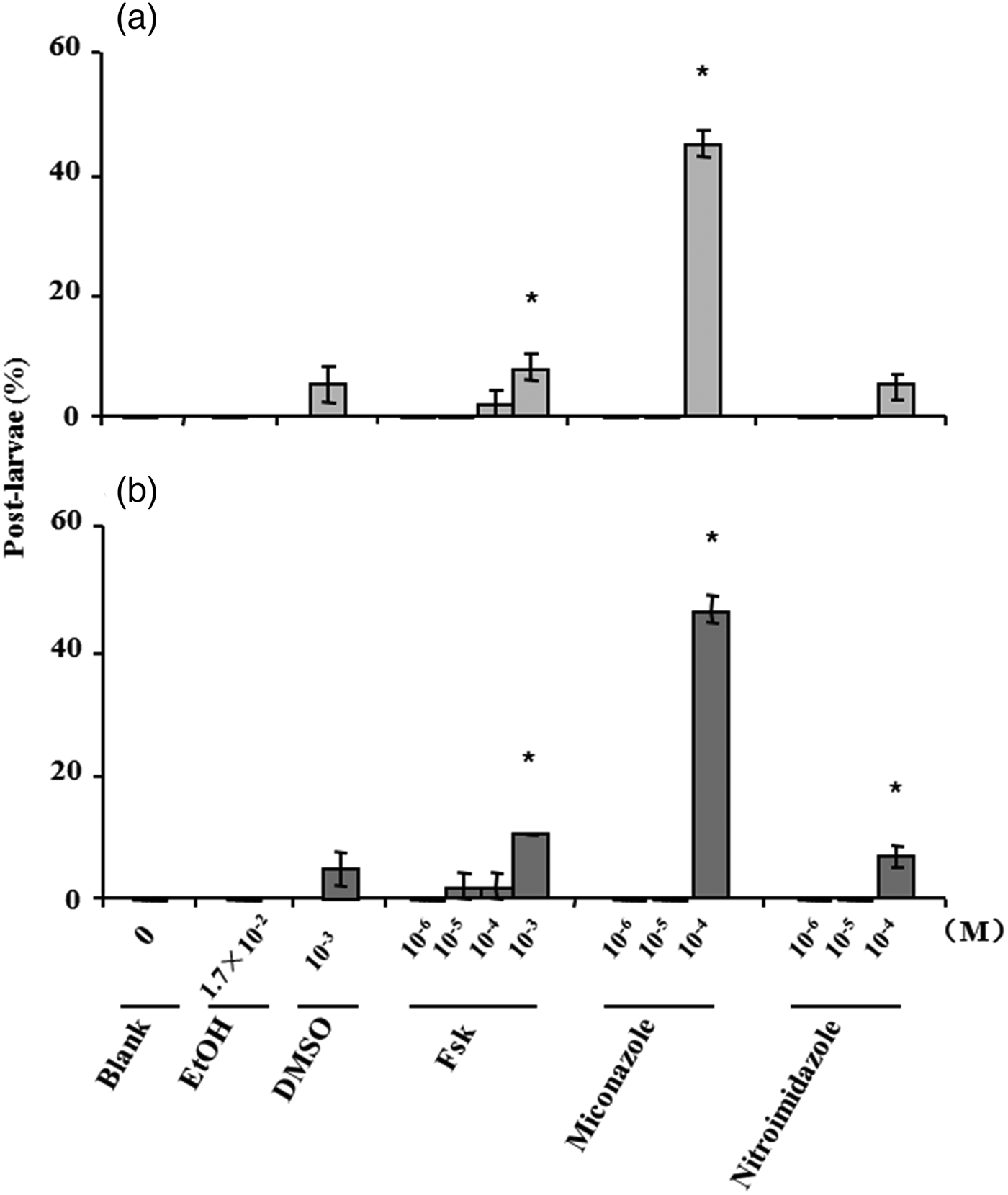
In the continuous assays, Fsk (P < 0.01), miconazole (P < 0.01) induced larval metamorphosis after 72 h (Figure 6a). After 96 h, nitroimidazole also showed inducing activity (P < 0.01) and the percentage of post-larvae was 7 ± 2% (Figure 6b). EtOH (P > 0.05) and DMSO (P > 0.05) did not show inducing activity even after 96 h. No dead pediveliger larvae were found even after 96 h.
Post-larvae (%) of M. coruscus following exposure to compounds affecting adenylate cyclase after 72 h (a) and 96 (b) in continuous exposure assays. Means ± SE (N = 6). * = P < 0.05.

DISCUSSION
In this study, we have demonstrated that neuropharmacological agents such as Gpp[NH]p, GTP-γ-S, IBMX, Thp, Ro 20–1724, Fsk, miconazole and nitroimidazole induced M. coruscus larval metamorphosis. Simultaneously, no mortality of pediveliger larvae was found for these neuropharmacological agents tested, suggesting that the above neuropharmacological agents can be used as active inducers for M. coruscus larval metamorphosis. A variety of studies have reported identification of neuropharmacological agents that induce larval metamorphosis of other invertebrates (Clare et al., Reference Clare, Thomas and Rittschof1995; Holm et al., Reference Holm, Nedved, Carpizo-Ituarte and Hadfield1998; Dobretsov & Qian, Reference Dobretsov and Qian2003; Yang et al., Reference Yang, Satuito, Bao and Kitamura2008, Reference Yang, Li, Satuito, Bao and Kitamura2011; Young et al., Reference Young, Alfaro and Robertson2011, Reference Young, Alfaro, Sánchez-Lazo and Robertson2015; Tran & Hadfield, Reference Tran and Hadfield2012). The purpose of these studies was to clarify the mechanism of larval settlement (Clare et al., Reference Clare, Thomas and Rittschof1995; Yamamoto et al., Reference Yamamoto, Tachibana, Kawaii, Matsumura and Fusetani1996; Holm et al., Reference Holm, Nedved, Carpizo-Ituarte and Hadfield1998; Tran & Hadfield, Reference Tran and Hadfield2012) and to provide useful information in fields of aquaculture, biofouling and antifouling (Dobretsov & Qian, Reference Dobretsov and Qian2003; Alfaro et al., Reference Alfaro, Young and Ganesan2011; Sánchez-Lazo et al., Reference Sánchez-Lazo, Martínez-Pita, Young and Alfaro2012; Yang et al., Reference Yang, Li, Satuito, Bao and Kitamura2011, Reference Yang, Li, Liang, Li, Chen, Bao and Li2014).
The present results show that Gpp[NH]p and GTP-γ-S induced larval metamorphosis of M. coruscus in continuous exposure assays, while not exhibiting any inducing activity on M. coruscus larval metamorphosis in 24 h exposure assays. Previous studies suggest that Gpp[NH]p showed no inducing activity on larval metamorphosis of Hydrodies elegans (Holm et al., Reference Holm, Nedved, Carpizo-Ituarte and Hadfield1998), Pocillopora damicornis (Tran & Hadfield, Reference Tran and Hadfield2012) and Montipora capitata (Tran & Hadfield, Reference Tran and Hadfield2012) in 24 h exposure assays, and then these authors suggested that GPCRs might not be involved in metamorphosis of these two species. Therefore, further bioassays need to be conducted on the effects of G protein activator Gpp[NH]p on larval metamorphosis of other invertebrates such as a polychaetes (Holm et al., Reference Holm, Nedved, Carpizo-Ituarte and Hadfield1998) and two corals (Tran & Hadfield, Reference Tran and Hadfield2012).
IBMX, a xanthine derivative, could inhibit the phosphodiesterase responsible for the degradation of cAMP and elevate intracellular cAMP levels (Pawlik, Reference Pawlik1990). The present finding that IBMX exhibited inducing activity on larval metamorphosis in M. coruscus is consistent with reports of other marine invertebrates, such as the polychaetes P. lapidosa californica (Pawlik, Reference Pawlik1990) and H. elegans (Holm et al., Reference Holm, Nedved, Carpizo-Ituarte and Hadfield1998), the hydrozoan H. echainata (Leitz, Reference Leitz1997), the abalone H. rufescens (Baxter & Morse, Reference Baxter and Morse1987), the mussel M. edulis (Dobretsov & Qian, Reference Dobretsov and Qian2003) and the barnacle B. amphitrite (Clare et al., Reference Clare, Thomas and Rittschof1995). Thus, IBMX might trigger the similar signal transduction pathways (Dobretsov & Qian, Reference Dobretsov and Qian2003). Another methylxanthine, theophylline also induced larval metamorphosis of M. coruscus in the present investigation. Similarly, theophylline also exhibited significant inducing activity on larval settlement and metamorphosis of H. elegans (Holm et al., Reference Holm, Nedved, Carpizo-Ituarte and Hadfield1998) and B. amphitrite (Clare et al., Reference Clare, Thomas and Rittschof1995). In contrast, theophylline showed no significantly inducing effect on larval metamorphosis of P. damicornis and M. capitata (Tran & Hadfield, Reference Tran and Hadfield2012). In the case of the selective phosphodiesterase inhibitor, previous studies showed that Ro 20–1724 had no effect on H. elegans (Holm et al., Reference Holm, Nedved, Carpizo-Ituarte and Hadfield1998), P. damicornis (Tran & Hadfield, Reference Tran and Hadfield2012) and M. capitata (Tran & Hadfield, Reference Tran and Hadfield2012). In this investigation, Ro 20–1724 showed significant inducing activity on larval metamorphosis of M. coruscus, indicating that larval metamorphosis may be mediated by the AC/cAMP pathway.
Except for the pharmacological manipulation of cAMP by inhibiting degradation of phosphodiesterase with xanthi, the cAMP analogues are used in pharmacological bioassays on marine invertebrate larvae due to the effectiveness at raising the intracellular levels of cyclic nucleotides (Clare et al., Reference Clare, Thomas and Rittschof1995). The cAMP analogue db-cAMP exhibited no significant inducing activity in larval settlement and metamorphosis of some invertebrates such as H. elegans (Holm et al., Reference Holm, Nedved, Carpizo-Ituarte and Hadfield1998), Phragmatopoma californica (Jensen & Morse, Reference Jensen and Morse1990), P. damicornis (Tran & Hadfield, Reference Tran and Hadfield2012), M. capitata (Tran & Hadfield, Reference Tran and Hadfield2012) and B. amphitrite (Clare et al., Reference Clare, Thomas and Rittschof1995). This study also confirmed that db-cAMP shows no inducing activity in M. coruscus. Although the clear action mechanism remains unknown, one reason is that the cuticle is impermeable to negatively charged nucleotides (Jensen & Morse, Reference Jensen and Morse1990).
In the present study, Fsk induced larval metamorphosis of M. coruscus. A similar result was also observed in the polychaete P. californica (Jensen & Morse, Reference Jensen and Morse1990). As known, Fsk activates adenylate cyclase in the AC/cAMP pathway. Thus, the present finding indicates that the AC/cAMP pathway is involved in the metamorphic signal transduction in M. coruscus. On the other hand, Fsk exhibited inhibitory effects on larval metamorphosis of two coral species (Tran & Hadfield, Reference Tran and Hadfield2012) and a polychaete (Holm et al., Reference Holm, Nedved, Carpizo-Ituarte and Hadfield1998), indicating that not the AC/cAMP pathway but other pathways may regulate the larval metamorphosis process. The possible explanation is that Fsk may act as a potassium- and calcium-channel blocker, have an effect on ion transport, and produce inhibition (Holm et al., Reference Holm, Nedved, Carpizo-Ituarte and Hadfield1998; Tran & Hadfield, Reference Tran and Hadfield2012). Therefore, the signal transduction pathways that mediate larval metamorphosis varied among the mussel (the present study), two coral species (Tran & Hadfield, Reference Tran and Hadfield2012) and a polychaete (Holm et al., Reference Holm, Nedved, Carpizo-Ituarte and Hadfield1998). Previous studies showed that miconazole, an adenylate cyclase inhibitor, inhibited the cypris settlement of B. amphitrite amphitrite, indicating that it may be due to physio-chemical effects (Clare et al., Reference Clare, Thomas and Rittschof1995). In contrast, we found that miconazole exhibited the most promising inducing activity in the M. coruscus in the present study. Thus, the mechanism that miconazole mediates larval settlement and metamorphosis may vary between the mussel (this study) and the barnacle (Clare et al., Reference Clare, Thomas and Rittschof1995), and this needs further study. In addition, the present study showed that miconazole at 10−4 M exhibited the maximum inducing capacity in the continuous exposure assay, and was 2.6-fold higher in comparison to that in the 24-h exposure assay. Thus, exposure time is crucial to screen the neuropharmacological agents (Yang et al., Reference Yang, Shen, Liang, Li, Bao and Li2013a, Reference Yang, Li, Li, Liu, Liang, Bao and Lib).
In conclusion, neuropharmacological agents affecting GPCRs exhibit no toxicity and could induce larval metamorphosis of M. coruscus. Miconazole could be a promising inducer of larval metamorphosis and may be used to improve larval production for aquaculture and used in biofouling research. Moreover, GPCRs and the Ac/cAMP pathway, generally mediate larval metamorphosis in M. coruscus. The present study identified effectively an artificial inducer of larval metamorphosis for biofouling studies, and gained novel pharmacological evidence that GPCRs mediate larval metamorphosis in M. coruscus. Further studies on molecular mechanisms of action of these compounds regarding larval metamorphosis in M. coruscus are needed.
FINANCIAL SUPPORT
This study was supported by the National Natural Science Foundation of China (No. 41606147, 31101885), the Shanghai Universities Plateau Discipline Project of Marine Sciences and the Peak Discipline Program for Fisheries from the Shanghai Municipal Government.