Introduction
Consent is a vital part of the management of surgical patients. It is important that patients understand what is going to be done to them, and that they fully comprehend all the risks of the procedure. This is particularly important in otology, and even more so in mastoid surgery: patients undergoing such surgery may have fairly minor symptoms, but the surgery itself exposes them to the risk of very serious complications.
In the UK, there is currently a drive to make patient information leaflets as simple and short as possible, and to cater for the ‘lowest common denominator’ of readership, based on the claim that the average reading age of the UK population is 12 years. Despite this, quite detailed information is sometimes required to enable patients to fully understand the implications of agreeing to undergo a particular surgical procedure.
Prior to the present study, the first author (MBP) had written a patient information leaflet detailing the risks of surgery for patients undergoing mastoid surgery, which covered four sides of A4 paper (see Appendix 1 for text). However, the hospital Patient Advice and Liaison Services team had expressed the opinion that the leaflet was too long and that patients would not understand it, and had suggested that the content should be reduced to fit onto one double-sided A4 sheet folded in thirds. Despite this input, the mastoidectomy information leaflet had been implemented unchanged, and had been used successfully for six years.
In the present study, the authors assessed the mastoidectomy patient information leaflet objectively, using readability formulae and the Ensuring Quality Information for Patients tool, and also obtained patients' views on its quality.
Materials and methods
Surgery on the mastoid bone exposes the patient to the risk of damage to very important structures, damage which can cause significant disability. The author of the mastoidectomy patient information leaflet felt that it was important to fully explain all potential risks to the patient. While verbal consent is valuable, the amount of information given in relation to mastoid surgery can be overwhelming, and it is unlikely that the patient will remember it all.
The mastoidectomy patient information leaflet was designed such that the patient was engaged in the consent process, by requiring them to tick a box to indicate that each section had been read; following each box, there was space to write down questions about that section. All risks were discussed verbally with the patient, using diagrams, at the time of listing for surgery. The patient information leaflet was then sent to patients with their admission details, a few weeks before admission. This gave the patient the opportunity to familiarise themselves with the procedure and its risks in a leisurely manner, and to think about the questions they would like to ask. The patient was requested to complete the form, sign it and bring it with them to their pre-operative appointment. At this appointment, the surgeon went through the form with the patient before the official hospital consent form was signed. The signed information leaflet was then filed in the notes with the consent form.
In the current study, 54 consecutive mastoidectomy patients received a questionnaire (see Appendix 2) asking for their opinion on the mastoidectomy patient information leaflet. The completed questionnaire was collected either at the pre-operative visit or on admission. The questionnaire was completed anonymously, although patients were able to leave their details on the form if they wished. The same questionnaire was given to both adult patients and the parents of paediatric patients.
When 54 questionnaires had been collected, the survey was stopped and the responses analysed.
In addition, several different readability formulae were used to score the readability of the mastoidectomy patient information leaflet. The Ensuring Quality Information for Patients tool was also used to analyse different aspects of the information sheet.
Results and analysis
The present study assessed the following: (1) patients' views on the quality of the mastoidectomy patient information leaflet; (2) the level of quality of the leaflet as evaluated by the Ensuring Quality Information for Patients tool; and (3) the readability of the leaflet as evaluated using various readability formulae.
Patients' views
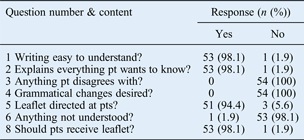
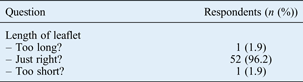
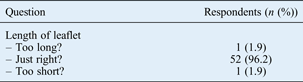
Completed questionnaires were obtained from 54 consecutive mastoidectomy patients. The majority of responses were very positive (Tables I and II). All but one patient (98.1 per cent) agreed that the leaflet was written in an easily understood way and that it explained everything that they wanted to know about the surgery. The same percentage of respondents agreed that the leaflet should be given to patients, while 94.4 per cent agreed that the leaflet was directed at patients. None of the respondents indicated that there were grammatical changes they wanted to make, or that there was anything in the leaflet they disagreed with. Regarding the length of the leaflet, only one respondent agreed that it was too long, the majority (96.3 per cent) agreed that it was ‘just right’ and, interestingly, one respondent indicated that it was too short.
Patient questionnaire results: questions 1–6 & 8

Pt = patient
Patient questionnaire results: question 7
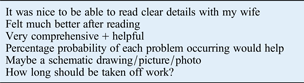
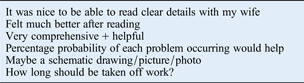
The questionnaire also had space for comments and suggestions. Table III lists all of the suggestions received.
Patient questionnaire comments
Objective quality of leaflet
The Ensuring Quality Information for Patients tool was used to objectively evaluate the quality of the mastoidectomy patient information leaflet.Reference Moult, Franck and Brady1 This tool was chosen as it had good validity and reliability and identified actions to be taken as a result of analysis. A score of 87.5 per cent was calculated. The ‘action recommendation’ for scores above 76 per cent was ‘continue to stock; review in two to three years’, i.e. no changes required.
Objective readability of leaflet
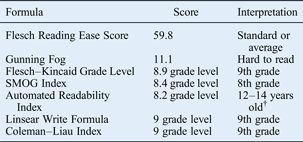
The online Text Readability Consensus Calculator was used to assess the readability of the leaflet.2 Based on 7 different readability formulae, the leaflet was scored at grade level 9, the reading level was assessed as standard or average, and the reader's age judged to be 13–15 years (i.e. eighth to ninth grade) (Table IV).
Mastoidectomy patient information leaflet readability scores*
* Obtained from the Text Readability Consensus Calculator. †That is, seventh and eighth graders. SMOG = Simple Measure of Gobbledygook
Discussion
Communicating accurate patient information about the risks of a proposed operation is a vital part of the informed consent process.3 The temporal bone contains many vital structures which if damaged could have a significant impact on the patient's quality of life; however, temporal bone surgery may be undertaken for conditions with only mild, or even no, symptoms.
Previous research has indicated that, just 5 minutes after a consultation, patients have already forgotten half of what the doctor has told them.Reference Kitching4 The percentage of retained information can be raised from approximately 20 per cent to 50 per cent by providing visual or written information as additional support.Reference Gauld5
The author of the mastoidectomy patient information leaflet assessed in the current study felt it was important to actively engage the patient in receiving the information. Because of the complexity of the disease and its surgery, and the potential number of complications, the mastoidectomy patient information leaflet filled four A4 pages. However, the hospital Patient Advice and Liaison Services team believed the leaflet was too long and complicated, and suggested simplifying the content so that the leaflet fitted onto one double-sided A4 sheet folded in thirds. Despite this input, the leaflet was introduced unchanged, and was used successfully for six years. The current study audited patient satisfaction with the leaflet; results indicated that 98.1 per cent of patients found it easy to understand, understood all the content, and felt it explained everything they wanted to know.
Readability refers to how easily the target audience for a text can read and understand it. It has been suggested that the readability level of a UK information sheet should correspond to the national average reading level, which is often stated to be 12 years of age.Reference Doak, Doak and Root6 Assessment of the readability of the mastoidectomy patient information leaflet, using 7 readability formulae available via an online readability calculator, suggested that the leaflet's readability was consistent with the reading level of eighth or ninth graders, i.e. 13–15 years of age. Only one of our patients indicated having a problem with understanding the leaflet, and, due to the leaflet content and layout, this patient was able to list all areas of misunderstanding, which were then explained verbally in simpler terms.
There are several problems with relying on readability scores. Firstly, such scores use criteria such as sentence length, syllable count and word length, so short words may score well even if they are not commonly used or widely understood. Long words such as mastoidectomy or cholesteatoma will increase the reading level of a given text; however, people suffering from chronic or complex conditions became familiar with medical terminology and jargon related to their disease. Therefore, objective assessment of the reading level of text including such words will not accurately reflect the reading difficulty encountered by more experienced patients.
There are potential disadvantages of ‘dumbing down’ an information sheet. A leaflet with a low readability score may lack the depth needed to supply the required information to certain patient groups. A style which is too simple may also appear patronising, may lack interest and authority, and may appear to underestimate or make light of potential serious health risks. One study found that texts edited to make them easier to read often became less interesting, and that readers preferred the original version.Reference Green and Olsen7 None of our respondents suggested that grammatical changes were needed to the mastoidectomy patient information leaflet.
• The average UK reading age is often quoted as 12 years
• A four-page mastoidectomy information leaflet was assessed
• The objectively assessed readability level was 13–15 years
• Almost all patients thought it easily understood and not too long
• Leaflets with low readability scores may lack the depth needed for mastoidectomy surgery consent
• Patient understanding is aided by active leaflet completion and appropriate timing of provision
A recent survey of adult (i.e. ages 16–65 years) literacy levels in England reported that 57 per cent of respondents achieved Entry Level 2 standard (i.e. the standard expected of 7–9 year-olds) or above.Reference Harding, Romanou, Williams, Peters, Winkley and Burke8 This compares favourably with 2003 results, which found that 44 per cent of respondents performed at Entry Level 2 or above.Reference Harding, Romanou, Williams, Peters, Winkley and Burke8, Reference Williams, Clemens, Oleinikoya and Tarvin9 These findings suggest that the average reading level in England has improved, supporting the argument against over-simplification of patient information.
Readability tools do not assess grammar, presentation, content or layout. For assessment of these elements, research tools such as the Ensuring Quality Information for Patients tool are useful. This tool was developed at Great Ormond Street Hospital to enable assessment of the quality of all types of written health information. It comprises a list of quality criteria (developed from the published literature on quality appraisal), presented as questions. The tool has been validated over a number of years, with results published in 2004.Reference Moult, Franck and Brady1 It also identifies actions to be taken as a result of the quality assessment. Applying the tool to the mastoidectomy patient information leaflet gave a score of 85.7 per cent, indicating that it was acceptable for clinical practice and that no alterations were necessary. However, it is also very important to get feedback from the users of any information sheet, rather than relying solely on readability scores and other objective assessment tools.
Conclusion
It is not always necessary to over-simplify patient information. Our experience suggests that the average reading age of patients undergoing mastoidectomy surgery is probably greater than 12 years old, so a slightly greater complexity can safely be used when giving information. The mastoidectomy patient information leaflet assessed in the current study involved active patient participation and encouraged patients to write down questions about any areas of misunderstanding, which could then be clarified. The 2012 Medical Protection Society review of the causes of settled claims over the preceding four years found that 10 per cent of claims were due to issues with consent.Reference Mackenzie10 Our experience with and assessment of our mastoidectomy patient information leaflet indicated that it was greatly valued by our patients; furthermore, we believe that using such a leaflet should help prevent consent issues arising, and would make claims easier to defend if one did arise. Our hospital has now formally adopted this leaflet, which is now produced in standard hospital literature format.
Readers wishing to use the mastoidectomy patient information leaflet should contact the first author via the correspondence details shown below; a Word format version can be forwarded to facilitate alteration to suit local circumstances and personal preferences.
Appendix 1. Text of the mastoidectomy patient information leaflet
Please read and complete this form before admission
Patient's name:
Side of operation: Right Left
We suggest you use a pen ticking each section as you read it and jotting down any questions.
Specialist support
If you require this leaflet in another language, large print or another format, i.e. audiotape, please contact the Patient and Customer Services on Freephone XXX.
Consent – What does this mean?
Before any doctor, nurse or therapist examines or treats you they must have your consent or permission. Consent ranges from allowing a doctor to take your blood pressure (rolling up your sleeve and presenting your arm is implied consent) to signing a form saying you agree to the treatment or operation. It is important before giving permission that you understand what you are agreeing to. If you do not understand – ask. More detailed information is available on request.
Mastoid surgery
The ‘mastoid bone’ is the area of bone behind your ear. It is a hollow bone and joins with the space behind the ear drum.
Surgery on the mastoid bone is performed for a number of reasons. The main two reasons are 1: for the treatment of cholesteatoma and 2: for the treatment of mastoid infections.
Cholesteatoma is a condition where the skin lining which is normally on the outer surface of the ear drum has grown into the space behind the ear drum and into the mastoid bone. The skin in this area can continue to grow and collect and may then damage some of the important structures in this area as discussed below. This skin collection (cholesteatoma) can also become infected and cause a smelly discharge from the ear. Although it is very rare infection can spread inwards to cause problems in or around the brain.
Surgery to remove a cholesteatoma involves drilling into the mastoid bone and lifting the ear drum. During the surgery all the structures in the ear and mastoid bone are at risk of being damaged. The risks of surgery are discussed below:
Anaesthesia
The operation typically takes 2–3 hours and is performed under general anaesthesia. There is some risk associated with any anaesthetic of this length, but this risk is very small. The anaesthetist will see you just before the operation to discuss any concerns you may have.
I have read and understood the above paragraph, please tick □
Questions:
Facial nerve damage
In order to gain access to the cholesteatoma the surgeon needs to drill very close to the facial nerve. During this procedure it is possible that the nerve could be damaged. The damage would result in a weakness or paralysis of one side of the face. This could be temporary or permanent. It is an extremely uncommon complication (less than 1%). The nerve is monitored throughout the operation. If left untreated cholesteatoma can damage the facial nerve.
I have read and understood the above paragraph, please tick □
Questions:
Hearing loss
The cholesteatoma will often have partly destroyed or grown behind the hearing bones. The hearing bones may need to be removed to allow removal of the cholesteatoma and this could make the hearing worse. Sometimes it will be possible to replace the hearing bones with an implant either at the time of surgery or at a later operation to try and improve the hearing. During surgery it is also possible for the nerve part of the hearing to be damaged and if this happens it cannot be repaired. Very rarely it is possible to lose all the hearing in the operated ear (dead ear).
I have read and understood the above paragraph, please tick □
Questions:
Dizziness or balance problem
The balance system is part of the inner ear. Part of the balance system bulges into the area which the cholesteatoma often covers. This area, or other parts of the balance system, could be damaged when trying to get access to the cholesteatoma which has spread deep into the mastoid bone. This damage is very uncommon. The cholesteatoma itself can thin the bone or wear through the bone over the balance organ leading to dizziness or deafness.
I have read and understood the above paragraph, please tick □
Questions:
Taste disturbance
The small nerve that supplies taste to one side of the tongue runs underneath the ear drum. In many patients with cholesteatoma the disease may have destroyed this nerve without the patient noticing. During the operation it will often need to be removed to allow access to the cholesteatoma. This may cause an abnormal taste sensation on one side of the tongue. If it happens this sensation is usually temporary but could be permanent.
I have read and understood the above paragraph, please tick □
Questions:
Further operations
Depending on the technique used, you may require one or two or possibly more operations to ensure that the disease is all gone and, if appropriate, the hearing is repaired. Your surgeon will discuss the technique to be used in your case. A ‘canal wall up’ technique, sometimes known as a CAT, usually requires a second operation about a year later.
I have read and understood the above paragraph, please tick □
Questions:
Mastoid cavity
After the operation depending on the technique used you may be left with a mastoid cavity. This is where the mastoid bone which has been drilled away is joined to the ear canal by removing the bony wall of the ear canal. Part of this process involves making your ear hole larger. A mastoid cavity may be small or large. It can take a number of weeks to become fully lined with new skin. Many mastoid cavities will clean themselves of wax, others will require removal of wax at the hospital on a regular basis to avoid infection. You may be allowed to get the ear wet or you may be advised to keep it dry. Occasionally cold air or cold water entering the mastoid cavity might make you feel dizzy. Most mastoid cavities should be dry and trouble-free. The ‘canal wall up’ technique, sometimes known as a CAT, tries to leave a normal ear canal and avoid a mastoid cavity.
I have read and understood the above paragraph, please tick □
Questions:
Tinnitus
Tinnitus is a noise which is heard by the patient but is not actually present in the environment. It is an internally generated noise due to a problem somewhere in the hearing pathway. In other words it may be generated from a problem inside the cochlea, in the hearing nerve or in the hearing pathways in the brain. Ear surgery may have no effect on any tinnitus that you or your child already have; alternatively it may cause tinnitus, worsen tinnitus, or improve or abolish tinnitus.
I have read and understood the above paragraph, please tick □
Questions:
Wound infection
Wound infection is uncommon. If the wound becomes infected during the healing process it will usually settle quickly with antibiotic treatment.
I have read and understood the above paragraph, please tick □
Questions:
Ear numbness
A cut is made in the skin around the ear. Sometimes the tiny nerves which supply the feeling to the ear may be cut. This can cause some numbness, usually around the top of the ear. If this happens it may take a number of months for the sensation to return. It is rare for the numbness be permanent.
I have read and understood the above paragraph, please tick □
Questions:
This information sheet is not intended to be an exclusive list of all possible complications.
After the operation
After the operation you will have a large bandage around the head.
Behind the ear there will be some plasters (Steristrips) covering the wound. These should be left in place for at least a week. Keep this area dry for 2 weeks.
The ear canal will be packed with a dressing which will be removed after 2–4 weeks.
A piece of cotton wool will be in place covering the ear hole. This may become moist and should be changed carefully.
The stitches used will dissolve themselves and so do not need to be removed.
You should keep the ear and the wound dry until you are seen.
In the first two weeks keep away from crowds of other people to minimise the risk of picking up an infection.
Avoid any strenuous exercise for a month.
Is there an alternative to surgery?
Surgery is not without risk, and the alternative to surgery is to persevere with regular cleaning and observation in the out-patient clinic. In the case of cholesteatoma this is not an alternative that we would normally recommend.
Looking down the ear canal in the out-patient clinic does not allow us to see the extent of the disease or completely remove it with the suction equipment. If the disease is left untreated it could damage any of the structures discussed above. Chronic infection could spread deeper into the head causing meningitis or brain abscess. These are rare but serious complications.
I have read and understood the above paragraph, please tick □
Questions:
I have read and understand the contents of this information sheet. I have been given adequate time to consider it and have discussed the above material with those whom I feel may be of benefit in my understanding of the above.
Signature of patient:____
or
Signature of patient's parent or guardian:____
Date:____
Appendix 2. Patient questionnaire about the mastoidectomy information leaflet
1 Is the information leaflet written so that it is easy to understand?
Yes No
2 Does it explain everything you would want to know?
Yes No
3 Is there anything you disagree with?
Yes No
4 Are there any grammatical changes you would make?
Yes No
5 Do you think this leaflet is directed at patients?
Yes No
6 Is there anything you do not understand?
Yes No
7 Is the leaflet:
Too long Just right Too short ?
8 Do you think this leaflet should be given to patients?
Yes No