INTRODUCTION
Anise (Pimpinella anisum) is an aromatic plant in the Apiaceae family. Its fruits are called aniseed and contain 1–4% of essential oil. (E)-Anethole is the major component (75–90%) of the essential oil, and other components include anisaldehyde, estragol, isoeugenol, γ-himachalene, anisol, acetoanisol and p-anisic acid (Gülçin et al., Reference Gülçin, Oktay, Kireçci and Küfrevioğlu2003; Kosalec et al., Reference Kosalec, Pepeljnjak and Kustrak2005). Both the seeds and the essential oil are widely used in medicine and perfumery, and as flavouring (e.g. the toothpaste and liquor industries). Medicinal applications include use as an appetizer, carminative and sedative agent, or for stimulating milk production in breast-feeding mothers (Tabanca et al., Reference Tabanca, Demirci, Özek, Kirimer, Başer, Bedir, Khan and Wedge2006). Additionally, it is known that various extracts and the essential oil of aniseed have antimicrobial, antioxidative and antifungal properties. Aniseed is used by the pharmaceutical industry in Europe, and it is commonly used in public health care and as a flavour ingredient in some alcoholic drinks in Turkey.
The yield and (E)-anethole content of aniseed are affected by the genotype, the ecological conditions and especially by agricultural practices, such as the sowing date, fertilizer and water application, and plant density (Arslan et al., Reference Arslan, Gürbüz, Bayrak and Gümüşcü2004; Bayram, Reference Bayram1992; El-Din, Reference El-Din2003; El-Hady, Reference El-Hady2005; Tabanca et al., Reference Tabanca, Demirci, Özek, Kirimer, Başer, Bedir, Khan and Wedge2006; Tort and Honermeier, Reference Tort and Honermeier2005; Saimasi et al., Reference Saimasi, Javanshir, Bieghi, Aliari, Gholozani and Afshar2003). However, there are no satisfactory data in the literature on the relationship between plant maturation and the yield and (E)-anethole content of aniseed. It is known that seeds have differing levels of maturity at harvesting (Nassar et al., Reference Nassar, El-Sahhar and Nassar2001). In addition, the loss of yield at early and late harvesting times and the levels of maturation of the seeds in the harvested plants may cause changes in the yield and (E)-anethole content of the crop (Omidbaigi et al., Reference Omidbaigi, Hadjiakhoondi and Saharkhiz2003).
This study was carried out to determine the effects of different plant maturation levels on the yields of seed, the essential oil and (E)-anethole content and some other components of aniseed.
MATERIALS AND METHODS
Field studies
The Denizli variety of anise, obtained from growers in Eastern Turkey, was used in the study.
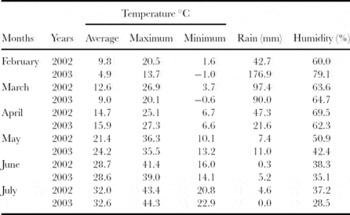
Field experiments were conducted during 2002 and 2003 growing seasons at the Agricultural Experiment Research Area of the Agricultural Faculty, Harran University, Sanliurfa, Turkey. The experimental field was located in southeastern Anatolia (on the Harran Plain) where semi-arid climate conditions prevail (see Table 1).
Climate data for the experimental site.

The climatic data for the 2002 and 2003 growing seasons showed similarities. In the first year, however, more moderate climatic conditions were recorded and the average and minimum daily temperatures during February and March were higher than the same period of the following year. Rainfall during the growing seasons totalled 199.7 mm in the first year and 305.1 mm in the second year (when 58% of the total was recorded in February).
The soil of the research field belonged to Harran I series and had A, B and C horizons, flat and/or flattish slope, alluvial main material and a deep profile. Soil analysis prior to sowing revealed 17% chalk, pH 7.84, 0.08% salt, 1.37% organic matter and a clay texture.
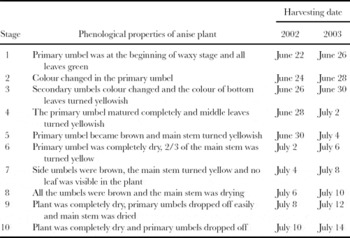
The experiment used a randomized complete block design with three replications. Each harvesting stage formed a different plot. The seeds were sown on 2 February 2002 and 2 February 2003 with 30 cm inter-row spacing and a seed application of 20 kg ha−1. Fertilizer was applied to all plots at the sowing stage (50 kg ha−1 each of nitrogen and phosphorus) and at the beginning of May (50 kg ha−1 of nitrogen). Each plot was set up as four rows each of 5 m length. After removal of the two side rows (which were disregarded in the analysis) from the middle part of each plot, the seeds were harvested at 10 different maturation stages. Harvesting was carried out when the seeds in the primary umbel reached the waxy stage and a total of 10 harvests were made at 2-day intervals. The plants harvested were dried at ambient temperature in shade. After hand rubbing of the dried plants, the seeds were separated from stalks by sieving and weighed. When needed, irrigation was applied during seed maturation and weed control by hoeing. Depending on the amount of precipitation, in the first year, the plants were irrigated on 22 May, 1 June, 13 June and 27 June, and in the second year, on 14 May, 7 June, 18 June and 30 June. Border irrigation was used.
In the trial, determinations were made of the yields per ha of seed, the essential oil and its % content of (E)-anethole, the weight (g) of 1000 seeds, the number of seeds per umbel, the number of umbels (with seed) per plant and number of seedless umbels per plant (Özel and Demirbilek, Reference Özel and Demirbilek2000).
Isolation of essential oil
Samples taken from the dried and cleaned mixed seeds were ground up. For each harvest stage, three 50 g subsamples were subjected to hydrodistillation for 120 min in order to obtain the yield of essential oil and oil samples for gas chromatography (GC) analysis.
Analysis of the essential oil
Analytical GC was carried out on a Thermo Quest-Finnigan Trace GC machine equipped with a flame ionization detector, an AS 2000 auto-sampler and a polyethylene glycol ZB-wax capillary column (30 m × 0.25 mm, 0.25 μm film thickness). The carrier gas (helium) flow was 1.5 ml min−1 and the split ratio was 50:1. The oven temperature programme was isothermal injection at 60 °C, followed by a 4 °C min−1 increase from 60 to 220 °C and 1 °C min−1 from 220 to 240 °C. The temperatures of both the injector and detector were held at 250 °C. The injection volume was 0.5 μl of oil.
Essential oil constituent determination
The relative content of individual essential oil components was measured on the basis of their peak areas on the GC trace. The identification of the individual compounds was made through archived retention indices and comparing the peaks of the samples with standards.
The (E)-anethole yield was calculated by multiplying the (E)-anethole content of the essential oil by the oil yield.
Statistical analysis
The data were subjected to analysis of variance (ANOVA) using randomized complete block design. The significance of differences among the harvesting stages was determined using Duncan's multiple range test (p < 0.005). All statistical analysis was carried out by applying MSTAT-C© software.
RESULTS AND DISCUSSION
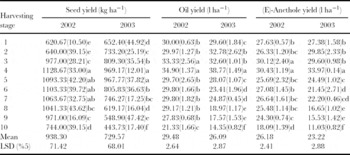
The harvesting stages and plant properties at the time of harvest are presented in Table 2. The results for the yields of seed, essential oil and (E)-anethole are given in Table 3 and Figures 1–5 provide illustrations of all the data obtained. Significant differences were noted between the harvesting stage and between the growing seasons. The differences between the growing seasons may be due to the differences in average temperature and irregularity in precipitation between 2002 and 2003 (Table 1).
Plant maturity stages of aniseed and harvesting dates.

Calculated yields for seed, essential oil and (E)-anethole by harvest stage.

Numbers in parentheses are standard deviations.
Means followed by the same letters (i.e. a, ab, abc etc.) were not significantly different from each other at the 5% significance level according to LSD test.
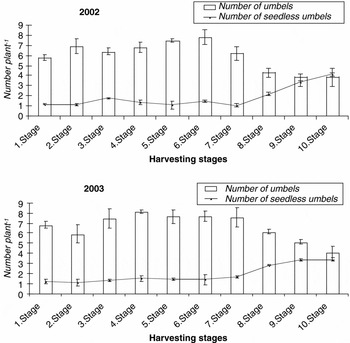
Average number of umbels with and without seed in anise harvested at different stages of plant maturity in 2002 and 2003. Error bars show standard deviation.

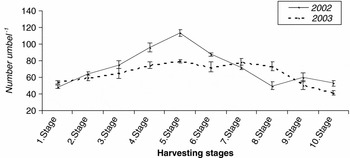
Average number of seeds per umbel in anise harvested at different plant maturity stages in 2002 and 2003. Error bars show standard deviation.

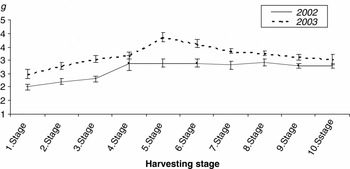
Average weights of 1000 seeds for harvests at different plant maturity stages in 2002 and 2003. Error bars show standard deviation.

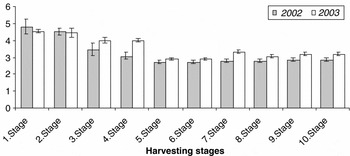
Average essential oil content (%, vol. wt−1) of seeds harvested at different plant maturity stages in 2002 and 2003. Error bars show standard deviation.

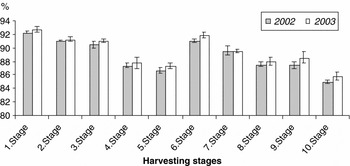
Average (E)-anethole content in the essential oil of aniseed harvested at different plant maturity stages in 2002 and 2003. Error bars show standard deviation.

Seed yield
Table 3 shows that for both years the seed yield was highest level at the fourth harvesting stage. Even though there were no statistical differences among the yield numbers at the fourth, fifth, sixth and seventh harvesting stages in 2002, these yield numbers tend to increase up to the fourth stage and then decrease thereafter gradually. This pattern may have resulted from the change in the numbers of umbels with seed per plant (Figure 1), the number of seeds per umbel (Figure 2) and the weight of 1000 seeds (Figure 3). Curioni et al. (Reference Curioni, Arizio, Garcia and Alfonso2003) reported that there was a positive correlation between the number of umbels per plant and the seed yield for anise. In our study, however the yield of seed decreased remarkably, due probably to the drop of early-matured umbels, after the forth harvesting stage in 2002 and the fifth harvesting stage in 2003 (Özel and Demirbilek, Reference Özel and Demirbilek2000; Özel et al., Reference Özel, Demirbilek and Çopur2001). Concomitant with the increase in the numbers of seedless umbels (Figure 1), the number of seed per umbel decreased (Figure 2).
Number of umbels
The number of umbels with seed was 3.8–7.8 per plant in 2002 and 4.0–8.1 per plant in 2003. The highest values were recorded at the sixth harvesting stage in the first year (2002) and at the fourth harvesting stage in the second year (2003). In general, early and late harvestings led to considerable decreases in the numbers of umbels (Figure 1). At the early harvesting stages, plants continue to grow leading to formation of new umbels. At later stages of harvesting (especially after the eighth harvesting stage), the first maturing seeds drop. These findings are in line with Nassar et al. (Reference Nassar, El-Sahhar and Nassar2001) who demonstrated that the first umbels are formed at top of the stem in anise and, then, side umbels are formed from top to the bottom of the plant.
Number of seedless umbels
The number of seedless umbels was 1.2–3.4 per plant in 2002 and 1.2–4.1 per plant in 2003. In both years, the highest figures were obtained at the tenth harvesting stage. Overall, the number of empty umbels increased after the seventh harvesting stage (Figure 1). This was due to the release of the seeds from the umbels. This finding was consistent with previous studies (Bayram, Reference Bayram1992; Özel and Demirbilek, Reference Özel and Demirbilek2000; Özel et al., Reference Özel, Demirbilek and Çopur2001).
Number of seeds per umbel
The average seed numbers was 49.0–113.9 per umbel in 2002 and 42.0–79.7 per umbel in 2003. In both years, the highest values were recorded after the fifth harvesting stage. Both in the early and late harvesting stages, the number of seeds per umbel decreased considerably (Figure 2).
Weight of 1000 seeds
The weight of 1000 seeds varied between 2.0 and 2.9 g in 2002 and 2.5 and 3.9 g in 2003. The lowest figures were noted at the first harvesting stage in both growing years. In 2002, after the third harvesting stage, the weight of 1000 seeds values remained almost unchanged (Figure 3).
Essential oil yields
The trend of variation in essential oil yields showed similarities to the changes in seed yield (Table 3). The highest essential oil yields were obtained at the fourth harvesting stage in both years. In contrast to the seed yield values, the yield of essential oil did not change greatly at the early or late harvesting stages in 2002. This resulted from the seed yield, as essential oil yield is calculated from the following formula:

Essential oil content of seeds
The essential oil content was 2.8–4.8% in 2002 and 2.9–4.5% in 2003. The highest values were obtained from the first harvesting stage in both years. In general, until the fifth harvesting stage, the essential oil content decreased continuously and then remained almost unchanged (Figure 4). The reason why the essential oil content was high at the early harvesting time may be the presence of higher number of seeds per unit weight. The weights of 1000 seeds increased up to the fourth and fifth harvesting stages (Figure 3). In addition, the decrease in essential oil contents in late harvests may have stemmed from the fact that the essential oil levels in the secretory passage decreased depending on the weather conditions after the periods of maturation. Similarly, Ceylan (Reference Ceylan1997) reported that essential oils were accumulated in the secretory passages and with late harvesting the essential oil contents decreased in aniseed.
(E)-Anethole yields
The calculated (E)-anethole yields increased up to the fourth harvesting stage and then decreased in both years (Table 3). In 2002, the (E)-anethole yields of aniseed harvested at the third and fourth harvesting stages showed no statistical differences. Although, the (E)-anethole contents were low in aniseed harvested at the fourth harvesting stage (Figure 5), the higher essential oil yields caused an increase in (E)-anethole yields, as the latter parameter is calculated by (E)-anethole content × essential oil yield.
(E)-Anethole content of the essential oil
The (E)-anethole content in the essential oil was in the range 84.8–92.1% in 2002 and 85.6–92.6% in 2003. The highest values were obtained from the first and sixth harvesting stages and declined at the later harvesting stages (Figure 5). This is consistent with the report of Omidbaigi et al., (Reference Omidbaigi, Hadjiakhoondi and Saharkhiz2003) that the (E)-anethole content in aniseed essential oil at the waxy stage was higher than the ripening stage. In both years, after the sixth harvesting stage the (E)-anethole content reached the highest level again due probably to the release of the seeds from the early-matured umbels. The high anethole content may be linked with the increase in the proportion of seeds at the waxy stage in newly matured umbels.
To conclude, since the highest yields of seeds, essential oil and (E)-anethole were obtained from the fourth harvesting stage when the main umbel was completely matured, this harvesting time was considered to be the most appropriate harvesting stage for aniseed. Additionally, at the first (beginning of waxy stage) and second (colour changes in the main stem) harvesting stages, the quality of essential oil was high. Therefore, to enhance yields genotypes which branch weakly or form single umbels should be identified, as well as suitable growing techniques.
Acknowledgement
I am very grateful to Dr Barbaros Ozer who helped and checked the English review of the manuscript.