1. Introduction and Motivation
The Dawning of Systemic Risks. Since Beck’s landmark contribution Risk Society, see Beck & Ritter (Reference Beck and Ritter1992), the term risk serves as a cornerstone to understand postmodern societies, which are characterized by the rapidly changing political and economic framework of recent decades due to globalization and digitalization. Along with these changes, embodied in significant economic growth, simultaneously a number of new (disruptive) risks emerged, manifested in a continuous number of crises, with the Financial Crisis 2007, the current COVID-19 pandemic and the Russian attack on the Ukraine being the most prominent examples. The frequent appearance of such adverse events is in stark contrast to the heuristic understanding that crises are viewed as rare events in a statistical sense. To capture this new normal, the acronym VUCA was coined to describe the related, volatilities, uncertainties, complexities, and ambiguities; see Bennis & Nanus (Reference Bennis and Nanus1985). Renn (Reference Renn2008) pointed out that systemic risks are the tribe of VUCA-related risks. The industrial reaction was the creation of a number of agility initiatives, whose strategic focus was on speeding up the ability to cope with both the negative consequences and to grasp related opportunities as well. Note that the strategy for solving VUCA-induced challenges is also coined VUCA which stands for vision, understanding, clarity, and agility.
Climate Risk. The most significant risk we are facing today is climate changeFootnote 1 as it is uniquely global, uniquely long-term, uniquely irreversible, and uniquely uncertain; see Wagner & Weitzman (Reference Wagner and Weitzman2015). During the last decades, the magnitude of the effects of climate change on all aspects of the political, societal, and economic live has been pointed out with increasing detail and accuracy in the IPCC reports; see Skula (Reference Skula2022) and Lee (Reference Lee2023).
Thus, climate risks are global, feature complex causal structures, nonlinear in the cause–effect relationship, and stochastic in their effect structure; see Renn (Reference Renn2016).
As the systemic character of climate risk has long been recognized, risk management efforts have been seemingly been channeled through this framework. However, climate change implied systemic risk is in a financial context predominantly treated along the paradigm of the financial crises, and the remedies applied were those developed during the financial crises (with the aim to stabilize the financial system). Thus, the focus was on robustness of the system, and its ability to absorb shocks was enhanced.
For instance, climate risk in the context of asset allocation was viewed as an optimization problem with the additional constrain of limiting CO
 $_2$
emissions of a portfolio (or decarbonizing portfolios); see Andersson et al. (Reference Andersson, Bolton and Samama2016) and Benedetti et al. (Reference Benedetti, Biffis, Chatzimichalakis, Fedele and Simm2021).
For more general portfolio analysis, climate risk is quantified in terms of a value-at-risk (VaR) approach, which tries to measure tail risk. Climate VaRFootnote
2
then quantifies the size of loss attributable to climate-related financial risks by comparing the value of assets in a world with climate change relative to the same world without climate change. These approaches rely on building (or using) scenarios as in the IPCC reports or provided by the Network for Greening the Financial System (NGFS) NGFS (Reference NGFS2021). A prominent example are Dietz et al. (Reference Dietz, Bowen, Dixon and Gradwell2016), who use an extended version of Nordhaus’s Dynamic Integrated Climate-Economy (DICE) model to estimate the impact of climate change on GDP growth. They find that the expected climate VaR of global financial assets today along the business-as-usual (BAU) emission path is
 $1.8$
% of global financial assets. However, much of the risk is in the tail; for example, the 99% percentile is 16.9% of global financial assets. Under the
 $2^\circ$
C pathway, the expected climate VaR is
 $1.2$
% of global financial assets and the 99% percentile is 9.2% of global financial assets.
Furthermore, the role of central banks was put in the spotlight and the treatment of systemic risk related to central bank activities has been widely discussed. Again, in parallel to the financial crises, climate risk is addressed in terms of tail risk and the required capital to generate robust institutions is quantified by stress tests. The most prominent examples are Bank of England (2019), Vermeulen (Reference Vermeulen2019), and Dunz et al. (Reference Dunz, Emambakhsh, Hennig, Kaijser, Kouratzoglou and Salleo2021); for a recent overview, see Acharya et al. (Reference Acharya, Berner, Engle, Jung, Stroebel, Zeng and Zhao2023). Typically, these scenarios do not make causal structures and cascading effects transparent. A detailed analysis of possible effects in the banking sector is given in Battiston et al. (Reference Battiston, Mandel and Monasterolo2017), Battiston & Monasterolo (Reference Battiston and Monasterolo2021), and Roncoroni et al. (Reference Roncoroni, Battiston, Farfán and Jaramillo2021) where the authors employ techniques from the analysis of networks. Chenet et al. (Reference Chenet, Ryan-Collins and van Lerven2021) argue for a combination of the precautionary principle and macroprudential policy tools in order to integrate the assessment of climate risk into financial policy.
The irreversible effects of climate change following the crossing of tipping points is hardly addressed in the scenario analysis approach. Prominent examples of such tipping points are the weakening of the Gulf Stream system, for which new evidence was presented recently in RealClimate (Reference RealClimate2015) and the melting of the artic ice cover, see Skula (Reference Skula2021). A thorough overview on the current state of possible tipping points is given in McKay et al. (Reference McKay, Staal, Abrams, Winkelmann, Sakschewski, Loriani, Fetzer, Cornell, Rockstrøm and Lenton2022). However, the effect of tipping points and heavy-tailed distribution on the social cost of carbon (SCC), and appropriate carbon prices have been discussed in Weitzman (Reference Weitzman2009), Weitzman (Reference Weitzman2011), Dietz (Reference Dietz2011), Dietz et al. (Reference Dietz, Bowen, Dixon and Gradwell2016), Daniel et al. (Reference Daniel, Litterman and Wagner2016), and Litterman (Reference Litterman2013). These papers point out the impact of the substantial climate tail risks on an appropriate price for emissions. To demonstrate the impact, let us outline a simple discrete version of Weitzman’s dismal theorem here (provided by Dietz, Reference Dietz2018). Assume
 $i=0, 1, \ldots n$
possible states of the future with consumption
 $c_i$
together with their corresponding probabilities
 $p_i$
. Calculate the marginal willingness to pay to avoid climate damage in terms of the expected marginal utility using a utility function
 $U$
. Then,
 \begin{equation*} \mathbb {E}(U'(c)) = \sum _{i=0}^k p_i U'(c_i). \end{equation*}
Let
 $i=0$
be the catastrophic state with
 $c_0$
very small but still positive, states
 $i=1, \ldots k$
non-catastrophic. If we consider a sequence of catastrophic futures
 $\left (c_0^{(n)}, p_0^{(n)}\right )$
with
 \begin{equation*} \lim _{n\rightarrow \infty } c_0^{(n)} = \lim _{n\rightarrow \infty } p_0^{(n)} =0, \end{equation*}
then the marginal willingness to pay is infinite if and only if
 \begin{equation*}\lim _{n\rightarrow \infty } p_0^{(n)} U'\left( c_0^{(n)}\right) = \infty. \end{equation*}
It follows that society’s marginal willingness to avoid zero consumption is unbounded. So if there is a future state in which the value of climate damage is at least as large as baseline consumption, society’s marginal willingness to avoid that state is unbounded. As the damage distribution has heavy tails such an outcome is very unlikely, but possible! Thus even in the context of being able to use probability distributions to assess climate risk, the fact that these distributions are heavy-tailed leads to unbounded social cost and thus to an unbounded price for carbon. However, the deep uncertainty associated with climate change may hide risks we are not even able to asses. To put it with Wagner & Weitzman (Reference Wagner and Weitzman2015):
Most everything we know tells us climate change is bad. Most everything we don’t know tells us it’s probably worse.
Thus, the risk management process for climate risks has to be extended beyond a capital-based approach extending the framework of robustness.
In the following, we provide in section 2 a framework for a risk management process which is able to address systemic risks within a resilience-based framework. Central is the definition of a model in a wide sense which we motivate using a sequence of illustrative examples. In section 3, we show how climate risk can be captured and addressed within this framework. We show the shortcomings of the robust approach to climate risk and outline how the resilience-based approach can be implemented in section 4. We close with a summary and an outline of further research questions in section 5.
2. Adapting the Risk Management Process to Systemic Risks
We now turn to a formal definition of systemic risk in the context of Renn’s VUCA framework see Renn (Reference Renn2016) and Renn and Klinke (Reference Renn and Klinke2015).
Definition 1 (Systemic Risk). Systemic risk refers to the risk of a breakdown in an entire system, as opposed to breakdowns in individual parts or components, and is evidenced by co-movements (correlation) among most of all parts.
Systemic risks arise from various sources (e.g., political, ecological, economical, etc
 $\ldots$
) and have been on the agenda of many stakeholders for a long time. They were already considered in the context of Solvency II, which was framed more than a decade ago. Their importance has been increasingly recognized by regulators. A major feature of systemic risk for the banking sector are domino effects, whereas this is not that obvious for the insurance sector; see Fouque & Langsam (Reference Fouque and Langsam2013) and Kemp (Reference Kemp2017) for comprehensive overviews. In order to address systemic risks, we now employ Renn’s VUCA characterization.
Example 1 (Renn’s approach to Systemic Risks). Typically, systemic risks are prone to one or some of the following (VUCA) characteristics:
-
complex causal structures,
-
nonlinear cause–effect relationships,
-
uncertainties, and
-
ambiguities.
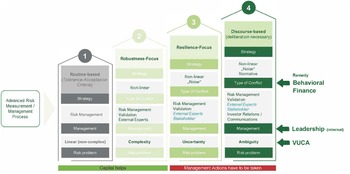
The following four-level approach, Figure 1 adapted from Renn & Klinke (Reference Renn and Klinke2015), shows, depending on the dominating VUCA component, which risk management strategy should be chosen.
Renn’s VUCA-adapted risk management approach, generalizing the process model as laid down in the ISO-Norm’s risk management framework. Source: adapted from Renn & Klinke (Reference Renn and Klinke2015).

The first level (routine-based approach) is applied to portfolios consisting of well-understood instruments (e.g., bonds) under normal circumstances. Here, traditional approaches will work perfectly (known unknowns). Model uncertainty is rather limited and a capital-based regulatory framework works well. Typically, decisions are easy to take.
For more complex situations, where extreme events (e.g., natural catastrophe models in non-life insurance) are involved, the second level is needed. Here typically, loadings are applied by experienced actuaries in order to take complexities adequately into account. Note that related risks are still considered to be acceptable, and the taken risks are in line with the strategy and the limit and threshold system. The complexities are buffered by additional capital in order to robustify the framework and to avoid surprises (mild unknown unknowns).
The remaining two levels are characterized by significant epistemic uncertainties which introduce wild unknown unknowns or even unknowable black swans(in the sense of Taleb, Reference Taleb2008). In such a situation, countermeasures, that is, actions against the risk, is the first choice. Here, senior management is to be incorporated in order to figure out the right prioritization but also to manage the expectations of external stakeholders. In such a situation, also very typical for climate risks, the application of regulatory capital requirements is cumbersome for a number of reasons.
-
In general, the risk is at least at the borderline of being unacceptable – this is the reason why senior management has to be involved.
Typically, the process of risk measurements is unstable (caused by ambiguities) and accompanied by various uncertainties.
-
In principle, taken management actions could be incorporated (analog to management rules in internal models) into the measurement process. However, this would amplify model uncertainty dramatically, because all conclusions and figures depend crucially on the assumptions underlying the measurement. Situations alike, led at the end of the 1990s to reject to build up VaR-type models for liquidity risks of banks.
To provide insights to epistemic aspects of formal properties of risk measures, we consider a monotone, translation invariant and sub-additive risk (coherent) measureFootnote
3
 $\varrho$
:
 \begin{equation} \text{CFO} : \varrho (X +A ) = \varrho (X) -a \end{equation}
This defines in an abstract sense the role of the CFO as a member of the first line of defense in the risk management, who should should be able to design a portfolio
 $A$
, which generates an expected return
 $a$
such that (1) is true.
The epistemic consequence of this requirement are discussed below:
Example 2 (Epistemic aspects of translation invariance). The invariance relation (1) and the hereby defined role of capital is crucial for the risk management process as a whole in various aspects.
-
Hedgeable Risk: The portfolio
 $A$
in relation (1) can be seen as an insurance; hence,
$X$
is assumed to be a hedgeable risk.
-
Valuation: The availability of a valuation function for
$X$
is a silent feature in (1) which is crucial for the calculation of
$\varrho (X)$
.


Due to the existential nature of climate risk, the homeostatic assumption that the risk management process can keep the control variable
 $\varrho (X)$
within predefined limits by means of the portfolio
 $A$
(or a cash amount
 $a$
) may fail for this particular systemic risk. Climate risks cannot be hedged because their consequences are beyond financial losses. Climate risks are highly uncertain and at least at the current stage of research difficult to price; hence, the (Knightian) risk cannot be estimated. The nature of systemic risk lies in the nonlinearities. All in all, the epistemic characteristics of climate risk erode the formal mathematical properties underlying the axiom of a translative risk measure, which is indispensable for charging a portfolio with a regulatory capital for climate risk.
In order to address climate risk, we structure the risk management process as follows:
-
The broad concept of a model in a wide sense is introduced. This allows to address factors of climate risk in a holistic way.
-
The phenomenon of climate risk is viewed as a systemic risk.
-
Systemic risks are characterized by VUCA. Depending on which of these components is dominating, appropriate risk management strategies can be chosen.
-
As climate risk is dominated by uncertainties, the current regulatory approach for insurance companies allows a smooth fit of climate risks in the framework of model risk. We will therefore explore the treatment of climate risk in this context.Footnote 4
Model in a wide sense. We start our exposition by introducing the concept of a model in a wide sense; see Jaschke & Stahl (Reference Jaschke and Stahl2007) and Stahl (Reference Stahl2016). Its definition intents to mirror the real-world complexity of risk management by considering a model as a holistic tool to understand and interpret reality.
In order to contrast ideas, let us consider a model in a narrow sense first. This model type can be understood as a functional
 $T$
on the space of distribution functions
 $F_X$
related to random vectors
 $X$
, representing the (stochastic) risk factors:Footnote
5
 \begin{equation} T(F_X). \end{equation}
Typically, the risk is then quantified by a risk measure,
 $\rho (X)$
, say. The perspective of this model class is dominated by a pure, objective setting with aleatoric uncertainties. In particular, this framework neglects important features of real-world requirements:
-
the focus of risk management, including the risk management process, is on decisions, not on measurement;
-
epistemic uncertainties have to be taken into account;
-
normative aspects related to stakeholders, especially the role of regulators and regulation, have to be considered;
-
systemic components such as markets and peers and their expectations and possible feedbacks need to be included;
-
organizational issues should be incorporated.
Therefore, we advocate the interpretation of models in a wider sense, which requires a broader concept of model uncertainty and, as a consequence, a broader concept of model validation. In addition, it includes the simultaneous application of three kinds of probability measures, namely real-world
 $\mathbb{P}$
, risk-neutral (pricing)
 $\mathbb{Q}$
, and subjective measure
 $\mathbb{S}$
. The latter aspect leads to so-called hybrid models; see Aven (Reference Aven2011) and Aven et al. (Reference Aven, Baraldi, Flage and Zino2014).
Definition 2 (Model in a wide sense). We define a model in a wide sense by the functional relation:
 \begin{equation} F(X_{t+h} \mid \circ ) \,:\!=\, F(X_{t+h} \mid \mathfrak{I}_t, Z_{H \mid t}, \mathbb{O}, \textrm{R}). \end{equation}
Here,
 $F$
is a forecast distribution with forecast horizon
 $h$
for the variable of interest,
 $X$
.
 $F$
is understood as the output of the model.
The definitions of the conditioning sets together with their interpretation are given in the following remarks.
-
1. The relational reference (3) conditions on the sources of risk
$\mathfrak{I}_t, Z_{H \mid t}, \mathbb{O}, \textrm{R}$
in the information set. It is the explicit incorporation of all sources of uncertainty in an holistic approach. Observe, that the information set on which solvency capital requirements (see European Commission, Reference European Commission2022 for a treatment of solvency regulations) are calculated is typically a subset of
$( \mathfrak{I}_t, Z_{H \mid t}, \mathbb{O}, \textrm{R})$
. -
2.
$\mathfrak{I}_t$
denotes ordinary data sets which are generated and updated continuously. It is further split into:(4)where
\begin{equation} \mathfrak{I}_t : = (\mathfrak{D}_t, \Lambda _t), \end{equation}
$\mathfrak{D}_t$
are data related to risk factors and
$\Lambda _t$
denotes an exposure vector. In the context of calibration or the usage of an economic scenario generatorFootnote
6
time series of prices of financial instruments are an example for
$ \mathfrak{I}_t$
. In addition to empirical data experts judgments might be used. We denote by
$\mathfrak{I}_t$
input data related to sources of risk represented by a particular model. The relation(5)is a version of (1), which states the information set explicitly. As such it is a model in a narrow sense. We refer to McNeal et al. (Reference McNeal, Embrechts and Frey2015) for several examples of this model type.
\begin{equation} F(X_{t+h} \mid \mathfrak{I}_t) \end{equation}
-
3. The information set
$Z_{H \mid t}$
denotes some background knowledge, given at time
$t$
for a time horizon
$H \gg h$
. On the one hand,
$Z_{H \mid t}$
is used during the modeling process (e.g., variable selection), and on the other hand it reflects forward-looking information and expertise (e.g., strategic issues, especially targets). Compared with the information set
$\mathfrak{I}_t$
,
$Z_{H \mid t}$
is not the output of a physical production process, but merely gathering external and internal opinions, expectations, etc. Note, (3) comprises micro- and macrofinancial resp. economic aspects as well. Furthermore, the incorporation of
$Z_{H \mid t}$
allows to determine the possible regret along with decisions based on (3). This builds the bridge from risk-based to risk-informed decisions and emphasizes the overarching function of the concept of Use Test under Solvency II; see European Insurance and Occupational Pensions Authority (2022). -
4. With
$\textrm{R}$
regulatory requirements are denoted, whose compliance is a prerequisite. Examples are the EIOPA frameworks, as well as requirements from rating agencies and investors; see European Insurance and Occupational Pensions Authority (2022). By deciding on specifics of the forecast horizon
$h$
, the level of significance, the granularity of risk categories, and via requirements on the organization and business processes external stakeholders may design the model (3). The influence on processes determines explicitly the costs and impacts on operational risk. -
5.
$\mathbb{O}$
denotes the organizational setup of the undertaking. For insurance groups with their separation of business lines, this goes hand in hand with complex segregation of duties and responsibilities. Furthermore, group-wide fractioned business processes are very common. -
6. The model (3) could also interpreted as:
(6)where
\begin{equation} F(X_{t+h} \mid \mathfrak{I}_t, \mathcal{K}), \end{equation}
$\mathcal{K}$
denotes the companies’ individual background knowledge, that is,
$\mathcal{K} = \big \{Z_{H \mid t}, \mathbb{O}, \textrm{R} \big \}.$
The term background knowledge emphasizes the subjectivity of
$\mathcal{K}$
.


In the context of financial regulation, the history of model risk traces back even beyond the era of so-called internal models. One main argument to allow firm-specific, stochastic models for regulatory purposes was the insight that standard formulas could not capture risks that come along with complex financial instruments. Hence, internal models were seen as a tool in order to reduce model risk in a standard formula’s approach. A path-breaking publication by the Office of the Controller of the Currency (OCC), see Comptroller of the Currency (2011), dominated the discussion how to conceptualize model risk.
How does Solvency II fit in the Framework? It is important to note that systemic risks are already considered in the Solvency II framework; see the legal comment in Stahl (Reference Stahl2016) for details.
Example 3
(Systemic Risk induced by Implementing Solvency II). The implementation of Solvency II came in the year 2016 into force. However, regulators started that process in the beginning of the new millennium with the conviction that for various reasons internal model performed superior to standardized regulatory approaches. This opinion eroded with the financial crisis. In consequence, the Solvency II project was postponed and the supervisory framework was completely restructured along with many consequences. One consequence was the decision to higher the level of capital compared to Solvency I. By and large the capital requirements were doubled. At the same time, interest rates declined almost to zero. This amplified the pressure especially for life insurance business with imbedded interest rate guarantees for policy holders. In the framework of a model in a wide sense, this can be interpreted as a systemic risk induced by Solvency II, that is,
 $\textrm{R}$
in (3).
It is interesting to see how regulators managed this systemic risk. They decided to apply measures related to the balance sheet (so-called transitionals) such that the insurer’s
 $CAR$
was sufficient comfortable to continue the business. However, this privilege was granted under the prerequisite that at least after 16 years the insurance satisfies the Solvency II requirements completely. Of course, this process of adapting to the new regime is tightly accompanied by the competent regulator. The difference measured in
 $CAR$
with and without transitionals was several hundred percent. The strategy of the regulators used the resiliency, in the sense of Renn’s approach, to overcome the critical situation.
Let us emphasize in this context also the (possible miss-)alignment of objectives of government and regulators on the one hand and economic and financial agents on the other hand. A striking example is given in Lengwiler (Reference Lengwiler2016), where pricing and risk modeling of securitization in terms of a historical analysis of financial mathematics is considered. His analysis provides new insights on the sociological interplay (and feedback) between the model
 $F_t$
and the context or background knowledge
 $\mathcal{K}$
resp.
 $Z_{t+H}$
in (3). In the context of securitization, the socio-political conventions (financing private real estate with public support) were replaced by financialized, market-oriented conventions, where public responsibilities were transformed to private ones. This changed the role and responsibilities of the involved stakeholders (public state, investors) fundamentally. With this shift in responsibility, the rules in performing the game also changed according to the paradigm of economics, whereas the normative authority of involved mathematicians and actuaries increased the legitimacy of those transactions. We should be aware of these lessons from the financial crisis when we try to estimate climate risks.
Lengwiler’s work raises a warning flag that neither mathematical models nor economic paradigms will capture human behavior, represented in the collective consciousness. Insofar, a new component of model risk emerges as the transformation delivered by the mathematical model cannot equate the roles of different stakeholders. We should be aware about this type of risk, because capital calculations for climate risks might repeat this story.
3. Climate Risk as Model Risk
To illustrate our approach, we will specify the setting of Solvency II further. Under the Solvency II regime, insurance companies are required to determine their solvency capital required (SCR) by means of an internal model or by the standardized formula. In addition, the Own Risk and Solvency Assessment (ORSA) stands for a process which insurance undertakings have to implement in order to quantify the amount of risk the insurance is exposed to, yet which is not covered by the SCR. We denote the amount of risk not captured risks by the
 $SCR$
with
 $NCR$
. At least systemic risks, emerging risks, strategic risks, and model risk (related either to the standardized formula or an internal model) have to be considered for the determination of
 $NCR$
. The principal stakeholder of ORSA reports is the board of the company, regulators are the second. In order to subsume climate risks as part of model risk, we employ the
 $NCR$
. It will be quantified, but no explicit regulatory capital will be required.
Let us calculate the amount of economic capitalFootnote
7
 $\textbf{C}$
necessary to cover all risks related to the model in a wide sense:
 \begin{equation} \textbf{C} = \varrho (F(X_{t+h} \mid \mathcal{I}_t, Z_{t+H}, \mathbb{O}, \textrm{R})). \end{equation}
Because (7) takes model uncertainties in the form of Definition 2 into account, climate risks may be captured. More precisely, climate risks are part of NCR. We interpret
 \begin{equation} \textbf{C} \,:\!=\, SCR \oplus NCR \equiv \varrho (F(X_{t+h} \mid \mathcal{I}_t, Z_{t+H}, \mathbb{O}, \textrm{R})) \end{equation}
as the aggregate of
 $SCR$
and
 $NCR$
, where
 $\oplus$
denotes aggregation. Thus,
 \begin{eqnarray} SCR &: = & \varrho (F(X_{t+h} \mid \mathcal{I}_t) \\ & \leqslant & \varrho (F(X_{t+h} \mid \mathcal{I}_t, Z_{t+H}, \mathbb{O}, \textrm{R})) = SCR \oplus NCR, \nonumber \\ & =& \textbf{C}\nonumber \end{eqnarray}
The difference
 $\textbf{C} - SCR$
yields an important input for the capital management process, which is outside the regulatory capital approach.
As shown above climate risks are already part of the NCR, and as such within the model risk framework. We now list further advantages in considering climate risk as model risk:
-
1. Climate risk is treated similar to other strategic risks the undertaking faces, for example, business cycles, digitalization, etc.
-
2. Model risk is already included within the ORSA process.
-
3. The inherent uncertainties are taken into account as resiliency is fostered. This is in line with other strategies to address the challenges in a VUCA environment.
-
4. A smooth fit to the current regulatory regime, which explicitly does not empower competent authorities to apply some type of capital add-on based on the ORSA or on recovery and resolution plan (RRP), is achieved.
-
5. A strong and visible signal that public duties are not delegated to investors is given.
-
6. The application of current approaches to systemic risk, such as SRISK, see Brownlees & Engle (Reference Brownlees and Engle2017), and their variants to climate risk, see Acharya et al. (Reference Acharya, Berner, Engle, Jung, Stroebel, Zeng and Zhao2023) would result in higher capital charges, if the system as such is in a bad situation. However, this is not in line with current risk management and regulatory approaches
-
7. Availability biases, possibly induced by measurement approaches, that would give climate risk a flavor of an acceptable risk as it fits within a limit and threshold system would be avoided.
-
8. Given that climate risk will also foster and catalyze innovations in finance and technology, it seems difficult to incorporate the positive unknowns.
-
9. The legal codification of regulatory capital requirements might increase regulatory risks for the undertaking, because for instance legal consequences of too low capital ratios can be disproportionate in light of the deep uncertainties related to climate risks.
As we saw that routine-based techniques of risk quantification do not work well for systemic risks and especially not for climate risks, we advocate the application of the so-called precommitment approach (PCA), inaugurated by Kupiec & O’Brian (Reference Kupiec and O’Brian1995) in the early days of modern risk management, as an alternative approach. Let us discuss this approach in some detail next.
De-mystifying the PCA. The PCA is based on a radical way to determine the necessary capital for market risk positions, as no prescriptions by the regulators are made, on how the capital is calculated. A penalty function is applied to the financial institution, if losses surpass the precommitted amount of capital. Among others, Goodhart et al. (Reference Goodhart, Hartmann, Lewellyn, Rojas-Suarez and Weisbrod1998) saw in the application of the penalty function by the regulator as well as in the calculation of the capital by the financial institutions a source of moral hazard and consequently rejected the PCA for regulatory purposes. Shephard-Walwyn & Litterman (Reference Shephard-Walwyn and Litterman1998) proposed a hybrid form of regulatory capital based on an internal model or standard approach plus a component derived by the PCA to cover complex risk and uncertainties beyond the regulatory capital. This is in spirit very close to (8). We extrapolate their approach insofar as we apply the internal model for the known unknowns, whereas the component related to the PCA is applied to the unknown unknowns; see Kleindorfer (Reference Kleindorfer2010). The latter may be renamed as model risk. Though the PCA was not adopted at former times, Casellina et al. (Reference Casellina, Pandolfo and Quagliariello2020) proposed its use recently in the context of firm-specific stress tests that are assumed to be superior compared to those neglecting specific information. Also, Chenet (Reference Chenet2021) advocated the use of PCA together with macroprudential policy in a financial stability context.
Observe that the precommitment is very similar to the way how shareholders are treated by listed companies. Once a year, the company commits to the expected revenues for the next year. This is an important input for investors to hold, buy, or sell their investment in the company. On a quarterly basis, the company informs the capital markets about success or risk in achieving theses committed targets. Both over- and under-shootings of the target caused, for example by surprising events, have to be communicated by a so-called ad hoc reporting. This process is successfully applied by capital markets. Furthermore, as the past has shown, capital markets react much quicker than regulators. Hence, the PCA is better than its image.
Roads toward managing climate risks. The landmark analysis outlined in Renn & Klinke (Reference Renn and Klinke2015) gives a roadmap on how to deal with systemic risks, which can be applied to climate risks. In the first step, the risk manager has to cluster the phenomenon according to the VUCA categories. Dominating is on the one hand, and the uncertainty inherent to climate risk and ambiguity on the other hand.
Hence, the as low as reasonable achievable (ALARA) precautionary principle should be applied. The uncertainty hits the liabilities of insurance companies directly via the realizations of physical risks, whereas transition risks are already present, only the size and timing are uncertain. Furthermore, the impact of climate risks on various nation’s economies is heterogenous which induces ambiguities with respect to various stakeholders (governments, undertakings
 $\ldots$
). In combination with resiliency strategies which allow to cope with transition risks, the undertaking prepares for adaptation. Currently, regulators put pressure on these issues.
We have shown that the current regulatory framework of Solvency II is in line with Renn’s framework. By means of the ORSA and RRP, systemic risks may be identified and also measured in order to define whether the risks are acceptable or tolerable. Furthermore, the regulatory framework prefers the application of resiliency principles to systemic risks related to uncertainty, not capital requirements. In fact, within the current legal framework (German law) for model uncertainties – in contrast to model errors – the result of ORSA analysis does not allow authorities to apply capital add-ons.
4. Robustness, Resilience, and the PCA
Recall the robustness refers to the ability to absorb a shock and resilience is the ability to bounce back after a shock. Thus, we can relate capital-based risk measures to generating robustness of the system, while the PCA aims to increase the resilience of a system.
In this section, we will illustrate the effect to both approaches regarding climate risk with various examples. Let us start with the result of the Bank of England stress test; see Bank of England (2019) for details on purpose and design.
Example 4
(Climate Stress Tests based on the Bank of England (BoE) Scenarios). Table 1 depicts the results of applying the BoE scenarios for a risk analysis in a large insurance group. For the different scenarios, we find moderate reductions for the capital adequacy ratio (CAR). E.g., for the business-as-usual scenario, a CAR of
 $ 250\%$
would drop to
 $200\%$
largely driven by effects on own funds. The impact on the solvency capital required (SCR) is not that influential.
Results of the bank of England stress test.

At a first sight, the impact of the stress scenarios seems quite high. However, results below will show however that the impact is judged as merely intermediate. This is not in line with the overall perception of the magnitude of climate risks, see for example the discussion of the SCC in the introduction. This underlines that the current state of knowledge about climate risks are prone to high level of uncertainty, which makes explicit capital requirements cumbersome. Again, the focus should be on the risks and not on the rules, that is, we should foster decision structures within undertakings that improve resiliency.
Before we compare the empirical results with other outputs from risk management, we emphasize the key role of the mapping:
 \begin{equation} T \,:\, \textbf{C} \longrightarrow \textbf{R} \end{equation}
which transforms climate-related risk factors
 $\textbf{C}$
into financial ones
 $\textbf{R}$
.
Table 2 shows the return periods for spreads, yields, equities, and real estate for the three BoE scenarios. The return periods are determined w.r.t. to an internal model’s economic scenario generator, denoted by
 $\mathcal{ESG}$
. For the BoE scenarios,
 $T$
culminates in significant credit spread shocks as a return periodFootnote
8
of about 125 years is estimated.
Return periods for key financial factors under the BoE scenarios.

In order to assess the magnitude of the CAR impact of the BoE stress test results, we provide quarterly CAR figures from 27 large insurance groups, which applied internal models for risk measurement, starting from 2016 based on the evaluations of publicly available insurer’s SFCR reports. Table 3 shows the range of these CAR figures.
Quarterly CAR variations.

We observe a variation of CAR values in a range of 10–80%. By and large, this volatility may attributed to three different sources:
-
model changes, including regulatory requirements,
-
changes in the portfolio (reshuffling), and
-
changes of market conditions.
Given the experience of nearly one decade, it is not unfair to assume that the impact of these three sources is at equal weight.
From Table 3, we conclude that 30–50 percentage points of CAR variability has been experienced; hence, this range is to be expected for the future. Observe that the BoE stress test generate CAR changes well within this range. Hence, the systemic character of climate risks is not addressed at all.
Building Blocks for the PCA. The development of forward-looking scenarios
 $\mathbb{S}$
is the crucial building block in order to run the PCA. To do this in a firm-specific fashion, a macroeconomic model has to come into play. Such an economic model is needed to generate forward-looking, economically coherent views on the macroeconomic development. The model needs to cover nearly all countries and to provide a long-time horizon that is appropriate for risks related to climate change. Such a through-the-cycle approach fits well with the long-term business model of insurers.
Given such a forward-looking macroeconomic model (or an economic scenario generator,
 $\mathcal{ESG}$
), the first step toward an analysis of climate risk can be done via reverse engineering. In the first step, an interdisciplinary group of experts should adapt the theoretical relation (10) to the undertakings situation. The outcome of this exercise is a set of scenarios
 $\textbf{s}=\big \{ s_1, \ldots, s_n \big \}$
with associated subjective probabilities
 $\textbf{p} =\big \{p_1, \ldots, p_n \big \}$
, where the pair (s, p) is denoted by
 $\mathbb{S}$
. The insights of the experts will act as a distortion function to the real world measure
 $\mathbb{P}$
in the
 $\mathcal{ESG}$
. This will help the undertaking to prioritize actions and decisions. In order to keep the operational burden for the determination of the impact of a chosen
 $\textbf{s}$
at a minimum, we approximate
 $\textbf{s}$
by the scenarios derived by an
 $\mathcal{ESG}$
of an internal model by:
 \begin{equation} \textbf{s}_m\,:\!=\, \min _{\textbf{e} \in \mathcal{ESG}} \| \textbf{s} - \textbf{e} \|. \end{equation}
In the next step, we determine the value
 $\nu$
of portfolio
 $\pi$
under the scenario
 $\textbf{s}_m$
:
 \begin{equation} \nu (\pi )(\textbf{s}_m) \end{equation}
of course we have to adjust
 \begin{equation} p_{\mathbb{P}}(\nu (\pi )(\textbf{s}_m) \geqslant x) \end{equation}
according to the distortion function of the experts. This is the moment, where the PCA comes into play, which elucidates subjective probabilities, in order to express differentiate between acceptance or tolerance level.
The following example shows that the proposed pragmatic approach works in practice.
Example 5
(Pragmatic Approach in Practice). In the first step, we have to solve the approximation problem (11). The following Table 4 shows 10 approximation to the BoE scenarios given the insurer’s
 $\mathcal{ESG}$
. The approximation is based on a
 $L^2$
- norm in
 $\mathbb{R}^n$
, the space of risk factors. Table 4 shows approximations with respect to an internal
 $\mathcal{ESG}$
for the three BoE climate scenariosFootnote
9
. The first row shows the BoE value and the further 10 rows show the results for the best
 $\mathcal{ESG}$
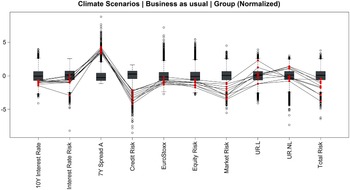
scenarios. Observe that the median of losses from these approximative scenarios is quite close to the result of the BoE scenarios. We applied a standardization in order to compare location and variability of risk factors and loss variables for the
 $\mathcal{ESG}$
scenarios in the BaU climate scenarioFootnote
10
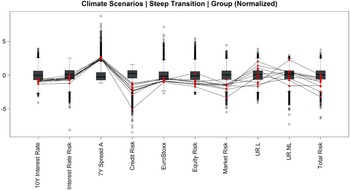
. The results are displayed in Fig. 2. By construction market risk dominates. In addition, observe that the trajectories of insurance risks underwriting life (UR.L) and non-life (UR.NL) indicate possible diversification effects.
Approximations for BoE scenarios.

Capital-based Climate Risk Assessments. Climate-adjusted capital requirements (CACRs) may be seen as an attempt to adjust the capital-based system by adjusting risk weights. However, as Phillips (Reference Phillips2023) points out there are both legal and practical issues related with an implementation. Regulators may implement capital requirements for the sole purpose to ensure the stability of financial institutions. Thus, evidence has to be provided that climate risks endanger the stability of institutions. Grünewald (Reference Grünewald2023) gives an overview on further possible regulatory tools, in particular borrower-based and liquidity-based tools. Again, the limited applicability of theses tools is shown.
Another, more forward-looking approach is labeled climate value-at-risk (ClimVaR). ClimVaR in its original version, see Dietz et al. (Reference Dietz, Bowen, Dixon and Gradwell2016) quantifies the size of loss attributable to climate-related financial risks by comparing the value of assets in a world with climate change relative to the same world without climate change and as such is largely scenario-based. More recent approaches combine scenarios, for example, from the IPCC Sixth Assessment Report (AR6), which consider the impact of climate change through different Shared Socioeconomic Pathways (SSPs). The impact of these scenarios on asset and liabilities is then calculated by using a (range of) integrated assessment model(s). The impact distributions of the scenarios are then combined by assigning likelihoods to obtain an aggregate distribution, which can be used to generate typical VaR numbers. As ClimVaR is used to calculate risk capital, it can be viewed as a mean to increase the robustness of the system.
Boxplots of standardized risk factors and loss variables (BaU).

Forward-looking Climate Risk Metrics. Recently, forward-looking metrics, such the ClimVaR and Implied Temperature Rise (ITR) have been proposed to replace the backward-looking emission-based metrics (such as emission intensities); see Hellmich & Kiesel (Reference Hellmich and Kiesel2021).
An ITR metric estimates a global temperature rise associated with the CO
 $_2$
emissions of a single entity (company, region, and country) or a selection of entities (investment portfolio, fund, or investment strategy). More specifically, an ITR analysis starts with a specific temperature target and a given time horizon (say 1,5
 $^\circ$
C by 2050). Given this target, a carbon emission budget available to reach it with a given probability can be specified. Now for the entity under consideration, the future emissions are projected from historical emissions and announced emission reduction targets. In the next step, the estimated future emissions are compared with the entities carbon emission budget. The under/overshot of the carbon budget can be mapped to the corresponding global temperature rise under the assumption the under/overshot is representative for the global economy. (For a detailed account of ITR metrics, see Institut Louis Bachelier et al., Reference Institut Louis Bachelier2020). As ITR disclosure directly informs about the position of an entity in relation to global climate targets, such as the 1,5
 $^{\circ }$
C–2
 $^{\circ }$
C range, it can be used to monitor the resilience of an entity. In particular, the time series of ITRs of the entity represents an indicator of the dynamics of climate risk of the entity in relation to the overall system.
Given a specific temperature target and a time horizon (say 1,5
 $^\circ$
C by 2050), a carbon emission budget available to reach the temperature target with a given probability can be specified. For the entity under consideration, the future emissions are projected from historical emissions and announced emission reduction targets. The estimated future emissions are compared with the entities carbon emission budget.
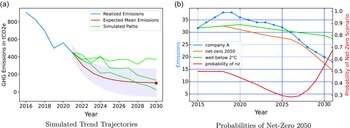
Based on a deterministic trend and normally distributed disturbances, Fig. 3(a) in Fig. 3 illustrates the analysis with a simulated paths and the 10th% and 90th% quantiles. Fig. 3(b) utilizes a Bayesian updating inspired by Flora & Tankov (Reference Flora and Tankov2022) to show the simulated paths (blue) of a firm and its probabilities of achieving a net-zero target. Observe the increase of probabilities as the firm intensifies its decarbonization efforts from 2025 to 2030.
Carbon budget analysis.

A further discussion of this approach together with additional underlying models can be found in Chekriy et al. (Reference Chekriy, Kiesel and Stahl2023).
Carbon Equivalence Principle (CEP). An alternative framework to measure a progress toward resilience is the CEP as suggested in Kenyon et al. (Reference Kenyon, Berrahoui and Macrina2022). Here, the authors suggest to use enabled (made possible) and caused (required for) carbon-equivalent emissions to be linked to financial products. Thus, a financial institution could define a dynamically decreasing carbon budget (say yearly until a given time horizon) and allocate this budget within the institution. As with risk capital, the institution would spend the carbon budget on the most rewarding financial products and activities.
Example 6. The CEP and the ITR can be used as a control quantity for a cybernetic control of the progress of a company toward resilience with feedback within the risk management approach proposed by Renn (Reference Renn2006). This allows companies to use processes established within the VUCA setting; see Fig. 1. Furthermore, the dynamic progress of a company toward an adaptation is measurable, which is key toward a verifiable quantitative classification (a key difference to binary sustainability classifications). Such an approach is comparable to example 6, which illustrated the regulatory treatment of life insurance companies during the implementation of Solvency II. This also provides a blueprint that has proven its usability. The general principle is to combine the PCA toward the implementation of resilient processes within a controllable dynamic model. Mapping the quantitative results in a model risk in the wide-sense framework allows the appropriate enterprise-wide risk management tools to be applied and also a regulatory macroaggregation which represents an overall view on the state of the system. The approach is open to further regulatory refinement and concrete control-theoretic methods for its implementation.
5. Conclusions
In this article, we propose a model which is able to deal with the particular features of climate risk characterized by deep uncertainty, nonlinearity, and cascading effects. As climate risk represents a systemic risk, we need to address it within the VUCA framework. We argue that the model in a wide sense provides the right structures to interpret systemic risks as model risk and relate it to Renn’s VUCA approach for risk management. We also point out that the current Solvency II framework (with its three-pillar approach) captures many of Renn’s paradigms of a VUCA framework, and that it can be smoothly interpreted in terms of the model in a wide sense. Furthermore, we provide evidence that the current capital-based approach toward climate risks is not appropriate (in particular, in the light of the transitionals applied to insurance companies). Strikingly, a comparison of historic volatility of CAR ratios shows that scenario-based CAR with respect to climate risk is well within the historic range. In addition, we suggest pragmatic approaches which harmonize regulatory climate scenarios with firm-specific ones. Overall, we argue for a resilience-based approach as the strategy of choice, which does not opt for capital. In terms of probabilistic risk assessment, we show that the PCA bridges the gap between traditional probabilistic frameworks and Kolomogorov with those suggested by Savage.
A. Results for additional climate scenarios
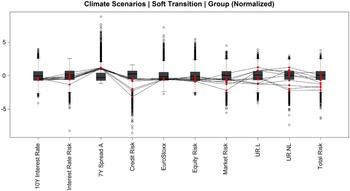
Boxplots of standardized risk factors and loss variables (soft transition).

Boxplots of standardized risk factors and loss variables (steep transition).