Introduction
Although exercise has been widely accepted as beneficial for health, successful implementation of exercise interventions presents a major challenge for many older people (Chao et al., Reference Chao, Foy and Farmer2000). This can be particularly true for people with dementia (Tilly and Reed, Reference Tilly and Reed2008), especially those who live in the community (Teri et al., Reference Teri2003). A review of interventions for people with dementia (Tilly and Reed, Reference Tilly and Reed2008) concluded that adherence to exercise interventions can often become more difficult as the severity of cognitive impairment increases. Adherence, which is defined as the extent to which a client completes the active element of treatment effectively after the therapist has given advice and instruction (Chen et al., Reference Chen, Neufeld, Feely and Skinner1999), comprises a wide variety of behaviors including entering into and continuing a treatment program (Brewer, Reference Brewer1998; Taylor et al., Reference Taylor, Dodd, McBurney and Graham2004). For exercise programs to be beneficial, clinicians must consider factors that influence both program commencement and completion. Investigation of the factors associated with adherence to a balance exercise program lends itself to a qualitative analysis by exploring the perceptions of the people who participate in the program.
Qualitative analysis has been used successfully in identifying factors important for adherence in other groups of people with physical or cognitive impairments (Allen et al., Reference Allen, Dodd, Taylor, McBurney and Larkin2004; Taylor et al., Reference Taylor, Dodd, McBurney and Graham2004; Dodd et al., Reference Dodd, Taylor, Denisenko and Prasad2006; O'Shea et al., Reference O'Shea, Taylor and Paratz2007). These qualitative studies in people with cerebral palsy, chronic obstructive pulmonary disease, and multiple sclerosis identified factors (such as a programs’ perceived potential benefits, and support or encouragement from health practitioners who conducted the programs) that were important in motivating participants to commence and complete programs. However, factors influencing commencement and adherence to exercise programs are likely to differ between clinical groups and for different exercise approaches. No previous qualitative studies indicating the factors that influenced adherence to balance exercise programs or other forms of exercise for people with Alzheimer's disease (AD) have been identified.
Therefore, the aim of this qualitative study was to identify factors that influence commencement and adherence to a home-based balance exercise program for older people with mild to moderate AD, based on the perceptions of participants who completed a six-month program. As people with AD commonly need the assistance of their caregivers to complete many everyday activities, it was anticipated that caregivers would play a critical role in program delivery. Therefore perceptions from the participants’ caregivers were also sought.
Methods
Study design
A phenomenological theoretical framework was used for data collection and analysis. This qualitative approach focuses on describing the participants’ lived experiences with the particular issue. It elicits rich, descriptive data from a lived experience by setting aside previous knowledge or theories, and investigators’ beliefs, experiences, and perceptions (Creswell, Reference Creswell2007). The current study was conducted in conjunction with a quantitative pilot randomized controlled trial (RCT) study investigating the feasibility and effectiveness of home-based balance exercise in people with mild to moderate AD (Hill et al., Reference Hill, LoGiudice, Lautenschlager, Said, Dodd and Suttanon2009). The pilot RCT demonstrated that the program was safe and feasible, and improved several balance and mobility outcomes (Suttanon et al., submitted).
Participants
Nineteen participants (ten older people with mild to moderate AD who had completed the balance exercise program, and nine of their caregivers who were involved in supervising or monitoring the program) were recruited to this study. One participant with AD who was living alone (with community supports) and had been doing exercise without caregiver supervision was also invited to participate in this qualitative study. Participants with AD were included in the RCT study (Hill et al., Reference Hill, LoGiudice, Lautenschlager, Said, Dodd and Suttanon2009) if they: (1) had a diagnosis of AD confirmed by medical specialist or Memory Clinic assessment; (2) had mild to moderate dementia (Mini-Mental State Examination (MMSE) score ≥ 10; Folstein et al., Reference Folstein, Folstein and McHugh1975; Magsi and Malloy, Reference Magsi and Malloy2005); (3) were independently mobile (able to walk outdoors with no more support than a single point stick); (4) were living in the community; and (5) had no other major neurological or orthopedic conditions that impacted on their functional mobility. All participants except one (who the physiotherapist conducting the exercise program reported was unable to remember the program or the physiotherapist's visits during the program) who completed the program were invited to take part in the qualitative study. Ten of the 11 invited participants with AD (with nine caregivers) agreed to take part in the qualitative study. The 11th participant and her caregiver declined as the participant with AD was in the process of transferring to residential care.
Home-based balance exercise program
The exercise program was based on an individualized home-exercise program that has been shown to reduce falls in older people without cognitive impairment (the Otago program, available at http://www.acc.co.nz/preventing-injuries/athome/older-people/information-for-older-people/otago-exercise-programme/index.htm; Campbell et al., Reference Campbell, Robertson, Gardner, Norton, Tilyard and Buchner1997). In the current study, the exercise program was modified to run for six months with five 15–20 minute sessions of exercise and five sessions of walking each week. The program duration and exercise sessions were modified to be less intense than the original program and to reduce the cognitive and attentional demands associated with some exercises (Hill et al., Reference Hill, LoGiudice, Lautenschlager, Said, Dodd and Suttanon2009).
An experienced physiotherapist with neurological rehabilitation and aged care experience selected the appropriate exercises for each participant, and these were demonstrated to the participant and their caregiver at an initial home visit. A booklet with illustrations and instructions for each exercise was provided to participants and their caregivers. A monthly exercise recording sheet with a list of prescribed exercises and walking was provided for participants or caregivers to record which exercises were done each day. Caregivers were asked to support the person with AD to adhere to the prescribed program by providing verbal reminders or encouragement as appropriate. During the six-month program, the physiotherapist completed six home visits to monitor progress, provide advice, and modify the exercises according to the participant's performance. In introducing and modifying the exercises, the physiotherapist paid particular attention to ensure exercises were performed safely. The first four visits were held two weeks apart, the next two visits were held six weeks apart, and five follow-up phone calls were made by the physiotherapist in between face-to-face visits. This pattern provided frequent support early in the program to maximize the participants’ and caregivers’ understanding of the exercises and to increase safety. In addition to these pre-scheduled contacts, participants and caregivers were invited to contact the physiotherapist if required at any time.
Data collection
Ethical approval was obtained from the relevant Health Services and University Human Research Ethics Committees. Written informed consent was obtained from participants or their next of kin or their caregivers, and from the caregivers who were interviewed.
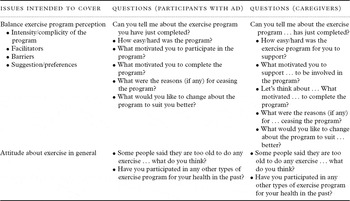
Semi-structured in-depth interviews were employed to explore the participants’ and caregivers’ perceptions of the exercise program, and their attitudes to the importance of doing exercise. Semi-structured interviews were used because this method allows the interviewers to establish a conversational style and to question participants spontaneously. It provides opportunities to follow-up responses and elicits more details from participants (Liamputtong, Reference Liamputtong2009).
The preliminary schedule of questions developed to guide the interview contained broad areas to be discussed and was revised as new topics were raised during the interview (Table 1). Questions explored the contexts or factors that had influenced participants’ commencement and completion of the exercise program. Other questions assisted in understanding participants’ attitudes towards exercise in general.
Key questions forming the semi-structured interview schedule

AD = Alzheimer's disease.
The semi-structured interviews were conducted by two investigators (KB, PS). One investigator led the interview (KB) with the other (PS) assisting by asking follow-up questions and ensuring that the interview covered all relevant topics. The main interviewer was unknown to participants before the interviews. The second interviewer had met the participants when they were assessed for balance and mobility performance before the interview. Neither interviewer was involved in the implementation of the home-based balance exercise program.
The ten participants who completed the exercise program (the RCT) were reassessed within 30 days of its completion. At this time, they were invited to participate in the interview procedure and were given the opportunity to choose the time and location of their interview. As such, interviews were held on average 47 days after the exercise program was completed. Eight participants with AD and their caregivers were interviewed in their own home, and two participants with AD and one caregiver were interviewed at the researchers’ balance and mobility laboratory. Only the interviewers, the participant with AD, and, where relevant, their caregiver were present during interviews to minimize distraction or influence over participants' responses.
Each interview was audio-recorded and fully transcribed by a person unknown to participants. To ensure accuracy, the interviewers then compared each transcript with the relevant recorded file. Preliminary analyses of themes emerging from the caregivers’ interviews were sent to the caregivers to confirm accuracy and to allow them to add extra information or opinions that may have occurred to them since the interview. Any additional information or opinions returned from the caregivers were added to the thematic analysis. This process (member checking) enhances the credibility of the findings and interpretations (Creswell, Reference Creswell2007; Liamputtong, Reference Liamputtong2009). The corresponding preliminary analyses of themes from participants with AD were not sent to these participants to avoid possible stress caused by being asked to evaluate a written document.
Data analysis
“Thematic analysis” was employed in analyzing the participants’ transcripts. Two investigators (KB, PS) were primarily involved in data interpretation. KB qualified as an occupational therapist 17 years ago, and had worked for an aged care assessment service for five years assessing and coordinating the complex care needs of elderly community dwelling people, mostly older people with dementia. The other investigator (PS) qualified as a physiotherapist 13 years ago, and had been employed as a staff member of a university Physiotherapy Department, which included clinical work with older people with neurological conditions. She conducted the balance and mobility and falls risk assessments for all participants in the RCT study from which this qualitative study stemmed.
The two investigators independently read and re-read the transcripts. Phrases or sentences related to the study's areas of interest from each interview were identified and interpreted, and then manually classified into initial thematic areas (coding process). The initial themes from both investigators were then compared, with differences eliminated by discussion between the investigators. The agreed themes were then refined and further clustered by the research team into factors that influenced commencement and completion of the exercise program, identified separately between participants with AD and their caregivers. Opinion or information received from one participant could be included as a factor if the research team agreed that the opinion would add a different perspective and would help in providing beneficial information for improved healthcare provision for people with AD.
Verbatim quotations from participants are included to support the interpretations and thematic findings of the study. This process helps to enhance validity of the study (Liamputtong, Reference Liamputtong2009).
Results
Participants
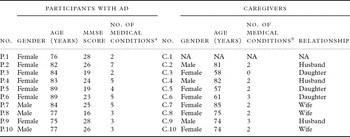
Participants with AD had a mean age of 81.6 (SD 5.2) years, with a mean number of health conditions (self-reported) of 3.9 (SD 1.6). These were verified by the caregivers where possible and included: dementia, arthritis, osteoporosis, lower-limb joint replacement, respiratory condition, cardiac condition, diabetes mellitus, and hypertension. Their average MMSE score was 23.4 (range 16–28) indicating mild to moderate severity of symptoms (Table 2). Caregivers were an average of 71.9 (SD 10.7) years old, with six of the nine people being a spouse of the person with AD, and the other three being a daughter. Other sample characteristics for participants with AD and caregivers are reported in Table 2.
Demographic data of participants (ten older people with AD and nine caregivers)

a Alzheimer's disease, arthritis, osteoporosis, back pain, lower-limb joint replacement, vestibular disorder or other dizziness symptoms, respiratory condition, cardiac condition, hypertension, diabetes mellitus.
b Arthritis, osteoporosis, back pain, lower-limb joint replacement, vestibular disorder or other dizziness symptoms, respiratory condition, cardiac condition, hypertension, diabetes mellitus.
P. = Participant with AD; MMSE = Mini-Mental State Examination; C. = Caregiver; NA = not available.
Thematic analysis
Themes are presented in two categories: factors that helped a person decide to commence the program and factors to help them adhere to the program.
Factors influencing the decision to commence the home-based balance exercise program
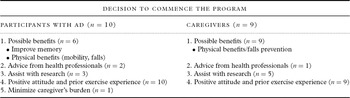
Four factors emerged as important in the caregivers’ decision to agree that participants commenced the exercise program (Table 3). Five factors emerged from the participants with AD, four of which were similar to those identified by the caregivers. The fifth factor identified by participants with AD was to minimize caregiver's burden (Table 3).
Participants with AD and their caregivers: reasons given for taking part in the home-based balance exercise program

n = number of participants with AD or caregivers.
Possible benefits. The reasons that participants with AD commenced the program were often related to their desire to reduce AD symptoms and improve their physical condition (i.e. mobility). As one participant said: “Well, I was very angry when I discovered that I was diagnosed with Alzheimer's . . . I decided it was time to do something about it” (P.2, female).
Caregivers also identified the potential physical benefits to participants as important in their decision to get involved. One caregiver said: “If we can get the confidence back and the walking back, the quality of life would be maintained. So that was the reason why we got stuck into it” (C.6, female).
Advice from health professionals. Advice from health professionals was identified as a factor in some of the participants’ decisions to commence the program. “Well, your colleague asked me . . . I think. Anyway, there were a couple suggestions that I might find it [the program] useful. And I did” (P.3, female). Similarly, a health professional recommendation influenced caregivers’ decisions to support the participants in taking up the program. “The girls there [a hospital], you know they asked me if I would be interested and I thought well I will go for anything that is going to help” (C.8, female).
Assist with research. Contribution to research to help other people was stated as another reason to undertake the program. “A lot of it was because I like to do things to help other people . . . we both do a lot volunteering” (P.9, female). One caregiver said: “If we can help, if mum can help with all this, it is going to help me when I get to that stage . . . future baby boomers” (C.6, female).
Positive attitude and prior exercise experience. A positive attitude towards exercise was identified as a factor for beginning the program by all participants and their caregivers. Nine of ten participants with AD and eight of nine caregivers reported prior participation in exercise. For example, one participant said: “I was always a great walker . . . I was a runner . . . I took first prize all the time . . . I used to go the gym . . . swimming” (P.4, female). And one caregiver said: “Yeah when I retired we used to walk miles every day” (C.7, female). All participants believed that exercise was important and beneficial to health and should be continued for as long as possible.
I am eighty-three . . . your body is deteriorating. To try and keep what you had the best of the ability and that is why I keep doing them [exercises]. (P.4, female)
[Too old to exercise?] Nonsense! You are giving up, if you have got that attitude. (P.7, male)
The caregivers’ also agreed that exercise provides benefits to a person's physical and mental health and should be sustained for as long as possible.
To keep you going . . . you need the exercise, you need movement. (C.7, female)
“Use it or lose it” yeah, I think that is the best idea. Keep going at it. (C.8, female)
Minimize caregiver's burden. A desire to minimize the burden on their caregiver was also identified as another reason to take part in the program by one participant with AD: “Well, to get out and not be a burden on XXX [daughter]” (P.5, female).
Factors influencing adherence to the home-based balance exercise program
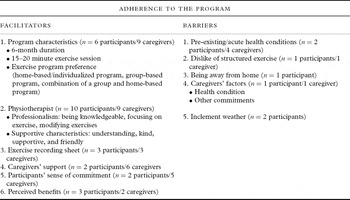
Table 4 summarizes the 11 factors identified by participants with AD and their caregivers as important in the decision to adhere to the program. Six of these factors facilitated completion, and five were barriers to completion.
Factors influencing adherence to the home-based balance exercise program: perceptions of participants with AD and their caregivers

n = number of participants with AD or caregivers.
Facilitators to program adherence. Six factors were identified as potential facilitators to completing the program. These were: (1) the program's characteristics, (2) the physiotherapist's role, (3) exercise recording sheet, (4) caregivers’ support, (5) participants’ sense of commitment, and (6) participants’ perceived benefit from the program (see Table 4).
The program's characteristics. The program, in terms of intensity and complexity, was considered suitable for people with mild to moderate severity of AD. The six-month program duration suited nine out of ten participants with AD and all caregivers: “I thought six months is a good period” (C.10, female); “I have accepted it [the length of the program], quite happy” (P.4, female).
The pattern of more frequent visits by the physiotherapist (PT) initially and the longer period between visits in the second half of the program was also identified as a facilitator to program completion: “I think they [physiotherapist visits] were pretty well spread-out” (C.5, female).
The exercise session length of 15–20 minutes proved consistently acceptable. “The [session] time was quite ample I think . . . he [the participant] was able to fit in quite easily” (C.10, female).
The provision of an exercise booklet detailing individual exercises in written and pictorial form helped participants with AD with varying abilities to complete the exercise program.
The exercises were very clear and XXX [the PT] wrote instructions if she varied them and mum [the participant] would have that on the table and she would flip over and “how do I do this?” It was easy for her to follow. (C.6, female)
Five out of the ten participants with AD were able to perform the exercises independently using the exercise booklets:
I made an effort . . . I had to look at it [the exercise booklet] every time. (P.1, female)
Well that is exactly [she could do the exercises herself], she did do them . . . I never saw her say that she couldn't do it. (C.9, male)
Other participants required varying levels of assistance from their caregivers, such as: (1) prompting from their caregivers to perform the exercises, “Mum did it consistently and probably because I used to jog her memory” (C.6, female); (2) supervision and direction to perform the exercises, “I would sit here and tell him [participant] what to do next . . . I should have had a director's chair that I could sit in . . . I just used to sit there and say ‘well now we'll do this one’ and so forth” (C.7, female); or (3) each session closely supervised by their caregiver, “I would show her [the participant] . . . I would start doing it and she would follow” (C.5, female).
Nine out of the ten participants with AD reported that they preferred a home-based exercise program to a group program or a community-based program.
I think I prefer doing it at home. Time wise . . . you could do it in the morning or you could do it in the night . . . . That is the other [exercise in community center] if you don't turn up and . . . if you are far away you have to account for that.” (P.9, male)
However, one participant stated that a group-based program would be better for her: “I think everything is better in a group, cause I am a very social person” (P.10, female).
All caregivers except one stated a preference for a one-on-one home-based exercise program. The reasons given for this were:
(1) Better monitoring by the physiotherapist: “I think the personal touch is certainly better . . . if you are doing anything wrong, she [the PT] would pick it up right away” (C.4, male);
(2) Personal interaction assisted participants’ concentration: “One on one you can get him to do things . . . he would lose concentration in a group” (C.8, female);
(3) Participants’ motivation to exercise was facilitated by direct interaction with the physiotherapist, expressed in terms of feeling accountable to the physiotherapist: “It [home-visit] does spur you on, you know, you think ‘well, she (PT) is coming next week, we better get busy’ (laughing) . . . you need that little just sometimes to keep you wound up” (C.5, female).
Caregivers also suggested that a combination of a group and home-based exercise program would help fulfill the social needs of some participants: “I think probably a combination of both of you can organize that you know, it as an outing . . . you could have a morning where they went and did exercise, had a cup of tea” (C.6, female).
The physiotherapist's role. The ongoing support received from the physiotherapist was another factor considered important. The physiotherapist was considered important to:
1. monitor that the exercises were done correctly: “She [the PT] kept reviewing it [exercise program] every time she came out and she made mum [the participant] do the exercises with her to make sure she was doing it right” (C.6, female); “She made sure that I knew how to” (P.4, female);
2. enable exercises to be modified according to individual ability: “If it was difficult, she [the PT] would tell me something that I might be able to do” (P.4, female), “She [the PT] did a lot of changes. She said ‘now you [participant] are doing it quite easy, why don't we make it a bit harder by doing such and such’” (C.10, female); and
3. be contactable when needed: “She [PT] didn't leave us out on a limb . . . and we always had contact if we needed her with the phone” (C.4, female).
The physiotherapist's professionalism was regarded as a valued characteristic. This included:
1. managing time effectively by focusing on the exercise delivery: for example one caregiver said, “She [PT] was not intrusive . . . she was not going to be here for . . . two hours and then you would be saying to yourself ‘God, I wish she would go away!,’ but she did the right thing, she just came, did it and went. Very professional she was” (C.4, male);
2. being knowledgeable: “She [PT] was good with the exercises; she explained why, what, how, and everything” (C.6, female); and
3. being firm yet encouraging: “She [PT] was good with mum [participant], she was good with me [caregiver] . . . and she was firm. She was good value” (C.6, female).
Participants and caregivers also thought it was important for the physiotherapist to be understanding, kind, friendly, and supportive. “She was very helpful and could understand a few were a bit difficult . . . yes, she was very supportive” (P.4, female).
Exercise recording sheet. Another factor that motivated program completion was the exercise recording sheet, which was perceived as a point of self-accountability or as an achievement. One participant said: “Cause you have got to fill that form [exercise recording sheet] in and if it was blank all the time, it would be a bit of a problem, wouldn't it?” (P.9, female). The caregivers’ perspective was similar: “That [exercise recording sheet] is necessary because after that month is over, she [participant] can look back and go ‘oh gee I did a good job’ and XXX [PT] would go ‘you have not missed a week, you have not missed a day’ . . . it is like giving the kids a gold star” (C.6, female).
Caregivers’ support. Another factor that motivated participants to complete the program was caregivers’ involvement and support. For example, one participant said, “He [caregiver] will often sit and watch and say ‘oh you could do a little bit better than that, try it.’ Yeah, well it makes you do it” (P.4, female); and one caregiver said, “If you have got somebody there to say ‘oh come on, we will do the next one’ you know things like that I think you carry on” (C.2, male).
Participants’ sense of commitment. A sense of commitment or determination by participants to finish what they had agreed to do was another factor mentioned as important. “Well what I start, I want to finish” (P.5, female); “He [participant] had to do it because he has committed . . . he has taken on this ‘yes, I will do it every day’ and he was motivated too actually” (C.10, female).
Participants’ perceived benefit from the program. Another motivating factor mentioned was that participants’ perceived a benefit from the program. “I realized that it was good for me . . . and I just kept doing it” (P.4, female); “Well, it is doing her [the participant] good. She thought she was, with the exercises she was improving, so we just kept on with it” (C.2, male).
Barriers to program adherence. Five factors were identified as potential barriers to completing the program (Table 4). These included:
1. Deterioration in participants’ pre-existing health conditions, which involved appointments and in some cases, hospitalizations: “Mum has been in hospital recently so it has tailed right off. I think August we hardly did any” (C.5, female).
2. The caregivers’ health and other commitments: “I had a cancer taken off my leg . . . those days we did not do the exercises” (C.8, female).
3. Participant's dislike of structured exercise: “I don't like exercises . . . I suppose I have not ever done them . . . so I am just a bad one at exercises” (P.6, female).
4. Traveling: “I have just been to a conference in Adelaide . . . so it got sort of gone by the way side . . . and things like that happen that crop up that you just cannot possibly do it each day . . . if you are at home it is a different matter” (P.2, female).
5. Inclement weather was also mentioned as another barrier: “If it was cold miserable day, I would not go for a walk” (P.4, female).
Discussion
This study is the first to provide information about factors influencing adherence (i.e., starting and completing the program) to a home-based exercise program designed to improve balance in people with AD.
One important factor in the initial decision to commence the program was the potential benefits of the program. This is consistent with previous studies which found that anticipated benefits of the program are key factors inducing older people to carry out their exercise programs (Chao et al., Reference Chao, Foy and Farmer2000; Yardley et al., Reference Yardley2006; Hawley, Reference Hawley2009). This supports the recommendation that providing information about the importance and possible benefits of the exercise program may enhance adherence. Because the involvement of caregivers and family members has also been shown to influence exercise adherence in people with physical or cognitive impairment (Heller et al., Reference Heller, Ying, Rimmer and Marks2002; Taylor et al., Reference Taylor, Dodd, McBurney and Graham2004), they should also be provided with information.
Recommendations from health professionals were another factor influencing the decision to take part in the program. Previous studies have highlighted the importance of support from health professionals to encourage people to take part in an exercise program (Taylor et al., Reference Taylor, Dodd, McBurney and Graham2004; O'Brien et al., Reference O'Brien, Dodd and Bilney2008). In clinical practice, this means that distribution of research findings supporting the potential benefits of exercise in people with dementia including AD through appropriate channels (e.g. AD Associations, relevant health professionals) may be important for engaging patients in exercise programs.
Another finding was that prior experience of being active, participating in exercises, and perceiving benefits of general exercise were reasons given by both participants and caregivers for taking up this exercise program. Other studies have cited previous positive experience and attitude towards exercise as a facilitator to engaging older people in new exercise approaches (Dodd et al., Reference Dodd, Taylor, Denisenko and Prasad2006; Courneya et al., Reference Courneya2010). In addition, participants’ willingness to exercise was found to be linked to adherence rates in previous studies investigating factors influencing adherence to exercise (Martin and Dubbert, Reference Martin and Dubbert1985; Taylor et al., Reference Taylor, Dodd, McBurney and Graham2004). In clinical practice, this means that it is important for therapists to gain an understanding of potential participant's attitude towards exercise. If the attitude is positive, this existing attitude can be harnessed to encourage participation. However, if the person dislikes formal exercising, the clinician may need to either use a different falls-prevention strategy such as advice and provision of appropriate footwear, prescription of a suitable gait aid, and/or home hazard modification, or alternatively use research evidence about the benefits of exercise to educate and encourage the person to participate.
One of the factors identified as important in assisting the program adherence was the design of the program. Most participants with AD and caregivers thought that the exercise program was well designed in terms of duration, session length, visit frequency, and program complexity. Our findings suggest the physiotherapist should visit regularly early in the program, but should also provide follow-up visits and phone contacts and be available when needed. Chao et al. (Reference Chao, Foy and Farmer2000) also identified that telephone contacts are a valuable component of home-based programs to facilitate exercise adherence among older adults. Providing clear and simple exercise instructions with accompanying pictures was also identified as important. The physiotherapist should consider using simple instructions, as well as encouraging the participant or caregiver to contact the physiotherapist if they require clarification.
Program adherence was also facilitated by the physiotherapist who was viewed by both participants and caregivers as an important motivator. Professionalism and a positive attitude by the physiotherapist were also important traits for both patients and caregivers. External support and motivation from professional program staff have also been reported to increase adherence to other exercise programs (Taylor et al., Reference Taylor, Dodd, McBurney and Graham2004; O'Brien et al., Reference O'Brien, Dodd and Bilney2008). This finding highlights the important role supervision by a qualified person such as a physiotherapist plays in delivering this type of exercise program successfully to people with AD.
Caregiver involvement was identified as necessary in supporting and encouraging participants with AD to complete this exercise program. Emotional and physical assistance from family members has been shown previously to be important in exercise participation, for example in people with cerebral palsy (Heller et al., Reference Heller, Ying, Rimmer and Marks2002; Taylor et al., Reference Taylor, Dodd, McBurney and Graham2004). Some other studies, however, do not cite caregiver support and involvement as being an important element contributing to program completion, for example, studies of general older adults (Chao et al., Reference Chao, Foy and Farmer2000), people with multiple sclerosis (Dodd et al., Reference Dodd, Taylor, Denisenko and Prasad2006), and people with Parkinson's disease without cognitive impairment (O'Brien et al., Reference O'Brien, Dodd and Bilney2008). In these populations, caregiver involvement was not shown to influence exercise participation. This perhaps highlights the importance of the role that caregivers might particularly play in conducting an exercise program in people with cognitive impairment. Therefore, a caregiver's capacity to be involved with the program should be considered in future programs for people with cognitive impairment, such as people with AD. Additionally, program providers need to be aware of potential increases in caregiver burden that may occur.
Ongoing perceived benefits, achieved by personal physical and activity improvement, reinforced by self-ongoing monitoring (the exercise recording sheet) and reassessments also assist in maintaining motivation throughout the program. Similar findings have been reported in other populations (Chao et al., Reference Chao, Foy and Farmer2000; Taylor et al., Reference Taylor, Dodd, McBurney and Graham2004; Dodd et al., Reference Dodd, Taylor, Denisenko and Prasad2006), including the need for ongoing evaluation of participant's ability to perform the exercises and progression of exercises.
The individualized and home-based nature of this program was also preferable to most participants and caregivers. One reason caregivers favored a home-based program was the one-on-one situation that was seen as aiding concentration, providing face-to-face supervision and accountability (to the physiotherapist). However, some mentioned the potential benefits of social interaction that a group-based program might provide as adding enjoyment and therefore potentially increasing adherence. As the study provided only a home-based exercise program, it is possible that the group-based program might also be found to be suitable for some other participants. In addition, some caregivers suggested that a combination program would be good for participants. Therefore, in clinical practice, offering alternative exercise formats, or combined home and group programs, would allow the participant and caregiver to choose the program most suitable and enjoyable for them, which might help promote program adherence.
Most factors identified as barriers to program adherence were similar to those reported in older people without cognitive impairment, including the dislike of structured exercise, and environmental factors (inclement weather and traveling or being away from home; Chao et al., 2000). Strategies previously recommended for dealing with the barriers to adherence of physical activity programs among general older adults such as systematic planning at the formative stages of an intervention, and advanced planning for environmental modifications (Chao et al., Reference Chao, Foy and Farmer2000), should be considered for use for people with AD. For example, a pre-intervention session, which includes a brief interview to gauge the participant's exercise history and preferential activities, might assist in designing the exercise program to suit these participants’ abilities and preferences. For people who do not enjoy structured exercises, the program could perhaps be designed to include the exercises into activities that the participant does like or regularly performs, for example, gardening. From a falls-prevention perspective though, the program should include activities that challenge balance performance safely (Sherrington et al., Reference Sherrington, Whitney, Lord, Herbert, Cumming and Close2008).
People with AD and in some cases their caregivers are generally older, and are likely to have a range of pre-existing health conditions. They may also develop new health conditions during the program. These health conditions may act as barriers to program adherence for this group. These barriers to program completion might not be present to the same extent in other populations (Chao et al., Reference Chao, Foy and Farmer2000; Dodd et al., Reference Dodd, Taylor, Denisenko and Prasad2006; O'Brien et al., Reference O'Brien, Dodd and Bilney2008). Therefore, a flexible program that accommodates absences from a program is required. Strategies to maximize re-engagement post illness (such as an extra home visit by the physiotherapist to re-adjust/modify the program to suit participant's or caregiver's current stated ability) should be built into programs for people with AD.
Strengths and limitations
This qualitative study is the first to explore the views and perceptions of a home-based balance exercise program in both people with AD and caregivers, and it adds to the literature by identifying factors influencing exercise commencement and program adherence in people with AD. The main study limitation was that only people with AD, who had volunteered to participate in the study and completed the exercise program, and their caregivers were recruited to this study. Perceptions of people with AD who discontinued the program and their caregivers might be different from those who completed the program. In particular, opinions about possible barriers to completing the program could be different. Another limitation was the relatively small sample size. Despite this, data saturation appeared to be occurring with few new factors identified towards the end of the interviews being completed.
It should be acknowledged that through the semi-structured interview approach, the presentation of questions could establish a bias in participants’ responses. Furthermore, the presence of the caregivers may have influenced the responses by the participants with AD. The presence of a third party in an interview situation might be seen as a distraction and/or might possibly cause participants’ hesitation in providing information in some cases. However, for participants with AD who are reliant on a caregiver for daily living, the absence of the caregiver at the interview could also influence the responses, most usually a reluctance to respond. The period of 47 days between the completion of the exercise program and the interview was due to some delays in scheduling of reassessments for the RCT (within one month of completion of the exercise program) and then making suitable times for the participants, caregivers, and investigators to meet for the interviews. This delay may have had some effect in reducing recall, particularly for the participants with AD. However, the exercise program had become an entrenched part of their routines over six months and participants did not appear to have difficulty with recalling this.
Conclusion
The study findings lead to three key recommendations for exercise programs in people with AD. First, pre-intervention strategies to increase adherence should be considered. These include educating people with AD, their families, and health professionals about potential benefits of exercise; evaluating the participants’ abilities and preferences; and evaluating the caregivers’ capability to be involved. Seeking commitments (perhaps even in written form) from caregivers and participants with AD to completing the program may also aid adherence. Secondly, the program should be individualized in terms of intensity and complexity for participants, and also in terms of availability/constraints for the caregivers, and be delivered by a physiotherapist with appropriate experience. Thirdly, strategies to support participants through the program should include: (1) ongoing support and encouragement from caregiver and physiotherapist, (2) provision of self-monitoring, together with intermittent evaluation, on the basis of which the participant can see progression or benefit, and (3) planning for any modifications or flexibility of the program to allow for re-engagement post program-absence.
Conflict of interests
None.
Description of author's roles
All authors contributed to the study concept and design. Data were collected by P. Suttanon and K. N. Byrne. Data analysis and interpretation were mainly carried out by P. Suttanon and K. N. Byrne under the supervision of K.D. Hill, K.J. Dodd, and C.M. Said. Drafting of the paper was conducted by P. Suttanon, with revision of the paper by all other authors.
Acknowledgments
We are grateful to all the people with AD and their caregivers who agreed to be part of the study, and to Professor Pranee Liamputtong for her kind advice.