

INTRODUCTION
The use of seclusion within mental health settings remains a contentious issue with concerns expressed by service users, carers and mental health professionals. Research evidence demonstrating its effectiveness in reducing aggressive incidents is lacking, albeit that systematic reviews have highlighted the absence of well designed and controlled studies (Sailas & Fenton, Reference Sailas and Fenton2000). Guidance from the UK Mental Health Act 1983 revised Code of Practice (2008) states that seclusion should be used only as an intervention of last resort when other measures have proven unsuccessful. However it has been reported that one of the potential consequences of reduced seclusion use is an increase in assaults on either clinical staff or patients (Khadivi et al., Reference Khadivi, Patel, Atkinson and Levine2004).
Specific concerns have been raised about seclusion use within mental health services. For example, the excessive reliance on seclusion to minimise disruptive and dangerous behaviour within healthcare settings may prevent mentally disordered individuals from either acquiring or developing the necessary coping skills required to successfully manage challenging situations. Similarly the excessive use of seclusion by healthcare staff may prevent clinical teams from acquiring the knowledge and skills in implementing strategies to manage aggression (Donat, Reference Donat2003). A cycle may then emerge of aggressive patients being managed by de-skilled, risk averse clinical teams, which may be difficult to break.
Following internal and external scrutiny (House of Lords, 2005) it became apparent that the use of seclusion at Ashworth Hospital, a high secure hospital in England, was excessive and there was a need for a change in practice and the development of a strategy to reduce the use of seclusion. Subsequently, following a review of successful strategies to reduce seclusion use in other units, a number of measures were implemented as part of a multidisciplinary seclusion reduction programme. These measures will be described. The purpose of this paper is to report changes in patterns of seclusion use and adverse incidents over a five-year period.
ANALYSIS SITE AND SAMPLING
The analysis was conducted at Ashworth hospital, part of Mersey Care NHS Trust. Ashworth Hospital is one of three high secure hospitals serving the population of England and Wales. Patients are admitted if they are suffering from a treatable mental disorder and present as an immediate and grave risk of harm to others. High secure hospitals share particular challenges, most notably a large proportion of patients experience persistent psychiatric conditions that have proven refractory to a variety of interventions and are associated with serious violence. The majority of patients at Ashworth hospital have a co-morbid mental illness with the most common diagnosis being that of schizophrenia and its sub-types. The population at Ashworth hospital during the study period was exclusively male, ranging between the ages of 18 and 68 years. The particular characteristics of patients within high secure hospitals have been described elsewhere (Harty et al., Reference Harty, Shaw and Thomas2004).
We collected data on all episodes of seclusion and all assaults, recorded as adverse incidents, at Ashworth hospital over the period January 2002 to January 2007. The term seclusion refers to the supervised confinement of a patient in a room, which may be locked to protect others from significant harm (Department of Health, 2008). An episode of seclusion is defined as commencing with the supervised confinement of a patient to a room. Termination of seclusion was defined as when the patient no longer required supervised confinement in a room. For all seclusion episodes a standard form was completed that included, in addition to clinical information, the date and time of initiation/termination. For the purpose of this analysis, seclusion episodes of longer than five days duration were categorised as segregation episodes.
All incidents of interpersonal aggression in the hospital result in an adverse incident form being completed. This violence is rated on a four-point hierarchical scale according to severity. Data on all assaults, whether actual or attempted, verbal or physical, irrespective of victim status was obtained over the same time period.
This analysis was reviewed by the local research and development committee and deemed to constitute a service evaluation.
STRATEGIES TO REDUCE THE USE OF SECLUSION
The measures introduced were improvements in organisational clinical governance frameworks already in place. The structures of these governance arrangements provided the means to raise the importance of seclusion reduction and convey the need to reduce reliance on its use to staff and patients throughout the hospital. The reduction of seclusion use became one of the service priorities.
Use of information and transparency
Integral to understanding seclusion use within the hospital was the analysis of accurate information. This allowed for the identification of specific trends in use within particular clinical areas. The information was reviewed in a number of forums including a dedicated multidisciplinary body to review seclusion use and monthly medical audit meetings. This allowed the service to analyse embedded clinical practice, challenge accepted cultural norms and offer guidance to clinical teams and help generate solutions. The information collected also assisted in benchmarking against other services with similar patient groups. Additionally, external agencies such as the Mental Health Act Commission and Trust executive and non-executive directors were standing invitees to seclusion review meetings in order to promote transparency of practice.
Effective use of audit and peer reviews
All seclusion episodes are discussed at monthly medical audit meetings attended by senior clinicians. Presentation and analysis of findings at audit meetings provides a useful forum to compare practice amongst different clinical teams with a view to improving transparency of clinical care and standardising clinical practice. Additionally, a seclusion peer group review meeting is held every month attended by senior medical staff to review treatment including pharmacological options for treatment refractory patients. A whole systems approach was adopted and anomalous systemic issues, for example thresholds for use of seclusion, were identified using six monthly seclusion audits conducted by medical staff. Standards audited included adherence to policy, assessment of risk and involvement of senior medical and nursing staff in care planning.
Positive risk management
Positive risk management was supported as part of carefully constructed care plans and built on the recognition of patients’ strengths that emphasised recovery. Positive risk management included working collaboratively with patients to develop care plans and in many cases incorporating the views of carers when deciding a plan of action. Therapeutic risk taking involved being clear to all involved about the potential benefits and the potential risks and using available resources and support to achieve a balance between a focus on reducing seclusion use and minimising potential adverse incidents.
The vast majority of patients requiring seclusion at Ashworth hospital have mental illness symptoms that are poorly controlled resulting in arousal, anxiety, paranoia and aggression. It is reported that clozapine has an independent effect on reducing violence and aggression (e.g. Chengappa et al., Reference Chengappa, Vasile, Levine, Ulrich, Baker, Gopalani and Schooler2002). We have made a similar finding in other research at this high secure hospital, as measured by a reduction in adverse incidents. Seclusion peer review meetings attended by senior medical staff allowed review of difficult clinical cases. Not infrequently the internal peer review was followed by external reviews (for example from the National Psychosis Unit, Maudsley hospital, UK). In a number of cases this facilitated rechallenge with clozapine for patients who had previously had this discontinued due to ‘red results’ with marked improvements in mental state, allowing discontinuation of seclusion. In some cases this was achieved through prescription of granulocyte colony stimulating factor.
Effective risk management requires an organisational strategy as well as efforts by clinical teams and individual practitioners. Accordingly, post incident reviews were held after all seclusion episodes to review events and enable shared learning. This included reporting any significant adverse events via critical incidents forms and scrutinising patient complaints relating to the use of seclusion.
Patient involvement
Increased patient involvement was achieved through improvements in advocacy provision, establishing a patients’ forum, and increased collaboration between clinical teams and patients. The latter was achieved, for example, by supporting patient participation in ward community meetings and having patient representatives on ward clinical business meetings. This provided the service with the opportunity to seek and take into consideration patient views when planning ward environmental designs to improve ward living areas and commenting on seclusion policy development.
The implementation of advance directives to manage service users at times of crisis without resorting to seclusion also proved successful in a number of cases and was encouraged. This was subsequently included as a core item of the annual care co-ordination process (Refocusing the Care Programme Approach) ensuring that it was discussed and reviewed.
Steps were taken to ensure patients in seclusion were not unnecessarily excluded from meaningful and therapeutic activity; particularly important for those patients subject to either frequent or extended periods of seclusion. This resulted in improvements in both the quality and quantity of occupational and recreational activities for this group. Patients unable to attend off ward activities were provided with ward based activity sessions. A novel approach was to use the hospital gymnasium facilities pro-actively to engage with younger patients who, not uncommonly, refused to engage with ‘traditional’ rehabilitation activities. This involved a change in organisation practice and culture and the aim was to build therapeutic alliances with patients in seclusion, and those assessed as likely to be secluded. This proved to be extremely popular and had a number of consequential benefits, including modelling of pro-social behaviour, use of conflict resolution and debriefing and providing ‘time out’ for both the patient and ward based staff. The gymnasium session involved a ward based nurse and a psychologist with non-clinical gymnasium staff to take part in an activity based treatment as part of an integrated care approach. This also allowed for improvements in physical health monitoring as patients were more likely to co-operate with requests for pulse and blood pressure monitoring and allow routine electrocardiogram monitoring as part of this activity.
Education and training
There was gradual improvement in the provision of targeted staff training. This included training in neurocognitive approaches for nursing staff working with patients with neurocognitive impairment and psychosocial interventions for staff working with chronically mentally ill patients with challenging behaviours. Emphasis was placed on de-escalation training and seclusion awareness was added to the induction programme for staff new to the service.
Enhanced clinical leadership
The aim was to effect a positive change in organisational culture and practice in relation to seclusion use. This was seen as crucial and a multi-disciplinary hospital group was formed, meeting on a monthly basis to facilitate clinical governance improvements. It was tasked, at a trust board level, with monitoring and reducing the use of seclusion, offering practical advice, identifying educational and training needs, developing and supporting initiatives to reduce seclusion and allocating resources where necessary. It was anticipated that with senior clinical managers on this group, its visibility, authority and impact would be enhanced. Therefore the composition of the group included all major clinical departmental heads including the clinical director, heads of social work and psychology and senior nursing staff. Each clinical lead was expected to share experiences and findings of the group with colleagues and promote discussion and debate within these areas to bring ideas and suggestions to the committee. Also present were modern matrons and ward managers from across the service. The aim was to demonstrate that seclusion reduction required multi-disciplinary involvement and ownership across all clinical domains.
The group meets on a monthly basis to review systemic issues (identified by audit, speaking with service users and clinical staff) and meet with individual patients in seclusion. The seclusion group enhanced their visibility within the clinical areas. This ‘management by walking’ allowed greater contact with front line clinical staff, offered opportunity to engage in discussion and debate about the use of seclusion, and provided a visible and accessible conduit for support and advice. The group also conducts internal independent seclusion reviews. The review typically results in clarification of the management plans to address the issues that resulted in the use of seclusion and identify steps required to terminate seclusion.
RESULTS
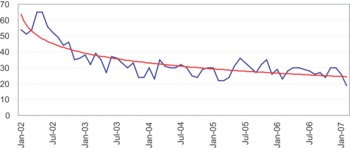
The number of seclusion episodes per month gradually fell from a high in January 2002 of 54 episodes per month to 18 episodes per month during January 2007 (Fig. 1), a reduction of 67%. An analysis of all incidents recorded for the period 2002–2006 also demonstrated a decrease. Comparative data of incidents for 2007 was not included as a result of the introduction of new Department of Health guidelines on the recording of incidents in high secure services (Department of Health, 2007). This led to subsequent changes to the classification of incidents. We found no increase in adverse incidents in conjunction with a reduction in seclusion episodes. Major incidents decreased by 63%, with moderate and minor incidents decreasing by 40%.
Seclusion episodes by month from Jan 2002 – Jan 2007

DISCUSSION
The main aim of this analysis was to determine whether the relatively simple measures implemented were associated with a reduction in the number of seclusion episodes and their duration in a high secure hospital. The results clearly demonstrate a progressive and sustained reduction in seclusion use with over a sixty per cent reduction in the number of seclusion episodes over a five year period. This equates to a net reduction of approximately forty seclusion episodes per month. We found no increase in either adverse incidents in general or assaults in particular, whether on patients or clinical staff, over the review period.
There was a sharp fall in seclusion episodes at the beginning of the seclusion reduction programme suggesting that there were a group of patients who could be managed using alternative strategies. As the rate of seclusion reduction gradually reduced we suggest, from our clinical experience, that this represents a more needs intensive group of patients. During the study period we found a small increase in short-term seclusion episodes which contributed to the overall relatively small reduction in short-term seclusion figures. This could have a number of explanations. For example, as long-term seclusion episodes were being discontinued these patients would, not infrequently, have short-term episodes as they were gradually re-integrated into unfamiliar clinical environments.
The measures described have previously been demonstrated to be useful in reducing seclusion use, although these studies have largely been conducted in low (Donat, Reference Donat2003) or non- secure settings (D'Orio et al., Reference D'Orio, Purselle, Stevens and Garlow2004). To the authors’ knowledge, this is the first analysis within a high secure setting and demonstrates that the measures are of benefit in a setting where there is a focus, arguably, on risk averse management and insufficient positive risk management. The seclusion review body was the means by which changes were implemented including a high level of managerial support and endorsement (Currier & Farley-Toombs, Reference Currier and Farley-Toombs2002; Betemps et al., Reference Betemps, Somoza and Buncher1993), instigating a change in organisational culture and practice (Beck et al., Reference Beck, Menditto and Baldwin1991), improving the seclusion review process (Donat, Reference Donat2003) and providing needs based rehabilitation activities. Our experience was that clinical teams largely welcomed the increased scrutiny as it facilitated clinical debate and allowed comparison between clinical areas within the hospital.
It is of course possible that the reduction in seclusion was unrelated to any of the measures described and may be, for example, due to a gradual reduction in the hospital patient population. We have considered this possibility and conclude that this was not the case. Firstly, the fall in seclusion episodes was approximately twice the reduction in the hospital census figures. Secondly, there is clinical evidence that seclusion patients were highly unlikely to be transferred to other hospitals whilst they remained in seclusion. The reduction in patient numbers within the hospital was a result of the transfer, to conditions of lower security, of those who rarely required seclusion.
Strengths and limitations
The authors recognise that our analysis has several limitations. As this was a retrospective analysis and not a controlled study, we cannot conclude that the reduction in seclusion episodes was due to the strategies implemented. As a number of changes were implemented during this period it is not possible to isolate and analyse the effects of a single factor. Although there was a clear association of reduction in both the duration and episodes of seclusion and the implementation of the described measures, we cannot categorically exclude other potential reasons for the observed reduction in seclusion. Indeed we accept that analyses of individual measures do not adequately capture the ‘fine-grain’ changes such as changes in organisational culture and clinical staff attitudes. We are currently exploring these factors in a qualitative study.
Furthermore, this retrospective analysis cannot be considered an experimental evaluation of the strategies identified in this article. There was an absence of a control group for obvious legal and ethical reasons. Several of the interventions were implemented over a period of several months and it would be too simplistic to describe them as categorical variables. Provision of clinical staff training, for example, depends not only on the adequacy of the training but also on the adequacy of implementation by clinical staff.
CONCLUSION
The results of this analysis demonstrate that reductions in seclusion use and improvements in clinical practice are achievable when it is identified as both a managerial and clinical priority, supplemented by robust performance monitoring and effective clinical governance arrangements. We believe the processes that have been described and implemented in this analysis can be duplicated within other secure psychiatric facilities without undue additional expenditure. Furthermore, most mental health units now routinely collect data on the use of seclusion and restraint so similar analyses could be conducted which may inform organisational objectives and perhaps lead to a national benchmarking exercise.