Introduction
The Chinese traditional herbal medicine, one of the bulky, Danshen, the radix of Salvia miltiorrhiza Bunge, is a perennial herb of the genus Salvia and the family Labiatae. It cherishes a rich and long history of several thousands of years, and possesses a wide range of pharmacological effects, including eliminating stasis to activate blood, relieving dysmenorrhoea and pain, cleaning the mind and keep free from troubles, cooling blood and relieving pain (Chen et al., Reference Chen, Guo and Zhang2015; Maione and Mascolo, Reference Maione and Mascolo2016; Cao et al., Reference Cao, Wu, Jia and Yang2017). It has been recorded early in Shennong's Classic of Materia Medica written in 1488~1505 AD as ‘mild cold, non-toxic and bitter taste’ and has the function of ‘blemish removal, vexation stopping and Qi benefiting’.
Traditionally, the identification and evaluation of Danshen have been based on sources, characters, physicochemical properties and bioassay (Li and Guo, Reference Li and Guo2010). There have been genetic diversity studies of S. miltiorrhiza by various molecular marker techniques, such as random amplified polymorphic DNA (RAPD) (Guo et al., Reference Guo, Lin, Feng and Zhao2002; Shi et al., Reference Shi, Liu, Hao and Xin2010), amplified fragment length polymorphism (AFLP) (Tang et al., Reference Tang, Wang, Chen, Wu and Yu2006; Wen et al., Reference Wen, Wu, Tian, Liu, Zhou and Xie2007), inter-simple sequence repeat (ISSR) (Song et al., Reference Song, Wang, Wang, Wang and Xie2008), ISSR and SRAP (Song et al., Reference Song, Li, Wang and Wang2010), chloroplast simple sequence repeats (SSR) (Wang et al., Reference Wang, He, Wang, Song, Guo and Yan2012) and expressed sequence tag-simple sequence repeats (EST-SSR) (Song et al., Reference Song, Wang, Chen and Zhu2014).
Recently Zhou et al. (Reference Zhou, Zhang, Huang, Xiao, Wu, Qi and Wei2021) assessed the wild germplasm diversity for S. miltiorrhiza and its related species which provided a fundamental genetic background for the cultivation and molecular breeding of this medicinally important species. Our group revealed the genetic diversity of cultivated Danshen populations by internal transcribed spacers (ITS) of the rDNA (Liao et al., Reference Liao, Ren, Sun, Kong, Liu, Yin and Li2021) and chloroplast rubisco large subunit (rbcL) gene (Feng et al., Reference Feng, Liao, Kong, Liu, Yin, Ma, Tang, Ren and Li2021).
There are two major classes of pharmacologically effective components in Danshen, the hydrophilic salvianolic acids, which are important compounds determining the medicinal quality of Danshen (Zhao et al., Reference Zhao, Hu, Liu and Leung2006), and the lipophilic tanshinones (Hung et al., Reference Hung, Pan and Hu2016). So far, it seems no genetic diversity has been revealed by the functional genes of S. miltiorrhiza, especially those related to tanshinone synthesis pathway. Recently a high-quality reference genome sequence of S. miltiorrhiza with the highest level of continuity has been released providing insights into tanshinone synthesis in its red rhizomes, and will facilitate future studies on the elucidation of the secondary metabolic pathway and the genetic improvement of S. miltiorrhiza (Song et al., Reference Song, Lin, Xing, Fen, Jin, Zhou, Gu, Wang and Li2020).
HMGR, 3-hydroxy-3-methylglutaryl-CoA reductase (EC1.1.1.34) catalyses HMG-CoA to mevalonate (MVA), the first committing step in the MVA pathway for isoprenoid biosynthesis in plants (Liao et al., Reference Liao, Zhou, Zhang, Wang, Yan, Zhang, Zhang, Li, Zhou and Kai2009). It should be also one of the major regulatory targets for the biosynthesis of tanshinones in S. miltiorrhiza.
There was a report showing the structural and functional conservation of the HMGR gene between yeast and human (Basson et al., Reference Basson, Thorsness, Finer-Moore, Stroud and Rine1988). The HMGR gene in S. miltiorrhiza has been cloned and characterized (Liao et al., Reference Liao, Zhou, Zhang, Wang, Yan, Zhang, Zhang, Li, Zhou and Kai2009), and the molecular mechanism of SmHMGR together with other several related genes in elicitor-induced tanshinone accumulation in S. miltiorrhiza hairy root cultures has been studied (Kai et al., Reference Kai, Liao, Xu, Wang, Zhou, Zhou, Qi, Xiao, Wang and Zhang2012).
However, no reports have been seen so far of its genomic SmHMGR counterpart, its genetic diversity, and phylogenetic relations in the abundant cultivated S. miltiorrhiza germplasm resources.
In order to understand the gene structure, genetic diversity and phylogenetic relations of the genomic SmHMGR genes in currently cultivated S. miltiorrhiza populations in China, and to lay a basis for its germplasm resources identification and evaluation, the complete genomic SmHMGR genes of the 38 cultivated populations of S. miltiorrhiza collected in China were for the first time cloned by walking technology with homologous primers, sequenced and the genetic diversity and phylogenetic relations among the populations based on the complete sequences were revealed in this research.
Materials and methods
Plant materials
Thirty-eight cultivated S. miltiorrhiza populations purchased mainly from three major seed industries representing more than 30 regions of China were the first field cultivated for morphological observation and confirmation in Southwest University Agricultural Station, Chongqing (N29°/E106°) and then leaves were used as materials for this study (Table 1).
The cultivated S. miltiorrhiza populations used in this study

N/E, North latitude/East longitude.
a HDSI, Hengda Seed Industry; TDSI, Tongda Seed Industry; FHSI, Fenghong Seed Industry; SC, Self-Collected.
Primer design
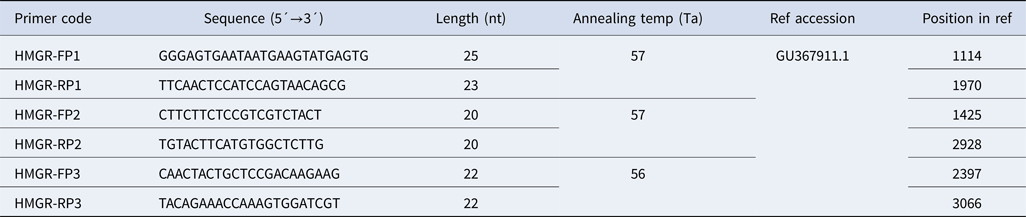
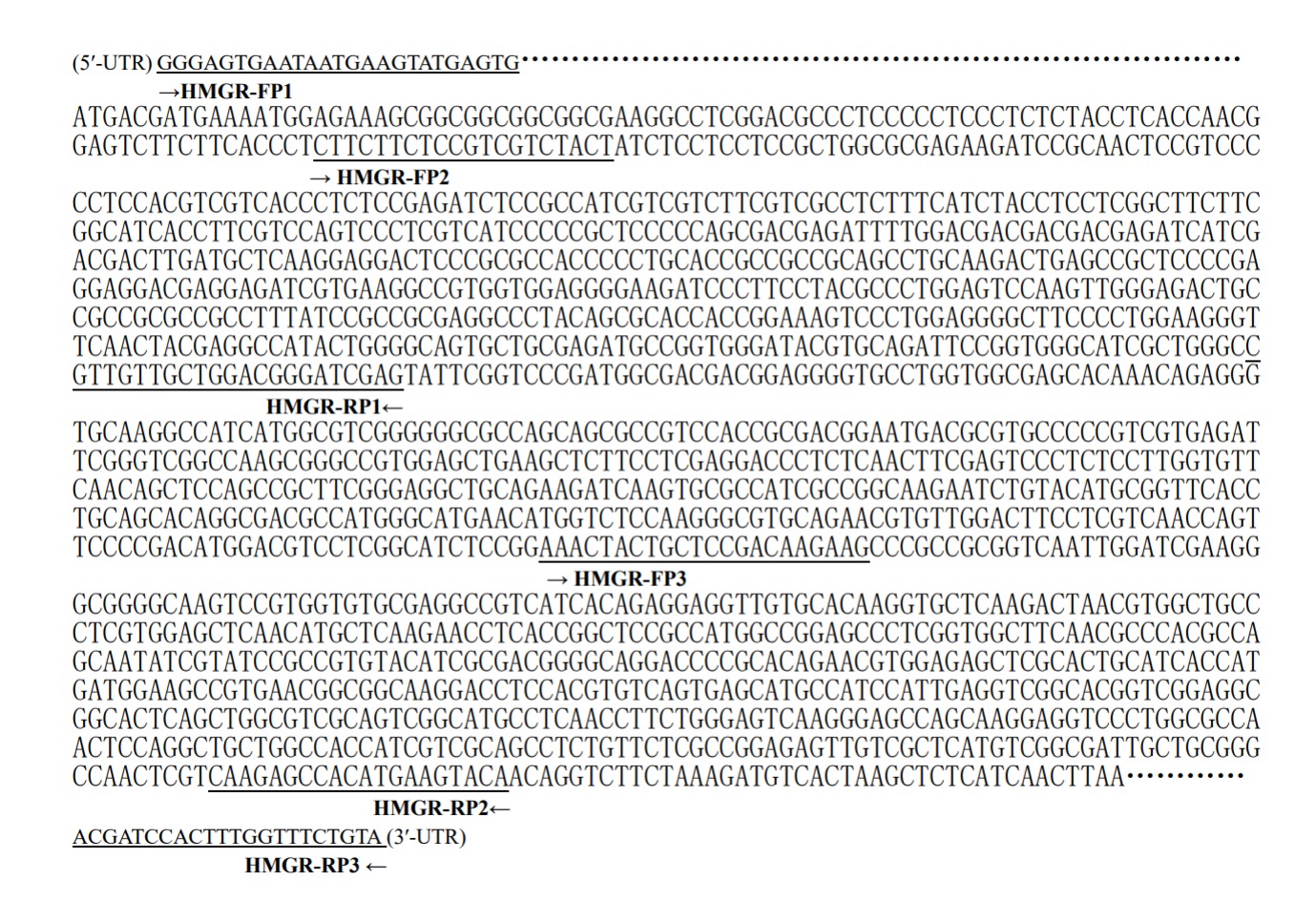
Three pairs of walking primers for the cloning of the genomic SmHMGR gene based on the reference accession (GU367911.1) were designed with Primer 5 (Table 2). Primer positions in the cloned SmHMGR gene as that of population W-SCHY-W-1 were given in online Supplementary Fig. S1.
Primers designed for the cloning of the SmHMGR gene

Extraction of genomic DNA
Qiagen DNeasy Plant Mini Kit (Multi Sciences, Hangzhou, China) was used for the extraction of total leaf genomic DNAs of the 38 cultivated S. miltiorrhiza populations according to the manufacturer's instruction. The purity and quantity of the isolated DNAs were evaluated by agarose gel electrophoresis followed by Goldview staining and determination of the purity ratios of A260/A280, using Shimadzu UV mini-1240 UV-VIS spectrophotometer (Shimadzu, Japan). The purified DNAs were dissolved in 10 mmol/l Tris-HCl buffer and stored at − 70 °C.
PCR amplification and product sequencing
About 1.0 μg of the genomic DNAs of the 38 cultivated S. miltiorrhiza populations were amplified in three segments with primer pairs HMGR-FP1/HMGR-RP1, HMGR-FP2/HMGR-RP2 and HMGR-FP3/HMGR-RP3 respectively in a reaction mixture of 50 μl: 1.1 × T3 Super PCR Mix 36.0~44 μl and 10 μmol/l primers each 2.0 μl (final concentration 0.4 μM). PCR amplification was run in Biometra TGRADIENT thermocycler (Biometra GmbH, Germany) with the following programme: initial-denaturation at 98 °C for 3 min followed by 35 cycles of denaturation at 98 °C for 10 s, annealing at 57/57/56 °C for 10 s and elongation at 72 °C for 5~15 s and a final extension step at 72 °C for 2 min.
The amplified products were electrophoresed in 1% agarose gel and visualized with Goldview staining; and after recovery and purification, bidirectionally sequenced by dideoxy chain termination with ABI Prism 310 Genetic Analyzer (Applied Biosystems, Foster City, USA).
Sequence data processing
The BLAST confirmed three segments of the SmHMGR gene of the 38 cultivated populations of S. miltiorrhiza were spliced with Vector NTI Advance 11 (Lu and Moriyama, Reference Lu and Moriyama2004). The complete sequences were manually checked to ensure the quality of sequences. The nucleotide variation sites of SmHMGR gene sequences of the 38 cultivated populations of S. miltiorrhiza were identified by Vector NTI Advance 11, and manually checked and confirmed. And finally, MEGA X (Kumar et al., Reference Kumar, Stecher, Li, Knyaz and Tamura2018) was used for phylogenetic tree construction by Neighbour-Joining (NJ).
Results and analyses
Genetic diversity analysis of the SmHMGR genes
Basic structural features of the SmHMGR genes of the cultivated S. miltiorrhiza populations
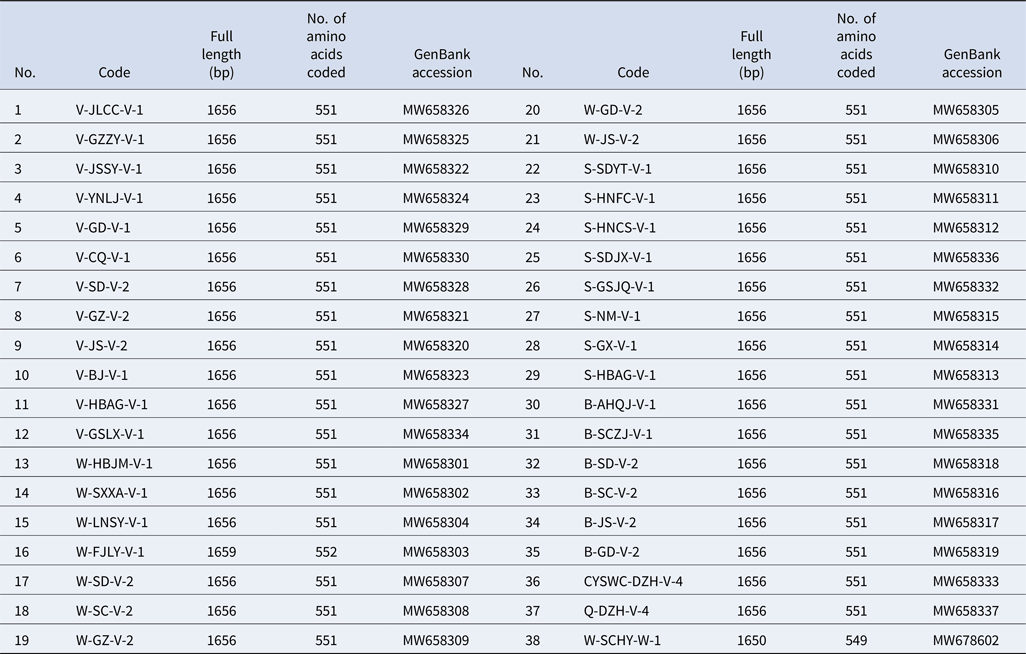
The confirmed complete genomic SmHMGR sequences were submitted to GenBank (Table 3). No introns were found in all the SmHMGR sequences. The genomic full length SmHMGR genes of the majority S. miltiorrhiza populations (36 populations) were 1656 bp, encoding 551 amino acids, while 2 populations, W-FJLY-V-1 and W-SCHY-W-1 were 1659 and 1650 bp encoding 552 and 549 amino acids respectively (Table 3).
Basic data of the genomic SmHMGR genes of the cultivated S. miltiorrhiza populations

Nucleotide variation of the genomic SmHMGR genes
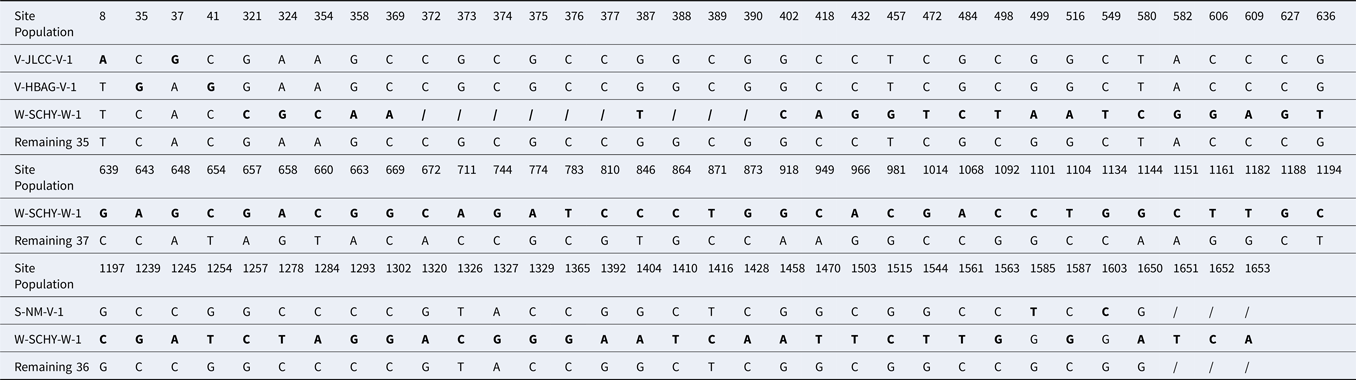
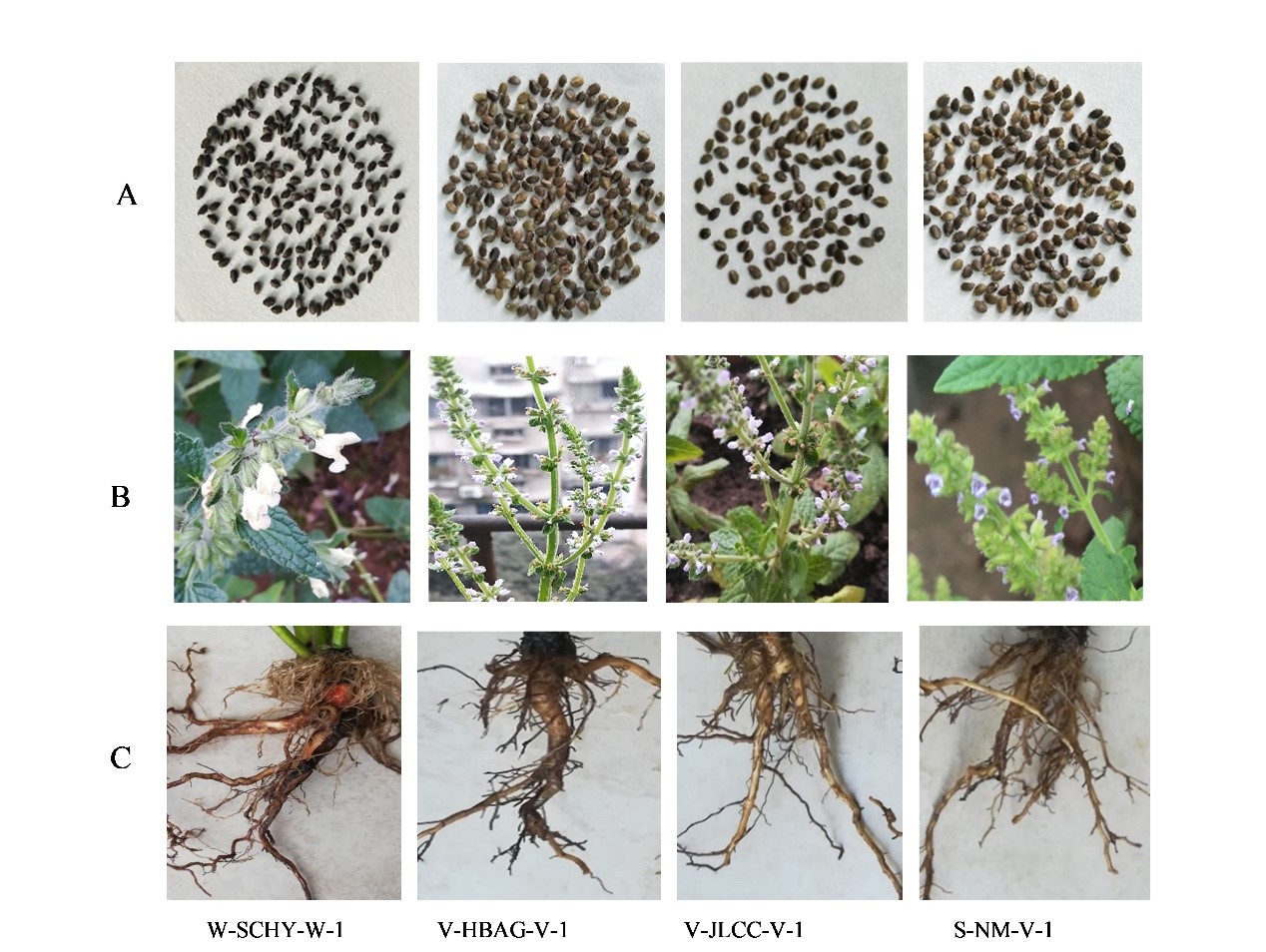
There were 103 SNP variation sites of the SmHMGR gene in 38 populations, with a variation rate of 6.22%, among which, 56 transitions, 35 transversions and 12 insertions/deletions. Most variations (96) occurred in W-SCHY-W-1, followed by five in S-NM-V-1, two in V-JLCC-V-1 and one in V-HBAG-V-1. The remaining 34 populations were in consensus. Four populations, V-JLCC-V-1, V-HBAG-V-1, W-SCHY-W-1 and S-NM-V-1, could be discriminated from the remaining 34 by SNP fingerprints (Table 4). The morphology of seed, flower and root of the four unique Danshen populations is shown in online Supplementary Fig. S2.
Nucleotide variation sites of SmHMGR sequences of S. miltiorrhiza populations

SNP variations were shown in bold type; ‘/’: deletions
Variations of the deduced amino acid sequences of SmHMGR genes
The deduced amino acid sequences of SmHMGR genes of the 38 S. miltiorrhiza populations all shared the two putative HMG CoA binding sites (EMPVGYVQIP/ TTEGCLVA) and the two NAD(P)H binding sites (DAMGMNM/GTVGGGT) as reported by Liao et al. (Reference Liao, Zhou, Zhang, Wang, Yan, Zhang, Zhang, Li, Zhou and Kai2009), indicating its high conservation. However, the stop codons were all found to be TAA rather than TGA as reported by Liao et al. (Reference Liao, Zhou, Zhang, Wang, Yan, Zhang, Zhang, Li, Zhou and Kai2009).
A total of 25 amino acid variation sites were detected: 10 were similar substitutions, 11 somewhat dissimilar substitutions, 3 deletion/insertions and one extra in W-SCHY-W-1 in which a stop codon was mutated to a sense codon for threonine; and among which 19 were in W-SCHY-W-1, two in each of S-NM-V-1, V-HBAG-V-1 and V-JLCC-V-1. All the amino acid variations occurred outside the conserved sites.
Four populations i.e.W-SCHY-W-1, S-NM-V-1, V-HBAG-V-1 and V-JLCC-V-1, could be discriminated from the remaining 34 populations by the amino acid variation sites of the SmHMGR gene (Table 5).
Amino acid variations encoded by SmHMGR genes of S. miltiorrhiza populations

Amino acid variation sites were shown in bold type; ‘/’ represents deletions; and ‘*’ represents stop codons.
Phylogenetic analyses of SmHMGR gene and the deduced amino acid sequences
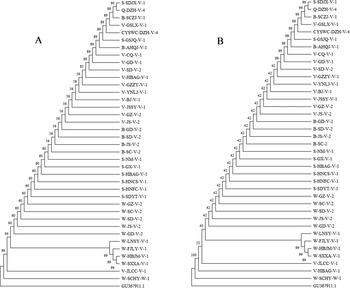
Phylogenetic trees based on the gene and the deduced amino acid sequences with the reference accession (GU367911.1) as the outgroup, both showed a very similar two-clade topological structure. The phylogenetic tree based on SmHMGR gene sequences showed that population W-SCHY-W-1 stands alone, and the other 37 populations clusters in another clade, which is subdivided into two subclades, with population V-JLCC-V-1 alone and the other 36 in another (Fig. 1A). Phylogenetic tree based on the deduced amino acid sequences showed that population W-SCHY-W-1 stands alone, and the other 37 populations clusters in another clade, which is subdivided into two subclades, with population V-HBAG-V-1 alone and the other 36 in another (Fig. 1B).
Phylogenetic trees based on SmHMGR gene (A) and the deduced amino acid sequences (B).

Conclusion and discussion
This study for the first time clarified the structure of the full length genomic SmHMGR genes for the majority S. miltiorrhiza populations: without intron, about 1656 bp in length and encoding about 551 amino acids, slightly different from the full length HMGR cDNA gene of S. miltiorrhiza as reported by Liao et al. (Reference Liao, Zhou, Zhang, Wang, Yan, Zhang, Zhang, Li, Zhou and Kai2009) (EU680958) which contained 1695 bp open reading frame (ORF) encoding 565 amino acids. Two unique populations W-SCHY-W-1 and W-FJLY-V-1 were found to be 1650 and 1659 bp in full length and encode 549 and 552 amino acids respectively.
The same four populations could be discriminated by both the nucleotide and the deduced amino acid sequence fingerprints of the SmHMGR gene.
The intronless nature of the SmHMGR gene might suggest its primitive nature. And the fact that all the stop codons found in the cloned SmHMGR genes were TAA rather than TGA as reported by Liao et al. (Reference Liao, Zhou, Zhang, Wang, Yan, Zhang, Zhang, Li, Zhou and Kai2009) might indicate the preference of stop codons in different populations. It would be very interesting to further study the evolution of introns and stop codon preference of the HMGR gene family.
Extensive nucleotide and deduced amino acid variations were found in the white flower S. miltiorrhiza Bge. f. alba population W-SCHY-W-1. It was reported that two more bioactive ingredients namely tetrahydrotanshiquinone and tanshinaldehyde were detected in S. miltiorrhiza Bge. f. alba (Li et al., Reference Li, Yang and Ma1991). Hang et al. (Reference Hang, Wang, Yang, Shu and Liang2008) found that most plant parts of S. miltiorrhiza Bge. f. alba has higher contents of bioactives than in S. miltiorrhiza Bge. There was no difference in the contents of tanshinone IIA and salvianolic acid B between S. miltiorrhiza Bge and S. miltiorrhiza Bge. f. alba, as revealed by HPLC (Shao et al., Reference Shao, Zhang and Li2009). The most recent integrated analysis of transcriptomics and metabolomics showed that certain anthocyanins were mainly responsible for the purple flower colour of S. miltiorrhiza. Low expression of the anthocyanin synthesis genes decreased the anthocyanin content but enhanced the accumulation of flavonoids in S. miltiorrhiza Bge. f. alba (Jiang et al., Reference Jiang, Zhang, Wen, Xie, Tian, Wen, Lu and Liu2020).
Compared with the purple flower majority, S. miltiorrhiza Bge. f. alba is generally of higher medicinal value. We suggest it will be worthy while to further investigate the genetic and expressional differences between S. miltiorrhiza Bge and S. miltiorrhiza Bge. f. alba as regard to the genes involved in the salvianolic acid and the tanshinone biosynthetic pathways.
This study laid a solid basis for the identification and evaluation of the cultivated S. miltiorrhiza germplasm resources, and for further comparative SmHMGR gene expression studies in relation to the contents of pharmacological ingredients among the currently cultivated S. miltiorrhiza populations.
Supplementary material
The supplementary material for this article can be found at https://doi.org/10.1017/S1479262122000120
Acknowledgements
This work was supported in part by the Study on the Identification of Rare Animal and Plant Germplasm Activity and the Traceability Technology, the National Key R&D Program of China Research and Application of National Quality Infrastructure (Project/ Subject SN 2017YFF0205305 and 2017YFF0210303) funded by the Ministry of Science and Technology of the People's Republic of China.
Ethical statement
This research did not involve any animal and/or human participants. The authors declare that they have no conflict of interests.