INTRODUCTION
The Protobranchia comprises the most abundant group of Pelecypoda from deep waters (400–5000 m), with about 29% of the species of the class, increasing to almost 57.3% on the abyssal plain (Sanders & Allen, Reference Sanders and Allen1973; Allen, Reference Allen2008). Of the several recent studies of the deep-sea molluscs of Brazil (Absalão & Pimenta, Reference Absalão and Pimenta2003; Caetano & Absalão, Reference Caetano and Absalão2005; Caetano et al., Reference Caetano, Scarabino and Absalão2006; Allen, Reference Allen2008; Oliveira & Absalão, Reference Oliveira and Absalão2008, Reference Oliveira and Absalão2009; Absalão, Reference Absalão2009), none has specifically treated the protobranchs.
There are about 60 species of Yoldiella worldwide and more than 40 species for the Atlantic Ocean; however, only three are known from Brazilian waters: Yoldiella biguttata Allen, Sanders & Hannah, Reference Allen, Sanders and Hannah1995; Y. curta Verrill & Bush, 1898; and Y. ella Allen, Sanders & Hannah, Reference Allen, Sanders and Hannah1995. This information does not reflect the real diversity, but rather the lack of studies in the area. Although Yoldiella comprises one of the most common and diverse genera of the Protobranchia in deep waters, its taxonomic rank is still in debate (Warén, Reference Warén1978, Reference Warén1989; Schileyko, Reference Schileyko1985; Allen & Hannah, Reference Allen and Hannah1986; Maxwell, Reference Maxwell1988; Kilburn, Reference Kilburn1994; Allen et al., Reference Allen, Sanders and Hannah1995; Ocklemann & Warén, Reference Ocklemann and Warén1998; La Perna, Reference La Perna2004, Reference La Perna2008a). Like many other protobranchs, the variation in the shell of Yoldiella species is never conspicuous, which may be due to the conservativeness of protobranchs morphology, and to a slow rate of evolution in the deep sea (Allen, Reference Allen, Trueman and Clarke1985; Allen & Hannah, Reference Allen and Hannah1986; Etter et al., Reference Etter, Rex, Chase and Quattro1999; Zardus, Reference Zardus2002) or to constraints imposed by lifestyle and habitat (Stanley, Reference Stanley1970; Etter et al., Reference Etter, Rex, Chase and Quattro1999).
Problems of subjectivity and uniformity among taxonomists in the perception of what constitutes a species, which are the most informative diagnostic features, and the morphological limits of each population lead to many uncertainties, and these have accounted for much of the problem in the identification and description of the species of this genus.
In spite of the undoubted importance of conchological traits for taxonomy, not uncommonly traditional definitions are based only on shell outline and fail to establish clear boundaries among different taxa, even at the genus level. For example, Yoldiella striolata (Brugnone, 1876) and Yoldiella philippiana (Nyst, 1845) (see Bonfitto & Sabelli, Reference Bonfitto and Sabelli1995; La Perna, Reference La Perna2008a); Y. jeffreysi and Y. valorousae Killeen & Turner (Reference Killeen and Turner2009) (see Allen, et al., Reference Allen, Sanders and Hannah1995; Killeen & Turner, Reference Killeen and Turner2009); Y. extensa Allen, Sanders & Hannah, Reference Allen, Sanders and Hannah1995; Y. nana (Sars, 1865), Y. inconspicua Verrill & Bush, 1898, and Y. fraterna Verrill & Bush, 1898 (Warén, Reference Warén1989).
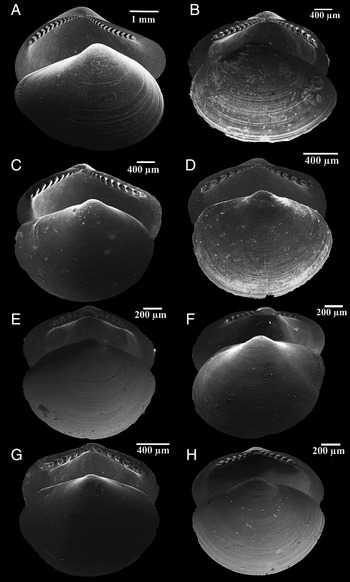
Morphometric analysis of the shell is a commonly used taxonomic tool in assessing local or regional conchological variations in molluscs (Branch & Marsh, Reference Branch and Marsh1978; Lam & Calow, Reference Lam and Calow1988; Kilgour et al., Reference Kilgour, Lynn and Mackie1990; Rolán, Reference Rolán1991; Absalão & De Paula, Reference Absalão and De Paula2004; Caetano & Absalão, Reference Caetano and Absalão2005; Caetano et al., Reference Caetano, Scarabino and Absalão2010). Many studies have focused on morphometric analyses to determine patterns in bivalve shells (Ubutaka, Reference Ubutaka2003; Oliveira & Morales, Reference Oliveira and Morales2010), the relationship of shell form to life habits (Stanley, Reference Stanley1970), to discriminate different populations (Rabarts & Whybrow, Reference Rabarts and Whybrow1979; Bonfitto & Sabelli, Reference Bonfitto and Sabelli1995; Fuiman et al., Reference Fuiman, Gage and Lamont1999), and to increase the number of useful taxonomic features (Allen & Hannah, Reference Allen and Hannah1989; Warén, Reference Warén1989; Rhind & Allen, Reference Rhind and Allen1992; Allen et al., Reference Allen, Sanders and Hannah1995; Allen & Sanders, Reference Allen and Sanders1996; Kafanov et al., Reference Kafanov, Danilin and Moshchenko1997; Domaneschi & Shea, Reference Domaneschi and Shea2004). Here we used the species Yoldiella biguttata; Y. similis Allen, Sanders & Hannah, Reference Allen, Sanders and Hannah1995; Yoldiella extensa Allen, Sanders & Hannah, Reference Allen, Sanders and Hannah1995; Y. aff. jeffreysi (Hidalgo, 1877); Yoldiella sp. 1; Yoldiella sp. 2; Yoldiella sp. 3; and Yoldiella sp. 4 (Figure 1) as a test to identify the power of morphometric analysis, utilizing data on the shell shape and hinge plate.
Yoldiella species used in the morphometric analysis: (A) Yoldiella sp. 1; (B) Yoldiella sp. 2; (C) Y. aff. jeffreysi (Hidalgo, 1877); (D) Y. similis Allen, Sanders & Hannah, Reference Allen, Sanders and Hannah1995; (E) Yoldiella sp. 3; (F) Y. biguttata Allen, Sanders & Hannah, Reference Allen, Sanders and Hannah1995; (G) Yoldiella sp. 4; (H) Y. extensa Allen, Sanders & Hannah, Reference Allen, Sanders and Hannah1995. Internal view, right valve: A, C and F; left view: B, D, E, G and H.

MATERIALS AND METHODS
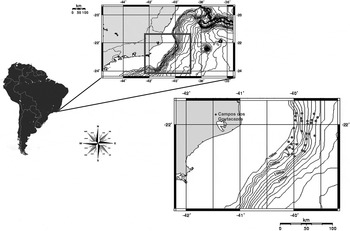
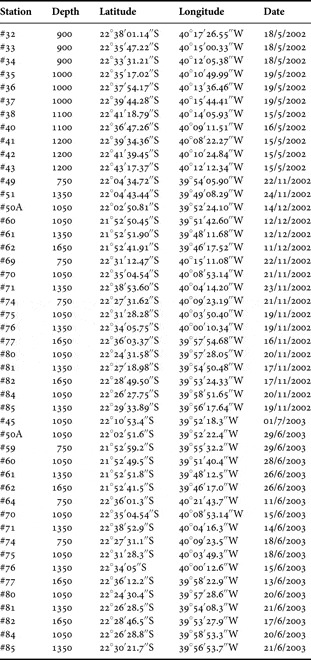
The samples used in the present study were collected by a box corer in the northern and southern regions of the Campos Basin, off Rio de Janeiro State, Brazil (Figure 2) by the research vessel ‘Astro-Garoupa’ belonging to Petrobras S.A. (a public Brazilian oil company) as part of the programme ‘Environmental Characterization of Campos Basin, RJ, Brazil’ in the years 2002 and 2003. Yoldiella spp. were present at 100 stations between the isobaths of 700 and 2000 m. The list of collected localities is given in Table 1. All the specimens studied (only empty shells were available) are deposited in the collection of Molluscs of the Instituto de Biologia, Universidade Federal do Rio de Janeiro (IBUFRJ). The taxonomic identifications were made by the observation and analyses of figures of Yoldiella types held at the British Museum of Natural History (BM(NH)), and types illustrated and/or well described (Verrill & Bush, Reference Verrill and Bush1897; Allen et al., Reference Allen, Sanders and Hannah1995; Bonfitto & Sabelli, Reference Bonfitto and Sabelli1995; Warén, Reference Warén1989; La Perna, Reference La Perna2008a, Reference La Pernab; Oliver et al., Reference Oliver, Holmes, Killeen and Turner2009).
Map of the sampled localities. Each dot represents a sampled station in Campos Basin, off Rio de Janeiro State, Brazil.

List of sampled localities of Campos Basin, off Rio de Janeiro State, Brazil.

Attempts to identify the species revealed the confused taxonomic status of the genus, and reinforced the need to undertake a morphometric approach to test the morphological discriminance of this group of species.
Morphometric analysis
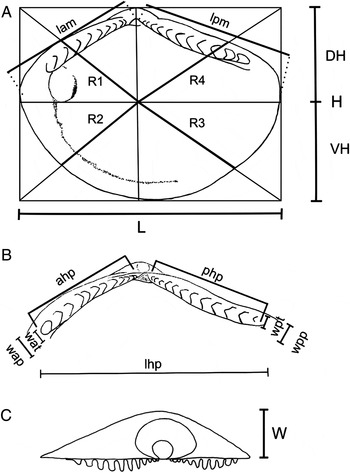
Each species had, whenever possible, 30 valves selected and drawn with the aid of a camera lucida. From these drawings, measurements were taken as follows (Figure 3): total length (L); height (H); dorsal height (DH); ventral height (VH); width of a valve (W); length of the antero-dorsal margin (lam); postero-dorsal margin length (lpm); total length of the hinge plate (lhp); length of the anterior and posterior hinge plate (ahp and php); width of the anterior hinge plate and teeth (wap and wat); width of the posterior hinge plate and teeth (wpp and wpt); lengths of the line beginning on the shell centre toward the vertex of the quadrant which composes the rectangle that limits the shell (R1, R2, R3 and R4). Also, the ratios of the total height to total length (H/L); width to total length (W/L); total length of the hinge plate to total length (lhp/L); width and length of the anterior hinge plate (wap/ahp); width and length of the posterior hinge plate (wpp/php); length of the anterior hinge plate and anterior margin (ahp/lam); and length of the posterior hinge plate and posterior margin (php/lpm). The angles of shell expansion were used at first, but did not seem to affect the models and so were discarded. The prodissoconch length, in spite of being a good tool to discriminate among the species (Allen et al., Reference Allen, Sanders and Hannah1995), was not easily discernible in all of them, and to avoid errors we preferred not to include this information in the analyses. Similar approaches were also used by Knudsen (Reference Knudsen1970), Rabarts & Whybrow (Reference Rabarts and Whybrow1979), Warén (Reference Warén1989), Rhind & Allen (Reference Rhind and Allen1992), Allen et al. (Reference Allen, Sanders and Hannah1995), Bonfitto & Sabelli (Reference Bonfitto and Sabelli1995), Fuiman et al. (Reference Fuiman, Gage and Lamont1999) and Caetano & Absalão (Reference Caetano and Absalão2005). However, the measurements of the distance between the centre of the shell and its margins, the width of the hinge teeth and the ratios of the width of the hinge plate to its length are used here for the first time.
Measurements used: (A) total length (L); height (H); dorsal height (DH); ventral height (VH); antero-dorsal margin length (lam); postero-dorsal margin length (lpm); centre to margin lengths (R1, R2, R3, and R4); (B) total length of the hinge plate (lhp); length of the anterior and posterior hinge plates (ahp and php); width of the anterior hinge plate and teeth (wap and wat); width of the posterior hinge plate and teeth (wpp and wpt); (C) width of a valve (W).

To assure independence among variables, we performed a preliminary correlation analysis among all variables, with strongly correlated variables (r ≥ 0.9) and/or with statistical significance (α < 0.05) being excluded to avoid redundancy. The normality of variables was verified through normal probability plots.
Having all taxa previously defined, according to traditional criteria largely based on shell shape subjective perception (see Benaim & Absalão, Reference Benaim and Absalão2011), and facing this identification proposal as a hypothesis to be tested, we performed a validation test. For this purpose a multivariate approach was carried out utilizing discriminant function analysis (DFA) to integrate all morphometric data in a single analysis, with the specific aims of: (1) to corroborate or not our previous identification; (2) to illustrate quantitative diagnostic features for the species and clusters of species; and (3) to assess which of the analysed features were the most important for the discrimination of these species. Forward stepwise procedures were employed to select the most useful discriminating variables. To perform these analyses, we standardized the morphometric data following Romesburg (Reference Romesburg1984). All statistical procedures were performed with STATISTICA software (version 7.0), StatSoft, Inc., Tulsa, Oklahoma.
RESULTS AND DISCUSSION
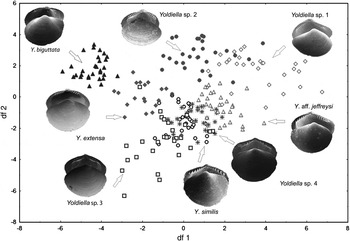
When observed all together, the eight species can be easily placed in different categories or groups, but the identification at the species level leads to doubts, as shown in Figure 4. One may argue that the degree of taxonomic uncertainty associated with these taxa would invalidate the whole statistical analysis, considering that the specific status could be uncertain. However, Benaim & Absalão (Reference Benaim and Absalão2010) have already elucidated this issue.
Discriminant function analysis with 8 taxa using morphometric data. df, discriminant function.

There is another potential bias in concern with the utilization of the same morphometric variables both in the characterization and in the secondary validation of our taxonomic decisions. However, the ‘traditional’ characterizations use, in an intuitive way, only part of the information which is contained in the morphometric variables. Here all of the information available within our morphometric variables is objectively managed, showing which variables are really important to discriminate among these similar species.
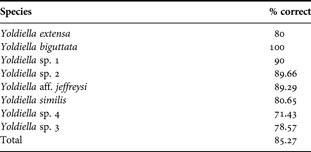
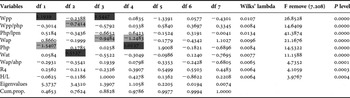
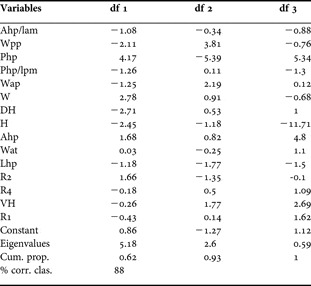
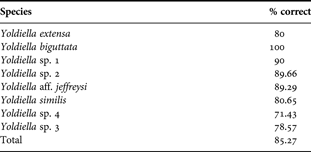
The species Y. biguttata is easily distinguished from the others, and no additional analysis will be conducted on it. As in the former, Y. extensa do not form a group with any other species, and show nothing but two overlapping cases. The pair Yoldiella sp. 2 and Yoldiella sp. 1 and the species group composed of Y. similis, Y. aff. jeffreysi, Yoldiella sp. 3, and Yoldiella sp. 4 merit separate analyses. The general multivariate DFA was able to distinguish between the eight species (Table 2). This analysis (Table 3; Figure 4) indicated that only 9 of the 25 original morphometric variables were necessary (R4, H/L, php, wap, wpp, wat, wap/ahp, wpp/php and ahp/lam) to construct a discriminant model that was effective in 85.27% of the cases. Some of the traditionally used morphometric parameters such as total length of the hinge plate (lhp), total height (H), dorsal height (DH), ventral height (VH) and total length (L) (Knudsen, 1970; Warén, Reference Warén1989; Rhind & Allen, Reference Rhind and Allen1992; Bonfitto & Sabelli, Reference Bonfitto and Sabelli1995) were excluded from the final analysis because they were highly correlated (r ≥ 0.9) with at least 9 other variables. Most of the misclassifications occurred with the pair Yoldiella sp. 2–Yoldiella sp. 1 and the species group Y. similis–Yoldiella sp. 3–Yoldiella sp. 4, where it is possible to see an intermingling among each other. Although Table 3 shows seven discriminant functions, their eigenvalues revealed that the discriminant functions 5, 6 and 7 made a negligible contribution, and therefore they will not be considered further. The morphometric variables wpp, wap, php, wpp/php and wat were the most important variables in the four main discriminant functions, and it became evident that morphometric variables of the hinge plate function are the major ones. Therefore, except for R4 and H/L, which represent the posterior expansion of the shell and the general shell shape respectively, all of the others deal with hinge features. Nevertheless, it is important to emphasize that a linear approach such as this, cannot properly deal with all of the information that general shape can give such as the contour of the rostral area, which seems to be an important feature to identify species. But, in spite of that, this set of variables was able to produce a good discrimination among all the considered species.
Percentage of cases correctly classified in each group considering the discriminant analysis with 8 taxa.
Standardized coefficients for canonical variables plus Wilks' lambda, F remove and P levels. Light dashed cells indicate most representative variables with negative values in each axis. Dark dashed cells indicate most representative variables with positive values in each axis.

Variables: for definition of abbreviations see Materials and Methods section; df, discriminant function; Cum. prop., cumulative proportion.
The Yoldiella sp. 1–Yoldiella sp. 2 problem
Di Geronimo & La Perna (Reference Di Geronimo and La Perna1997) concluded that Y. philippiana, Y. striolata, Y. propinqua, Y. tamara, and Y. pygmaea and allied species belong to a homogeneous group which differs from the Yoldiella type species in having thicker, more convex shells with a low rostrum and a longer and thicker hinge. Of these species, Yoldiella sp. 1 and Yoldiella sp. 2 co-occur in our region, and their positions in Figure 3 partially corroborate the group of species suggested by Di Geronimo & La Perna (Reference Di Geronimo and La Perna1997).
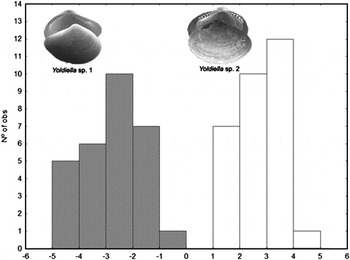
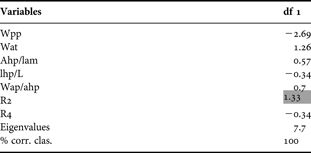
Table 4 and Figure 5 show that only seven morphometric variables (wpp, wat, ahp/Lam, lhp/L, wap/ahp, R2 and R4) were needed to establish a discriminant model that correctly separated all of the cases. Wpp and R2 were the most important ones. The specimens of Yoldiella sp. 2 are distributed on the positive side of the discriminant function, whereas Yoldiella sp. 1 individuals are on the negative side. Therefore, although both species share some morphological characters, as pointed out by Di Geronimo & La Perna (Reference Di Geronimo and La Perna1997), a specific analysis based on morphometric variables was quite effective in discriminating between them. Again, following the general approach with the eight species together, wpp and wat appeared among the most important discriminant variables, suggesting the importance of hinge characters in the discrimination of Yoldiella species.
Discriminant analysis between Yoldiella sp. 1 and Yoldiella sp. 2 using morphometric data. The abscissa axis is a discriminant function.

Standardized coefficients for canonical variables from discriminant analysis between Yoldiella sp. 1 and Yoldiella sp. 2.
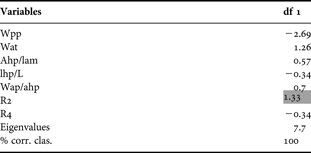
Variables: for definition of abbreviations see Materials and Methods section; df, discriminant function; % corr. clas., percentage of cases correctly classified.
The Yoldiella similis–Y.aff. jeffreysi–Yoldiella sp. 3 and Yoldiella sp. 4 cluster
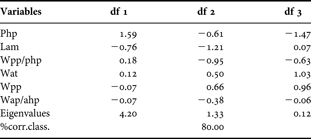
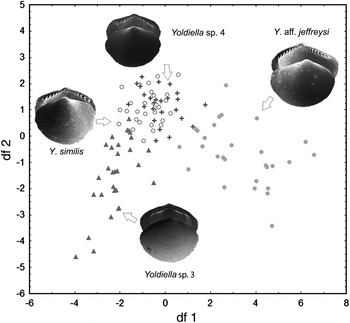
As seen in Figure 3, these species show a gradual intermingling among each other, but when this cluster of species is analysed alone (Table 5; Figure 7), Y. aff. jeffreysi and Yoldiella sp. 3 are distinguished from the others. Yoldiella sp. 3 is easily separated from the others, since all its specimens are on the negative side of both discriminant functions. In contrast, Y. aff. jeffreysi is spread on the positive side of discriminant function 1. Therefore we obtained a total of 80% correct categorization using six morphometric variables (wpp, php, wat, lam, wat/ahp and wpp/php). The most important morphometric variables were php and lam (Table 5).
Standardized coefficients for canonical variables from discriminant analysis of Yoldiella similis, Yoldiella aff. jeffreysi, Yoldiella sp. 3 and Yoldiella sp. 4.
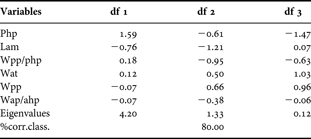
Variables: for definition of abbreviations see Materials and Methods section; df, discriminant function; % corr. clas., percentage of cases correctly classified.
Most of our possible errors are concentrated on the pair Yoldiella similis–Yoldiella sp. 4, as shown by the broad overlap among them seen in Figure 6. This apparent mixture might lead us to consider that these could be a single species, but there are two qualitative differences between Y. similis and Yoldiella sp. 4 that were not formally included in this analysis: the more acute hinge teeth, and the more triangular resilifer of the latter species (these differences can be seen in Figure 1).
Discriminant analysis with 4 taxa using morphometric data to test size influence. df, discriminant function.

GENERAL DISCUSSION
The shell shape is a feature intrinsically related to life habits (Stanley, Reference Stanley1970), and many species of protobranchs have been described based mainly on the shell shape and with the number of teeth playing as one of the major features (Kilburn, Reference Kilburn1994; Allen et al., Reference Allen, Sanders and Hannah1995). In fact, shell shape is the most common character used in determining species, not only among the Pelecypoda, but among all the Mollusca. Although, in a general way, shell shape can and must be used, caution should be taken in groups that exhibit allometric growth and for which additional information about shell ornamentation, lunule, escutcheon and carina is lacking (Allen et al., Reference Allen, Sanders and Hannah1995; Zardus, Reference Zardus2002). Recently, Oliveira & Morales (Reference Oliveira and Morales2010) analysed the number of teeth of protobranchs as a character to distinguish among species, and found that this is not a good tool to be used with so much weight, since the number of the teeth increases with shell growth. Notwithstanding, it does not reflect all of the information that can be extracted from the hinge plate, as shown by the importance of the morphometric characters selected in our analysis.
In all three discriminant analyses performed here, the hinge plate variables not only were always present, but were always included among the major contributing morphometric variables. Among these, the width of the posterior hinge plate (wpp) was most frequently sampled as the most important one. This means that a large amount of taxonomically useful information has not been considered in most taxonomic studies of protobranchs (Laghi, Reference Laghi1984; Kilburn, Reference Kilburn1994; Allen et al., Reference Allen, Sanders and Hannah1995; La Perna, Reference La Perna2004, 2008a). Although some kind of information about hinge plate is commonly given (hinge plate width and length) this is not precise enough to allow any kind of detailed comparison between species. An exception is Warén (Reference Warén1989), who considered the ‘thickness’ of the hinge (our wpp) as an important feature for the discrimination of species, and used it to distinguish among three pairs of Yoldiella species.
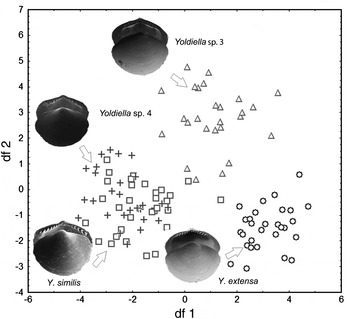
An additional aspect that deserves attention is the possible influence of the specimen size on our discriminant analysis. To test this, we selected the species of the same general size (Y. similis, Y. extensa, Yoldiella sp. 3 and Yoldiella sp. 4) and submitted them to the same discriminant procedure. Table 6 and Figure 7 show that size was not a relevant subjacent character that could be hidden in our morphometric analysis, since these same-sized species could be correctly discriminated in 88.6% of the cases.
Discriminant analysis with 4 taxa using morphometric data. df, discriminant function.

Standardized coefficients for canonical variables from discriminant analysis used at the size test.

Variables: for definition of abbreviations see Materials and Methods section; df, discriminant function; Cum. prop., cumulative proportion; % corr. clas., percentage of cases correctly classified.
Based on our results, we presume that hinge-plate morphometrics have good potential to be a tool for improving species discrimination, especially when there are a few evident differences among those taxa.
ACKNOWLEDGEMENTS
We are indebted to Dr Anders Warén for his help with the literature; Dr Rafael La Perna for revising the final text and for the exchange of ideas about identity of Y. striolata; undergraduate student Diniz C.P. Viegas for help on the morphometric measurements; MSc Raquel Medeiros for the pictures of the types taken at the British Museum; and Dr Ellen Strong for the high quality pictures of the types held at the Smithsonian Institution. We are also grateful to Dr Carlos Henrique Caetano, Dr Jean Valentin and Dr Paulo Paiva for their profitable discussion about the statistics. We also thank Petrobras S.A. (Brazilian Petroleum Co.) for the access to this deep water material and CNPq for the fellowship to both authors.