Natural disasters disrupt communities, displace persons and animals, and hamper travel and communications. Residents often temporarily relocate to shelters. The shelter environment can cause people to experience new illness and injuries and can exacerbate existing conditions.Reference Cavey, Spector and Ehrhardt 1 , 2 Morbidity surveillance among sheltered populations is key to understanding the population’s needs in real time, allocating resources, facilitating public health actions to address identified needs, and preparing for future disasters.Reference Lurie, Manolio and Patterson 3 - 5 Timely and actionable shelter surveillance relies on rapid, accurate data collection and reporting. Collecting accurate and complete surveillance data in post-disaster settings can be challengingReference Batts, Fleischauer and Noe 4 - 7 and labor-intensive. 8
Hurricane Sandy made landfall in New Jersey on October 29, 2012, as a post-tropical cyclone, displacing thousands and causing travel delays because of flooding, washouts, debris, and gasoline shortages throughout the state. Widespread power and Internet outages and damage to telephone lines hampered communication.
Red Cross has an established morbidity surveillance process that uses a daily 1-page aggregate morbidity form per shelter. However, the American Red Cross (Red Cross) has found data collection and reporting difficult to implement and sustain during large-scale disasters with multiple competing priorities. Post-disaster environments are often extremely fluid. Shelters rapidly open and close, and there is often insufficient staff, information technology resources, and supervisory support at the shelter location.Reference Noe, Schnall and Wolkin 9 As expected, during the first week shelters were open after Hurricane Sandy, limited morbidity surveillance data were reported to the Red Cross response headquarters for the state. To support and facilitate surveillance in New Jersey shelters, a shelter surveillance team was created near the end of the first week that shelters were open, comprising personnel from the Centers for Disease Control and Prevention (CDC) and the New Jersey Department of Health in conjunction with the Red Cross. The team trained shelter personnel on remote transmission of surveillance data and assessed the completeness of reporting remotely, via cellular phone, compared with daily in-person shelter visits.
Methods
We identified and prioritized shelters for surveillance by using the Red Cross National Shelter System midnight census counts. We prioritized by the number of residents and anticipated the time each was to remain open, so that the first shelters visited were the most populous and those expected to remain open the longest as shelters were consolidated at the most suitable sites. Surveillance teams visited shelters in order of priority and incorporated them into the surveillance system according to a multistep process based on the feasibility and acceptability of surveillance (Supplemental Figure 1 in the online data supplement). For shelters where health services staff were conducting surveillance, team members answered questions and established daily pickup of morbidity data. If surveillance was not occurring, team members provided just-in-time verbal training that explained (1) the importance of daily surveillance, (2) the data collection tool and how to collect data, (3) the initiation of the surveillance process, and (4) the process for daily pickup of forms by surveillance team members.
Each shelter collected aggregate morbidity surveillance data in 24-hour periods by using either a Red Cross aggregate surveillance form or a similar form containing the same variables developed for use in non–Red Cross shelters (Supplemental Figure 2 in the online data supplement). Aggregate forms contained no personally identifiable information and were reportable via fax, e-mail, or text message without privacy concerns. One week after initiation of the surveillance system, personnel at the shelters that still remained open were asked about possible methods for reporting data remotely, and a plan was developed for cell phone–based remote reporting to the surveillance team that incorporated each shelter’s preferred method (i.e., e-mail or text message). Each shelter received an in-person visit for training on remote reporting, and the system was tested by having health services personnel report test data remotely by use of the protocol. During this training visit, step-by-step instructions for cell phone remote reporting that included points of contact for reporting and questions were taped to the health services table in each shelter. Thereafter, remote reporting via e-mail or text message sent by cellular phone continued until each shelter closed and regular visits to shelters were discontinued.
Completed surveillance forms were initially collected in person during team visits to shelters from November 4 to 11, 2012. Forms were transmitted via cell phone remotely from November 12 to 21, 2012, when the last shelters in New Jersey closed. In both cases, aggregate data were entered into a spreadsheet and a summary report was created daily at the CDC. This report was shared with the New Jersey Red Cross response headquarters as well as with the New Jersey Department of Health; these offices further distributed reports to Red Cross regional and local assets and local health departments. Once a team visited a shelter to collect their surveillance forms, the shelter was enrolled in the system. Each day an enrolled shelter remained open was categorized as “surveillance form reported” or “surveillance form missing.” Using these categorizations, we calculated an overall percentage of missing surveillance forms and tested for differences in the proportions of collected versus missing forms between in-person and cell phone remote reporting periods by chi-square analysis. Analysis was conducted by using SAS version 9.2 (SAS Institute, Inc., Cary, North Carolina).
Results
From November 4 to 11, 2012, team members visited 27 shelters, 23 of which provided health services. Twelve shelters were collecting, but not reporting, surveillance data; all agreed to participate in the surveillance system. The remaining 11 shelters were not conducting surveillance; 9 of those shelters agreed to participate. Thus, 21 shelters were enrolled in the surveillance system project (Supplemental Figure 1).
Staff at 11 shelters selected their preferred methods for remote reporting; 3 shelters selected multiple possible methods of remote reporting that were considered equally preferred. Reporting via text message sent from a cellular phone was selected by 6 shelters, e-mail sent from a cellular phone was selected by 5 shelters, and faxing was selected as a preferred method by 3 shelters. Ultimately, all shelters submitted reports via personally owned cellular phones. Each day, shelter personnel photographed their completed surveillance forms by using the phone’s built-in camera and then sent the photos as attachments to e-mail or text messages. Shelters reported remotely from November 12 to 21. Remote reporting continued successfully throughout personnel changes because outgoing shelter personnel trained incoming personnel during their period of overlap on surveillance and reporting. Cell phone reporting also opened up a communication channel with each shelter, allowing for clarification questions to be asked and answered by shelter health services staff, or a reminder to be sent if a surveillance form was not submitted.
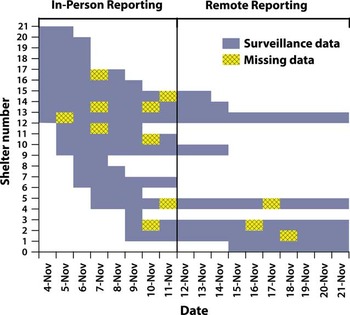
From November 4 to 21, 2012, a total of 21 shelters completed and reported 134 aggregate surveillance forms from a possible total of 146 (8% missing; 12/146 possible surveillance forms; Figure 1). When stratified by period, 9/91 (10%) daily aggregate forms were missing during the in-person reporting period (November 4–11), and 3/55 (5%) aggregate forms were missing for the remote reporting period (November 12–21), demonstrating that the proportion of collected versus missing surveillance forms did not differ significantly for the in-person and remote reporting periods (χ2=0.8941; df=1; P=0.34). No apparent difference in reporting was detected between Red Cross and non–Red Cross shelters; however, data were too sparse to allow for statistical analysis.
The 21 Shelters Included in the Surveillance System After Hurricane Sandy, New Jersey, November 4–21, 2012. For each 24-hour period during which a shelter was open and had been included in the surveillance system, data are shown as reported (solid) or missing (hatched). Shelters were incorporated into the surveillance system during multiple days, beginning on November 4, 2012. Shelters after large disasters are dynamic, with many of the initial shelters closing and the remaining shelter residents consolidated at sites suitable for long-term sheltering. As a result, more shelters closed than opened during the surveillance period. Newly opened shelters were incorporated into the surveillance system as quickly as possible, but there was often a 1- to 2-day lag before that was possible.

Discussion
Substantial progress has been made since Hurricane Katrina (August 2005) in developing effective morbidity surveillance tools,Reference Batts, Fleischauer and Noe 4 but data collection in post-disaster settings is labor-intensive and often results in high rates of missing data. 8 , Reference Ridpath, Bregman and Jones 10 The results of this project demonstrate that transmitting de-identified aggregate surveillance forms via cellular phone is possible and acceptable to shelter staff and does not compromise data capture rates. Remote reporting might allow for expanded surveillance during disasters, resulting in time and personnel savings. A key finding was that cellular phone reporting maintained a 2-way communication channel with each shelter, continued successfully throughout personnel changes at the shelters, and provided a means of timely data exchange when travel and other communication channels were limited—a common need in other disaster responses. 5 - 7
Aggregate morbidity data are syndromic and do not allow for the tracking of individuals or stratified analyses. Nonetheless, timely reporting in this response facilitated the rapid activation of local public health resources when symptoms of infectious disease increased in a shelter, as well as the targeting of mental health and pharmacy assets, regardless of the reporting method. Although it was not possible during this project to assess the quality of the aggregate surveillance data reported, future work might determine whether the quality of aggregate data varies over time or across reporting methods.
Cellular phones increasingly play a role in public health data collection for non-personally-identifiable data.Reference Freifeld, Chunara and Mekaru 11 As smartphone ownership increases, smartphone camera resolution increases, and cellular phone networks are fortified, this reporting method could become increasingly viable during disaster response. However, a limitation during the data collection period after Hurricane Sandy was that pictures occasionally were blurry, leading to possible data entry errors. In most cases, a response via text message or e-mail requesting a new photograph of the aggregate data form solved the problem. Another possible solution is to develop a smartphone application for direct data entry to minimize errors, eliminate the need for data entry at headquarters, and accelerate reporting. The possible costs and logistics of such a method would require further exploration.
Initial in-person visits heightened awareness and educated shelter staff on the importance and process of daily surveillance. Similar surveillance efforts in New York City after Hurricane Sandy were initiated via telephone and experienced low reporting rates before in-person visits were made to each shelter.Reference Ridpath, Bregman and Jones 10 It appears likely that the initial in-person visits in this project were critical to initiating surveillance that could then be maintained via remote reporting. We demonstrated that timely shelter surveillance was possible after a major statewide disaster by use of a remote reporting method. This New Jersey pilot project was successful because it prioritized shelters, provided just-in-time in-person training, and leveraged cell phones as a means to sustain surveillance dialogue between shelter staff and public health. Consideration of this strategy for future responses is warranted.
Acknowledgments
The authors thank the many shelter volunteers who participated in data collection and reporting in the aftermath of Hurricane Sandy, as well as Denise Garon; Nicole Mazur; Fernando McLean, Jr; Jason Mehr; and Barbara Montana from the New Jersey Department of Health and Diana Bensyl and several additional reviewers from the Centers for Disease Control and Prevention for their helpful contributions.
Disclaimer
The findings and conclusions in this report are those of the author(s) and do not necessarily represent the official position of the Centers for Disease Control and Prevention.
Supplementary material
To view supplementary material for this article, please visit http://dx.doi.org/10.1017/dmp.2015.164.