Nontypeable Haemophilus influenzae (NTHi) is an important pathogenReference Van Eldere, Slack, Ladhani and Cripps 1 that causes otitis media in childrenReference Cilveti, Olmo and Pérez-Jove 2 and lower respiratory tract infections (LRIs), including exacerbations of chronic obstructive pulmonary disease, in adults.Reference Wilkinson, Aris and Bourne 3 Nontypeable H. influenzae is less virulent than encapsulated serotypesReference Agrawal and Murphy 4 ; however, after the introduction of H. influenzae type b (Hib) conjugative vaccines, the burden of invasive NTHi disease has increased among older people.Reference Dworkin, Park and Borchardt 5 – Reference Van Wessel, Rodenburg, Veenhoven, Spanjaard, van der Ende and Sanders 7 Furthermore, the emergence of antimicrobial-resistant strains, such as the β-lactamase-negative ampicillin-resistant (BLNAR) strain, is posing a threat to public health, especially in East Asian countries such as Japan.Reference Yanagihara, Kadota and Aoki 8
Nontypeable H. influenzae is a commensal pathogen of the upper respiratory tract that is common in the general population. The proportion of NTHi carriage varies depending on the geographical area and risk of exposure: NTHi colonizes 9.4%–87.1% of childrenReference Oikawa, Ishiwada and Takahashi 9 – Reference Smith-Vaughan, Beissbarth and Bowman 12 and 18%–30% of adults.Reference Mackenzie, Leach, Carapetis, Fisher and Morris 13 – Reference Hammitt, Akech and Morpeth 15 Although NTHi carriers are normally asymptomatic, a human nasopharyngeal colonization study demonstrated that in healthy adults, the acquisition of NTHi results in upper respiratory tract symptoms.Reference Winokur, Chaloner, Doern, Ferreira and Apicella 16 Nontypeable H. influenzae can be transmitted human to human through respiratory droplets. Therefore, NTHi may cause an outbreak of upper respiratory tract infection (URI) in crowded settings. However, evidence of NTHi URI outbreaks is scarce, which may be because establishing a causal association between the detection of NTHi from upper respiratory tract samples and URI symptoms is difficult.
In July 2015, an outbreak of acute respiratory infection (ARI) was identified in an acute-care hospital in Kochi, Japan. We conducted an intensive epidemiological investigation and found that this outbreak was caused by a BLNAR NTHi strain.
Description of Outbreak
The hospital is located in the center of Kochi in western Japan and provides primary, secondary, and tertiary care for residents. On July 1, 2015, 4 nurses working in an acute-care ward (ward A) developed acute upper respiratory symptoms and reported them to the hospital. The hospital infection control team (ICT) initiated an investigation and identified a male patient, aged 96 years, who had been hospitalized in ward A with a diagnosis of aspiration pneumonia with fever, chills, and respiratory symptoms since June 18 (index patient). The patient initially improved after antibiotic treatment but redeveloped fever, cough, and sputum on June 29. According to the hospital laboratory record, sputum samples were collected from the index patient on June 18 and 29, and their cultures yielded Haemophilus influenzae. The ICT also identified 4 patients with respiratory symptoms who had been hospitalized in the same room as the index patient and an additional 4 nurses in ward A who had developed respiratory symptoms after the admission of the index patient. The ICT immediately reported this event to the Kochi Municipal Health Center and initiated an intensive epidemiological investigation and intervention in collaboration with the Institute of Tropical Medicine, Nagasaki University (ITM-NU) and National Institute of Infectious Diseases (NIID).
METHODS
Outbreak Investigation and Study Population
The outbreak investigation was conducted from July 1 to August 31, 2015, through prospective surveillance and retrospective data collection. We targeted all patients who had been hospitalized in the same room with the index patient and all medical staff and nursing students who had been working in ward A. Participants provided sputum or throat swab samples at the time of the interview. Chest x-rays of symptomatic participants were interpreted by an expert pulmonologist. Participants were asked to report if any symptoms developed after the initial survey until the end of the follow-up period (August 31).
Participants were diagnosed as ARI if they had developed any of the following symptoms: cough, sneezing, sputum, sore throat, or respiratory distress. Among ARI cases, participants were diagnosed as lower respiratory tract infection (LRI) if their sputum samples yielded causative bacteria or their chest x-rays demonstrated infiltrate shadows; otherwise they were diagnosed as URI. Participants were considered as contacts of the index patient if they shared a room with the index patient or cared for the index patient. The contacts of the index patient were identified using the nursing duty roster and bed management records.
Study Design
We conducted 2 analyses to identify a causative agent and risk factors for disease. First, to verify BLNAR NTHi as a cause of this ARI outbreak, we performed a cross-sectional study to examine the association between detected pathogens and ARI among all participants. Second, we conducted a case-control study to identify the risk factors for ARI caused by BLNAR NTHi. Cases were participants with ARI whose culture yielded BLNAR NTHi, and controls were participants without ARI whose culture or polymerase chain reaction (PCR) assay did not yield any bacterial pathogens.
Microbiological Methods
Nasopharyngeal and sputum samples were cultured in the hospital laboratory. Haemophilus influenzae identification and the β-lactamase test were performed using the ID Test HN 20 Rapid Kit (Nissui Pharmaceutical, Tokyo, Japan). The antibiotic susceptibility test was performed with the broth microdilution method using Dryplate Eiken DP34 (Eiken Chemical, Tokyo, Japan). Samples were transported to ITM-NU for PCR testing. DNA and RNA were extracted from the samples using the QIAamp DNA mini kit (Qiagen, Hilden, Germany) and QIA viral RNA minikit (Qiagen, Valencia, CA), respectively. In-house multiplex PCR assays were performed to detect 3 bacterial pathogens (the omp p6 gene of H. influenzae, the lytA gene of Streptococcus pneumoniae, and the copB gene of Moraxella catarrhalis) and 13 respiratory viruses (influenza A, influenza B, RSV, hMPV, PIV-1, PIV-2, PIV-3, PIV-4, rhinovirus, coronavirus, adenovirus, and bocavirus) as described previously.Reference Yoshida, Suzuki and Yamamoto 17 Haemophilus influenzae isolates were sent to NIID for serotyping and genotyping. Serotypes of the H. influenzae isolates were identified by coagulation using antiserum purchased from Denka Seiken (Tokyo, Japan). Pulsed-field gel electrophoresis (PFGE) was performed on isolates to determine genetic relatedness. To determine genetic similarity, the band-based similarity coefficients were calculated using Dice’s formula: 2h/a+b, where h is the number of matching bands and a+b is the total number of bands being compared.Reference Dice 18 The DNA was digested with SmaI (Takara Shuzo, Shiga, Japan). Multilocus sequence typing (MLST) was performed by the DNA sequencing of 7 housekeeping genes: adk, atpG, frdB, fucK, mdh, pgi, and recA.Reference Meats, Feil and Stringer 19 Sequence types (ST) were determined using the H. influenzae MLST website (http://haemlphilus.mlst.net).
Statistical Analysis
An epidemic curve of the symptomatic participants was generated according to the date of onset by their occupation type. As the index case redeveloped respiratory symptoms after antibiotic treatment, its date of onset was shown twice in the epidemic curve. The microbiological test results were compared between participants with and without ARI using simple tabulations and χ2 tests. For the case-control study, univariate and multivariate analyses were conducted using logistic regression models. All analyses were performed using Stata version 14.0 software (StataCorp, College Station, TX).
Ethics
The Institutional Review Board of Chikamori Hospital (Kochi, Japan) approved this study. Written informed consent was obtained from each survey participant at the time of data and sample collection.
RESULTS
Case Characteristics and Epidemiological Risk Factors
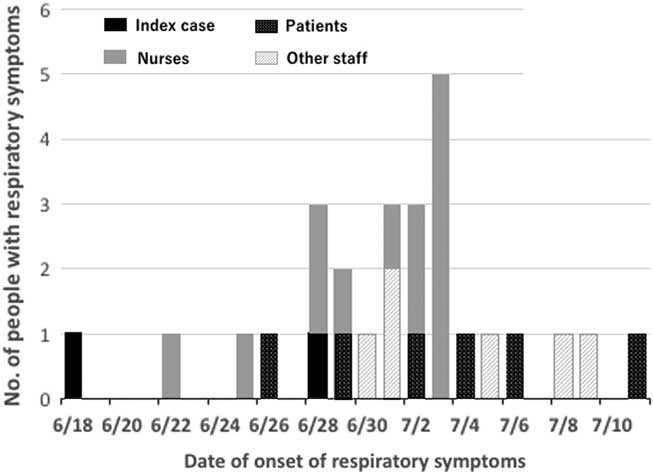
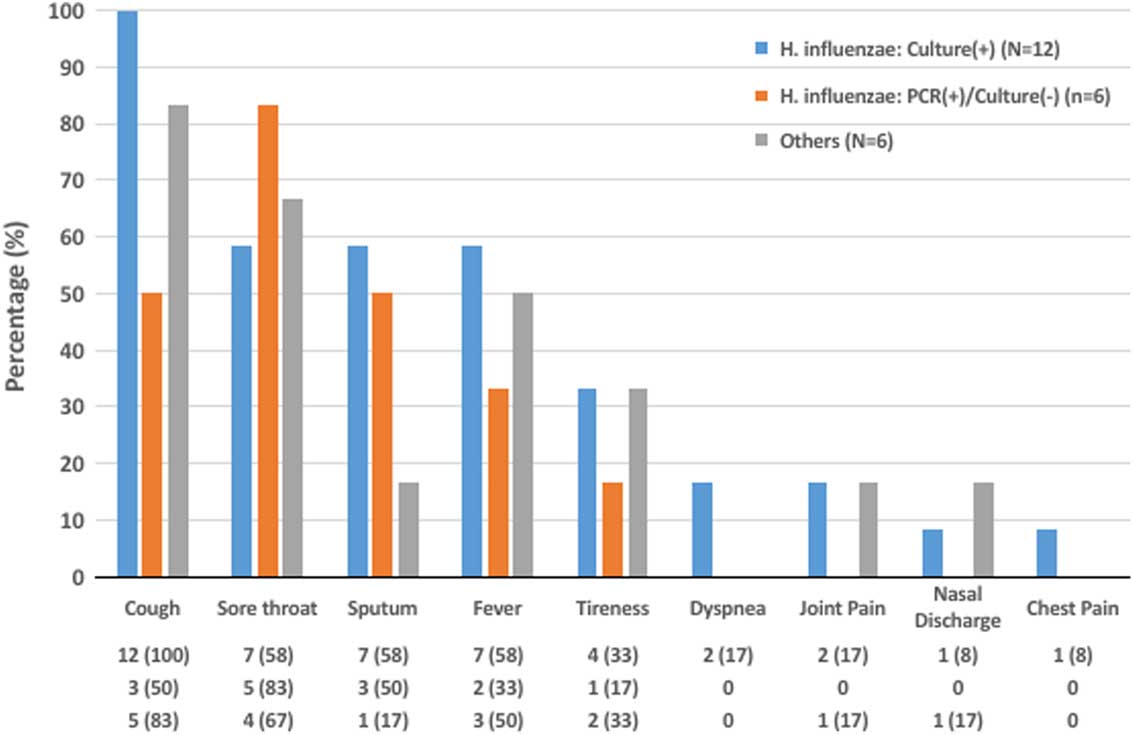
A total of 78 participants, including the index patient, were enrolled in the outbreak investigation. Of these, 47 (60.3%) were female, and the median age was 43 years (range, 20–97 years). Moreover, 19 were hospitalized patients, 31 were nurses, and 28 were other co-medical staff. Of all 78 participants, 27 (34.6%) reported respiratory symptoms during the investigation time. The epidemic curve of the ARI cases is shown in Figure 1. After the index patient had been hospitalized on June 18, the number of symptomatic participants gradually increased, reached its peak on June 28, and declined thereafter. Most ARI cases showed mild respiratory symptoms (Figure 2). Cough and sore throat were the leading symptoms, followed by fever and fatigue. Among 27 participants with ARI, 24 were diagnosed as URI, and 3 participants (including the index patient) were diagnosed as LRI. No one died during the follow-up period.
Epidemic curve of acute respiratory infection cases (N=27).

Symptoms of acute respiratory infection by Haemophilus influenzae infection status (N=27). Number (percentage) are shown.

Microbiological Findings
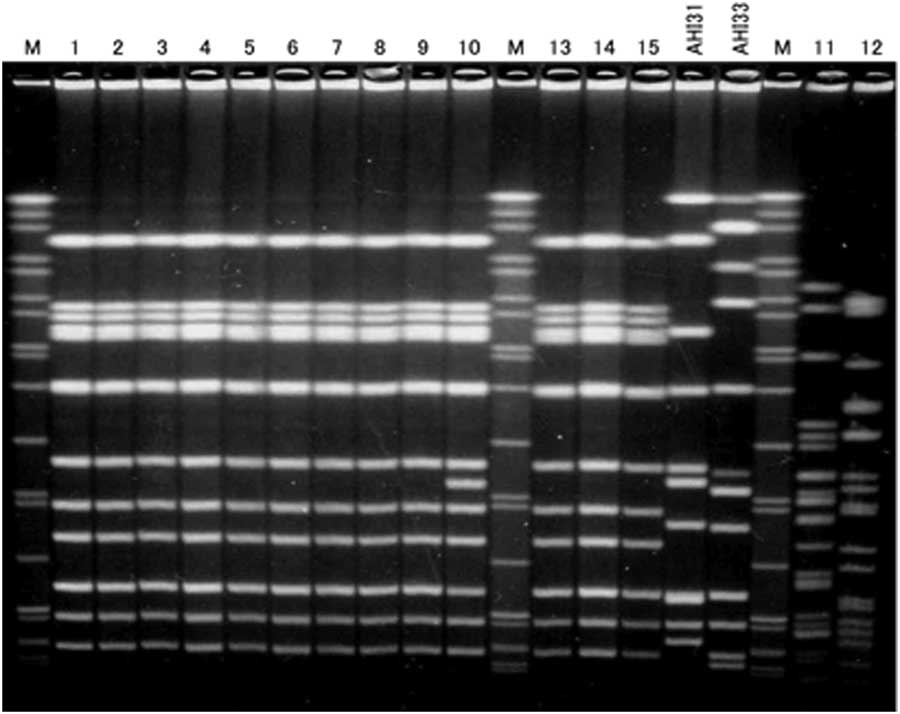
In total, 3 sputum samples and 74 throat swab samples were collected from 77 participants, including 26 ARI cases. Nontypeable H. influenzae was identified by culture in 15 individuals: 3 from sputum samples and 12 from throat samples. Of 15 NTHi isolates, 13 were BLNAR and showed indistinguishable antibiotic-resistance patterns (minimum inhibitory concentration [MIC]: ampicillin, 4 µg/mL; cefazolin, >2 µg/mL; ceftriaxone, 0.25 µg/mL; meropenem, 0.25 µg/mL) (Supplementary Table 1). Furthermore, 13 NTHi isolates showed identical PFGE patterns (Figure 3). One isolate (no. 10) showed 1 band difference that corresponded to the Dice similarity coefficient of 0.96 and was classified as an identical isolate. The MLST results showed that these isolates belonged to sequence type 159.
Pulsed-field gel electrophoresis of the SmaI restriction fragments of the Haemophilus influenzae isolates. Lanes 1–10 and 13–15: H. influenzae isolates from the study participants. Lanes AHI31 and AHI33: H. influenzae isolates from invasive disease cases that were unrelated to the outbreak. Lanes 11–12: H. parainfluenzae isolates from the study participants. NOTE. M, molecular size marker.

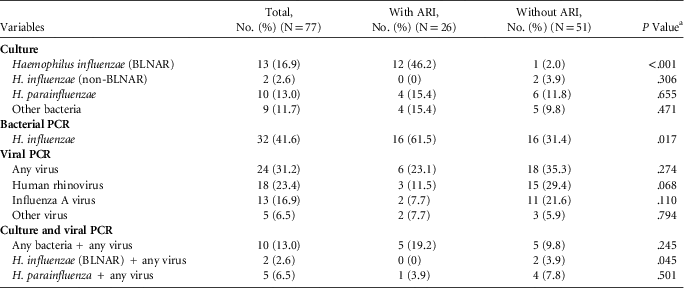
Respiratory samples were further tested for bacterial and viral pathogens with PCR assays. Overall, 15 individuals tested positive for H. influenzae: 11 were positive by both culture and PCR, and 4 were negative by culture. Viruses were detected in 24 individuals (31.2%): human rhinovirus (HRV; N=18, 23.4%) was the leading virus detected, followed by influenza A (N=13, 16.9%). Viral-bacterial codetection was observed in 10 individuals; 2 individuals were positive for a virus (adenovirus and HMPV) and were culture positive for H. influenzae (Table 1).
Microbiological Characteristics of the Acute Respiratory Infection (ARI) (N=77)

NOTE. ARI, acute respiratory infection; BLNAR, β-lactamase-negative ampicillin-resistant; PCR, polymerase chain reaction assay.
a P values were determined using the χ2 test.
The detection rate of BLNAR NTHi was substantially higher among participants with ARI (46.2%) than those without ARI (2.0%) (Table 1). Haemophilus parainfluenzae and viruses were not associated with ARI.
Assessment of the Risk of ARI Caused by BLNAR NTHi
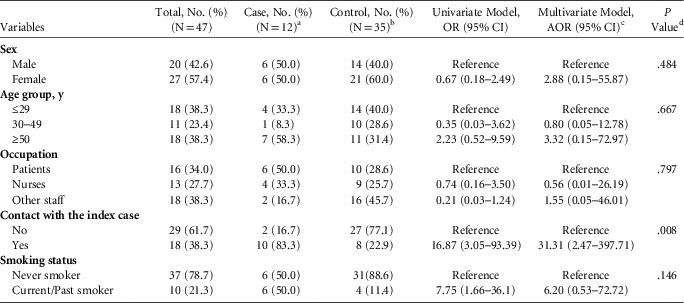
In the univariate analysis, the history of contact with the index patient and smoking were strongly associated with the development of ARI by BLNAR NTHi (Table 2). The multivariate analysis found that the history of contact with the index patient was independently associated with symptom development by BLNAR NTHi (adjusted odds ratio [OR], 31.31; 95% CI, 2.47–397.71).
Univariate and Multivariate Analysis for Risk Factor Causing the β-Lactamase-Negative Ampicillin-Resistant (BLNAR) Nontypeable Haemophilus influenzae (NTHi) Outbreak

NOTE. OR, odds ratio; CI, confidence interval; AOR, adjusted odds ratio.
a Case patients had ARI and cultures positive for BLANR NTHi.
b Control patients had no acute respiratory infection and were culture negative and PCR negative for NTHi.
c Odds ratio adjusting for sex, age, occupation, contact with the index case and smoking status.
d P values were tested using the likelihood-ratio test.
Control Measures
The ICT implemented the following infection control measures: contact precautions, reemphasis of hand hygiene, and close observation of compliance with infection control practices. Hospital staff who developed ARI were requested to wear surgical masks or stay home until their symptoms resolved. In total, 9 NTHi culture-positive participants with respiratory symptoms were treated with levofloxacin or ceftriaxone. Follow-up nasopharyngeal swab samples were collected from 6 participants after the treatment, and no participant was culture positive for NTHi. No new case was noted from July 11 to August 31.
DISCUSSION
This nosocomial ARI outbreak among patients and healthcare workers was caused by the BLNAR NTHi strain. Most patients developed URI, and the transmission occurred rapidly without causing severe disease in the hospital setting. The strong association between the exposure to the index patient and symptom development indicated that the main source of transmission was a single patient. The high prevalence of BLNAR NTHi among our patients (46.2%) and the identical microbiological pattern implied that BLNAR NTHi caused the outbreak transmitted from the index case. Our findings suggest that some drug-resistant NTHi strains can efficiently spread among adults in crowded settings.
Although NTHi is a known cause of respiratory infections, such as otitis media and pneumonia,Reference Van Eldere, Slack, Ladhani and Cripps 1 – Reference Wilkinson, Aris and Bourne 3 its potential to cause a nosocomial URI outbreak is not fully understood. Andersson et alReference Andersson, Resman and Eitrem 20 reported an outbreak of NTHi that occurred in a long-term care facility for the elderly in Sweden. According to their report, “7 of the 11 residents in a long-term care facility were colonized with NTHi, 4 of them were hospitalized, and a fifth resident died from pneumonia.”Reference Andersson, Resman and Eitrem 20 Another study from Taiwan reported that 12 patients in a respiratory care ward with a 36-bed capacity had developed pneumonia caused by NTHi.Reference Yang, Chen and Wang 21 These findings suggest that some NTHi strains have potential to cause pneumonia outbreaks among high-risk patients in crowded settings. In contrast to previous outbreak reports, in this outbreak, a BLNAR NTHi strain caused URI and spread rapidly among healthy healthcare workers.Reference Goetz, O’Brien, Musser and Ward 22 – Reference Hekker, van der Schee and Kempers 24 Smoking and underlying respiratory diseases are also associated with NTHi infections among adults; however, this association was not observed in the current outbreak. The explanation for the differences in disease severity and transmissibility in this BLNAR NTHi outbreak and previous outbreaks might be 2-fold. First, in Japan, the prevalence of BLNAR strains is particularly high, having increased from 26.7% in 2010 to 33.5% in 2015, as documented by the nationwide surveillance of the antimicrobial susceptibility of bacteria respiratory pathogens among adults.Reference Yanagihara, Kadota and Aoki 8 , Reference Niki, Hanaki and Matsumoto 25 In our setting, the prevalence of BLNAR was >40% in 2015 (data not shown). Some BLNAR strains circulating among the Japanese population might have a higher transmissibility than other NTHi strains.Reference Watanabe, Hoshino and Sugita 26 Second, in this outbreak, we identified ST159 from all NTHi cases. ST159 has been associated with COPD and has been predominantly detected in the respiratory tracts of a hospitalized group of older age (>50 years).Reference Murphy, Lesse, Kirkham, Zhong, Sethi and Munson 27 , Reference Skaare, Anthonisen and Caugant 28 According to Andersson et al,Reference Andersson, Resman and Eitrem 20 the NTHi isolates identified in the pneumonia outbreak in Sweden were ST14. The transmissibility and pathogenicity of NTHi may be different by sequence type.
Our risk-factor analysis demonstrated that exposure to the index patient, such as being in the same room with the index patient or caring for the index patient, was strongly associated with symptom development. However, no medical devices, such as a spirometer or medication nebulizer, were shared among our participants, as previously reported,Reference Gough, Kraak, Anderson, Nichols, Slack and McGhie 29 , Reference Sturm, Mostert, Rouing and Van Klingeren 30 Furthermore, although healthcare workers increase the risk of respiratory infections in hospital settings, as previous outbreak reports have noted,Reference Andersson, Resman and Eitrem 20 , Reference Kuster, Shah and Coleman 31 the risk of BLNAR NTHi ARI was similar between healthcare workers and patients. These findings suggested that this NTHi outbreak was caused by person-to-person transmission through direct contact or respiratory droplets. To control for NTHi transmission in hospital settings, the importance of hand hygiene and the use of medical masks when healthcare workers care for patients, especially those who have respiratory symptoms, should be emphasized. The effects of other preventive measures, such as vaccination, need further study.
Generally, URIs are highly associated with respiratory virusesReference Lu, Tong and Pei 32 and increase the risk of bacterial infections. According to a previous study, viral infections of the upper respiratory tract increase the risk of secondary bacterial infection and the bacterial density.Reference Thors, Christensen, Morales-Aza, Vipond, Muir and Finn 33 In addition, previous studies have associated bacterial and viral coinfection with higher morbidity and mortality among childrenReference Klugman, Chien and Madhi 34 and people with underlying respiratory diseases.Reference Wilkinson, Aris and Bourne 3 Although our study detected viruses in the upper respiratory tracts of 24 of 77 of the individuals (31.2%) and viral coinfection in the respiratory tracts of 10 of 77 of the individuals (13.0%), no association was observed between virus detection status and URI development. However, considering the high rate of bacterial colonization (66%–72.3%) and viral coinfection (4.3%–22%) observed among asymptomatic healthcare workers,Reference Raina MacIntyre, Chughtai and Zhang 35 , Reference Hassoun, Huff and Weisman 36 the transmission risk of bacteria due to viral coinfection among nasopharyngeal bacteria may need to be considered. Further studies are needed to clarify the mechanism of NTHi transmission and the role of viruses in hospital settings.
This outbreak investigation has several limitations. First, although the investigation was initiated immediately after the identification of the outbreak, some clinical data were collected retrospectively. The symptoms collecting by interview might have introduced recall bias. However, the information on the contact with the index patient was collected objectively, based on the work records, so the epidemiological linkage with the index patient was confirmed without recall bias. Second, some sputum and nasopharyngeal samples were collected 1 week after the start of symptoms. No one took antibiotics for their symptoms before the outbreak investigation commenced, so the bacterial load would not have changed via medication. However, the prevalence of culture positivity might be underestimated. Third, the sample size may be too small to identify other important risk factors of NTHi transmission, such as age and smoking status.
In this report, we demonstrated that a BLNAR NTHi strain caused a URI outbreak in an acute-care hospital. BLNAR NTHi has potential to cause URI among healthy adults and spread rapidly in hospital settings. Considering its high prevalence in the population of East Asia, we should reconsider the importance of implementing existing infectious control measures for BLNAR NTHi, and we should seek to establish new preventive methods, such as vaccination.Reference Murphy 37
ACKNOWLEDGMENTS
We thank all patients and hospital staff who participated in the study. We also thank Rina Shiramizu and Kyoko Uchibori (Institute of Tropical Medicine, Nagasaki University, Nagasaki, Japan) for performing PCR assays.
Financial support: This study was supported by the Ministry of Health, Labor, and Welfare of Japan (grant no. H28 Shinko-Shitei-005), JSPS KAKENHI (grant no. 15K09571), and the Institute of Tropical Medicine, Nagasaki University, Japan.
Potential conflicts of interest: All authors report no conflicts of interest relevant to this article.
SUPPLEMENTARY MATERIAL
To view supplementary material for this article, please visit https://doi.org/10.1017/ice.2018.56