Introduction
Over the past decades, the number of preterm deliveries and the number of survivors, even extremely immature infants, have been increasingReference Goldenberg, Culhane, Iams and Romero 1 . This has resulted in a new and growing population of young people born preterm. Recently, large epidemiological studies showed that preterm birth is strongly associated with hypertensionReference Johansson, Iliadou and Bergvall 2 – Reference Crump, Winkleby, Sundquist and Sundquist 4 and mortality due to cardiovascular disorders in young adulthoodReference Crump, Sundquist, Sundquist and Winkleby 5 . Although the mechanisms underlying the relationship between cardiovascular diseases in adulthood and preterm birth are still unclear, early impairment of arterial wall properties may permanently alter cardiovascular physiologyReference Oren, Vos and Bos 6 – Reference Rossi, Tauzin and Marchand 8 . Premature babies have deficient elastin synthesis in the wall of the aorta, which may lead to permanent changes in arterial stiffnessReference Martyn and Greenwald 9 – Reference Berry, Looker and Germain 10 . In a previous study, we showed that arterial stiffness, based on two different complementary approaches of assessing arterial compliance, increases as early as the 5th day of life in very low birth weight premature infants and that this increase persists at least until the 7th weekReference Tauzin, Rossi and Guisiano 7 .
Further, arterial stiffness, estimated by measuring the right carotid–radial pulse wave velocity (PWV), is increased in adolescents (mean age, 14 years) who were born prematurely with a birth weight appropriate for gestational ageReference Rossi, Tauzin and Marchand 8 . The aim of the present study was to investigate the possible effects of premature birth on systemic blood pressure (BP) and arterial stiffness in young adults.
Methods
Subjects
This study was approved by the local research ethics committee, and all subjects provided written informed consent.
Subjects born preterm between January 1984 and December 1985 at Timone’s University Hospital Centre were identified by reviewing the records of the neonatal nursery.
Premature birth was defined as birth at a gestational age of <37 weeks, estimated from the mother’s last menstrual period and/or on the basis of early antenatal ultrasonography. Subjects with a birth weight appropriate for their gestational age defined by a weight of more than the 10th percentile value and of less than the 90th percentile value for the gestational age at birth were considered eligible for the study.
Patients were recruited through long-term follow up consultation from among adults who were born preterm and hospitalized in our neonatal unit. Details on birth characteristics were obtained from the original medical records at the Department of Neonatology.
The control subjects were healthy young adults, born at term between January 1984 and December 1985, with a birth weight appropriate for their gestational age defined by a weight of more than the 10th percentile value and of less than the 90th percentile value for their gestational age at birth. Data on birth weight and gestational age at birth were obtained from their personal records.
The exclusion criteria were a previous history of chronic disease, drug use, congenital malformations and the presence of a single umbilical artery.
Screening for each young adult included a physical examination and taking of medical history. In an interview, the patients were asked about their cardiovascular risk factors (e.g., diabetes, hypercholesterolemia, hypertension, nicotine addiction, and familial history of cardiovascular disease) for chronic disease and medical treatment.
Data on maternal characteristics such as maternal age, presence of preeclampsia, nicotine addiction, and multiple pregnancies were recorded. Additionally, foetal and neonatal characteristics of gender, weight, height and head circumference at birth; gestational age; APGAR score; length of hospital stay; and breast feeding were recorded. Finally, data on outcome characteristics such as weight and height at birth, 4 months, 12 months, 48 months, 6 years and 21 years were obtained from personal records.
Measurements
All measurements were performed by the same experienced operator after the subject had been rested for 15 min in a supine position in a quiet room with a stable environmental temperature (22°C).
Brachial BP and heart rate were recorded at the right arm using an automated sphygmomanometer (Omron HEM 705 CP; Omron Healthcare Europe B.V., Hoofddorp, The Netherlands). The pulse pressure was calculated as the systolic BP (SBP) minus the diastolic BP (DBP), and the mean arterial pressure (MAP) was estimated as the sum of the DBP and one-third of the pulse pressure.
Arterial stiffness was estimated by measuring the right carotid–radial PWV m/s using a validated non-invasive automated method (Complior; Artech Medical, Pantin, France)Reference Asmar, Benetos and Topouchian 11 . Briefly, waveforms were simultaneously obtained transcutaneously over the right common carotid artery and the right radial artery during a minimum period of 10–15 s. The time delay was measured between the base of the two waveforms, and the distance covered by the waves was measured directly between the radial recording site and the suprasternal notch, measured with the arm held perpendicular to the trunk.
The average of three measurements was calculated for each parameter.
Data analysis
All measurements are expressed as the mean and 95% reference ranges [confidence intervals (CI)]. A t-test for paired or unpaired data was used for normally distributed data. Non-parametric Wilcoxon and Mann–Whitney U-tests were used for paired and unpaired data, respectively, when distributions were not normal. A P-value of <0.05 was considered significant.
Results
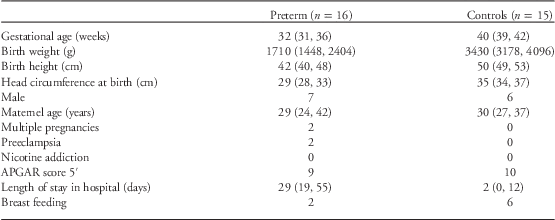
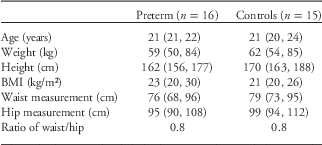
Sixteen adults [mean age 21 years (CI 21–22)] born preterm [mean age at birth 32 weeks of gestation (CI 31–36)] with a birth weight [mean weight 1710 g (CI 1448–2404)] appropriate for their gestational age were compared with 15 adults [mean age 21 years (CI 20–24)] born at term [mean age at birth 40 weeks of gestation (CI 39–42)] with a birth weight [mean weight 3430 g (CI 3178–4096)] appropriate for their gestational age (Tables 1 and 2).
Characteristics of adults at birth

Data are expressed as mean and 95% reference ranges (confidence intervals) or as number of subjects.
Characteristics of adults at enrolment

BMI, body mass index.
Data are expressed as mean and 95% reference ranges (confidence intervals).
None of the subjects had received antenatal betamethasone to accelerate fetal pulmonary maturation. The mothers of two patients born preterm had developed preeclampsia. None of the mothers were smokers. Fewer patients who were born preterm were breast fed. The two groups did not differ with regard to other perinatal data. Most girls in both groups were taking oral contraceptive medication. Four patients who were born preterm were smokers (Table 1).
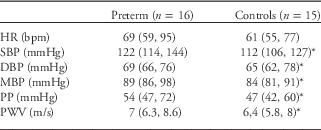
The young adults who were born preterm had a significantly higher SBP, DBP and MAP than did the control group of young adults born at term (Table 3).
SBP, HR and PWV at enrolment

HR, heart rate; SBP, systolic blood pressure; DBP, diastolic blood pressure; MBP, mean blood pressure; PP, pulse pressure; PWV, pulse wave velocity.
Data are expressed as mean and 95% reference ranges (confidence intervals).
*P value<0.05.
Further, pulse pressure and PWV, which reflect arterial stiffness, were higher in the group of young adults born preterm than in the control group (Table 3).
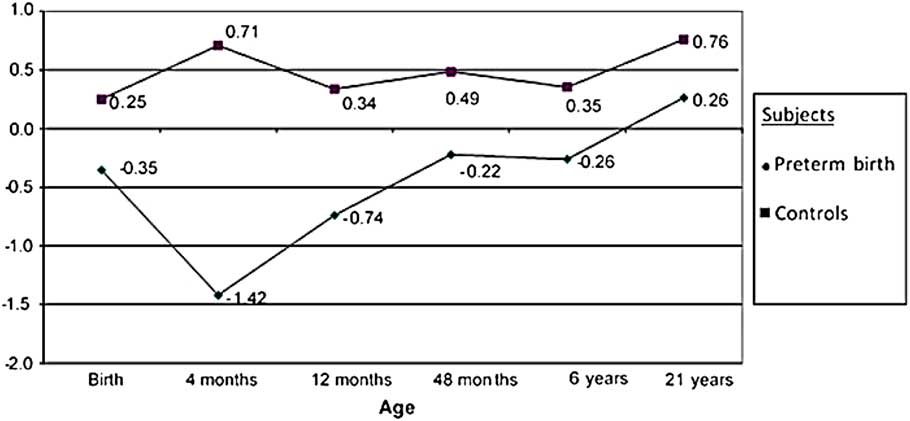
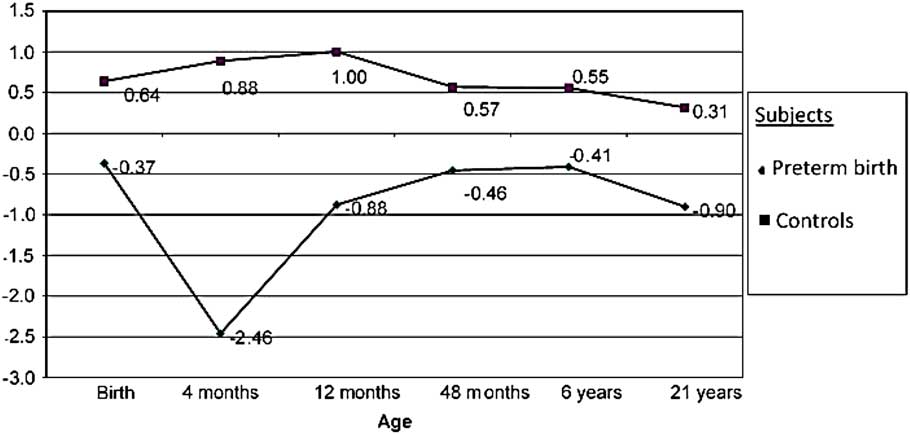
Weight and height from birth to the age of 21 years were tracked for both groups. Data on longitudinal growth parameters including weight and height at birth, 4, 12 and 48 months and 6 and 21 years were expressed in standard deviation scores at each growth interval (Figs 1 and 2).
Changes in standard deviation scores for weight at each growth interval.
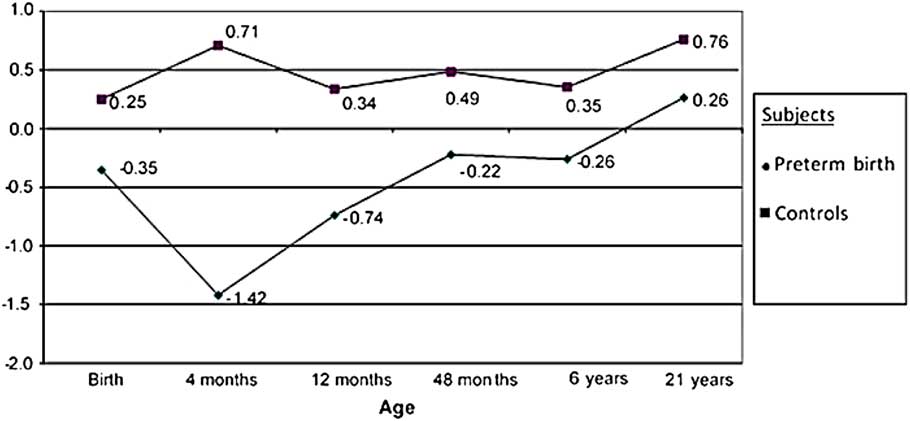
Changes in standard deviation scores for height at each growth interval.
Patients born preterm showed strong growth failure at 4 months of age, likely because data on these patients were reported in postnatal age, and rapidly caught up between 4 months and 4 years of age. However, at the age of 21 years, they were shorter than were adults born at term. The pattern of growth was not significantly associated with systemic BP or arterial stiffness.
Discussion
This study shows that young adults who were born preterm had higher SBP, DBP and MAP and arterial stiffness (reflected by pulse pressure and PWV) than adults born at term. Our findings are consistent with large epidemiological studies that show that preterm birth is associated with an increase in systemic BP in adulthoodReference Johansson, Iliadou and Bergvall 2 – Reference Crump, Winkleby, Sundquist and Sundquist 4 .
The increase in systemic BP in adults born preterm in this study may be underestimated due to the fact that preterm adults are smaller than controls. Indeed, accordingly to previous studies, adults born preterm are smaller than are those born at term at 21 years of ageReference Hack, Schluchter and Cartar 12 , Reference Ericson and Källén 13 and height has been reported to be associated with systemic BP during developmentReference André, Deschamps and Gueguen 14 . The statement that rapid catch up growth from childhood to adulthood explains (even partially) the relationship between gestational age and systemic BP need to be debated. Indeed, people who are thin at birth but who gain weight rapidly during early childhood (1–5 years) have high systemic BP in adulthoodReference Moore, Cockington, Ryan and Robinson 15 , Reference Law, Shiell, Newsome, Martyn and de Swiet 16 . In the present study, it may be speculated that growth is some proxy measure of adverse physiology in premature individuals, but the data do not show that rapid catch up growth explains the relationships between gestational age and systemic BP.
Several mechanisms have been proposed to explain the relationship between an increase in systemic BP over the long term and a low birth weight due to preterm birth. These include abnormal micro-vascularizationReference Hellström, Hård, Niklasson, Svensson and Jacobsson 17 , decreased endothelial functionReference Bassareo, Fanos and Puddu 18 , decreased glomerulogenesisReference Rodriguez, Gómez and Abitbol 19 , and decreased elastin content in elastic arteries which may lead to permanent changes in arterial stiffnessReference Oren, Vos and Bos 6 – Reference Berry, Looker and Germain 10 . In our study, pulse pressure and PWV, which reflect arterial stiffness, were increased in adults born preterm. This finding is consistent with previous studies, which report an increase in pulse pressure in adolescent girls born pretermReference Bonamy, Bendito and Martin 20 and a trend for an inverse relationship between PWV and gestational age in young adultsReference Oren, Vos and Bos 6 . More recently, we have shown that adolescents (mean age, 14 years) born with a low birth weight (mean weight at birth, 2073 g) appropriate for the gestational age exclusively due to preterm birth (mean age at birth, 32 weeks of gestation) have higher systemic BP and arterial stiffness than those born at term, with a birth weight appropriate for the gestational ageReference Rossi, Tauzin and Marchand 8 .
Arterial stiffness is primarily determined by the presence of a long half-life scleroprotein, elastin, in the vessel wall. Martyn et al. speculated that a failure to synthesize adequate amounts of elastin during a critical period during foetal life cannot be compensated for at a later stage and may trigger the persistent increase in arterial stiffness in adulthoodReference Martyn and Greenwald 9 . Impaired elastin synthesis due to preterm birth has been observed in anatomic pieces of immature human aortaReference Berry, Looker and Germain 10 . Arterial stiffness, resulting in high pulse pressure and accelerated PWV, greatly increases with age and is an independent cardiovascular risk factor. The increase in pulse pressure and PWV predispose an individual to hypertension, left-ventricular hypertrophy, and cardiovascular diseaseReference de Simone, Roman and Koren 21 – Reference Laurent, Katsahian and Fassot 23 .
In summary, young adults with a low birth weight due to preterm birth may have increased systemic BP and arterial stiffness, which are predisposing factors for cardiovascular diseases in adulthood. Further studies should focus on the long-term follow-up of adults born preterm to monitor systemic BP and aortic elastic properties with the aim to prevent cardiovascular diseases in this population.
Financial Support
This research received no specific grant from any funding agency, commercial or not-for-profit sectors.
Conflict of interest
None.
Ethical Standards
Research was conducted according to the Good Clinical Practice guidelines developed by the International Conference on Harmonization.