The public stigma of mental illness is a construct that encompasses beliefs, emotions and negative behaviors on behalf of society towards people with a mental illness (Michaels, López, Rüsch, & Corrigan, Reference Michaels, López, Rüsch and Corrigan2012). Mental disorders are often associated with negative stereotypes such as danger, unpredictability or incompetence, which, in turn, generate emotions of fear, anger, grief, etc. and can lead to behaviors of devaluation, discrimination and social rejection (Rüsch, Angermeyer, & Corrigan, Reference Rüsch, Angermeyer and Corrigan2005). The public stigma associated with mental illness is a widely studied phenomenon that has been observed in various sociocultural contexts (Angermeyer & Schomerus, Reference Angermeyer and Schomerus2017; Mascayano, Lips, Mena, & Manchego, Reference Mascayano, Lips, Mena and Manchego2015; Parcesepe & Cabassa, Reference Parcesepe and Cabassa2013), such as our country, Spain (Crespo, Pérez-Santos, Muñoz, & Guillén, Reference Crespo, Pérez-Santos, Muñoz and Guillén2008; Ruiz et al., Reference Ruiz, Montes, Correas Lauffer, Álvarez, Mauriño and De Dios Perrino2012).
An important aspect of public stigma is that the person him/herself can anticipate the negative consequences he/she will experience when having a mental illness, even when these consequences have not occurred. This anticipation of rejection is called perceived or anticipated stigma, and is differentiated from the experienced stigma, that is, from specific stigmatizing experiences that the person has suffered (Cechnicki, Angermeyer, & Bielańska, Reference Cechnicki, Angermeyer and Bielańska2011). In a study conducted among people with schizophrenia, bipolar disorder and depressive disorder (Farrelly et al., Reference Farrelly, Clement, Gabbidon, Jeffery, Dockery, Lassman and Thornicroft2014), 93% of the participants anticipated discrimination and 87% of the participants had experienced discrimination during the previous year. Gerlinger et al.’s (Reference Gerlinger, Hauser, De Hert, Lacluyse, Wampers and Correll2013) review, focused on studies of people with schizophrenia spectrum disorders, showed that approximately 65% of participants had perceived stigma and 56% had experienced it.
Sometimes, the person with mental illness accepts and internalizes the stereotypes and prejudices existing in society about their condition, which is known as internalized stigma or self-stigma (Al-Khouja & Corrigan, Reference Al-Khouja and Corrigan2017). The percentage of people reporting moderate or high levels of internalized stigma was 22% in Brohan, Elgie, Sartorius, and Thornicroft’s (Reference Brohan, Elgie, Sartorius and Thornicroft2010) study and 44% in Picco et al.’s (Reference Picco, Pang, Lau, Jeyagurunathan, Satghare, Abdin and Subramaniam2016) study. A study carried out across fourteen European countries (Evans-Lacko, Brohan, Mojtabai, & Thornicroft, Reference Evans-Lacko, Brohan, Mojtabai and Thornicroft2012) suggests a direct connection between public and internalized stigma: People with mental illnesses living in countries with less stigmatizing attitudes showed lower levels of internalized stigma.
Another very interesting question in relation to internalized stigma is the “Why try” effect (Corrigan, Bink, Schmidt, Jones, & Rüsch, Reference Corrigan, Bink, Schmidt, Jones and Rüsch2016). Those people with mental illness who are aware of the existing stereotypes and who agree with them are more likely to experience low self-esteem and to stop pursuing their personal goals, such as getting a job or having friends, as they believe that they are not valuable enough to achieve these goals. Therefore, internalized stigma would have both emotional and behavioral consequences. In Muñoz, Sanz, Pérez-Santos, and Quiroga’s (Reference Muñoz, Sanz, Pérez-Santos and Quiroga2011) study, both the person’s recovery expectations and internalized stigma directly influenced their psychosocial performance.
One of the current models proposed to understand internalized stigma is Wood, Byrne, and Morrison’s (Reference Wood, Byrne and Morrison2017) integrative cognitive model, which identifies key processes in the development and maintenance of internalized stigma in psychosis. This model suggests that there is a connection between identification with the group and the awareness of stigma (for example, when receiving a diagnosis) and the triggers of stigma, which activate a series of self-stigmatizing central beliefs. These beliefs are associated, in a bidirectional way, with emotional, physiological, cognitive and behavioral responses that maintain the internalized stigma and that, in turn, are influenced by protective factors (such as having a social support network, peer support or the development of personal goals for recovery). This type of model has clinical implications of great interest and underlines the importance of directing clinical interventions towards those processes and responses that are affected by stigma.
In order to work and reduce the internalized stigma in people with mental illness, various types of psychological and psychosocial interventions have been developed. Although in recent years, different systematic reviews and meta-analyses have been published on interventions to reduce internalized stigma in people with mental illness, their results are inconclusive. Two of these works support its effectiveness, with effect sizes ranging from small to moderate (Tsang et al., Reference Tsang, Ching, Tang, Lam, Law and Wan2016; Yanos, Lucksted, Drapalski, Roe, & Lysaker, Reference Yanos, Lucksted, Drapalski, Roe and Lysaker2015), but other studies have not found sufficient evidence on the effectiveness of these interventions (Büchter & Messer, Reference Büchter and Messer2017; Wood, Byrne, Varese, & Morrison, Reference Wood, Byrne, Varese and Morrison2016). Of the four existing reviews, only that of Büchter and Messer (Reference Büchter and Messer2017) had demanding criteria for the inclusion of studies, such as the need to have a control group.
In short, the review of the literature shows that internalized stigma has an important presence in people with a mental illness and usually leads to different negative consequences in the lives of these people. Although there are several reviews about the effectiveness of interventions to reduce internalized stigma, no clear results have been obtained, thus it seems relevant to continue investigating this issue. The objective of the present study is to perform a systematic and updated review on the characteristics and effectiveness of interventions aimed at reducing internalized stigma in people with mental illness, using restrictive inclusion criteria that ensure methodological rigor.
Method
To carry out this review study, the recommendations of the PRISMA statement (Urrútia & Bonfill, Reference Urrútia and Bonfill2010) have been taken into consideration. The bibliographic search was carried out in the MEDLINE, PsycARTICLES, Psychology Database, PsycINFO, Public Health Database y Social Science Databases. The combination of the following descriptors was used as search criteria: (Mental illness OR mental health OR psychiatric OR schizophreni* OR psychosis OR psychotic OR delusional OR depressi* OR bipolar OR schizoaffective OR personality disorder) AND (stigma OR self-stigma* OR self-perception OR internalized stigma OR internalised stigma OR shame OR devaluation) AND (intervention OR program OR therapy OR psychotherapy OR treatment OR trial OR cbt). The bibliography of articles related to the topic was also revised to expand access to more research, as well as previous reviews and meta-analyses.
The inclusion criteria for the studies were the following: 1. Applying a specific intervention to reduce internalized stigma in people with mental disorders. 2. Having a control group. 3. Having at least two moments of measurement (pre and post treatment). 4. Being published between 2008 and 2018. 5. Being published in scientific journals indexed in JCR, in English or Spanish.
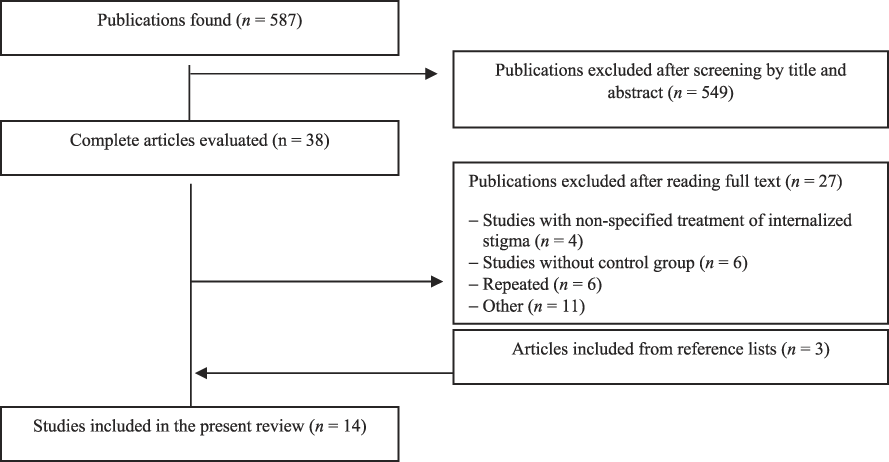
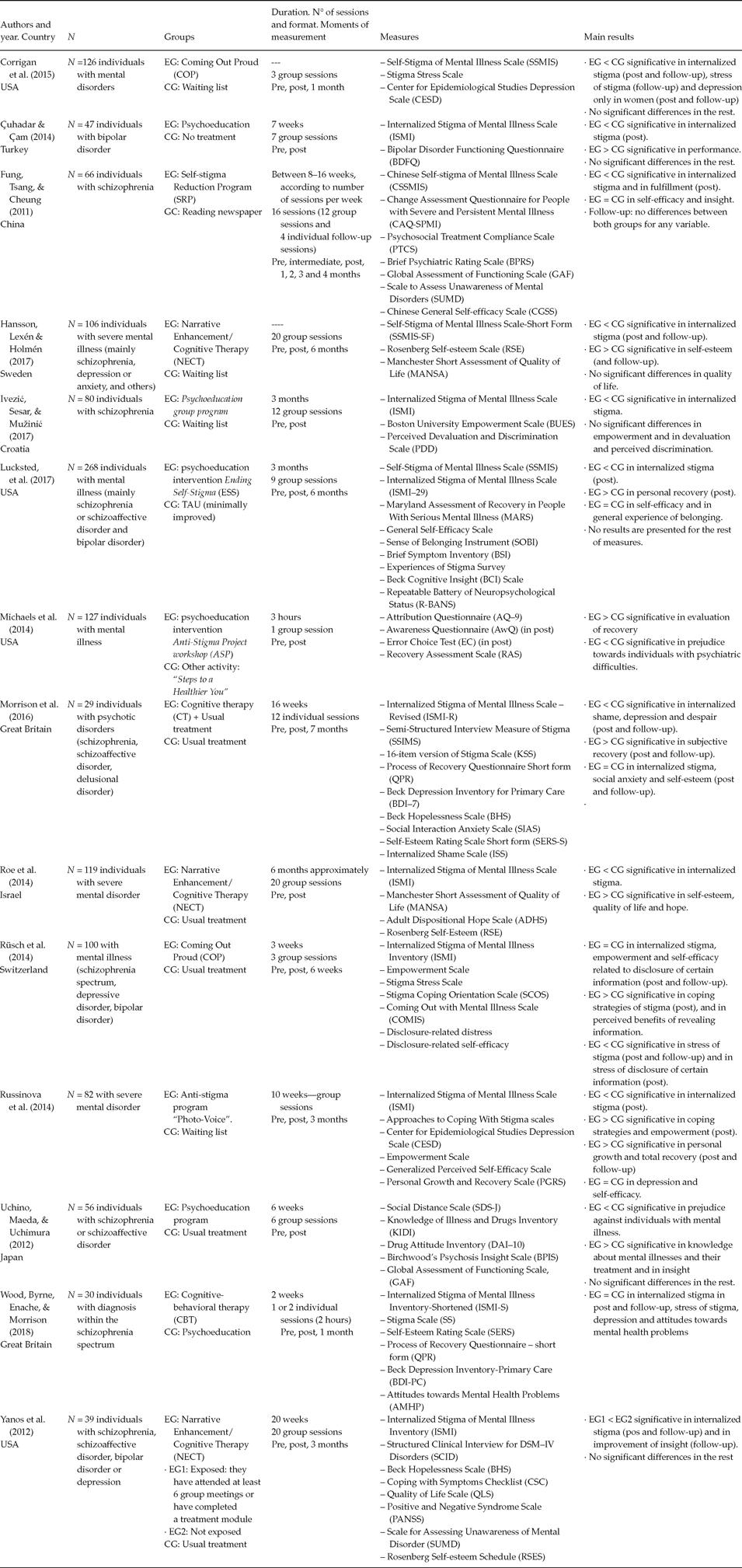
The search strategy is summarized in Figure 1. In each of the screenings, the inclusion criteria discussed above were followed. There were certain articles that passed the first screening (based on the abstract and/or title) because they apparently fulfilled the inclusion criteria. However, the subsequent detailed reading of the entire article revealed that this was not the case and these articles were excluded in the next step of the process. Finally, 14 articles were included that met the inclusion criteria, which are summarized, in alphabetical order, in Table 1.
Diagram of the Process of Article Selection for Inclusion in the Present Review.

Summary of Articles on Interventions to Reduce Internalized Stigma in People with Severe Mental Disorder (2008–2018)

Note: EG = experimental group; CG = control group; ES = effect size.
Results
Participants
The samples of the studies had been obtained through mental health institutions and with the help of pamphlets and similar materials. In two of the 14 studies (Çuhadar & Çam, Reference Çuhadar and Çam2014; Hansson, Lexén, & Holmén, Reference Hansson, Lexén and Holmén2017) there was no reference made as to how the sample was obtained. The number of participants was equal to or greater than 30 people in most articles. The smallest sample consisted of 29 participants (Michaels et al., Reference Michaels, Corrigan, Buchholz, Brown, Arthur, Netter and Macdonald-Wilson2014) and the largest sample had 268 participants (Lucksted et al., Reference Lucksted, Drapalski, Brown, Wilson, Charlotte, Mullane and Fang2017). The average age was 42 years. In 7 studies, the sample was mainly composed of women (Corrigan et al., Reference Corrigan, Larson, Michaels, Buchholz, Del Rossi, Fontecchio and Rüsch2015; Çuhadar & Çam, Reference Çuhadar and Çam2014; Ivezić, Sesar, & Mužinić, Reference Ivezić, Sesar and Mužinić2017; Michaels et al., Reference Michaels, Corrigan, Buchholz, Brown, Arthur, Netter and Macdonald-Wilson2014; Rüsch et al., Reference Rüsch, Abbruzzese, Hagedorn, Hartenhauer, Kaufmann, Curschellas and Corrigan2014; Yanos, Roe, West, Smith, & Lysaker, Reference Yanos, Roe, West, Smith and Lysaker2012).
In 11 of the 14 articles, the diagnosis of the participants was specified. In seven of them (Hansson et al., Reference Hansson, Lexén and Holmén2017; Lucksted et al., Reference Lucksted, Drapalski, Brown, Wilson, Charlotte, Mullane and Fang2017; Morrison et al., Reference Morrison, Burke, Murphy, Pyle, Bowe, Varese and Wood2016; Rüsch et al., Reference Rüsch, Abbruzzese, Hagedorn, Hartenhauer, Kaufmann, Curschellas and Corrigan2014; Uchino, Maeda, & Uchimura, Reference Uchino, Maeda and Uchimura2012; Wood, Byrne, Enache, & Morrison, Reference Wood, Byrne, Enache and Morrison2018; Yanos et al., Reference Yanos, Roe, West, Smith and Lysaker2012), the numbers of participants with different disorders were specified. In five articles (Hansson et al., Reference Hansson, Lexén and Holmén2017; Lucksted et al., Reference Lucksted, Drapalski, Brown, Wilson, Charlotte, Mullane and Fang2017; Roe et al., Reference Roe, Hasson-Ohayon, Mashiach-Eizenberg, Derhy, Lysaker and Yanos2014; Uchino et al., Reference Uchino, Maeda and Uchimura2012; Wood et al., Reference Wood, Byrne, Enache and Morrison2018), most of the sample had a diagnosis of schizophrenia. In another article (Morrison et al., Reference Morrison, Burke, Murphy, Pyle, Bowe, Varese and Wood2016), most of the sample had suffered a psychotic episode. In other cases, the sample was composed mostly of people with depressive disorder (Rüsch et al., Reference Rüsch, Abbruzzese, Hagedorn, Hartenhauer, Kaufmann, Curschellas and Corrigan2014) or by people with schizoaffective disorder (Yanos et al., Reference Yanos, Roe, West, Smith and Lysaker2012). In another article (Çuhadar & Çam, Reference Çuhadar and Çam2014), the sample was composed only of people with bipolar disorder and in another two studies, the sample was composed exclusively by people with schizophrenia (Fung, Tsang, & Cheung, Reference Fung, Tsang and Cheung2011; Ivezić et al., Reference Ivezić, Sesar and Mužinić2017).
Characteristics of the interventions
Regarding the type of intervention in the experimental groups, the most frequent were psychoeducational interventions on stigma (Çuhadar & Çam, Reference Çuhadar and Çam2014; Ivezić et al., Reference Ivezić, Sesar and Mužinić2017; Lucksted et al., Reference Lucksted, Drapalski, Brown, Wilson, Charlotte, Mullane and Fang2017; Michaels et al., Reference Michaels, Corrigan, Buchholz, Brown, Arthur, Netter and Macdonald-Wilson2014; Uchino et al., Reference Uchino, Maeda and Uchimura2012). All of them focused on psychoeducation about mental health and mental disorders, about the different forms of stigma and about the strategies to deal with it, although they differed in the number and duration of sessions. For example, the shortest intervention was the so-called “Anti-Stigma Project” workshop (Michaels et al., Reference Michaels, Corrigan, Buchholz, Brown, Arthur, Netter and Macdonald-Wilson2014), which consists of a single 3-hour session. In this workshop, participants were informed about the impact of stigma on the lives of people with mental illness and their families. In contrast, the longest intervention was the “Psychoeducation group program” by Ivezić et al. (Reference Ivezić, Sesar and Mužinić2017), which consisted of 12 group sessions over 3 months. Through a psychoeducational approach based on the principles of recovery and empowerment, a better knowledge of the disease, prevention of relapse, reduction of internalized stigma and coping with social stigma and discrimination were favored.
The second most frequent type of intervention were the studies that applied the so-called “Narrative Enhancement/Cognitive Therapy” (NECT) (Hansson et al., Reference Hansson, Lexén and Holmén2017; Roe et al., Reference Roe, Hasson-Ohayon, Mashiach-Eizenberg, Derhy, Lysaker and Yanos2014; Yanos et al., Reference Yanos, Roe, West, Smith and Lysaker2012). It consisted of a multi-component group intervention, whose objective was to help people with mental disorders to recognize the effects of stigma on themselves, to identify and reconsider self-stigmatizing beliefs, and to build a richer personal narrative. Its duration was 8 weeks and it included psychoeducational sessions on stigma, sessions aimed at cognitive restructuring, and sessions in which narrative techniques were used.
In two of the studies, the multicomponent program “Coming Out Proud” (COP) was applied (Corrigan et al., Reference Corrigan, Larson, Michaels, Buchholz, Del Rossi, Fontecchio and Rüsch2015; Rüsch et al., Reference Rüsch, Abbruzzese, Hagedorn, Hartenhauer, Kaufmann, Curschellas and Corrigan2014). It was a group intervention based on disclosure, which consisted of 3 sessions of two hours each. Its objective was to support the participants in their personal decision process with respect to revealing (or not) the mental disorder in the different contexts of their life.
In one of the studies, the multicomponent program “Photo-Voice” (Russinova et al., Reference Russinova, Rogers, Gagne, Bloch, Drake and Mueser2014) was applied. This intervention was led by peers that, starting from an artistic activity, defied stigma and worked to empower people with mental illnesses. It combined psychoeducational components, experiential exercises and activities of community participation and integration.
In addition, another study applied the “Self-stigma Reduction Program” (SRP) (Fung et al., Reference Fung, Tsang and Cheung2011), which is a multicomponent intervention that combines psychoeducation, cognitive-behavioral therapy, motivational interview, social skills training and training to achieve objectives.
The remaining studies evaluated cognitive therapy together with the usual treatment (Morrison et al., Reference Morrison, Burke, Murphy, Pyle, Bowe, Varese and Wood2016) and cognitive-behavioral therapy (CBT) (Wood et al., Reference Wood, Byrne, Enache and Morrison2018). In both cases, self-stigmatizing stereotypes and beliefs were approached using cognitive-behavioral strategies, such as guided discovery, cognitive restructuring techniques, behavioral experiments, assessment of advantages and disadvantages of various ways of dealing with stigma, and training in skills.
The development of the therapies were explained in a more detailed way or by referring to the manuals used in all the articles, except in one of studies (Uchino et al., Reference Uchino, Maeda and Uchimura2012), in which the objectives of the therapy were explained but its development was not indicated.
The average number of sessions of the studies was approximately 10 sessions, with the minimum being one session (Michaels et al., Reference Michaels, Corrigan, Buchholz, Brown, Arthur, Netter and Macdonald-Wilson2014; Wood et al., Reference Wood, Byrne, Enache and Morrison2018) and the maximum being 20 sessions (Hansson et al., Reference Hansson, Lexén and Holmén2017; Roe et al., Reference Roe, Hasson-Ohayon, Mashiach-Eizenberg, Derhy, Lysaker and Yanos2014; Yanos et al., Reference Yanos, Roe, West, Smith and Lysaker2012). One study did not specify the number of sessions performed (Russinova et al., Reference Russinova, Rogers, Gagne, Bloch, Drake and Mueser2014). Regarding the format of the interventions, the sessions were carried out in groups in 11 of the studies. In two interventions (Morrison et al., Reference Morrison, Burke, Murphy, Pyle, Bowe, Varese and Wood2016; Wood et al., Reference Wood, Byrne, Enache and Morrison2018), the sessions were carried out individually, while in another study, the two modalities were combined (Fung et al., Reference Fung, Tsang and Cheung2011). The average duration of the interventions was around 10 weeks, with a minimum of 3 hours (Michaels et al., Reference Michaels, Corrigan, Buchholz, Brown, Arthur, Netter and Macdonald-Wilson2014) and a maximum of 20 weeks (Yanos et al., Reference Yanos, Roe, West, Smith and Lysaker2012).
Most studies used the usual treatment as a comparison group (Lucksted et al., Reference Lucksted, Drapalski, Brown, Wilson, Charlotte, Mullane and Fang2017; Roe et al., Reference Roe, Hasson-Ohayon, Mashiach-Eizenberg, Derhy, Lysaker and Yanos2014; Rüsch et al., Reference Rüsch, Abbruzzese, Hagedorn, Hartenhauer, Kaufmann, Curschellas and Corrigan2014; Uchino et al., Reference Uchino, Maeda and Uchimura2012; Wood et al., Reference Wood, Byrne, Enache and Morrison2018; Yanos et al., Reference Yanos, Roe, West, Smith and Lysaker2012). In 3 of studies, it was not clear what the usual treatment consisted of (Roe et al., Reference Roe, Hasson-Ohayon, Mashiach-Eizenberg, Derhy, Lysaker and Yanos2014; Rüsch et al., Reference Rüsch, Abbruzzese, Hagedorn, Hartenhauer, Kaufmann, Curschellas and Corrigan2014; Uchino et al., Reference Uchino, Maeda and Uchimura2012), while in the remaining 3, it was generally indicated that the usual treatment involved psychiatric and psychosocial rehabilitation in the community setting (Lucksted et al., Reference Lucksted, Drapalski, Brown, Wilson, Charlotte, Mullane and Fang2017; Wood et al., Reference Wood, Byrne, Enache and Morrison2018; Yanos et al., Reference Yanos, Roe, West, Smith and Lysaker2012). The waiting list was used as a control in 4 studies (Corrigan et al., Reference Corrigan, Larson, Michaels, Buchholz, Del Rossi, Fontecchio and Rüsch2015; Hansson et al., Reference Hansson, Lexén and Holmén2017; Ivezić et al., Reference Ivezić, Sesar and Mužinić2017; Russinova et al., Reference Russinova, Rogers, Gagne, Bloch, Drake and Mueser2014). In the rest, psychoeducation (Wood et al., Reference Wood, Byrne, Enache and Morrison2018), no treatment (Çuhadar & Çam, Reference Çuhadar and Çam2014), or another type of activity, such as reading a newspaper (Fung et al., Reference Fung, Tsang and Cheung2011), or watching a video (Michaels et al., Reference Michaels, Corrigan, Buchholz, Brown, Arthur, Netter and Macdonald-Wilson2014) were used as control.
Results of the interventions
The evaluation of results was carried out in all cases through standardized scales on internalized stigma and other variables of interest, such as self-esteem, quality of life, empowerment, depression or coping strategies. The most widely used instrument to assess internalized stigma was the Internalized Stigma of Mental Illness Scale (ISMI), which was used in nine studies (Çuhadar & Çam, Reference Çuhadar and Çam2014; Ivezić et al., Reference Ivezić, Sesar and Mužinić2017; Lucksted et al., Reference Lucksted, Drapalski, Brown, Wilson, Charlotte, Mullane and Fang2017; Morrison et al., Reference Morrison, Burke, Murphy, Pyle, Bowe, Varese and Wood2016; Roe et al., Reference Roe, Hasson-Ohayon, Mashiach-Eizenberg, Derhy, Lysaker and Yanos2014; Rüsch et al., Reference Rüsch, Abbruzzese, Hagedorn, Hartenhauer, Kaufmann, Curschellas and Corrigan2014; Russinova et al., Reference Russinova, Rogers, Gagne, Bloch, Drake and Mueser2014; Wood et al., Reference Wood, Byrne, Enache and Morrison2018; Yanos et al., Reference Yanos, Roe, West, Smith and Lysaker2012).
Regarding the effectiveness of interventions to reduce internalized stigma (see Table 2), significant results were obtained in 9 of the 14 studies. More specifically, "Coming Out Proud" obtained a significant reduction compared to the waiting list (Corrigan et al., Reference Corrigan, Larson, Michaels, Buchholz, Del Rossi, Fontecchio and Rüsch2015). Interventions based on psychoeducation obtained a significant reduction compared to the waiting list (Ivezić et al., Reference Ivezić, Sesar and Mužinić2017), the usual treatment (Lucksted et al., Reference Lucksted, Drapalski, Brown, Wilson, Charlotte, Mullane and Fang2017; Uchino et al., Reference Uchino, Maeda and Uchimura2012) and no treatment (Fung et al., Reference Fung, Tsang and Cheung2011). The "Narrative Enhancement/Cognitive Therapy" program obtained a significant reduction when compared with the waiting list (Hansson et al., Reference Hansson, Lexén and Holmén2017) and with the usual treatment (Roe et al., Reference Roe, Hasson-Ohayon, Mashiach-Eizenberg, Derhy, Lysaker and Yanos2014). The "Photo-voice" program obtained a significant reduction compared to the waiting list (Russinova et al., Reference Russinova, Rogers, Gagne, Bloch, Drake and Mueser2014). The "Self-stigma Reduction Program" obtained a significant reduction compared to the performance of another activity in the post-treatment, although there were no differences in the follow-ups (Fung et al., Reference Fung, Tsang and Cheung2011).
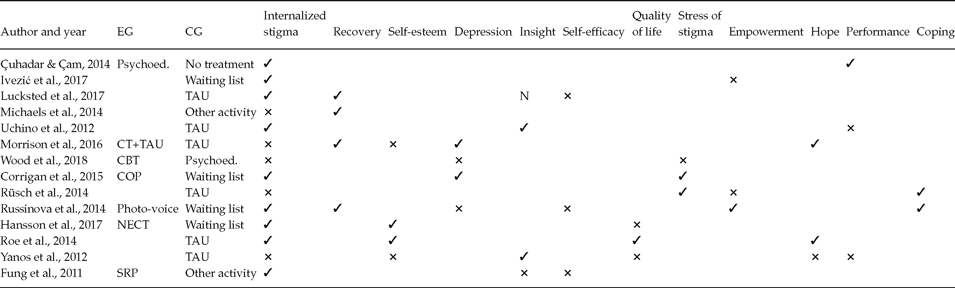
Summary of the Results of Interventions in Internalized Stigma and in Other Evaluated Variables

Note: EG = experimental group; CG = control group; Psychoed. = Psychoeducation; TAU = Usual treatment; CT = Cognitive therapy; CBT = Cognitive-behavioral therapy; COP = Coming Out Proud; NECT = Narrative Enhancement/Cognitive Therapy; SRP = Self-stigma Reduction Program.
✓ = Significant results; × = Non-significant results.
Regarding the effect size, there was considerable variability among the 11 articles that provided this data (Corrigan et al., Reference Corrigan, Larson, Michaels, Buchholz, Del Rossi, Fontecchio and Rüsch2015; Fung et al., Reference Fung, Tsang and Cheung2011; Hansson et al., Reference Hansson, Lexén and Holmén2017; Ivezić et al., Reference Ivezić, Sesar and Mužinić2017; Lucksted et al., Reference Lucksted, Drapalski, Brown, Wilson, Charlotte, Mullane and Fang2017; Morrison et al., Reference Morrison, Burke, Murphy, Pyle, Bowe, Varese and Wood2016; Roe et al., Reference Roe, Hasson-Ohayon, Mashiach-Eizenberg, Derhy, Lysaker and Yanos2014; Rüsch et al., Reference Rüsch, Abbruzzese, Hagedorn, Hartenhauer, Kaufmann, Curschellas and Corrigan2014; Russinova et al., Reference Russinova, Rogers, Gagne, Bloch, Drake and Mueser2014; Wood et al., Reference Wood, Byrne, Enache and Morrison2018; Yanos et al., Reference Yanos, Roe, West, Smith and Lysaker2012) but, apart from the measure used, values that indicated a small or moderate effect size predominated.
With regard to the effects on other variables, Table 3 synthesizes the results in the main variables that have been studied. Subjective recovery improved in all cases in which it was evaluated, regardless of the type of intervention performed (Lucksted et al., Reference Lucksted, Drapalski, Brown, Wilson, Charlotte, Mullane and Fang2017; Michaels et al., Reference Michaels, Corrigan, Buchholz, Brown, Arthur, Netter and Macdonald-Wilson2014; Morrison et al., Reference Morrison, Burke, Murphy, Pyle, Bowe, Varese and Wood2016; Russinova et al., Reference Russinova, Rogers, Gagne, Bloch, Drake and Mueser2014), as well as coping strategies (Rüsch et al., Reference Rüsch, Abbruzzese, Hagedorn, Hartenhauer, Kaufmann, Curschellas and Corrigan2014; Russinova et al., Reference Russinova, Rogers, Gagne, Bloch, Drake and Mueser2014). Self-esteem improved significantly in two of the studies where "Narrative Enhancement/Cognitive Therapy" was used (Hansson et al., Reference Hansson, Lexén and Holmén2017; Roe et al., Reference Roe, Hasson-Ohayon, Mashiach-Eizenberg, Derhy, Lysaker and Yanos2014). However, it did not improve in Yanos et al.’s (Reference Yanos, Roe, West, Smith and Lysaker2012) study where the same intervention was used or when cognitive therapy was performed along with the usual treatment (Morrison et al., Reference Morrison, Burke, Murphy, Pyle, Bowe, Varese and Wood2016). The results in the rest of the variables are heterogeneous. For example, stress related to stigma improved significantly in the two cases in which "Coming Out Proud" was performed (Corrigan et al., Reference Corrigan, Larson, Michaels, Buchholz, Del Rossi, Fontecchio and Rüsch2015; Rüsch et al., Reference Rüsch, Abbruzzese, Hagedorn, Hartenhauer, Kaufmann, Curschellas and Corrigan2014), whereas it did not improve when CBT was used (Wood et al., Reference Wood, Byrne, Enache and Morrison2018). Empowerment only improved when "Photo-voice" was carried out (Russinova et al., Reference Russinova, Rogers, Gagne, Bloch, Drake and Mueser2014), but not with other interventions (Ivezić et al., Reference Ivezić, Sesar and Mužinić2017; Rüsch et al., Reference Rüsch, Abbruzzese, Hagedorn, Hartenhauer, Kaufmann, Curschellas and Corrigan2014). Depression decreased significantly with cognitive therapy along with the usual treatment during the post-treatment (Morrison et al., Reference Morrison, Burke, Murphy, Pyle, Bowe, Varese and Wood2016), but not with "Photo-voice" (Russinova et al., Reference Russinova, Rogers, Gagne, Bloch, Drake and Mueser2014) or with CBT (Wood et al., 2014).
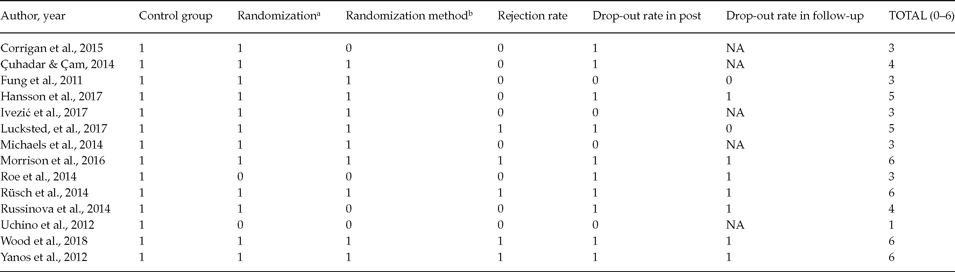
Methodological Quality of the Studies included in the Present Review

Note: 0 = No; 1 = Yes; NA = Not applicable (there is no follow-up)
a Study described as randomized.
b The randomization method is adequately described.
Methodological quality of the studies
Finally, we have analyzed the methodological quality of the studies included in this review using a scale that assesses the following aspects: Existence of a control group, existence of randomization, information on the randomization method, on the rejection rate, on the rate of dropouts and on the effect size. Table 3 reveals that six of the studies reached levels of maximum methodological quality, between 5 and 6 points. However, six articles presented a limited methodological quality, with scores equal to or less than 3 points.
Overall, the main limitation is the lack of information about the rejection rate to participate in the study, which was only indicated in five of the articles. It should be borne in mind that all the selected studies had a control group, as it was one of the inclusion criteria of this review. Random assignment was performed in all studies, except for one, but only nine of them specified the procedure used to carry this randomization out. With regard to drop-outs during the study, the rate of drop-outs in post-treatment was indicated in ten of the 14 articles, and in seven of the 9 articles that include the follow-up period, the drop-out rate is indicated during said period.
Discussion
In this review, a variety of psychological and psychosocial interventions aimed at reducing internalized stigma in people with severe mental disorder have been found. The present review is not limited to specific diagnoses but has adopted the definition of severe mental disorder proposed by the National Institute of Mental Health (USA), which includes three dimensions to consider: diagnosis, duration and disability (see Ruggeri, Leese, Thornicroft, Bisoffi, & Tansella, Reference Ruggeri, Leese, Thornicroft, Bisoffi and Tansella2000). Thus, the term severe mental disorder encompasses various types of alterations of prolonged duration, which entail a variable degree of disability and social dysfunction, and which must be addressed in various healthcare resources of the psychiatric and social care network (Comunidad de Madrid, 2003; Conejo et al., Reference Conejo, Moreno, Morales, Alot, García-Herrera, González and Moreno Küstner2014; Guinea, Reference Guinea2007). That is, those with schizophrenia spectrum disorders, but also those with other mental disorders such as bipolar disorder, major depression or personality disorders, would be considered as being included in the group of people with severe and lasting mental disorders and who, as a consequence of their illness, have persistent disabilities.
The interventions found could be grouped into several blocks: (a) Psychoeducational interventions on stigma (Çuhadar & Çam, Reference Çuhadar and Çam2014; Ivezić et al., Reference Ivezić, Sesar and Mužinić2017; Lucksted et al., Reference Lucksted, Drapalski, Brown, Wilson, Charlotte, Mullane and Fang2017; Michaels et al., Reference Michaels, Corrigan, Buchholz, Brown, Arthur, Netter and Macdonald-Wilson2014; Uchino et al., Reference Uchino, Maeda and Uchimura2012); (b) cognitive-behavioral interventions, mainly aimed at modifying self-stigmatizing beliefs (Morrison et al., Reference Morrison, Burke, Murphy, Pyle, Bowe, Varese and Wood2016; Wood et al., Reference Wood, Byrne, Enache and Morrison2018); c) interventions focused on the disclosure of mental illness (Corrigan et al., Reference Corrigan, Larson, Michaels, Buchholz, Del Rossi, Fontecchio and Rüsch2015; Rüsch et al., Reference Rüsch, Abbruzzese, Hagedorn, Hartenhauer, Kaufmann, Curschellas and Corrigan2014); (d) multicomponent interventions that combine several of the above (Fung et al., Reference Fung, Tsang and Cheung2011; Hansson et al., Reference Hansson, Lexén and Holmén2017; Roe et al., Reference Roe, Hasson-Ohayon, Mashiach-Eizenberg, Derhy, Lysaker and Yanos2014; Russinova et al., Reference Russinova, Rogers, Gagne, Bloch, Drake and Mueser2014; Yanos et al., Reference Yanos, Roe, West, Smith and Lysaker2012). Most studies have obtained a reduction of internalized stigma (at least in some aspects of it), in post-treatment and/or follow-up, with small to moderate effect sizes. These results coincide with those found in the reviews by Tsang et al. (Reference Tsang, Ching, Tang, Lam, Law and Wan2016) and Yanos et al. (Reference Yanos, Lucksted, Drapalski, Roe and Lysaker2015). However, different results have been found depending on the characteristics of the intervention and the group with which it was compared. Interventions aimed at reducing internalized stigma have also been proven to be effective in significantly improving other aspects, especially those of subjective recovery and coping strategies when facing stigma. In this case, there was also great variability depending on the variable and the type of intervention performed.
The present review shows that the most common interventions are those based on psychoeducation on stigma or those that include some psychoeducational component of this type. With respect to the effectiveness of interventions whose main element is psychoeducation on stigma, the results show its positive effects in reducing internalized stigma. However, these results should be considered with caution, as half of these studies have a poor methodological quality (Ivezić et al., Reference Ivezić, Sesar and Mužinić2017; Michaels et al., Reference Michaels, Corrigan, Buchholz, Brown, Arthur, Netter and Macdonald-Wilson2014; Uchino et al., Reference Uchino, Maeda and Uchimura2012). The common aspects of interventions based on psychoeducation are the provision of information about mental disorders, internalized stigma and strategies to cope with it. In this regard, Yanos et al. (Reference Yanos, Lucksted, Drapalski, Roe and Lysaker2015) stated that obtaining information about the myths of the disease serves as a tool to think critically and not internalize stigmatizing feelings and behaviors present in society.
Regarding multicomponent interventions, these combine psychoeducational, cognitive-behavioral, narrative, and motivational elements as well as elements based on mutual support and empowerment. This type of intervention offers very positive results, not only about the internalized stigma but about other variables related to it. Along this line, a study on the effectiveness of an intervention program on internalized stigma (PAREI) has recently been developed, which combines psychoeducational, cognitive-behavioral, motivational and peer support strategies (Díaz-Mandado, Reference Díaz-Mandado2015). The results have shown significant improvements in the emotional dimension of internalized stigma, the perceived legitimacy of discrimination, the subjective recovery and social functioning in the experimental group compared to the usual treatment control group.
In relation to the cognitive-behavioral interventions, they have focused on cognitive aspects, especially on the cognitive restructuring of beliefs and self-stigmatizing schemes and on the assessment of advantages and disadvantages of various forms of coping with stigma. The two interventions found did not show differences in the internalized stigma compared to the usual treatment (which, in turn, included very varied options among which cognitive therapy was included) nor a differential effectiveness with respect to receiving psychoeducation on stigma. With regard to the programs based on disclosure, the results are not consistent with respect to the reduction of internalized stigma, as significant results were obtained in the study compared with the waiting list but not with the usual treatment.
If the characteristics of the five studies without statistically significant results on internalized stigma are studied in depth, it is observed that three of them present the shortest duration of the set of reviewed interventions, specifically between one and three sessions (Michaels et al., Reference Michaels, Corrigan, Buchholz, Brown, Arthur, Netter and Macdonald-Wilson2014; Rüsch et al., Reference Rüsch, Abbruzzese, Hagedorn, Hartenhauer, Kaufmann, Curschellas and Corrigan2014; Wood et al., Reference Wood, Byrne, Enache and Morrison2018). It is noteworthy that stereotypes and prejudices, in general, are particularly resistant to change, so that longer interventions may be required to produce changes in the internalized stigma. The other two studies (Morrison et al., Reference Morrison, Burke, Murphy, Pyle, Bowe, Varese and Wood2016; Yanos et al., Reference Yanos, Roe, West, Smith and Lysaker2012) presented longer interventions, but had the smallest sample sizes together with Wood’s (2018) study, which may have influenced the absence of significant results due to the low statistical power. Another interesting issue is that the two interventions that followed an individual format did not obtain significant results on internalized stigma (Morrison et al., Reference Morrison, Burke, Murphy, Pyle, Bowe, Varese and Wood2016; Wood et al., Reference Wood, Byrne, Enache and Morrison2018). A study on the opinions of users of mental health services who participated in a course in clinical psychology found that they perceived positively having a space to talk and feel respected, as well as providing learning opportunities, as this provided different opinions and points of view (Campbell & Wilson, Reference Campbell and Wilson2017). In this regard, it has been found that peer education reduced internalized stigma in older people with depression (Conner, McKinnon, Ward, Reynolds, & Brown, Reference Conner, McKinnon, Ward, Reynolds and Brown2015). It seems therefore advisable to provide a group format when working on internalized stigma.
An interesting finding is the fact that different intervention modalities had different effects on variables directly or indirectly related to internalized stigma. In this sense, knowing in depth the characteristics and objectives of each person will enable planning the intervention (or combination of interventions) that is most effective for them. For example, if the person has a high degree of stress associated with the stigma of mental illness, an intervention approach based on disclosure will be especially useful. However, if the intention is to promote empowerment and community participation, an intervention based on the "Photo-voice" methodology will be the option of choice. The information provided by this review is therefore valuable when it comes to designing and applying evidence-based interventions tailored to the needs of the person.
Based on the above, we can conclude that: (a) Most of the interventions reviewed are effective in reducing internalized stigma, although with small to moderate effect sizes; (b) many of the interventions aimed at reducing internalized stigma produce improvements in other aspects such as subjective recovery, coping strategies, or self-esteem; (c) psychoeducation on aspects related to the stigma of mental illness is a common element in most interventions; (d) psychoeducational interventions on stigma and multicomponent interventions are the most used and are effective in reducing internalized stigma; (e) cognitive-behavioral interventions and interventions based on disclosure are applied to a lesser extent and their results are inconclusive.