Introduction
Financial abuse of older people is among the most prevalent but difficult to substantiate types of elder abuse (Rabiner, O'Keeffe and Brown Reference Rabiner, O'Keeffe and Brown2004). A distinguishing feature of financial abuse in older age is that even if the abuse stops it is often too late to recover the assets of the older person. Also, unlike in younger age groups, the opportunities to restore these financial assets are considerably diminished due to the lack of work opportunities or reduced physical or cognitive capacity to continue in the workforce. The impact of the loss of financial security on an older person can be devastating and may result in a rapid decline in health, early mortality and dependency on state welfare systems (Davies et al. Reference Davies, Harries, Gilhooly. and Gilhooly2011). Conventionally, elder financial abuse is considered within the context of interpersonal relationships, but there is a growing recognition that distal influences such as societal attitudes to inheritance and practices by financial institutions can contribute directly or indirectly to financial mistreatment. At a societal level there is a moral and ethical willingness to protect older people from financial exploitation but a lack of exploration and recognition of distal contexts, such as the normative practices of financial institutions, may inhibit the development of the broad range of strategies required for the effective prevention of financial abuse.
Much of the research into elder abuse including financial abuse has focused on identifying risk factors at the interpersonal victim and perpetrator level (Acierno et al. Reference Acierno, Hernandez, Amstadter, Resnick, Steve, Muzzy and Kilpatrick2010; Cooper, Selwood and Livingston Reference Cooper, Selwood and Livingston2008; Sethi et al. Reference Sethi, Wood, Mitis, Bellis, Penhale, Marmolejo, Lowenstein, Manthorpe and Ulvestad Karki2011). With a few exceptions, there is little explicit examination of the mechanisms whereby wider social, economic and organisational factors act as the precursor and provide the backdrop to abusive situations (Setterlund et al. Reference Setterlund, Tilse, Wilson, McCawley and Rosenman2007). The conduct of financial institutions regarding the assets of older people has received scant attention, yet such institutions can have considerable influence on older clients' decision making. This paper aims to explore the boundaries between interpersonal financial mistreatment and financial mistreatment involving financial institutions, with a view to developing a broader discourse on abusive behaviours and, in turn, examine the implications for preventative strategies in financial abuse.
Defining financial abuse
Financial abuse has been defined in the literature as the illegal or improper exploitation and/or use of funds or resources of an older person (National Centre on Elder Abuse 1998; World Health Organisation (WHO) 2002). Research measures of financial abuse in population studies have focused on clearly defined and memorable incidents such as having money or property stolen, being put under pressure to releases assets, or misuse of power of attorney (Biggs et al. Reference Biggs, Manthrope, Tinker, Doyle and Erens2009; Cooper, Selwood and Livingston Reference Cooper, Selwood and Livingston2008; Crosby et al. 2007; Naughton et al. Reference Naughton, Drennan, Lyons, Lafferty, Treacy, Phelan, O'Loughlin and Delaney2012). The definition usually restricts perpetrators to individuals ‘in a position of trust’, e.g. family, friends, care workers or neighbours. Labelling actions as financial abuse from a social service or legal perspective is more complicated (Rabiner, O'Keeffe and Brown Reference Rabiner, O'Keeffe and Brown2004). A framework suggested by Wilber and Reynolds (Reference Wilber and Reynolds1996) and expanded upon by Kemp and Mosqueda (Reference Kemp and Mosqueda2005) outlined four core and interrelated criteria that may be considered when classifying an action as financial abuse: (a) the characteristics of the older person suggesting vulnerability, (b) the relationship between the older person and the suspect, (c) the comparative costs and benefits of the relationship to the parties involved, and (d) the type of influence used. Financial abuse viewed through this lens underlines the insidious and hidden nature of this type of abuse where the boundaries between acceptable financial support and misuse or exploitation of financial assets can be blurred (Conrad et al. Reference Conrad, Iris, Ridings, Faim, Rosen and Wilber2011).
Whereas interpersonal financial abuse has been defined, mistreatment by financial institutions of older people has not been recognised as a distinct concept in the academic literature to date. The widely accepted definition used above, and adopted by the WHO (2002), is applicable, but individuals in a ‘position of trust’ are replaced by financial institutions in this instance. In this paper, it is suggested that financial institution mistreatment of older people occurs when the direct or indirect practices of financial institutions target or threaten the financial wellbeing of older people. It can be argued that older people are not at greater risk than other members of the population and, therefore, do not deserve any particular attention in this regard. However, this paper suggests that financial institutions are in a unique position to influence financial decision making that can lead directly or indirectly to the misuse of older people's financial assets.
Although the potential role of financial institutions in elder abuse has been alluded to (Mulroy and O'Neill Reference Mulroy and O'Neill2011; Setterlund et al. Reference Setterlund, Tilse, Wilson, McCawley and Rosenman2007), there has been little concept development and exact pathways have not been described. One possible indirect mechanism, of particularly high risk, is the transfer of assets or the use of an older person's assets for security against third-party loans. Financial institutions are fundamentally responsible for agreeing the mechanisms and securities through which financial contracts are agreed, including recovery of the debt from non-performing loans. The assets of older people can be part of these arrangements. Intergenerational asset transfer is a widely accepted and even promoted method of wealth distribution. Internationally, it is estimated that up to 30 per cent of people aged 50 years and older transfer assets mainly within the family unit and to younger generations (Albertini, Kohli and Vogel Reference Albertini, Kohli and Vogel2007; Attias-Donfut, Ogg and Wolff Reference Attias-Donfut, Ogg and Wolff2005). The vast majority of these transactions are consensual and more significantly do not jeopardise the long-term financial welfare of the donor. However, case reports from social services suggest a proportion of older people experience harm and distress. The reportage of a repossession of an older woman's family home in Ireland (Irish Times 2012) and a number of other cases has highlighted situations where older people's assets are accepted by financial institutions as security against third-party financial contracts.
Asset transfers are supported by legal process and financial regulation. Central to these processes is the older person demonstrating mental capacity to make such a decision, but this alone may not provide sufficient protection. Jackson and Hafemeister (Reference Jackson and Hafemeister2012) highlighted that interpersonal financial abuse incidents were frequently accompanied by other types of abuse, especially psychological abuse. Based on the criteria of financial abuse outlined by Wilber and Reynolds (Reference Wilber and Reynolds1996), it is likely that financial institutions, through accepting the assets of older people, facilitate financial contracts that would fail to demonstrate a cost benefit, acceptable risk to the older person or an absence of vulnerability beyond just cognitive function.
As well as this indirect role, financial institutions have also been involved in more explicit practices that can be regarded as a breach of their position of trust. Such activities include the selling of inappropriate financial products to older people or pressurising older people to invest their financial assets (Financial Ombudsman Ireland 2013). There is little or no information on the extent to which financial institutions engage in these practices and there is no prevalence data from the perspective of older people themselves. Recent investigations into banking behaviour such as payment protection insurance (PPI) in the United Kingdom (UK), demonstrate that older people are not the only group affected by unethical or illegal banking practices. Yet older people are at considerable risk because they may hold more traditional views of banks as trustworthy and acting in their interest. In addition, many older people are reluctant to report their experiences and are less likely to engage in complex and lengthy redress processes.
Interconnected theories of elder abuse
The idea that financial institutions mistreat older people through promoting inappropriate financial products or accepting assets as securities for third-party financial transactions is controversial. It is even more provocative if seen as part of, or linked to, interpersonal abuse. Earlier theories used to explain elder abuse, such as psycho-pathology, power imbalances, social exchange and care-giver stress (Conrad et al. Reference Conrad, Iris, Ridings, Faim, Rosen and Wilber2011; Rabiner, O'Keeffe and Brown Reference Rabiner, O'Keeffe and Brown2004; Setterlund et al. Reference Setterlund, Tilse, Wilson, McCawley and Rosenman2007), tend to ignore the multiplicity of factors beyond the immediate interpersonal dyad relationship that can be catalysts for elder abuse (National Research Council Reference Bonnie and Wallace2003). The social ecology framework proposed by Schiamberg and Gans (Reference Schiamberg and Gans2008) offers a perspective to explore the interconnected pathways between interpersonal and external influences. The central hypothesis in a social ecology framework is that the relationship quality of an older person and a ‘trusted other’ arises from the interplay between the immediate relationship and distal external influences. A social ecology framework suggests four interrelated spheres of influence, starting with the micro-level (victim and perpetrator characteristics) and extending to the fourth macro-sphere involving the broad cultural ideology, governmental and institutional systems, and norms of practice that create the contextual risk factors for elder abuse (Schiamberg and Gans Reference Schiamberg and Gans2008). Research is beginning to emerge that explores the direct and indirect influence of external factors on the quality of dyadic relationships. Von Heydrich, Schiamberg and Chee (Reference von Heydrich, Schiamberg and Chee2012), for example, used an ‘ecological bi-focal model’ to explore internal and distal factors influencing the quality of the older person and adult–child relationship in the context of physical elder abuse. Among other variables, the authors reported that ‘a strong and independent external financial pressure (beyond the dyad's immediate context) on the adult child will decrease the relationship quality and increase the likelihood of physical abuse’ (von Heydrich, Schiamberg and Chee Reference von Heydrich, Schiamberg and Chee2012: 85). Similarly, Setterlund et al. (Reference Setterlund, Tilse, Wilson, McCawley and Rosenman2007) used routine activities theory to explore the practices of people who became responsible for managing the assets of older people. Poor management and a lack of understanding of the boundaries of the role can lead to exploitative behaviours which at times are potentiated by underlying ageism and expectations of intergenerational asset transfers (Setterlund et al. Reference Setterlund, Tilse, Wilson, McCawley and Rosenman2007).
Characteristics of elder abuse
At the interpersonal level, there is a small body of literature that describes the unique characteristics associated with financial elder abuse (Acierno et al. Reference Acierno, Hernandez, Amstadter, Resnick, Steve, Muzzy and Kilpatrick2010; Garre-Olmo et al. Reference Garre-Olmo, Plana-Pujol, López-Pousa, Juvinya, Vila and Vilalta-Franch2009; McCawley et al. Reference McCawley, Tilse, Watson, Rosenman and Sterlund2006). Jackson and Hafemeister (Reference Jackson and Hafemeister2012) further classified characteristics based on experiences of pure financial abuse involving only financial mistreatment, or hybrid financial abuse where financial abuse co-existed with other types of abuse, such as psychological or physical abuse. There may also be a cultural dimension to financial abuse, as older people from some ethnic groups can be more willing to tolerate financial exploitation (Beach et al. Reference Beach, Schulz, Castle and Rosen2010; Moon, Tomita and Jung-Kamei Reference Moon, Tomita and Jung-Kamei2002).
Although financial abuse shares many of the same characteristics as other types of abuse and the impact on older people's psychological, physical and financial wellbeing are no less devastating (Davies et al. Reference Davies, Harries, Gilhooly. and Gilhooly2011), it is argued that financial abuse is different as the behaviour is uniquely related to the older person's financial assets. The abuse can be planned, and in some cases the legal profession and financial institutions may be involved in facilitating the abuse, whether directly or indirectly (Arksey et al. Reference Arksey, Cordon, Glending and Hirst2006; Conrad et al. Reference Conrad, Iris, Ridings, Faim, Rosen and Wilber2011; Mulroy and O'Neill Reference Mulroy and O'Neill2011; Rabiner, O'Keeffe and Brown Reference Phillips, Phillips, Ajrouch and Hillcoat-Nalletamby2004; Setterlund et al. Reference Setterlund, Tilse, Wilson, McCawley and Rosenman2007). Levels of interpersonal abuse have been measured in population studies but direct mistreatment by financial institutions (selling or pressurising people to buy financial products) has not been examined within the same population.
The paper examines the unique and shared characteristics of older people who have disclosed experiences of either interpersonal financial abuse or direct mistreatment by a financial institution, and how these behaviours impact on the wellbeing of older people. Its specific objectives are to (a) identify the prevalence of self-reported interpersonal financial abuse and mistreatment perpetrated by financial institutions within a community-dwelling population of older people; (b) examine the types of financial mistreatment incidents reported by these older people; and (c) compare the characteristics of respondents reporting interpersonal financial abuse and those reporting mistreatment by financial institutions.
Methodology
A national prevalence survey of elder abuse among a community-dwelling population was carried out in Ireland in 2010. The overall prevalence data and a full description of the methodology are reported elsewhere (Naughton et al. Reference Naughton, Drennan, Lyons, Lafferty, Treacy, Phelan, O'Loughlin and Delaney2012). A national representative random sample of 2,021 older people aged 65 years and above was recruited using multi-stage cluster random probability sampling with quota controls for age and gender. One hundred and fifty clusters were randomly selected, each representing an electoral division (the smallest legally defined administrative area in the State). Within each cluster 14 face-to-face interviews were conducted. As a register of older people was not available, a random route-finding approach was used whereby interviewers followed a strict set of instructions to identify homes to approach (Hader and Gabler Reference Hader and Gabler2003). Interviewers visited nearly 6,000 addresses in order to obtain the required sample size. The study received ethical approval and all participants gave verbal assent to participate. The participant response rate for the survey was 83 per cent (N = 2,021). Formal tests of cognitive ability were not carried out, but the interview entailed over 40 questions and took between 20 and 60 minutes to complete. Respondents who become confused during the course of the interview, provided inconsistent answers or were unable to understand the questions were excluded from the analysis. In total, 108 individuals were excluded or declined to participate due to physical or mental disability.
Experiences of interpersonal financial abuse were based on nine behavioural questions such as ‘have you had money, possessions or land stolen from you?’ Interviewees were asked to recall events over two time periods: experiences of abuse in ‘the previous 12 months' and ‘since turning age 65 years’ (i.e. over the lifecourse of older age). Experiences of abuse by strangers, such as house burglaries, were excluded from this analysis. The questions were adapted from the UK and New York State prevalence surveys of elder abuse (Berman and Lachs Reference Berman and Lachs2011; O'Keeffe et al. Reference O'Keeffe, Hills, Doyle, McCreadie, Scholes, Constantine, Tinker, Manthorpe, Biggs and Erens2007).
Two questions on institutional financial mistreatment were constructed based on individual case histories from the Office of the Financial Ombudsman, in Ireland. These questions concerned the selling of financial products to older people and represent preliminary data on the mistreatment of older people by financial institutions.
The questions asked were:
Since turning 65 years of age…
1. Have you felt pressured by a bank/building society/insurance company to buy any of their financial products such as bonds, insurance policies (excludes car or household insurance)?
2. Has a bank/building society/insurance company sold you a financial product or investment or insurance policy that you did not understand (excludes car or house insurance)?
If participants answered ‘yes’ to either question, they were asked additional questions on type of organisation (bank, building society, insurance company or other), if it occurred in the last 12 months and frequency (none, once, two to nine, or ten or more times) and, finally, ‘how serious a problem was this for you? (not serious, somewhat/moderately serious, very serious)’.
Survey instruments
A number of validated instruments were used to identify associated risk factors. The Short Form 8 (SF-8), an eight-item instrument, was used to measure self-reported physical and mental health. The usability, reliability and validity of the SF-8 are reported elsewhere (Lefante et al. Reference Lefante, Harmon, Ashby, Barnard and Webber2005; Roberts et al. Reference Roberts, Browne, Ocaka, Oyok and Sondorp2008; Turner-Bowker et al. Reference Turner-Bowker, Bayliss, Ware and Kosinski2003). In this analysis, the mean scores and standard deviations (SD) for the physical and mental health sub-scales are reported. The Oslo-3 Social Support Scale is a three-item instrument using four- or five-point Likert response scales (Boen et al. Reference Boen, Dalgard, Johansen and Nord2010). An overall score for social support was generated by additively combining the three items. The Community Deprivation Index (CDI) was also calculated for all participants. The communities in which participants lived were categorised according to the National Deprivation Index for Health and Social Research in Ireland (Kelly and Teljeur Reference Kelly and Teljeur2007). Based on the 2006 census data, each electoral division (cluster) was allocated a deprivation index based on a number of indicators such as unemployment, car ownership, rented accommodation, etc. (Kelly and Teljeur Reference Kelly and Teljeur2007). The index ranks communities from one (least) to ten (most deprived), the mean CDI scores and standard deviations are reported.
Statistical analysis
The data were analysed using descriptive statistics. Frequencies, percentages, means and standard deviations are presented. Differences between groups were calculated using chi-square statistic or Fisher's exact test for categorical variables or independent t-test for continuous variables. Bonferroni p values were calculated to adjust for multiple testing. Statistical significance was set at p = 0.05. All analysis was performed using SAS (version 9).
Results
Demographics
The mean age of the study sample was 74.5 years (SD = 6.6, minimum 65, maximum 98 years) and a majority of the population were women (54%, N = 1,109). Just over 30 per cent had completed secondary-level education or higher and 73 per cent lived on less than €440 per week (corresponding to the minimum state pension for a married couple). The profile of the study population was comparable to data from the 2006 and more recent 2011 national census data for this age group.
Prevalence and type of financial mistreatment
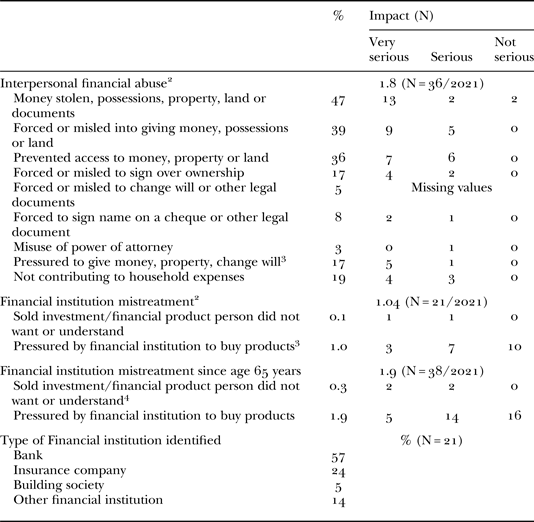
Overall, 36 out of 2,021 participants (1.8%, 95% confidence interval (CI) = 1.08–2.48) reported some kind of interpersonal financial abuse in the 12 months prior to the survey. This figure rose to 42 participants (2%, 95% CI = 1.29–2.86) when considering abuse experiences over the course of older age (since the age of 65 years). In the 12 months prior to the survey, the most frequently reported behaviours were having money or possessions stolen, or being forced or misled into giving money, land or possessions. Among the 1.8 per cent of participants who experienced interpersonal financial abuse, over one-fifth indicated being forced to sign over property or change a will which requires a legal process. Sixty per cent (N = 21/36) of participants believed that the behaviour had a very serious impact on their wellbeing and over a third (N = 12/36) perceived it had a moderate impact on them.
Characteristics of interpersonal financial abuse
People who disclosed financial abuse most frequently identified adult children (36%, N = 13/36) as perpetrators, followed by other relatives 22 per cent (N = 8/36), neighbours 19 per cent (N = 7/36), and spouse or partner 11 per cent (N = 4/36). Acquaintances (people known to the older person but not part of their intimate circle) accounted for 11 per cent (N = 4/36) of perpetrators. Among participants who disclosed experiences of interpersonal financial abuse, over half (53%, 19/36) described pure financial mistreatment solely related to their financial affairs. The remaining 47 per cent (N = 17/36) of people experienced hybrid abuse where financial abuse was accompanied by other types of abuse, mainly psychological (N = 16) abuse, and to a lesser extent physical (N = 5) abuse and neglect (N = 4). A comparison of the socio-demographic and economic profiles of these two groups identified no statistical differences with the exception of mental health. Participants who disclosed hybrid abuse had significantly lower mental health scores (mean = 32.4, SD = 11.1) compared to the pure financial abuse group (mean = 43.9, SD = 11.9) (t = 2.97, p = 0.005). The sample size involved in this comparison was small and results should be interpreted with caution (data available from author).
Financial institutional mistreatment
Twenty-one participants (out of 2,021; 1.04%, 95% CI = 0.4–1.6) described pressure to buy or being sold financial products they did not want or understand by financial institutions in the year prior to the survey (Table 1). Two participants reported both interpersonal and financial institution mistreatment. Thirteen per cent viewed their experiences of financial institution mistreatment as very serious, 42 per cent felt it was a moderately serious problem, while 44 per cent felt it had no impact on them (Table 1). The institutions most frequently identified engaging in these practices were banks, noted by 57 per cent (12/21) of participants (Table 1).
Type of interpersonal financial abuse and financial institution mistreatment reported and the perceived impact on the older person1

Notes: 1. Participants were allowed to indicate more than a single type of behaviour (multiple response), thus the numbers total more than 100 per cent. 2. In the past 12 months. 3. Pressured by perpetrator but did not succeed. 4. One value missing concerning the impact.
Institutional and interpersonal abuse
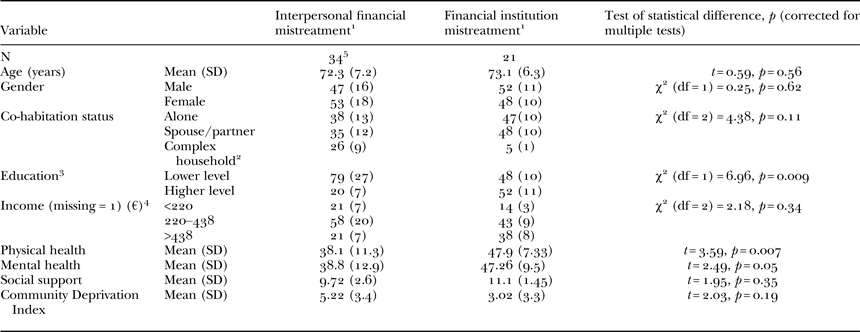
In Table 2, a comparison between people who disclosed interpersonal abuse and people who described financial institution mistreatment is presented. For the purpose of this analysis, the two individuals that reported both interpersonal and financial institution mistreatment were retained in the financial institution group and removed from the interpersonal abuse group. Overall, the groups were similar in socio-demographic and income profile, but significant differences were seen in education level and health status. People who reported financial institution mistreatment had attained higher levels of education and had higher mean scores for physical and mental health compared to people who had experienced interpersonal abuse. In addition, people who reported financial institution mistreatment tended to live in less-deprived communities: mean CDI score of 3.0 (SD = 3.3) compared to a CDI score of 5.22 (SD = 3.4) in the interpersonal abuse group (higher scores indicate greater levels of community deprivation). The statistical difference reached borderline significance using a standard t-test (p = 0.05) but fell outside statistical significance when a Bonferroni correction was applied (p = 0.19).
A comparison of the characteristics of people who disclosed interpersonal and financial institution mistreatment
Notes: SD: standard deviation. df: degrees of freedom. 1. Values are percentages with N in parentheses except where given as mean (SD). 2. Living with adult children or other relative. 3. Lower = none, primary or did not complete secondary level; higher = completed secondary level or above. 4. <€220 per week is the minimum state pension for a single person. 5. Two people who reported both interpersonal and financial abuse are excluded from interpersonal abuse data, but remain in the Financial mistreatment group.
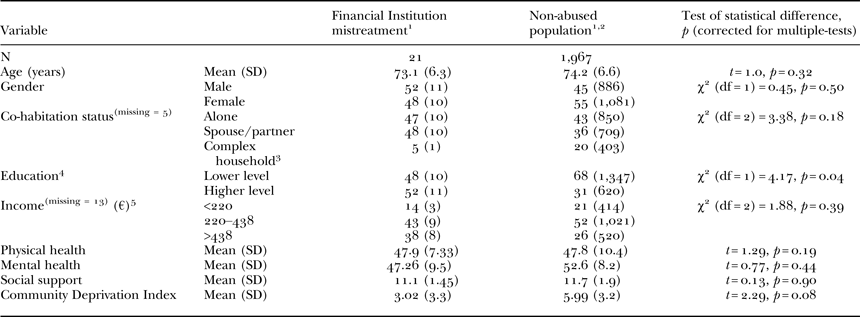
The analysis was repeated comparing people who described financial institution mistreatment with the non-abused population (excludes people who disclosed any interpersonal abuse). The profile of the two groups was largely similar (Table 3), again, financial institution mistreatment tended to be associated with higher levels of education and living in less-deprived communities.
Comparison of people who disclosed institutional financial abuse and the non-abused general population
Notes: SD: standard deviation. df: degrees of freedom. 1. Values are percentages with N in parentheses except where given as mean (SD). 2. Excludes people who disclosed physical, psychological, sexual, financial abuse or neglect in the past 12 months. 3. Living with adult children or other relative. 4. Lower = none, primary or did not complete secondary level; higher = completed secondary level or above. 5. <€220 per week is the minimum state pension for a single person.
Discussion
Financial mistreatment of older people is a complex phenomenon. This paper illustrates that in addition to interpersonal behaviours, there are practices by financial institutions that impact on older people's financial security and emotional wellbeing. The percentage of participants reporting interpersonal financial abuse in the 12 months prior to the survey was 1.8 per cent, nearly double that reporting financial institution mistreatment (1%). Just under half of people who disclosed interpersonal financial abuse also reported psychological abuse (hybrid abuse). Among the most frequent behaviours reported was being forced to give or sign over ownership of money, land or possessions. In the case of financial institution mistreatment, being pressurised into buying financial products was most frequently reported. Two individuals reported both types of mistreatment; this number is too small to draw any conclusions. However, it is likely to represent a reality for some older people whereby their asset profile attracts the attention of both family members and financial institutions.
At 1.8 per cent, the prevalence of interpersonal financial abuse in the previous 12 months falls within the range of 0.7–5.1 per cent found in other recent community prevalence studies (Acierno et al. Reference Acierno, Hernandez, Amstadter, Resnick, Steve, Muzzy and Kilpatrick2010; Berman and Lachs Reference Berman and Lachs2011; De Donder et al. Reference De Donder, Louma, Penhale, Lang, Santos, Tamutiene, Koivusilta, Schopf, Ferreira Aives, Reingarde, Peryyu, Savola and Verte2011). Lindert et al. (Reference Lindert, de Luna, Torres-Gonzales, Barros, Ioannidi-Kopolou, Melchiorre, Stankunas, Macassa and Soares2013) reported an average prevalence of 3.8 per cent based on urban populations across seven European cities. However, it is difficult to draw direct comparisons because of differences in definitions of financial abuse and study methodologies used (De Donder et al. Reference De Donder, Louma, Penhale, Lang, Santos, Tamutiene, Koivusilta, Schopf, Ferreira Aives, Reingarde, Peryyu, Savola and Verte2011). This is one of the first studies to compare the prevalence of pure and hybrid financial abuse in a community-dwelling population and identified a high level (nearly 50%) of co-occurring interpersonal abuse behaviours.
The authors are not aware of other studies that have examined older people's experiences with financial institutions in relation to selling financial products. In this study, the prevalence of financial institution mistreatment was lower than interpersonal mistreatment. However, as only two types of financial institution practices were included in the survey, this requires further conceptualisation in future research.
A concept of financial institution mistreatment
People who experienced financial institution mistreatment tended to be better educated, have better health and live in less-deprived communities. Possible explanations are that financial institutions may target older people with a particular asset profile, this group of people are more likely to use investment services, or the people who disclosed this type of mistreatment are more aware of such practices due to higher levels of education. It is also acknowledged that people in the survey generally regarded this type of financial mistreatment as much less serious compared to interpersonal financial mistreatment. As the numbers in this cohort are small and the range of questions limited, the data on financial institution mistreatment can only be regarded as preliminary.
This paper argues for a broader conceptualisation and discussion of financial institution mistreatment of older people. In a similar manner in which selling PPIs was investigated, there is a range of financial practices with particular implications for older people that require scrutiny. Practices such as reverse mortgages, accepting guarantees from older people for third-party loans, or banking employees advising people in debt to seek financial support from parents, invariably place some older people at risk of undue pressure, coercion or deception to release assets. This paper draws attention to cases of interpersonal financial abuse where hybrid, mainly psychological, abuse co-occurred. Although the direct abuse is at the interpersonal level, financial institutions may be part of the broader macro-context. A potential mechanism to disincentivise some types of abuse, especially concerning assets such as an older person's home, are to implement more stringent risk–benefit assessment criteria by financial institutions to preserve an older person's long-term financial wellbeing. The criteria outlined by Wilber and Reynolds (Reference Wilber and Reynolds1996) could become part of strategies to ensure ‘more responsible’ financial advice and lending by financial institutions. However, there is an important balance between adding extra layers of protection and preserving the human right of self-determination given sufficient mental capacity.
A social ecology perspective
The remainder of this paper will explore the way a social ecology lens can be used to examine the connections between interpersonal behaviour, financial institutional practices and societal attitudes in creating opportunities for the financial mistreatment of older people. Biggs and Haapala (Reference Biggs and Haapala2013) describe how definitional and conceptual boundaries have evolved around elder mistreatment, ageism and human rights, resulting in disconnected discourses, policies and strategies around these related entities. Financial abuse, in particular, transcends these conceptual boundaries, and challenges the view that interpersonal abuse exists in isolation from the influence of financial institutions and wider societal attitudes that may disproportionately value the assets of older people over their welfare.
There are incidents of financial mistreatment where financial and legal institutions, legislature and government policies act as permissors of mistreatment (Martin, Williams and O'Neill Reference Martin, Williams and O'Neill2009; Mulroy and O'Neill Reference Mulroy and O'Neill2011). Examples of practices that can act as a catalyst for financial elder abuse have already been identified, and include the transfer of assets, or power of attorney, that may not explicitly benefit the older person or ensure their long-term security. In Ireland, a longitudinal cohort study of people aged 50 years and older estimated that 24 per cent of older households transferred a financial or material gift worth €5,000 or more to adult children over a ten-year period (Kamiya and Timonen Reference Kamiya, Timonen, Barrett, Savva, Timonen and Kenny2011). The authors noted that while the proportion of financial transfers decreased with the increasing age of the donor, the value of the transfers significantly increased. It is assumed that the vast majority of such transfers are consensual and occur without undue pressure from the recipient, but the possibility of an abusive scenario is not considered in this or similar research (Albertini, Kohli and Vogel Reference Albertini, Kohli and Vogel2007; Attias-Donfut, Ogg and Wolff Reference Attias-Donfut, Ogg and Wolff2005; Kamiya and Timonen Reference Kamiya, Timonen, Barrett, Savva, Timonen and Kenny2011). The data reported herein suggest that between 17 and 39 per cent of the interpersonal financial abuse incidents may be inappropriate asset transfers. The concept of asset transfers and financial abuse, including contextual factors, requires more explicit linkage in future research to inform preventive strategies. Equally, there is a need to examine the impact on family relations when there is a refusal to transfer assets.
Asset transfers represent a fine balance between respecting the right to privacy and autonomy and a state's obligation to protect specific groups. This introduces a human rights perspective, whereby principles of justice and dignity should reflect ageing policy and link the concerns of older people to wider society (Morgan and David Reference Morgan and David2002). Tang more explicitly links human rights with financial circumstances and quotes the United Nations Committee on Economic Social and Cultural Rights, ‘in times of recession and restructuring of the economy, older persons are particularly at risk and that states have a duty to protect them’ (Tang Reference Tang2008: 110). The social ecology model recognises that human behaviour is not immune to wider economic events and stressors that can culminate in targeting older people for their assets. The current survey was carried out in 2010 at the peak of the economic crisis in Ireland, typified by high levels of individual debt; it is noteworthy that the majority of interpersonal abuse and financial institution mistreatment incidents occurred in the previous 12 months rather than over the course of older age (since age 65 years). This pattern is also reflected in statistics from the Health Service Executive's (HSE) database on elder abuse cases which shows an annual increase in reported incidences of financial abuse from 16 per cent in 2008 to 21 per cent in 2012 (HSE 2013), while in the UK approximately one-quarter of referrals to Safeguarding Services were for financial abuse (Social Care Institute for Excellence 2011). Currently, financial institutions, and even State tax revenue systems, are not compelled to question sources of debt repayment beyond regulations designed to prohibit money laundering from criminal activity. In other words, the possibility of elder financial abuse is not actively considered.
Viewing older people as ‘untapped’ sources of wealth is evident in individual behaviour as well as financial institution practices that include the promotion of inappropriate financial products. It can be argued this attitude is an example of ageism, where there is willingness by younger generations to see older people as separate from themselves and their own interests (Biggs and Haapala Reference Biggs and Haapala2013; Wilson et al. Reference Wilson, Tilse, Setterlund and Rosenman2009). Phillips (Reference Phillips, Phillips, Ajrouch and Hillcoat-Nalletamby2010) describes an ‘othering effect’ whereby older people are categorised as different and inferior. In financial abuse, ageism plays a part in societal attitudes to the transfer of assets where individual expectations of assets, regardless of the health and social needs of the older person, are put first (Wilson et al. Reference Wilson, Tilse, Setterlund and Rosenman2009). This societal attitude is reinforced by legal and taxation incentives that reward early asset transfers and ignore the increasing longevity of current populations and the potential need to self-finance care.
The social ecology model points to the interlinking pathways in financial elder abuse between apparently disconnected spheres of influence, from the micro individual, to the macro government, institution and societal level. Biggs and Haapala (Reference Biggs, Manthrope, Tinker, Doyle and Erens2013: 1303) caution that there can be a tendency to turn a ‘blind eye’, allowing the development of ‘normative gaps in which the problem is not recognised in relation to a particular group, either in legislature, or as a social construct’. As countries start to emerge from the economic crisis, there is a need to examine critically the financial practices, legislative frameworks, government policies and, above all, societal attitudes that reduce older people to the status of ‘untapped wealth’, leaving them at risk of interpersonal and financial institution mistreatment. Strategies to prevent elder financial abuse need to focus not just on the interpersonal behaviour but on wider financial institutional practices, legal frameworks, government policies and ageist attitudes.
Strategies to manage financial mistreatment
Financial institutions and legal practitioners have a key role to play in preventing some types of interpersonal financial abuse, but there is a need to increase awareness of that role and improve training (Crosby et al. Reference Crosby, Clark, Hayes, Jones and Lievesley2008; Gilhooly et al. Reference Gilhooly, Harries, Gilhooly, Hennessy, Gilbert, Stanley and Penhale2012; Social Care Institute for Excellence 2011; Wilson et al. Reference Wilson, Tilse, Setterlund and Rosenman2009). The recent number of financial institution scandals suggests there is a need to critically examine a range of banking behaviours; among these, interactions with older people deserve particular attention, and in a timely fashion, to ensure direct benefit for this group. In addition to potential aberrant behaviour, the rapid switch to electronic banking, combined with the closure of local branches, place some older people at risk due to increased reliance on third parties to help manage their financial affairs. This is an area that has received little attention from either government or financial institutions in terms of working with older people's groups to develop and promote safe and viable alternatives (Mulroy and O'Neill Reference Mulroy and O'Neill2011). There is no doubt that financial institutions face considerable challenges in trying to protect their clients from both direct and indirect forms of financial abuse. However, as a new era in banking emerges, after the malpractices of recent decades, there is an opportunity to rebuild confidence and trust through developing genuine person-centred practices that meet the needs of their entire customer base.
At the minimum, developing financial literacy services for older people and those who manage their financial affairs is a priority (Crosby et al. Reference Crosby, Clark, Hayes, Jones and Lievesley2008; Setterlund et al. Reference Setterlund, Tilse, Wilson, McCawley and Rosenman2007; Wilson et al. Reference Wilson, Tilse, Setterlund and Rosenman2009). Financial literacy should focus on both day-to-day transactions and financial investment products. Money management services may be of benefit in easing the transition to electronic financial services and supporting financial decision making, especially during the early stages of cognitive decline (McCawley et al. Reference McCawley, Tilse, Watson, Rosenman and Sterlund2006). Such services will require strict regulation through independent monitoring and should include active engagement with the financial services industry.
At a national and international level, codes of practice for financial and legal institutions in dealing with the financial affairs of older people are required, especially where the risks associated with asset transfers outweigh the benefits for older people. Such a risk assessment needs to extend beyond a narrow focus on cognitive vulnerability and recognise the psychological pressure that can accompany interpersonal financial abuse. Ageism is a core challenge in society, diminishing personhood and increasing the risk of abuse. It allows the financial assets of an older person to be viewed as disconnected from the welfare of the individual as well as from the interests of society. Individual attitudes to asset transfers, government policies, legislation and institution norms of practice that may promote, and even legitimise, ageism need to be recognised and challenged.
Limitations
The number of participants disclosing interpersonal or financial institution mistreatment was small and limited the ability to detect individual risk factors. The results should be interpreted with caution and it is likely some risk factors for financial mistreatment were not significant due to inadequate statistical power. This type of cross-sectional survey design is likely to exclude some of the higher-risk groups, e.g. people with cognitive decline, and may represent the tip of the iceberg (Berman and Lachs Reference Berman and Lachs2011; Conrad et al. Reference Conrad, Iris, Ridings, Faim, Rosen and Wilber2011).
Defining financial institution mistreatment based on two parameters (pressure to buy or the sale of financial products) is likely to underestimate the extent of institutional practices that negatively impact on the financial wellbeing of older people (Crosby et al. Reference Crosby, Clark, Hayes, Jones and Lievesley2008). There is a need for explorative studies to identify and examine the impact of a broader range of financial practices. Further research is also needed to articulate the nature of the interactions between micro- and macro-level factors, including the role of ageism and normative institutional practices that create the circumstances for abusive behaviours to occur in older age.
Conclusion
This paper reports the prevalence of interpersonal financial abuse in a national representative sample of older people; in addition, it provides preliminary empirical evidence of mistreatment by financial institutions. At a superficial level, the characteristics of these two groups appear divergent in terms of health, education and perhaps affluence. However, based on a social ecology framework this may be an over-simplification of a complex reality, where individual behaviour is influenced by broader social attitudes to ageing and wealth distribution that can be reflected in government policies, legislation and normative practices of the financial sector.
The paper calls for an exploration of the concept of financial mistreatment by financial institutions within society and, particularly, as it relates to the financial security and wellbeing of older people. A social ecology framework highlights that social gerontology research, including elder abuse, needs to move beyond identifying prevalence and characteristics to a more sophisticated understanding of the interconnected pathways between individual behaviours, outcomes and external influences. Finally, financial abuse in older age is multifaceted and the development of effective preventative strategies will require sustained commitment from governments and the financial industry, as well as the involvement of older people to identify realistic and acceptable solutions.
Acknowledgements
The authors would like to thank the study participants and the interviewers for their time and courage in talking about elder abuse. The authors acknowledge the National Centre for the Protection of Older People (NCPOP) research team, the NCPOP Board of Directors, Tim Grant, CSTAR, University College Dublin, for statistical advice, and the NCPOP International Advisory Committee—Professor Karl Pillemer, Cornell University Institute for Translational Research on Aging, Professor Simon Biggs, Kings College London, Dr Isabel Iborra Marmolejo, Queen Sofia Centre for Studies on Violence, Valencia, Spain—for the contribution of their time, effort and dedication; also Dr Mark Lachs, Cornell University Centre for Aging Research for advice on instrument design. This study was granted ethical approval by the University College Dublin Human Science Ethics Committee, Dublin, Ireland.