Early research on the development of cultural complexity among Archaic societies in North America's Eastern Woodlands focused on a number of variables, including food storage, domestication of plants, exchange of valuables, permanent habitations, cemeteries, social ranking, and elaboration of art in a social context (Brown Reference Brown1985:201). Although complexity can be manifested in a number of ways materially (see Gibson and Carr Reference Gibson and Carr2004), many authors focus on the power of belief and ritual in the development of complex cultural behaviors in the Archaic (Claassen Reference Claassen, Sassaman and Anderson1996, Reference Claassen2015; Sassaman Reference Sassaman2004). Most studies dealing with such ideological complexity cite the development of complex mortuary ceremonialism and, in the Southeast at least, monumental architecture (e.g., shell and earthen mounds and enclosures) as initial manifestations of such complexity (Claassen Reference Claassen2015; Sassaman and Heckenberger Reference Sassaman, Heckenberger, Gibson and Carr2004). These are public works and behaviors, but is it possible for ideological complexity to appear within primarily domestic contexts?
I refer here to the late Middle to Late Archaic (ca. 6000–3000 BP) multiseason, macroband basecamps recorded at sites such as Koster on the lower Illinois River Valley (Brown and Vierra Reference Brown, Vierra, Phillips and Brown1983:184, Figure 9.6), Black Earth in the lower Ohio Valley (Jefferies Reference Jefferies2008:155–157), Riverton in the lower Wabash River Valley (Winters Reference Winters1969), Bluegrass in southwestern Indiana (Stafford et al. Reference Stafford, Richards and Anslinger2000), DuPont and related components in southwest Ohio (Vickery Reference Vickery, Otto and Redmond2008), and Lamoka Lake in upper New York (Ritchie Reference Ritchie1980). With the exception of Riverton, which is discussed in greater detail below, discussion of ideological complexity is minimal, and then primarily in regard to socioeconomic inferences derived from the study of large cemetery populations (Brown Reference Brown1985:218–219; Jefferies Reference Jefferies2008:156–158; but see Claassen Reference Claassen2015 for a notable exception).
The recent discovery of several puddled (moistened) clay surfaces at the Late Archaic multiseason basecamp known as Burrell Orchard (33LN15) in northeastern Ohio stands in stark contrast to previously documented Late Archaic settlements in the surrounding region (Purtill Reference Purtill, Redmond and Genheimer2015; Stothers and Abel Reference Stothers and Abel1993). In fact, the prepared clay surfaces at Burrell Orchard are exceptional and unique in the middle Ohio River Valley-lower Great Lakes region and indicate a labor investment well beyond that most likely expended on the more typical unfloored, wooden post dwellings (Purtill Reference Purtill, Redmond and Genheimer2015; Stothers and Abel Reference Stothers and Abel1993; Stothers et al. Reference Stothers, Abel, Schneider, Prufer, Pedde and Meindl2001; but see Ellis et al. Reference Ellis, Keron, Menzies, Monckton, Stewart, Redmond and Genheimer2015). Are these floors simply that, or did they serve a function unrelated to everyday domestic life? The archaeological records of similarly formed clay surfaces documented primarily in Eastern Woodlands formal mortuary contexts (e.g., mound and earthwork) point to functions involving ritualism and ceremonial activities generally unrelated to domestic activities. Thus, study of the prepared clay features at Burrell Orchard may offer insights into the nature of Late Archaic ritual that are relevant to understanding cultural complexity within the Eastern Woodlands. This paper describes the prepared clay floors at Burrell Orchard and assesses the evidence for possible domestic and ritual associations of these features. The results suggest that the clay surfaces hosted specialized, short-term ritual activity.
Clay Floor Features at Burrell Orchard
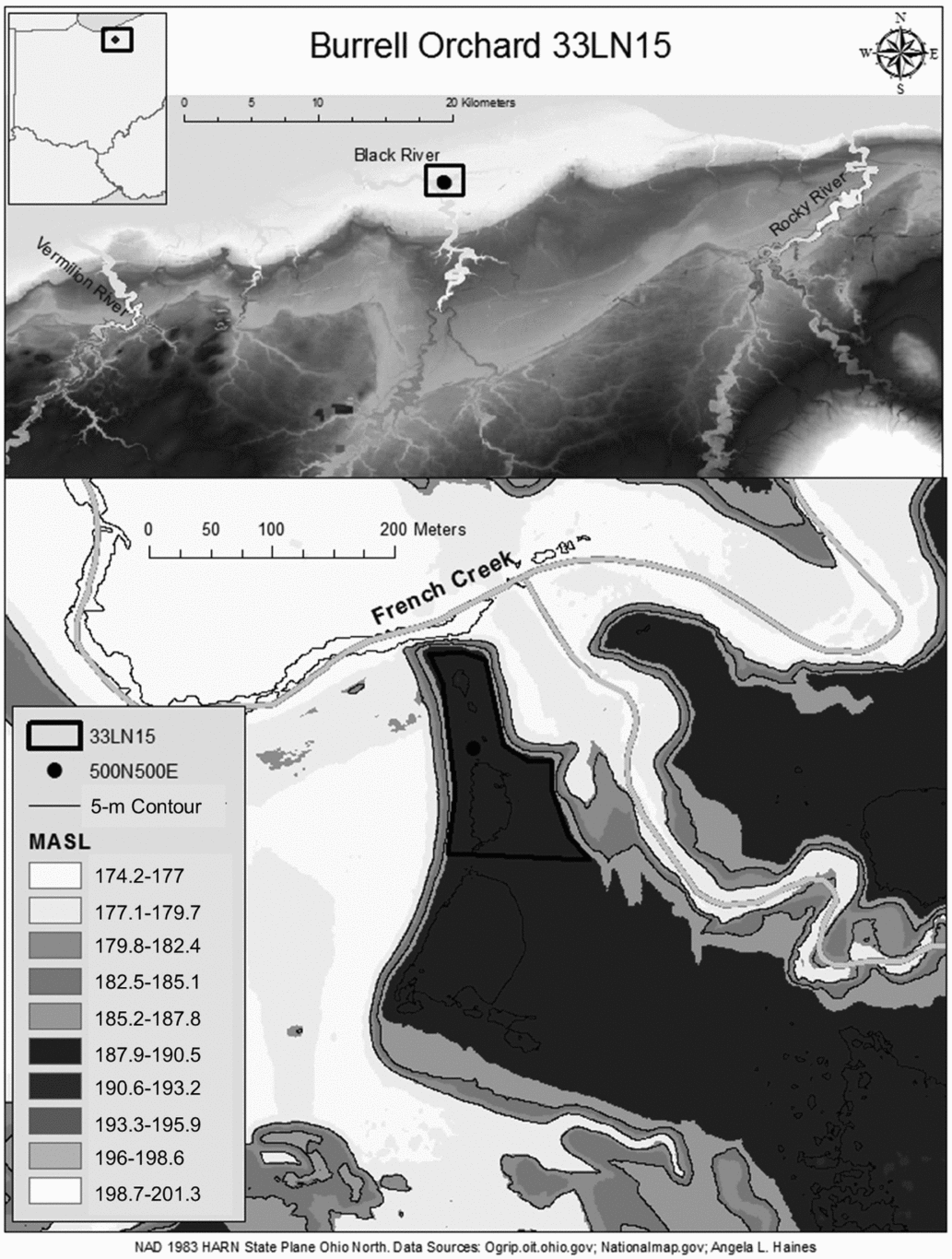
The Burrell Orchard site is located in Sheffield Village, Lorain County, Ohio. It is situated on a flat shale bedrock promontory overlooking French Creek to the north and the Black River, approximately 600 m to the west (Figure 1). The promontory is capped by late Pleistocene Lake Erie Plain deposits of clay loam soil (Ernst and Musgrave Reference Ernst, Musgrave and Hayhurst1976:68–69). Pre-Euroamerican settlement vegetation of the immediate site area was dominated by oak-hickory forest (Ives Reference Ives1947:23) with the adjacent lowlands consisting of elm-ash swamp forest interrupted by a large (wet?) prairie opening to the north, between the lower Black River and the Lake Erie shoreline (Gordon Reference Gordon1966).
Location and physical setting of the Burrell Orchard site.

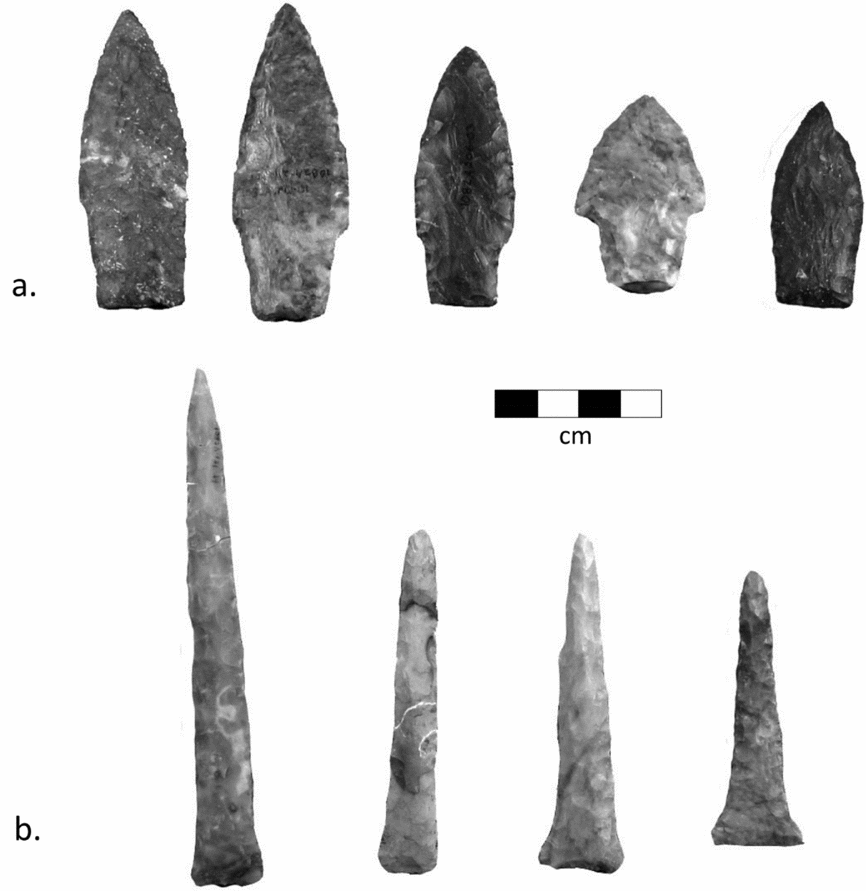
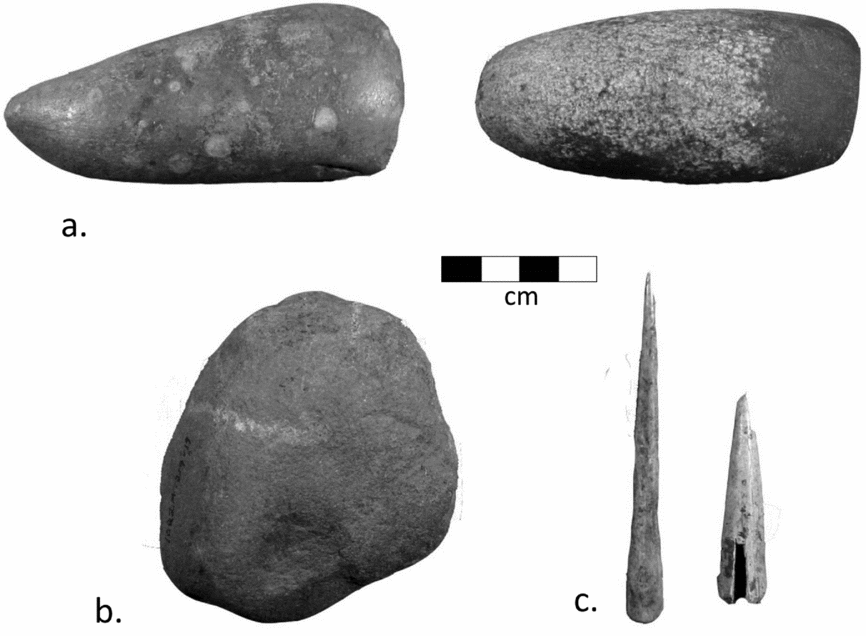
The Cleveland Museum of Natural History (CMNH) conducted 17 weeks of test excavations over four field seasons (2008, 2014–2016) at the Burrell Orchard site under the direction of the author and assisted by volunteers of the Firelands Archaeological Research Center (Redmond and Scanlan Reference Redmond and Scanlan2009; Redmond, Scanlan, and Haines Reference Redmond, Scanlan and Haines2016; Redmond, Scanlan, and Marley Reference Redmond, Scanlan and Marley2015, Reference Redmond, Scanlan and Marley2016). Systematic shovel-testing and geophysical-geochemical surveys (Burks and Locke-Rogers Reference Burks and Locke-Rogers2015; Nolan and Redmond Reference Nolan and Redmond2015) revealed that approximately 0.82 ha of the northern end of the promontory (including the abandoned orchard) is covered by a nearly continuous, stratified sheet midden deposit extending from 20 to 80 cm below the surface. Two primary, cultural-stratigraphic units have been defined for the midden: a fire-cracked rock (FCR)-rich, upper midden zone (Stratum III); and a lower midden stratum (Stratum II) consisting of highly organic sediment and containing high densities of nutshell and animal bone with lesser amounts of FCR. Stratum II deposits appear to be most closely associated with the construction and use of the clay floors and produced Late Archaic-period flaked and ground stone tools, chert debitage, and bone and antler implements. The flaked stone tool assemblage is dominated by stemmed lanceolate points and long, expanded stem perforators (Miller and Redmond Reference Miller and Redmond2016) made from Upper Mercer and Flint Ridge (Vanport member) chert from eastern Ohio (Figure 2). Ground stone tools include pitted anvilstones, manos, and sandstone abraders; splinter bone awls, antler flakers and socketed tines, and ground and polished bone pins comprise the bone and antler assemblage (Figure 3).
Selected (a) projectile points and (b) perforators from Burrell Orchard.

Selected (a) ground stone celts, (b) anvilstone, and (c) bone pin and socketed antler point from Burrell Orchard.

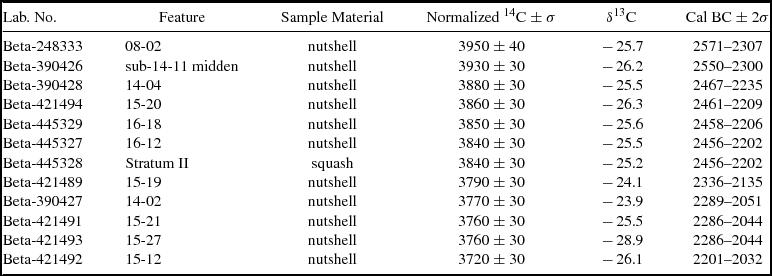
Twelve radiocarbon assays of carbonized material (primarily nutshell) from midden and pit contexts point to a maximum occupation dating between 2571 and 2032 cal BC (Table 1). Scattered remains of grit-tempered pottery and triangular (Levanna and Madison types) projectile points from plow zone contexts reveal one or more superficial Late Prehistoric period components dating between cal AD 1045 and 1650. Late Archaic cultural features predominate and include post molds, rock concentrations, surface hearths (heat-oxidized stains), tool cache and storage pits, smudge pits, and other small to large-sized pits of uncertain functions. Subsistence remains were dominated by large quantities of highly fragmented deer bone and antler, as well as carbonized shells from the processing of hickory and black walnuts. Faunal remains also included squirrel, red fox, muskrat, opossum, raccoon, woodchuck, wild turkey, turtle, and several types of fish, including catfish and freshwater drum. Botanical remains include significant numbers of hickory and black walnut, and some of domesticated squash. One fragment of squash rind produced an age of 3840 ± 30 BP (Beta-445328; Table 1).
Radiocarbon Determinations from Burrell Orchard Late Archaic Cultural Contexts.

Note: All dates on carbonized materials; calibrated by CALIB 7.0 (Reimer et al. Reference Reimer, Bard, Bayliss, Warren Beck, Blackwell, Bronk Ramsey, Brown, Buck, Edwards, Friedrich, Grootes, Guilderson, Haflidason, Hajdas, Hatté, Heaton, Hogg, Hughen, Kaiser, Kromer, Manning, Reimer, Richards, Scott, Southon, Turney and van derPlicht2013; Stuiver and Reimer Reference Stuiver and Reimer1993).
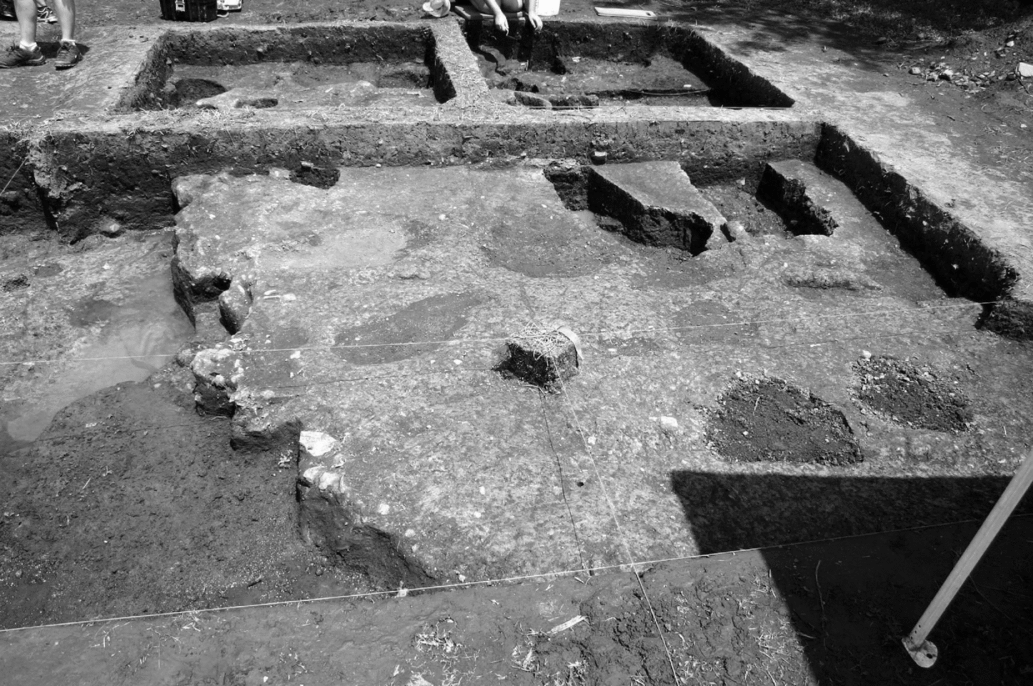
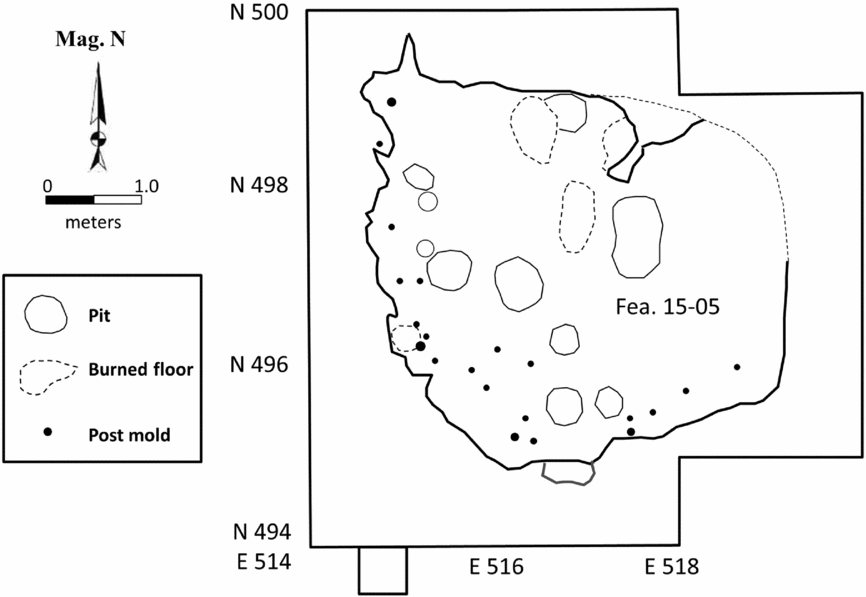
Over three field seasons, excavation exposed several large, stratified sections of prepared clay surfaces or floors. The largest, contiguous area of puddled clay (Feature 15-05) covers ~17 m2 and is 10 cm thick (Figures 4 and 5). The source of the clay of Feature 15-05 is uncertain; however, the culturally sterile, Lake Erie Plain sediments stratified beneath the midden deposits consist of a yellow, silty clay loam that closely resembles the material used to construct the floors. X-ray diffraction analysis of samples of Feature 15-05 and the subsoil clay revealed that both consist of nearly identical forms of illite clay. The only significant difference is that the subsoil matrix contains higher percentages of silt and sand than the floor clay. Thus, if the local subsoil clay was quarried for use in constructing the floors, then some processing (levigation?) was undertaken to remove significant amounts of silt and sand. Such processing would have entailed a substantial amount of time and labor to produce the estimated 1.6 m3 of processed clay needed to construct Feature 15-05.
View of largest clay floor (Feature 15-05) looking north.

Plan of Feature 15-05 clay surface, associated features, and post molds representing Structure 2.

Several shallow pit features, surface hearths, and a few smudge pits occur on the Feature 15-05 floor, along with small, scattered clusters of FCR. A distinct area of burning near the center of this floor (Feature 15-18) may represent a concentration of surface hearths. Further excavation beneath this area of upper floor layer exposed a discrete, stratified series of small burned and unburned clay layers and charcoal concentrations (Feature 16-08), which may represent sequential constructions of surface hearths in this area over an extended period of time.
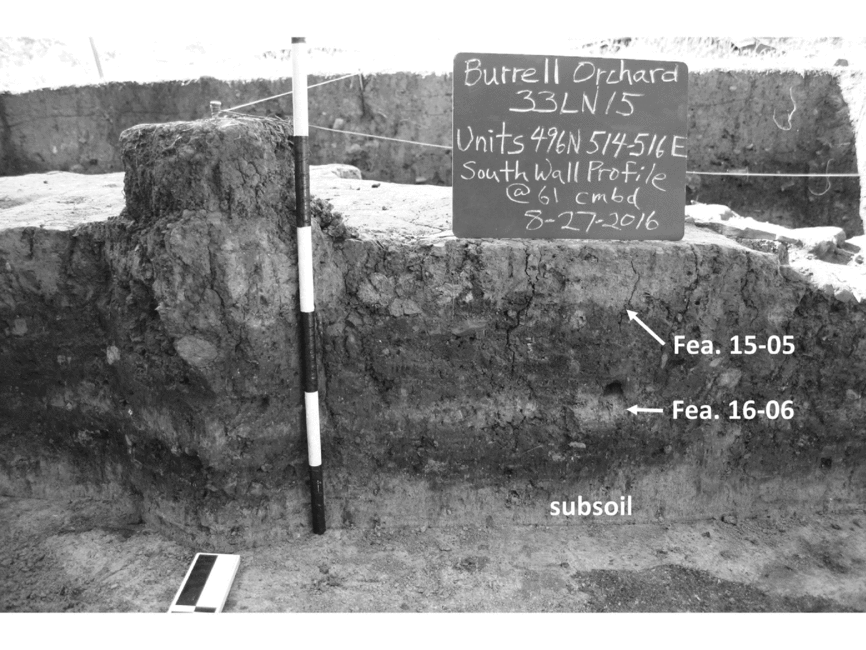
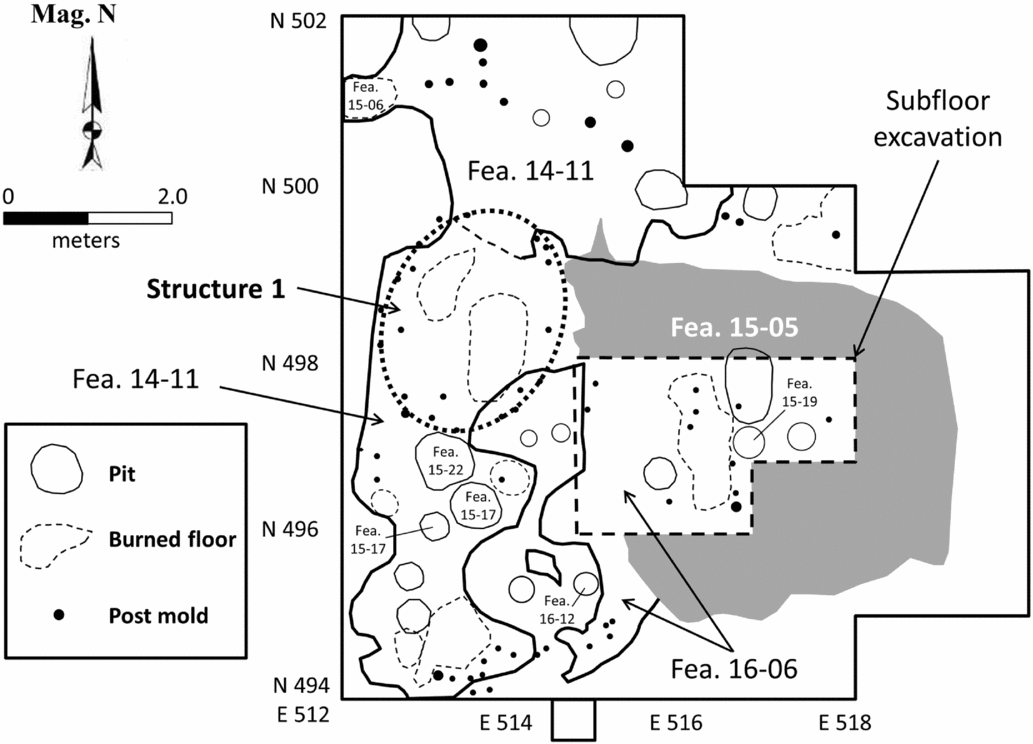
About 13 cm below Feature 15-05 is a thinner (3–5 cm), puddled clay floor (Feature 16-06) of approximately the same surface area and separated from the upper floor by a layer of midden (Figure 6). Excavation in 2016 exposed a 6.5 m2 section of this lower floor to reveal several small pits, surface hearths, and FCR clusters very similar to those identified on the upper floor. Directly to the west and approximately 25 cm below the level of Feature 15-05 are a series of smaller clay surfaces (Figure 7). These deeper floors (Feature 14-11) are each about 5 cm thick and were constructed just a few centimeters above the natural subsoil (lake plain clay) deposits. All these floors are interconnected and exhibit the remains of small surface hearths, small pits, and FCR concentrations.
Vertical section of deposits showing stratification of Feature 15-05 above the remains of Feature 16-06 and stratified with midden soil.

Plan of block excavation area showing lower clay floors (Features 14-11 and 16-06), associated features, and proposed outline of Structure 1.

Post-mold patterns delineated on Features 15-05 and 14-11 suggest that wooden post structures were erected upon portions of these clay surfaces. An apparently complete structural outline (Structure 1) is evident on the northern section of Feature 14-11 as an oval of small post molds enclosing an area of ~4.7 m2 (Figure 7). A 90 cm wide opening at the northern end of this post line may mark a doorway. No post molds representing interior supports were detected inside this structure, which points to the construction of a bent-pole (tension) superstructure. A fire-reddened section of the interior clay floor most likely represents the sequential use of several small surface hearths within the structure. Immediately to the south of this structure is a large pit (Feature 15-22) that contained an assortment of worn manos or handheld grinding stones and pitted anvilstones, the largest of which weighs 9.5 kg. Directly south of this pit are the remains of a small puddled clay basin (Feature 15-17) that contained an isolated deer astragalus and bone awl fragment. This basin measures 60 cm in diameter, is roughly circular, and shows no evidence of burning. The cache of used ground stone tools and the clay basin indicate that at least some activities were carried out on unroofed sections of the clay floors. Likewise, the southern floor section of Feature 14-11 contained additional surface hearths, FCR clusters, charcoal stains, and thin deposits of ash without evidence for a covering structure.
A larger structural configuration is an arc of small (5 cm diameter) post molds that extends along the southern and western margins of Feature 15-05. This post outline (Structure 2) has a maximum diameter of 4.8 m and encloses most of the identified floor features (Figure 5). In form, it resembles the C-shaped structure type described by Purtill (Reference Purtill, Redmond and Genheimer2015) for other Archaic sites in the region (see above). It is possible that this structure may have originally extended completely around the clay floor, but modern disturbance and weathering of the eastern and northern margins of Feature 15-05 prohibited the discovery of any additional post molds that may have formed a more complete structure.
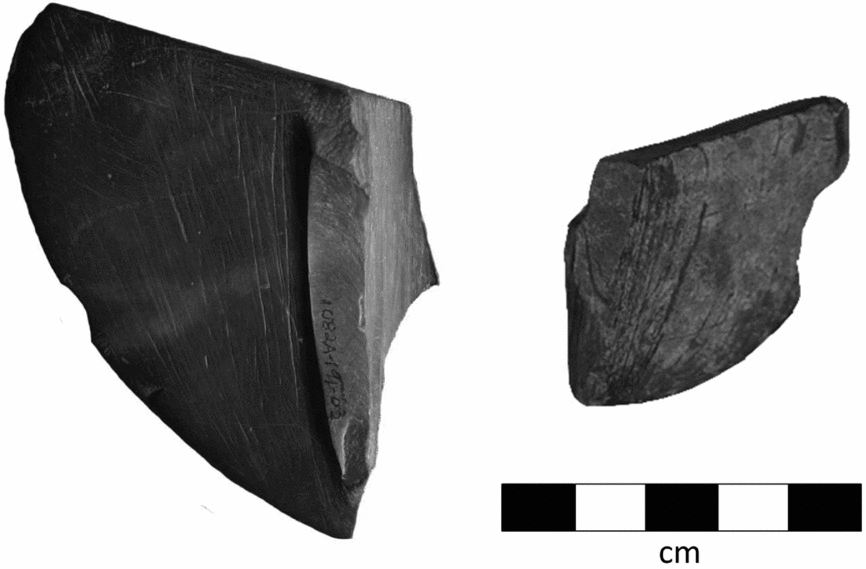
Few formal artifacts were directly associated with the floors; however, eight chert perforators were recovered on floor surfaces and, in several cases, in midden deposits stratified between floors. In contrast, projectile points were conspicuously absent from most floor contexts. Of particular note are two broken bannerstones that were recovered from pit features sealed beneath Feature 15-05 (see below; Figure 8).
Bannerstone fragments found in association with Feature 15-05.

Clay Architecture in Ritualized Contexts
Other than at Burrell Orchard, large prepared clay surfaces during the Late Archaic are undocumented in most of the lower Great Lakes and middle Ohio Valley regions. Instead, the use of clay to create special surfaces took place later in time and almost exclusively in ritualized contexts. Here I define ritual as repetitive, prescribed behaviors that include the use of designated objects, and involve communication with non-human entities (Greber Reference Greber, Redmond and Genheimer2015:121–122). In the precontact Eastern Woodlands, such behaviors were most likely of a sacred character, dealing with spiritual or cosmological concerns. Such ritualized behaviors are reflected by prepared clay floors—often of multiple colors and textures—beneath Hopewell mounds. For example, salvage excavations at the Edwin Harness Mound in Ross County, Ohio, exposed up to five stratified floors at the base of the mound in association with the multiroom “Big House” post structure (Greber Reference Greber1983). The uppermost of these floors was a heavy yellowish-brown clay that supported most of the mortuary-ritual features such as tombs, pits, postholes, and burned surfaces (Greber Reference Greber1983:24). The extensive use of puddled clay for floors, tombs, and ritual basins is also documented at several other Middle Woodland Hopewell, as well as Early Woodland Adena mortuary-ritual contexts in the middle Ohio Valley (Greber Reference Greber, Redmond and Genheimer2015:98, 100, 104–105, 108, 111, 113, 118–119, Figure 5.14; Pollack and Schlarb Reference Pollack, Schlarb, Wright and Henry2013; Webb and Snow Reference Webb and Snow1974:161–162).
The use of clay within ritual contexts extended into the Late Prehistoric period of the region as well. In Kentucky, for example, clay was used in the construction of small Fort Ancient Tradition mounds and to line large post molds, cap pit and post features, and form floors associated with large “public” structures (Pollack and Henderson Reference Pollack, Henderson, Redmond and Genheimer2015:308, 313). The use of clay floors has also been documented in Mississippian mounds (Emerson Reference Emerson, Emerson and Lewis1991), but of particular interest to this study are the “shrine house” structures discovered at several Mississippian ceremonial (pilgrimage) centers in western Illinois (Pauketat Reference Pauketat2013). Clay of various colors was used to cover the floors of several structures and line associated post molds and some pit features at Emerald, Pfeffer, and Halliday sites in the area (Pauketat Reference Pauketat2013:173–175; Skousen Reference Skousen2016:222). Skousen (Reference Skousen2016) examined several small post structures in shrine houses at Emerald that contained small storage or cache pits containing minor amounts of flaked and ground stone tools, Eastern Agricultural Complex plant seeds, and ceramic vessels. Skousen (Reference Skousen2016:222–225) interprets the complete stone tools, in particular, as ritual offerings.
The use of clay surfaces in Middle to Late Archaic ceremonial-mortuary contexts is rare north of the Ohio River; however, well-documented examples are present farther to the south. Most notable are the prepared clay surfaces documented at several shell midden/mound localities in the Green River region of western Kentucky and “midden mounds” of the middle Tennessee River Valley in northern Alabama (Sassaman and Ledbetter Reference Sassaman, Ledbetter, Sassaman and Anderson1996:78; Webb Reference Webb1950a:272; Reference Webb1950b:363). Some of these constructions consist of small, fire-reddened patches of clay that some interpret as cooking “griddles” (Sherwood and Chapman Reference Sherwood and Chapman2005:72); however, most of these are less than 1 m in diameter and would not qualify as structural floors. Clay surfaces of greater diameters (ca. 2–3 m) are also present at shell midden sites and are identified as habitation loci (Webb and DeJarnette Reference Webb and DeJarnette1942:238).
Perhaps the most completely documented example of clay surfaces of the kind found at Burrell Orchard occur at the Riverton site, located on the lower Wabash River in southwestern Indiana (Winters Reference Winters1969). Extensive excavations in Riverton's Area X revealed up to 10 floors or platforms made of yellow clay surrounded by thick sheet midden. The most complete of these were rectanguloid in plan and ranged from 10 to 15 cm thick. Several platforms contained small hearths, and Winters recorded a few intrusive burials. In a few cases, hearths took the form of small, heat-oxidized patches of the clay. Other kinds of pit features were generally rare, although several clusters of burned sandstone were associated with some platforms. Surface areas of five of the most complete floors ranged from 6.35 to 24.15 m2 (Winters Reference Winters1969:Table 5.3) with an average of 15.0 m2 (σ = 6.9). Almost no post molds were identified in association with any of the clay platforms, leading Winters (Reference Winters1969:98) to conclude that no structures were erected on these surfaces.
Despite the absence of formal dwellings, Winters considered Area X to represent the “living area” of the Riverton site with activities focusing primarily on “domestic and manufacturing activities” as indicated by contents of the surrounding middens, ground stone tool caches, nutshell and burned rock concentrations, and bone and antler implements (Winters Reference Winters1969:98–99). In addition to a few burials and their artifact contents, small deposits of red ochre and possible ceremonial objects such as a cloudblower pipe, a wolf canine pendant, a mussel-shell paint cup, a bone flute, and a turtle shell rattle were found in pits and middens near the clay platforms. Winters, however, interpreted the nonburial objects in this list as having been stored near to, rather than used in activities on the floors themselves (Winters Reference Winters1969:99).
Recently, Cheryl Claassen has reinterpreted the Riverton site clay platforms as possible ritual shrines rather than domestic house floors (Claassen Reference Claassen2010:153, 2015:109–111). Her analysis focuses on three associated burial features and artifact caches that include assorted flaked stone tools, ground stone implements, animal bones, and shell ornaments. Of particular significance are the pipe, turtle shell rattles, paint cups, and bone flutes described above. She also sees nearby deposits of burned sandstone, as well as several pits as indicative of ritual use, as they contained animal bones from numerous species, cut antler sections, bone implements, chert bifaces and projectile point fragments, and shell and bone ornaments (Claassen Reference Claassen2015:111). These collections of artifacts are interpreted as special offerings used in world renewal rituals. Claassen concludes that:
Association with ritual makes these [clay] surfaces candidates for feasting facilities, either as cooking areas, food preparation areas, or guest seating, given both their sizes and their extra effort to prepare. Renewal of these floors and their paucity in most sites, suggests to me that they were special-use features. (Claassen Reference Claassen2010:153)
Claassen's reinterpretation of the Riverton clay platforms as loci of ritual rather than household activity emphasizes their uniqueness and acknowledges their unusual archaeological signature. Indeed, the apparently rare occurrence of clay floors in Late Archaic contexts across the region strongly suggests that the sites where these features are present were not simple seasonal basecamps at which only mundane subsistence activities, tool manufacture, food storage, dwelling construction, and socializing took place. In fact, Late Archaic residential basecamps lacking clay floors are rather abundant and well documented in the middle and lower Ohio Valley and tributary stream valleys (Jefferies Reference Jefferies2008:214–216; Patton and Curran Reference Patton and Curran2016; Purtill Reference Purtill, Emerson, McElrath and Fortier2009:583–584). Some basecamp localities with communal cooking facilities and evidence of heavy nut and deer exploitation are interpreted as aggregation centers for small local communities. Such macroband encampments are viewed as loci for increasing economic production (cooperative hunting and gathering) and communal consumption (feasting) in conjunction with collective ceremonialism (Heyman et al. Reference Heyman, Abrams, Freter, Abrams and Freter2005:68–70).
Unfortunately, the kinds of behaviors that archaeologists characterize as ritual leave material residues that, in many cases, can also be interpreted as debris left behind by the kinds of domestic (i.e., nonritualized) activities listed above. In particular, I refer to hypothesized sacred or ritual-ceremonial contexts consisting of large deposits of whole or fragmented animal bones or stone tools and debitage interpreted as “offerings” (Claassen Reference Claassen2010, Reference Claassen2016:276–284). Less ambiguous, ritualized contexts that most researchers readily acknowledge as ritual include formal mortuary features (i.e., primary or secondary burials and associated funerary objects/offerings) and caches of rare, specially made bifaces or other formal stone tools often made of exotic raw materials (Greber Reference Greber and Pacheco1996; Greber and Ruhl Reference Greber and Ruhl2000; Prufer et al. Reference Prufer, Seeman and Mensforth1984; Redmond Reference Redmond2008; Seeman and Soday Reference Seeman and Soday1980).
The interpretive difficulties that arise when dealing with nonmortuary features and deposits, such as the lithic and animal bone caches mentioned above, may have to do with the creation of a false dichotomy that segregates past socio-cultural behavior into domestic versus ritualized realms. In fact, abundant anthropological and historical case studies of Eastern Woodland native societies make clear that such a separation was not central to native worldviews (Byers Reference Byers2004, Reference Byers2011; Carr Reference Carr, Troy Case and Carr2008; Claassen Reference Claassen2010; Hall Reference Hall1997, Reference Hall and Plew1998). Instead, most of the actions and objects ingrained within everyday living were perceived by native actors as clothed in ritual and energized with the spirits of human and other-than-human beings (Hill Reference Hill2011:408; Ingold Reference Ingold2006; Moore and Thompson Reference Moore and Thompson2012). As such, what Western observers would characterize as mundane, domestic activity also likely possessed a sacred nature, which in part determined what actions took place and how objects were treated. Thus, for example, even apparently simple, straightforward actions such as digging a pit and placing objects in the earth can be simultaneously interpreted as refuse-disposal and making an offering to spirits of the underworld. Given the acknowledged indigenous perception of the innate sacredness of all human (and nonhuman) actions and objects, how does one usefully interpret unique phenomena such as the Late Archaic clay floor features at localities such as Burrell Orchard? It would seem that the most direct course of action is to search for overt expressions of ritual that can also be assessed from the parallel perspective of everyday domestic (household) behavior.
Assessing Domestic and Ritual Use of the Burrell Orchard Clay Floors
If viewed as laboriously constructed foundations for dwellings that housed small groups of Late Archaic hunters and gatherers for extended periods, the Burrell Orchard clay surfaces fit expectations for a Late Archaic-period multi-season basecamp. Undoubtedly, the thick midden deposits containing evidence for a variety of activities involving the processing of both deer and hickory nuts would seem to support the necessity of substantial housing. But, as discussed below, much of the specific evidence for functions taking place in association with the large clay floors, as well as the characteristics of the floors themselves, does not easily equate with interpretation of these structures as households. In fact, it is the author's position that much of what was recovered on, in, and under these floors is more fully explained within a context of ritual rather than domestic activities.
Claassen's (Reference Claassen2015:109–111) interpretation of the Riverton site clay platforms as ritual shrines provides a guide to assess the possible ritual aspects of Burrell Orchard's clay floors. At Riverton, deposits of human remains, stone tools, and animal bones associated with the clay platforms are deemed particularly significant. We have not yet identified any formal burial features or obvious mortuary caches at Burrell Orchard, although there are some isolated human skeletal elements: a charred section of human cranium from plow zone deposits above the northern floor section of Feature 14-11, a fragment of human maxilla in upper midden deposits about 1 m west of the southern section of Feature 14-11, a complete human mandible in lower midden deposits between the lower clay floors of Feature 14-11 and 16-06, and a fragment of human frontal bone in lower midden deposits close to the southern section of Feature 14-11. It may be that the cranial and maxilla fragments, given their small sizes and more superficial (upper midden) locations, were secondarily deposited due to agricultural disturbance of one or more yet undiscovered burial features. On the other hand, the frontal bone section and complete mandible seems more likely to have been deliberately deposited, perhaps in small pits, within lower midden strata and adjacent to sections of lower clay floors (Features 14-11 and 16-06).
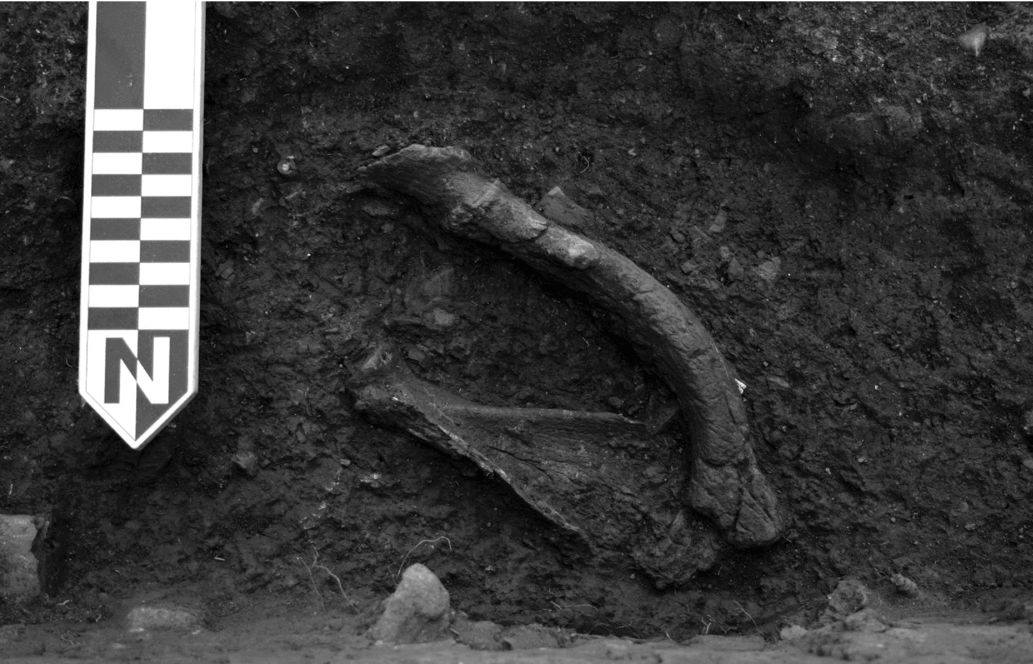
We also recorded at least three instances of deliberate faunal bone deposition. These included a complete deer scapula and section of deer antler found side by side under a covering of siltstone slabs within a small pit (Feature 15-08) situated just above the southern section of Feature 14-11 (Figure 9), and a deer scapula fragment and antler pair in a small basin (Feature 16-12) associated with (or beneath) a southwestern extension of Feature 16-06. The 20 cm segment of deer antler in this pit was lying on a layer of stones that, upon removal, revealed a 12 cm fragment of a deer scapula resting upon a patch of heat-oxidized soil and charcoal. Since neither the scapula nor antler showed any indication of burning, it appears that these bones were deposited in a formal, staged sequence: first, a small fire was kindled in the bottom of the pit and then extinguished; next, the deer scapula was deposited and then covered by a layer of stones; then the segment of deer antler was deposited upon the stones and the pit was filled. This evidence points to a rather complex process involving fire-making, followed by the sequential deposition of selected deer bone elements and stones. Although we recorded several small pits of the size and shape of Feature 16-12, no others exhibited this arrangement of contents. Feature 16-12 was also the only pit that contained fragments of domesticated squash, as well as burned hazelnut shells and charcoal from sycamore rather than the more common oak or hickory wood. The use of fire and relatively rare kinds of nut and wood fuels, as well as a cultigen in this context, likely signals the special, ritual nature of this depositional episode. Finally, the pairing of deer scapulae and antler in these two pits may suggest that these particular elements, or perhaps their pairing, were important aspects of this form of ritualized behavior.
Paired deer scapula and antler segment in Feature 15-08.

Another possible ritual animal bone deposition is a large section of deer mandible lying on a small burned patch of a lower clay floor (Feature 16-06) that protruded from beneath the southern margin of Feature 15-05, the uppermost clay surface. Generally, most deer bones recovered from midden strata at Burrell Orchard are heavily fragmented; however, this particular mandible section was one of the most complete specimens from the site. The proximity of the bone to the burned clay surface indicates that a small fire was made, and possibly extinguished, prior to the placement of the partial deer jaw on top, a sequence of events reminiscent of the contents of Feature 16-12, but unlike it and Feature 15-08, this mandible was directly associated with one of the clay floors (Feature 15-05).
Two other possible ritual deposits of individual animal bones involve deer astragali, each of which was modified for suspension, by either drilling or notching. The notched specimen was found in the puddled clay basin (Feature 15-17), along with the bone awl tip described above. The other astragalus was recovered from midden deposits stratified between the upper (Feature 15-05) and lower (Feature 16-06) clay surfaces. Modified animal astragali occur in many sites across the globe (Gilmour Reference Gilmour1997; Koerper Reference Koerper2008; Lewis Reference Lewis1988). In some cases, these artifacts appear to be sockets for spindles or gaming pieces; however, others, such as modified walrus astragali from the Arctic, are more likely amulets used in hunting rituals, particularly those specimens that were modified for attaching a cord or some other means of suspension (Hill Reference Hill2011:414). Hill notes that “Amulets made from the bone, skin or tusk of the desired animal provide a material link between hunter and prey. . . . [They] drew the person of the walrus to the hunter by attracting it to the material remains of its own kind” (2011:415).
In contrast to the deposition of individual bone elements is the relatively dense concentration of fragmented faunal remains found in Stratum II midden deposits bordering the south margin of Features 15-05 and 16-06. This thick accumulation of primarily deer bone appears to be the residue from the extraction of marrow and grease (Wolverton et al. Reference Wolverton, Nagaoka, Densmore and Fullerton2008). The density of this accumulation (844 g/m3) significantly exceeds the densities of deer bone in midden strata not associated with clay surfaces (294 g/m3). This pattern suggests that the fragmented bone mass was not the result of random discard, but instead represents intentional deposition or caching for a specific purpose, such as a ceremonial deposit or offering associated with ritual activities taking place on the nearby clay floor(s).
Many archaeologists see the deliberate deposition of disarticulated elements and masses of bone from both human and nonhuman beings as ritual offerings (Byers Reference Byers2011, Reference Byers2015; Claassen Reference Claassen2016; Hall Reference Hall1997). Ethnographic analogies to historic Native American hunting rituals support explanations involving the use of such bones in spirit-release, world-renewal, or hunting-fertility rituals (Brown Reference Brown2005; Brown and Emery Reference Brown and Emery2008; Claassen Reference Claassen2015; Hall Reference Hall1997). For example, many North American hunting societies are known to have regularly made offerings to spirit guardians or caretakers of game animals to ensure continued availability of prey and successful hunting (Claassen Reference Claassen2016:280–281; Hill Reference Hill2011). In this light, the deposits of selected deer elements (scapulae, antler sections, and mandibles) described above can be reasonably interpreted as the remains of such ritualized offerings. Likewise, the apparent deposits of disarticulated human remains (complete mandible and frontal bone fragment) may be the result of spirit-release or world-renewal rituals.
Other possible ritual deposits involving stone artifacts are associated with the clay floors. The two bannerstone fragments in pits sealed beneath Feature 15-05 may represent deliberate offerings deposited prior to the construction of the final clay floor at that location. Both artifacts are badly broken along the longitudinal bores and damaged at the margins of each wing (Figure 8). Further, a fragment of the central section of the larger bannerstone was unknowingly discovered two years earlier in the upper midden stratum a few meters away. This find indicates that the bannerstone was fractured in several pieces prior to burial in the small pit (Feature 15–19) and covered later by the upper clay floor. Since bannerstones are often interpreted as ritually charged objects (Hall Reference Hall1997:110; Sassaman Reference Sassaman2010:105), such excessive destruction is unlikely to have resulted from ordinary use but instead may point to ritualized acts of destruction (sacrifice) and burial (Webb Reference Webb1974:327–327). The contexts of these bannerstone fragments beneath the Feature 15-05 floor may also reflect “foundation” or “commemorative” deposits, that is, offerings of spiritually charged objects installed at the closing or decommissioning of one activity floor or the dedication of a new clay surface (Steadman Reference Steadman2016:260–261). In this regard, some of the complete or fragmented chert perforators found on the Burrell Orchard clay floors or sandwiched between floor layers may represent similar types of ritual offerings.
Another stone tool deposit was uncovered at the southeastern margin of Feature 15-05. This cache included two celts, three hammerstones, and two anvilstones distributed in a linear concentration measuring approximately 1 m long (east-west) by 50 cm (north-south). All implements showed signs of moderate to heavy usage. Due to the heavily eroded state of the clay floor at this eastern end, it was unclear whether the stone tools were originally deposited on the floor itself or in the midden directly adjacent to the floor. Unlike the cache of large milling stones described above (Feature 15–22), this deposit was not made in a discernible pit feature. Instead, the artifacts looked as if they had been placed together along the edge of the clay floor, much as we would expect if this collection originated as a dedicational deposit involved in rituals held at the closing of the activity surface.
Evidence for other kinds of activities carried out upon the clay floors themselves suggests something other than traditional household functions. Most unusual are the large numbers of small, burned (heat-oxidized) patches on discrete areas of these floors. These are likely the locations where fires were made, extinguished, and then the residues of burnings removed. As such, these features most likely represent short-term, perhaps single-use, fires kindled for some specific and limited purpose. Small collections of FCR near to some of these surface hearths suggest that one purpose was the heating of rock for cooking or boiling. If so, however, this activity was not repeated more than a few times, since all these features lack the typical, often layered, deposits of charcoal, ash, and burned soil normally found in classic hearth features.
One unusual variation on the surface hearth phenomenon is a vertical sequence of burned and unburned clay surfaces documented near the center of, but beneath, Feature 15-05. This irregularly shaped feature (16-08) measured ~30 × 100 cm. Excavation of its northernmost section revealed three stratified layers, the uppermost of which consisted of a 5 cm thick yellow clay stratum separated by 8 cm of midden soil from the overlying Feature 15-05 floor. Directly beneath this clay surface was a separate layer of burned (red) clay of equal thickness to the first that, in turn, sat upon an 8 cm thick basal layer of charcoal-laden soil. This sequence of deposits reveals a series of activities that began with the kindling of a wood fire in the base of a pit. This fire was then extinguished and covered by a clay layer that was subsequently burned. Any charcoal or other residue resulting from this fire was cleaned up and then the capping layer of yellow clay was added without further burning. This sequence of fire-making could be explained simply as the residue from episodes of burning in a small fire pit; however, such a scenario does not account for the deposition of two clay layers but the burning of only one, and in at least one stage the burned residue was removed but not in the remaining (basal) layer. In any case, the layering of burned and unburned clay is not typical of most domestic hearth features used for cooking or to heat a dwelling. As with the more common surface hearth features, each burning episode represented by Feature 16-08 appears to have been brief and limited in extent. Such short-term use does not seem to equate well with long-term (multiseasonal) occupation of the clay floors for domestic activities. Instead, this temporary fire may have been kindled for the burning of ritual offerings, as observed, for example, at contemporary Maya hunting shrines in Mesoamerica (Brown and Emery Reference Brown and Emery2008:317).
In a few cases, surface fires were also kindled on small (<1 m diameter) patches of yellow clay surrounded by midden soil (e.g., Feature 14-06). These may be similar to Southeastern cooking griddles mentioned above and used for the roasting or parching of nuts, fish, or other foods (Sherwood and Chapman Reference Sherwood and Chapman2005). Unlike the Burrell Orchard examples, however, the Southeastern griddles often exhibit textile impressions and are associated with charcoal and ash deposits. Such small, burned-clay surfaces are indeed likely to have been constructed for specialized cooking activities, but they are essentially different from the larger floors documented at Burrell Orchard on which small isolated fires were made.
The discrete, short-term nature of the burning activities conducted on the Burrell Orchard clay surfaces is also reflected in the small pits identified on and under the floors. Unfortunately, several of the numerous small, shallow basins recorded on the surface of Feature 15-05 contained very low frequencies of chert debitage, FCR, bone, and nutshell, thus revealing little about their original functions. However, the lack of large bone elements or spiritually powerful objects such as the bannerstone would seem to eliminate most of these pits as ritual deposits or offerings. Some pits may represent small cache or storage pits for personal items, but if so, the original contents were removed by the users. With the exception of Feature 16-05, which contained one of the bannerstone fragments and one large anvilstone similar to those found in Feature 15-22, none of the floor pits were large or deep enough to properly serve as communal food storage facilities. Perhaps some of the larger pits functioned as hide-lined, nut-boiling pits; however, convincing evidence from large multi-season basecamps in Illinois, for example, indicates that such features were large, with volumes averaging more than 100 liters (Stafford Reference Stafford1991). A few of the smallest pits did contain dense concentrations of charcoal in their basal layers and were consequently interpreted as smudge pits. Some interpret such pits as facilities for smoking deer hides, based on abundant ethnographic evidence (Binford Reference Binford1967). But the possibility also exists that at least some of these features were used to make smoke for ceremonies taking place on the clay floors, such as the making of bone or tool offerings as discussed above. Since none of these smudge pits exhibit multiple fill layers, it appears that they served a temporary, perhaps one-time, function.
One other important feature form that is closely associated with two of the clay floors are post-mold configurations that appear to represent wooden superstructures. As described above, the most complete post-mold outline recorded at this site (Structure 1) can reasonably be interpreted as an oval-shaped dwelling with a maximum dimension of about 2.5 m. Its small size and rather diminutive post molds mark this structure as unsuitable for use as a permanent dwelling for even a nuclear family. Further, the small cluster of surface hearths on the interior floor of this dwelling indicate that only small, temporary fires were made inside, rather than the more permanent, layered hearth features that might be expected for a house. Instead, a construction like this appears most suitable for a temporary, short-term use that necessitated a fire but that did not require the installation of storage or cooking facilities. Such use reasonably coincides with a ritualized function such as that of a sweat lodge.
The C-shaped configuration of small posts surrounding the southwestern margins of Feature 15-05 (Structure 2) may represent a larger shelter for a nuclear family occupying this largest of clay floors. It does match one of the most common Archaic dwelling forms cited by Purtill (Reference Purtill, Redmond and Genheimer2015) for the Ohio region. However, Purtill characterizes such structures as most likely “warm-weather domiciles” given their significant exposure to the elements (Purtill Reference Purtill, Redmond and Genheimer2015:27). As a completely enclosed structure, which would have been the case if the post molds continued completely around the margins of Feature 15-05, Structure 2 would still have lacked the expected domestic features for storage and extended periods of heating, cooking, etc., that one would expect in a family dwelling occupied during the late fall to early winter seasons. Instead, the structure appears to be nondomestic. The documented use of only small, temporary fires and the use of only a few small, shallow pits supports this interpretation of Feature 15-05. As such, Structure 2 may have been a partial barrier or screen to obscure sacred ceremonies from public view.
Two additional attributes of the prepared clay floors appear to have limited their use as long-term household dwellings. As discussed briefly above, all the recorded clay surfaces except Feature 15-05 are very thin with average thicknesses of 3–5 cm. In fact, a transverse section of Feature 15-05 revealed that this floor, with an overall thickness of 10 cm, may actually have been a composite of at least two thinner floors with one laid directly on top of the earlier surface. This would then indicate that a typical floor was indeed very thin, no more than about 5 cm thick when initially laid down. Another limiting characteristic of these floors is that the majority of their surfaces were composed of air-dried clay rather than having been hardened through burning of the entire surface area. As noted above, only small, discrete patches of floor were (inadvertently?) hardened through the kindling of small fires. Taken together, the characteristic thinness and relative softness of the clay floors indicates that they would not have made very durable surfaces for continuous domestic activities over an extended period of time. This deficiency was clearly illustrated during our fieldwork when large areas of the exposed surface of Feature 15-05 began to form numerous cracks as it dried relatively soon after exposure. Even occasional rain and humid conditions of a typical northern Ohio summer did not arrest the cracking to any great extent, despite our best efforts to tread lightly as we worked. Given the results of the foregoing assessment of these large clay surfaces and their accompanying features, these features most likely represent special ritual facilities or shrines that hosted hunting rituals or other ceremonial activities.
Conclusions
[W]hile our analytical vocabulary is well-attuned to the conceptual distinctions between base-camps and a host of other “economic” sites, we tend to see sacred places as forming nodes in a cognitive overlay that stands in opposition to, rather than in relationship with, the factors structuring the spatial and temporal organization of more practical ‘adaptive’ activities like hunting, fishing and gathering. [Jordan Reference Jordan and Cannon2011:28, emphasis in original]
The prepared clay floors documented at the Burrell Orchard site are rare and unusual features and, as such, readily defy easy explanation. I argue here that their primary functions were of a ritual nature and involved activities that were designed to ensure success in deer hunting and possibly to secure other resources such as other game, fish, and nuts. The specific nature of these rituals is unclear; the rituals at least included the deposition of stone tools (milling stones, celts/adzes, chert perforators) and isolated human and deer bones (sometimes as antler-scapula pairs). The localized burning or heating of some as yet unidentified materials was also an important activity that was restricted to the clay floors themselves. The stratification of clay floors points to a process of construction, use, abandonment, and renewal (reconstruction) that was likely played out in rituals involving the commissioning and decommissioning of each surface. Such events were apparently marked by the deposition of offerings of spiritually charged objects such as the slate bannerstones, deer astragali amulets, and possibly the isolated human remains.
The existence of such ritual facilities or shrines at what was otherwise a typical Late Archaic basecamp, should not be an unexpected occurrence. Most archaeologists might agree that cultural activities taking place at such settlements included a wide range of activities, some mundane and others highly ritualized. Indeed, at Burrell Orchard the discovery of numerous post molds at the base of midden deposits and other features, all located apart from the clay floors, likely indicates household dwellings with associated cooking pits, smudge (hide-smoking) pits, and storage facilities (Redmond and Scanlan Reference Redmond and Scanlan2009; Redmond et al. Reference Redmond, Scanlan and Marley2015, Reference Redmond, Scanlan and Marley2016, Reference Redmond, Scanlan and Haines2017). The expansive midden deposits, rich with stone and bone, point to diverse domestic activities related to animal butchery, hide-smoking, nut-processing, fishing, toolmaking, and plant processing. But the obvious importance of hunting in particular at such localities would also have required regular attention to appeasing forest spirits, such as the “master of animals” who controlled the flow of game to human hunters (Feest Reference Feest1986:9; Hill Reference Hill2011; Hultkrantz Reference Hultkrantz1979:142–143). Very likely all hunters carried out rituals involving prayer and offerings in order to invoke the assistance of such powerful supernatural entities. In such a cultural context, archaeological evidence for this and other classes of ritualized activities should be forthcoming, recognizable, and expected. Such now appears to be the case at Burrell Orchard.
Acknowledgments
The author is grateful for the cooperation and support of the Lorain County Metro Parks, the Firelands Archaeological Research Center, and the Sheffield Village Historical Society. Essential funding was provided by the Laub Foundation, the Albert G. & Olive H. Schlink Foundation, the Cleveland Museum of Natural History, the Ohio History Fund, and the Cleveland Archaeological Society. Special thanks to Brian Scanlan, Ann DuFresne, James Bowers, Meghan Marley, Angela Haines, Jarrod Burks, and a legion of student interns, volunteers, and participants in the CMNH Archaeology in Action program.
Data Availability Statement
All Burrell Orchard site field records and artifact collections are curated in the Department of Archaeology, Cleveland Museum of Natural History. These materials are available for examination by professional researchers upon request to the author.